Strength and Conditioning Case StudySimon Elkinson BSc CSCS PES CES
Case Study OverviewIntroduction to RugbyAthlete Profile/HistoryNeeds Analysis – sport/position specificTestingAthlete’s GoalsS+C ConsiderationsProgrammingSummary
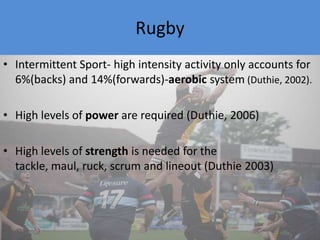
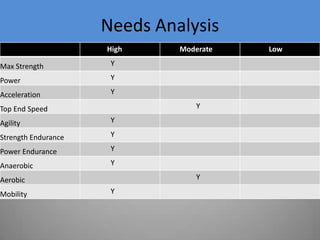
RugbyIntermittent Sport- high intensity activity only accounts for 6%(backs) and 14%(forwards)-aerobic system (Duthie, 2002). High levels of power are required (Duthie, 2006)High levels of strength is needed for the tackle, maul, ruck, scrum and lineout (Duthie 2003)
RugbyDeutch et al (1998) identified that Rugby players typically sprinted 10-20 meters = develop acceleration along with agility and some work on top speed (Duthie, 2006)
Anaerobic power and capacity = successful performance in team sports (Tesch,P 1984)
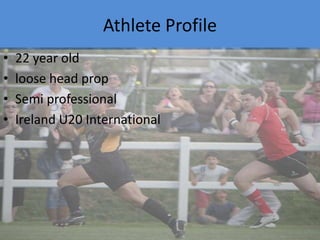
The aerobic system is required to allow athletes to compete and recover over an   80min game (El-Abd, J. 2005,Tomlin and Wenger 2001, Mathews and Fox 1971) Athlete Profile22 year old loose head propSemi professionalIreland U20 International
Needs Analysis
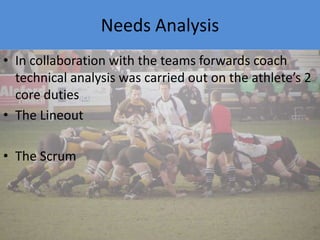
Needs AnalysisIn collaboration with the teams forwards coach technical analysis was carried out on the athlete’s 2 core dutiesThe LineoutThe Scrum
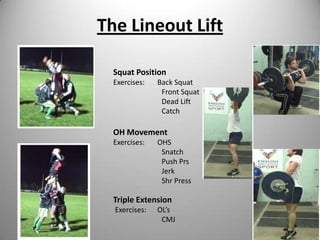
The Lineout LiftSquat PositionExercises:       Back Squat 	         Front Squat	         Dead Lift	         CatchOH MovementExercises:       OHS       	         Snatch	         Push Prs	         Jerk	         Shr PressTriple Extension     Exercises:      OL’s	         CMJ
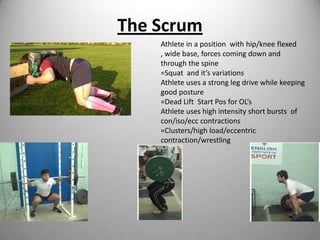
The ScrumAthlete in a position  with hip/knee flexed , wide base, forces coming down and through the spine=Squat  and it’s variationsAthlete uses a strong leg drive while keeping good posture=Dead Lift  Start Pos for OL’sAthlete uses high intensity short bursts  of con/iso/ecc contractions=Clusters/high load/eccentric contraction/wrestling
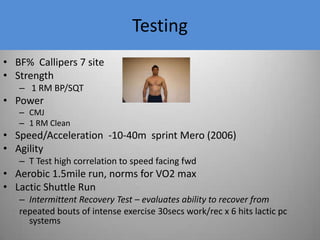
TestingBF%  Callipers 7 site Strength 1 RM BP/SQT  PowerCMJ  1 RM CleanSpeed/Acceleration  -10-40m  sprint Mero (2006)AgilityT Test high correlation to speed facing fwdAerobic 1.5mile run, norms for VO2 maxLactic Shuttle Run Intermittent Recovery Test – evaluates ability to recover fromrepeated bouts of intense exercise 30secs work/rec x 6 hits lactic pc systems
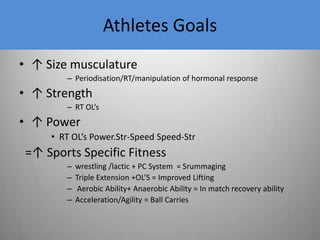
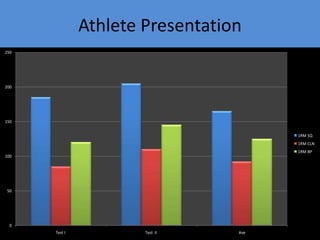
Athletes Goals↑ Size musculature                                Periodisation/RT/manipulation of hormonal response↑ Strength RT OL’s↑ PowerRT OL’s Power.Str-Speed Speed-Str  =↑ Sports Specific Fitnesswrestling /lactic + PC System  = SrummagingTriple Extension +OL’S = Improved Lifting Aerobic Ability+ Anaerobic Ability = In match recovery ability Acceleration/Agility = Ball Carries
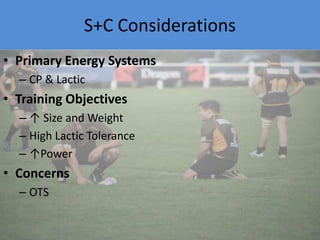
S+C ConsiderationsPrimary Energy SystemsCP & LacticTraining Objectives↑ Size and WeightHigh Lactic Tolerance↑PowerConcernsOTS
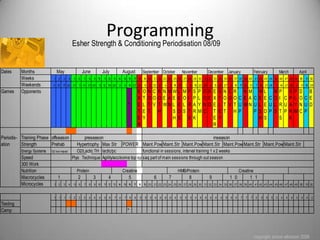
Programming
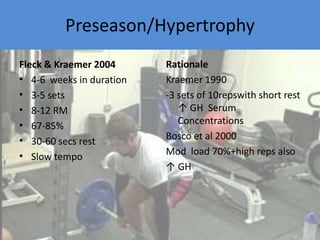
Preseason/HypertrophyFleck & Kraemer 20044-6  weeks in duration3-5 sets  8-12 RM67-85%30-60 secs restSlow tempo       RationaleKraemer 1990-3 sets of 10repswith short rest ↑ GH  Serum ConcentrationsBosco et al 2000Mod  load 70%+high reps also↑ GH
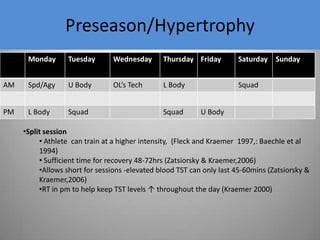
Preseason/HypertrophySplit session
 Athlete  can train at a higher intensity,  (Fleck and Kraemer  1997,: Baechle et al 1994)
 Sufficient time for recovery 48-72hrs (Zatsiorsky & Kraemer,2006)
Allows short for sessions -elevated blood TST can only last 45-60mins (Zatsiorsky & Kraemer,2006)
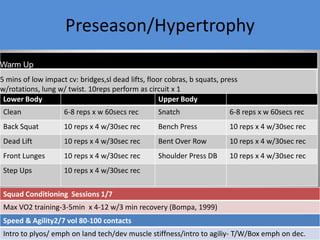
RT in pm to help keep TST levels ↑ throughout the day (Kraemer 2000)Preseason/Hypertrophy
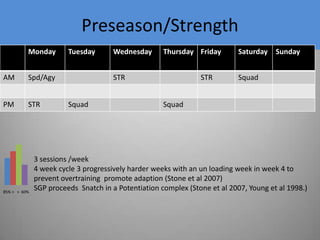
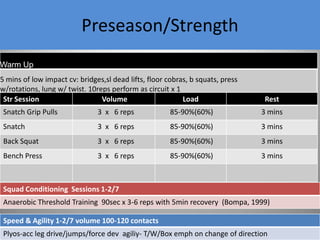
Preseason/Strength3 sessions /week4 week cycle 3 progressively harder weeks with an un loading week in week 4 to prevent overtraining  promote adaption (Stone et al 2007)SGP proceeds  Snatch in a Potentiation complex (Stone et al 2007, Young et al 1998.)85% >   >  60%
Preseason/Strength
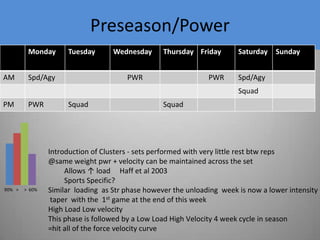
Preseason/Power
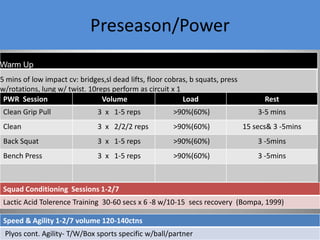
Preseason/Power
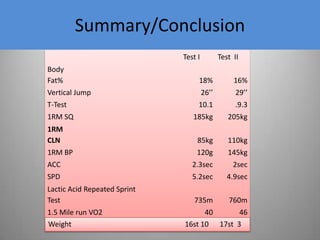
Summary/Conclusion
Athlete Presentation

Strength And Conditioning Case Study

  • 1.
    Strength and ConditioningCase StudySimon Elkinson BSc CSCS PES CES
  • 2.
    Case Study OverviewIntroductionto RugbyAthlete Profile/HistoryNeeds Analysis – sport/position specificTestingAthlete’s GoalsS+C ConsiderationsProgrammingSummary
  • 3.
    RugbyIntermittent Sport- highintensity activity only accounts for 6%(backs) and 14%(forwards)-aerobic system (Duthie, 2002). High levels of power are required (Duthie, 2006)High levels of strength is needed for the tackle, maul, ruck, scrum and lineout (Duthie 2003)
  • 4.
    RugbyDeutch et al(1998) identified that Rugby players typically sprinted 10-20 meters = develop acceleration along with agility and some work on top speed (Duthie, 2006)
  • 5.
    Anaerobic power andcapacity = successful performance in team sports (Tesch,P 1984)
  • 6.
    The aerobic systemis required to allow athletes to compete and recover over an 80min game (El-Abd, J. 2005,Tomlin and Wenger 2001, Mathews and Fox 1971) Athlete Profile22 year old loose head propSemi professionalIreland U20 International
  • 7.
  • 8.
    Needs AnalysisIn collaborationwith the teams forwards coach technical analysis was carried out on the athlete’s 2 core dutiesThe LineoutThe Scrum
  • 9.
    The Lineout LiftSquatPositionExercises: Back Squat Front Squat Dead Lift CatchOH MovementExercises: OHS Snatch Push Prs Jerk Shr PressTriple Extension Exercises: OL’s CMJ
  • 10.
    The ScrumAthlete ina position with hip/knee flexed , wide base, forces coming down and through the spine=Squat and it’s variationsAthlete uses a strong leg drive while keeping good posture=Dead Lift Start Pos for OL’sAthlete uses high intensity short bursts of con/iso/ecc contractions=Clusters/high load/eccentric contraction/wrestling
  • 11.
    TestingBF% Callipers7 site Strength 1 RM BP/SQT PowerCMJ 1 RM CleanSpeed/Acceleration -10-40m sprint Mero (2006)AgilityT Test high correlation to speed facing fwdAerobic 1.5mile run, norms for VO2 maxLactic Shuttle Run Intermittent Recovery Test – evaluates ability to recover fromrepeated bouts of intense exercise 30secs work/rec x 6 hits lactic pc systems
  • 12.
    Athletes Goals↑ Sizemusculature Periodisation/RT/manipulation of hormonal response↑ Strength RT OL’s↑ PowerRT OL’s Power.Str-Speed Speed-Str =↑ Sports Specific Fitnesswrestling /lactic + PC System = SrummagingTriple Extension +OL’S = Improved Lifting Aerobic Ability+ Anaerobic Ability = In match recovery ability Acceleration/Agility = Ball Carries
  • 13.
    S+C ConsiderationsPrimary EnergySystemsCP & LacticTraining Objectives↑ Size and WeightHigh Lactic Tolerance↑PowerConcernsOTS
  • 14.
  • 15.
    Preseason/HypertrophyFleck & Kraemer20044-6 weeks in duration3-5 sets 8-12 RM67-85%30-60 secs restSlow tempo RationaleKraemer 1990-3 sets of 10repswith short rest ↑ GH Serum ConcentrationsBosco et al 2000Mod load 70%+high reps also↑ GH
  • 16.
  • 17.
    Athlete can train at a higher intensity, (Fleck and Kraemer 1997,: Baechle et al 1994)
  • 18.
    Sufficient timefor recovery 48-72hrs (Zatsiorsky & Kraemer,2006)
  • 19.
    Allows short forsessions -elevated blood TST can only last 45-60mins (Zatsiorsky & Kraemer,2006)
  • 20.
    RT in pmto help keep TST levels ↑ throughout the day (Kraemer 2000)Preseason/Hypertrophy
  • 21.
    Preseason/Strength3 sessions /week4week cycle 3 progressively harder weeks with an un loading week in week 4 to prevent overtraining promote adaption (Stone et al 2007)SGP proceeds Snatch in a Potentiation complex (Stone et al 2007, Young et al 1998.)85% > > 60%
  • 22.
  • 23.
  • 24.
  • 25.
  • 26.
  • 27.
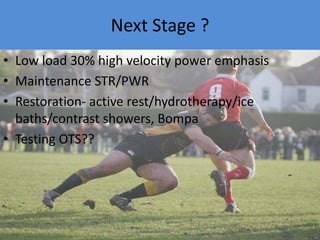
    Next Stage ?Lowload 30% high velocity power emphasisMaintenance STR/PWRRestoration- active rest/hydrotherapy/ice baths/contrast showers, BompaTesting OTS??
  • 28.
    ReferencesACSM. (2006). ACSM’sguidleines for exercise testing and prescription 7th edition. USA. Lippincott,Williams and Wilkins.Baechle, T.R. and Roger W.E. (2000)Essentials of Strength and Conditioning (2nd ed). Human Kinetics.USA Duthie, G.M., Pyne, D.B., Marsh, D.J. and Hooper, S.L. (2006) ‘Sprint patterns in rugby union playersduring competition’. Journal of Strength and Conditioning Research, 20 (1), pp. 208-13.Duthie GM, Pyne DB, Hooper S. (2003).’The applied physiology and game analysis of rugby union'. SportsMedicine, 33(13), pp. 973-91.El-Abd, J. (2005). ‘An Objective time-motion analysis of elite rugby union’. Journal of Sports SciencesFebruary 1.Haff, C. G., Whitely, A., McCoy, L.B., O’Bryant, H.S., Kilgore, J.L., Haff, E.E., Pierse,K., and Stone, M.H.(2003).’Effects of different set configurations on barbell configurations on barbell velocity anddisplacement during a clean pull.’ Journal of Strength and Conditioning Research 17: 95-103.Kraemer, W.J. (2000). ‘Endocrine responses to resistance training’. In Baechle, T.R. and Earle, R.W. (eds).Essentials of Strength and Conditioning (2nd ed.).USA:Human Kinetics p.91-114.Mathews,D. and Fox,E.(1971).The physiological basis of physical education and athletics. Saunders. USAMERO, A. ‘Force-time characteristics and running velocity of male sprinters during the accelerationphase of sprinting’. Research Exercise and Sport. 59:94–98. 1988.Russel, A. (2008). Evidence-based Performance Assessments.NASM presentation. www.nasm.org.
  • 29.
    References cont.Tesch, P.(1984). ‘Bridging the Gap: Anaerobic Testing’, NSCA Journal of Strength andConditioning . P44 + 67.Tomlin, D.L., and Wenger, H.A. (2001). ‘The relationship between aerobic fitness andrecovery from high intensity intermittent exercise’. Sports Medicine 31, p1-11.Tomlin, D.L., and Wenger, H.A. (2001). ‘The relationship between aerobic fitness andrecovery from high intensity intermittent exercise’. Sports Medicine 31, p1-11.Young, W.B., Jenner, A. and Griffiths, K. (1998).’Acute enhancement of power performancefrom heavy load squats Journal of Strength and Conditioning Research 12: 82-84.
  • 30.
    BooksBompa, T. O.And Carrera, M.C. (2005).Periodization training forsports. (2nd ed). USA:Human Kinetics.Baechle, T.R. And Earle. R.W. (2000). Essentials of strength andconditioning training. (2nd ed.). Champaign, IL: Human Kinetics.Fleck, S.J. And Kraemer W.J. (2004). Designing resistanceTraining programs. (3rd ed.). Champaign, IL: Human Kinetics.Stone, M.H., Stone, M. And Sands, W.A. (2007). Principles andpractice or resistance Training. Human Kinetics, USAZatsiorsky,M. & Kraemer, J.(2006).Science and Practice ofStrength Training(2NE ed.).Human Kinetics