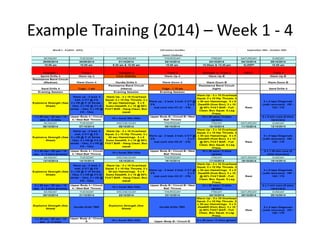
Training Essentials for the Development of Junior –Elite Sprint Hurdler
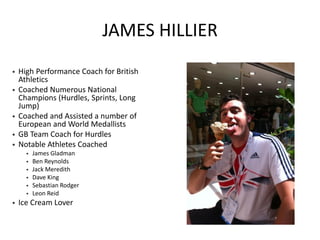
JAMES HILLIER 
•High Performance Coach for British Athletics 
•Coached Numerous National Champions (Hurdles, Sprints, Long Jump) 
•Coached and Assisted a number of European and World Medallists 
•GB Team Coach for Hurdles 
•Notable Athletes Coached 
•James Gladman 
•Ben Reynolds 
•Jack Meredith 
•Dave King 
•Sebastian Rodger 
•Leon Reid 
•Ice Cream Lover
Hurdles –The Technical Model
RHYTHM 
•‘Ability to consistentlyrun in a fluent, measured and uniform way’ 
•Rhythm is related to stride pattern (competitive rhythm) and also relates to ‘sighting’ hurdles with the minimum amount of compromise 
•Development of specific rhythm MUST be practised as close to competitive conditions as possible 
•It is more important to first develop running rhythm (i.e. Running between hurdles is initial priority over actual hurdle clearance) 
•Training rhythm for both the sprint hurdles and the 300m/400m hurdles requires mental and physiological progressions so you need to continuously reflect in order to improve
EFFICIENCY 
•‘The amount of energy required to run at a certain speed’ (McArdle, Katch& Katch, 1996) 
•Energy is not unlimited. Even in a sprint hurdles race it is important to set the race up in an biomechanically efficient way 
•Related to lactic acid accumulation in a given muscle at a given speed after a certain amount of time (i.e. Towards the end of a race) 
•In the 400m hurdles the objective is to minimise lactic acid accumulation in first 250 –300, therefore allowing athlete to run faster and hurdle better at the end of the race
MOMENTUM 
•‘The relationship between the speedof an athlete and his / her energyat a certain time’ 
•If an athlete loses momentum they lose speed and waste energy 
•Momentum is directly related to rhythm and efficiency (and vice versa). If momentum is compromised then you will HAVE to see compromise in rhythm and efficiency 
•One of the most important elements of any hurdles race is the ability to maintain momentum over the last 3 hurdles 
•Technical competence, understanding of the physiological needs of the event and plenty of event specific training is therefore vital
THE SPRINT HURDLES 
•A successful sprint hurdler combines high speed with accurate technical efficiency 
•Technical prowess is measured by the athlete’s ability to perform a series of well-timed and consistent ‘hurdle strides’ whilst maintaining speed and postural control 
Technical Focus: - 
•Improving Running Rhythm 
•Take Off 
•Run Off
The Starting Point 
•You are what you are 
•Heredity 
•Environment 
–Home 
–Culture 
•You are what you do 
•Training regime 
•Work rate 
•Consistency 
•Progression 
•Continuous Development 
•Mind vsBody 
•Feedback 
•Reflection 
•LEARNING
Top Junior –Elite Athlete 
•Understand the Individual 
•What additional training stimuli can you add to the programme? 
•Goal is to raise strengths AND weaknesses 
•Athlete must start taking ownership of sessions 
•Relationship between coach and athlete evolves 
•Underlying Goal is to best prepare the athlete to perform in Championships
Development of the Coach 
•Its not about YOU! 
•Its not about being a strong coach but having a strong Athlete –Coach Relationship 
•Understand yourself. What makes you tick? 
•Get help (Mentor, Friends, Family) 
•Goal is to continuously reflect and feedback without too much emotion and honestly 
•What’s important –results vs process? 
•Coach the Athlete to ‘find the answers’ 
•Coaching is a voyage of discovery
What is Required to be Elite? 
•Discipline and Purposeful Practice 
•Accurate 
•Consistency 
•Confidence 
•BELIEF
The Championships Equation 
•Execute Task in Training 
•Execute Task in Training under competitive STRESS 
•Execute Task in low –level competition 
•Execute Task in high –level competition 
•Execute Task in high –level competition UNDER FATIGUEPRESSURE 
(INFORMATION + UNDERSTANDING) * APPLICATION = PERFORMANCE 
How are you going to replicate PRESSURE and TECHNIQUE UNDER FATIGUE in your programme?
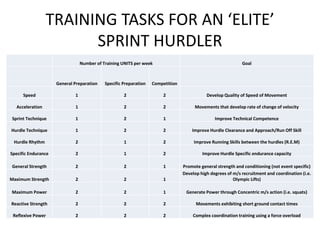
TRAINING TASKS FOR AN ‘ELITE’ SPRINT HURDLER 
Number of Training UNITS per week 
Goal 
General Preparation 
Specific Preparation 
Competition 
Speed 
1 
2 
2 
Develop Quality of Speed of Movement 
Acceleration 
1 
2 
2 
Movements that develop rate of change of velocity 
Sprint Technique 
1 
2 
1 
Improve Technical Competence 
Hurdle Technique 
1 
2 
2 
Improve Hurdle Clearance and Approach/Run Off Skill 
Hurdle Rhythm 
2 
1 
2 
Improve Running Skills between the hurdles (R.E.M) 
Specific Endurance 
2 
1 
2 
Improve Hurdle Specific endurance capacity 
General Strength 
2 
2 
1 
Promote general strength and conditioning (not event specific) 
Maximum Strength 
2 
2 
1 
Develop high degrees of m/s recruitment and coordination (i.e. Olympic Lifts) 
Maximum Power 
2 
2 
1 
Generate Power through Concentric m/s action (i.e. squats) 
Reactive Strength 
2 
2 
2 
Movements exhibiting short ground contact times 
Reflexive Power 
2 
2 
2 
Complex coordination training using a force overload
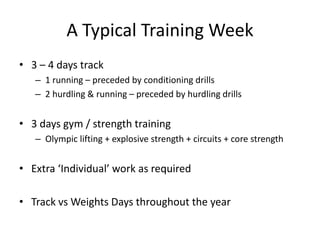
A Typical Training Week 
•3 –4 days track 
–1 running –preceded by conditioning drills 
–2 hurdling & running –preceded by hurdling drills 
•3 days gym / strength training 
–Olympic lifting + explosive strength + circuits + core strength 
•Extra ‘Individual’ work as required 
•Track vsWeights Days throughout the year
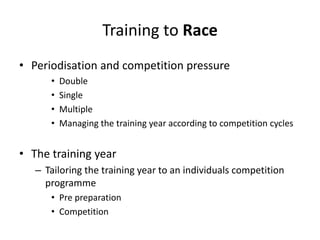
Training to Race 
•Periodisationand competition pressure 
•Double 
•Single 
•Multiple 
•Managing the training year according to competition cycles 
•The training year 
–Tailoring the training year to an individuals competition programme 
•Pre preparation 
•Competition
HURDLING ACTIVITIES WITHIN THE TRAINING YEAR 
•Drills 
–Trail leg, lead leg & over the top 
•Phase 1 -basic hurdling skills (4 -6 weeks) 
•Phase 2 –progressive hurdling -5 between stretched 
-Intro to 3 stride hurdling brought in
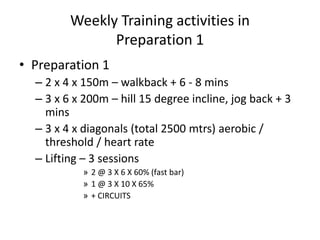
Weekly Training activities in Preparation 1 
•Preparation 1 
–2 x 4 x 150m –walkback+ 6 -8 mins 
–3 x 6 x 200m –hill 15 degree incline, jog back + 3 mins 
–3 x 4 x diagonals (total 2500 mtrs) aerobic / threshold / heart rate 
–Lifting –3 sessions 
»2 @ 3 X 6X 60% (fast bar) 
»1 @ 3 X 10 X 65% 
»+ CIRCUITS
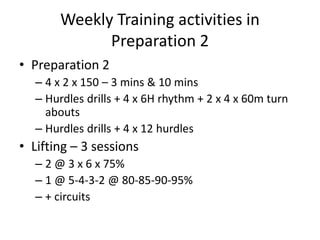
Weekly Training activities in Preparation 2 
•Preparation 2 
–4 x 2 x 150 –3 mins& 10 mins 
–Hurdles drills + 4 x 6H rhythm + 2 x 4 x 60m turn abouts 
–Hurdles drills + 4 x 12 hurdles 
•Lifting –3 sessions 
–2 @ 3 x 6 x 75% 
–1 @ 5-4-3-2 @ 80-85-90-95% 
–+ circuits
Example Training (2013) –Week 1 -4 
Week 1 -4 (2013 -2014) 
Sprint Hurdlers 
September 30th -October 27th 
MONDAY 
TUESDAY 
WEDNESDAY 
THURSDAY 
FRIDAY 
SATURDAY 
SUNDAY 
30/09/2013 
01/10/2013 
02/10/2013 
03/10/2013 
04/10/2013 
05/10/2013 
06/10/2013 
11.00 am 
10.00 am & 14.00 pm 
10.00 am 
10.00 am & 14.00 pm 
13.30 pm 
SLEEP! 
10.00 am 
Aerobic / Interval / Tolerance 
Weights & Circuits 
Lactic Tolerance 
Weights & Circuits 
Speed / Speed Endurance 
REST 
Aerobic 
Goals / Psychology 
Treatment / Self Therapy 
Mobility 
Treatment / Self Therapy 
Mobility 
Rest 
Individual Needs 
2 x 4 Laps Diagonals (HR 130 - 170) 
Warm Up -3 x 10 Overhead Squat, 3 x 10 Hip Thrusts, 3 x 30 sec Hamstrings. 3 x 6 @ 60% FAST BAR - Hang Clean, Full Squat, RDL 
3 x 30 sec / 20 sec / 15 sec. 3 / 2 mins& 8 mins 
Warm Up -3 x 10 Overhead Squat, 3 x 10 Hip Thrusts, 3 x 30 sec Hamstrings. 3 x 6 @ 60% FAST BAR -Full Clean, Step Ups, S. Leg Press (4 x 4). 
Testing 10 x 30m hill sprints. 4 x 60m 30 secs/ 5 mins(grass) 
Rest 
Weights Circuit and Circuits (ABS) + Regeneration Exercises (sand and bare feet drills) 
MONDAY 
TUESDAY 
WEDNESDAY 
THURSDAY 
FRIDAY 
SATURDAY 
SUNDAY 
07/10/2013 
08/10/2013 
09/10/2013 
10/10/2013 
11/10/2013 
12/10/2013 
13/10/2013 
Speed Drills. 6 x 60m easy strides with walkback. 3 x 4 Laps Diagonals (Hr 130 - 170) 
Warm Up -3 x 10 Overhead Squat, 3 x 10 Hip Thrusts, 3 x 30 sec Hamstrings. 3 x 6 @ 60% FAST BAR - Hang Clean, Full Squat, RDL 
3 x 30 sec / 20 sec / 15 sec. 3 / 2 mins & 8 mins 
Warm Up -3 x 10 Overhead Squat, 3 x 10 Hip Thrusts, 3 x 30 sec Hamstrings. 3 x 6 @ 60% FAST BAR -Full Clean, Step Ups, S. Leg Press (4 x 4) 
10 x 30m hill sprints. 4 x 60m 30 secs/ 5 mins(grass) 
Rest 
Weights Circuit and Circuits (ABS) + Regeneration Exercises (sand and bare feet drills) 
MONDAY 
TUESDAY 
WEDNESDAY 
THURSDAY 
FRIDAY 
SATURDAY 
SUNDAY 
14/10/2013 
15/10/2013 
16/10/2013 
17/10/2013 
18/10/2013 
19/10/2013 
20/10/2013 
Speed Drills. 6 x 60m easy strides with walkback. 3 x 4 Laps Diagonals (HR 130 - 170) 
Warm Up -3 x 10 Overhead Squat, 3 x 10 Hip Thrusts, 3 x 30 sec Hamstrings. 3 x 6 @ 60% FAST BAR - Hang Clean, Full Squat, RDL pm -Hurdle Drills. 6 x H5 easy rhythm 
3 x 45 sec / 30 sec / 15 sec. 4 / 3 mins & 8 mins 
Warm Up -3 x 10 Overhead Squat, 3 x 10 Hip Thrusts, 3 x 30 sec Hamstrings. 3 x 6 @ 60% FAST BAR -Full Clean, Step Ups, S. Leg Press (4 x 4) pm -Hurdle Drills. 6 x H5 easy rhythm 
10 x 30m hill sprints. 4 x 60m 30 secs/ 5 mins(track) 
Rest 
Weights Circuit and Circuits (ABS) + Regeneration Exercises (sand and bare feet drills) 
MONDAY 
TUESDAY 
WEDNESDAY 
THURSDAY 
FRIDAY 
SATURDAY 
SUNDAY 
21/10/2013 
22/10/2013 
23/10/2013 
24/10/2013 
25/10/2013 
26/10/2013 
27/10/2013 
Speed Drills. 6 x 60m easy strides with walkback. 3 x 5 Laps Diagonals (HR 130 - 170) 
Warm Up -3 x 10 Overhead Squat, 3 x 10 Hip Thrusts, 3 x 30 sec Hamstrings. 3 x 6 @ 60% FAST BAR - Hang Clean, Full Squat, RDL pm -Hurdle Drills. 6 x H5 easy rhythm. 
3 x 45 sec / 30 sec / 15 sec. 4 / 3 mins & 8 mins 
Warm Up -3 x 10 Overhead Squat, 3 x 10 Hip Thrusts, 3 x 30 sec Hamstrings. 3 x 6 @ 60% FAST BAR -Full Clean, Step Ups, S. Leg Press (4 x 4) pm -Hurdle Drills. 6 x H5 easy rhythm 
10 x 30m hill sprints. 4 x 60m 30 secs/ 5 mins(track) 
Rest 
Weights Circuit and Circuits (ABS) + Regeneration Exercises (sand and bare feet drills)
Example Training (2014) –Week 1 -4
HURDLING ACTIVITIES WITHIN THE TRAINING YEAR 
•Drills continue throughout the year, before every session and competition 
•Phase 3 -hurdling -4 x 8 H ---> 4 x 12 
•Pre Competition -Blocks, Set up H1 & H2 
Then -e.g. 1 x 2H, 1 X 3H, 2 x 5H 
or 4 x 10H (H1 normal, 
H2 -H9 in one foot 
length)
Example Training –Week 9-12 
Sprint Hurdlers 
December 2012 
Sunday 
Monday 
Tuesday 
Wednesday 
Thursday 
Friday 
Saturday 
1 
Rest 
2 
3 
4 
5 
6 
7 
8 
Weights -Clean / Snatch (3 x 6), Straight Leg Deadlift (3 x 6), Full Squat (4 x 4), Bench (3 x 6) & ABS 
4 x 2 x150. Recovery -3 / 10 mins. > 17.5 
Sand Drills, Warm Up - Overhead Squat, Sumo Dead Lift, RDL -Weights 5 x 2 (Hip Thrusts, Full Clean, Deadlift from box, 1/2 Squats). Weights Circuit & ABS 
Hurdle drills (in 4). 4 x H12 (in 1) & GURU 
PREHAB CIRCUIT OF YOUR CHOICE, Warm Up -Overhead Squat, Hamstring Holds, RDL - FAST Weights with TENDO 4 x 4 (Hang Clean, Hang Snatch, Jump Squat). CONTRAST LIFTS 
MAT Work -5 x H1, then 4 x Hurdle 2. Recovery walkback. 3 x 3 x 80m -1 min & 6 mins. HIP FLEXOR WORK 
Rest 
9 
10 
11 
12 
13 
14 
15 
Weights -Clean / Snatch (3 x 6), Straight Leg Deadlift (3 x 6), Full Squat (4 x 4), Bench (3 x 6) & ABS 
TEST WEEK 
TEST WEEK 
TEST WEEK 
PREHAB CIRCUIT OF YOUR CHOICE, Warm Up -Overhead Squat, Hamstring Holds, RDL - FAST Weights with TENDO 4 x 4 (Hang Clean, Hang Snatch, Jump Squat). CONTRAST LIFTS 
MAT Work -5 x H1, then 4 x Hurdle 2. Recovery walkback. 3 x 3 x 80m -1 min & 6 mins. HIP FLEXOR WORK 
Rest 
16 
17 
18 
19 
20 
21 
22 
Weights -Clean / Snatch (3 x 6), Straight Leg Deadlift (3 x 6), Full Squat (4 x 4), Bench (3 x 6) & ABS 
4 x 2 x 150. Recovery -3 / 10 mins. > 17 
Sand Drills, Warm Up - Overhead Squat, Sumo Dead Lift, RDL -Weights 5 x 2 (Hip Thrusts, Full Clean, Deadlift from box, 1/2 Squats). Weights Circuit & ABS 
Hurdle drills (in 4). 4 x H12 (in 1) & GURU 
PREHAB CIRCUIT OF YOUR CHOICE, Warm Up -Overhead Squat, Hamstring Holds, RDL - FAST Weights with TENDO 4 x 4 (Hang Clean, Hang Snatch, Jump Squat). CONTRAST LIFTS 
MAT Work -5 x H1, then 4 x Hurdle 2. Recovery walkback. 3 x 3 x 80m -1 min & 6 mins. HIP FLEXOR WORK 
Rest 
23 
24 
25 
26 
27 
28 
29 
Weights -Clean / Snatch (3 x 6), Straight Leg Deadlift (3 x 6), Full Squat (4 x 4), Bench (3 x 6) & ABS 
MAT Work -5 x H1, then 4 x Hurdle 6. Recovery walkback. 3 x 90m -6 mins. HIP FLEXOR WORK 
Rest 
Rest 
Weights & Circuits 
Rest 
10 x 100m on grass 
30 
31 
Notes 
Weights -Clean / Snatch (3 x 6), Straight Leg Deadlift (3 x 6), Full Squat (4 x 4), Bench (3 x 6) & ABS 
10 x 100m on grass
Running / Hurdling activities 
•Preparation 3 
–150+100 x 2 x 2. 30s + 5 mins + 10 mins 
–Hurdles drills + 4 x 6H from blocks + 5 x 60 metres 
–4 x 12H from blocks 
•Lifting 
–3 per week as in prep 2 
–+ circuits
Training activities 
•Pre –competition 
–5 x 90 m (hit last 30m) 
–Hurdles drills + 2 x 2H + 2 x 4H + 1 x 5H + 
3 -4 x flying 30’s (30m build + 30m fly) 
–Hurdles drills + 4 x 5H + 3 x 30m elastic tows 
•Lifting as prep 3
Training activities 
•Competition 
–Training will fit in the competition programme 
–Lifting will go to 1 session every 7 –10 days 
–Intensity will be high 
–Volume will be low 
–Rest and recovery are essential
Example Training –Competition Season 
June 2013 
Sunday 
Monday 
Tuesday 
Wednesday 
Thursday 
Friday 
Saturday 
1 
Oordegem 
2 
3 
4 
5 
6 
7 
8 
Rest 
5 x Double flying 20's. Time last 3 
Wgts 5-4-3-2 @ 75/80/85/90%. Hurdle IMMEDIATEY after lift 
5 x 5 hurdles (3,3,5,3 strides) 
Wgts 3 x 3 @ 85%/87.5%/90%. MAT WORK 
4 x Flying 30's 
Rest 
9 
10 
11 
12 
13 
14 
15 
1 between hurdling. 10 hurdles @ 3' 14 steps in x 3 trail / 3 OT. Glutes, Calves & Core. Rehab 
5 x Double flying 20's. Time last 3 
Wgts 3 x 6 @ 60%. Hang Clean / Jump Squats (BW) 
5 x 5 hurdles (3,3,5,3 strides) 
Warm Up. MATS 
4 x H2 
Rest 
16 
17 
18 
19 
20 
21 
22 
U20 / U23 Champs 
5 x Double flying 20's. Time last 3 
Wgts 5-4-3-2 @ 75/80/85/90%. Hurdle IMMEDIATEY after lift 
5 x 5 hurdles (3,3,5,3 strides) 
Wgts 3 x 6 @ 60%. Hang Clean / Jump Squats (BW) 
4 x H2 
Rest 
23 
24 
25 
26 
27 
28 
29 
1 between hurdling. 10 hurdles @ 3' 14 steps in x 3 trail / 3 OT. Glutes, Calves & Core. Rehab 
4 x H6 Competitive 
Wgts 3 x 6 @ 60%. Hang Clean / Jump Squats (BW) 
5 x 5 hurdles (3,3,5,3 strides) 
Warm Up. MATS 
Rest 
Mannheim 
30 
Notes 
Mannheim 
[42]
Control Tests 
•Very Important to measure PROGRESS 
•Hurdles touch down times 
–Individual touch down times difficult 
(lack of accuracy compared to real times) 
–Start to H8 (for example) easier to be accurate and relevant. 
–I use start to touch down H10 x 4 reps as a guide to hurdles endurance.
Male vsFemale Considerations 
Main difference is hurdle height relative to limb length which means that the majority of women at elite level can straddle the hurdle -Men cannot 
Relative proportions are: 
Female Sub 13.00s: Hurdle is 49.7% of their height 
Male Sub 13.50s: Hurdle is 57.1% of their height 
Therefore: 
Women: Take off closer to the hurdle -1.95 -2.10m from Hurdle, and land further away -0.80 to 1.00m 
Men: 2.00-2.20 & 1.15-1.30m 
Males tend to lean further forward on attack but this is only a function of hurdle height relative to limb length -body lean will still increase speed across and off the hurdle 
Speed dominates both the male and female event at elite level but perhaps males can (at the moment) get away with small deficiencies in raw speed through excellent technique –But not much
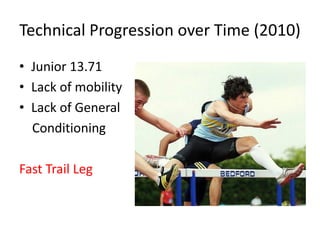
Technical Progression over Time (2010) 
•Junior 13.71 
•Lack of mobility 
•Lack of General 
Conditioning 
Fast Trail Leg
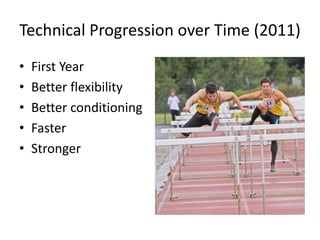
Technical Progression over Time (2011) 
•First Year 
•Better flexibility 
•Better conditioning 
•Faster 
•Stronger
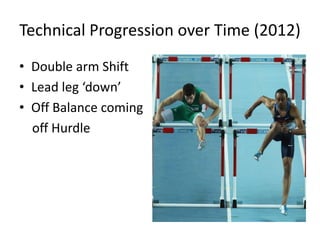
Technical Progression over Time (2012) 
•Double arm Shift 
•Lead leg ‘down’ 
•Off Balance coming 
off Hurdle
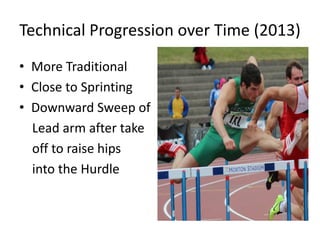
Technical Progression over Time (2013) 
•More Traditional 
•Close to Sprinting 
•Downward Sweep of 
Lead arm after take 
off to raise hips 
into the Hurdle
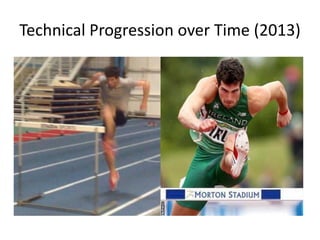
Technical Progression over Time (2013)
Questions?

James Hillier - Training Essentials for the Development of an Advanced High Hurdler

  • 1.
    Training Essentials forthe Development of Junior –Elite Sprint Hurdler
  • 2.
    JAMES HILLIER •HighPerformance Coach for British Athletics •Coached Numerous National Champions (Hurdles, Sprints, Long Jump) •Coached and Assisted a number of European and World Medallists •GB Team Coach for Hurdles •Notable Athletes Coached •James Gladman •Ben Reynolds •Jack Meredith •Dave King •Sebastian Rodger •Leon Reid •Ice Cream Lover
  • 3.
  • 4.
    RHYTHM •‘Ability toconsistentlyrun in a fluent, measured and uniform way’ •Rhythm is related to stride pattern (competitive rhythm) and also relates to ‘sighting’ hurdles with the minimum amount of compromise •Development of specific rhythm MUST be practised as close to competitive conditions as possible •It is more important to first develop running rhythm (i.e. Running between hurdles is initial priority over actual hurdle clearance) •Training rhythm for both the sprint hurdles and the 300m/400m hurdles requires mental and physiological progressions so you need to continuously reflect in order to improve
  • 5.
    EFFICIENCY •‘The amountof energy required to run at a certain speed’ (McArdle, Katch& Katch, 1996) •Energy is not unlimited. Even in a sprint hurdles race it is important to set the race up in an biomechanically efficient way •Related to lactic acid accumulation in a given muscle at a given speed after a certain amount of time (i.e. Towards the end of a race) •In the 400m hurdles the objective is to minimise lactic acid accumulation in first 250 –300, therefore allowing athlete to run faster and hurdle better at the end of the race
  • 6.
    MOMENTUM •‘The relationshipbetween the speedof an athlete and his / her energyat a certain time’ •If an athlete loses momentum they lose speed and waste energy •Momentum is directly related to rhythm and efficiency (and vice versa). If momentum is compromised then you will HAVE to see compromise in rhythm and efficiency •One of the most important elements of any hurdles race is the ability to maintain momentum over the last 3 hurdles •Technical competence, understanding of the physiological needs of the event and plenty of event specific training is therefore vital
  • 7.
    THE SPRINT HURDLES •A successful sprint hurdler combines high speed with accurate technical efficiency •Technical prowess is measured by the athlete’s ability to perform a series of well-timed and consistent ‘hurdle strides’ whilst maintaining speed and postural control Technical Focus: - •Improving Running Rhythm •Take Off •Run Off
  • 8.
    The Starting Point •You are what you are •Heredity •Environment –Home –Culture •You are what you do •Training regime •Work rate •Consistency •Progression •Continuous Development •Mind vsBody •Feedback •Reflection •LEARNING
  • 9.
    Top Junior –EliteAthlete •Understand the Individual •What additional training stimuli can you add to the programme? •Goal is to raise strengths AND weaknesses •Athlete must start taking ownership of sessions •Relationship between coach and athlete evolves •Underlying Goal is to best prepare the athlete to perform in Championships
  • 10.
    Development of theCoach •Its not about YOU! •Its not about being a strong coach but having a strong Athlete –Coach Relationship •Understand yourself. What makes you tick? •Get help (Mentor, Friends, Family) •Goal is to continuously reflect and feedback without too much emotion and honestly •What’s important –results vs process? •Coach the Athlete to ‘find the answers’ •Coaching is a voyage of discovery
  • 11.
    What is Requiredto be Elite? •Discipline and Purposeful Practice •Accurate •Consistency •Confidence •BELIEF
  • 12.
    The Championships Equation •Execute Task in Training •Execute Task in Training under competitive STRESS •Execute Task in low –level competition •Execute Task in high –level competition •Execute Task in high –level competition UNDER FATIGUEPRESSURE (INFORMATION + UNDERSTANDING) * APPLICATION = PERFORMANCE How are you going to replicate PRESSURE and TECHNIQUE UNDER FATIGUE in your programme?
  • 13.
    TRAINING TASKS FORAN ‘ELITE’ SPRINT HURDLER Number of Training UNITS per week Goal General Preparation Specific Preparation Competition Speed 1 2 2 Develop Quality of Speed of Movement Acceleration 1 2 2 Movements that develop rate of change of velocity Sprint Technique 1 2 1 Improve Technical Competence Hurdle Technique 1 2 2 Improve Hurdle Clearance and Approach/Run Off Skill Hurdle Rhythm 2 1 2 Improve Running Skills between the hurdles (R.E.M) Specific Endurance 2 1 2 Improve Hurdle Specific endurance capacity General Strength 2 2 1 Promote general strength and conditioning (not event specific) Maximum Strength 2 2 1 Develop high degrees of m/s recruitment and coordination (i.e. Olympic Lifts) Maximum Power 2 2 1 Generate Power through Concentric m/s action (i.e. squats) Reactive Strength 2 2 2 Movements exhibiting short ground contact times Reflexive Power 2 2 2 Complex coordination training using a force overload
  • 14.
    A Typical TrainingWeek •3 –4 days track –1 running –preceded by conditioning drills –2 hurdling & running –preceded by hurdling drills •3 days gym / strength training –Olympic lifting + explosive strength + circuits + core strength •Extra ‘Individual’ work as required •Track vsWeights Days throughout the year
  • 15.
    Training to Race •Periodisationand competition pressure •Double •Single •Multiple •Managing the training year according to competition cycles •The training year –Tailoring the training year to an individuals competition programme •Pre preparation •Competition
  • 16.
    HURDLING ACTIVITIES WITHINTHE TRAINING YEAR •Drills –Trail leg, lead leg & over the top •Phase 1 -basic hurdling skills (4 -6 weeks) •Phase 2 –progressive hurdling -5 between stretched -Intro to 3 stride hurdling brought in
  • 17.
    Weekly Training activitiesin Preparation 1 •Preparation 1 –2 x 4 x 150m –walkback+ 6 -8 mins –3 x 6 x 200m –hill 15 degree incline, jog back + 3 mins –3 x 4 x diagonals (total 2500 mtrs) aerobic / threshold / heart rate –Lifting –3 sessions »2 @ 3 X 6X 60% (fast bar) »1 @ 3 X 10 X 65% »+ CIRCUITS
  • 18.
    Weekly Training activitiesin Preparation 2 •Preparation 2 –4 x 2 x 150 –3 mins& 10 mins –Hurdles drills + 4 x 6H rhythm + 2 x 4 x 60m turn abouts –Hurdles drills + 4 x 12 hurdles •Lifting –3 sessions –2 @ 3 x 6 x 75% –1 @ 5-4-3-2 @ 80-85-90-95% –+ circuits
  • 19.
    Example Training (2013)–Week 1 -4 Week 1 -4 (2013 -2014) Sprint Hurdlers September 30th -October 27th MONDAY TUESDAY WEDNESDAY THURSDAY FRIDAY SATURDAY SUNDAY 30/09/2013 01/10/2013 02/10/2013 03/10/2013 04/10/2013 05/10/2013 06/10/2013 11.00 am 10.00 am & 14.00 pm 10.00 am 10.00 am & 14.00 pm 13.30 pm SLEEP! 10.00 am Aerobic / Interval / Tolerance Weights & Circuits Lactic Tolerance Weights & Circuits Speed / Speed Endurance REST Aerobic Goals / Psychology Treatment / Self Therapy Mobility Treatment / Self Therapy Mobility Rest Individual Needs 2 x 4 Laps Diagonals (HR 130 - 170) Warm Up -3 x 10 Overhead Squat, 3 x 10 Hip Thrusts, 3 x 30 sec Hamstrings. 3 x 6 @ 60% FAST BAR - Hang Clean, Full Squat, RDL 3 x 30 sec / 20 sec / 15 sec. 3 / 2 mins& 8 mins Warm Up -3 x 10 Overhead Squat, 3 x 10 Hip Thrusts, 3 x 30 sec Hamstrings. 3 x 6 @ 60% FAST BAR -Full Clean, Step Ups, S. Leg Press (4 x 4). Testing 10 x 30m hill sprints. 4 x 60m 30 secs/ 5 mins(grass) Rest Weights Circuit and Circuits (ABS) + Regeneration Exercises (sand and bare feet drills) MONDAY TUESDAY WEDNESDAY THURSDAY FRIDAY SATURDAY SUNDAY 07/10/2013 08/10/2013 09/10/2013 10/10/2013 11/10/2013 12/10/2013 13/10/2013 Speed Drills. 6 x 60m easy strides with walkback. 3 x 4 Laps Diagonals (Hr 130 - 170) Warm Up -3 x 10 Overhead Squat, 3 x 10 Hip Thrusts, 3 x 30 sec Hamstrings. 3 x 6 @ 60% FAST BAR - Hang Clean, Full Squat, RDL 3 x 30 sec / 20 sec / 15 sec. 3 / 2 mins & 8 mins Warm Up -3 x 10 Overhead Squat, 3 x 10 Hip Thrusts, 3 x 30 sec Hamstrings. 3 x 6 @ 60% FAST BAR -Full Clean, Step Ups, S. Leg Press (4 x 4) 10 x 30m hill sprints. 4 x 60m 30 secs/ 5 mins(grass) Rest Weights Circuit and Circuits (ABS) + Regeneration Exercises (sand and bare feet drills) MONDAY TUESDAY WEDNESDAY THURSDAY FRIDAY SATURDAY SUNDAY 14/10/2013 15/10/2013 16/10/2013 17/10/2013 18/10/2013 19/10/2013 20/10/2013 Speed Drills. 6 x 60m easy strides with walkback. 3 x 4 Laps Diagonals (HR 130 - 170) Warm Up -3 x 10 Overhead Squat, 3 x 10 Hip Thrusts, 3 x 30 sec Hamstrings. 3 x 6 @ 60% FAST BAR - Hang Clean, Full Squat, RDL pm -Hurdle Drills. 6 x H5 easy rhythm 3 x 45 sec / 30 sec / 15 sec. 4 / 3 mins & 8 mins Warm Up -3 x 10 Overhead Squat, 3 x 10 Hip Thrusts, 3 x 30 sec Hamstrings. 3 x 6 @ 60% FAST BAR -Full Clean, Step Ups, S. Leg Press (4 x 4) pm -Hurdle Drills. 6 x H5 easy rhythm 10 x 30m hill sprints. 4 x 60m 30 secs/ 5 mins(track) Rest Weights Circuit and Circuits (ABS) + Regeneration Exercises (sand and bare feet drills) MONDAY TUESDAY WEDNESDAY THURSDAY FRIDAY SATURDAY SUNDAY 21/10/2013 22/10/2013 23/10/2013 24/10/2013 25/10/2013 26/10/2013 27/10/2013 Speed Drills. 6 x 60m easy strides with walkback. 3 x 5 Laps Diagonals (HR 130 - 170) Warm Up -3 x 10 Overhead Squat, 3 x 10 Hip Thrusts, 3 x 30 sec Hamstrings. 3 x 6 @ 60% FAST BAR - Hang Clean, Full Squat, RDL pm -Hurdle Drills. 6 x H5 easy rhythm. 3 x 45 sec / 30 sec / 15 sec. 4 / 3 mins & 8 mins Warm Up -3 x 10 Overhead Squat, 3 x 10 Hip Thrusts, 3 x 30 sec Hamstrings. 3 x 6 @ 60% FAST BAR -Full Clean, Step Ups, S. Leg Press (4 x 4) pm -Hurdle Drills. 6 x H5 easy rhythm 10 x 30m hill sprints. 4 x 60m 30 secs/ 5 mins(track) Rest Weights Circuit and Circuits (ABS) + Regeneration Exercises (sand and bare feet drills)
  • 20.
  • 21.
    HURDLING ACTIVITIES WITHINTHE TRAINING YEAR •Drills continue throughout the year, before every session and competition •Phase 3 -hurdling -4 x 8 H ---> 4 x 12 •Pre Competition -Blocks, Set up H1 & H2 Then -e.g. 1 x 2H, 1 X 3H, 2 x 5H or 4 x 10H (H1 normal, H2 -H9 in one foot length)
  • 22.
    Example Training –Week9-12 Sprint Hurdlers December 2012 Sunday Monday Tuesday Wednesday Thursday Friday Saturday 1 Rest 2 3 4 5 6 7 8 Weights -Clean / Snatch (3 x 6), Straight Leg Deadlift (3 x 6), Full Squat (4 x 4), Bench (3 x 6) & ABS 4 x 2 x150. Recovery -3 / 10 mins. > 17.5 Sand Drills, Warm Up - Overhead Squat, Sumo Dead Lift, RDL -Weights 5 x 2 (Hip Thrusts, Full Clean, Deadlift from box, 1/2 Squats). Weights Circuit & ABS Hurdle drills (in 4). 4 x H12 (in 1) & GURU PREHAB CIRCUIT OF YOUR CHOICE, Warm Up -Overhead Squat, Hamstring Holds, RDL - FAST Weights with TENDO 4 x 4 (Hang Clean, Hang Snatch, Jump Squat). CONTRAST LIFTS MAT Work -5 x H1, then 4 x Hurdle 2. Recovery walkback. 3 x 3 x 80m -1 min & 6 mins. HIP FLEXOR WORK Rest 9 10 11 12 13 14 15 Weights -Clean / Snatch (3 x 6), Straight Leg Deadlift (3 x 6), Full Squat (4 x 4), Bench (3 x 6) & ABS TEST WEEK TEST WEEK TEST WEEK PREHAB CIRCUIT OF YOUR CHOICE, Warm Up -Overhead Squat, Hamstring Holds, RDL - FAST Weights with TENDO 4 x 4 (Hang Clean, Hang Snatch, Jump Squat). CONTRAST LIFTS MAT Work -5 x H1, then 4 x Hurdle 2. Recovery walkback. 3 x 3 x 80m -1 min & 6 mins. HIP FLEXOR WORK Rest 16 17 18 19 20 21 22 Weights -Clean / Snatch (3 x 6), Straight Leg Deadlift (3 x 6), Full Squat (4 x 4), Bench (3 x 6) & ABS 4 x 2 x 150. Recovery -3 / 10 mins. > 17 Sand Drills, Warm Up - Overhead Squat, Sumo Dead Lift, RDL -Weights 5 x 2 (Hip Thrusts, Full Clean, Deadlift from box, 1/2 Squats). Weights Circuit & ABS Hurdle drills (in 4). 4 x H12 (in 1) & GURU PREHAB CIRCUIT OF YOUR CHOICE, Warm Up -Overhead Squat, Hamstring Holds, RDL - FAST Weights with TENDO 4 x 4 (Hang Clean, Hang Snatch, Jump Squat). CONTRAST LIFTS MAT Work -5 x H1, then 4 x Hurdle 2. Recovery walkback. 3 x 3 x 80m -1 min & 6 mins. HIP FLEXOR WORK Rest 23 24 25 26 27 28 29 Weights -Clean / Snatch (3 x 6), Straight Leg Deadlift (3 x 6), Full Squat (4 x 4), Bench (3 x 6) & ABS MAT Work -5 x H1, then 4 x Hurdle 6. Recovery walkback. 3 x 90m -6 mins. HIP FLEXOR WORK Rest Rest Weights & Circuits Rest 10 x 100m on grass 30 31 Notes Weights -Clean / Snatch (3 x 6), Straight Leg Deadlift (3 x 6), Full Squat (4 x 4), Bench (3 x 6) & ABS 10 x 100m on grass
  • 23.
    Running / Hurdlingactivities •Preparation 3 –150+100 x 2 x 2. 30s + 5 mins + 10 mins –Hurdles drills + 4 x 6H from blocks + 5 x 60 metres –4 x 12H from blocks •Lifting –3 per week as in prep 2 –+ circuits
  • 24.
    Training activities •Pre–competition –5 x 90 m (hit last 30m) –Hurdles drills + 2 x 2H + 2 x 4H + 1 x 5H + 3 -4 x flying 30’s (30m build + 30m fly) –Hurdles drills + 4 x 5H + 3 x 30m elastic tows •Lifting as prep 3
  • 25.
    Training activities •Competition –Training will fit in the competition programme –Lifting will go to 1 session every 7 –10 days –Intensity will be high –Volume will be low –Rest and recovery are essential
  • 26.
    Example Training –CompetitionSeason June 2013 Sunday Monday Tuesday Wednesday Thursday Friday Saturday 1 Oordegem 2 3 4 5 6 7 8 Rest 5 x Double flying 20's. Time last 3 Wgts 5-4-3-2 @ 75/80/85/90%. Hurdle IMMEDIATEY after lift 5 x 5 hurdles (3,3,5,3 strides) Wgts 3 x 3 @ 85%/87.5%/90%. MAT WORK 4 x Flying 30's Rest 9 10 11 12 13 14 15 1 between hurdling. 10 hurdles @ 3' 14 steps in x 3 trail / 3 OT. Glutes, Calves & Core. Rehab 5 x Double flying 20's. Time last 3 Wgts 3 x 6 @ 60%. Hang Clean / Jump Squats (BW) 5 x 5 hurdles (3,3,5,3 strides) Warm Up. MATS 4 x H2 Rest 16 17 18 19 20 21 22 U20 / U23 Champs 5 x Double flying 20's. Time last 3 Wgts 5-4-3-2 @ 75/80/85/90%. Hurdle IMMEDIATEY after lift 5 x 5 hurdles (3,3,5,3 strides) Wgts 3 x 6 @ 60%. Hang Clean / Jump Squats (BW) 4 x H2 Rest 23 24 25 26 27 28 29 1 between hurdling. 10 hurdles @ 3' 14 steps in x 3 trail / 3 OT. Glutes, Calves & Core. Rehab 4 x H6 Competitive Wgts 3 x 6 @ 60%. Hang Clean / Jump Squats (BW) 5 x 5 hurdles (3,3,5,3 strides) Warm Up. MATS Rest Mannheim 30 Notes Mannheim [42]
  • 27.
    Control Tests •VeryImportant to measure PROGRESS •Hurdles touch down times –Individual touch down times difficult (lack of accuracy compared to real times) –Start to H8 (for example) easier to be accurate and relevant. –I use start to touch down H10 x 4 reps as a guide to hurdles endurance.
  • 28.
    Male vsFemale Considerations Main difference is hurdle height relative to limb length which means that the majority of women at elite level can straddle the hurdle -Men cannot Relative proportions are: Female Sub 13.00s: Hurdle is 49.7% of their height Male Sub 13.50s: Hurdle is 57.1% of their height Therefore: Women: Take off closer to the hurdle -1.95 -2.10m from Hurdle, and land further away -0.80 to 1.00m Men: 2.00-2.20 & 1.15-1.30m Males tend to lean further forward on attack but this is only a function of hurdle height relative to limb length -body lean will still increase speed across and off the hurdle Speed dominates both the male and female event at elite level but perhaps males can (at the moment) get away with small deficiencies in raw speed through excellent technique –But not much
  • 29.
    Technical Progression overTime (2010) •Junior 13.71 •Lack of mobility •Lack of General Conditioning Fast Trail Leg
  • 30.
    Technical Progression overTime (2011) •First Year •Better flexibility •Better conditioning •Faster •Stronger
  • 31.
    Technical Progression overTime (2012) •Double arm Shift •Lead leg ‘down’ •Off Balance coming off Hurdle
  • 32.
    Technical Progression overTime (2013) •More Traditional •Close to Sprinting •Downward Sweep of Lead arm after take off to raise hips into the Hurdle
  • 33.
  • 34.