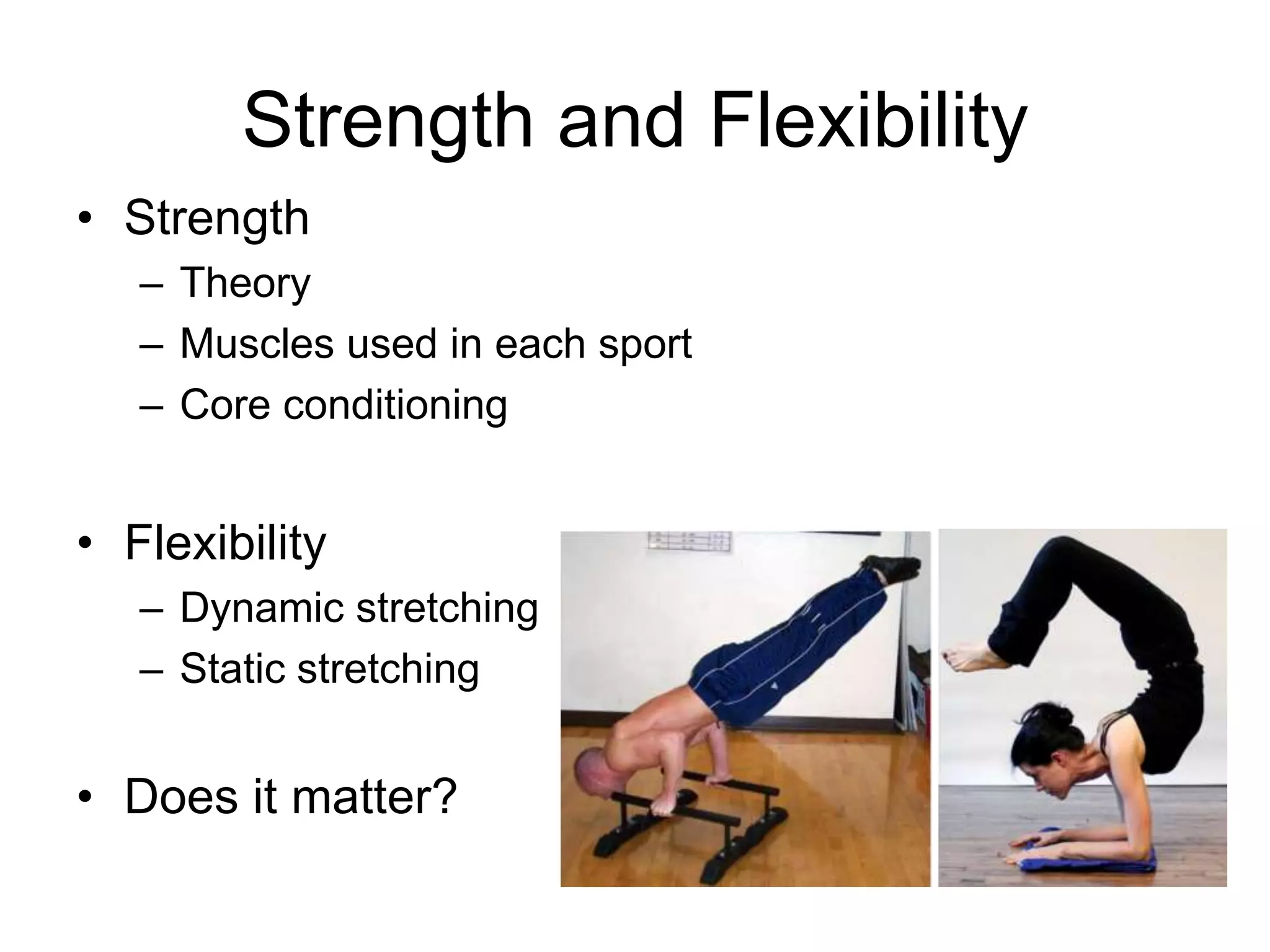
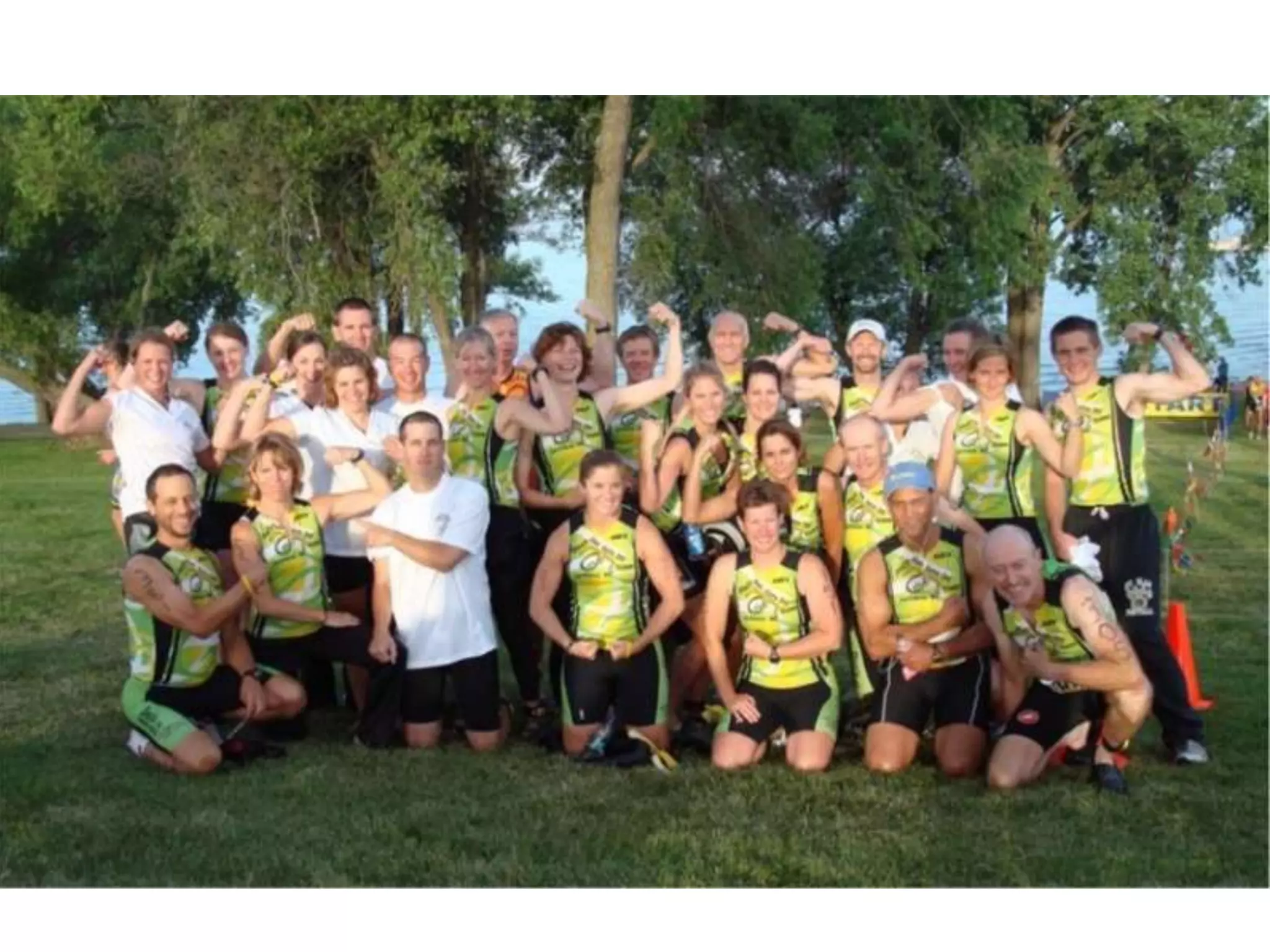
Strength and Flexibility
• Strength
– Theory
– Muscles used in each sport
– Core conditioning
• Flexibility
– Dynamic stretching
– Static stretching
• Does it matter?
Strength Training
Misconceptions
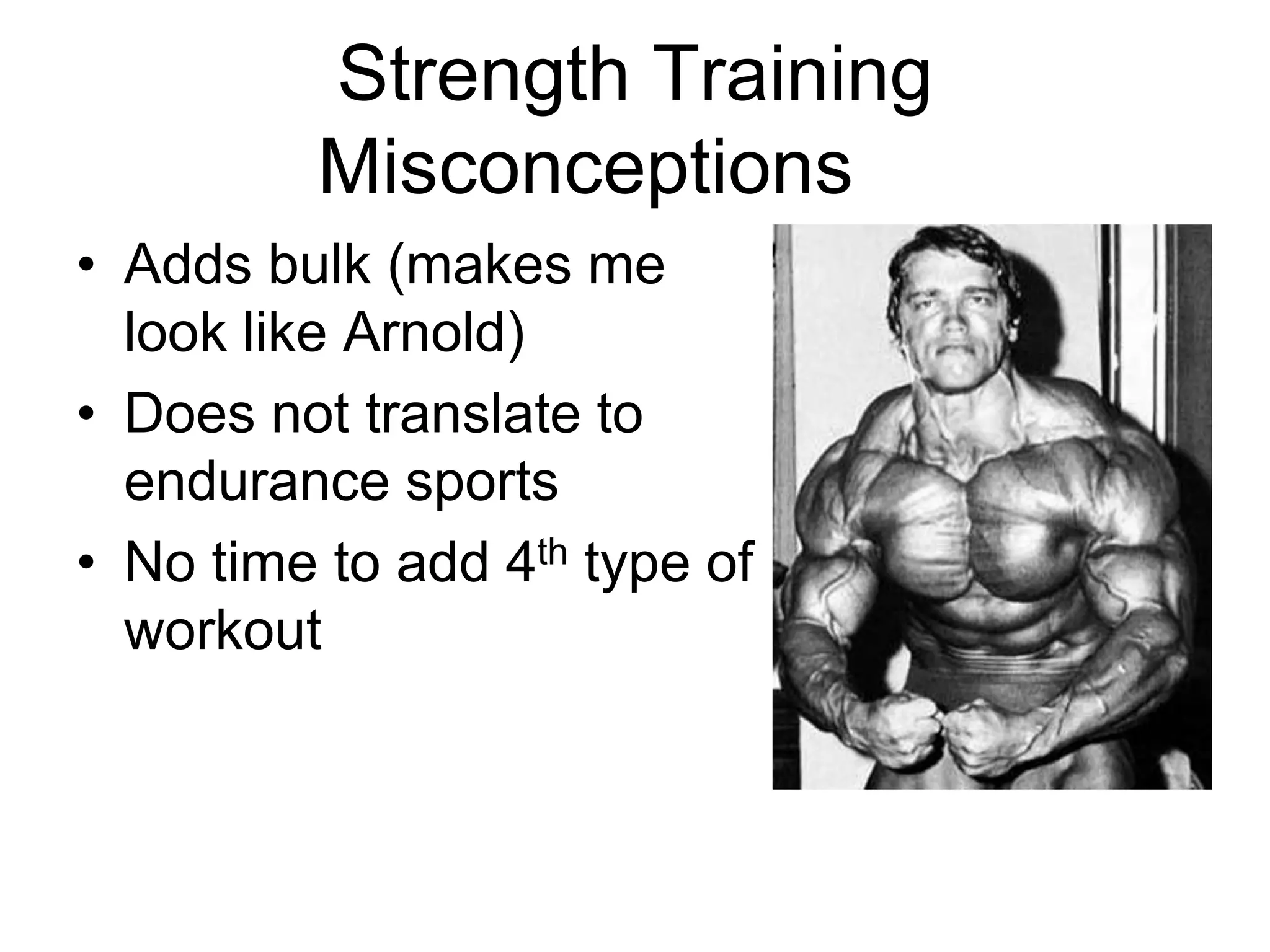
• Adds bulk (makes me
look like Arnold)
• Does not translate to
endurance sports
• No time to add 4th type of
workout
Benefits of Resistance Training
• Supplements normal training 5-10% (30-50
minutes a week)
• Focus on gaining functional power not size
• Stimulates hormone production that can be
damaged from endurance training
– Increases HGH, testosterone
• Helps repair tissues, build muscle, lose fat, anti-inflammatory
• Recruit muscle fibers and strengthen the brain muscle
connection.
• Improves efficiency
• Strengthens tissues and lowers injury risk
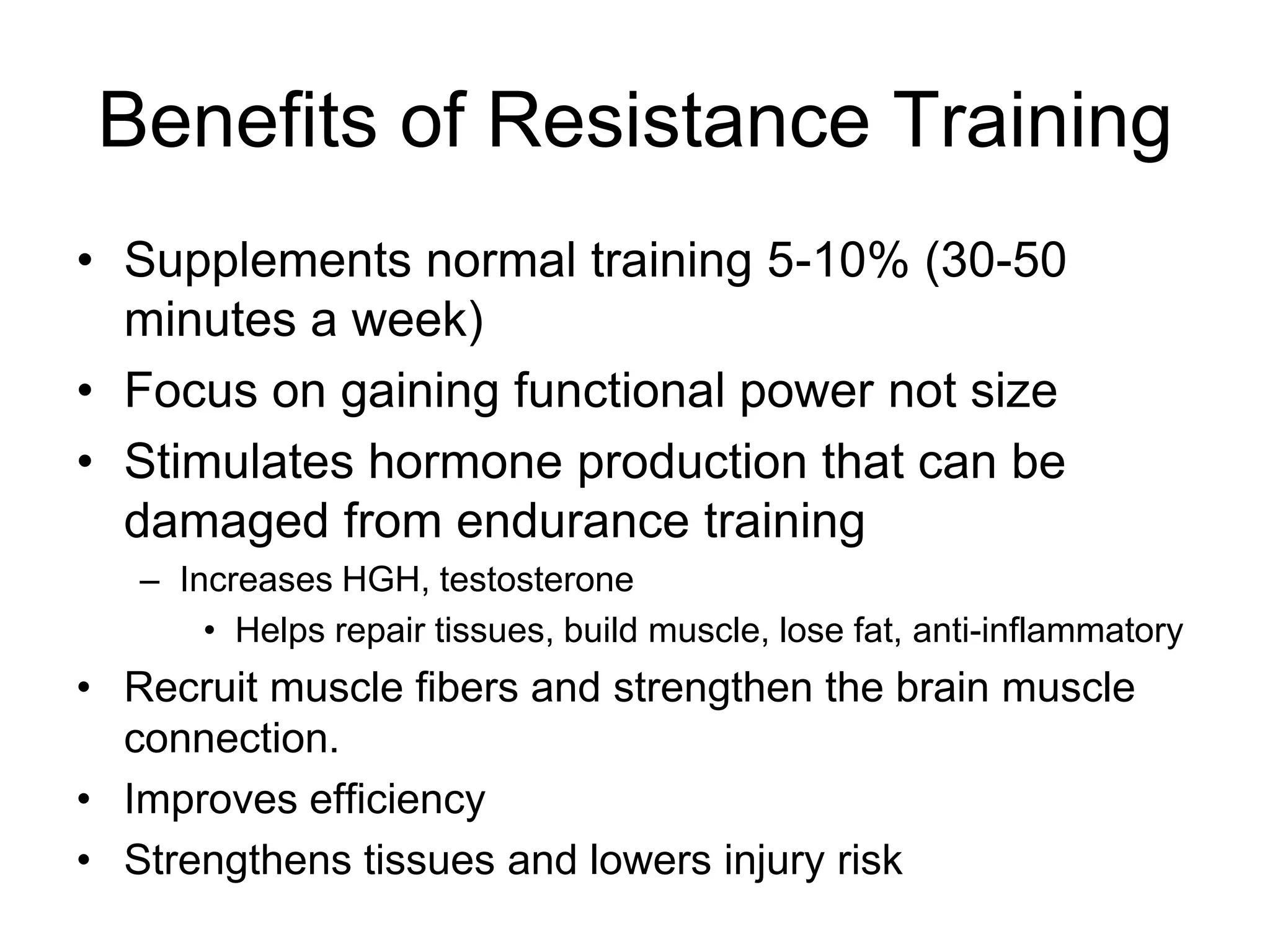
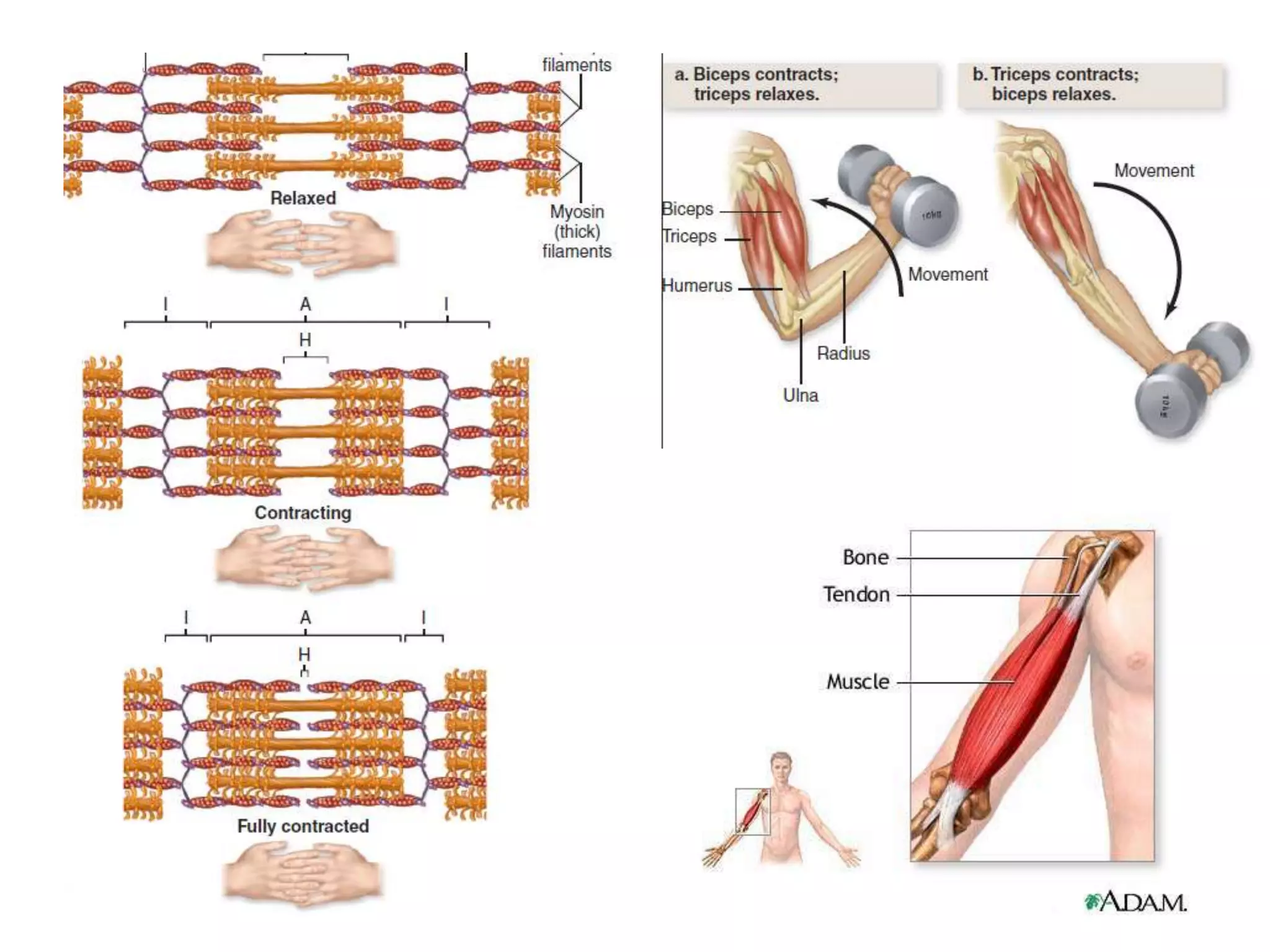
Hypertrophy – response to stress
• Stress muscle
• Responds by
increasing size of
cells.
• Requires
– Recovery period (rest)
– Carbs and protein
(4:1)
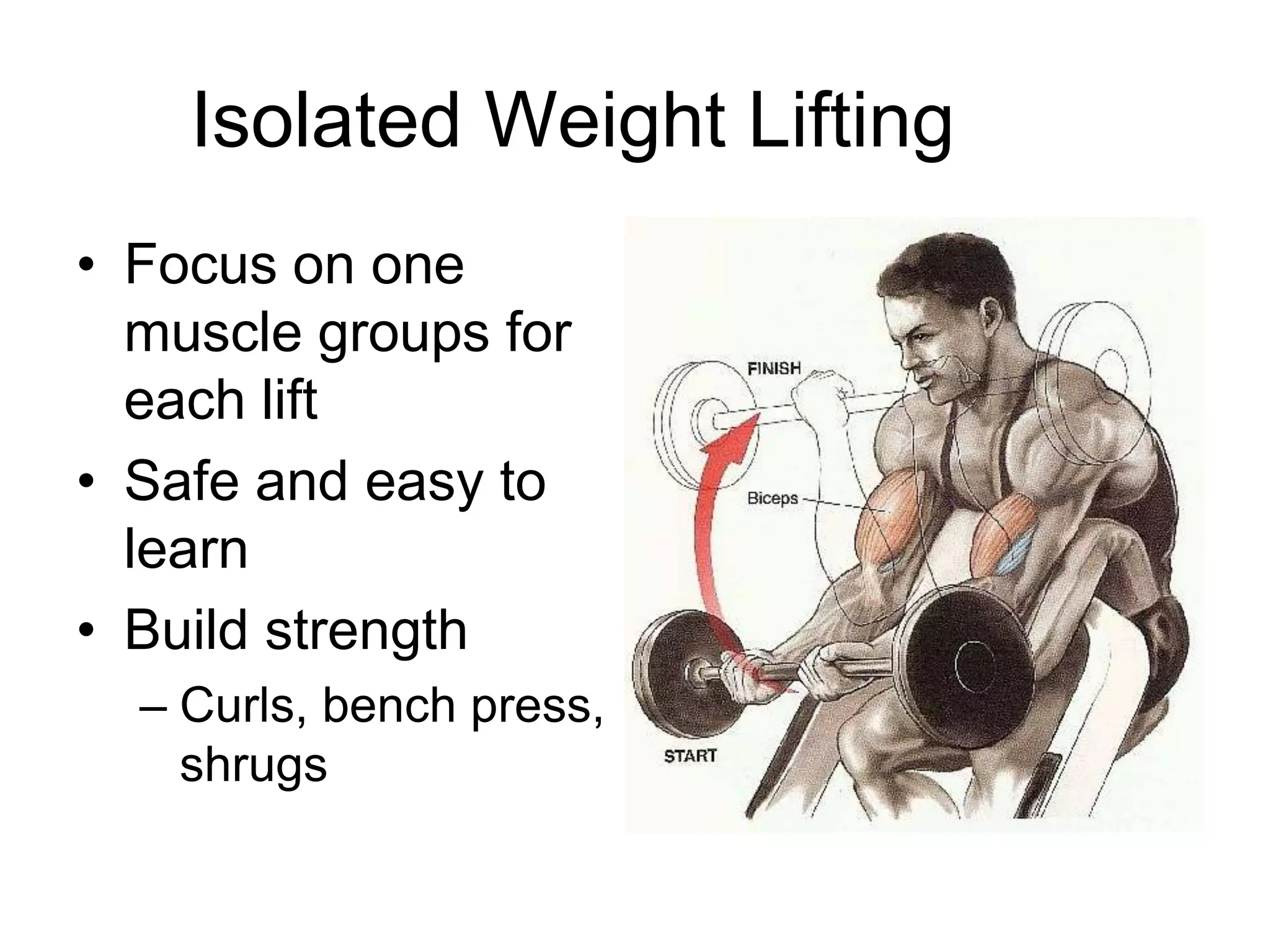
Isolated Weight Lifting
• Focus on one
muscle groups for
each lift
• Safe and easy to
learn
• Build strength
– Curls, bench press,
shrugs
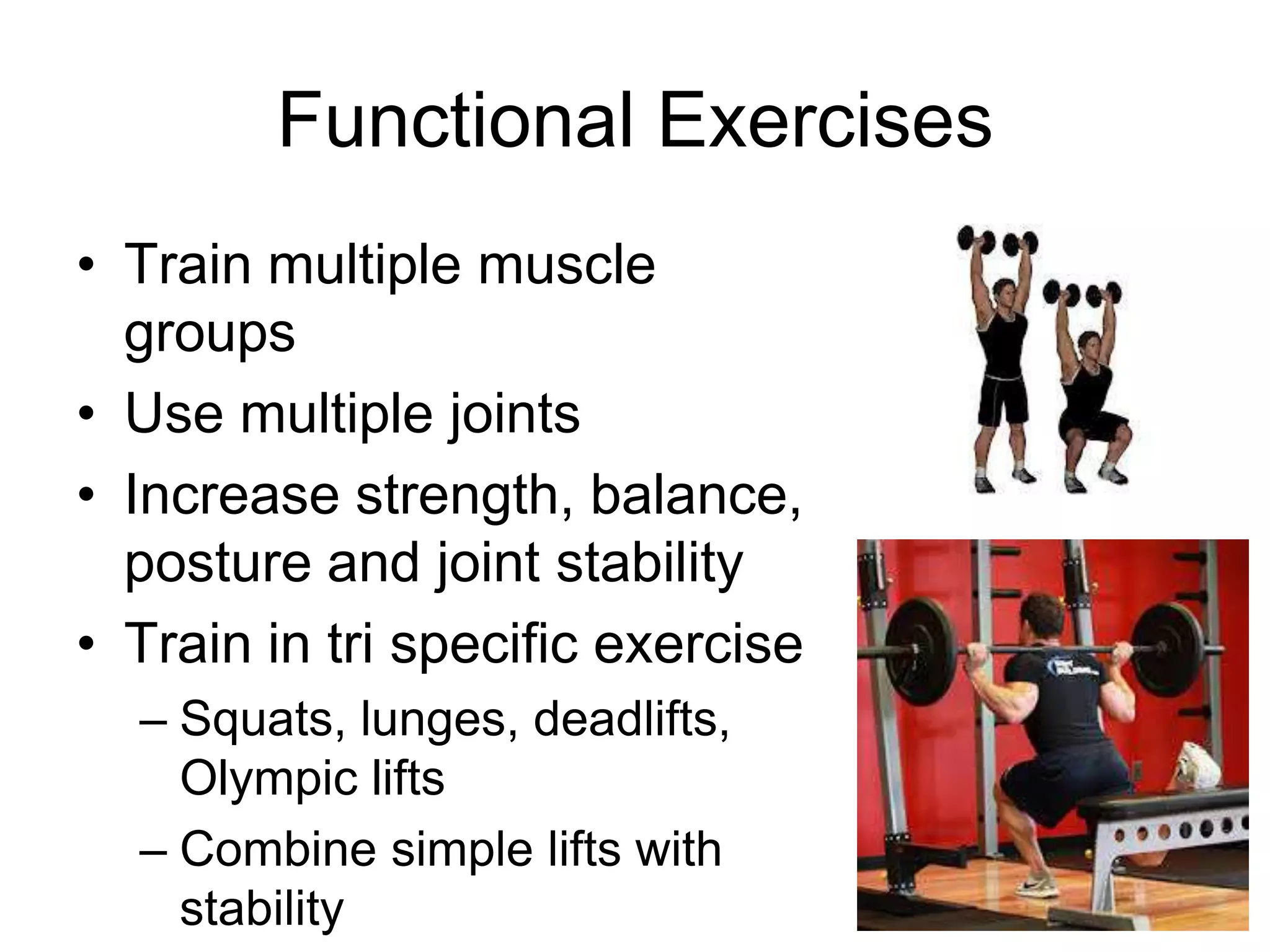
Functional Exercises
• Train multiple muscle
groups
• Use multiple joints
• Increase strength, balance,
posture and joint stability
• Train in tri specific exercise
– Squats, lunges, deadlifts,
Olympic lifts
– Combine simple lifts with
stability
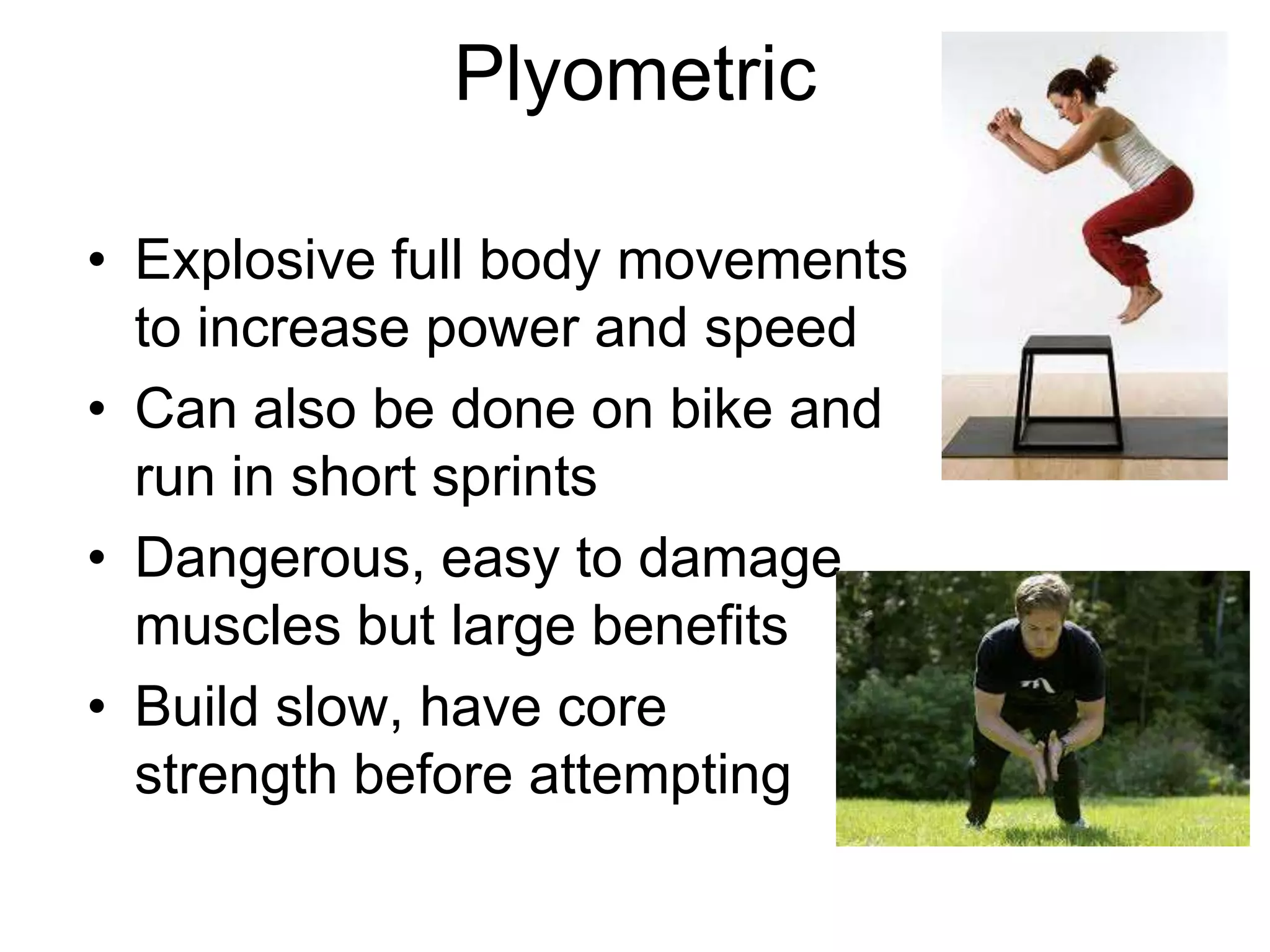
Plyometric
• Explosive full body movements
to increase power and speed
• Can also be done on bike and
run in short sprints
• Dangerous, easy to damage
muscles but large benefits
• Build slow, have core
strength before attempting
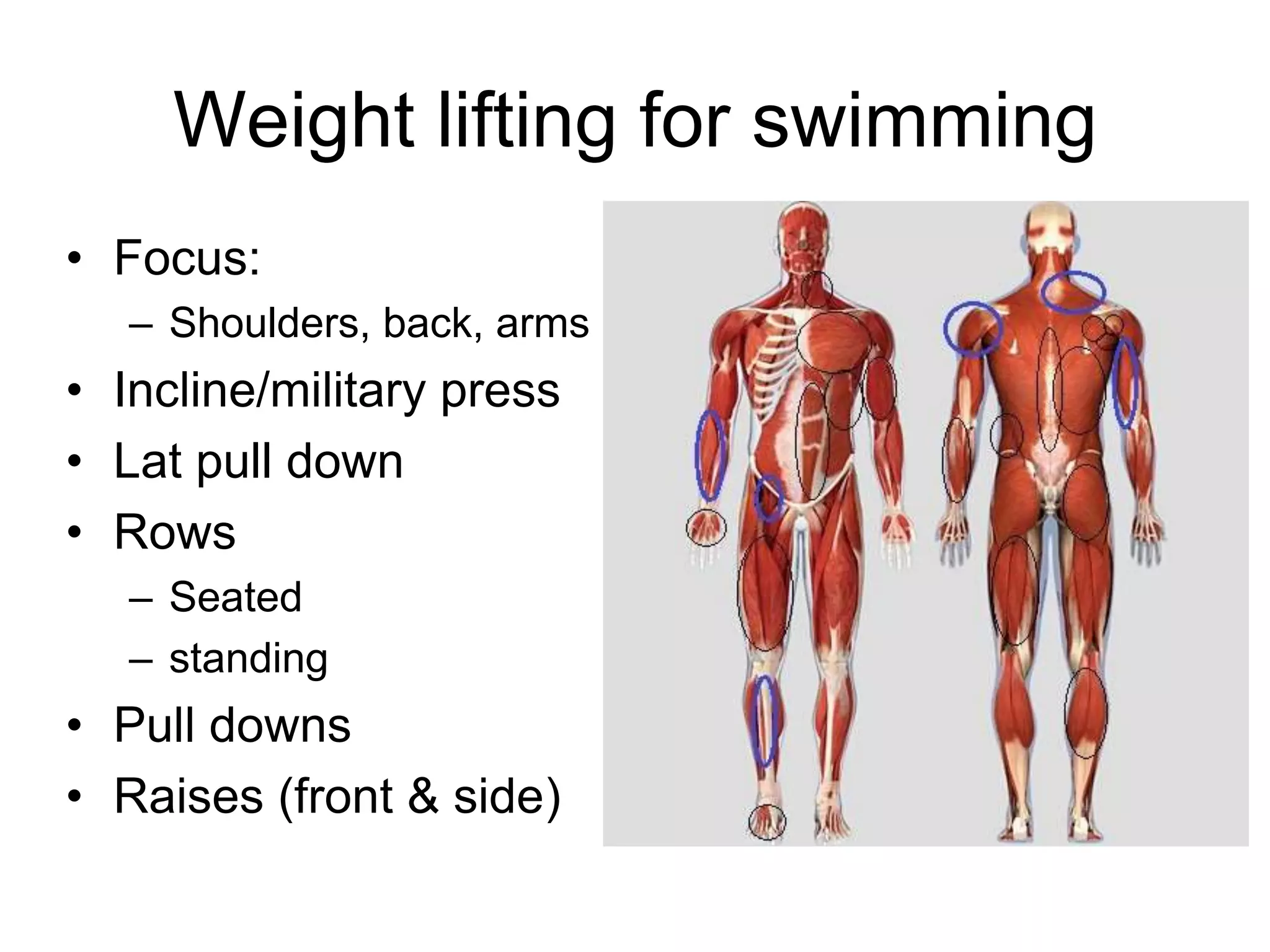
Weight lifting for swimming
• Focus:
– Shoulders, back, arms
• Incline/military press
• Lat pull down
• Rows
– Seated
– standing
• Pull downs
• Raises (front & side)
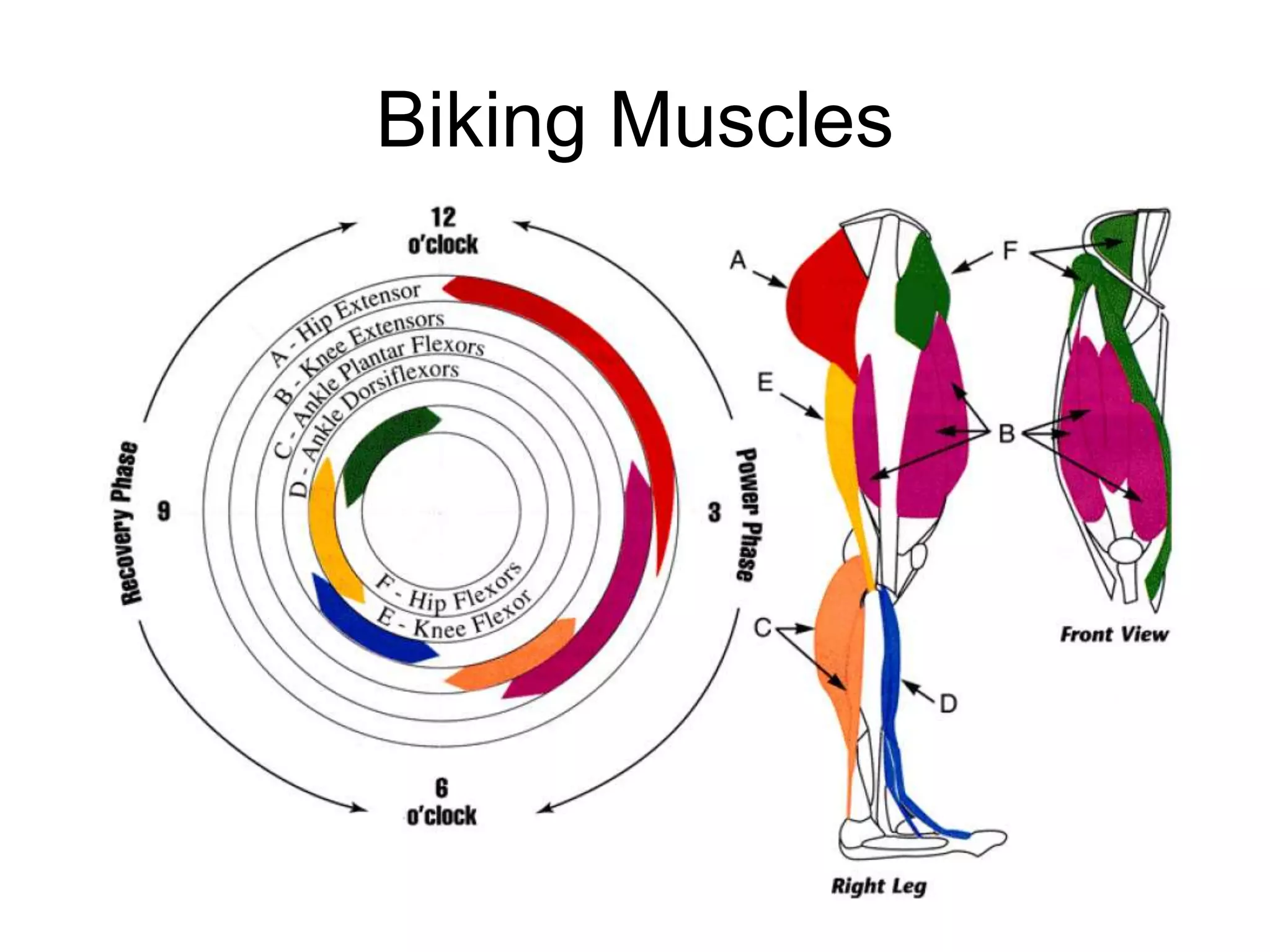
Biking Muscles
Run Muscles
• Biking and Running use the same
muscle groups, but use them slightly
differently.
• Quads - push down in cycling, pull up in running
• Hamstrings - pull up in cycling during recover, pull
the weight of the lower leg up in running
• Gluteal muscles - push down in cycling, work to
stabilize the trunk in running
• Gastrocnemius (calf muscle) - push the final part
of power phase in cycling, push off in running
Bike/Run Exercise
• Isolation exercises
– Leg press
– Leg extension
– Hamstring curls
– Calf raises
– Adductor/Abductor
– Rows
– Pushups
– Pull-ups
• Functional
– Squat
• Single leg
• With dumbbell press
– Deadlift
– Lunges
– Step-ups
• Plyometric
– Bounding
– Box jump
– Squat jump
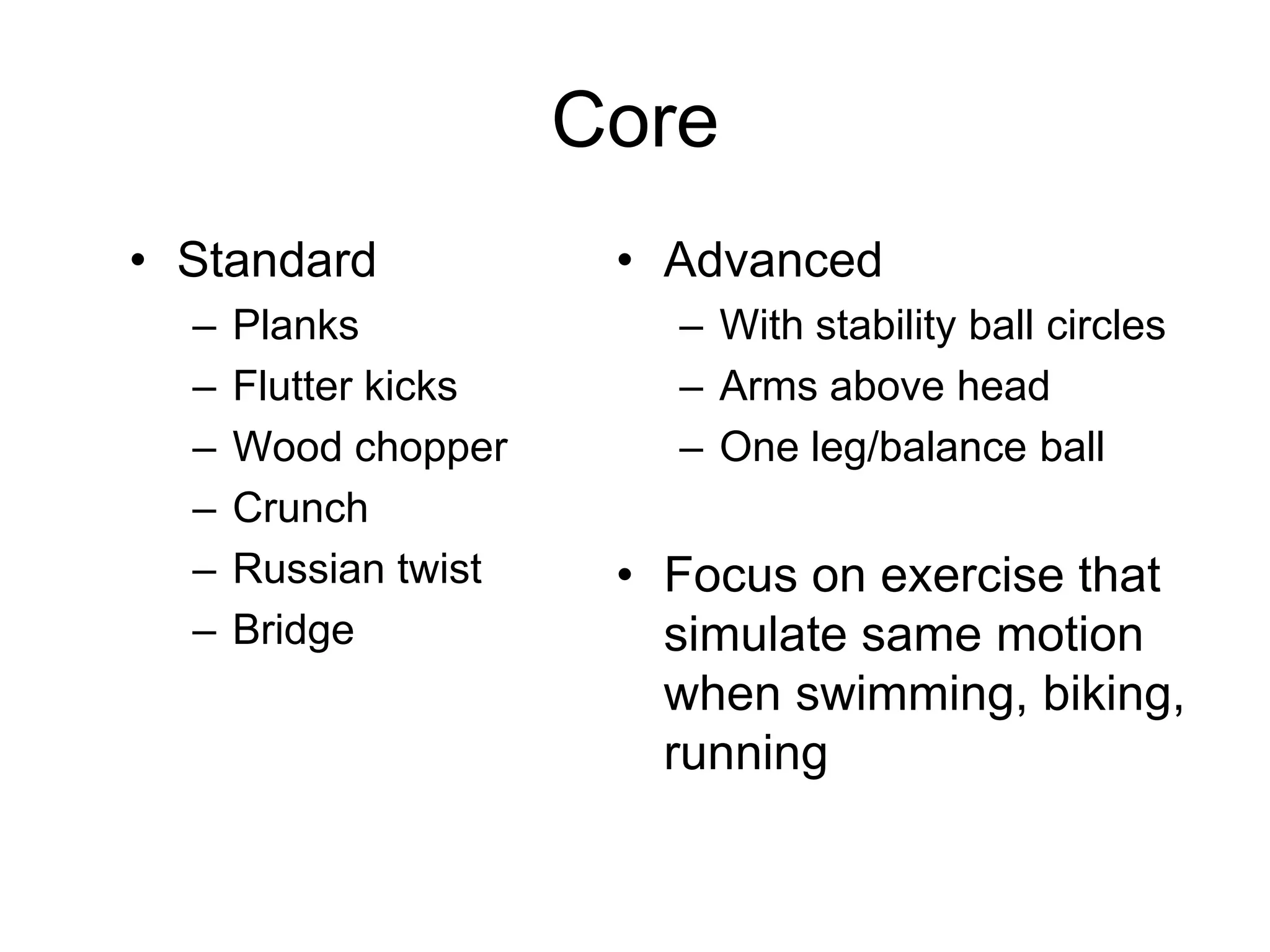
Core
• Standard
– Planks
– Flutter kicks
– Wood chopper
– Crunch
– Russian twist
– Bridge
• Advanced
– With stability ball circles
– Arms above head
– One leg/balance ball
• Focus on exercise that
simulate same motion
when swimming, biking,
running
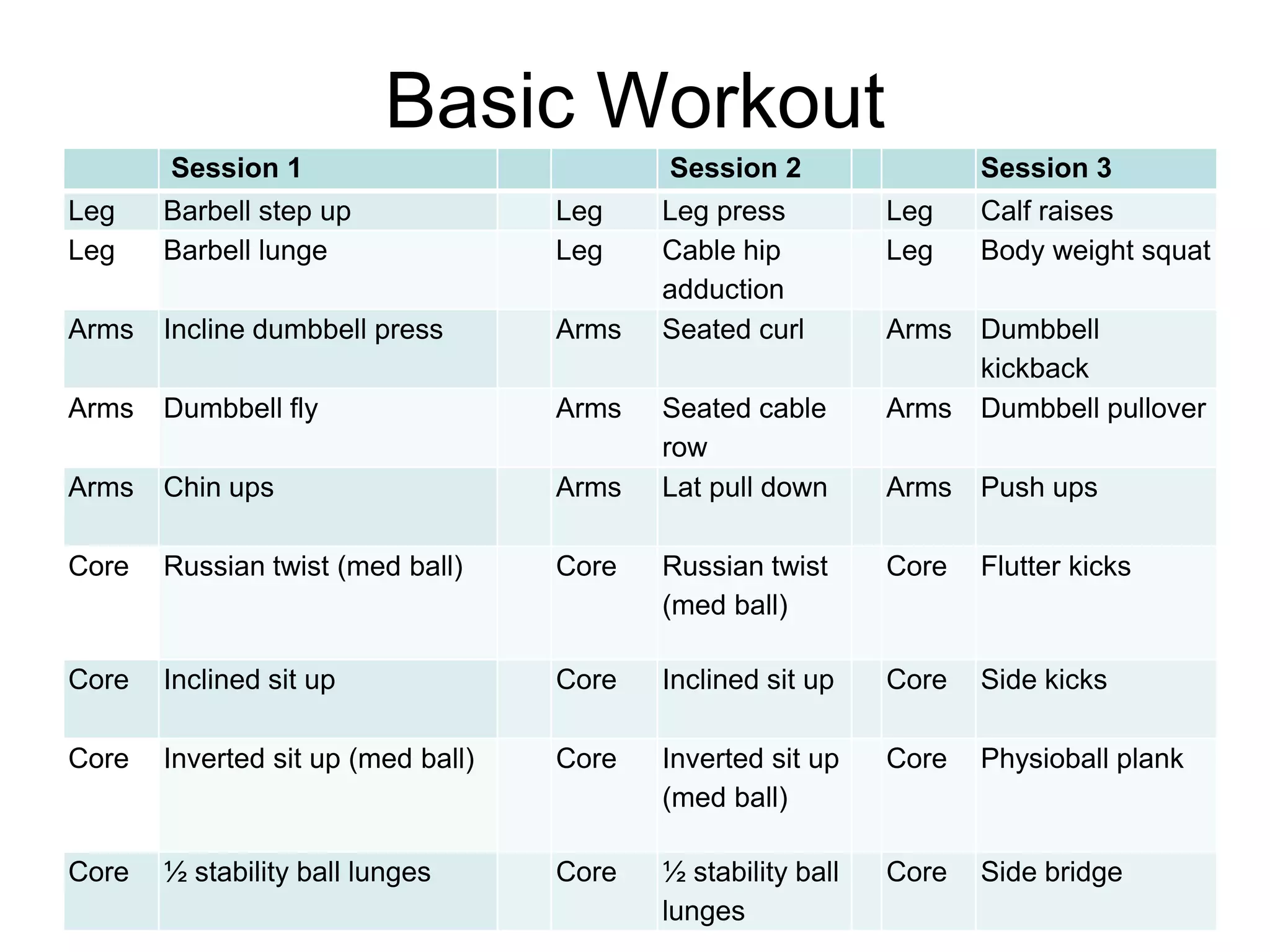
Basic Workout
Session 1 Session 2 Session 3
Leg Barbell step up Leg Leg press Leg Calf raises
Leg Barbell lunge Leg Cable hip
adduction
Leg Body weight squat
Arms Incline dumbbell press Arms Seated curl Arms Dumbbell
kickback
Arms Dumbbell fly Arms Seated cable
row
Arms Dumbbell pullover
Arms Chin ups Arms Lat pull down Arms Push ups
Core Russian twist (med ball) Core Russian twist
(med ball)
Core Flutter kicks
Core Inclined sit up Core Inclined sit up Core Side kicks
Core Inverted sit up (med ball) Core Inverted sit up
(med ball)
Core Physioball plank
Core ½ stability ball lunges Core ½ stability ball
lunges
Core Side bridge
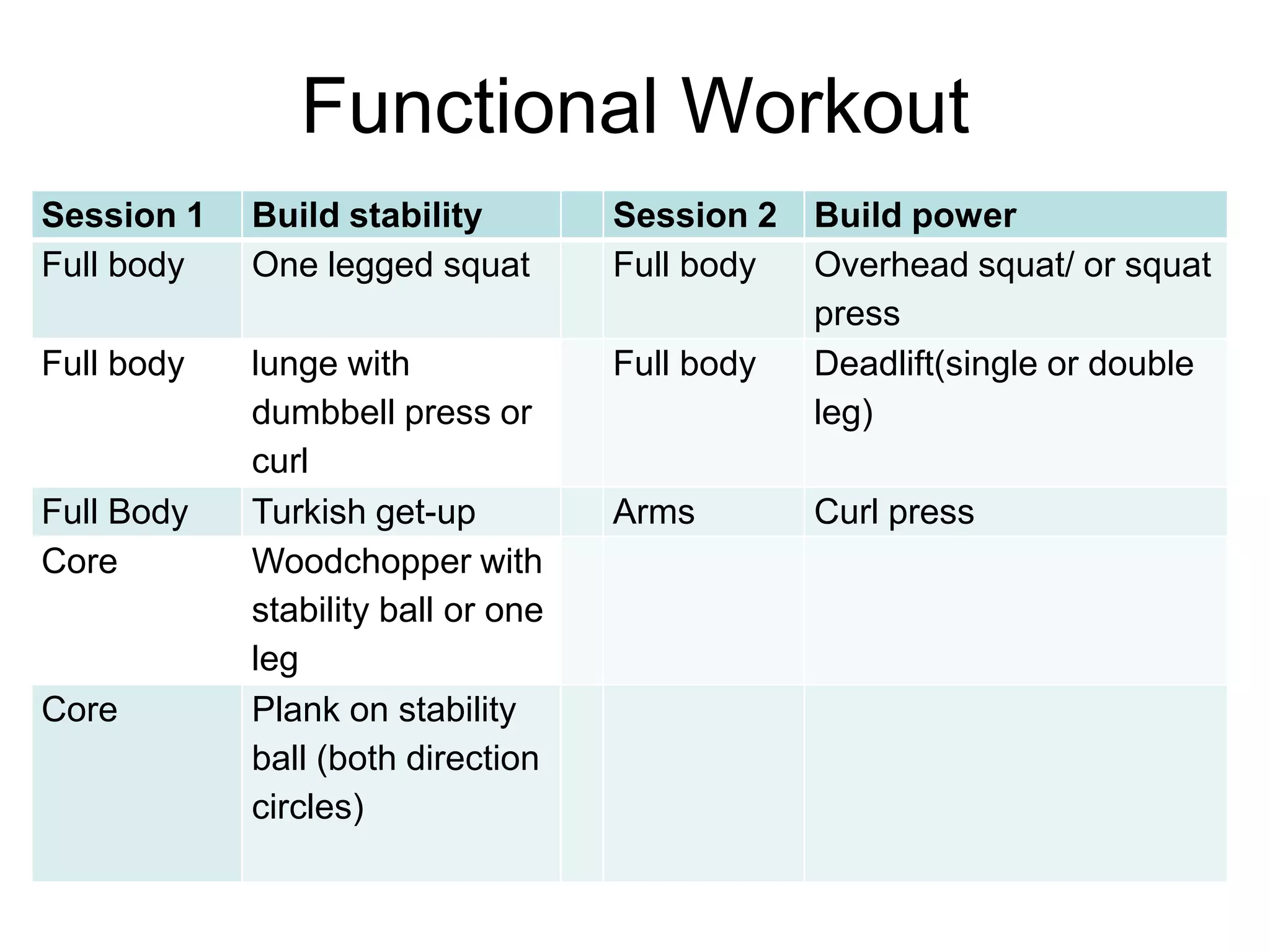
Functional Workout
Session 1 Build stability Session 2 Build power
Full body One legged squat Full body Overhead squat/ or squat
press
Full body lunge with
dumbbell press or
curl
Full body Deadlift(single or double
leg)
Full Body Turkish get-up Arms Curl press
Core Woodchopper with
stability ball or one
leg
Core Plank on stability
ball (both direction
circles)
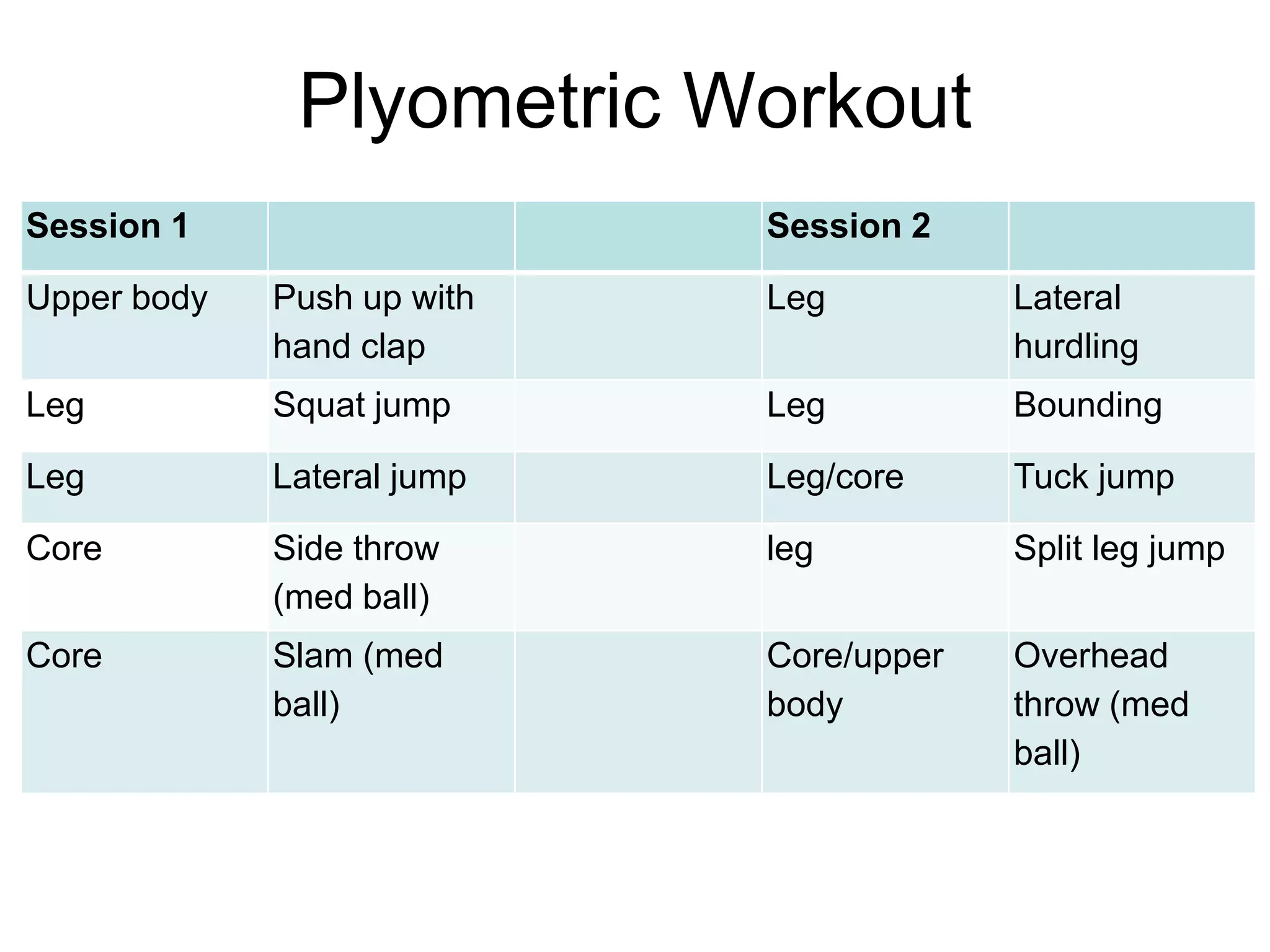
Plyometric Workout
Session 1 Session 2
Upper body Push up with
hand clap
Leg Lateral
hurdling
Leg Squat jump Leg Bounding
Leg Lateral jump Leg/core Tuck jump
Core Side throw
(med ball)
leg Split leg jump
Core Slam (med
ball)
Core/upper
body
Overhead
throw (med
ball)
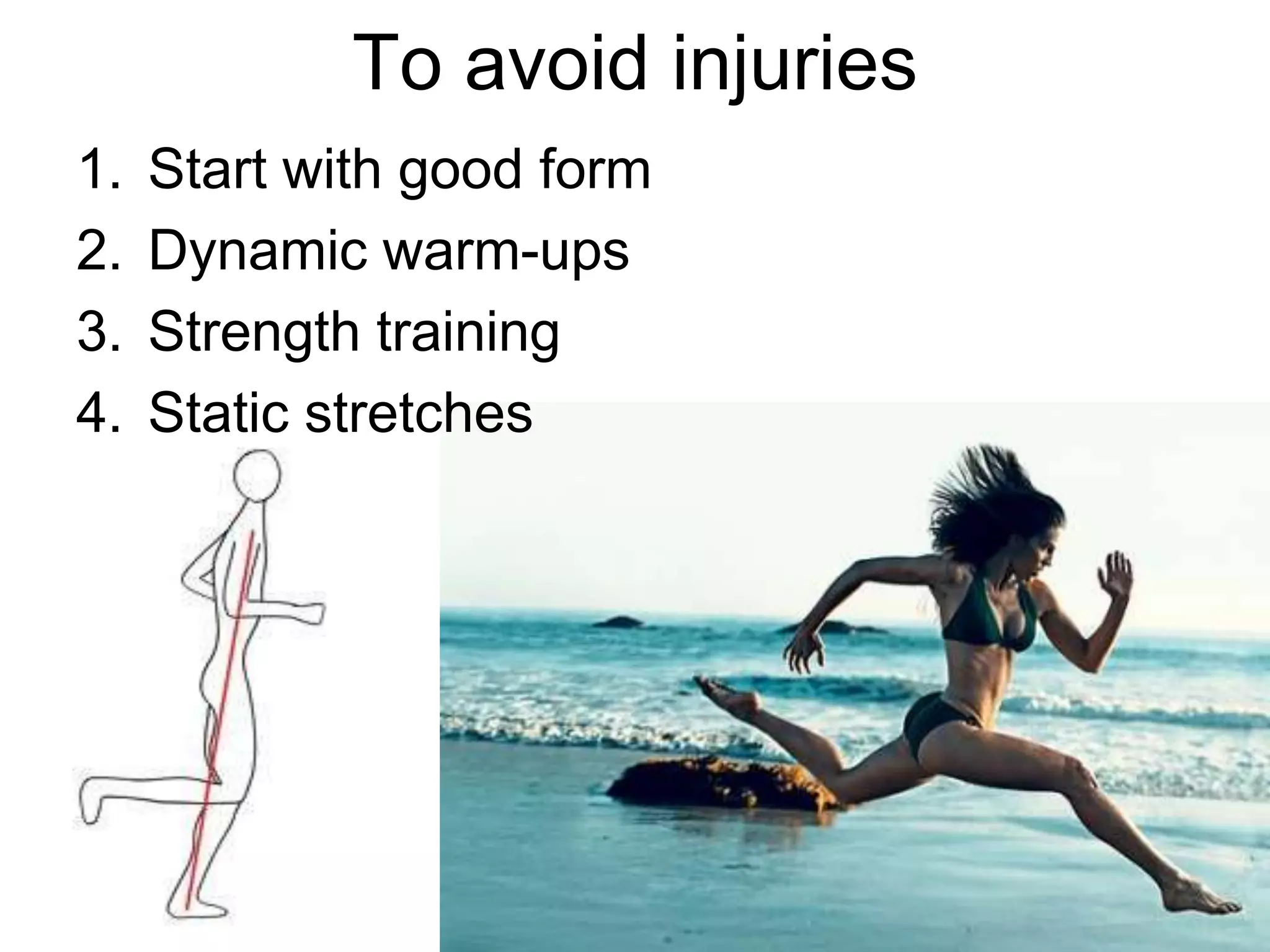
To avoid injuries
1. Start with good form
2. Dynamic warm-ups
3. Strength training
4. Static stretches
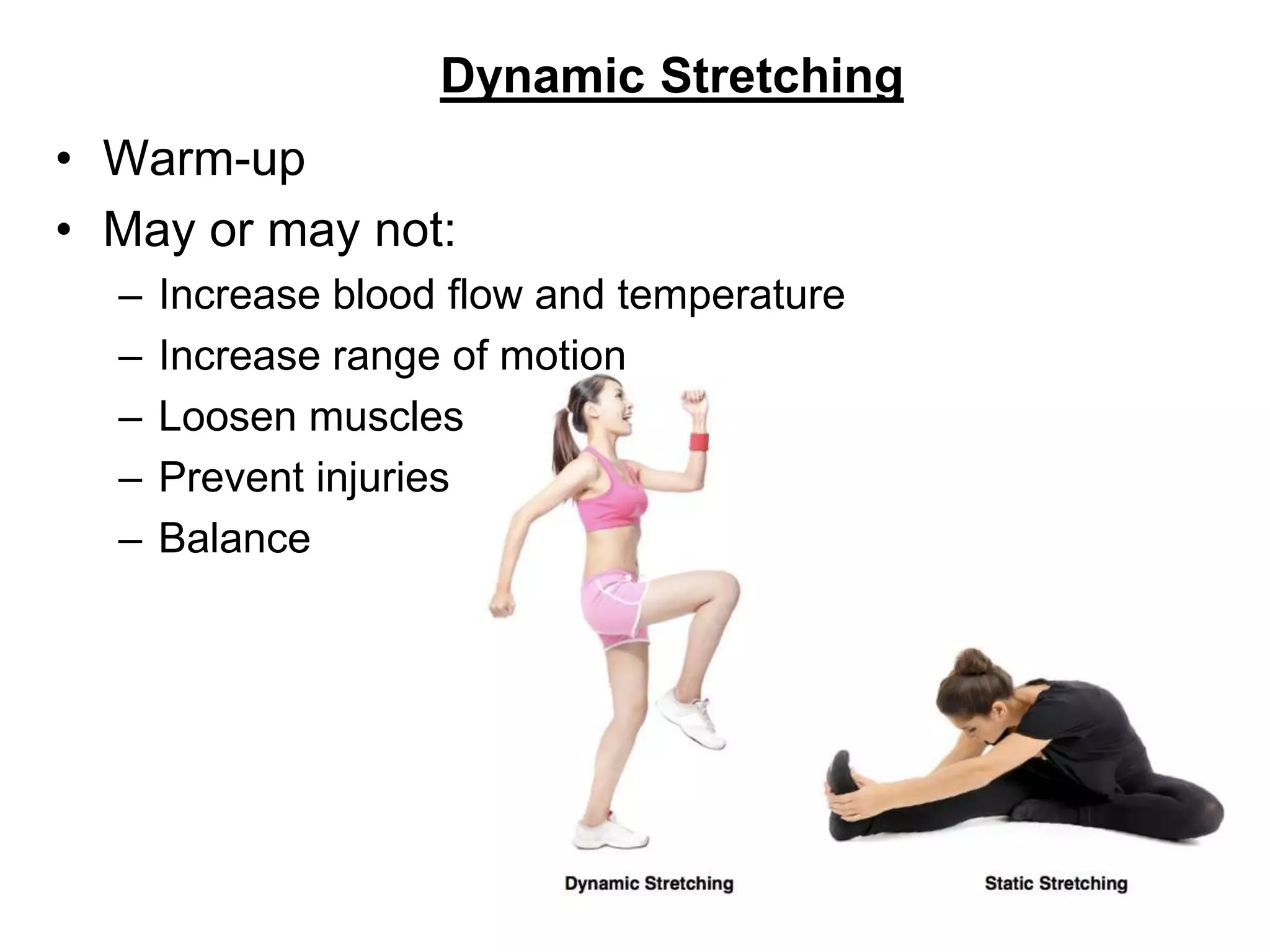
Dynamic Stretching
• Warm-up
• May or may not:
– Increase blood flow and temperature
– Increase range of motion
– Loosen muscles
– Prevent injuries
– Balance
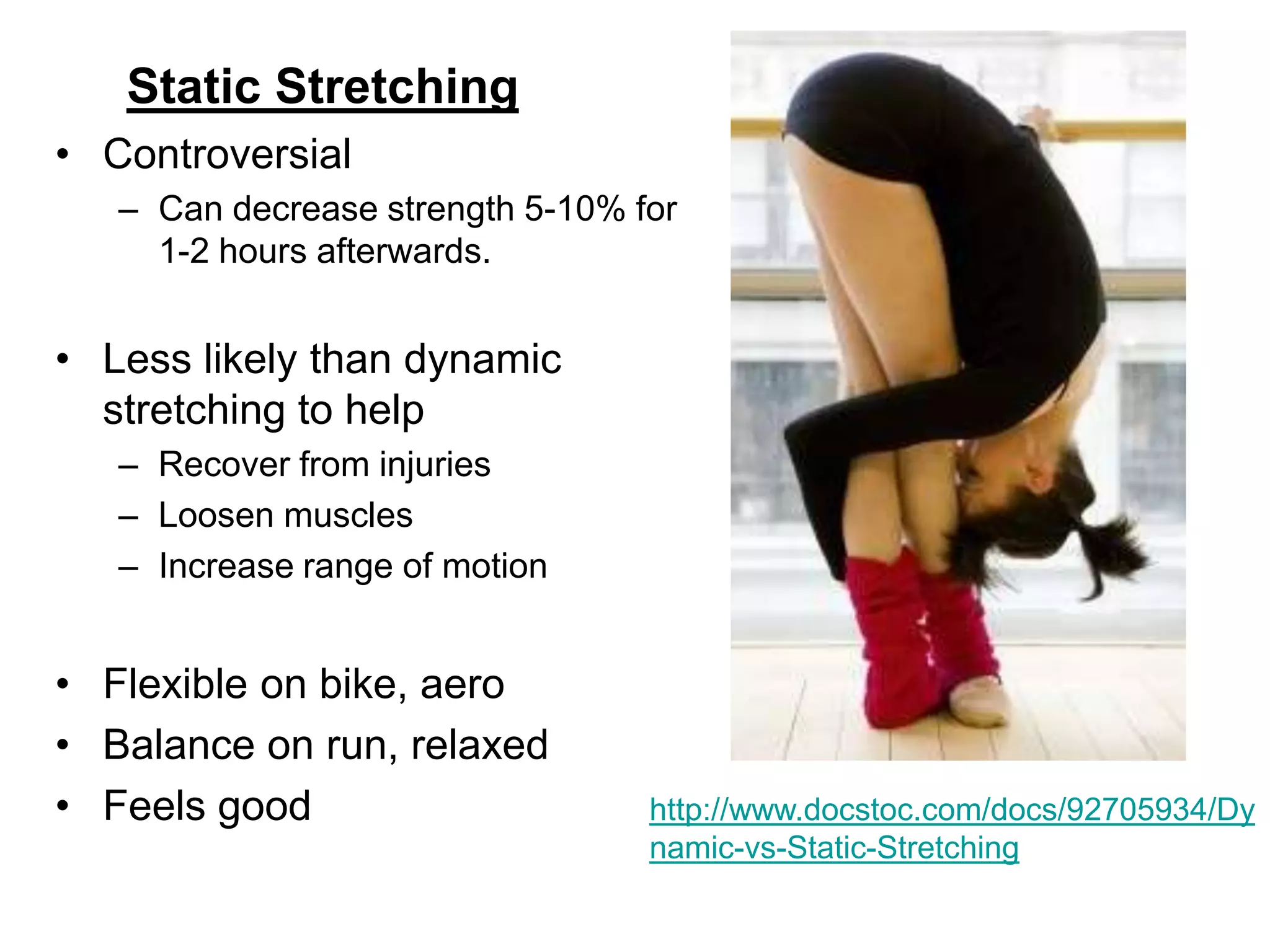
Static Stretching
• Controversial
– Can decrease strength 5-10% for
1-2 hours afterwards.
• Less likely than dynamic
stretching to help
– Recover from injuries
– Loosen muscles
– Increase range of motion
• Flexible on bike, aero
• Balance on run, relaxed
• Feels good http://www.docstoc.com/docs/92705934/Dy
namic-vs-Static-Stretching
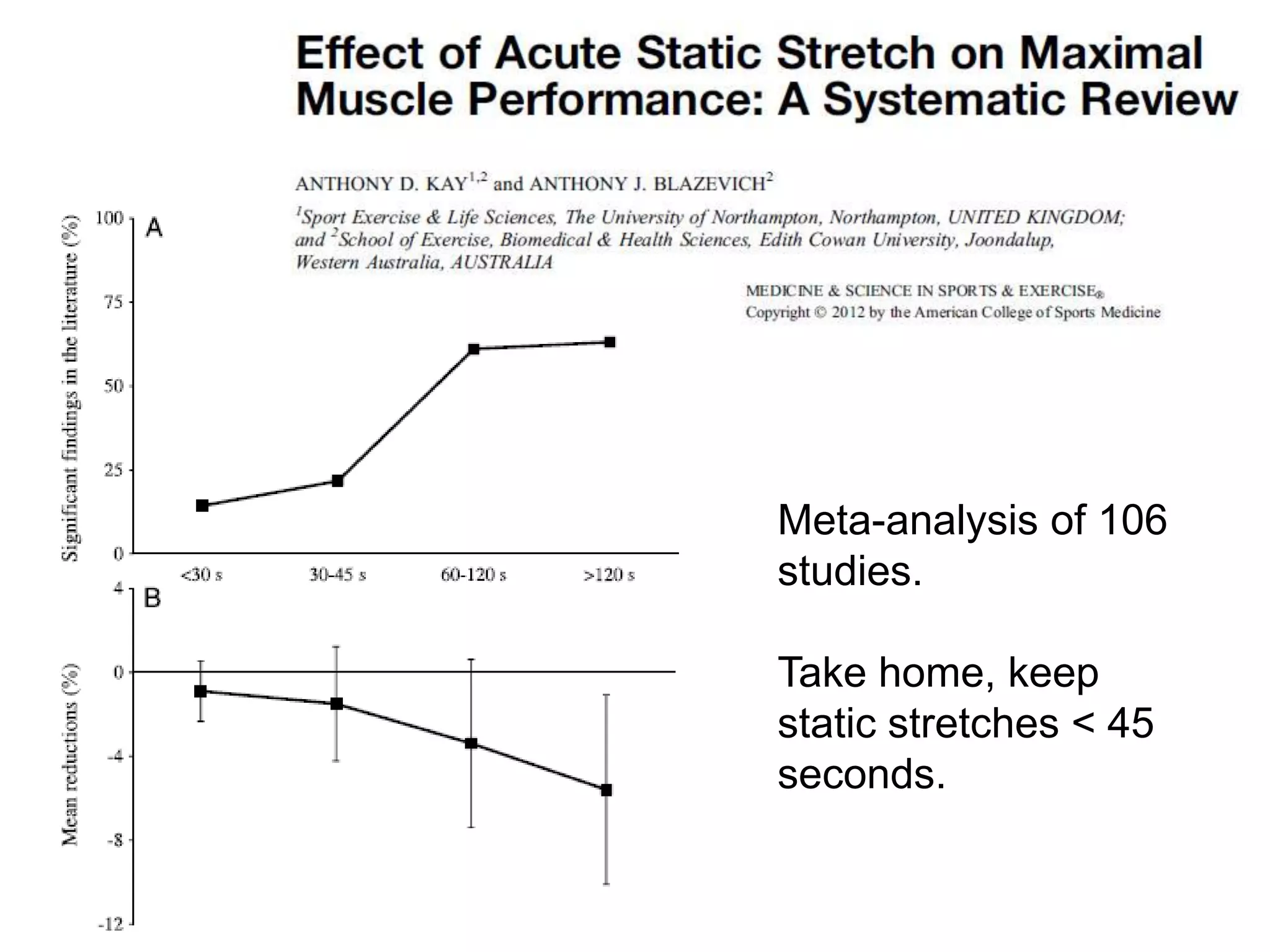
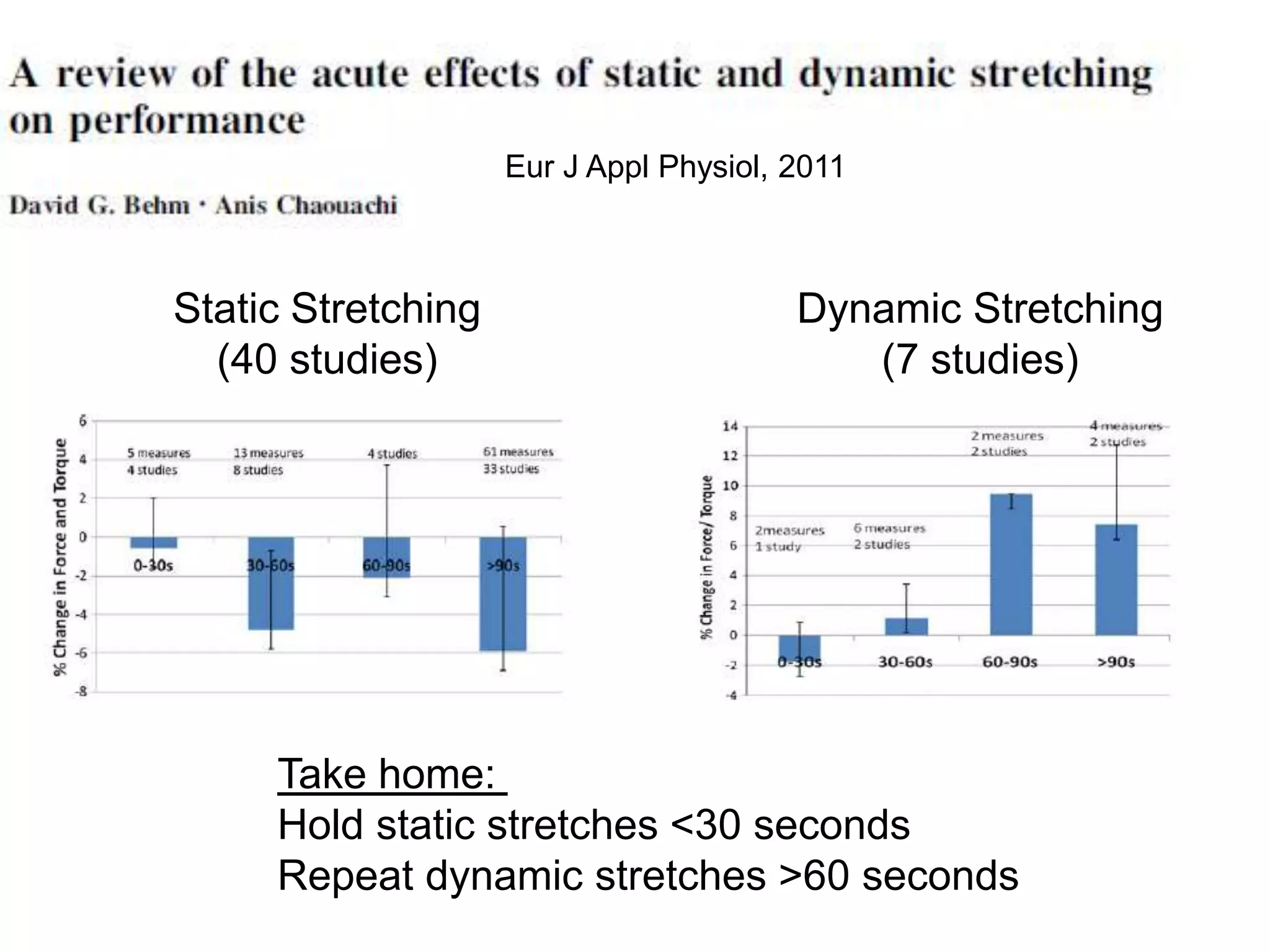
Meta-analysis of 106
studies.
Take home, keep
static stretches < 45
seconds.
Eur J Appl Physiol, 2011
Static Stretching
(40 studies)
Dynamic Stretching
(7 studies)
Take home:
Hold static stretches <30 seconds
Repeat dynamic stretches >60 seconds
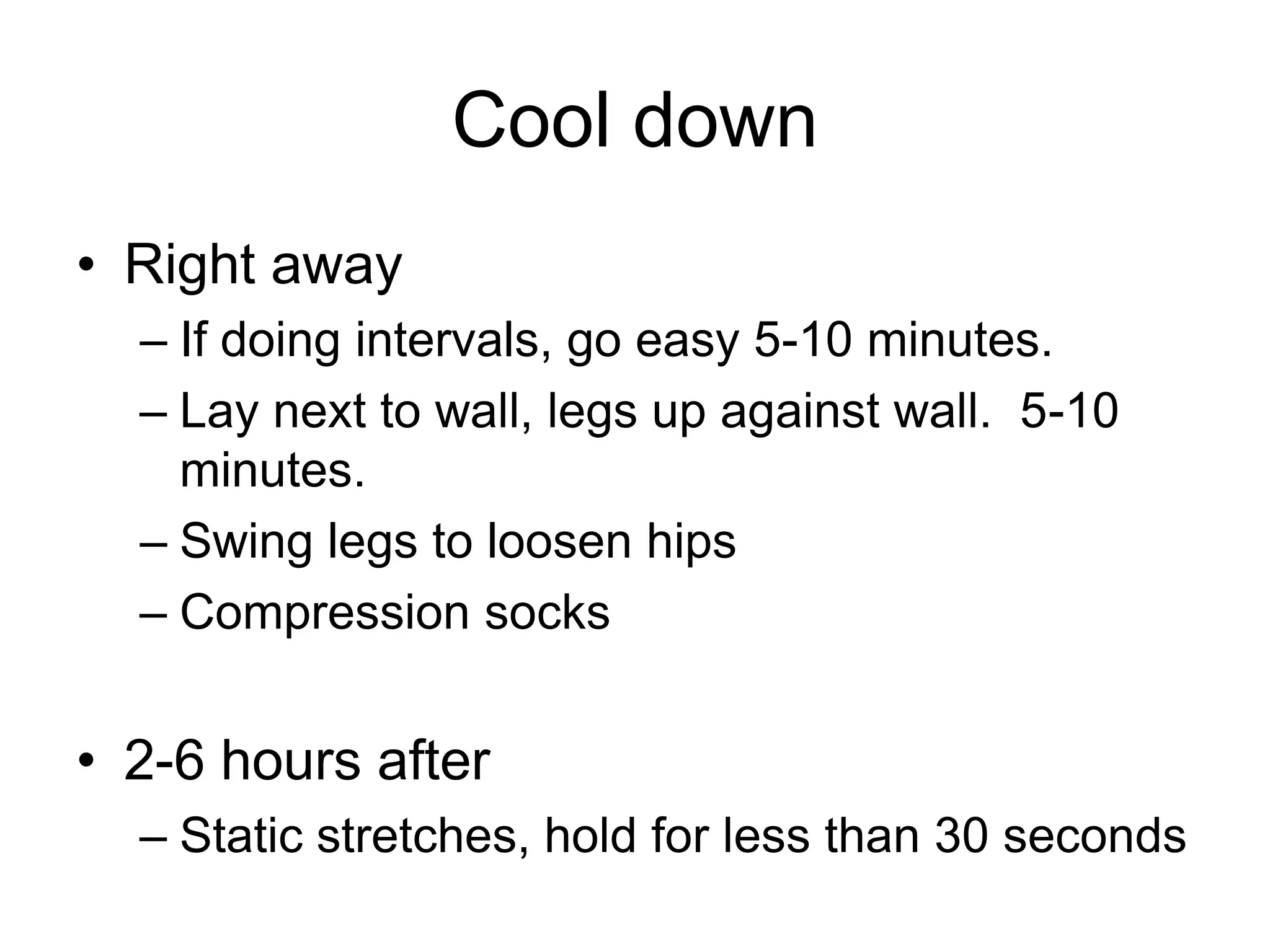
Cool down
• Right away
– If doing intervals, go easy 5-10 minutes.
– Lay next to wall, legs up against wall. 5-10
minutes.
– Swing legs to loosen hips
– Compression socks
• 2-6 hours after
– Static stretches, hold for less than 30 seconds
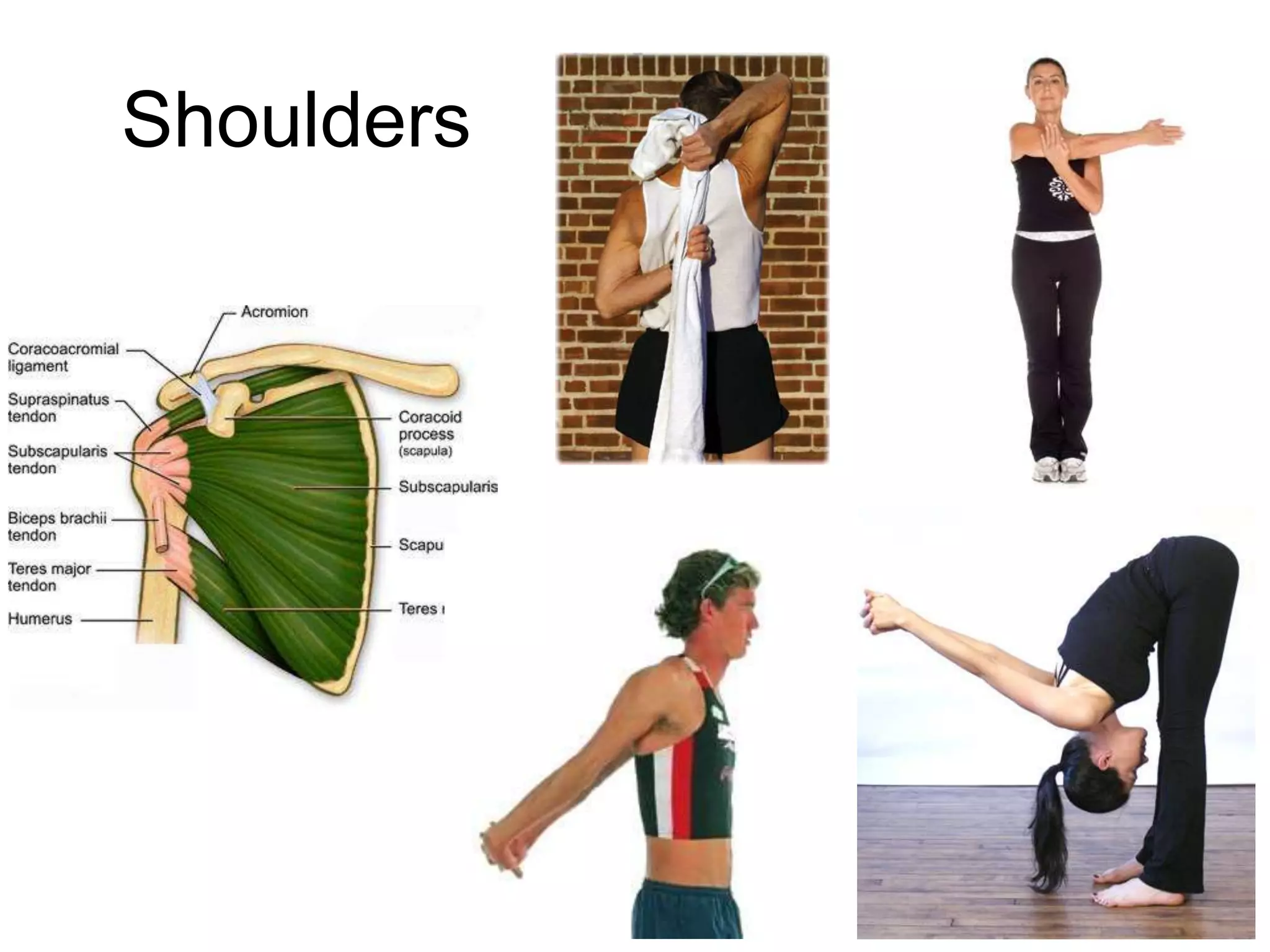
Shoulders
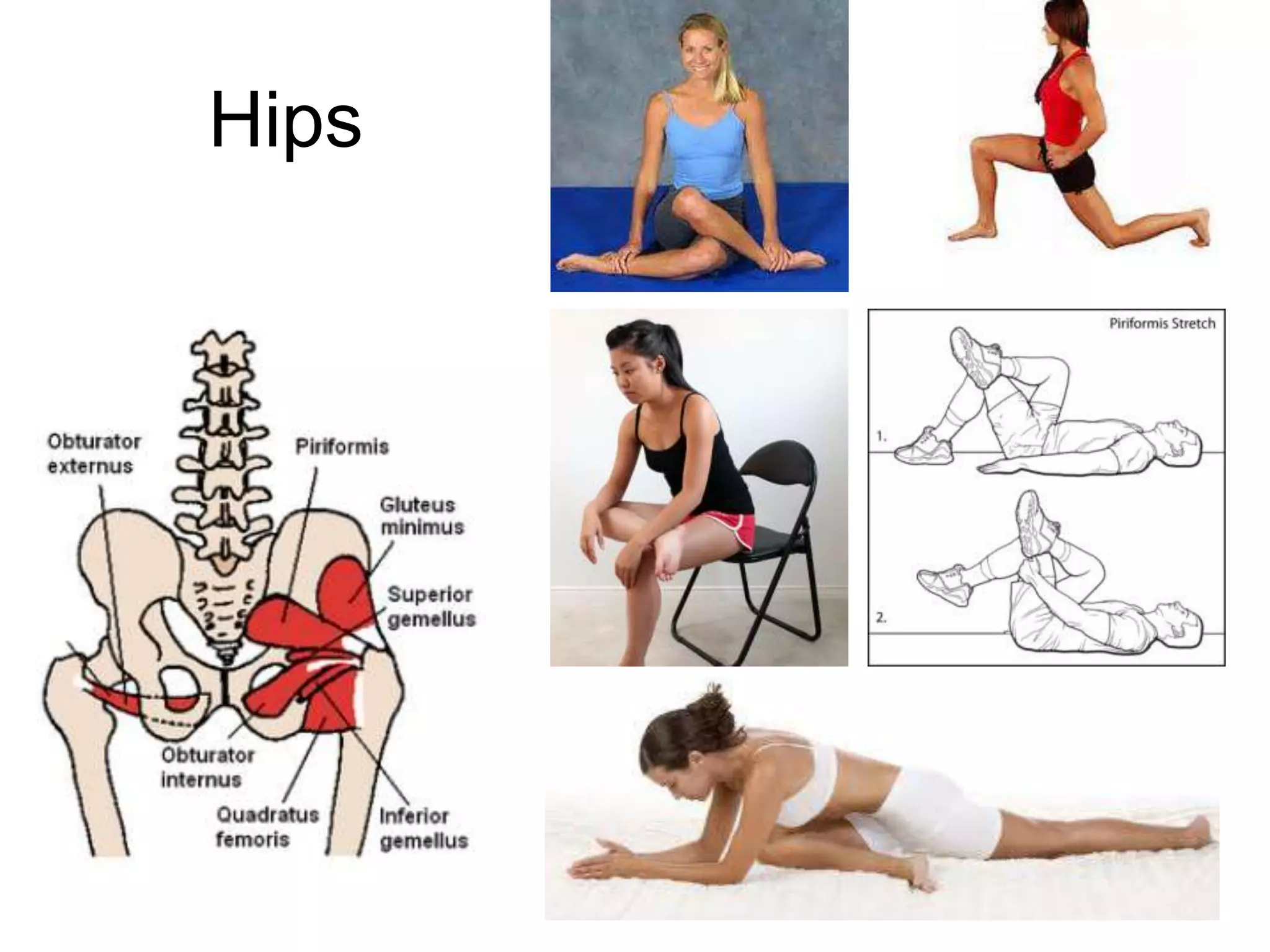
Hips
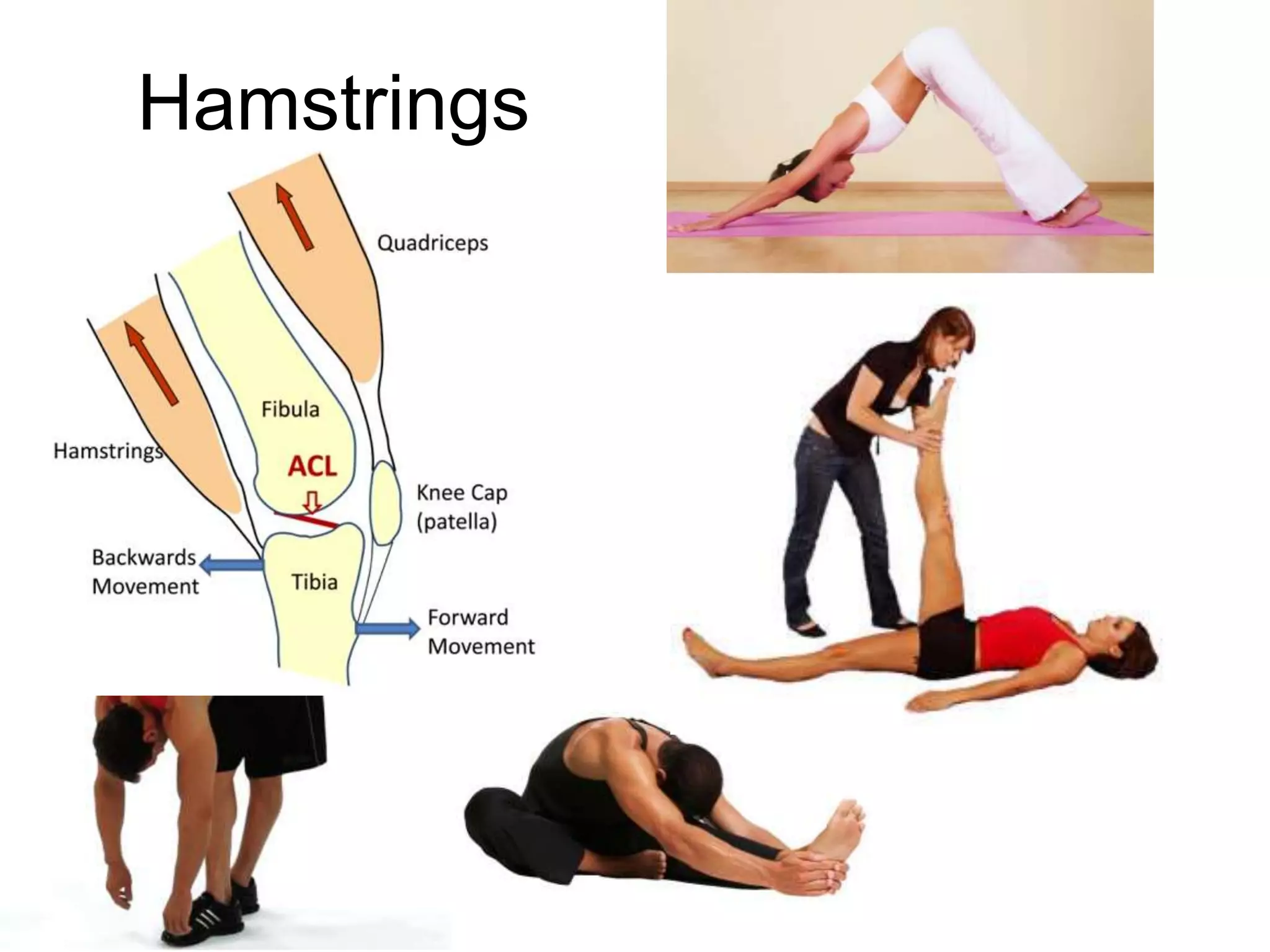
Hamstrings
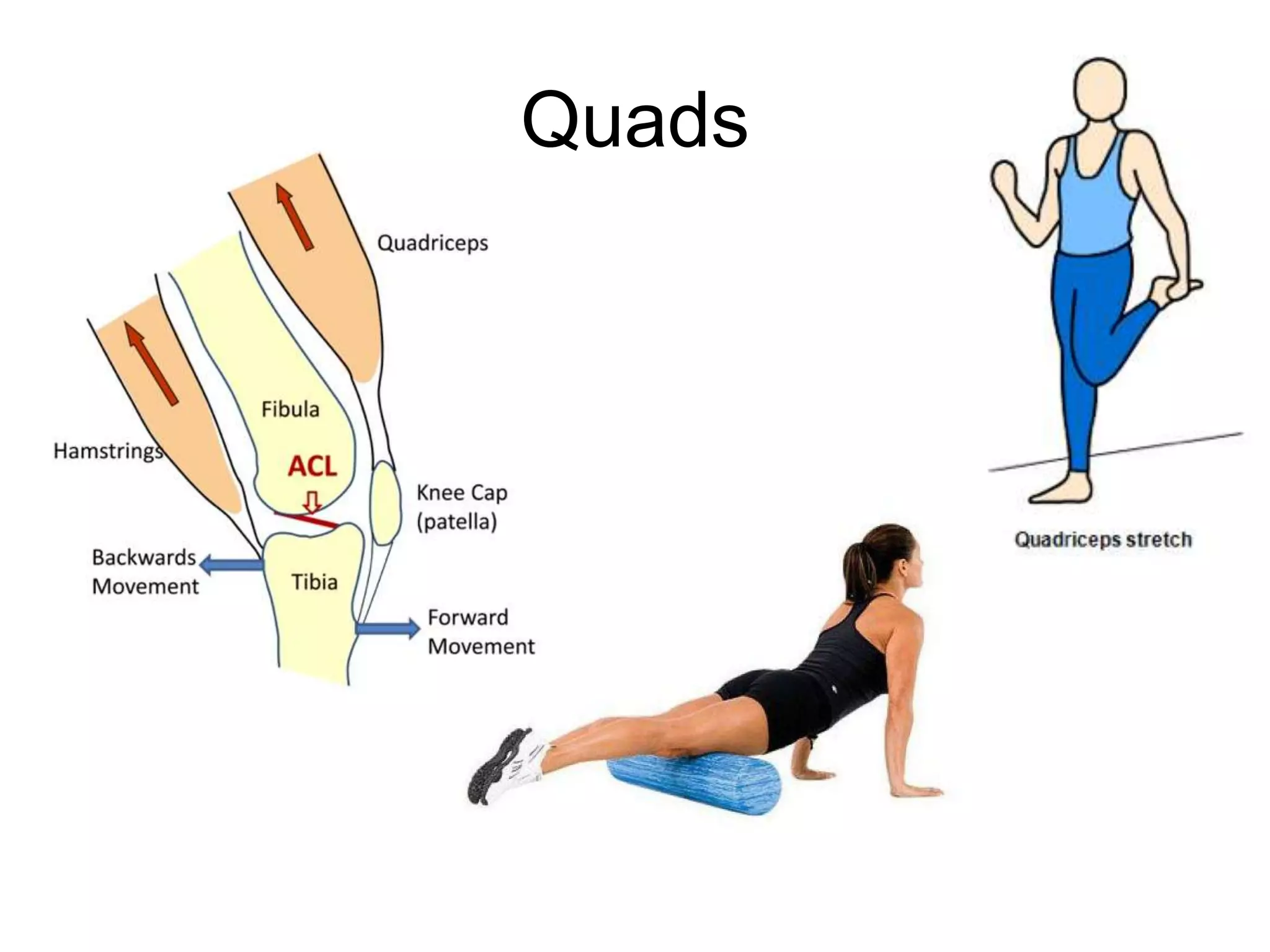
Quads
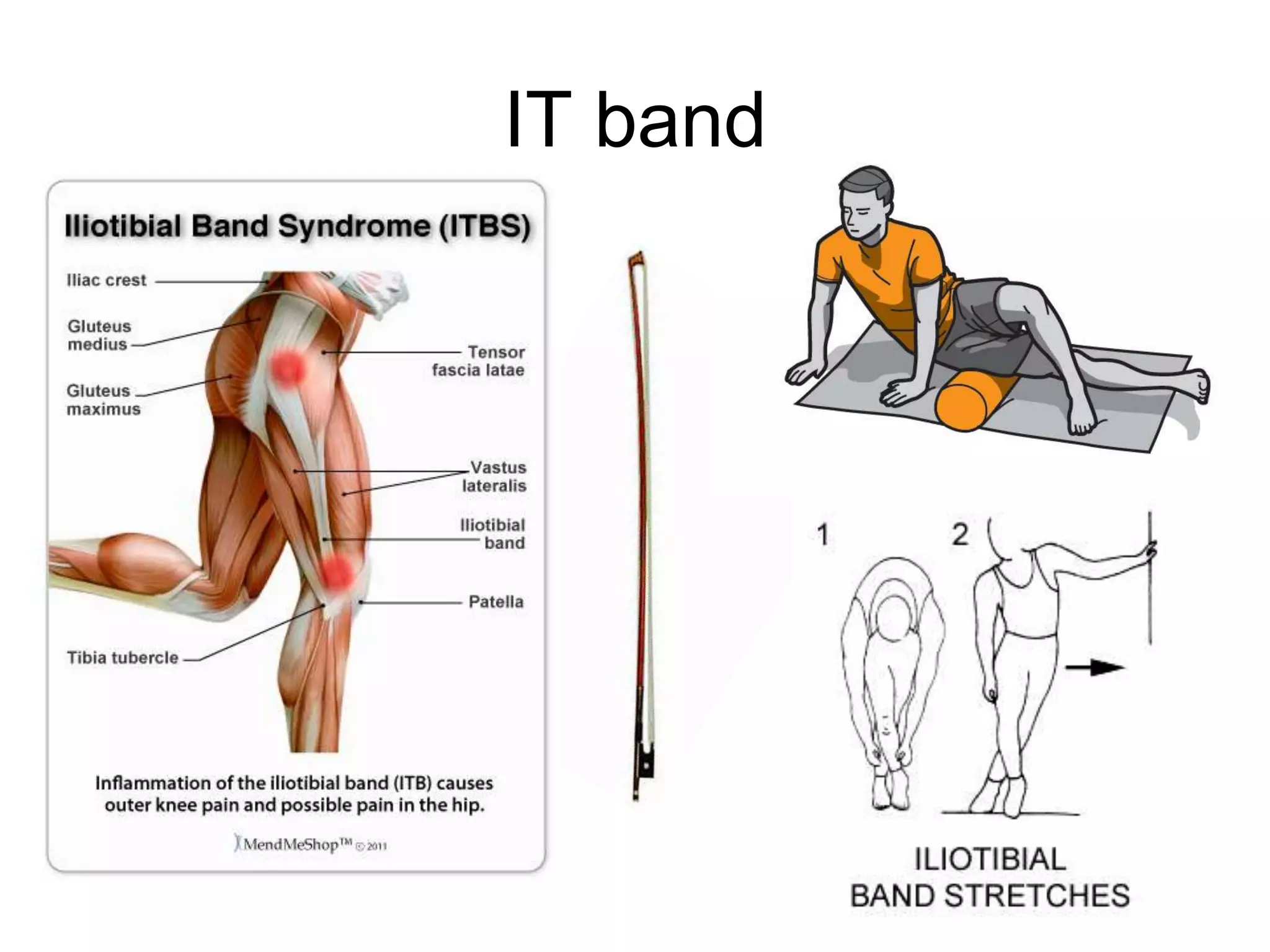
IT band
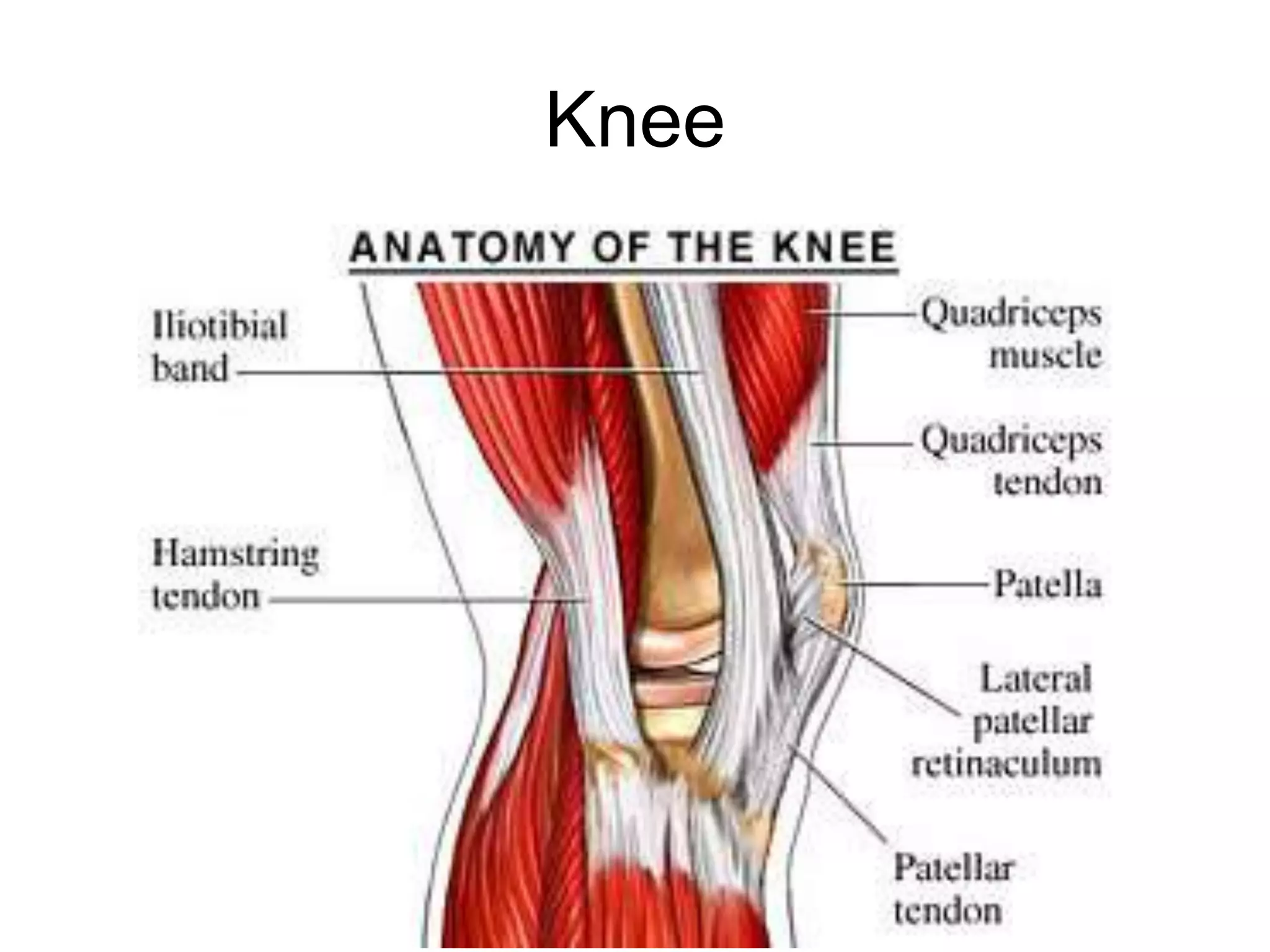
Knee
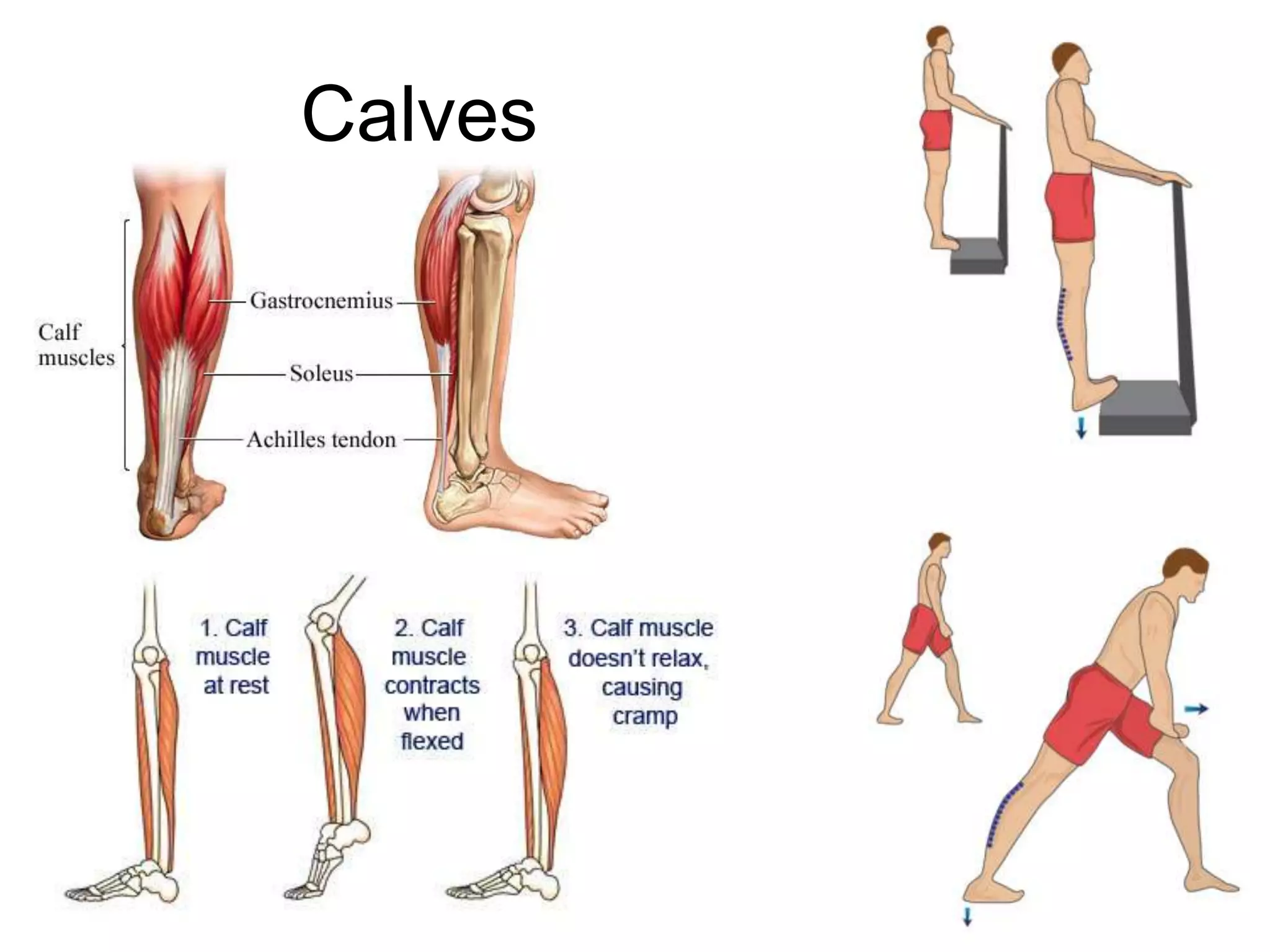
Calves
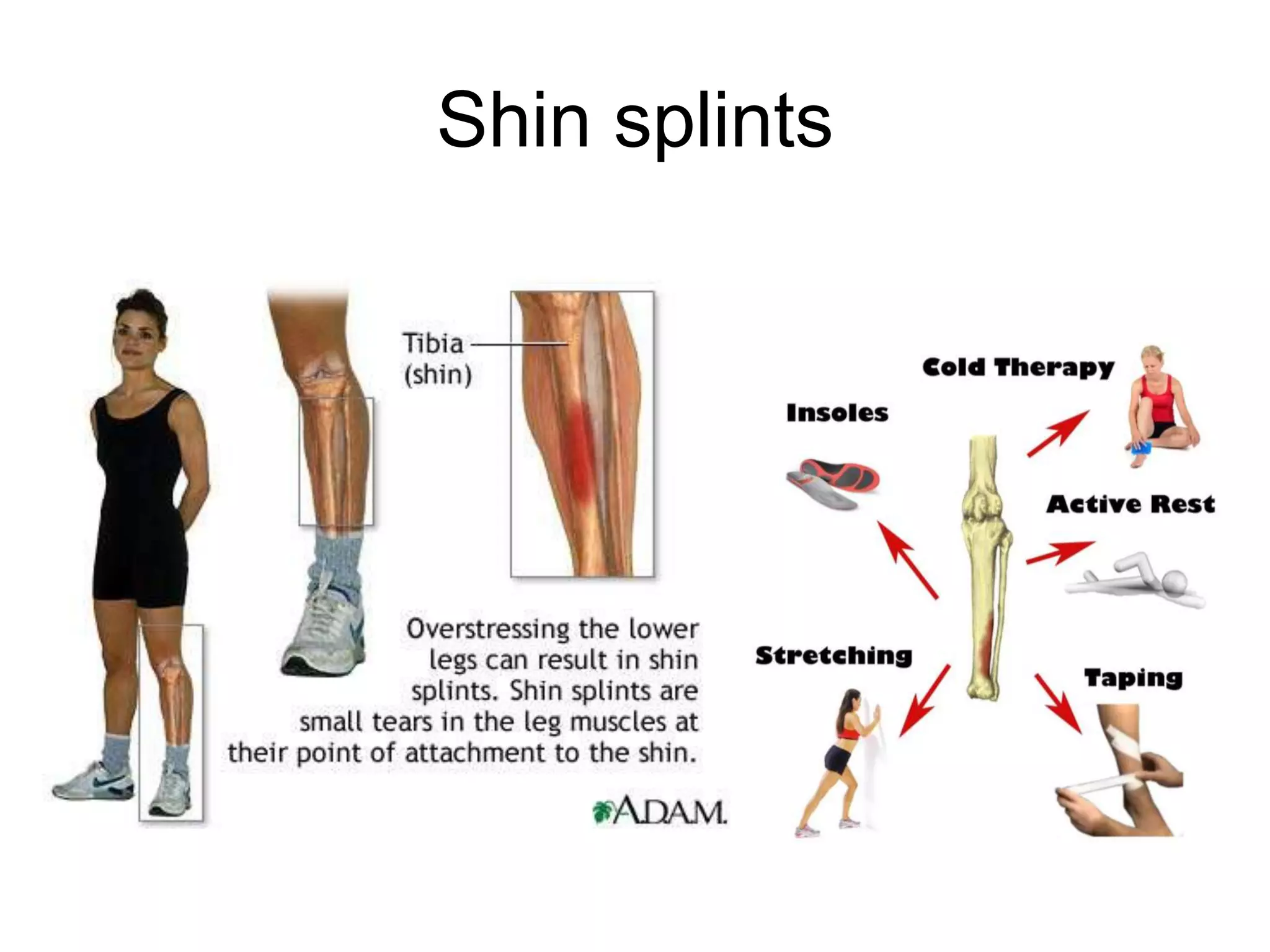
Shin splints
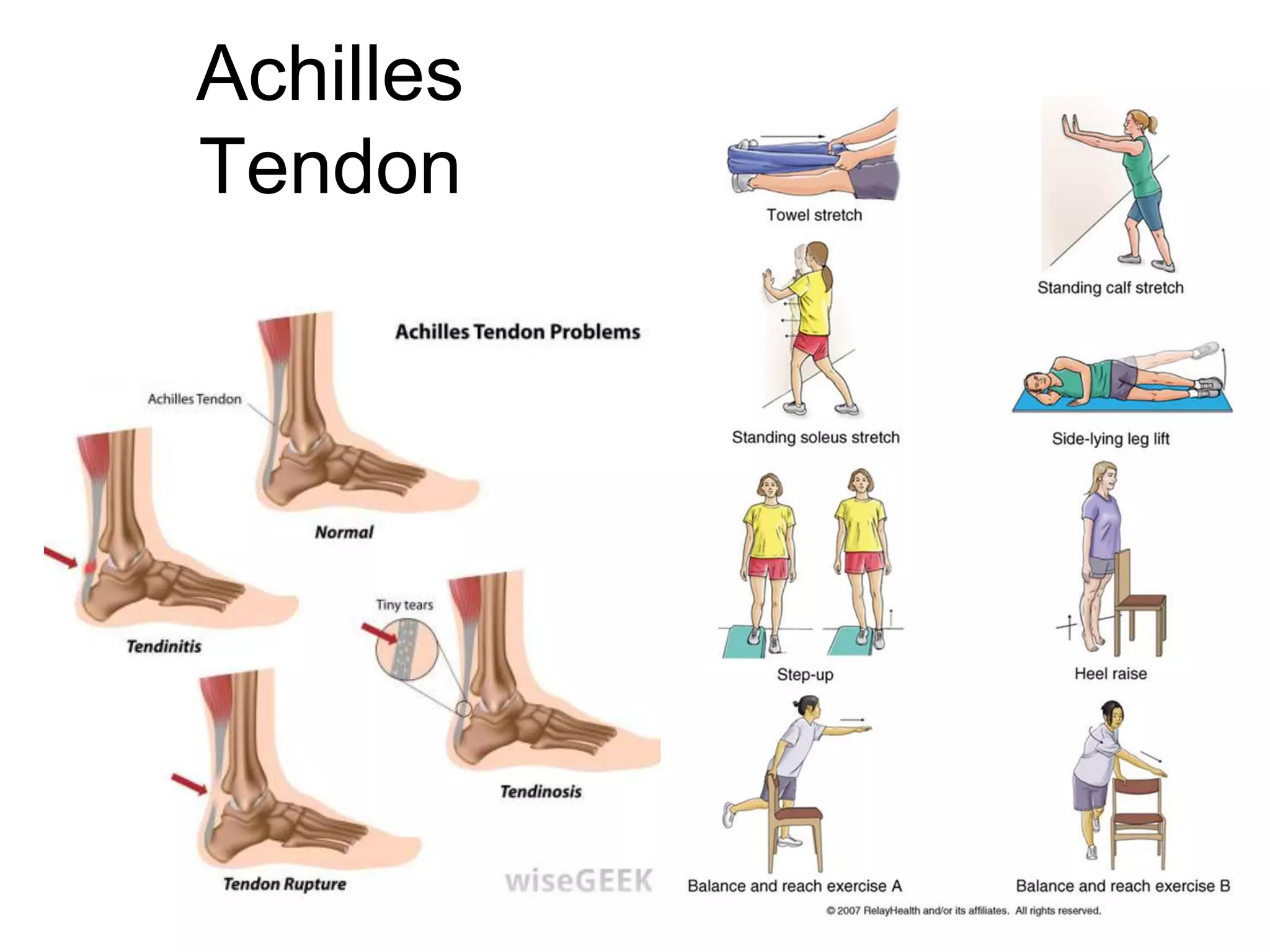
Achilles
Tendon
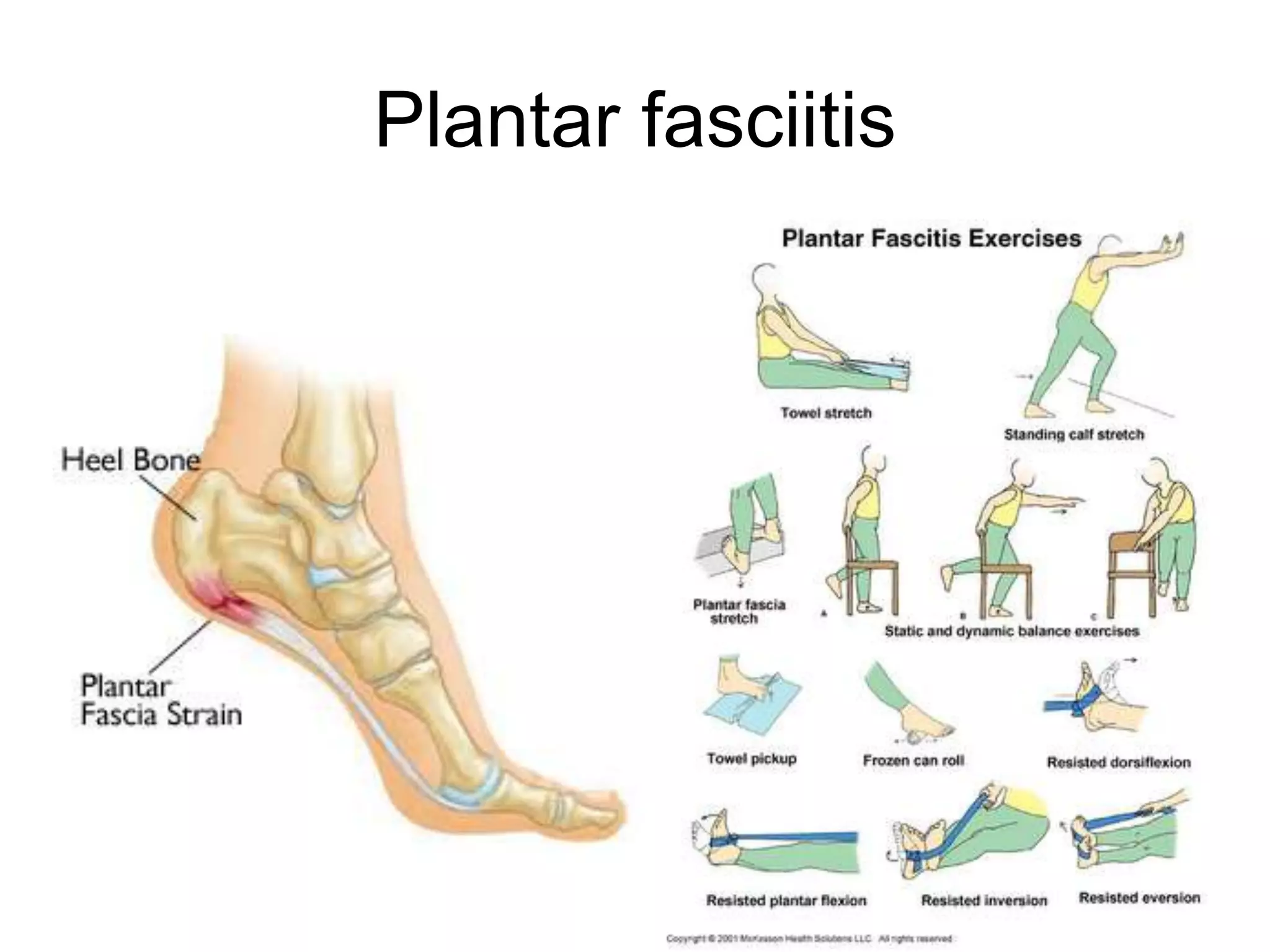
Plantar fasciitis
4 strength and flexibility

4 strength and flexibility

  • 1.
    Strength and Flexibility •Strength – Theory – Muscles used in each sport – Core conditioning • Flexibility – Dynamic stretching – Static stretching • Does it matter?
  • 2.
    Strength Training Misconceptions • Addsbulk (makes me look like Arnold) • Does not translate to endurance sports • No time to add 4th type of workout
  • 3.
    Benefits of ResistanceTraining • Supplements normal training 5-10% (30-50 minutes a week) • Focus on gaining functional power not size • Stimulates hormone production that can be damaged from endurance training – Increases HGH, testosterone • Helps repair tissues, build muscle, lose fat, anti-inflammatory • Recruit muscle fibers and strengthen the brain muscle connection. • Improves efficiency • Strengthens tissues and lowers injury risk
  • 4.
    Hypertrophy – responseto stress • Stress muscle • Responds by increasing size of cells. • Requires – Recovery period (rest) – Carbs and protein (4:1)
  • 6.
    Isolated Weight Lifting •Focus on one muscle groups for each lift • Safe and easy to learn • Build strength – Curls, bench press, shrugs
  • 7.
    Functional Exercises • Trainmultiple muscle groups • Use multiple joints • Increase strength, balance, posture and joint stability • Train in tri specific exercise – Squats, lunges, deadlifts, Olympic lifts – Combine simple lifts with stability
  • 8.
    Plyometric • Explosive fullbody movements to increase power and speed • Can also be done on bike and run in short sprints • Dangerous, easy to damage muscles but large benefits • Build slow, have core strength before attempting
  • 9.
    Weight lifting forswimming • Focus: – Shoulders, back, arms • Incline/military press • Lat pull down • Rows – Seated – standing • Pull downs • Raises (front & side)
  • 10.
  • 11.
    Run Muscles • Bikingand Running use the same muscle groups, but use them slightly differently. • Quads - push down in cycling, pull up in running • Hamstrings - pull up in cycling during recover, pull the weight of the lower leg up in running • Gluteal muscles - push down in cycling, work to stabilize the trunk in running • Gastrocnemius (calf muscle) - push the final part of power phase in cycling, push off in running
  • 12.
    Bike/Run Exercise • Isolationexercises – Leg press – Leg extension – Hamstring curls – Calf raises – Adductor/Abductor – Rows – Pushups – Pull-ups • Functional – Squat • Single leg • With dumbbell press – Deadlift – Lunges – Step-ups • Plyometric – Bounding – Box jump – Squat jump
  • 13.
    Core • Standard – Planks –Flutter kicks – Wood chopper – Crunch – Russian twist – Bridge • Advanced – With stability ball circles – Arms above head – One leg/balance ball • Focus on exercise that simulate same motion when swimming, biking, running
  • 14.
    Basic Workout Session 1Session 2 Session 3 Leg Barbell step up Leg Leg press Leg Calf raises Leg Barbell lunge Leg Cable hip adduction Leg Body weight squat Arms Incline dumbbell press Arms Seated curl Arms Dumbbell kickback Arms Dumbbell fly Arms Seated cable row Arms Dumbbell pullover Arms Chin ups Arms Lat pull down Arms Push ups Core Russian twist (med ball) Core Russian twist (med ball) Core Flutter kicks Core Inclined sit up Core Inclined sit up Core Side kicks Core Inverted sit up (med ball) Core Inverted sit up (med ball) Core Physioball plank Core ½ stability ball lunges Core ½ stability ball lunges Core Side bridge
  • 15.
    Functional Workout Session 1Build stability Session 2 Build power Full body One legged squat Full body Overhead squat/ or squat press Full body lunge with dumbbell press or curl Full body Deadlift(single or double leg) Full Body Turkish get-up Arms Curl press Core Woodchopper with stability ball or one leg Core Plank on stability ball (both direction circles)
  • 16.
    Plyometric Workout Session 1Session 2 Upper body Push up with hand clap Leg Lateral hurdling Leg Squat jump Leg Bounding Leg Lateral jump Leg/core Tuck jump Core Side throw (med ball) leg Split leg jump Core Slam (med ball) Core/upper body Overhead throw (med ball)
  • 17.
    To avoid injuries 1.Start with good form 2. Dynamic warm-ups 3. Strength training 4. Static stretches
  • 18.
    Dynamic Stretching • Warm-up •May or may not: – Increase blood flow and temperature – Increase range of motion – Loosen muscles – Prevent injuries – Balance
  • 19.
    Static Stretching • Controversial –Can decrease strength 5-10% for 1-2 hours afterwards. • Less likely than dynamic stretching to help – Recover from injuries – Loosen muscles – Increase range of motion • Flexible on bike, aero • Balance on run, relaxed • Feels good http://www.docstoc.com/docs/92705934/Dy namic-vs-Static-Stretching
  • 20.
    Meta-analysis of 106 studies. Takehome, keep static stretches < 45 seconds.
  • 21.
    Eur J ApplPhysiol, 2011 Static Stretching (40 studies) Dynamic Stretching (7 studies) Take home: Hold static stretches <30 seconds Repeat dynamic stretches >60 seconds
  • 22.
    Cool down • Rightaway – If doing intervals, go easy 5-10 minutes. – Lay next to wall, legs up against wall. 5-10 minutes. – Swing legs to loosen hips – Compression socks • 2-6 hours after – Static stretches, hold for less than 30 seconds
  • 23.
  • 24.
  • 25.
  • 26.
  • 27.
  • 28.
  • 29.
  • 30.
  • 31.
  • 32.