Athlete Profile
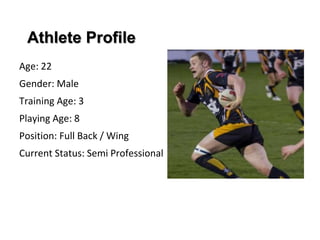
Age: 22
Gender: Male
Training Age: 3
Playing Age: 8
Position: Full Back / Wing
Current Status: Semi Professional
Needs analysis (Sport)
•80 Minute intermittent contact sport
▪ Places high demands on the anaerobic and aerobic energy
systems. (Gabbett, 2002, Appleby, 2012)
▪ Requires high levels of acceleration, agility, muscular strength and
power along with maximal aerobic power. (Gabbett et al, 2008)
•Up to 10,000m can be covered (Meir et al., 2001)
▪ Including walking, jogging, sprinting deceleration and change of
direction.
▪ Backs typically covering more distance than forwards. (Brewer et al,
1995; Meir et al, 1993, Mclellan et al, 2011)
Needs Analysis (Sport)
•Up to 40 tackles per game (Brewer & Davis, 1995)
▪ Repeated high force generation and acceptance.
•Average of 35 sprints per game (Gabbett, 2011)
▪ Majority being <20m
▪ Greater repeated sprint ability = more time performing high speed
running.
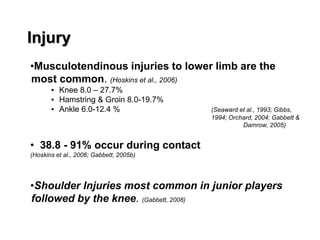
Injury
•Musculotendinous injuries to lower limb are the
most common. (Hoskins et al., 2006)
▪ Knee 8.0 – 27.7%
▪ Hamstring & Groin 8.0-19.7%
▪ Ankle 6.0-12.4 % (Seaward et al., 1993; Gibbs,
1994; Orchard, 2004; Gabbett &
Damrow, 2005)
• 38.8 - 91% occur during contact
(Hoskins et al., 2006; Gabbett, 2005b)
•Shoulder Injuries most common in junior players
followed by the knee. (Gabbett, 2008)
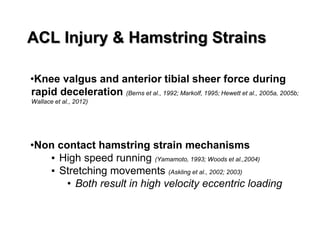
ACL Injury & Hamstring Strains
•Knee valgus and anterior tibial sheer force during
rapid deceleration (Berns et al., 1992; Markolf, 1995; Hewett et al., 2005a, 2005b;
Wallace et al., 2012)
•Non contact hamstring strain mechanisms
▪ High speed running (Yamamoto, 1993; Woods et al.,2004)
▪ Stretching movements (Askling et al., 2002; 2003)
• Both result in high velocity eccentric loading
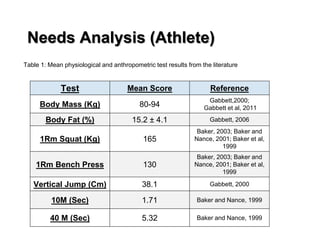
Needs Analysis (Athlete)
Test Mean Score Reference
Body Mass (Kg) 80-94
Gabbett,2000;
Gabbett et al, 2011
Body Fat (%) 15.2 ± 4.1 Gabbett, 2006
1Rm Squat (Kg) 165
Baker, 2003; Baker and
Nance, 2001; Baker et al,
1999
1Rm Bench Press 130
Baker, 2003; Baker and
Nance, 2001; Baker et al,
1999
Vertical Jump (Cm) 38.1 Gabbett, 2000
10M (Sec) 1.71 Baker and Nance, 1999
40 M (Sec) 5.32 Baker and Nance, 1999
Table 1: Mean physiological and anthropometric test results from the literature
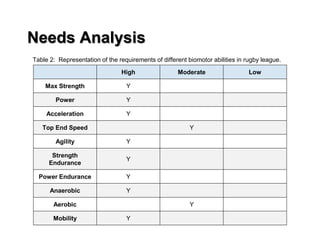
Needs Analysis
High Moderate Low
Max Strength Y
Power Y
Acceleration Y
Top End Speed Y
Agility Y
Strength
Endurance
Y
Power Endurance Y
Anaerobic Y
Aerobic Y
Mobility Y
Table 2: Representation of the requirements of different biomotor abilities in rugby league.
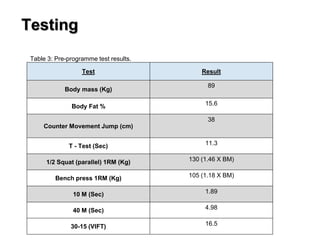
Testing
Test Result
Body mass (Kg)
89
Body Fat % 15.6
Counter Movement Jump (cm)
38
T - Test (Sec) 11.3
1/2 Squat (parallel) 1RM (Kg) 130 (1.46 X BM)
Bench press 1RM (Kg) 105 (1.18 X BM)
10 M (Sec) 1.89
40 M (Sec) 4.98
30-15 (VIFT) 16.5
Table 3: Pre-programme test results.
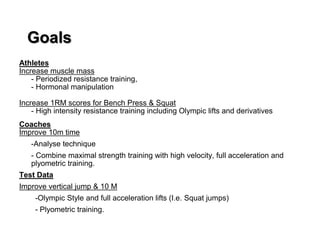
Goals
Athletes
Increase muscle mass
- Periodized resistance training,
- Hormonal manipulation
Increase 1RM scores for Bench Press & Squat
- High intensity resistance training including Olympic lifts and derivatives
Coaches
Improve 10m time
-Analyse technique
- Combine maximal strength training with high velocity, full acceleration and
plyometric training.
Test Data
Improve vertical jump & 10 M
-Olympic Style and full acceleration lifts (I.e. Squat jumps)
- Plyometric training.
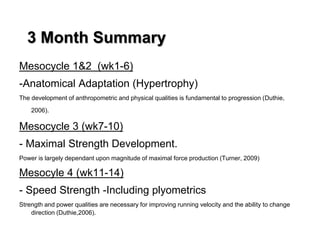
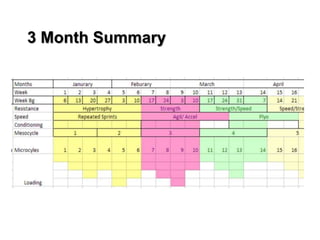
3 Month Summary
Mesocycle 1&2 (wk1-6)
-Anatomical Adaptation (Hypertrophy)
The development of anthropometric and physical qualities is fundamental to progression (Duthie,
2006).
Mesocycle 3 (wk7-10)
- Maximal Strength Development.
Power is largely dependant upon magnitude of maximal force production (Turner, 2009)
Mesocyle 4 (wk11-14)
- Speed Strength -Including plyometrics
Strength and power qualities are necessary for improving running velocity and the ability to change
direction (Duthie,2006).
3 Month Summary
Implementation
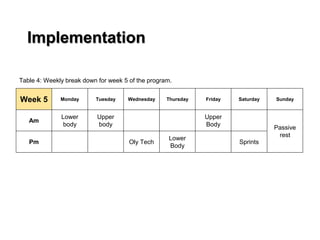
Table 4: Weekly break down for week 5 of the program.
Week 5 Monday Tuesday Wednesday Thursday Friday Saturday Sunday
Am
Lower
body
Upper
body
Upper
Body
Passive
rest
Pm Oly Tech
Lower
Body
Sprints
Implementation
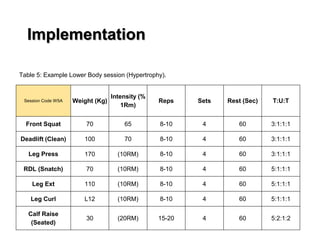
Session Code W5A Weight (Kg)
Intensity (%
1Rm)
Reps Sets Rest (Sec) T:U:T
Front Squat 70 65 8-10 4 60 3:1:1:1
Deadlift (Clean) 100 70 8-10 4 60 3:1:1:1
Leg Press 170 (10RM) 8-10 4 60 3:1:1:1
RDL (Snatch) 70 (10RM) 8-10 4 60 5:1:1:1
Leg Ext 110 (10RM) 8-10 4 60 5:1:1:1
Leg Curl L12 (10RM) 8-10 4 60 5:1:1:1
Calf Raise
(Seated)
30 (20RM) 15-20 4 60 5:2:1:2
Table 5: Example Lower Body session (Hypertrophy).
Implementation
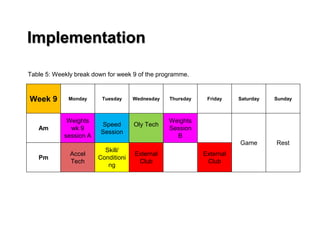
Week 9 Monday Tuesday Wednesday Thursday Friday Saturday Sunday
Am
Weights
wk 9
session A
Speed
Session
Oly Tech
Weights
Session
B
Game Rest
Pm
Accel
Tech
Skill/
Conditioni
ng
External
Club
External
Club
Table 5: Weekly break down for week 9 of the programme.
Implementation
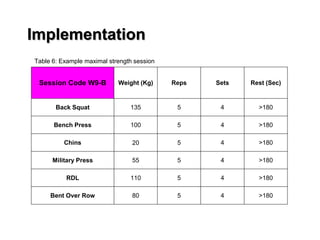
Session Code W9-B Weight (Kg) Reps Sets Rest (Sec)
Back Squat 135 5 4 >180
Bench Press 100 5 4 >180
Chins 20 5 4 >180
Military Press 55 5 4 >180
RDL 110 5 4 >180
Bent Over Row 80 5 4 >180
Table 6: Example maximal strength session
Implementation
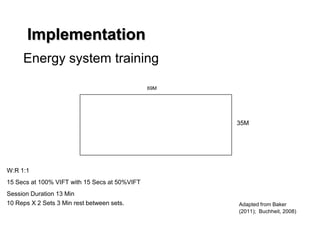
Energy system training
Adapted from Baker
(2011); Buchheit, 2008)
69M
35M
W:R 1:1
15 Secs at 100% VIFT with 15 Secs at 50%VIFT
Session Duration 13 Min
10 Reps X 2 Sets 3 Min rest between sets.
Implementation
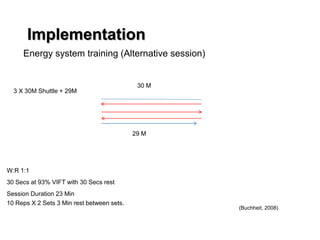
Energy system training (Alternative session)
(Buchheit, 2008)
W:R 1:1
30 Secs at 93% VIFT with 30 Secs rest
Session Duration 23 Min
10 Reps X 2 Sets 3 Min rest between sets.
30 M
29 M
3 X 30M Shuttle + 29M
Implementation
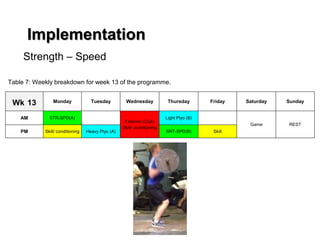
Strength – Speed
Wk 13 Monday Tuesday Wednesday Thursday Friday Saturday Sunday
AM STR-SPD(A)
External (Club)
Skill/ conditioning
Light Plyo (B)
Game REST
PM Skill/ conditioning Heavy Plyo (A) SRT-SPD(B) Skill
Table 7: Weekly breakdown for week 13 of the programme.
Implementation
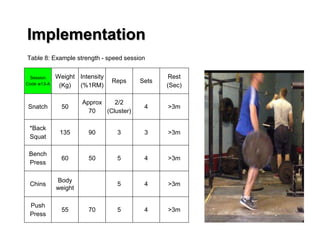
Session
Code w13-A
Weight
(Kg)
Intensity
(%1RM)
Reps Sets
Rest
(Sec)
Snatch 50
Approx
70
2/2
(Cluster)
4 >3m
*Back
Squat
135 90 3 3 >3m
Bench
Press
60 50 5 4 >3m
Chins
Body
weight
5 4 >3m
Push
Press
55 70 5 4 >3m
Table 8: Example strength - speed session
Implementation
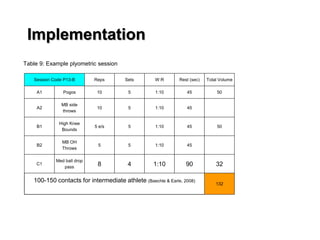
Session Code P13-B Reps Sets W:R Rest (sec) Total Volume
A1 Pogos 10 5 1:10 45 50
A2
MB side
throws
10 5 1:10 45
B1
High Knee
Bounds
5 e/s 5 1:10 45 50
B2
MB OH
Throws
5 5 1:10 45
C1
Med ball drop
pass
8 4 1:10 90 32
100-150 contacts for intermediate athlete (Baechle & Earle, 2008)
132
Table 9: Example plyometric session
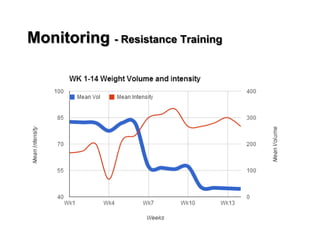
Monitoring - Resistance Training
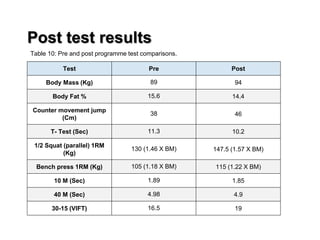
Post test results
Test Pre Post
Body Mass (Kg) 89 94
Body Fat % 15.6 14.4
Counter movement jump
(Cm)
38 46
T- Test (Sec) 11.3 10.2
1/2 Squat (parallel) 1RM
(Kg)
130 (1.46 X BM) 147.5 (1.57 X BM)
Bench press 1RM (Kg) 105 (1.18 X BM) 115 (1.22 X BM)
10 M (Sec) 1.89 1.85
40 M (Sec) 4.98 4.9
30-15 (VIFT) 16.5 19
Table 10: Pre and post programme test comparisons.
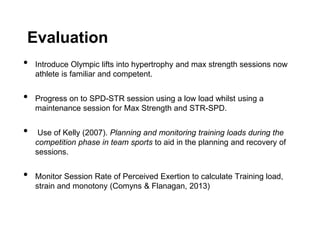
Evaluation
• Introduce Olympic lifts into hypertrophy and max strength sessions now
athlete is familiar and competent.
• Progress on to SPD-STR session using a low load whilst using a
maintenance session for Max Strength and STR-SPD.
• Use of Kelly (2007). Planning and monitoring training loads during the
competition phase in team sports to aid in the planning and recovery of
sessions.
• Monitor Session Rate of Perceived Exertion to calculate Training load,
strain and monotony (Comyns & Flanagan, 2013)
References
• Appleby B, newton RU, and cormie P. Changes in strength over a 2-year period in professional rugby union players. J strength cond res
26: 2538–2546, 2012.
• Baker, d. (2011). Recent trends in high intensity aerobic training for field sports. UK strength and conditioning association journal.
2011,22:3-8
• Baker D, nance S. The relation between running speed and measures of strength and power in professional rugby league players. J
strength cond res 1999;13:230–5.
• Baechle, t. R., & Earle, r. W. (2008). Essentials of strength training and conditioning. Champaign, IL, human kinetics
• Brewer, J. And J. Davis, applied physiology of rugby league. Sports medicine, 1995. 20(3): p. 129-138.
• Buchheit m, laursen pb, kuhnle j, et al. Game-based training in young elite handball players. Int J sports med 2009;30:251–258.
• Buchheit m: the 30-15 intermittent fitness test: accuracy for individualizing interval training 151 of young of young intermittent sport
players. J strength cond res. 2008; 22:365-374.
• Comyns, t., & Flanagan, e. P. (2013). Applications of the session rating of perceived exertion system in professional rugby union. Strength
and conditioning journal. 35, 78-85.
• Duthie gm. (2006). A framework for the physical development of elite rugby union players. International journal of sports physiology and
performance. 1, 2-13.
• Fleck, s. J., & Kraemer, w. J. (2004). Designing resistance training programs. Champaign, IL, human kinetics.
• Gabbett, t.J. (2002). Training injuries in rugby league: an evaluation of skill-based conditioning games. Journal of strength and
conditioning research. 16 (2): 236-41.
• Gabbett tj, jenkins dg, & abernethy b. (2012). Physical demands of professional rugby league training and competition using
microtechnology. Journal of science and medicine in sport / sports medicine australia. 15, 80-6.
• Gabbett t, king t and jenkins d. 2008. Applied physiology of rugby league. Sports med 38(2) pp 119 – 138
References
•Gabbett TJ. A comparison of physiological and anthropometric characteristics among playing positions in sub-elite rugby league players.
J Sports Sci 2006; 24: 1273-80
•GABBETT, T. (2002). Physiological characteristics of junior and senior rugby league players. BMJ Group.
http://www.ncbi.nlm.nih.gov/pmc/articles/PMC1724544.
•Gabbett TJ. Physiological and anthropometric characteristics of amateur rugby league players. Br J Sports Med 2000; 34: 303-7
• GABBETT T.J., JENKINS D.G., & ABERNETHY B. (2011). Correlates of tackling ability in highperformance rugby league
players. Journal of Strength and Conditioning Research. 25, 72-79
• MCLELLAN CP, LOVELL DI, & GASS GC. (2011). Performance analysis of elite Rugby League match play using global positioning
systems. Journal of Strength and Conditioning Research / National Strength & Conditioning Association. 25, 1703-10.
• Meir, R., D. Arthur, and M. Forrest, Time and motion analysis of professional rugby league: a case study. Strength and Conditioning
Coach, 1993. 3(1): p. 24-29.
• OPAR, DAVID A., WILLIAMS, MORGAN, TIMMINS, RYAN, HICKEY, JACK, DUHIG, STEVEN, & SHIELD, ANTHONY.
(2014). Eccentric hamstring strength and hamstring injury risk in Australian footballers. American College of Sports Medicine.
http://eprints.qut.edu.au/75526/.
• Hill-Haas S, Coutts AJ, Dawson B, et al. Generic vs small-sided game training in soccer. Int J Sports Med 2009;30:636–642.
• Hori N. & Stone M. 2005. Weightlifting Exercises Enhance Athletic Performance That Requires High Load Speed Strength. Strength
and Conditioning Journal Vol 27 (4) pp 50 – 55
• Impellizzeri FM, Marcora SM, Castagna C, et al. Physiological and performance effects of generic versus specific aerobic training in
soccer players. Int J Sports Med 2006;27:483–492.
• Komi PV, Kaneko M, Aura O. EMG activity of leg extensor muscles with special reference to mechanical efficiency in concentric and
eccentric exercise. Int J Sports Med. 1987; 8(Suppl):22–9
• King, D.A., Jenkins, D., Gabbett, T.J. (2009). A time–motion analysis of professional rugby league match-play.Journal of Sports
Sciences, 27(3): 213–219.
References
• KELLY, V. (2007). Planning and monitoring training loads during the competition phase in team sports. [Beenleigh, Qld.], The
Association.
• Turner, A. (2009) Training for power: Principles and Practice, UK strength and conditioning association journal, 2009:14: p.20-32

Strength and conditioning case study

  • 2.
    Athlete Profile Age: 22 Gender:Male Training Age: 3 Playing Age: 8 Position: Full Back / Wing Current Status: Semi Professional
  • 3.
    Needs analysis (Sport) •80Minute intermittent contact sport ▪ Places high demands on the anaerobic and aerobic energy systems. (Gabbett, 2002, Appleby, 2012) ▪ Requires high levels of acceleration, agility, muscular strength and power along with maximal aerobic power. (Gabbett et al, 2008) •Up to 10,000m can be covered (Meir et al., 2001) ▪ Including walking, jogging, sprinting deceleration and change of direction. ▪ Backs typically covering more distance than forwards. (Brewer et al, 1995; Meir et al, 1993, Mclellan et al, 2011)
  • 4.
    Needs Analysis (Sport) •Upto 40 tackles per game (Brewer & Davis, 1995) ▪ Repeated high force generation and acceptance. •Average of 35 sprints per game (Gabbett, 2011) ▪ Majority being <20m ▪ Greater repeated sprint ability = more time performing high speed running.
  • 5.
    Injury •Musculotendinous injuries tolower limb are the most common. (Hoskins et al., 2006) ▪ Knee 8.0 – 27.7% ▪ Hamstring & Groin 8.0-19.7% ▪ Ankle 6.0-12.4 % (Seaward et al., 1993; Gibbs, 1994; Orchard, 2004; Gabbett & Damrow, 2005) • 38.8 - 91% occur during contact (Hoskins et al., 2006; Gabbett, 2005b) •Shoulder Injuries most common in junior players followed by the knee. (Gabbett, 2008)
  • 6.
    ACL Injury &Hamstring Strains •Knee valgus and anterior tibial sheer force during rapid deceleration (Berns et al., 1992; Markolf, 1995; Hewett et al., 2005a, 2005b; Wallace et al., 2012) •Non contact hamstring strain mechanisms ▪ High speed running (Yamamoto, 1993; Woods et al.,2004) ▪ Stretching movements (Askling et al., 2002; 2003) • Both result in high velocity eccentric loading
  • 7.
    Needs Analysis (Athlete) TestMean Score Reference Body Mass (Kg) 80-94 Gabbett,2000; Gabbett et al, 2011 Body Fat (%) 15.2 ± 4.1 Gabbett, 2006 1Rm Squat (Kg) 165 Baker, 2003; Baker and Nance, 2001; Baker et al, 1999 1Rm Bench Press 130 Baker, 2003; Baker and Nance, 2001; Baker et al, 1999 Vertical Jump (Cm) 38.1 Gabbett, 2000 10M (Sec) 1.71 Baker and Nance, 1999 40 M (Sec) 5.32 Baker and Nance, 1999 Table 1: Mean physiological and anthropometric test results from the literature
  • 8.
    Needs Analysis High ModerateLow Max Strength Y Power Y Acceleration Y Top End Speed Y Agility Y Strength Endurance Y Power Endurance Y Anaerobic Y Aerobic Y Mobility Y Table 2: Representation of the requirements of different biomotor abilities in rugby league.
  • 9.
    Testing Test Result Body mass(Kg) 89 Body Fat % 15.6 Counter Movement Jump (cm) 38 T - Test (Sec) 11.3 1/2 Squat (parallel) 1RM (Kg) 130 (1.46 X BM) Bench press 1RM (Kg) 105 (1.18 X BM) 10 M (Sec) 1.89 40 M (Sec) 4.98 30-15 (VIFT) 16.5 Table 3: Pre-programme test results.
  • 10.
    Goals Athletes Increase muscle mass -Periodized resistance training, - Hormonal manipulation Increase 1RM scores for Bench Press & Squat - High intensity resistance training including Olympic lifts and derivatives Coaches Improve 10m time -Analyse technique - Combine maximal strength training with high velocity, full acceleration and plyometric training. Test Data Improve vertical jump & 10 M -Olympic Style and full acceleration lifts (I.e. Squat jumps) - Plyometric training.
  • 11.
    3 Month Summary Mesocycle1&2 (wk1-6) -Anatomical Adaptation (Hypertrophy) The development of anthropometric and physical qualities is fundamental to progression (Duthie, 2006). Mesocycle 3 (wk7-10) - Maximal Strength Development. Power is largely dependant upon magnitude of maximal force production (Turner, 2009) Mesocyle 4 (wk11-14) - Speed Strength -Including plyometrics Strength and power qualities are necessary for improving running velocity and the ability to change direction (Duthie,2006).
  • 12.
  • 13.
    Implementation Table 4: Weeklybreak down for week 5 of the program. Week 5 Monday Tuesday Wednesday Thursday Friday Saturday Sunday Am Lower body Upper body Upper Body Passive rest Pm Oly Tech Lower Body Sprints
  • 14.
    Implementation Session Code W5AWeight (Kg) Intensity (% 1Rm) Reps Sets Rest (Sec) T:U:T Front Squat 70 65 8-10 4 60 3:1:1:1 Deadlift (Clean) 100 70 8-10 4 60 3:1:1:1 Leg Press 170 (10RM) 8-10 4 60 3:1:1:1 RDL (Snatch) 70 (10RM) 8-10 4 60 5:1:1:1 Leg Ext 110 (10RM) 8-10 4 60 5:1:1:1 Leg Curl L12 (10RM) 8-10 4 60 5:1:1:1 Calf Raise (Seated) 30 (20RM) 15-20 4 60 5:2:1:2 Table 5: Example Lower Body session (Hypertrophy).
  • 15.
    Implementation Week 9 MondayTuesday Wednesday Thursday Friday Saturday Sunday Am Weights wk 9 session A Speed Session Oly Tech Weights Session B Game Rest Pm Accel Tech Skill/ Conditioni ng External Club External Club Table 5: Weekly break down for week 9 of the programme.
  • 16.
    Implementation Session Code W9-BWeight (Kg) Reps Sets Rest (Sec) Back Squat 135 5 4 >180 Bench Press 100 5 4 >180 Chins 20 5 4 >180 Military Press 55 5 4 >180 RDL 110 5 4 >180 Bent Over Row 80 5 4 >180 Table 6: Example maximal strength session
  • 17.
    Implementation Energy system training Adaptedfrom Baker (2011); Buchheit, 2008) 69M 35M W:R 1:1 15 Secs at 100% VIFT with 15 Secs at 50%VIFT Session Duration 13 Min 10 Reps X 2 Sets 3 Min rest between sets.
  • 18.
    Implementation Energy system training(Alternative session) (Buchheit, 2008) W:R 1:1 30 Secs at 93% VIFT with 30 Secs rest Session Duration 23 Min 10 Reps X 2 Sets 3 Min rest between sets. 30 M 29 M 3 X 30M Shuttle + 29M
  • 19.
    Implementation Strength – Speed Wk13 Monday Tuesday Wednesday Thursday Friday Saturday Sunday AM STR-SPD(A) External (Club) Skill/ conditioning Light Plyo (B) Game REST PM Skill/ conditioning Heavy Plyo (A) SRT-SPD(B) Skill Table 7: Weekly breakdown for week 13 of the programme.
  • 20.
    Implementation Session Code w13-A Weight (Kg) Intensity (%1RM) Reps Sets Rest (Sec) Snatch50 Approx 70 2/2 (Cluster) 4 >3m *Back Squat 135 90 3 3 >3m Bench Press 60 50 5 4 >3m Chins Body weight 5 4 >3m Push Press 55 70 5 4 >3m Table 8: Example strength - speed session
  • 21.
    Implementation Session Code P13-BReps Sets W:R Rest (sec) Total Volume A1 Pogos 10 5 1:10 45 50 A2 MB side throws 10 5 1:10 45 B1 High Knee Bounds 5 e/s 5 1:10 45 50 B2 MB OH Throws 5 5 1:10 45 C1 Med ball drop pass 8 4 1:10 90 32 100-150 contacts for intermediate athlete (Baechle & Earle, 2008) 132 Table 9: Example plyometric session
  • 22.
  • 23.
    Post test results TestPre Post Body Mass (Kg) 89 94 Body Fat % 15.6 14.4 Counter movement jump (Cm) 38 46 T- Test (Sec) 11.3 10.2 1/2 Squat (parallel) 1RM (Kg) 130 (1.46 X BM) 147.5 (1.57 X BM) Bench press 1RM (Kg) 105 (1.18 X BM) 115 (1.22 X BM) 10 M (Sec) 1.89 1.85 40 M (Sec) 4.98 4.9 30-15 (VIFT) 16.5 19 Table 10: Pre and post programme test comparisons.
  • 24.
    Evaluation • Introduce Olympiclifts into hypertrophy and max strength sessions now athlete is familiar and competent. • Progress on to SPD-STR session using a low load whilst using a maintenance session for Max Strength and STR-SPD. • Use of Kelly (2007). Planning and monitoring training loads during the competition phase in team sports to aid in the planning and recovery of sessions. • Monitor Session Rate of Perceived Exertion to calculate Training load, strain and monotony (Comyns & Flanagan, 2013)
  • 25.
    References • Appleby B,newton RU, and cormie P. Changes in strength over a 2-year period in professional rugby union players. J strength cond res 26: 2538–2546, 2012. • Baker, d. (2011). Recent trends in high intensity aerobic training for field sports. UK strength and conditioning association journal. 2011,22:3-8 • Baker D, nance S. The relation between running speed and measures of strength and power in professional rugby league players. J strength cond res 1999;13:230–5. • Baechle, t. R., & Earle, r. W. (2008). Essentials of strength training and conditioning. Champaign, IL, human kinetics • Brewer, J. And J. Davis, applied physiology of rugby league. Sports medicine, 1995. 20(3): p. 129-138. • Buchheit m, laursen pb, kuhnle j, et al. Game-based training in young elite handball players. Int J sports med 2009;30:251–258. • Buchheit m: the 30-15 intermittent fitness test: accuracy for individualizing interval training 151 of young of young intermittent sport players. J strength cond res. 2008; 22:365-374. • Comyns, t., & Flanagan, e. P. (2013). Applications of the session rating of perceived exertion system in professional rugby union. Strength and conditioning journal. 35, 78-85. • Duthie gm. (2006). A framework for the physical development of elite rugby union players. International journal of sports physiology and performance. 1, 2-13. • Fleck, s. J., & Kraemer, w. J. (2004). Designing resistance training programs. Champaign, IL, human kinetics. • Gabbett, t.J. (2002). Training injuries in rugby league: an evaluation of skill-based conditioning games. Journal of strength and conditioning research. 16 (2): 236-41. • Gabbett tj, jenkins dg, & abernethy b. (2012). Physical demands of professional rugby league training and competition using microtechnology. Journal of science and medicine in sport / sports medicine australia. 15, 80-6. • Gabbett t, king t and jenkins d. 2008. Applied physiology of rugby league. Sports med 38(2) pp 119 – 138
  • 26.
    References •Gabbett TJ. Acomparison of physiological and anthropometric characteristics among playing positions in sub-elite rugby league players. J Sports Sci 2006; 24: 1273-80 •GABBETT, T. (2002). Physiological characteristics of junior and senior rugby league players. BMJ Group. http://www.ncbi.nlm.nih.gov/pmc/articles/PMC1724544. •Gabbett TJ. Physiological and anthropometric characteristics of amateur rugby league players. Br J Sports Med 2000; 34: 303-7 • GABBETT T.J., JENKINS D.G., & ABERNETHY B. (2011). Correlates of tackling ability in highperformance rugby league players. Journal of Strength and Conditioning Research. 25, 72-79 • MCLELLAN CP, LOVELL DI, & GASS GC. (2011). Performance analysis of elite Rugby League match play using global positioning systems. Journal of Strength and Conditioning Research / National Strength & Conditioning Association. 25, 1703-10. • Meir, R., D. Arthur, and M. Forrest, Time and motion analysis of professional rugby league: a case study. Strength and Conditioning Coach, 1993. 3(1): p. 24-29. • OPAR, DAVID A., WILLIAMS, MORGAN, TIMMINS, RYAN, HICKEY, JACK, DUHIG, STEVEN, & SHIELD, ANTHONY. (2014). Eccentric hamstring strength and hamstring injury risk in Australian footballers. American College of Sports Medicine. http://eprints.qut.edu.au/75526/. • Hill-Haas S, Coutts AJ, Dawson B, et al. Generic vs small-sided game training in soccer. Int J Sports Med 2009;30:636–642. • Hori N. & Stone M. 2005. Weightlifting Exercises Enhance Athletic Performance That Requires High Load Speed Strength. Strength and Conditioning Journal Vol 27 (4) pp 50 – 55 • Impellizzeri FM, Marcora SM, Castagna C, et al. Physiological and performance effects of generic versus specific aerobic training in soccer players. Int J Sports Med 2006;27:483–492. • Komi PV, Kaneko M, Aura O. EMG activity of leg extensor muscles with special reference to mechanical efficiency in concentric and eccentric exercise. Int J Sports Med. 1987; 8(Suppl):22–9 • King, D.A., Jenkins, D., Gabbett, T.J. (2009). A time–motion analysis of professional rugby league match-play.Journal of Sports Sciences, 27(3): 213–219.
  • 27.
    References • KELLY, V.(2007). Planning and monitoring training loads during the competition phase in team sports. [Beenleigh, Qld.], The Association. • Turner, A. (2009) Training for power: Principles and Practice, UK strength and conditioning association journal, 2009:14: p.20-32