Driving Innovation


                     Stratified Medicines
                     Innovation Platform

                                Graham Bell
                     Lead Specialist Stratified Medicine
Driving Innovation


    New strategy launched 2011
Driving Innovation

                     Challenge Lead Innovation
Driving Innovation


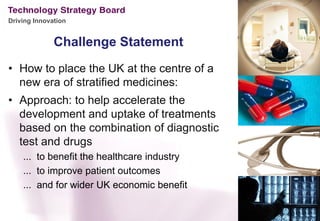
              Challenge Statement
• How to place the UK at the centre of a
  new era of stratified medicines:
• Approach: to help accelerate the
  development and uptake of treatments
  based on the combination of diagnostic
  test and drugs
    ... to benefit the healthcare industry
    ... to improve patient outcomes
    ... and for wider UK economic benefit
Driving Innovation


             Programme Partners
• Technology Strategy Board
• Department of Health
• Scottish Government Health Directorate
• National Institutes for Clinical Excellence
• Medical Research Council
• Cancer Research UK
• Arthritis Research UK
Driving Innovation

 Stratified Medicine Innovation Platform

Together the partners will invest over £200
million over a 5 year period will be invested
to accelerate Stratified Medicine in the UK.

The aim is to bring the government,
researchers and business together in a
major initiative that will place the UK at the
centre of a revolution in the diagnosis and
treatment of disease.
Driving Innovation


                            First calls

   • Tumour Profiling & Data Capture (£5.8m)
       – Working along side CRUK programme
       – Funded 6 projects
   • Inflammatory Biomarkers (£4.3m)
       – Working along side MRC:ABPI programme
       – Funded 4 projects
   • Business Models and Value Systems (£0.9m)
       – Funded three projects
Driving Innovation


          Technology Roadmapping
• Build a UK vision for stratified medicine
    – ..... that the UK can deliver
    – ...... supported by the SMIP and PMG
• Build a community of people who will help
• Take a strategic view of investment options
    – Identify the barriers
    – Programme activity to overcome them
    – Investments in support of the programme activities
Driving Innovation
                                      Vision for 2025
   •   The UK should be the best place to develop, and have adopted, stratified medicine. This will
       benefit patients, provide cost-effective solutions for the NHS and other healthcare providers and
       create opportunities for business


   •   There should be an increased collaborative culture throughout the sector based around shared
       resources, and systems should be in place for effective data collection, sharing, governance and
       use across sectors (including NHS, business, academia, regulators and NICE)


   •   It should be quicker and less expensive to develop new drug-diagnostic combinations and have
       them licensed, and success should be reflected in increased UK economic growth


   •   It should be possible for all NHS patients to be involved in medical research if they wish, including
       through use of patient information and records, in order to inform the next generation of successful
       therapies


   •   There should be a smooth reimbursement process for stratified therapies and diagnostics, and an
       intellectual property (IP) framework that encourages innovation


   •   The UK health system should have established stratified care pathways, and evidence should be
       available to show that patient outcomes are improved where stratified medicine is used
Driving Innovation


                     Key Themes
  • Incentivising adoption
  • Increasing awareness
  • Patient recruitment – consents and ethics
  • Clinical trials
  • Data – collection, management and use
  • Regulation and standards
  • Intellectual property
  • Bio-banks and biomarkers
  • Increasing the impact of R&D investment
Driving Innovation

              Incentivising adoption
  Key message:

  Adoption of products into the healthcare
    system was seen key during the
    workshops.
  There are many activities ongoing in this
    area reflecting it’s importance to both
    Industry and health service
  Sound demonstration of value for money
    for products is seen as the key
    deliverable
Driving Innovation

                Increasing awareness
   Key message:

   Need to develop a sound information
    base and ensure that professionals
    and public are provided with evidence
    and a rational for Stratification.
   For professionals proof of effectiveness
     and value
   For public avoid the message that
     stratification is a form of rationing
Driving Innovation

Patient recruitment – consents and ethics
Key messages:

Often patient consents are restrictive and
  do not allow use in research projects
  beyond the immediate study. Broader
  consents are preferred.
Ethical consideration needs to be given to
  later incidental findings particularly in the
  area of whole genome screening.
Driving Innovation
                     Clinical trials
Key messages:

Delays around identifying the appropriate
 patients and recruiting into trials is one of
 the key bottle necks in development.
 Any systems to pre-identify patient
 cohorts could save significant resource.
New types of trial design will need to be
 discussed and approved by regulatory
 agencies
Driving Innovation

Data – collection, management and use
Key message:

There is a significant quantity of highly
  relevant data already in existence within
  the NHS and in Pharma companies.
  Finding some way to share this data
  appropriately could benefit all.
Will require significant effort in data
 standardisation to enable open sharing.
Driving Innovation

           Regulation and standards
Key message:

Regulation is a key gatekeeper in drug
 development, all products must be safe
 and effective (but how should trials be
 designed to show efficacy in preselected
 groups)
There was a desire for more regulatory
  guidance around both trial design for
  stratified products and in the validation of
  tests and test protocols.
Driving Innovation

                Intellectual property
Key message:

This was raised as a concern by diagnostic
  companies who were concerned that
  “homebrew” tests did not face a level
  playing field.
Quality systems being implemented
 nationally may help to improve this but
 companies would like to see strong IP
 protection for tests.
Driving Innovation

          Bio-banks and biomarkers
   Key messages:

   There is a recognition that access to
     appropriate samples with clinical
     annotation is key and that having linked
     Bio-banks with standardised systems
     would help
   Clarity or standardisation around what
     information is required to “validate” a
     biomarker
Driving Innovation
Increasing the impact of R&D investment
 Key message:

The desire is to increase the impact of
  everyones R&D spend, public, private
  and third sector
There was a widespread acceptance that
  no single organisation could make a
  difference alone. The key is coordinated
  activity in multiple areas simultaneously.
  Only by working together
Driving Innovation


                     Summary

There was a widespread acceptance that
  no single organisation can make a
  significant difference working alone. The
  key is coordinated activity in multiple
  areas simultaneously.
Driving Innovation


                     Where Next?
      Adverse Events and Non-Responders
                      ( up to £7.5m)

• Developing tests to predict risk of suffering
  adverse events, or non response to
  current therapies.
    – Phase 1: Health economic valuation of product
      and impact on clinical care pathway
    – Phase 2: Funding of development of most
      successful projects from phase 1
    – SBRI in partnership with Dept of Health
Driving Innovation


                     Contact details

   • Dr Graham Bell (graham.bell@tsb.gov.uk)
   • Dr Alasdair Gaw (alasdair.gaw@tsb.gov.uk)


   • https://ktn.innovateuk.org/web/stratified-medicines-
     innovation-platform

Stratified Medicines Innovation Platform

  • 1.
    Driving Innovation Stratified Medicines Innovation Platform Graham Bell Lead Specialist Stratified Medicine
  • 2.
    Driving Innovation New strategy launched 2011
  • 3.
    Driving Innovation Challenge Lead Innovation
  • 4.
    Driving Innovation Challenge Statement • How to place the UK at the centre of a new era of stratified medicines: • Approach: to help accelerate the development and uptake of treatments based on the combination of diagnostic test and drugs ... to benefit the healthcare industry ... to improve patient outcomes ... and for wider UK economic benefit
  • 5.
    Driving Innovation Programme Partners • Technology Strategy Board • Department of Health • Scottish Government Health Directorate • National Institutes for Clinical Excellence • Medical Research Council • Cancer Research UK • Arthritis Research UK
  • 6.
    Driving Innovation StratifiedMedicine Innovation Platform Together the partners will invest over £200 million over a 5 year period will be invested to accelerate Stratified Medicine in the UK. The aim is to bring the government, researchers and business together in a major initiative that will place the UK at the centre of a revolution in the diagnosis and treatment of disease.
  • 7.
    Driving Innovation First calls • Tumour Profiling & Data Capture (£5.8m) – Working along side CRUK programme – Funded 6 projects • Inflammatory Biomarkers (£4.3m) – Working along side MRC:ABPI programme – Funded 4 projects • Business Models and Value Systems (£0.9m) – Funded three projects
  • 8.
    Driving Innovation Technology Roadmapping • Build a UK vision for stratified medicine – ..... that the UK can deliver – ...... supported by the SMIP and PMG • Build a community of people who will help • Take a strategic view of investment options – Identify the barriers – Programme activity to overcome them – Investments in support of the programme activities
  • 9.
    Driving Innovation Vision for 2025 • The UK should be the best place to develop, and have adopted, stratified medicine. This will benefit patients, provide cost-effective solutions for the NHS and other healthcare providers and create opportunities for business • There should be an increased collaborative culture throughout the sector based around shared resources, and systems should be in place for effective data collection, sharing, governance and use across sectors (including NHS, business, academia, regulators and NICE) • It should be quicker and less expensive to develop new drug-diagnostic combinations and have them licensed, and success should be reflected in increased UK economic growth • It should be possible for all NHS patients to be involved in medical research if they wish, including through use of patient information and records, in order to inform the next generation of successful therapies • There should be a smooth reimbursement process for stratified therapies and diagnostics, and an intellectual property (IP) framework that encourages innovation • The UK health system should have established stratified care pathways, and evidence should be available to show that patient outcomes are improved where stratified medicine is used
  • 10.
    Driving Innovation Key Themes • Incentivising adoption • Increasing awareness • Patient recruitment – consents and ethics • Clinical trials • Data – collection, management and use • Regulation and standards • Intellectual property • Bio-banks and biomarkers • Increasing the impact of R&D investment
  • 11.
    Driving Innovation Incentivising adoption Key message: Adoption of products into the healthcare system was seen key during the workshops. There are many activities ongoing in this area reflecting it’s importance to both Industry and health service Sound demonstration of value for money for products is seen as the key deliverable
  • 12.
    Driving Innovation Increasing awareness Key message: Need to develop a sound information base and ensure that professionals and public are provided with evidence and a rational for Stratification. For professionals proof of effectiveness and value For public avoid the message that stratification is a form of rationing
  • 13.
    Driving Innovation Patient recruitment– consents and ethics Key messages: Often patient consents are restrictive and do not allow use in research projects beyond the immediate study. Broader consents are preferred. Ethical consideration needs to be given to later incidental findings particularly in the area of whole genome screening.
  • 14.
    Driving Innovation Clinical trials Key messages: Delays around identifying the appropriate patients and recruiting into trials is one of the key bottle necks in development. Any systems to pre-identify patient cohorts could save significant resource. New types of trial design will need to be discussed and approved by regulatory agencies
  • 15.
    Driving Innovation Data –collection, management and use Key message: There is a significant quantity of highly relevant data already in existence within the NHS and in Pharma companies. Finding some way to share this data appropriately could benefit all. Will require significant effort in data standardisation to enable open sharing.
  • 16.
    Driving Innovation Regulation and standards Key message: Regulation is a key gatekeeper in drug development, all products must be safe and effective (but how should trials be designed to show efficacy in preselected groups) There was a desire for more regulatory guidance around both trial design for stratified products and in the validation of tests and test protocols.
  • 17.
    Driving Innovation Intellectual property Key message: This was raised as a concern by diagnostic companies who were concerned that “homebrew” tests did not face a level playing field. Quality systems being implemented nationally may help to improve this but companies would like to see strong IP protection for tests.
  • 18.
    Driving Innovation Bio-banks and biomarkers Key messages: There is a recognition that access to appropriate samples with clinical annotation is key and that having linked Bio-banks with standardised systems would help Clarity or standardisation around what information is required to “validate” a biomarker
  • 19.
    Driving Innovation Increasing theimpact of R&D investment Key message: The desire is to increase the impact of everyones R&D spend, public, private and third sector There was a widespread acceptance that no single organisation could make a difference alone. The key is coordinated activity in multiple areas simultaneously. Only by working together
  • 20.
    Driving Innovation Summary There was a widespread acceptance that no single organisation can make a significant difference working alone. The key is coordinated activity in multiple areas simultaneously.
  • 21.
    Driving Innovation Where Next? Adverse Events and Non-Responders ( up to £7.5m) • Developing tests to predict risk of suffering adverse events, or non response to current therapies. – Phase 1: Health economic valuation of product and impact on clinical care pathway – Phase 2: Funding of development of most successful projects from phase 1 – SBRI in partnership with Dept of Health
  • 22.
    Driving Innovation Contact details • Dr Graham Bell (graham.bell@tsb.gov.uk) • Dr Alasdair Gaw (alasdair.gaw@tsb.gov.uk) • https://ktn.innovateuk.org/web/stratified-medicines- innovation-platform