October 17th, 2017
PATIENTS – SCIENCE – INDUSTRY
Sustaining patient engagement resources - public-private platforms
Derick Mitchell
My Talk
1. IPPOSI?
2. Patient Involvement in Medicines R&D
3. How patient orgs & industry can interact
4. Generating patient-based evidence
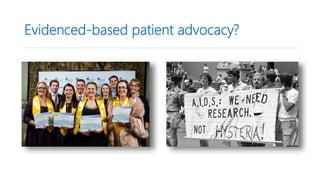
Evidenced-based patient advocacy?
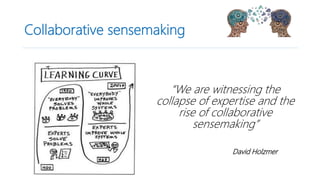
Collaborative sensemaking
“We are witnessing the
collapse of expertise and the
rise of collaborative
sensemaking”
David Holzmer
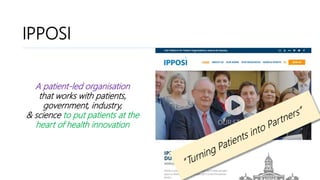
IPPOSI? Who?IPPOSI
A patient-led organisation
that works with patients,
government, industry,
& science to put patients at the
heart of health innovation
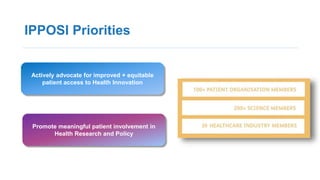
IPPOSI Priorities
20
Actively advocate for improved + equitable
patient access to Health Innovation
Promote meaningful patient involvement in
Health Research and Policy
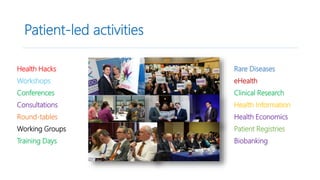
Patient-led activities
Health Hacks
Workshops
Conferences
Consultations
Round-tables
Working Groups
Training Days
Rare Diseases
eHealth
Clinical Research
Health Information
Health Economics
Patient Registries
Biobanking
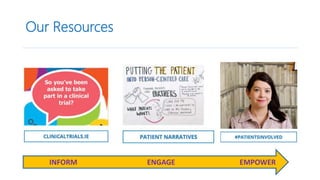
Our Resources
INFORM ENGAGE EMPOWER
Incorporating the patient voice
• Hierarchical Rhetoric
• ‘Walking the walk’ at the highest possible level
Challenges:
• Decision-makers never want to change their processes
• Patients are not trained in health policy, dialogue
• Many patient orgs are not focused on policy/R&D issues
“The perfect is the enemy of the good”
What do patient advocates want re: medicines R&D?
That the patient voice is listened to
• To be involved as early as possible in clinical research design, priority setting, policy
• To improve the quality of clinical research - less wastage
• To ensure better use/reuse of research outputs and tools
• To generate impact and burden data to support the results of the clinical trials
• To use online / ehealth / mobile health apps to generate patient-based evidence
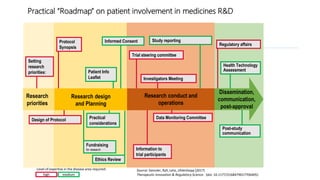
Practical “Roadmap” on patient involvement in medicines R&D
Research design
and Planning
Design of Protocol
Informed Consent Study reporting
Post-study
communication
Patient Info
Leaflet
Trial steering committee
Investigators Meeting
Level of expertise in the disease area required:
mediumhigh
Data Monitoring CommitteePractical
considerations
Health Technology
Assessment
Protocol
Synopsis
Research
priorities
Setting
research
priorities:
Information to
trial participants
Research conduct and
operations
Regulatory affairs
Dissemination,
communication,
post-approval
Source: Geissler, Ryll, Leto, Uhlenhopp (2017)
Therapeutic Innovation & Regulatory Science. (doi: 10.1177/2168479017706405)
Fundraising
for research
Ethics Review
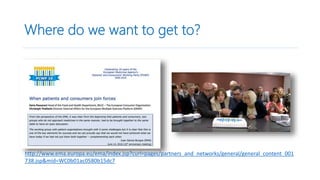
Where do we want to get to?
http://www.ema.europa.eu/ema/index.jsp?curl=pages/partners_and_networks/general/general_content_001
738.jsp&mid=WC0b01ac0580b15dc7
How patients, industry can interact on R&D
• Move from obsessive use of compliance to measuring the
value of interaction
• Look at legislation, regulation, codes of conduct and see what
needs to be changed
• Avoid rhetoric of ‘patient voice’ – not matched by reality
Challenges to interacting
• Lack of Trust
• Lack of mutual learning
• Perceived (or real) legal barriers, conflict of interest
• Silo-thinking, finger-pointing
• Lack of standardized metrics to measure impact and benefits of patient
involvement
• Lack of capacity and training in patient organisations
• Over-compliance
Basic Rules
• Trust and transparency
• All that patient organisations have is their credibility
• They must also be effective and feel trusted
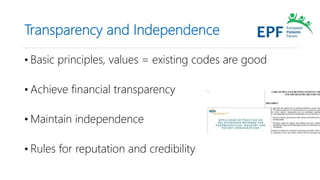
Transparency and Independence
• Basic principles, values = existing codes are good
• Achieve financial transparency
• Maintain independence
• Rules for reputation and credibility
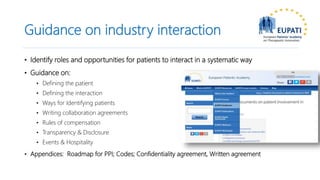
Guidance on industry interaction
• Identify roles and opportunities for patients to interact in a systematic way
• Guidance on:
• Defining the patient
• Defining the interaction
• Ways for Identifying patients
• Writing collaboration agreements
• Rules of compensation
• Transparency & Disclosure
• Events & Hospitality
• Appendices: Roadmap for PPI; Codes; Confidentiality agreement, Written agreement
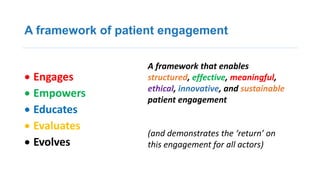
A framework of patient engagement
 Engages
 Empowers
 Educates
 Evaluates
 Evolves
A framework that enables
structured, effective, meaningful,
ethical, innovative, and sustainable
patient engagement
(and demonstrates the ‘return’ on
this engagement for all actors)
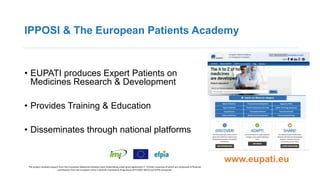
IPPOSI & The European Patients Academy
• EUPATI produces Expert Patients on
Medicines Research & Development
• Provides Training & Education
• Disseminates through national platforms
The project received support from the Innovative Medicines Initiative Joint Undertaking under grant agreement n° 115334, resources of which are composed of financial
contribution from the European Union's Seventh Framework Programme (FP7/2007-2013) and EFPIA companies.
www.eupati.eu
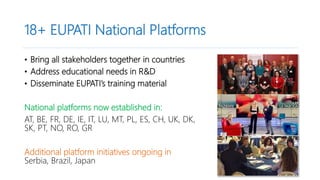
18+ EUPATI National Platforms
• Bring all stakeholders together in countries
• Address educational needs in R&D
• Disseminate EUPATI’s training material
National platforms now established in:
AT, BE, FR, DE, IE, IT, LU, MT, PL, ES, CH, UK, DK,
SK, PT, NO, RO, GR
Additional platform initiatives ongoing in
Serbia, Brazil, Japan
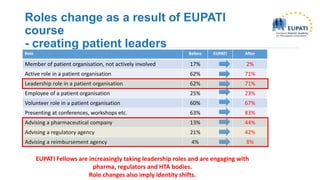
Roles change as a result of EUPATI
course
- creating patient leaders
Role Before EUPATI After
Member of patient organisation, not actively involved 17% 2%
Active role in a patient organisation 62% 71%
Leadership role in a patient organisation 62% 71%
Employee of a patient organisation 25% 23%
Volunteer role in a patient organisation 60% 67%
Presenting at conferences, workshops etc. 63% 83%
Advising a pharmaceutical company 13% 44%
Advising a regulatory agency 21% 42%
Advising a reimbursement agency 4% 8%
EUPATI Fellows are increasingly taking leadership roles and are engaging with
pharma, regulators and HTA bodies.
Role changes also imply identity shifts.
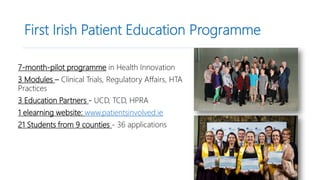
First Irish Patient Education Programme
7-month-pilot programme in Health Innovation
3 Modules – Clinical Trials, Regulatory Affairs, HTA
Practices
3 Education Partners - UCD, TCD, HPRA
1 elearning website: www.patientsinvolved.ie
21 Students from 9 counties - 36 applications
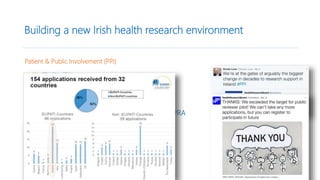
Building a new Irish health research environment
Patient & Public Involvement (PPI)
2014 – PPI Paper - Irish Health Research Forum
2016/17 – PPI Reviewers – Health Research Board
2017 – PPI Funding – €1.2mio - HRB + IRC
2017 – Scientific Advice – Patient Involvement – HPRA
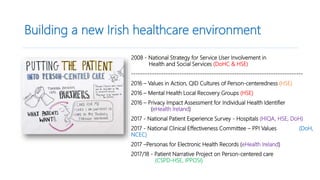
Building a new Irish healthcare environment
2008 - National Strategy for Service User Involvement in
Health and Social Services (DoHC & HSE)
---------------------------------------------------------------------------
2016 – Values in Action, QID Cultures of Person-centeredness (HSE)
2016 – Mental Health Local Recovery Groups (HSE)
2016 – Privacy Impact Assessment for Individual Health Identifier
(eHealth Ireland)
2017 - National Patient Experience Survey - Hospitals (HIQA, HSE, DoH)
2017 - National Clinical Effectiveness Committee – PPI Values (DoH,
NCEC)
2017 –Personas for Electronic Health Records (eHealth Ireland)
2017/18 - Patient Narrative Project on Person-centered care
(CSPD-HSE, IPPOSI)
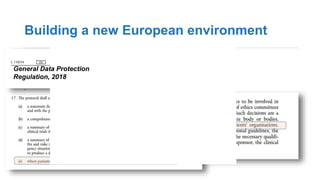
EU Clinical Trial Regulation, 2018
Building a new European environment
General Data Protection
Regulation, 2018
Generating patient-based evidence
• Stakeholders take decisions based on evidence, not on
(our) anecdotes
• Patient organisations are best-placed to generate patient-
relevant data
• Cost-effectiveness is key. Prove that the informed patient is
cost-effective…..!
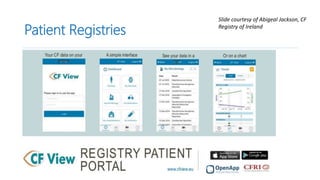
Patient Registries
• Evaluating new treatments in real-world settings
(Pharmaco-vigilance)
• Rare Disease Reference Centres of Excellence
Slide courtesy of Abigeal Jackson, CF
Registry of Ireland
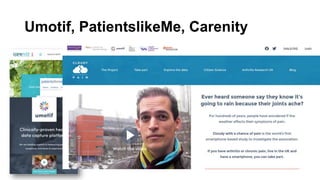
Umotif, PatientslikeMe, Carenity
Graphically display charts, timelines and
various representations of different measures
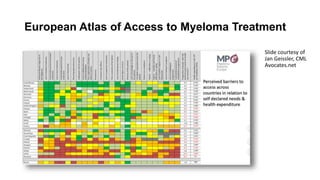
European Atlas of Access to Myeloma Treatment
Slide courtesy of
Jan Geissler, CML
Avocates.net
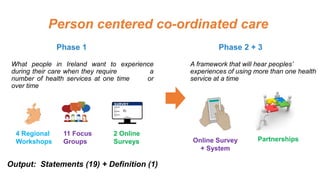
Person centered co-ordinated care
Phase 1
What people in Ireland want to experience
during their care when they require a
number of health services at one time or
over time
Phase 2 + 3
A framework that will hear peoples’
experiences of using more than one health
service at a time
11 Focus
Groups
2 Online
Surveys
4 Regional
Workshops
Output: Statements (19) + Definition (1)
Online Survey
+ System
Partnerships
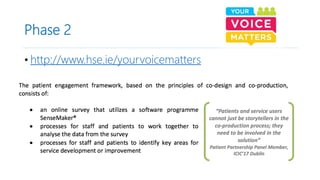
Phase 2
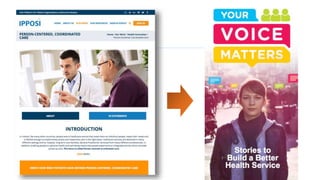
• http://www.hse.ie/yourvoicematters
By end of 2017… By end of 2018…
A ‘tried and tested’ framework
• To hear a high volume of patients’
experiences through the online
survey
• To use data to influence service
design, delivery and improvement
of integrated care
• A qualitative and quantitative
evaluation of the proof of concept
within the context of the HSE;
Integration into ‘business as usual’
• Framework (incl. resource
implications) to be integrated into a
‘business as usual’ model
• Quality and Patient Safety Structures
at CHO level will be essential
• QID publication: ‘Quality and Safety
Committees; Guidance and resources’
Take home messages
• When someone tells you that patients cannot understand or just
do not want to know, just look at the data…..
• Our relationship is fragile, dynamic, uncomfortable, ambitious,
and goal-oriented
• Over-interpretation and legal paternalism is a barrier to trusted,
effective partnership
• Healthcare Environment is changing….are you?
With thanks to…
• Abigeal Jackson, CF Registry of Ireland
• Jan Geissler, Patvocates
• Avril Daly, Retina International
• David Haerry, EATG
• Francois Houyez, EURORDIS
• Matthew May, EUPATI
• Kaisa Immonen, EPF
• Aine Carroll, HSE
Thank you!
@IPPOSI
www.ipposi.ie
dmitchell@ipposi.ie

EPIS meeting - Dr Derick Mitchell - October 2017

  • 1.
    October 17th, 2017 PATIENTS– SCIENCE – INDUSTRY Sustaining patient engagement resources - public-private platforms Derick Mitchell
  • 2.
    My Talk 1. IPPOSI? 2.Patient Involvement in Medicines R&D 3. How patient orgs & industry can interact 4. Generating patient-based evidence
  • 3.
  • 4.
    Collaborative sensemaking “We arewitnessing the collapse of expertise and the rise of collaborative sensemaking” David Holzmer
  • 5.
    IPPOSI? Who?IPPOSI A patient-ledorganisation that works with patients, government, industry, & science to put patients at the heart of health innovation
  • 6.
    IPPOSI Priorities 20 Actively advocatefor improved + equitable patient access to Health Innovation Promote meaningful patient involvement in Health Research and Policy
  • 7.
    Patient-led activities Health Hacks Workshops Conferences Consultations Round-tables WorkingGroups Training Days Rare Diseases eHealth Clinical Research Health Information Health Economics Patient Registries Biobanking
  • 8.
  • 9.
    Incorporating the patientvoice • Hierarchical Rhetoric • ‘Walking the walk’ at the highest possible level Challenges: • Decision-makers never want to change their processes • Patients are not trained in health policy, dialogue • Many patient orgs are not focused on policy/R&D issues “The perfect is the enemy of the good”
  • 10.
    What do patientadvocates want re: medicines R&D? That the patient voice is listened to • To be involved as early as possible in clinical research design, priority setting, policy • To improve the quality of clinical research - less wastage • To ensure better use/reuse of research outputs and tools • To generate impact and burden data to support the results of the clinical trials • To use online / ehealth / mobile health apps to generate patient-based evidence
  • 11.
    Practical “Roadmap” onpatient involvement in medicines R&D Research design and Planning Design of Protocol Informed Consent Study reporting Post-study communication Patient Info Leaflet Trial steering committee Investigators Meeting Level of expertise in the disease area required: mediumhigh Data Monitoring CommitteePractical considerations Health Technology Assessment Protocol Synopsis Research priorities Setting research priorities: Information to trial participants Research conduct and operations Regulatory affairs Dissemination, communication, post-approval Source: Geissler, Ryll, Leto, Uhlenhopp (2017) Therapeutic Innovation & Regulatory Science. (doi: 10.1177/2168479017706405) Fundraising for research Ethics Review
  • 12.
    Where do wewant to get to? http://www.ema.europa.eu/ema/index.jsp?curl=pages/partners_and_networks/general/general_content_001 738.jsp&mid=WC0b01ac0580b15dc7
  • 13.
    How patients, industrycan interact on R&D • Move from obsessive use of compliance to measuring the value of interaction • Look at legislation, regulation, codes of conduct and see what needs to be changed • Avoid rhetoric of ‘patient voice’ – not matched by reality
  • 14.
    Challenges to interacting •Lack of Trust • Lack of mutual learning • Perceived (or real) legal barriers, conflict of interest • Silo-thinking, finger-pointing • Lack of standardized metrics to measure impact and benefits of patient involvement • Lack of capacity and training in patient organisations • Over-compliance
  • 15.
    Basic Rules • Trustand transparency • All that patient organisations have is their credibility • They must also be effective and feel trusted
  • 16.
    Transparency and Independence •Basic principles, values = existing codes are good • Achieve financial transparency • Maintain independence • Rules for reputation and credibility
  • 17.
    Guidance on industryinteraction • Identify roles and opportunities for patients to interact in a systematic way • Guidance on: • Defining the patient • Defining the interaction • Ways for Identifying patients • Writing collaboration agreements • Rules of compensation • Transparency & Disclosure • Events & Hospitality • Appendices: Roadmap for PPI; Codes; Confidentiality agreement, Written agreement
  • 18.
    A framework ofpatient engagement  Engages  Empowers  Educates  Evaluates  Evolves A framework that enables structured, effective, meaningful, ethical, innovative, and sustainable patient engagement (and demonstrates the ‘return’ on this engagement for all actors)
  • 19.
    IPPOSI & TheEuropean Patients Academy • EUPATI produces Expert Patients on Medicines Research & Development • Provides Training & Education • Disseminates through national platforms The project received support from the Innovative Medicines Initiative Joint Undertaking under grant agreement n° 115334, resources of which are composed of financial contribution from the European Union's Seventh Framework Programme (FP7/2007-2013) and EFPIA companies. www.eupati.eu
  • 20.
    18+ EUPATI NationalPlatforms • Bring all stakeholders together in countries • Address educational needs in R&D • Disseminate EUPATI’s training material National platforms now established in: AT, BE, FR, DE, IE, IT, LU, MT, PL, ES, CH, UK, DK, SK, PT, NO, RO, GR Additional platform initiatives ongoing in Serbia, Brazil, Japan
  • 21.
    Roles change asa result of EUPATI course - creating patient leaders Role Before EUPATI After Member of patient organisation, not actively involved 17% 2% Active role in a patient organisation 62% 71% Leadership role in a patient organisation 62% 71% Employee of a patient organisation 25% 23% Volunteer role in a patient organisation 60% 67% Presenting at conferences, workshops etc. 63% 83% Advising a pharmaceutical company 13% 44% Advising a regulatory agency 21% 42% Advising a reimbursement agency 4% 8% EUPATI Fellows are increasingly taking leadership roles and are engaging with pharma, regulators and HTA bodies. Role changes also imply identity shifts.
  • 22.
    First Irish PatientEducation Programme 7-month-pilot programme in Health Innovation 3 Modules – Clinical Trials, Regulatory Affairs, HTA Practices 3 Education Partners - UCD, TCD, HPRA 1 elearning website: www.patientsinvolved.ie 21 Students from 9 counties - 36 applications
  • 23.
    Building a newIrish health research environment Patient & Public Involvement (PPI) 2014 – PPI Paper - Irish Health Research Forum 2016/17 – PPI Reviewers – Health Research Board 2017 – PPI Funding – €1.2mio - HRB + IRC 2017 – Scientific Advice – Patient Involvement – HPRA
  • 24.
    Building a newIrish healthcare environment 2008 - National Strategy for Service User Involvement in Health and Social Services (DoHC & HSE) --------------------------------------------------------------------------- 2016 – Values in Action, QID Cultures of Person-centeredness (HSE) 2016 – Mental Health Local Recovery Groups (HSE) 2016 – Privacy Impact Assessment for Individual Health Identifier (eHealth Ireland) 2017 - National Patient Experience Survey - Hospitals (HIQA, HSE, DoH) 2017 - National Clinical Effectiveness Committee – PPI Values (DoH, NCEC) 2017 –Personas for Electronic Health Records (eHealth Ireland) 2017/18 - Patient Narrative Project on Person-centered care (CSPD-HSE, IPPOSI)
  • 25.
    EU Clinical TrialRegulation, 2018 Building a new European environment General Data Protection Regulation, 2018
  • 26.
    Generating patient-based evidence •Stakeholders take decisions based on evidence, not on (our) anecdotes • Patient organisations are best-placed to generate patient- relevant data • Cost-effectiveness is key. Prove that the informed patient is cost-effective…..!
  • 27.
    Patient Registries • Evaluatingnew treatments in real-world settings (Pharmaco-vigilance) • Rare Disease Reference Centres of Excellence Slide courtesy of Abigeal Jackson, CF Registry of Ireland
  • 28.
    Umotif, PatientslikeMe, Carenity Graphicallydisplay charts, timelines and various representations of different measures
  • 29.
    European Atlas ofAccess to Myeloma Treatment Slide courtesy of Jan Geissler, CML Avocates.net
  • 30.
    Person centered co-ordinatedcare Phase 1 What people in Ireland want to experience during their care when they require a number of health services at one time or over time Phase 2 + 3 A framework that will hear peoples’ experiences of using more than one health service at a time 11 Focus Groups 2 Online Surveys 4 Regional Workshops Output: Statements (19) + Definition (1) Online Survey + System Partnerships
  • 32.
  • 33.
    By end of2017… By end of 2018… A ‘tried and tested’ framework • To hear a high volume of patients’ experiences through the online survey • To use data to influence service design, delivery and improvement of integrated care • A qualitative and quantitative evaluation of the proof of concept within the context of the HSE; Integration into ‘business as usual’ • Framework (incl. resource implications) to be integrated into a ‘business as usual’ model • Quality and Patient Safety Structures at CHO level will be essential • QID publication: ‘Quality and Safety Committees; Guidance and resources’
  • 34.
    Take home messages •When someone tells you that patients cannot understand or just do not want to know, just look at the data….. • Our relationship is fragile, dynamic, uncomfortable, ambitious, and goal-oriented • Over-interpretation and legal paternalism is a barrier to trusted, effective partnership • Healthcare Environment is changing….are you?
  • 35.
    With thanks to… •Abigeal Jackson, CF Registry of Ireland • Jan Geissler, Patvocates • Avril Daly, Retina International • David Haerry, EATG • Francois Houyez, EURORDIS • Matthew May, EUPATI • Kaisa Immonen, EPF • Aine Carroll, HSE
  • 36.

Editor's Notes

  • #4 Last year – experience of patients here I presented the why, who etc. focus on HTA agencies This year?
  • #6 A patient-led platform that provides a structured way of facilitating interaction between patients, government, industry, science and academia to put patients at the heart of policy and medicines development. In pursuit of this we hold workshops, discussion groups, training days and conferences on policy, legislation and regulation around the development of new medicines, products, devices and diagnostics for unmet medical needs.
  • #10 Regulators and funders are doing it!
  • #11 building real world effectiveness data – for example - following a decision of conditional reimbursement, incorporating patient relevant outcomes.
  • #12 The different levels in which Patient Organisations and patient representatives can get involved in the clinical trial process These are examples of points in time when patient insights and engagement would be sought by multiple stakeholders This is to demonstrate patient involvement is reality and is in practice, not some funky new idea that may be done in the future!
  • #14 Typical = this is what we’ve done – you agree with us don’t you? Patients; What if we say no? Well, we’ll go ahead anyway…
  • #15 Cultivating your own garden, Silo-thinking, finger-pointing leads to consolidation of individual, non-consolidated, processes, rules and (interpretation of) codes Agreed Values? Harmonized processes? Quality Standards? Compliance was once established to ensure independence, now stifling trustful and transparent collaborations
  • #19 providing better care, creating positive flow and a virtuous circle
  • #24 Health services in Ireland are including patient voices in decision making to a greater extent now than ever before. The HSE’s National Strategy for Service User Involvement 2008-2013, the National Patients Forum, the National Patient Experience Survey and the IPPOSI-led Patient Narrative project are examples. Furthermore, the Department of Health is working with IPPOSI and other relevant patient-led organisations in areas such as rare diseases, dementia and others. Training required to get the expertise required to contribute to research & development projects
  • #25 Context is how do you transform services towards what people want, when they want them.
  • #29 uMotif uses the capabilities of smartphones– such as accelerometers– to perform simple diagnostics integrated with results from quizzes, timed games, etc., to measure symptoms
  • #32 10,000 Voices in NI - 14,000 patients have now completed this survey
  • #34 identification of enablers and challenges to successful implementation