0
1
Introduction
This report provides a synthesis of the key questions and insights
generated during the Technology Ventures series (a series that
throughout has been supported by background scholarly research,
see boxes 1 and 2). The Technology Ventures series is a high level
forum that brings together policy makers, investors, entrepreneurs,
senior academics and executives to discuss new approaches for
technology development, transfer and spin-out of technology
ventures. The events held at the Manchester Metropolitan University
Business and Law School, and in partnership with the University of
Manchester, during 2010-2012 addressed:
 21st Century Paradigms
 New Innovation Models
 Industry Platforms
 Practices for Accelerating Innovation
With a particular sector focus on:
 Digital, Electronics and Internet of Things
 Pharmaceutical, Biotechnology and Healthcare
 Personal Health and Wellness
2
Box 1. Key Questions
 How do we accelerate innovation in a technologically-driven,
connected society?
 What new innovation models can help us to orchestrate
increasing complexity and diversity?
 What new economic and business models do we need to consider
and adopt?
 What new models of health, wellness and healthcare can be
enabled by digital technologies, open collaboration and crowd-
sourcing?
 What immediate actions and policy changes are required to
promote the above innovation models, as well as new ventures,
and economic growth?
Box 2. Methodology
 Keynote presentations provided background knowledge with
respect to the topic areas (these are available at
www.technologyventures.info)
 Structured discussions were facilitated by academic and industry
mentors during the interactive workshops.
 Over 150 people from industry and academia participated in the
four events; see list of keynote speakers, mentors and
participating organisations in annexe A.
 Key findings from these discussions are provided in the
concluding section; see table 2 and box 7.
3
21st
Century Paradigms
“In medicine we have traditionally been responsible for what was reasonably
known, however in a connected society, we have become responsible for what
could have been reasonably known had we collected and organized the
intelligence appropriately”
Brigitte Piniewski, MD CMO PeaceHealth Laboratories
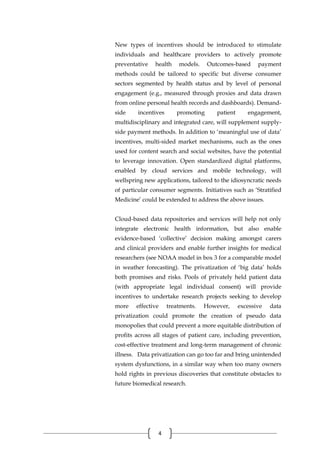
The needs of modern societies have changed. Communities are
no longer accidentally well. Our traditional medical model
assumes we are all well until we are ill. This relic of a bygone
era has kept society on “stand by” until such time as sufficient
or measurable illness occurs. Yet rescue medicine is rare today
as the bulk of medical practice is in fact the relentless pursuit
of evidence-based chronic care management. Until recently,
the bulk of technology innovation has been focused on the
automation of medical care with the hopes of reducing
redundancies, delivering efficiencies and ultimately achieving
cost reductions. Yet years later, with prevalence rates of
chronic disease tripling and little hope of dramatically
lowering costs through perfect care, the imperative to develop
successful prevention strategies looms even larger.
4
New types of incentives should be introduced to stimulate
individuals and healthcare providers to actively promote
preventative health models. Outcomes-based payment
methods could be tailored to specific but diverse consumer
sectors segmented by health status and by level of personal
engagement (e.g., measured through proxies and data drawn
from online personal health records and dashboards). Demand-
side incentives promoting patient engagement,
multidisciplinary and integrated care, will supplement supply-
side payment methods. In addition to ‘meaningful use of data’
incentives, multi-sided market mechanisms, such as the ones
used for content search and social websites, have the potential
to leverage innovation. Open standardized digital platforms,
enabled by cloud services and mobile technology, will
wellspring new applications, tailored to the idiosyncratic needs
of particular consumer segments. Initiatives such as ‘Stratified
Medicine’ could be extended to address the above issues.
Cloud-based data repositories and services will help not only
integrate electronic health information, but also enable
evidence-based ‘collective’ decision making amongst carers
and clinical providers and enable further insights for medical
researchers (see NOAA model in box 3 for a comparable model
in weather forecasting). The privatization of ‘big data’ holds
both promises and risks. Pools of privately held patient data
(with appropriate legal individual consent) will provide
incentives to undertake research projects seeking to develop
more effective treatments. However, excessive data
privatization could promote the creation of pseudo data
monopolies that could prevent a more equitable distribution of
profits across all stages of patient care, including prevention,
cost-effective treatment and long-term management of chronic
illness. Data privatization can go too far and bring unintended
system dysfunctions, in a similar way when too many owners
hold rights in previous discoveries that constitute obstacles to
future biomedical research.
5
To avoid monopolistic behaviour, new government regulations
would need to be devised to safeguard universal data access as
a vehicle to more perfect competition. Data should be able to be
accessed by ‘certified’ third parties through reasonable
payments mechanisms, and that at the same time would allow
providers of large data repositories and cloud-services to
sustain their digital business. Furthermore, adequate legal
changes to patient data privacy law and government
regulations (e.g., equivalent to HIPAA) would reduce the
burden on pharmaceutical sector as a whole by making patient
data access more equitable and reducing the cost of medical
discoveries, hence benefiting patients.
The implementation of this vision that aligns supply and
demand of health services, will have far reaching economic,
social and healthcare ramifications and benefits by encouraging
collaborative IT development, proactive attitudes towards
wellbeing and primary care, and improved healthcare services.
This change of paradigm could be compared to similar
historical socio-technical changes previously seen in other
industries such as consumer banking and finance, with a new
ecosystem of firms and entrepreneurs promoting the creation
of digital markets and preventative and wellness services.
6
Box 3. Personal Health Data Management Models
The US National Oceanic Atmospheric Administration (NOAA) weather model may well be the
key to unleashing innovative business models to support the rapid co-evolution of pro-active
prevention strategies. In weather, we simply sprinkle the environment with sensors and the raw
data (wind speed and direction, temperature, humidity and other parameters) all flow freely
into a repository or data commons. This raw data is shared freely with multiple business models
on top of the rich data source such as local weather channels, air traffic resources and so on. In
health, “sprinkling sensors” will fail to generate any meaningful data flow unless we promote a
crowd-sourced open collaboration approach. The case for cross-generational collaboration is
strong. Older folks who might benefit from technology solutions to help manage complex health
conditions are generally not confident in using digital aides. Many seniors forget how to power
up their digital solutions, struggle to sync data and often fail to adjust user preferences because
it is just too complicated. This is in extreme contrast to the younger generation; our youth trying
to fund their university education. These students are digital natives and represent a scalable
resource that would enable the data flow for the equivalent of the NOAA model in Health.
Creating a rich substrate of clinically relevant crowd data will be the fundamental requirement
to advance the digital health agenda at the pace of change. This work highlights a reasonable
means to expose public health knowledge gaps and proposes crowd sourced approaches to
defining “what is reachable” by free living communities. In this model, communities are no
longer “on standby” but are active co-producers of the intelligence needed by SME to produce
relevant solutions. The recent H1N1 epidemic as an obvious example of how accelerated cross-
generational health intelligence could supply new ventures with the data substrate needed to
produce a “flu patch” that could significantly protect society from future epidemics.
Fundamentally, innovative business models will depend upon a rich NOAA-like substrate of
shared data to advance the digital health industry in rapid, scalable, clinically relevant and
ultimately sustainable ways.
*Brigitte Piniewski, MD CMO PeaceHealth Laboratories
7
New Innovation Models
The global pharmaceutical, biotechnology and healthcare
industries are experiencing fundamental changes that are
driving the emergence of new innovation models. For
instance, the increasing number of new biotechnology firms
bringing radical new knowledge, technologies and processes is
driving the emergence of new models of innovation – this
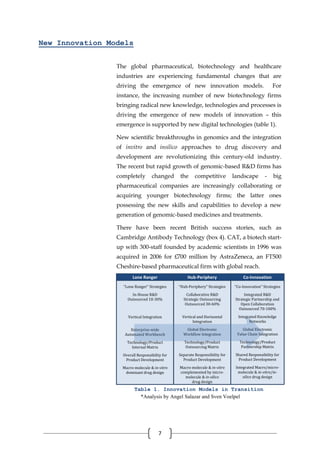
emergence is supported by new digital technologies (table 1).
New scientific breakthroughs in genomics and the integration
of invitro and insilico approaches to drug discovery and
development are revolutionizing this century-old industry.
The recent but rapid growth of genomic-based R&D firms has
completely changed the competitive landscape - big
pharmaceutical companies are increasingly collaborating or
acquiring younger biotechnology firms; the latter ones
possessing the new skills and capabilities to develop a new
generation of genomic-based medicines and treatments.
There have been recent British success stories, such as
Cambridge Antibody Technology (box 4). CAT, a biotech start-
up with 300-staff founded by academic scientists in 1996 was
acquired in 2006 for £700 million by AstraZeneca, an FT500
Cheshire-based pharmaceutical firm with global reach.
Lone Ranger Hub-Periphery Co-Innovation
“Lone Ranger” Strategies
In-House R&D
Outsourced 10-30%
Vertical Integration
Enterprise-wide
Automated Workbench
Technology/Product
Internal Matrix
Overall Responsibility for
Product Development
Macro-molecule & in-vitro
dominant drug design
“Hub-Periphery” Strategies
Collaborative R&D
Strategic Outsourcing
Outsourced 30-60%
Vertical and Horizontal
Integration
Global Electronic
Workflow Integration
Technology/Product
Outsourcing Matrix
Separate Responsibility for
Product Development
Macro-molecule & in-vitro
complemented by micro-
molecule & in-silico
drug design
“Co-Innovation” Strategies
Integrated R&D
Strategic Partnership and
Open Collaboration
Outsourced 70-100%
Integrated Knowledge
Networks
Global Electronic
Value Chain Integration
Technology/Product
Partnership Matrix
Shared Responsibility for
Product Development
Integrated Macro/micro-
molecule & in-vitro/in-
silico drug design
Table 1. Innovation Models in Transition
*Analysis by Angel Salazar and Sven Voelpel
8
Box 4. Background and Basic Facts about Cambridge Antibody Technology
Cambridge Antibody Technology (CAT) was a leading UK-based biotechnology company that pioneered
proprietary technology and capabilities in human monoclonal antibodies for drug discovery and
development in a number of strategic therapeutic areas. The founding research team, responsible for their
core patents, included Greg Winter, John McCafferty, Andrew Griffiths and David Chiswell, and the Medical
Research Council.
Antibody phage display technology, combined with automated high-throughput screening, enables mining
complex combinatorial libraries and the identification of potentially powerful drug leads. CAT developed
strong information management capabilities to organize and screen data to enable rapid lead discovery
using these antibody libraries. The more “rational” drug design process become integrated within disciplines
that include chemistry, pharmacology, molecular biology, and computer modelling and structure
determination using X-ray and NMR technology.
Created in 1990 with six people, it had grown to 300 people in 2006. From the onset, CAT's strategy was to
exploit its technology platforms through licensing partnerships. It’s first IPO in 1997 raised £41 million.
CAT’s initial strategy was based on licensing its proprietary technology to several companies, including
Amgen, Chugai, Dyax, Genzyme, Human Genome Sciences, Merck & Co., Micromet, Pfizer, and Wyeth
Research. CAT had 44 employees in 1996, growing to 150 by 1998.
In later stages, CAT developed long-term collaborative alliances with a number of biopharmaceutical
companies to jointly discover, develop and commercialize human monoclonal antibody-based products,
including AstraZeneca, Zenyth, Genzyme and Merck (e.g., HIV-mediated infectious diseases). CAT had
seven derived product candidates in clinical development by 2002, and 10 by 2005. CAT’s technology was
used to create ‘adalimumab’ (marketed by Abbott as Humira), the first fully human antibody blockbuster
drug. CAT ranked 58 in the 500 fastest growing European high tech firms according to Deloitte, and listed in
The Times’ 2001 list of Europe’s 50 hottest technology companies. AstraZeneca finally acquired CAT after a
multi-million bid at the end of 2006.
Source: Company reports and interviews prior to acquisition.
9
Industry Platforms
“The complex reciprocal relationships that make up ARM’s ecosystem
are one of our main sources of competitive advantage"
-Tudor Brown, Cofounder and President of ARM 2008-2012
As a new era of the knowledge-networked innovation
economy is now being experienced, a shift towards
competition based on new value innovation is becoming
evident. A unique feature of this approach to competition is
that the company providing the core technology in the
platform relies heavily, and sometimes exclusively, on other
companies to make actual products or offer specific services
that provide value to the end user. Platform research and
actual company examples suggest several basic concepts that
are important to the creation of a successful industry
platform2. ARM is another success story, which can help
illustrate these concepts; see box 5. ARM is a complex platform
system which is highly modular at various levels of the stack,
has standardised interfaces, and also exhibits relatively low
levels of differentiation for end-users. In summary:
 ARM’s platform technology has solved a basic industry
problem through its range of microprocessor designs
and other products aimed at low power usage,
 ARM achieves both economies of scale by affordable
licensing of standard designs and generating long-term
royalty streams, and economies of scope by using
modular and easily modifiable designs.
 ARM has built and organised its ecosystem of partners
using external partnerships and community building
initiatives that help reducing coordination and learning
costs.
 ARM generates direct and indirect network effects.
*Analysis by Michael Cusumano and Angel Salazar.
10
Box 5. Background and Basic Facts about ARM
ARM is based in Cambridge, UK, and was originally founded in 1990 as a joint venture between Acorn
Computers, Apple, and VLSI Technologies. In total, as of 2011, ARM had over 900 partner companies
utilizing its platform technology in different forms, while various companies manufactured over six billion
microprocessors and electronic devices based on ARM designs. In 2011, ARM had approximately 2000
employees and annual revenues of $785 million, but an impressive market value of nearly $8 billion at year’s
end, approximately 10 times revenues. By contrast, Microsoft and Intel generally had market capitalizations
of no more than 3 times annual revenues, Apple 4 times revenues, and Google about 7 times revenues. One
reason for this ten-fold ratio is that ARM profits from its IP using licenses and royalties from product
development partners, not incurring fixed overhead manufacturing costs of operating its own foundries for
example, and hence promoting increasing return s to scale.
ARM designs can be found as the main microprocessor in over 90 percent of mobile phones, including those
made by fierce competitors such as Nokia, Sony Ericsson, Samsung, HTC, and Apple. ARM designs also
appear in many other devices, including the Apple iPod, and portable Nintendo and Sony PlayStation game
devices. In addition, ARM microcontrollers are embedded in an increasing array of industrial equipment and
consumer devices (or so called Internet of Things devices), occupying about 10% of this nascent market.
Forecasts indicate 34 billion electronic devices powered by ARM processors by 2015, and over 150 billion by
2020. ARM’s revenue is also continuously growing due to its introduction of new versions of its
microprocessor designs for new applications, which generate overlapping streams of future royalties.
Royalty revenue was already 52% (US$405.6 million) against 36% (US$285.6 million) for licenses in 2011.
Also, revenue from past processors is not yet negligible but still rising while income from newer ones
catching up, thanks to a highly diversified user base. It takes four hours to five years to move from license to
royalty income for a new processor. Cumulative licenses for ARM7, ARM9 and ARM11 processor families
were 171, 270 and 79 respectively in 2011.
Source: ARM’s Annual Report 2011
11
Practices for Accelerating Innovation
"Often, the key to innovation isn't about more features or higher-
fidelity data, but about asking, and answering, the right question."
-Andrew Rosenthal, COO, MASSIVE HEALTH, San Francisco
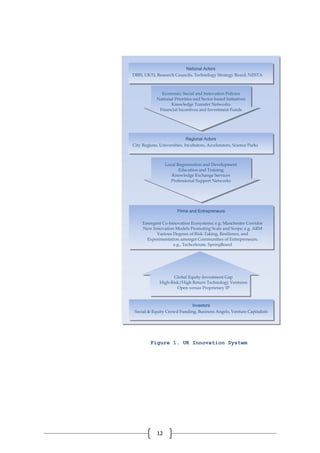
Figure 1 shows the range of actors involved within the UK
Innovation System. We focus on the lower tiers of the system
and in context to the North West in particular here:
A gradual change towards supporting incremental and
potentially disruptive innovation in universities has facilitated
the development of reasonably strong stock of entrepreneurial
capabilities, supported through incubation programmes and
knowledge exchange services. Universities are playing an even
more important role acting as catalysts of technology ventures
and economic progress.
The Manchester Integrative Medicine and Innovative
Technologies (MIMIT) centre is a working example of a
structured approach to identify patient needs and accelerate
innovation. Start-up founder clubs and accelerator
programmes such as Techcelerate and Springboard, amongst
others, are successfully contributing to accelerate early stage
development and strengthening the innovation capabilities of
technology start-ups with relatively limited bootstrapped
resources. A recent initiative promoting ecosystem
development is the Manchester Ecosystem in mHealth led by
the University of Manchester, which brings together health
and social care providers and commissioners, industry and
academia in a partnership to accelerate innovation and
adoption of new mHealth solutions; see box 6.
12
Figure 1. UK Innovation System
National Actors
DBIS, UKTI, Research Councils, Technology Strategy Board, NESTA
Regional Actors
City Regions, Universities, Incubators, Accelerators, Science Parks
Economic, Social and Innovation Policies
National Priorities and Sector-based Initiatives
Knowledge Transfer Networks
Financial Incentives and Investment Funds
Local Regeneration and Development
Education and Training
Knowledge Exchange Services
Professional Support Networks
Firms and Entrepreneurs
Investors
Social & Equity Crowd Funding, Business Angels, Venture Capitalists
Global Equity-Investment Gap
High-Risk/High Return Technology Ventures
Open versus Proprietary IP
Emergent Co-Innovation Ecosystems; e.g. Manchester Corridor
New Innovation Models Promoting Scale and Scope; e.g. ARM
Various Degrees of Risk-Taking, Resilience, and
Experimentation amongst Communities of Entrepreneurs;
e.g., Techcelerate, SpringBoard
e,
13
Box 6. mHealth and the Manchester mHealth Ecosystem
Europe, like the rest of the developed world, is facing unprecedented
challenges to established models of health and social care. Characterised by
the ability to collect real-time information, facilitate access to integrated
health data, provide personalised feedback, and exploit social networking
with informal as well as formal careers, mHealth has great potential to offer
solutions to these challenges; transforming healthcare, social care and
wellbeing. At the same time it is evident that mHealth has a history of
numerous trials which, however successful, rarely result in adoption at scale
into routine practise. The reasons for this include:
 Poor understanding of users’ needs
 Point solutions that fail to address how to integrate into the whole
system
 Failure to develop sustainable business models
 Failure to plan for pilot-to-deployment
The Manchester mHealth Ecosystem is a ground breaking concept designed
to address these challenges and embrace the opportunities of the mHealth
marketplace. Serving a population of 3.2 million people within a ten mile
radius of the UK’s second city, the Manchester Ecosystem is the flagship for
the European Connected Health Alliance (ECHAlliance) network for
mHealth Ecosystems stretching across Europe. Recent Ecosystems based on
the Manchester’s model have recently been launched in Finland and
Northern Ireland, and another is planned in Catalonia.
The Ecosystem brings together health and community care providers and
commissioners, a leading clinical research network, a world-class research
university, city-region government, major international companies and
innovative SMEs in a permanent partnership committed to ‘making mHealth
happen’. The Ecosystem delivers:
 A multi-sector partnership of significant critical mass.
 An ‘innovation factory’ designed to ensure sharing of best practice
and develop innovative solutions.
 A reliable route from mHealth innovation to routine service, with
realistic pilot-to-pilot adoption business plans demonstrating costs,
benefits and impacts on quality outcomes.
 Lower barriers to innovation by operating under standard
agreements, and facilitating access to a large, well characterised
population.
14
Overall, innovation ecosystems are organically morphing
towards more sophisticated co-innovation models promoting
reciprocal relationships. There has been a gradual shift from
in-house R&D to outsourcing and collaboration in the North
West. Technological and market knowledge is being
transferred both formally through collaborative projects
between industry and universities connected through the
Manchester Corridor, and more informally within fluid
professional and entrepreneurial networks, as in the case of
the Daresbury’s Innovation Campus and Techcelerate.
Another example of initiatives promoting open innovation is
the opportunistic formation of consortiums of small and large
firms pulling resources together, often motivated by
competitions form the Technology Strategy Board aimed at
pre-commercialisation stages and EU funding programmes at
more experimental R&D stages. Other examples are
knowledge transfer partnerships promoting the exchange of
knowledge services and graduates between universities and
small and medium sized firms.
Finance practices have evolved from no-risk funding available
back in the 1990s, to government sponsored venture trusts and
the first private venture capital investments in early 2000s,
which accounted for more than two thirds of risk-based
investment in the UK by the end of that decade. More recently,
the high risk nature of investing in technology firms and the
‘funding gap’ have promoted investment practices to shift
from single-VC to syndication, which is the bundling of
investment funding from various investors into one start-up.
A more recent trend is the emergence of equity crowd-funding
platforms such as Seedrs and CrowdCube based in the UK,
with the overall investment expected to grow to over £200
million in 2012 (including social crowd-funding)21.
Other recent developments are corporate-sponsored
acceleration programmes such as Microsoft’s BizSparks and
DreamSparks, providing partner status to start-ups and
incubators and access to their core technology and product
development and commercialization expertise.
15
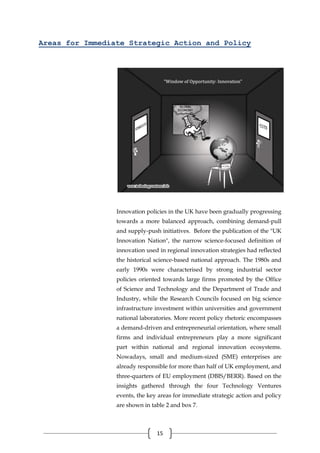
Areas for Immediate Strategic Action and Policy
Innovation policies in the UK have been gradually progressing
towards a more balanced approach, combining demand-pull
and supply-push initiatives. Before the publication of the "UK
Innovation Nation", the narrow science-focused definition of
innovation used in regional innovation strategies had reflected
the historical science-based national approach. The 1980s and
early 1990s were characterised by strong industrial sector
policies oriented towards large firms promoted by the Office
of Science and Technology and the Department of Trade and
Industry, while the Research Councils focused on big science
infrastructure investment within universities and government
national laboratories. More recent policy rhetoric encompasses
a demand-driven and entrepreneurial orientation, where small
firms and individual entrepreneurs play a more significant
part within national and regional innovation ecosystems.
Nowadays, small and medium-sized (SME) enterprises are
already responsible for more than half of UK employment, and
three-quarters of EU employment (DBIS/BERR). Based on the
insights gathered through the four Technology Ventures
events, the key areas for immediate strategic action and policy
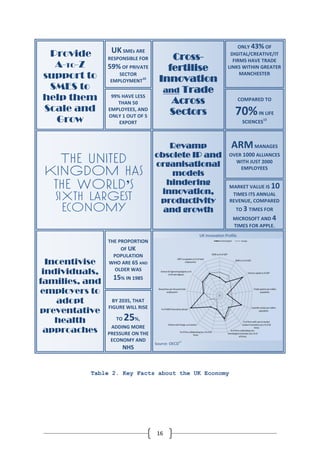
are shown in table 2 and box 7.
16
Provide
A-TO-Z
support to
SMES to
help them
Scale and
Grow
UKSMEs ARE
RESPONSIBLE FOR
59% OF PRIVATE
SECTOR
EMPLOYMENT
10
Cross-
fertilise
Innovation
and Trade
Across
Sectors
ONLY 43% OF
DIGITAL/CREATIVE/IT
FIRMS HAVE TRADE
LINKS WITHIN GREATER
MANCHESTER
99% HAVE LESS
THAN 50
EMPLOYEES, AND
ONLY 1 OUT OF 5
EXPORT
COMPARED TO
70%IN LIFE
SCIENCES
12
Revamp
obsolete IP and
organisational
models
hindering
innovation,
productivity
and growth
ARMMANAGES
OVER 1000 ALLIANCES
WITH JUST 2000
EMPLOYEES
MARKET VALUE IS 10
TIMES ITS ANNUAL
REVENUE, COMPARED
TO 3 TIMES FOR
MICROSOFT AND 4
TIMES FOR APPLE.
Incentivise
individuals,
families, and
employers to
adopt
preventative
health
approaches
THE PROPORTION
OF UK
POPULATION
WHO ARE 65 AND
OLDER WAS
15% IN 1985
UK Innovation Profile
Source: OECD17
BY 2035, THAT
FIGURE WILL RISE
TO 25%,
ADDING MORE
PRESSURE ON THE
ECONOMY AND
NHS
Table 2. Key Facts about the UK Economy
17
Box 7. Key Areas for Immediate Strategic Action and Policy
 An innovation agenda driven by the pressing needs of our society that includes preventative
health, wellness, and individual and corporate social responsibility1,2,18. See table 2.
 Recent research on economic performance and innovation corroborates the importance of
industry-specific policies, besides macro-economic stability, in fostering
growth3,4,5,6,13. Addressing the specific dynamic nature of industry sectors requires
industry-focused interventions with a clear focus on entire ecosystems of firms including
SMEs rather than just an overemphasis on large corporations. For instance, new types of
industry specific taxation targeting SMEs would encourage their growth. Examples have
already been seen in industry areas such as low carbon emission and renewable energy.
 New economic models and financial incentives that could help overcoming old silos
mentality, breaking ‘garden walls’, both in public and private sectors. A promising area is
new products and services supported by public sharing and also commercial trading of
‘big data’, allowing for granularity and scope, particularly in healthcare and biomedical
research8,15,19,20.
 Emergent innovation clusters often suffer from fragmentation and dislocation. New cluster
and international trade policies should balance their emphasis on exports and outward
investment and promote domestic inter-firm trade and inward investment11,12.
 Starting, managing and growing new ventures often have high learning and coordination
costs across all development stages. Besides the existing knowledge exchange initiatives
such as university-based KTPs and private-led innovation accelerators, more
comprehensive approaches to venture development in early and later stages would
contribute to increase their rate of success and turnover.
 Open collaboration and fluid networks including small firms and local communities of
early adopters are essential to foster the ‘democratic’ growth of our ecosystems, enabling
social enterprise and also promoting proactive healthy attitudes13.
 New kinds of investment and the need to be creative on how we think about this because
traditional forms of investment might not be the right ones to move forward in a resource
constrained global environment. Two of these kinds of new finance are social and equity
crowdfunding9, 13.
 Government incentives to large companies for creating and extending skills-development,
co-innovation and procurement programmes with smaller firms, following similar
approaches used in the public sector; e.g., U.S. Small Business Innovation Program7,10,13.
18
References
1) Benedict Clemens, David Coady and Sanjeev Gupta (Editors) The Economics of Public Health
Care Reform in Advanced and Emerging Economies, International Monetary Fund, 2012
2) Brigitte Piniewski, Cristiano Codagnone and David Osimo, Nudging Lifestyles for Better
Health Outcomes; Crowdsourced Data and Persuasive Technologies for Behavioural Change,
Institute for Prospective Technological Studies- JRC-European Commission, 2011
3) Caroline Chapman, Phil Cooke, Lisa De Propis, Stewart MacNeill and Juan Mateos-Garcia,
Creative Clusters and Innovation: Putting Creativity on the Map, NESTA
4) Charles Roxburgh, James Manyka, Richard Dobbs and Jan Mischke, Trading Myths:
Addressing Misconceptions about Trade, Jobs and Competitiveness, McKinsey Global
Institute, 2012
5) James Manika et al., How to Compete and Grow: A Sector Guide to Policy, McKinsey Global
Institute, 2010
6) Robert Atkinson and Stephen Ezell, Innovation Economics: The Race for Global Advantage,
Yale University Press
7) Department for Business Innovation and Skills, Innovation and Research Strategy for Growth,
2011
8) Glenn Crocker, UK Life Science Start-up Report, Mobius, 2011
9) Liam Collins and Yannis Pierrakis, The Venture Crowd: Crowdfunding Equity Investment
into Business, NESTA, 2012
10) Lord Heseltine of Thenford, No Stone Unturned in Pursuit of Growth, 2012
11) Manchester Independent Economic Review, Growing Inward and Indigenous Investment,
2009
12) Manchester Independent Economic Review, The Case for Agglomeration Economics, Growing
Inward and Indigenous Investment, 2009
13) NESTA, Plan-I: The Case for Innovation-led Growth, 2012
14) New Economy, North West Quarterly Economic Outlook, August 2012
15) Strength and Opportunity: The Landscape of the Medical Technology Medical Biotechnology,
Industrial Biotechnology and Pharmaceutical Sectors, BIS-UKTI-DH, 2011
16) Regional Economic Forecasting Panel, State of the North West Economy: A Long-term
forecast for the Northwest 2010-2010
17) OECD Science, Technology and Industry Outlook 2010: UK country profile
18) Ruth Puttick, Innovations in Prevention, NESTA, 2012
19) Big Data: The Power and Possibilities of Big Data, NESTA Hot Topics report, 2012
20) Health Knowledge as a Common, NESTA Blog. Last accessed on 1/12/2012
www.nesta.org.uk
21) Peter Baeck, Lian Collins and Stian Westlake, Crowding In, NESTA, 2012
19
Annexe A. List of Advisors, Mentors and Keynote Speakers
SERIES CHAIR:
Dr Angel Salazar, Manchester Metropolitan University Business and Law School
ADVISORS AND INDUSTRY MENTORS:
Professor Ian Miles, Manchester Institute of Innovation Research
Dr Lawrence Green, Manchester Metropolitan University Business and Law School
Professor Iain Buchan, North West Institute for Bio-Health Informatics
Dr Nigel Rix, Director, Electronics Knowledge Transfer Network
Zulf Choudhary, Manchester Investors Group
Dr Jose Hurtado, Pablo Olavide University
Richard Wiffen, Passion for Life Group
Dr Geoff Davison, CEO, BioNow
Jon Bradford, Springboard
KEYNOTE SPEAKERS:
Professor Michael Cusumano, MIT Sloan Management School
Dr Brigitte Piniewski, PeaceHealth Labs, Portland, Oregon
Dr David Bozward, National Council for Graduate Entrepreneurship
Dr John Ainsworth, mHealth Innovation Centre, University of Manchester
Ruth Norris, mHealth Innovation Centre, University of Manchester
Dr Mairi Robertson, New Media Partners
Andrew Rosenthal, Massive Health
Ivan Farneti, Doughty Hanson & Co
Dr Matthew Bonam, AstraZeneca
Professor Jackie Oldham, MIMIT
Marc D’Abbadie, SPARK Impact
Imran Farooq, MMC Learning
Robert Wakeling, Wadaro
Stephen Pattisson, ARM
Dr Joel Laird, Fiorano
Peter Moss, HSBC
20
PARTNER ORGANISATIONS AND SPONSORS:
21
How to reference this publication:
Salazar, Angel (Ed.) Technology Ventures: Synthesis Report 2010-2012, Manchester
Metropolitan University Business and Law School, 2012

TECHNOLOGYVENTURES-SYNTHESISREPORT

  • 1.
  • 2.
    1 Introduction This report providesa synthesis of the key questions and insights generated during the Technology Ventures series (a series that throughout has been supported by background scholarly research, see boxes 1 and 2). The Technology Ventures series is a high level forum that brings together policy makers, investors, entrepreneurs, senior academics and executives to discuss new approaches for technology development, transfer and spin-out of technology ventures. The events held at the Manchester Metropolitan University Business and Law School, and in partnership with the University of Manchester, during 2010-2012 addressed:  21st Century Paradigms  New Innovation Models  Industry Platforms  Practices for Accelerating Innovation With a particular sector focus on:  Digital, Electronics and Internet of Things  Pharmaceutical, Biotechnology and Healthcare  Personal Health and Wellness
  • 3.
    2 Box 1. KeyQuestions  How do we accelerate innovation in a technologically-driven, connected society?  What new innovation models can help us to orchestrate increasing complexity and diversity?  What new economic and business models do we need to consider and adopt?  What new models of health, wellness and healthcare can be enabled by digital technologies, open collaboration and crowd- sourcing?  What immediate actions and policy changes are required to promote the above innovation models, as well as new ventures, and economic growth? Box 2. Methodology  Keynote presentations provided background knowledge with respect to the topic areas (these are available at www.technologyventures.info)  Structured discussions were facilitated by academic and industry mentors during the interactive workshops.  Over 150 people from industry and academia participated in the four events; see list of keynote speakers, mentors and participating organisations in annexe A.  Key findings from these discussions are provided in the concluding section; see table 2 and box 7.
  • 4.
    3 21st Century Paradigms “In medicinewe have traditionally been responsible for what was reasonably known, however in a connected society, we have become responsible for what could have been reasonably known had we collected and organized the intelligence appropriately” Brigitte Piniewski, MD CMO PeaceHealth Laboratories The needs of modern societies have changed. Communities are no longer accidentally well. Our traditional medical model assumes we are all well until we are ill. This relic of a bygone era has kept society on “stand by” until such time as sufficient or measurable illness occurs. Yet rescue medicine is rare today as the bulk of medical practice is in fact the relentless pursuit of evidence-based chronic care management. Until recently, the bulk of technology innovation has been focused on the automation of medical care with the hopes of reducing redundancies, delivering efficiencies and ultimately achieving cost reductions. Yet years later, with prevalence rates of chronic disease tripling and little hope of dramatically lowering costs through perfect care, the imperative to develop successful prevention strategies looms even larger.
  • 5.
    4 New types ofincentives should be introduced to stimulate individuals and healthcare providers to actively promote preventative health models. Outcomes-based payment methods could be tailored to specific but diverse consumer sectors segmented by health status and by level of personal engagement (e.g., measured through proxies and data drawn from online personal health records and dashboards). Demand- side incentives promoting patient engagement, multidisciplinary and integrated care, will supplement supply- side payment methods. In addition to ‘meaningful use of data’ incentives, multi-sided market mechanisms, such as the ones used for content search and social websites, have the potential to leverage innovation. Open standardized digital platforms, enabled by cloud services and mobile technology, will wellspring new applications, tailored to the idiosyncratic needs of particular consumer segments. Initiatives such as ‘Stratified Medicine’ could be extended to address the above issues. Cloud-based data repositories and services will help not only integrate electronic health information, but also enable evidence-based ‘collective’ decision making amongst carers and clinical providers and enable further insights for medical researchers (see NOAA model in box 3 for a comparable model in weather forecasting). The privatization of ‘big data’ holds both promises and risks. Pools of privately held patient data (with appropriate legal individual consent) will provide incentives to undertake research projects seeking to develop more effective treatments. However, excessive data privatization could promote the creation of pseudo data monopolies that could prevent a more equitable distribution of profits across all stages of patient care, including prevention, cost-effective treatment and long-term management of chronic illness. Data privatization can go too far and bring unintended system dysfunctions, in a similar way when too many owners hold rights in previous discoveries that constitute obstacles to future biomedical research.
  • 6.
    5 To avoid monopolisticbehaviour, new government regulations would need to be devised to safeguard universal data access as a vehicle to more perfect competition. Data should be able to be accessed by ‘certified’ third parties through reasonable payments mechanisms, and that at the same time would allow providers of large data repositories and cloud-services to sustain their digital business. Furthermore, adequate legal changes to patient data privacy law and government regulations (e.g., equivalent to HIPAA) would reduce the burden on pharmaceutical sector as a whole by making patient data access more equitable and reducing the cost of medical discoveries, hence benefiting patients. The implementation of this vision that aligns supply and demand of health services, will have far reaching economic, social and healthcare ramifications and benefits by encouraging collaborative IT development, proactive attitudes towards wellbeing and primary care, and improved healthcare services. This change of paradigm could be compared to similar historical socio-technical changes previously seen in other industries such as consumer banking and finance, with a new ecosystem of firms and entrepreneurs promoting the creation of digital markets and preventative and wellness services.
  • 7.
    6 Box 3. PersonalHealth Data Management Models The US National Oceanic Atmospheric Administration (NOAA) weather model may well be the key to unleashing innovative business models to support the rapid co-evolution of pro-active prevention strategies. In weather, we simply sprinkle the environment with sensors and the raw data (wind speed and direction, temperature, humidity and other parameters) all flow freely into a repository or data commons. This raw data is shared freely with multiple business models on top of the rich data source such as local weather channels, air traffic resources and so on. In health, “sprinkling sensors” will fail to generate any meaningful data flow unless we promote a crowd-sourced open collaboration approach. The case for cross-generational collaboration is strong. Older folks who might benefit from technology solutions to help manage complex health conditions are generally not confident in using digital aides. Many seniors forget how to power up their digital solutions, struggle to sync data and often fail to adjust user preferences because it is just too complicated. This is in extreme contrast to the younger generation; our youth trying to fund their university education. These students are digital natives and represent a scalable resource that would enable the data flow for the equivalent of the NOAA model in Health. Creating a rich substrate of clinically relevant crowd data will be the fundamental requirement to advance the digital health agenda at the pace of change. This work highlights a reasonable means to expose public health knowledge gaps and proposes crowd sourced approaches to defining “what is reachable” by free living communities. In this model, communities are no longer “on standby” but are active co-producers of the intelligence needed by SME to produce relevant solutions. The recent H1N1 epidemic as an obvious example of how accelerated cross- generational health intelligence could supply new ventures with the data substrate needed to produce a “flu patch” that could significantly protect society from future epidemics. Fundamentally, innovative business models will depend upon a rich NOAA-like substrate of shared data to advance the digital health industry in rapid, scalable, clinically relevant and ultimately sustainable ways. *Brigitte Piniewski, MD CMO PeaceHealth Laboratories
  • 8.
    7 New Innovation Models Theglobal pharmaceutical, biotechnology and healthcare industries are experiencing fundamental changes that are driving the emergence of new innovation models. For instance, the increasing number of new biotechnology firms bringing radical new knowledge, technologies and processes is driving the emergence of new models of innovation – this emergence is supported by new digital technologies (table 1). New scientific breakthroughs in genomics and the integration of invitro and insilico approaches to drug discovery and development are revolutionizing this century-old industry. The recent but rapid growth of genomic-based R&D firms has completely changed the competitive landscape - big pharmaceutical companies are increasingly collaborating or acquiring younger biotechnology firms; the latter ones possessing the new skills and capabilities to develop a new generation of genomic-based medicines and treatments. There have been recent British success stories, such as Cambridge Antibody Technology (box 4). CAT, a biotech start- up with 300-staff founded by academic scientists in 1996 was acquired in 2006 for £700 million by AstraZeneca, an FT500 Cheshire-based pharmaceutical firm with global reach. Lone Ranger Hub-Periphery Co-Innovation “Lone Ranger” Strategies In-House R&D Outsourced 10-30% Vertical Integration Enterprise-wide Automated Workbench Technology/Product Internal Matrix Overall Responsibility for Product Development Macro-molecule & in-vitro dominant drug design “Hub-Periphery” Strategies Collaborative R&D Strategic Outsourcing Outsourced 30-60% Vertical and Horizontal Integration Global Electronic Workflow Integration Technology/Product Outsourcing Matrix Separate Responsibility for Product Development Macro-molecule & in-vitro complemented by micro- molecule & in-silico drug design “Co-Innovation” Strategies Integrated R&D Strategic Partnership and Open Collaboration Outsourced 70-100% Integrated Knowledge Networks Global Electronic Value Chain Integration Technology/Product Partnership Matrix Shared Responsibility for Product Development Integrated Macro/micro- molecule & in-vitro/in- silico drug design Table 1. Innovation Models in Transition *Analysis by Angel Salazar and Sven Voelpel
  • 9.
    8 Box 4. Backgroundand Basic Facts about Cambridge Antibody Technology Cambridge Antibody Technology (CAT) was a leading UK-based biotechnology company that pioneered proprietary technology and capabilities in human monoclonal antibodies for drug discovery and development in a number of strategic therapeutic areas. The founding research team, responsible for their core patents, included Greg Winter, John McCafferty, Andrew Griffiths and David Chiswell, and the Medical Research Council. Antibody phage display technology, combined with automated high-throughput screening, enables mining complex combinatorial libraries and the identification of potentially powerful drug leads. CAT developed strong information management capabilities to organize and screen data to enable rapid lead discovery using these antibody libraries. The more “rational” drug design process become integrated within disciplines that include chemistry, pharmacology, molecular biology, and computer modelling and structure determination using X-ray and NMR technology. Created in 1990 with six people, it had grown to 300 people in 2006. From the onset, CAT's strategy was to exploit its technology platforms through licensing partnerships. It’s first IPO in 1997 raised £41 million. CAT’s initial strategy was based on licensing its proprietary technology to several companies, including Amgen, Chugai, Dyax, Genzyme, Human Genome Sciences, Merck & Co., Micromet, Pfizer, and Wyeth Research. CAT had 44 employees in 1996, growing to 150 by 1998. In later stages, CAT developed long-term collaborative alliances with a number of biopharmaceutical companies to jointly discover, develop and commercialize human monoclonal antibody-based products, including AstraZeneca, Zenyth, Genzyme and Merck (e.g., HIV-mediated infectious diseases). CAT had seven derived product candidates in clinical development by 2002, and 10 by 2005. CAT’s technology was used to create ‘adalimumab’ (marketed by Abbott as Humira), the first fully human antibody blockbuster drug. CAT ranked 58 in the 500 fastest growing European high tech firms according to Deloitte, and listed in The Times’ 2001 list of Europe’s 50 hottest technology companies. AstraZeneca finally acquired CAT after a multi-million bid at the end of 2006. Source: Company reports and interviews prior to acquisition.
  • 10.
    9 Industry Platforms “The complexreciprocal relationships that make up ARM’s ecosystem are one of our main sources of competitive advantage" -Tudor Brown, Cofounder and President of ARM 2008-2012 As a new era of the knowledge-networked innovation economy is now being experienced, a shift towards competition based on new value innovation is becoming evident. A unique feature of this approach to competition is that the company providing the core technology in the platform relies heavily, and sometimes exclusively, on other companies to make actual products or offer specific services that provide value to the end user. Platform research and actual company examples suggest several basic concepts that are important to the creation of a successful industry platform2. ARM is another success story, which can help illustrate these concepts; see box 5. ARM is a complex platform system which is highly modular at various levels of the stack, has standardised interfaces, and also exhibits relatively low levels of differentiation for end-users. In summary:  ARM’s platform technology has solved a basic industry problem through its range of microprocessor designs and other products aimed at low power usage,  ARM achieves both economies of scale by affordable licensing of standard designs and generating long-term royalty streams, and economies of scope by using modular and easily modifiable designs.  ARM has built and organised its ecosystem of partners using external partnerships and community building initiatives that help reducing coordination and learning costs.  ARM generates direct and indirect network effects. *Analysis by Michael Cusumano and Angel Salazar.
  • 11.
    10 Box 5. Backgroundand Basic Facts about ARM ARM is based in Cambridge, UK, and was originally founded in 1990 as a joint venture between Acorn Computers, Apple, and VLSI Technologies. In total, as of 2011, ARM had over 900 partner companies utilizing its platform technology in different forms, while various companies manufactured over six billion microprocessors and electronic devices based on ARM designs. In 2011, ARM had approximately 2000 employees and annual revenues of $785 million, but an impressive market value of nearly $8 billion at year’s end, approximately 10 times revenues. By contrast, Microsoft and Intel generally had market capitalizations of no more than 3 times annual revenues, Apple 4 times revenues, and Google about 7 times revenues. One reason for this ten-fold ratio is that ARM profits from its IP using licenses and royalties from product development partners, not incurring fixed overhead manufacturing costs of operating its own foundries for example, and hence promoting increasing return s to scale. ARM designs can be found as the main microprocessor in over 90 percent of mobile phones, including those made by fierce competitors such as Nokia, Sony Ericsson, Samsung, HTC, and Apple. ARM designs also appear in many other devices, including the Apple iPod, and portable Nintendo and Sony PlayStation game devices. In addition, ARM microcontrollers are embedded in an increasing array of industrial equipment and consumer devices (or so called Internet of Things devices), occupying about 10% of this nascent market. Forecasts indicate 34 billion electronic devices powered by ARM processors by 2015, and over 150 billion by 2020. ARM’s revenue is also continuously growing due to its introduction of new versions of its microprocessor designs for new applications, which generate overlapping streams of future royalties. Royalty revenue was already 52% (US$405.6 million) against 36% (US$285.6 million) for licenses in 2011. Also, revenue from past processors is not yet negligible but still rising while income from newer ones catching up, thanks to a highly diversified user base. It takes four hours to five years to move from license to royalty income for a new processor. Cumulative licenses for ARM7, ARM9 and ARM11 processor families were 171, 270 and 79 respectively in 2011. Source: ARM’s Annual Report 2011
  • 12.
    11 Practices for AcceleratingInnovation "Often, the key to innovation isn't about more features or higher- fidelity data, but about asking, and answering, the right question." -Andrew Rosenthal, COO, MASSIVE HEALTH, San Francisco Figure 1 shows the range of actors involved within the UK Innovation System. We focus on the lower tiers of the system and in context to the North West in particular here: A gradual change towards supporting incremental and potentially disruptive innovation in universities has facilitated the development of reasonably strong stock of entrepreneurial capabilities, supported through incubation programmes and knowledge exchange services. Universities are playing an even more important role acting as catalysts of technology ventures and economic progress. The Manchester Integrative Medicine and Innovative Technologies (MIMIT) centre is a working example of a structured approach to identify patient needs and accelerate innovation. Start-up founder clubs and accelerator programmes such as Techcelerate and Springboard, amongst others, are successfully contributing to accelerate early stage development and strengthening the innovation capabilities of technology start-ups with relatively limited bootstrapped resources. A recent initiative promoting ecosystem development is the Manchester Ecosystem in mHealth led by the University of Manchester, which brings together health and social care providers and commissioners, industry and academia in a partnership to accelerate innovation and adoption of new mHealth solutions; see box 6.
  • 13.
    12 Figure 1. UKInnovation System National Actors DBIS, UKTI, Research Councils, Technology Strategy Board, NESTA Regional Actors City Regions, Universities, Incubators, Accelerators, Science Parks Economic, Social and Innovation Policies National Priorities and Sector-based Initiatives Knowledge Transfer Networks Financial Incentives and Investment Funds Local Regeneration and Development Education and Training Knowledge Exchange Services Professional Support Networks Firms and Entrepreneurs Investors Social & Equity Crowd Funding, Business Angels, Venture Capitalists Global Equity-Investment Gap High-Risk/High Return Technology Ventures Open versus Proprietary IP Emergent Co-Innovation Ecosystems; e.g. Manchester Corridor New Innovation Models Promoting Scale and Scope; e.g. ARM Various Degrees of Risk-Taking, Resilience, and Experimentation amongst Communities of Entrepreneurs; e.g., Techcelerate, SpringBoard e,
  • 14.
    13 Box 6. mHealthand the Manchester mHealth Ecosystem Europe, like the rest of the developed world, is facing unprecedented challenges to established models of health and social care. Characterised by the ability to collect real-time information, facilitate access to integrated health data, provide personalised feedback, and exploit social networking with informal as well as formal careers, mHealth has great potential to offer solutions to these challenges; transforming healthcare, social care and wellbeing. At the same time it is evident that mHealth has a history of numerous trials which, however successful, rarely result in adoption at scale into routine practise. The reasons for this include:  Poor understanding of users’ needs  Point solutions that fail to address how to integrate into the whole system  Failure to develop sustainable business models  Failure to plan for pilot-to-deployment The Manchester mHealth Ecosystem is a ground breaking concept designed to address these challenges and embrace the opportunities of the mHealth marketplace. Serving a population of 3.2 million people within a ten mile radius of the UK’s second city, the Manchester Ecosystem is the flagship for the European Connected Health Alliance (ECHAlliance) network for mHealth Ecosystems stretching across Europe. Recent Ecosystems based on the Manchester’s model have recently been launched in Finland and Northern Ireland, and another is planned in Catalonia. The Ecosystem brings together health and community care providers and commissioners, a leading clinical research network, a world-class research university, city-region government, major international companies and innovative SMEs in a permanent partnership committed to ‘making mHealth happen’. The Ecosystem delivers:  A multi-sector partnership of significant critical mass.  An ‘innovation factory’ designed to ensure sharing of best practice and develop innovative solutions.  A reliable route from mHealth innovation to routine service, with realistic pilot-to-pilot adoption business plans demonstrating costs, benefits and impacts on quality outcomes.  Lower barriers to innovation by operating under standard agreements, and facilitating access to a large, well characterised population.
  • 15.
    14 Overall, innovation ecosystemsare organically morphing towards more sophisticated co-innovation models promoting reciprocal relationships. There has been a gradual shift from in-house R&D to outsourcing and collaboration in the North West. Technological and market knowledge is being transferred both formally through collaborative projects between industry and universities connected through the Manchester Corridor, and more informally within fluid professional and entrepreneurial networks, as in the case of the Daresbury’s Innovation Campus and Techcelerate. Another example of initiatives promoting open innovation is the opportunistic formation of consortiums of small and large firms pulling resources together, often motivated by competitions form the Technology Strategy Board aimed at pre-commercialisation stages and EU funding programmes at more experimental R&D stages. Other examples are knowledge transfer partnerships promoting the exchange of knowledge services and graduates between universities and small and medium sized firms. Finance practices have evolved from no-risk funding available back in the 1990s, to government sponsored venture trusts and the first private venture capital investments in early 2000s, which accounted for more than two thirds of risk-based investment in the UK by the end of that decade. More recently, the high risk nature of investing in technology firms and the ‘funding gap’ have promoted investment practices to shift from single-VC to syndication, which is the bundling of investment funding from various investors into one start-up. A more recent trend is the emergence of equity crowd-funding platforms such as Seedrs and CrowdCube based in the UK, with the overall investment expected to grow to over £200 million in 2012 (including social crowd-funding)21. Other recent developments are corporate-sponsored acceleration programmes such as Microsoft’s BizSparks and DreamSparks, providing partner status to start-ups and incubators and access to their core technology and product development and commercialization expertise.
  • 16.
    15 Areas for ImmediateStrategic Action and Policy Innovation policies in the UK have been gradually progressing towards a more balanced approach, combining demand-pull and supply-push initiatives. Before the publication of the "UK Innovation Nation", the narrow science-focused definition of innovation used in regional innovation strategies had reflected the historical science-based national approach. The 1980s and early 1990s were characterised by strong industrial sector policies oriented towards large firms promoted by the Office of Science and Technology and the Department of Trade and Industry, while the Research Councils focused on big science infrastructure investment within universities and government national laboratories. More recent policy rhetoric encompasses a demand-driven and entrepreneurial orientation, where small firms and individual entrepreneurs play a more significant part within national and regional innovation ecosystems. Nowadays, small and medium-sized (SME) enterprises are already responsible for more than half of UK employment, and three-quarters of EU employment (DBIS/BERR). Based on the insights gathered through the four Technology Ventures events, the key areas for immediate strategic action and policy are shown in table 2 and box 7.
  • 17.
    16 Provide A-TO-Z support to SMES to helpthem Scale and Grow UKSMEs ARE RESPONSIBLE FOR 59% OF PRIVATE SECTOR EMPLOYMENT 10 Cross- fertilise Innovation and Trade Across Sectors ONLY 43% OF DIGITAL/CREATIVE/IT FIRMS HAVE TRADE LINKS WITHIN GREATER MANCHESTER 99% HAVE LESS THAN 50 EMPLOYEES, AND ONLY 1 OUT OF 5 EXPORT COMPARED TO 70%IN LIFE SCIENCES 12 Revamp obsolete IP and organisational models hindering innovation, productivity and growth ARMMANAGES OVER 1000 ALLIANCES WITH JUST 2000 EMPLOYEES MARKET VALUE IS 10 TIMES ITS ANNUAL REVENUE, COMPARED TO 3 TIMES FOR MICROSOFT AND 4 TIMES FOR APPLE. Incentivise individuals, families, and employers to adopt preventative health approaches THE PROPORTION OF UK POPULATION WHO ARE 65 AND OLDER WAS 15% IN 1985 UK Innovation Profile Source: OECD17 BY 2035, THAT FIGURE WILL RISE TO 25%, ADDING MORE PRESSURE ON THE ECONOMY AND NHS Table 2. Key Facts about the UK Economy
  • 18.
    17 Box 7. KeyAreas for Immediate Strategic Action and Policy  An innovation agenda driven by the pressing needs of our society that includes preventative health, wellness, and individual and corporate social responsibility1,2,18. See table 2.  Recent research on economic performance and innovation corroborates the importance of industry-specific policies, besides macro-economic stability, in fostering growth3,4,5,6,13. Addressing the specific dynamic nature of industry sectors requires industry-focused interventions with a clear focus on entire ecosystems of firms including SMEs rather than just an overemphasis on large corporations. For instance, new types of industry specific taxation targeting SMEs would encourage their growth. Examples have already been seen in industry areas such as low carbon emission and renewable energy.  New economic models and financial incentives that could help overcoming old silos mentality, breaking ‘garden walls’, both in public and private sectors. A promising area is new products and services supported by public sharing and also commercial trading of ‘big data’, allowing for granularity and scope, particularly in healthcare and biomedical research8,15,19,20.  Emergent innovation clusters often suffer from fragmentation and dislocation. New cluster and international trade policies should balance their emphasis on exports and outward investment and promote domestic inter-firm trade and inward investment11,12.  Starting, managing and growing new ventures often have high learning and coordination costs across all development stages. Besides the existing knowledge exchange initiatives such as university-based KTPs and private-led innovation accelerators, more comprehensive approaches to venture development in early and later stages would contribute to increase their rate of success and turnover.  Open collaboration and fluid networks including small firms and local communities of early adopters are essential to foster the ‘democratic’ growth of our ecosystems, enabling social enterprise and also promoting proactive healthy attitudes13.  New kinds of investment and the need to be creative on how we think about this because traditional forms of investment might not be the right ones to move forward in a resource constrained global environment. Two of these kinds of new finance are social and equity crowdfunding9, 13.  Government incentives to large companies for creating and extending skills-development, co-innovation and procurement programmes with smaller firms, following similar approaches used in the public sector; e.g., U.S. Small Business Innovation Program7,10,13.
  • 19.
    18 References 1) Benedict Clemens,David Coady and Sanjeev Gupta (Editors) The Economics of Public Health Care Reform in Advanced and Emerging Economies, International Monetary Fund, 2012 2) Brigitte Piniewski, Cristiano Codagnone and David Osimo, Nudging Lifestyles for Better Health Outcomes; Crowdsourced Data and Persuasive Technologies for Behavioural Change, Institute for Prospective Technological Studies- JRC-European Commission, 2011 3) Caroline Chapman, Phil Cooke, Lisa De Propis, Stewart MacNeill and Juan Mateos-Garcia, Creative Clusters and Innovation: Putting Creativity on the Map, NESTA 4) Charles Roxburgh, James Manyka, Richard Dobbs and Jan Mischke, Trading Myths: Addressing Misconceptions about Trade, Jobs and Competitiveness, McKinsey Global Institute, 2012 5) James Manika et al., How to Compete and Grow: A Sector Guide to Policy, McKinsey Global Institute, 2010 6) Robert Atkinson and Stephen Ezell, Innovation Economics: The Race for Global Advantage, Yale University Press 7) Department for Business Innovation and Skills, Innovation and Research Strategy for Growth, 2011 8) Glenn Crocker, UK Life Science Start-up Report, Mobius, 2011 9) Liam Collins and Yannis Pierrakis, The Venture Crowd: Crowdfunding Equity Investment into Business, NESTA, 2012 10) Lord Heseltine of Thenford, No Stone Unturned in Pursuit of Growth, 2012 11) Manchester Independent Economic Review, Growing Inward and Indigenous Investment, 2009 12) Manchester Independent Economic Review, The Case for Agglomeration Economics, Growing Inward and Indigenous Investment, 2009 13) NESTA, Plan-I: The Case for Innovation-led Growth, 2012 14) New Economy, North West Quarterly Economic Outlook, August 2012 15) Strength and Opportunity: The Landscape of the Medical Technology Medical Biotechnology, Industrial Biotechnology and Pharmaceutical Sectors, BIS-UKTI-DH, 2011 16) Regional Economic Forecasting Panel, State of the North West Economy: A Long-term forecast for the Northwest 2010-2010 17) OECD Science, Technology and Industry Outlook 2010: UK country profile 18) Ruth Puttick, Innovations in Prevention, NESTA, 2012 19) Big Data: The Power and Possibilities of Big Data, NESTA Hot Topics report, 2012 20) Health Knowledge as a Common, NESTA Blog. Last accessed on 1/12/2012 www.nesta.org.uk 21) Peter Baeck, Lian Collins and Stian Westlake, Crowding In, NESTA, 2012
  • 20.
    19 Annexe A. Listof Advisors, Mentors and Keynote Speakers SERIES CHAIR: Dr Angel Salazar, Manchester Metropolitan University Business and Law School ADVISORS AND INDUSTRY MENTORS: Professor Ian Miles, Manchester Institute of Innovation Research Dr Lawrence Green, Manchester Metropolitan University Business and Law School Professor Iain Buchan, North West Institute for Bio-Health Informatics Dr Nigel Rix, Director, Electronics Knowledge Transfer Network Zulf Choudhary, Manchester Investors Group Dr Jose Hurtado, Pablo Olavide University Richard Wiffen, Passion for Life Group Dr Geoff Davison, CEO, BioNow Jon Bradford, Springboard KEYNOTE SPEAKERS: Professor Michael Cusumano, MIT Sloan Management School Dr Brigitte Piniewski, PeaceHealth Labs, Portland, Oregon Dr David Bozward, National Council for Graduate Entrepreneurship Dr John Ainsworth, mHealth Innovation Centre, University of Manchester Ruth Norris, mHealth Innovation Centre, University of Manchester Dr Mairi Robertson, New Media Partners Andrew Rosenthal, Massive Health Ivan Farneti, Doughty Hanson & Co Dr Matthew Bonam, AstraZeneca Professor Jackie Oldham, MIMIT Marc D’Abbadie, SPARK Impact Imran Farooq, MMC Learning Robert Wakeling, Wadaro Stephen Pattisson, ARM Dr Joel Laird, Fiorano Peter Moss, HSBC
  • 21.
  • 22.
    21 How to referencethis publication: Salazar, Angel (Ed.) Technology Ventures: Synthesis Report 2010-2012, Manchester Metropolitan University Business and Law School, 2012