ROADMAP MOLECULAR DIAGNOSTICS

     1.Doel

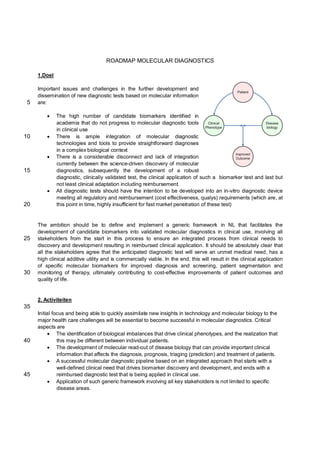
     Important issues and challenges in the further development and
     dissemination of new diagnostic tests based on molecular information
 5   are:

             The high number of candidate biomarkers identified in
              academia that do not progress to molecular diagnostic tools
              in clinical use
10           There is ample integration of molecular diagnostic
              technologies and tools to provide straightforward diagnoses
              in a complex biological context
             There is a considerable disconnect and lack of integration
              currently between the science-driven discovery of molecular
15            diagnostics, subsequently the development of a robust
              diagnostic, clinically validated test, the clinical application of such a biomarker test and last but
              not least clinical adaptation including reimbursement.
             All diagnostic tests should have the intention to be developed into an in-vitro diagnostic device
              meeting all regulatory and reimbursement (cost effectiveness, qualys) requirements (which are, at
20            this point in time, highly insufficient for fast market penetration of these test)


     The ambition should be to define and implement a generic framework in NL that facilitates the
     development of candidate biomarkers into validated molecular diagnostics in clinical use, involving all
25   stakeholders from the start in this process to ensure an integrated process from clinical needs to
     discovery and development resulting in reimbursed clinical application. It should be absolutely clear that
     all the stakeholders agree that the anticipated diagnostic test will serve an unmet medical need, has a
     high clinical additive utility and is commercially viable. In the end, this will result in the clinical application
     of specific molecular biomarkers for improved diagnosis and screening, patient segmentation and
30   monitoring of therapy, ultimately contributing to cost-effective improvements of patient outcomes and
     quality of life.


     2. Activiteiten
35
     Initial focus and being able to quickly assimilate new insights in technology and molecular biology to the
     major health care challenges will be essential to become successful in molecular diagnostics. Critical
     aspects are
           The identification of biological imbalances that drive clinical phenotypes, and the realization that
40             this may be different between individual patients.
           The development of molecular read-out of disease biology that can provide important clinical
               information that affects the diagnosis, prognosis, triaging (prediction) and treatment of patients.
           A successful molecular diagnostic pipeline based on an integrated approach that starts with a
               well-defined clinical need that drives biomarker discovery and development, and ends with a
45             reimbursed diagnostic test that is being applied in clinical use.
           Application of such generic framework involving all key stakeholders is not limited to specific
               disease areas.
ROADMAP MOLECULAR DIAGNOSTICS

            Molecular diagnostic read-out methods include a variety of technology platforms including e.g.
             simple laboratory tests and high-content imaging modalities.
50          Biomarker based diagnostic tests hold great promise for increasing cost-effectiveness in
             healthcare by facilitating personalized therapies


55

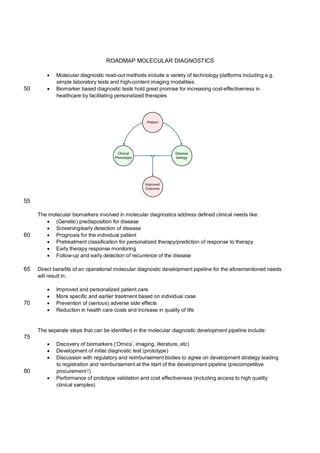
     The molecular biomarkers involved in molecular diagnostics address defined clinical needs like:
         (Genetic) predisposition for disease
         Screening/early detection of disease
60       Prognosis for the individual patient
         Pretreatment classification for personalized therapy/prediction of response to therapy
         Early therapy response monitoring
         Follow-up and early detection of recurrence of the disease

65   Direct benefits of an operational molecular diagnostic development pipeline for the aforementioned needs
     will result in:

            Improved and personalized patient care
            More specific and earlier treatment based on individual case
70          Prevention of (serious) adverse side effects
            Reduction in health care costs and increase in quality of life


     The separate steps that can be identified in the molecular diagnostic development pipeline include:
75
            Discovery of biomarkers (‘Omics’, imaging, literature, etc)
            Development of initial diagnostic test (prototype)
            Discussion with regulatory and reimbursement bodies to agree on development strategy leading
             to registration and reimbursement at the start of the development pipeline (precompetitive
80           procurement !)
            Performance of prototype validation and cost effectiveness (including access to high quality
             clinical samples)
ROADMAP MOLECULAR DIAGNOSTICS

               Optimization of the prototype and development of the full (IVD) diagnostic test that meets
                regulatory requirements
 85            Analytical and clinical validation of diagnostic test
               Standardized application in clinical setting


 90   The process to convert these steps into one integrated pipeline include:

               Define and standardize the molecular diagnostic development pipeline from discovery to a
                reimbursed clinical service that will contribute to a cost effective health solution
               Involve key stakeholders in building such integrated pipeline
 95            Ensure early buy-in of end users (patients, clinicians, health care insurance)
               Support particularly those projects that demonstrate the added value in society

      The required conditions and enabling technologies are:

100            Accessible collections of well-defined biosamples (biobanks)
               Accessible data sets with clinical/phenotype annotations
               Appropriate and accepted molecular read-out technologies
               Facilitating IT infrastructure
               Appropriate Quality Assurance
105            Availability of In Vitro Diagnostic development and production capabilities

      Besides the technical challenge in Molecular Diagnostics to obtain the “highest level of information from
      the smallest amount of sample”, the major roadblocks for an attractive R&D “ecosystem” are
      predominantly related to guidelines, inappropriate or lacking regulations and a reimbursement system
110   unable to accommodate the evaluation and implementation of complex molecular diagnostic products.

      Ultimately, the compelling arguments for increased investments in Molecular Diagnostics and the
      rationale for its use are :

115            Cost containment by early detection allowing secondary prevention and early treatment of less
                advanced (and more costly) disease states
               Keeping patients as active society members (labor participation) for longer time
               Defining target population avoids unnecessary treatment and prevents toxicity from treatment
               Monitoring results avoids unnecessary continuation of ineffective treatment and also avoids Rx
120             related complications
               Improve quality of life


      3. Case
125
      A. Prioriteit

      Priority setting in this Roadmap is directly related to addressing a therapeutic area that has a high
      medical need for improved application of molecular diagnostics and should involve all parts of the
ROADMAP MOLECULAR DIAGNOSTICS

130   molecular diagnostic development pipeline with a phased but connected approach from discovery to
      application and implementation of effective healthcare solutions. An important aspect will be to use
      molecular diagnostics to bridge research to clinic, thus also reducing animal experimentation following 3V
      guide lines.

135   B. Sterktes

      Scientific landscape in Netherlands
      The public-private partnerships that have been operational in NL since 2006 have changed the mindset of
      researchers and industry towards an integrated team approach. Experts in their individual disciplines work
140   closely together towards an innovative solution that would not have been possible by the separate parts.
      Several groups have succeeded in creating highly effective multi- and cross disciplinary teams where
      industry meets academia. This is unique in the world.

      Technologies
145   Within these partnerships, much expertise has been built around basic research, biomaterials, clinical
      applications, shared infrastructure and enabling technologies (ESFRI (EATRIS, BBMRI. ELIXIR, ECRIN),
      PSI, PALGA, NGI centers, etc). The Netherlands has state-of-the-art molecular diagnostic activities
      closely integrated with clinical practice within the setting of the UMC’s and through the public-private
      partnership network. Based on a firm academic presence in molecular biology, a spectrum of small and
150   medium enterprises form an excellent industrial base for innovations focused on unmet clinical needs.
      Dutch research groups are highly productive in both application development and biological discovery.
      The continued development of technologies within the NGI technology centers and CTMM has brought
      the field to a level that allows molecular diagnostic development with methodologies that have proven to
      be robust.
155
      The implementation of this knowledge and technical capabilities to improve health in real life is still a
      major hurdle. Applied research institutes, the government, payers and patients should help implementing
      these findings. Provided that the molecular diagnostic development pipeline can now be extended to
      clinical care and reimbursement involving key stakeholders as we propose in this Roadmap, these
160   characteristics put the Netherlands in an excellent position to be an example worldwide of integrated
      applied diagnostic development.


165   5. Aansluiting

      There are direct links with other top sectors, e.g. High Tech Systems & Materials (nanomedicine) and
      DTL (enabling technologies)

170   Molecular diagnostics comprise the tools that enable improved biological and clinical research. As such,
      this Roadmap relates to many other disciplines in the Life Sciences and health Sector:
            Enabling technologies and infrastructure: application of technologies, biobanking, data analysis
              into the integrated molecular diagnostic development pipeline.
            Imaging and image guided therapies: application of the developed integrated molecular
175           diagnostic development pipeline into imaging applications in health care.
ROADMAP MOLECULAR DIAGNOSTICS

             ICT and clinical decision support: application of molecular diagnostic information into clinical
              decisions, supported by ICT e.g. electronic medical record, TraIT/DISC/DTL.
             Pharmacology & pharmacotherapy, Regenerative medicine, Nutrition & health: flow of candidate
              biomarkers into the integrated molecular diagnostic development pipeline to mature into robust
180           tests that support research in these Roadmaps
             Health economics: application of health technology assessment to support selection of those
              therapeutic areas based on calculated costs and effects

      Many different stakeholders are directly involved in and impacted by the development and implementation
185   of molecular diagnostics: Nederlandse Hartstichting (NHS), Koningin Wilhelmina Fonds (KWF) , Diabetes
      fonds, Nierstichting, Rheumafonds, etc.

      A large number of on-going public-private partnerships within the existing TTI’s (CTMM, BMM, TI Pharma)
      are engaged in all kind of activities directly related to Molecular Diagnostics. There is a need for further
190   coordination and integration between different programs that range from biomarker discovery to
      diagnostic assay development and implementation, particularly in the area of technology adoption and
      data handling (TraIT, DTL, NBIC, Parelsnoer, eSience).
      As indicated in the ‘Topsectorenplan’, several networks have been formed that focus on improving health
      and use molecular diagnostics as key drivers of change (e.g. Healthy Aging, Health Valley).
195   Other relevant initiatives comprise the TNO programs “Preventie enTherapie Opmaat” en “3V”, as
      supported by ministry of VWS, the ZonMw program Translational research and the NGI Pre-Seed
      program.

      Relevant European programs include Biomedical ESFRI programs for infrastructure (EATRIS, Elixir,
200   BBMRI), IMI (OpenPhacts, Portrait).

Roadmap Molecular Diagnostics

  • 1.
    ROADMAP MOLECULAR DIAGNOSTICS 1.Doel Important issues and challenges in the further development and dissemination of new diagnostic tests based on molecular information 5 are:  The high number of candidate biomarkers identified in academia that do not progress to molecular diagnostic tools in clinical use 10  There is ample integration of molecular diagnostic technologies and tools to provide straightforward diagnoses in a complex biological context  There is a considerable disconnect and lack of integration currently between the science-driven discovery of molecular 15 diagnostics, subsequently the development of a robust diagnostic, clinically validated test, the clinical application of such a biomarker test and last but not least clinical adaptation including reimbursement.  All diagnostic tests should have the intention to be developed into an in-vitro diagnostic device meeting all regulatory and reimbursement (cost effectiveness, qualys) requirements (which are, at 20 this point in time, highly insufficient for fast market penetration of these test) The ambition should be to define and implement a generic framework in NL that facilitates the development of candidate biomarkers into validated molecular diagnostics in clinical use, involving all 25 stakeholders from the start in this process to ensure an integrated process from clinical needs to discovery and development resulting in reimbursed clinical application. It should be absolutely clear that all the stakeholders agree that the anticipated diagnostic test will serve an unmet medical need, has a high clinical additive utility and is commercially viable. In the end, this will result in the clinical application of specific molecular biomarkers for improved diagnosis and screening, patient segmentation and 30 monitoring of therapy, ultimately contributing to cost-effective improvements of patient outcomes and quality of life. 2. Activiteiten 35 Initial focus and being able to quickly assimilate new insights in technology and molecular biology to the major health care challenges will be essential to become successful in molecular diagnostics. Critical aspects are  The identification of biological imbalances that drive clinical phenotypes, and the realization that 40 this may be different between individual patients.  The development of molecular read-out of disease biology that can provide important clinical information that affects the diagnosis, prognosis, triaging (prediction) and treatment of patients.  A successful molecular diagnostic pipeline based on an integrated approach that starts with a well-defined clinical need that drives biomarker discovery and development, and ends with a 45 reimbursed diagnostic test that is being applied in clinical use.  Application of such generic framework involving all key stakeholders is not limited to specific disease areas.
  • 2.
    ROADMAP MOLECULAR DIAGNOSTICS  Molecular diagnostic read-out methods include a variety of technology platforms including e.g. simple laboratory tests and high-content imaging modalities. 50  Biomarker based diagnostic tests hold great promise for increasing cost-effectiveness in healthcare by facilitating personalized therapies 55 The molecular biomarkers involved in molecular diagnostics address defined clinical needs like:  (Genetic) predisposition for disease  Screening/early detection of disease 60  Prognosis for the individual patient  Pretreatment classification for personalized therapy/prediction of response to therapy  Early therapy response monitoring  Follow-up and early detection of recurrence of the disease 65 Direct benefits of an operational molecular diagnostic development pipeline for the aforementioned needs will result in:  Improved and personalized patient care  More specific and earlier treatment based on individual case 70  Prevention of (serious) adverse side effects  Reduction in health care costs and increase in quality of life The separate steps that can be identified in the molecular diagnostic development pipeline include: 75  Discovery of biomarkers (‘Omics’, imaging, literature, etc)  Development of initial diagnostic test (prototype)  Discussion with regulatory and reimbursement bodies to agree on development strategy leading to registration and reimbursement at the start of the development pipeline (precompetitive 80 procurement !)  Performance of prototype validation and cost effectiveness (including access to high quality clinical samples)
  • 3.
    ROADMAP MOLECULAR DIAGNOSTICS  Optimization of the prototype and development of the full (IVD) diagnostic test that meets regulatory requirements 85  Analytical and clinical validation of diagnostic test  Standardized application in clinical setting 90 The process to convert these steps into one integrated pipeline include:  Define and standardize the molecular diagnostic development pipeline from discovery to a reimbursed clinical service that will contribute to a cost effective health solution  Involve key stakeholders in building such integrated pipeline 95  Ensure early buy-in of end users (patients, clinicians, health care insurance)  Support particularly those projects that demonstrate the added value in society The required conditions and enabling technologies are: 100  Accessible collections of well-defined biosamples (biobanks)  Accessible data sets with clinical/phenotype annotations  Appropriate and accepted molecular read-out technologies  Facilitating IT infrastructure  Appropriate Quality Assurance 105  Availability of In Vitro Diagnostic development and production capabilities Besides the technical challenge in Molecular Diagnostics to obtain the “highest level of information from the smallest amount of sample”, the major roadblocks for an attractive R&D “ecosystem” are predominantly related to guidelines, inappropriate or lacking regulations and a reimbursement system 110 unable to accommodate the evaluation and implementation of complex molecular diagnostic products. Ultimately, the compelling arguments for increased investments in Molecular Diagnostics and the rationale for its use are : 115  Cost containment by early detection allowing secondary prevention and early treatment of less advanced (and more costly) disease states  Keeping patients as active society members (labor participation) for longer time  Defining target population avoids unnecessary treatment and prevents toxicity from treatment  Monitoring results avoids unnecessary continuation of ineffective treatment and also avoids Rx 120 related complications  Improve quality of life 3. Case 125 A. Prioriteit Priority setting in this Roadmap is directly related to addressing a therapeutic area that has a high medical need for improved application of molecular diagnostics and should involve all parts of the
  • 4.
    ROADMAP MOLECULAR DIAGNOSTICS 130 molecular diagnostic development pipeline with a phased but connected approach from discovery to application and implementation of effective healthcare solutions. An important aspect will be to use molecular diagnostics to bridge research to clinic, thus also reducing animal experimentation following 3V guide lines. 135 B. Sterktes Scientific landscape in Netherlands The public-private partnerships that have been operational in NL since 2006 have changed the mindset of researchers and industry towards an integrated team approach. Experts in their individual disciplines work 140 closely together towards an innovative solution that would not have been possible by the separate parts. Several groups have succeeded in creating highly effective multi- and cross disciplinary teams where industry meets academia. This is unique in the world. Technologies 145 Within these partnerships, much expertise has been built around basic research, biomaterials, clinical applications, shared infrastructure and enabling technologies (ESFRI (EATRIS, BBMRI. ELIXIR, ECRIN), PSI, PALGA, NGI centers, etc). The Netherlands has state-of-the-art molecular diagnostic activities closely integrated with clinical practice within the setting of the UMC’s and through the public-private partnership network. Based on a firm academic presence in molecular biology, a spectrum of small and 150 medium enterprises form an excellent industrial base for innovations focused on unmet clinical needs. Dutch research groups are highly productive in both application development and biological discovery. The continued development of technologies within the NGI technology centers and CTMM has brought the field to a level that allows molecular diagnostic development with methodologies that have proven to be robust. 155 The implementation of this knowledge and technical capabilities to improve health in real life is still a major hurdle. Applied research institutes, the government, payers and patients should help implementing these findings. Provided that the molecular diagnostic development pipeline can now be extended to clinical care and reimbursement involving key stakeholders as we propose in this Roadmap, these 160 characteristics put the Netherlands in an excellent position to be an example worldwide of integrated applied diagnostic development. 165 5. Aansluiting There are direct links with other top sectors, e.g. High Tech Systems & Materials (nanomedicine) and DTL (enabling technologies) 170 Molecular diagnostics comprise the tools that enable improved biological and clinical research. As such, this Roadmap relates to many other disciplines in the Life Sciences and health Sector:  Enabling technologies and infrastructure: application of technologies, biobanking, data analysis into the integrated molecular diagnostic development pipeline.  Imaging and image guided therapies: application of the developed integrated molecular 175 diagnostic development pipeline into imaging applications in health care.
  • 5.
    ROADMAP MOLECULAR DIAGNOSTICS  ICT and clinical decision support: application of molecular diagnostic information into clinical decisions, supported by ICT e.g. electronic medical record, TraIT/DISC/DTL.  Pharmacology & pharmacotherapy, Regenerative medicine, Nutrition & health: flow of candidate biomarkers into the integrated molecular diagnostic development pipeline to mature into robust 180 tests that support research in these Roadmaps  Health economics: application of health technology assessment to support selection of those therapeutic areas based on calculated costs and effects Many different stakeholders are directly involved in and impacted by the development and implementation 185 of molecular diagnostics: Nederlandse Hartstichting (NHS), Koningin Wilhelmina Fonds (KWF) , Diabetes fonds, Nierstichting, Rheumafonds, etc. A large number of on-going public-private partnerships within the existing TTI’s (CTMM, BMM, TI Pharma) are engaged in all kind of activities directly related to Molecular Diagnostics. There is a need for further 190 coordination and integration between different programs that range from biomarker discovery to diagnostic assay development and implementation, particularly in the area of technology adoption and data handling (TraIT, DTL, NBIC, Parelsnoer, eSience). As indicated in the ‘Topsectorenplan’, several networks have been formed that focus on improving health and use molecular diagnostics as key drivers of change (e.g. Healthy Aging, Health Valley). 195 Other relevant initiatives comprise the TNO programs “Preventie enTherapie Opmaat” en “3V”, as supported by ministry of VWS, the ZonMw program Translational research and the NGI Pre-Seed program. Relevant European programs include Biomedical ESFRI programs for infrastructure (EATRIS, Elixir, 200 BBMRI), IMI (OpenPhacts, Portrait).