Environmental Scanning and
Opportunity Analysis
Environmental scanning
 The monitoring, evaluating, and disseminating
of information from the external and internal
environments to key people within the
corporation to avoid strategic surprise and
ensure the long-term health of the firm.
Environmental scanning
 Environmental scanning is a concept from
business management by which businesses
gather information from the environment, to
better achieve a sustainable competitive
advantage.
 To sustain competitive advantage the company
must also respond to the information gathered
from environmental scanning by altering its
strategies and plans when the need arises.
External Environmental Variables:
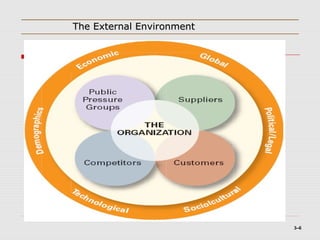
Societal / community environmentSocietal / community environment:
General forces that do not directly touch
on the short-run activities but often
influence its long-run decisions.
External Environmental Variables
Task environmentTask environment:
Those elements or groups that directly
affect the corporation and, in turn, are
affected by it. The task environment is
the industry within which that firm
operates.
3–6
The External EnvironmentThe External Environment
External Environmental Variables
Industry analysisIndustry analysis:
An in-depth examination of key factors
within a corporation’s task environment.
External Environmental Variables
Societal environment forcesSocietal environment forces:
 Economic forces
 Regulate the exchange of materials,
money, energy, and information
 Technological forces
 Generate problem-solving inventions
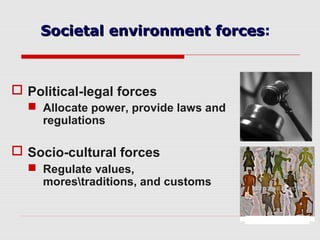
 Political-legal forces
 Allocate power, provide laws and
regulations
 Socio-cultural forces
 Regulate values,
morestraditions, and customs
Societal environment forcesSocietal environment forces:
Societal Environment
Important Variables
Economic
GDP trends
Interest rates
Money supply
Inflation rates
Unemployment levels
Wage/price controls
Devaluation/revaluation
Energy availability and
cost
Disposable and
discretionary income
Technological
Total government
spending for R&D
Total industry
spending for R&D
Focus of technological
efforts
Patent protection
New products
New developments in
technology transfer
from lab to
marketplace
Productivity
improvements
through automation
Political-Legal
Antitrust regulations
Environmental
protection laws
Tax laws
Special incentives
Foreign trade
regulations
Attitudes toward
foreign companies
Laws on hiring and
promotion
Stability of
government
Sociocultural
Lifestyle changes
Career expectations
Consumer activism
Rate of family
formation
Growth rate of
population
Age distribution of
population
Regional shifts in
population
Life expectancies
Birth rates
Prentice Hall, 2000 Chapter 3 11
Scanning the External Environment
Analysis of Societal Environment
Economic, Sociocultural, Technological, Political-Legal Factors
Selection of
Strategic Factors
• Opportunities
• Threats
Market
Analysis
Competitor
Analysis
Supplier
Analysis
Governmental
Analysis
Interest Group
Analysis
Community
Analysis
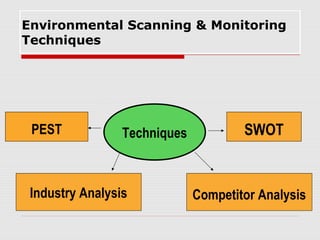
Environmental Scanning & Monitoring
Techniques
SWOT
Industry Analysis
Techniques
Competitor Analysis
PEST
Industry Analysis
Industry
A group of firms producing a similar
product or service, such as soft drinks,
health services or financial services.
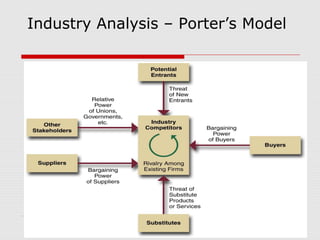
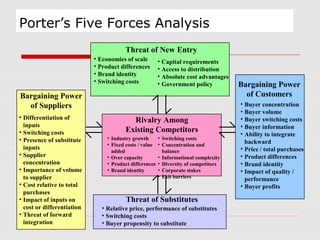
Industry Analysis – Porter’s Model
Threat of New Entry
Rivalry Among
Existing Competitors
Bargaining Power
of Customers
Threat of Substitutes
Bargaining Power
of Suppliers
• Economies of scale
• Product differences
• Brand identity
• Switching costs
• Capital requirements
• Access to distribution
• Absolute cost advantages
• Government policy
• Relative price, performance of substitutes
• Switching costs
• Buyer propensity to substitute
• Industry growth
• Fixed costs / value
added
• Over capacity
• Product differences
• Brand identity
• Switching costs
• Concentration and
balance
• Informational complexity
• Diversity of competitors
• Corporate stakes
• Exit barriers
• Differentiation of
inputs
• Switching costs
• Presence of substitute
inputs
• Supplier
concentration
• Importance of volume
to supplier
• Cost relative to total
purchases
• Impact of inputs on
cost or differentiation
• Threat of forward
integration
• Buyer concentration
• Buyer volume
• Buyer switching costs
• Buyer information
• Ability to integrate
backward
• Price / total purchases
• Product differences
• Brand identity
• Impact of quality /
performance
• Buyer profits
Porter’s Five Forces Analysis
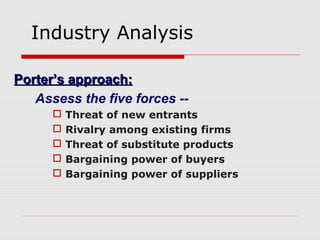
Industry Analysis
Porter’s approach:Porter’s approach:
Assess the five forces --
 Threat of new entrants
 Rivalry among existing firms
 Threat of substitute products
 Bargaining power of buyers
 Bargaining power of suppliers
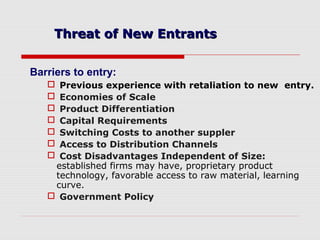
Barriers to entry:
 Previous experience with retaliation to new entry.
 Economies of Scale
 Product Differentiation
 Capital Requirements
 Switching Costs to another suppler
 Access to Distribution Channels
 Cost Disadvantages Independent of Size:
established firms may have, proprietary product
technology, favorable access to raw material, learning
curve.
 Government Policy
Threat of New EntrantsThreat of New Entrants
The threat of new entry
(competitors).
 New entries expand industry’s productive
capacity.
 “Unless the market grows, new entries
intensifies the fight for market share”.
 The result is prices go down which, lowering
industry profitability.
Rivalry Among Existing FirmsRivalry Among Existing Firms
 Signs of strong rivalry
 Rivalry is intense when:
 The industry is growing slowly and/or has
excess capacity
 The industry has a high fixed-costs structure
(economies of scale are necessary and market
share an absolute must)
 The products or services are undifferentiated
Rivalry Among Existing FirmsRivalry Among Existing Firms
 More intense when:
 There is a large number of competitors
(note: fragmented and consolidated
industries)
 The barriers to exit the industry are high
(e.g. assets that do not have other uses)
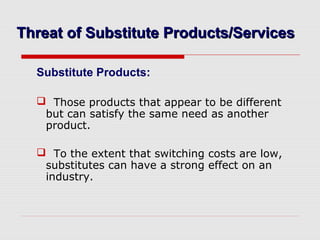
Threat of Substitute Products/ServicesThreat of Substitute Products/Services
Substitute Products:
 Those products that appear to be different
but can satisfy the same need as another
product.
 To the extent that switching costs are low,
substitutes can have a strong effect on an
industry.
Threat of Substitute Products/ServicesThreat of Substitute Products/Services
 Substitutes are Powerful when:
 price of substitute product is competitive /
comparable
 performance of substitute product is
similar
 there are availability/delivery problems
among firms in the industry
 the substitute is more technologically
advanced
Bargaining Power of BuyersBargaining Power of Buyers
Buyer is powerful when:
 Buyer purchases large proportion of seller’s
products
 Buyer has the potential to integrate backward
 Alternative suppliers are plentiful
 Changing suppliers costs very little
 Purchased product represents a high
percentage of a buyer’s costs
 Buyer earns low profits
 Purchased product is unimportant to the final
quality or price of a buyer’s products
Bargaining Power of SuppliersBargaining Power of Suppliers
Supplier is powerful when:
 Supplier industry is dominated by a few
companies but sells to many
 Its product is unique and/or has high switching
costs
 Substitutes are not readily available
 Suppliers are able to integrate forward and
compete directly with present customer
 The buyer purchases in small quantities
Level of attraction of competitive
environment
 The competitive environment is
relatively unattractive when:
 Rivalry is strong
 Entry barriers are low and entry is likely
 Competition from substitutes is strong
 Suppliers and customers have
considerable bargaining power
Industry Analysis of Indian
Telephone Industry.
Telecommunication in India.
 Indian Telecommunication industry, with
about 565.82 million phone connections (June
2010).
 In 2008 it was about 325.2 millions.
 The growth is expected to continue and the
total projected subscribers in 2010 will cross
650 million.
The breakup of wireless subscriber base in India as of May 2010 is given below.]
Operator
Subscriber
base
Bharti Airtel 99,549,208
Vodafone Essar 74,080,707
BSNL 53,598,591
Idea Cellular 41,243,253
Aircel 20,685,711
MTNL 4,568,269
BPL 2,256,862
Spice Telecom 4,235,023
Reliance
Communications
77,223,264
HFCL Infotel 382,602
Sistema Shyam 936,189
Tata Teleservices 36,486,763
Threat of entrants
 High cost for setting up infrastructure.
 Brand name of existing players.
 Spectrum license cost.
 Minimum requirement of number of
towers demanded by the govt. of India.
Bargaining power of Buyers.
 Price sensitive customers.
 High competition.
 Low switching costs (MNP Services).
Bargaining Power of the suppliers.
 Large number of suppliers.
 Shared infrastructure.
 Low govt. influence on the
industry.
Rivalry among Competitors
 High Fixed cost.
 Exit barriers.
 Price wars.
 Less time to get advantages of
innovation.
Availability of substitutes
 A lot of substitutes are available;
like postage, internet etc. But they are
not the perfect substitutes.
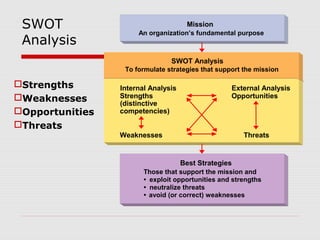
SWOT Analysis
SWOT
Analysis
Strengths
Weaknesses
Opportunities
Threats
Mission
An organization’s fundamental purpose
Best Strategies
SWOT Analysis
To formulate strategies that support the mission
Those that support the mission and
• exploit opportunities and strengths
• neutralize threats
• avoid (or correct) weaknesses
Internal Analysis
Strengths
(distinctive
competencies)
Weaknesses Threats
External Analysis
Opportunities
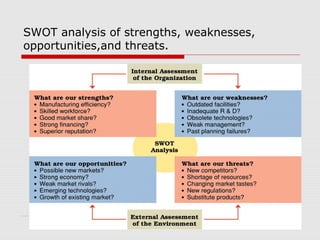
SWOT analysis of strengths, weaknesses,
opportunities,and threats.
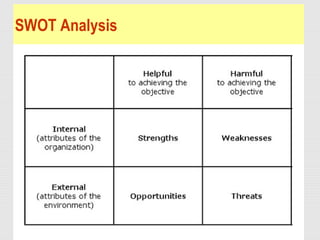
SWOT Analysis
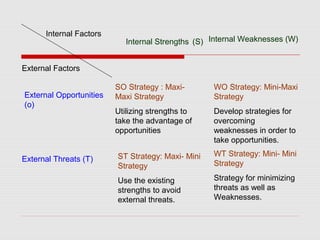
TOWS Matrix
Internal Factors
External Factors
Internal Strengths (S) Internal Weaknesses (W)
External Opportunities
(o)
External Threats (T)
SO Strategy : Maxi-
Maxi Strategy
Utilizing strengths to
take the advantage of
opportunities
ST Strategy: Maxi- Mini
Strategy
Use the existing
strengths to avoid
external threats.
WT Strategy: Mini- Mini
Strategy
Strategy for minimizing
threats as well as
Weaknesses.
WO Strategy: Mini-Maxi
Strategy
Develop strategies for
overcoming
weaknesses in order to
take opportunities.
PEST analysis
 Political factors
 Economic factors
 Socio-cultural factors
 Technological factors
Political/legal
 Monopolies
 Environmental protection laws
 Taxation policy
 Employment laws
 Government policy
 Legislation
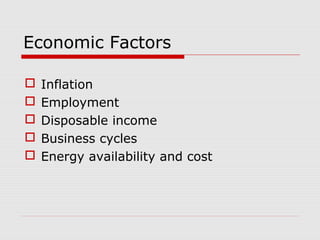
Economic Factors
 Inflation
 Employment
 Disposable income
 Business cycles
 Energy availability and cost
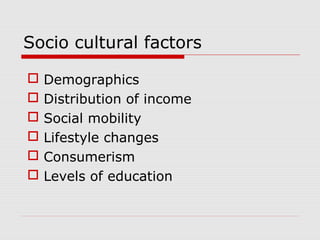
Socio cultural factors
 Demographics
 Distribution of income
 Social mobility
 Lifestyle changes
 Consumerism
 Levels of education
Technological
 New discoveries and innovations
 Speed of technology transfer
 Rates of obsolescence
 Internet
 Information technology
Industry Analysis
Strategic GroupsStrategic Groups
 Defined:
A set of business units or firms that
pursue similar strategies with similar
resources.
Strategic group analysis
 “Aims to identify organizations with
similar strategic characteristics,
following similar strategies or
competing on similar bases”.
Why strategic group analysis is
important?
 Identify most direct competitor.
 On what basis the competitors are
competing on.
 It raises the question of how possible
to move from one group to another.
Strategic TypesStrategic Types
 It is used to analyze the level of competitive
intensity within a particular industry.
 Defined:
Category of firms based on a common
strategic orientation and a combination of
structure, culture, and processes consistent
with that strategy.
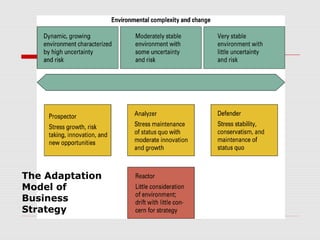
 Categorized by one of four general strategic
orientations
 Defenders
Companies with a limited product line; focus on
improving efficiency of current operations
Strategic TypesStrategic Types
 Prospectors:
 Companies with fairly broad product lines; focus on
product innovation and market opportunities.
 Analyzers:
 Corporations that operate in at least two different
product-market areas – one stable and one variable.
 Reactors:
 Corporations that lack a consistent strategy-structure-
culture relationship.
The Adaptation
Model of
Business
Strategy

Environmental scanning

  • 1.
  • 2.
    Environmental scanning  Themonitoring, evaluating, and disseminating of information from the external and internal environments to key people within the corporation to avoid strategic surprise and ensure the long-term health of the firm.
  • 3.
    Environmental scanning  Environmentalscanning is a concept from business management by which businesses gather information from the environment, to better achieve a sustainable competitive advantage.  To sustain competitive advantage the company must also respond to the information gathered from environmental scanning by altering its strategies and plans when the need arises.
  • 4.
    External Environmental Variables: Societal/ community environmentSocietal / community environment: General forces that do not directly touch on the short-run activities but often influence its long-run decisions.
  • 5.
    External Environmental Variables TaskenvironmentTask environment: Those elements or groups that directly affect the corporation and, in turn, are affected by it. The task environment is the industry within which that firm operates.
  • 6.
  • 7.
    External Environmental Variables IndustryanalysisIndustry analysis: An in-depth examination of key factors within a corporation’s task environment.
  • 8.
    External Environmental Variables Societalenvironment forcesSocietal environment forces:  Economic forces  Regulate the exchange of materials, money, energy, and information  Technological forces  Generate problem-solving inventions
  • 9.
     Political-legal forces Allocate power, provide laws and regulations  Socio-cultural forces  Regulate values, morestraditions, and customs Societal environment forcesSocietal environment forces:
  • 10.
    Societal Environment Important Variables Economic GDPtrends Interest rates Money supply Inflation rates Unemployment levels Wage/price controls Devaluation/revaluation Energy availability and cost Disposable and discretionary income Technological Total government spending for R&D Total industry spending for R&D Focus of technological efforts Patent protection New products New developments in technology transfer from lab to marketplace Productivity improvements through automation Political-Legal Antitrust regulations Environmental protection laws Tax laws Special incentives Foreign trade regulations Attitudes toward foreign companies Laws on hiring and promotion Stability of government Sociocultural Lifestyle changes Career expectations Consumer activism Rate of family formation Growth rate of population Age distribution of population Regional shifts in population Life expectancies Birth rates
  • 11.
    Prentice Hall, 2000Chapter 3 11 Scanning the External Environment Analysis of Societal Environment Economic, Sociocultural, Technological, Political-Legal Factors Selection of Strategic Factors • Opportunities • Threats Market Analysis Competitor Analysis Supplier Analysis Governmental Analysis Interest Group Analysis Community Analysis
  • 12.
    Environmental Scanning &Monitoring Techniques SWOT Industry Analysis Techniques Competitor Analysis PEST
  • 13.
    Industry Analysis Industry A groupof firms producing a similar product or service, such as soft drinks, health services or financial services.
  • 14.
    Industry Analysis –Porter’s Model
  • 15.
    Threat of NewEntry Rivalry Among Existing Competitors Bargaining Power of Customers Threat of Substitutes Bargaining Power of Suppliers • Economies of scale • Product differences • Brand identity • Switching costs • Capital requirements • Access to distribution • Absolute cost advantages • Government policy • Relative price, performance of substitutes • Switching costs • Buyer propensity to substitute • Industry growth • Fixed costs / value added • Over capacity • Product differences • Brand identity • Switching costs • Concentration and balance • Informational complexity • Diversity of competitors • Corporate stakes • Exit barriers • Differentiation of inputs • Switching costs • Presence of substitute inputs • Supplier concentration • Importance of volume to supplier • Cost relative to total purchases • Impact of inputs on cost or differentiation • Threat of forward integration • Buyer concentration • Buyer volume • Buyer switching costs • Buyer information • Ability to integrate backward • Price / total purchases • Product differences • Brand identity • Impact of quality / performance • Buyer profits Porter’s Five Forces Analysis
  • 16.
    Industry Analysis Porter’s approach:Porter’sapproach: Assess the five forces --  Threat of new entrants  Rivalry among existing firms  Threat of substitute products  Bargaining power of buyers  Bargaining power of suppliers
  • 17.
    Barriers to entry: Previous experience with retaliation to new entry.  Economies of Scale  Product Differentiation  Capital Requirements  Switching Costs to another suppler  Access to Distribution Channels  Cost Disadvantages Independent of Size: established firms may have, proprietary product technology, favorable access to raw material, learning curve.  Government Policy Threat of New EntrantsThreat of New Entrants
  • 18.
    The threat ofnew entry (competitors).  New entries expand industry’s productive capacity.  “Unless the market grows, new entries intensifies the fight for market share”.  The result is prices go down which, lowering industry profitability.
  • 19.
    Rivalry Among ExistingFirmsRivalry Among Existing Firms  Signs of strong rivalry  Rivalry is intense when:  The industry is growing slowly and/or has excess capacity  The industry has a high fixed-costs structure (economies of scale are necessary and market share an absolute must)  The products or services are undifferentiated
  • 20.
    Rivalry Among ExistingFirmsRivalry Among Existing Firms  More intense when:  There is a large number of competitors (note: fragmented and consolidated industries)  The barriers to exit the industry are high (e.g. assets that do not have other uses)
  • 21.
    Threat of SubstituteProducts/ServicesThreat of Substitute Products/Services Substitute Products:  Those products that appear to be different but can satisfy the same need as another product.  To the extent that switching costs are low, substitutes can have a strong effect on an industry.
  • 22.
    Threat of SubstituteProducts/ServicesThreat of Substitute Products/Services  Substitutes are Powerful when:  price of substitute product is competitive / comparable  performance of substitute product is similar  there are availability/delivery problems among firms in the industry  the substitute is more technologically advanced
  • 23.
    Bargaining Power ofBuyersBargaining Power of Buyers Buyer is powerful when:  Buyer purchases large proportion of seller’s products  Buyer has the potential to integrate backward  Alternative suppliers are plentiful  Changing suppliers costs very little  Purchased product represents a high percentage of a buyer’s costs  Buyer earns low profits  Purchased product is unimportant to the final quality or price of a buyer’s products
  • 24.
    Bargaining Power ofSuppliersBargaining Power of Suppliers Supplier is powerful when:  Supplier industry is dominated by a few companies but sells to many  Its product is unique and/or has high switching costs  Substitutes are not readily available  Suppliers are able to integrate forward and compete directly with present customer  The buyer purchases in small quantities
  • 25.
    Level of attractionof competitive environment  The competitive environment is relatively unattractive when:  Rivalry is strong  Entry barriers are low and entry is likely  Competition from substitutes is strong  Suppliers and customers have considerable bargaining power
  • 26.
    Industry Analysis ofIndian Telephone Industry.
  • 27.
    Telecommunication in India. Indian Telecommunication industry, with about 565.82 million phone connections (June 2010).  In 2008 it was about 325.2 millions.  The growth is expected to continue and the total projected subscribers in 2010 will cross 650 million.
  • 28.
    The breakup ofwireless subscriber base in India as of May 2010 is given below.] Operator Subscriber base Bharti Airtel 99,549,208 Vodafone Essar 74,080,707 BSNL 53,598,591 Idea Cellular 41,243,253 Aircel 20,685,711 MTNL 4,568,269 BPL 2,256,862 Spice Telecom 4,235,023 Reliance Communications 77,223,264 HFCL Infotel 382,602 Sistema Shyam 936,189 Tata Teleservices 36,486,763
  • 29.
    Threat of entrants High cost for setting up infrastructure.  Brand name of existing players.  Spectrum license cost.  Minimum requirement of number of towers demanded by the govt. of India.
  • 30.
    Bargaining power ofBuyers.  Price sensitive customers.  High competition.  Low switching costs (MNP Services).
  • 31.
    Bargaining Power ofthe suppliers.  Large number of suppliers.  Shared infrastructure.  Low govt. influence on the industry.
  • 32.
    Rivalry among Competitors High Fixed cost.  Exit barriers.  Price wars.  Less time to get advantages of innovation.
  • 33.
    Availability of substitutes A lot of substitutes are available; like postage, internet etc. But they are not the perfect substitutes.
  • 34.
  • 35.
    SWOT Analysis Strengths Weaknesses Opportunities Threats Mission An organization’s fundamentalpurpose Best Strategies SWOT Analysis To formulate strategies that support the mission Those that support the mission and • exploit opportunities and strengths • neutralize threats • avoid (or correct) weaknesses Internal Analysis Strengths (distinctive competencies) Weaknesses Threats External Analysis Opportunities
  • 36.
    SWOT analysis ofstrengths, weaknesses, opportunities,and threats.
  • 37.
  • 38.
  • 39.
    Internal Factors External Factors InternalStrengths (S) Internal Weaknesses (W) External Opportunities (o) External Threats (T) SO Strategy : Maxi- Maxi Strategy Utilizing strengths to take the advantage of opportunities ST Strategy: Maxi- Mini Strategy Use the existing strengths to avoid external threats. WT Strategy: Mini- Mini Strategy Strategy for minimizing threats as well as Weaknesses. WO Strategy: Mini-Maxi Strategy Develop strategies for overcoming weaknesses in order to take opportunities.
  • 40.
    PEST analysis  Politicalfactors  Economic factors  Socio-cultural factors  Technological factors
  • 41.
    Political/legal  Monopolies  Environmentalprotection laws  Taxation policy  Employment laws  Government policy  Legislation
  • 42.
    Economic Factors  Inflation Employment  Disposable income  Business cycles  Energy availability and cost
  • 43.
    Socio cultural factors Demographics  Distribution of income  Social mobility  Lifestyle changes  Consumerism  Levels of education
  • 44.
    Technological  New discoveriesand innovations  Speed of technology transfer  Rates of obsolescence  Internet  Information technology
  • 45.
    Industry Analysis Strategic GroupsStrategicGroups  Defined: A set of business units or firms that pursue similar strategies with similar resources.
  • 46.
    Strategic group analysis “Aims to identify organizations with similar strategic characteristics, following similar strategies or competing on similar bases”.
  • 47.
    Why strategic groupanalysis is important?  Identify most direct competitor.  On what basis the competitors are competing on.  It raises the question of how possible to move from one group to another.
  • 48.
    Strategic TypesStrategic Types It is used to analyze the level of competitive intensity within a particular industry.  Defined: Category of firms based on a common strategic orientation and a combination of structure, culture, and processes consistent with that strategy.
  • 49.
     Categorized byone of four general strategic orientations  Defenders Companies with a limited product line; focus on improving efficiency of current operations Strategic TypesStrategic Types
  • 50.
    Strategic TypesStrategic Types Prospectors:  Companies with fairly broad product lines; focus on product innovation and market opportunities.  Analyzers:  Corporations that operate in at least two different product-market areas – one stable and one variable.  Reactors:  Corporations that lack a consistent strategy-structure- culture relationship.
  • 51.

Editor's Notes

  • #16 There’s a laundry list of things to consider under each force But the key is to sort through the list quickly and identify the important factors, explore those in depth