Strategy And Performance Competing Through Competences John Mills
Strategy And Performance Competing Through Competences John Mills
Strategy And Performance Competing Through Competences John Mills
Strategy And Performance Competing Through Competences John Mills
Strategy And Performance Competing Through Competences John Mills
1.
Strategy And PerformanceCompeting Through
Competences John Mills download
https://ebookbell.com/product/strategy-and-performance-competing-
through-competences-john-mills-1639730
Explore and download more ebooks at ebookbell.com
2.
Here are somerecommended products that we believe you will be
interested in. You can click the link to download.
Strategy And Performance Of Water Supply And Sanitation Providers
Unescoihe Phd Thesis 1st Edition Marco Schouten
https://ebookbell.com/product/strategy-and-performance-of-water-
supply-and-sanitation-providers-unescoihe-phd-thesis-1st-edition-
marco-schouten-2214958
Strategy And Performance Of Knowledge Flow 1st Ed Yu Yu Yao Chen
https://ebookbell.com/product/strategy-and-performance-of-knowledge-
flow-1st-ed-yu-yu-yao-chen-7149830
Contemporary Issues In International Business Institutions Strategy
And Performance 1st Edition Davide Castellani
https://ebookbell.com/product/contemporary-issues-in-international-
business-institutions-strategy-and-performance-1st-edition-davide-
castellani-6989132
Corporate Strategy Remastered I High Performance Strategy And
Leadership In A Volatile Disrupted World 1st Edition Paul Hunter
https://ebookbell.com/product/corporate-strategy-remastered-i-high-
performance-strategy-and-leadership-in-a-volatile-disrupted-world-1st-
edition-paul-hunter-33997922
3.
Internationalism And ModeSwitching Performance Strategy And Timing
2012th Edition Uwe Sachse
https://ebookbell.com/product/internationalism-and-mode-switching-
performance-strategy-and-timing-2012th-edition-uwe-sachse-2483304
Effects Of Injection Parameters And Injection Strategy On Emissions
And Performance Of A Twostroke Opposedpiston Diesel Engine Saeid
Shirvani
https://ebookbell.com/product/effects-of-injection-parameters-and-
injection-strategy-on-emissions-and-performance-of-a-twostroke-
opposedpiston-diesel-engine-saeid-shirvani-34396924
Riskbased Performance Management Integrating Strategy And Risk
Management Andrew Smart
https://ebookbell.com/product/riskbased-performance-management-
integrating-strategy-and-risk-management-andrew-smart-5378696
Strategic Planning And Performance Management Develop And Measure A
Winning Strategy Graham Kenny
https://ebookbell.com/product/strategic-planning-and-performance-
management-develop-and-measure-a-winning-strategy-graham-kenny-1638020
Strategy Structure And Performance In A Transition Economy An
Institutional Perspective On Configurations In Russia 1st Edition
Tobias Weigl Auth
https://ebookbell.com/product/strategy-structure-and-performance-in-a-
transition-economy-an-institutional-perspective-on-configurations-in-
russia-1st-edition-tobias-weigl-auth-4268488
v
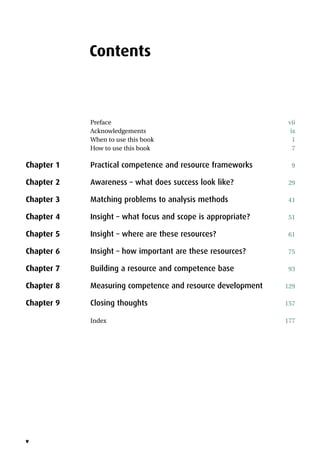
Contents
Preface vii
Acknowledgements ix
Whento use this book 1
How to use this book 7
Chapter 1 Practical competence and resource frameworks 9
Chapter 2 Awareness – what does success look like? 29
Chapter 3 Matching problems to analysis methods 41
Chapter 4 Insight – what focus and scope is appropriate? 51
Chapter 5 Insight – where are these resources? 61
Chapter 6 Insight – how important are these resources? 75
Chapter 7 Building a resource and competence base 93
Chapter 8 Measuring competence and resource development 129
Chapter 9 Closing thoughts 157
Index 177
13.
Preface
This book isdesigned to help company managers and directors make
their business more profitable and longer lived. Why longer lived?
Customers are fickle and markets can change very quickly. So for a
company to have long life it must be able to survive unexpected and
severe knocks from markets. From our experience in helping many
firms to develop their strategy those that concentrate solely on mar-
ket/customer perspectives tend to produce business objectives of no
more than one to two years duration. Firms that use a resource-based
and a market/customer perspective produce similar plans but they also
produce longer-lived objectives for building resources and strengths
often applicable to a wider range of markets than those currently being
exploited. They seem more aware of the fundamental drivers of busi-
ness performance in any market and so are better prepared to face
crises in their current markets.
Practically all firms base their business objectives on satisfying their
customer needs. This is a valuable initial approach for aligning prod-
ucts, services and objectives with existing markets. It is based on the
opportunities and threats half of a SWOT1 analysis. However, most firms
neglect the other half of the analysis. They do not identify the sources of
their strengths and weaknesses. You know the achievement of any of
your business objectives is dependent on your strengths and weakness-
es. For example, all firms in a market may wish to reduce their new
product leadtimes but one will do so more quickly and reliably than
others. Why is that? Is it because of the market? No – it is to do with the
resources each company can access (cash, knowledge, equipment, val-
ues, reward systems, etc.) and the effectiveness of the management of
those resources towards reducing leadtime. Why do firms neglect to
analyse their strengths and weaknesses? Partly because it is much easier
to analyse markets that are, so to speak, ‘out there’ than to speak about
strengths and weaknesses which are ‘in here, in you, round this table
and just outside that door’. It is also because there are few pragmatic
methods to help managers and because those that do exist do little to
reduce the inherent subjectivity in managers looking at themselves.
1 SWOT – strengths, weaknesses, opportunities and threats.
vii
14.
viii Preface
The twoprocesses we describe aim to redress this imbalance by con-
centrating on the analysis of your firm’s strengths and weaknesses. The
issues here are less to do with the markets your firm is in and more to
do with the company itself. What are you good at and not so good at?
What are the important differences between you and your competitors?
We believe that every firm, including yours, is unique. And it is on the
peculiarities that make your firm unique that sustainable competitive
advantages can be based. The processes help you to understand your
potential and actual strengths and weaknesses. They show how you can
build a more sustainable competitive advantage by revealing the unique
resources that underlie your firm’s strengths and weaknesses. Improving
these resources and managing them more effectively will reinforce your
strengths and ameliorate your weaknesses and thereby improve your
competitive position.
15.
ix
Acknowledgements
We must firstthank those who funded our research for without them we
could not have begun. The Engineering and Physical Sciences Research
Council provided the first rolling grant in this area and Rolls-Royce
Aerospace, Domino Printing Sciences, Ai Qualitek Ltd, Leica
Lithographic Systems, The Thomas Group, T & N Technology (now part
of Federal Mogul) and BAE Systems have all provided significant sup-
port for the research.
Many other companies and organisations in addition to the above
have supported the research with their valuable time, providing a test-
ing ground for refining and validating our methods. Individuals in these
companies have sometimes become researchers themselves, reflecting
on our joint experiences and adding their insight to ours, we thank
them all but particularly David Deakin, Dr Rick Mitchell and Dr David
Adams.
We value the encouragement of colleagues and especially Professor
Mike Gregory whose interest in making resource-based theory available
to managers began the Institute’s work in this area and to Dr Michael
Lewis of Warwick Business School whose PhD studies formed a solid
basis for our efforts.
17.
1
When to usethis book
There are five general circumstances
1. When you are considering changing the boundaries of your business,
for example:
• By acquisition or divestment
• Entering joint ventures or other partnership arrangements
• Considering Make versus Buy alternatives
• Entering new markets
• Taking on new technologies
2. When disaster is at hand
3. When you are trying to build a more sustainable competitive advantage
4. When you need fresh perspectives on how to improve your business
5. When you wish to take account of your resources in plans to achieve
your objectives
Taking each in turn:
Changing your business boundaries
There are large and small ways of altering your business boundaries but
each can be strategically critical.
It may be very tempting to stop manufacturing some of your compo-
nents and buy them from specialists but will this be wise in the long
run? Make versus buy decisions need information and insight into the
current and potential long-term value of the resources that will be lost.
Down this road can lie over-dependence on suppliers and eventual
‘hollowing out’.
RCA
RCA began out-sourcing the metal parts for the electron guns in TV tubes because it cost less, then they
out-sourced the gun assembly for the same reason, But with it their capability to design electron guns
slid away. Their cheap supplier was Sony, who actively built on knowledge supplied by RCA and invented
the Trinitron system – the rest is history.
18.
IBM
Even more dramaticexamples were IBM’s decisions to outsource their PC operating system to a firm
called Microsoft and to out-source the microprocessor design to Intel.
A smaller way of changing your boundary is in the creation of dealer-
ships to break into new, foreign markets. How would you choose
between alternatives? The quick advice is choose a firm that is like you,
that values the same things you do because they will be developing your
reputation and brand in that country, see the experience of Anon Inc.
Anon Inc.*
A firm set up a number of distributors in different parts of the world to sell and service its products. A key
customer segment was food and drink manufacturers, a sector dominated by multi-national giants.
Unfortunately two of the distributors were much more interested in selling products than servicing. Their
service departments had poor facilities and it was difficult to convince the distributors’ owners that good
service could make money. They were only interested in the chase for the next order. Inevitably that atti-
tude created problems for the firm’s service reputation in those countries. Unfortunately that reputation
propagated through a key multi-national customer and affected sales in countries that were actually
being serviced well.
Larger boundary changes take place during acquisitions and divest-
ments. Here it is critical to assess the strengths and weaknesses of the
target, your organisation and the resulting combination. In divestment
decisions, just like make versus buy decisions, it is crucial to make sure a
valuable resource is not being discarded along with low-value resources.
Disaster is at hand
It could be that prospects in your current markets and/or current technolo-
gies look bleak, there is little growth and competition is intensifying. Entry
into new markets and/or adopting new technologies appear to be the only
ways forward. But this can be a dangerous strategy, how can you minimise
the risks? There is a saying that when disaster strikes an individual they are
‘thrown back on their resources’. This is also true for companies:
• What are the resources that underlay your past strengths?
• Can they be configured to provide value in another market?
• Is some of your knowledge of technology X transferable to technology Y?
• Can your knowledge of particular customers be used to create a partic-
ular niche based on a set of customer needs that you can meet?
2 When to use this book
*Companies that have been given fictitious names are identified by an asterisk throughout the book.
19.
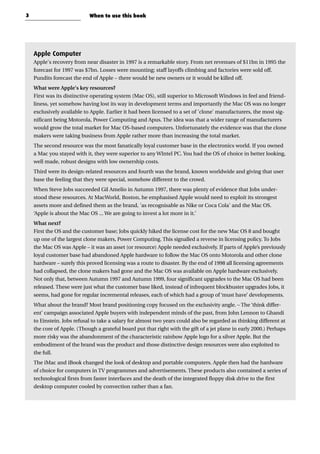
Apple Computer
Apple's recoveryfrom near disaster in 1997 is a remarkable story. From net revenues of $11bn in 1995 the
forecast for 1997 was $7bn. Losses were mounting; staff layoffs climbing and factories were sold off.
Pundits forecast the end of Apple – there would be new owners or it would be killed off.
What were Apple's key resources?
First was its distinctive operating system (Mac OS), still superior to Microsoft Windows in feel and friend-
liness, yet somehow having lost its way in development terms and importantly the Mac OS was no longer
exclusively available to Apple. Earlier it had been licensed to a set of 'clone' manufacturers, the most sig-
nificant being Motorola, Power Computing and Apus. The idea was that a wider range of manufacturers
would grow the total market for Mac OS-based computers. Unfortunately the evidence was that the clone
makers were taking business from Apple rather more than increasing the total market.
The second resource was the most fanatically loyal customer base in the electronics world. If you owned
a Mac you stayed with it, they were superior to any WIntel PC. You had the OS of choice in better looking,
well made, robust designs with low ownership costs.
Third were its design-related resources and fourth was the brand, known worldwide and giving that user
base the feeling that they were special, somehow different to the crowd.
When Steve Jobs succeeded Gil Amelio in Autumn 1997, there was plenty of evidence that Jobs under-
stood these resources. At MacWorld, Boston, he emphasised Apple would need to exploit its strongest
assets more and defined them as the brand, 'as recognisable as Nike or Coca Cola' and the Mac OS.
‘Apple is about the Mac OS ... We are going to invest a lot more in it.’
What next?
First the OS and the customer base; Jobs quickly hiked the license cost for the new Mac OS 8 and bought
up one of the largest clone makers, Power Computing. This signalled a reverse in licensing policy. To Jobs
the Mac OS was Apple – it was an asset (or resource) Apple needed exclusively. If parts of Apple’s previously
loyal customer base had abandoned Apple hardware to follow the Mac OS onto Motorola and other clone
hardware – surely this proved licensing was a route to disaster. By the end of 1998 all licensing agreements
had collapsed, the clone makers had gone and the Mac OS was available on Apple hardware exclusively.
Not only that, between Autumn 1997 and Autumn 1999, four significant upgrades to the Mac OS had been
released. These were just what the customer base liked, instead of infrequent blockbuster upgrades Jobs, it
seems, had gone for regular incremental releases, each of which had a group of ‘must have’ developments.
What about the brand? Most brand positioning copy focused on the exclusivity angle. – The ‘think differ-
ent’ campaign associated Apple buyers with independent minds of the past, from John Lennon to Ghandi
to Einstein. Jobs refusal to take a salary for almost two years could also be regarded as thinking different at
the core of Apple. (Though a grateful board put that right with the gift of a jet plane in early 2000.) Perhaps
more risky was the abandonment of the characteristic rainbow Apple logo for a silver Apple. But the
embodiment of the brand was the product and those distinctive design resources were also exploited to
the full.
The iMac and iBook changed the look of desktop and portable computers. Apple then had the hardware
of choice for computers in TV programmes and advertisements. These products also contained a series of
technological firsts from faster interfaces and the death of the integrated floppy disk drive to the first
desktop computer cooled by convection rather than a fan.
3 When to use this book
20.
Building a moresustainable advantage
Managers face a consistent drive to improve on performance metrics like
delivery leadtime and quality, delivery reliability, rate of cost reduction
and so on. Many of the means of improving are, to a degree, generic best
practices that all firms pursue. This can become like a treadmill with little
relief. Your competitors are improving by incorporating the same
improvements you are. In contrast resource-based analysis concentrates
on finding the differences between firms, especially those differences that
it is difficult for competitors to copy. The aim is to base a competitive
advantage around those differences so the advantages generated last
longer, they are more sustainable.
The Apple computer example shows how a firm with unique
resources in its market that were difficult and expensive to copy can
survive and prosper in a fast-moving market. The trick seems to be that
you have to understand and remember what those resources are and
continue to exploit them. One of Apple’s founders, Steve Jobs, remem-
bered them very well – he would wouldn’t he? He was the one who bor-
rowed the graphical user interface from Xerox’s PARC laboratory and
had it designed into the first Mac OS.
Fresh insights on how to improve
Resource-based thinking offers you a new perspective on your business,
a new way of looking at your firm. In our experience it is inevitable that
with that fresh view a group of important improvement ideas are crys-
tallised. This tends to happen early in the analysis at the point where
your resources are first identified.
Abacus*
A worldwide supplier of industrial measuring equipment, Abacus, had already decided to gain an advan-
tage over competitors through improving the competence of its service activities. This included installa-
tion, service and repair, consumables supply, customer training, advice and maintenance contract nego-
tiation. Their first improvements were to product training, defining service engineer toolkits and indeed
defining what good service was from health and safety issues to dress code, all were documented in a
service standard. The standard was audited yearly within fully owned and third party sales and service
organisations. Standards were improving, metrics showing service response times were also improving –
what else should be done?
A resource analysis revealed some areas that had not been tackled. One example was the central role of
the service engineer to offering good service. Competent service engineers can solve technical problems
and some of the social problems caused if a machine breaks down. Customers can get frustrated and
annoyed and it is difficult to recruit staff that can handle these two aspects of the job. But Abacus had no
way of testing how competent new recruits or experienced staff actually were at these skills. An engineer
4 When to use this book
21.
would be recruitedbecause s/he did well in the interview and had passed relevant exams. Following that
s/he would receive product training either locally or at the factory - there were no exams to show how
well the training had been understood and little motivation for colleagues to expose an engineer who was
failing. During the time it takes for the underperforming engineer to be discovered or to leave, much
damage can be done.
In response a set of technical competency tests were designed and psychological tests were used routine-
ly during interviews to test basic technical understanding and to identify traits useful for dealing with
customers. The technical tests are used throughout the world, while outlets have the freedom to use more
culturally coherent psychological tests where available. The resource analysis also showed that in wholly
owned service centres if an engineer settled in the chances were s/he would stay on average seven years,
rather higher than usual in these positions. Recruiting better engineers could therefore pay off for a con-
siderable time.
Taking account of your resources in the decisions to achieve your
objectives
Not many managers consciously build their firm’s resources, resources
like a large manufacturing plant are regarded as means not ends. They
are needed to achieve business objectives like growth, low leadtimes,
continually falling prices. It is, however, well worth thinking about the
resources you’ll have when your objectives are achieved. Are these
resources in a better state than when you set out to achieve your objec-
tives? Any manager has a duty to shareholders to steward a firm’s
resources, to leave them in a better state than he received them as well
as to exploit those resources to generate cash for dividends and share
price growth. There is significant evidence that many US companies
have been placing too much emphasis on current shareholder benefits
to the long-term detriment of their companies. We shall return to this
theme in Chapter 9.
All these circumstances benefit greatly from an understanding of the
resources that underlie your firm’s strengths and weaknesses. Not only
that, changing your firm’s boundaries, developing new markets or tak-
ing on new technologies and facing up to potentially catastrophic mar-
ket changes are strategic with a capital S. They are amongst the most
difficult, risky and potentially rewarding decisions you will take.
An aside for small companies and start-ups
If you are in a small or start-up company you may be assuming that this
book is meant for medium to large companies. If so, you are wrong.
(Although sizable companies that have not taken a close look at their
resources recently are almost sure of surprises.)
5 When to use this book
22.
6
For the start-upand small companies the issue is lack of resources,
of a need to grow your firm’s resource and competence base and espe-
cially to grow the resource of management. Start-ups, in particular, are
practically by definition focused on their resources and competences.
For it is these that differentiate them from competitors – the new idea,
perspective and knowledge that others do not possess, the ability to
move faster and to more proactively address the implications of new
ideas without the encumbrances of a past history. These are the
resources and competences that make your firm useful and valuable to
larger firms. They are your firm. Your challenge is to exploit them most
effectively and that is a matter of management, the resource of manage-
ment. This book and the resource analysis approaches it suggests are
certainly valuable for organisations short of resources – they are the
ones who arguably need to understand their resources and resource
development needs the most.
When to use this book
23.
7
How to usethis book
This book is designed with two aims in mind:
• First to make the ideas of resource-based strategy available to you
• Second to help you use these ideas in your businesses to improve your
competitive position and your firm’s longevity
This is not a text-book full of dry theory. It is a document built from
the experience of applying resource-based theory in a variety of indus-
trial settings. For that reason it contains many insights from practice –
what happens when you apply these ideas – alongside a supportive the-
oretical base. As Kurt Lewin put it, ‘There’s nothing so practical as a
good theory’ and resource-based theory is a very good one. We have
tried hard to cover any necessary theory in a pragmatic and jargon-free
manner and have assumed you are quite unfamiliar with resource-
based ideas. The book contains many case study examples at a rather
more detailed, yet pragmatic, level than most books on the subject. In
particular there are tools we have developed and tested that enable you
to use the ideas.
Chapter 1 is devoted to explaining resource-based ideas and the defi-
nitions we use. To understand later chapters, Chapter 1 is essential even
if you believe you are familiar with the ideas.
Chapter 2 takes a top-down excursion into resource and competence
analysis describing a method suitable for management teams. We have
called this approach ‘Awareness’ because it provides you with a practi-
cal understanding of resource and competence ideas. It is especially
helpful for making resource-aware choices in plans to achieve your
business objectives.
In Chapter 3 we review the pros and cons of the Awareness method
and explain the need for a more detailed bottom-up method capable of
making a detailed evaluation of the resources your firm uses. Which are
the most important? Which hold you back? Which can take you for-
ward? We have called this second approach ‘Insight’ because it gives a
more in-depth understanding of your resource base. It is intended for
project teams sponsored by board directors.
Chapters 4 to 6 describe the three steps of the Insight approach. This
method provides an analysis of your current resources and practical insight
into gaining a sustainable advantage and the issues surrounding make ver-
sus buy, acquisition, divestment, new market entry, taking on new tech-
nologies and facing large unfavourable dislocations in your markets.
24.
8
Each of chapters4 to 6 poses a question; provides tools to address
that question; supplies case and other illustrative examples; and is
accompanied by the thinking and experience that have shaped those
tools. In these chapters the book (as in Chapter 2) can be used as a
working document alongside a project to apply resource-based
approaches to improve your company’s position.
Chapter 7 covers alternative means of improving the resource and
competence base uncovered in previous chapters. It too contains exam-
ples, tools and insights from real experience.
Chapter 8 is concerned with the measurement of resources and com-
petences. This is a subject that has yet to be fully addressed either by
managers or academics. Its importance is related to the attention com-
petence and resource-building investments receive around manage-
ment and board room tables. It is only relatively recently that attention
to non-financial measures like delivery leadtime have become of cen-
tral interest alongside the dominant financial data. Measuring resources
and competences is a further step along the route to measuring causes
rather than outcomes. How might you measure the improvement in the
resources underlying your delivery leadtime competence? We offer
examples and some insight into what is involved in placing tangible
measures of resource and competence development next to last
month’s actual figures and the rest of the year’s financial forecast.
Chapter 9 summarises and discusses four topics. The first is a set of
health warnings on using competence- and resource-based ideas, the
second is a discussion on the relationship between market- and
resource-based strategy-making that points to the contingencies that
make resource-based strategy particularly relevant and valuable. Third
is a discussion on ‘shareholder value’, and its relevance to resource-
based ideas and finally thoughts on other recent developments in strat-
egy-making and the future role of resource-based ideas.
How to use this book
WILLIAM COBBETT
Advice toYoung Men
William Cobbett, the celebrated English political writer,
was born in March, 1762, at Farnham in Surrey. He took a
dislike to rural occupations, and at an early age went to
London, where he was employed for a few months as a
copying clerk. This work was distasteful to him, and he
enlisted in the army, and went with his regiment to Nova
Scotia. On returning to England in 1791, he obtained his
discharge, married, and went to America. In Philadelphia he
commenced his career as a political writer. Cobbett's "Advice
to Young Men" was published in 1830. It has always been the
most popular of his books, partly because of its subject, and
partly because it illustrates so well the bold and forceful
directness of his style. An intensely egotistical and confident
man, Cobbett believed that his own strangely inconsistent life
was a model for all men. Yet, contrary to what might have
been expected, he was a delightful man in the domestic
circle, and the story of his marriage—which has been
narrated in his "Rural Rides"—is one of the romances of
literary life. The original introduction to the "Advice"
contained personal reference incredible in anyone except
Cobbett. Said he, "Few will be disposed to question my fitness
for the task. If such a man be not qualified to give advice, no
man is qualified." And he went on to claim for himself "genius
and something more." He certainly had a remarkable fund of
28.
commonsense, except whenhis subject was himself. Cobbett
died June 18, 1835.
I.—To a Youth
You are arrived, let us suppose, at the age of from fourteen to
nearly twenty, and I here offer you my advice towards making you a
happy man, useful to all about you, and an honour to those from
whom you sprang. Start, I beseech you, with a conviction firmly
fixed in your mind that you have no right to live in this world without
doing work of some sort or other. To wish to live on the labour of
others is to contemplate a fraud.
Happiness ought to be your great object, and it is to be found
only in independence. Turn your back on what is called interest.
Write it on your heart that you will depend solely on your own merit
and your own exertions, for that which a man owes to favour or to
partiality, that same favour or partiality is constantly liable to take
from him.
The great source of independence the French express in three
words, "Vivre de peu." "To live upon little" is the great security
against slavery; and this precept extends to dress and other things
besides food and drink. Extravagance in dress arises from the notion
that all the people in the street will be looking at you as you walk
out; but all the sensible people that happen to see you will think
nothing at all about you. Natural beauty of person always will and
must have some weight, even with men, and great weight with
women; but this does not want to be set off by expensive clothes.
A love of what is called "good eating and drinking," if very
unamiable in a grown-up person, is perfectly hateful in a youth. I
have never known such a man worthy of respect.
Next, as to amusements. Dancing is at once rational and
healthful; it is the natural amusement of young people, and none
but the most grovelling and hateful tyranny, or the most stupid and
despicable fanaticism, ever raised its voice against it. As to gaming,
29.
it is alwayscriminal, either in itself or in its tendency. The basis of it
is covetousness; a desire to take from others something for which
you have given, and intend to give, no equivalent.
Be careful in choosing your companions; and lay down as a rule
never to be departed from that no youth or man ought to be called
your friend who is addicted to indecent talk.
In your manners be neither boorish nor blunt, but even these
are preferable to simpering and crawling. Be obedient where
obedience is due; for it is no act of meanness to yield implicit and
ready obedience to those who have a right to demand it at your
hands. None are so saucy and disobedient as slaves; and, when you
come to read history, you will find that in proportion as nations have
been free has been their reverence for the laws.
Let me now turn to the things which you ought to do. And, first
of all, the husbanding of your time. Young people require more sleep
than those that are grown up, and the number of hours cannot well
be, on an average, less than eight. An hour in bed is better than an
hours spent over the fire in an idle gossip.
Money is said to be power; but superior sobriety, industry, and
activity are still a more certain source of power. Booklearning is not
only proper, but highly commendable; and portions of it are
absolutely necessary in every case of trade or profession. One of
these portions is distinct reading, plain and neat writing, and
arithmetic. The next thing is the grammar of your own language, for
grammar is the foundation of all literature. Excellence in your own
calling is the first thing to be aimed at. After this may come general
knowledge. Geography naturally follows grammar; and you should
begin with that of this kingdom. When you come to history, begin
also with that of your own country; and here it is my bounded duty
to put you well on your guard. The works of our historians are, as
far as they relate to former times, masses of lies unmatched by any
others that the world has ever seen.
II.—To a Young Man
30.
To be poorand independent is very nearly an impossibility;
though poverty is, except where there is an actual want of food and
raiment, a thing much more imaginary than real. Resolve to set this
false shame of being poor at defiance. Nevertheless, men ought to
take care of their names, ought to use them prudently and sparingly,
and to keep their expenses always within the bounds of their
income, be it what it may.
One of the effectual means of doing this is to purchase with
ready money. Innumerable things are not bought at all with ready
money which would be bought in case of trust; it is so much easier
to order a thing than to pay for it. I believe that, generally speaking,
you pay for the same article a fourth part more in the case of trust
than you do in the case of ready money. The purchasing with ready
money really means that you have more money to purchase with.
A great evil arising from the desire not to be thought poor is the
destructive thing honoured by the name of "speculation," but which
ought to be called gambling. It is a purchasing of something to be
sold again with a great profit at a considerable hazard. Your life,
while you are thus engaged, is the life of a gamester: a life of
general gloom, enlivened now and then by a gleam of hope or of
success.
In all situations of life avoid the trammels of the law. If you win
your suit and are poorer than you were before, what do you
accomplish? Better to put up with the loss of one pound than with
two, with all the loss of time and all the mortification and anxiety
attending a law suit.
Unless your business or your profession be duly attended to
there can be no real pleasure in any other employment of a portion
of your time. Men, however, must have some leisure, some
relaxation from business; and in the choice of this relaxation much
of your happiness will depend.
Where fields and gardens are at hand, they present the most
rational scenes for leisure. Nothing can be more stupid than sitting,
31.
sotting over apot and a glass, sending out smoke from the head,
and articulating, at intervals, nonsense about all sorts of things.
Another mode of spending the leisure time is that of books. To
come at the true history of a country you must read its laws; you
must read books treating of its usages and customs in former times;
and you must particularly inform yourselves as to prices of labour
and of food. But there is one thing always to be guarded against,
and that is not to admire and applaud anything you read merely
because it is the fashion to admire and applaud it. Read, consider
well what you read, form your own judgments, and stand by that
judgment until fact or argument be offered to convince you of your
error.
III.—To a Lover
There are two descriptions of lovers on whom all advice would
be wasted, namely, those in whose minds passion so wholly
overpowers reason as to deprive the party of his sober senses, and
those who love according to the rules of arithmetic, or measure their
matrimonial expectations by the claim of the land-surveyor.
I address myself to the reader whom I suppose to be a real
lover, but not so smitten as to be bereft of reason. You should never
forget that marriage is a thing to last for life, and that, generally
speaking, it is to make life happy or miserable.
The things which you ought to desire in a wife are chastity,
sobriety, industry, frugality, cleanliness, knowledge of domestic
affairs, good temper and beauty.
Chastity, perfect modesty, in word, deed, and even thought, is so
essential that without it no female is fit to be a wife. If prudery
mean false modesty, it is to be despised; but if it mean modesty
pushed to the utmost extent, I confess that I like it. The very
elements of jealousy ought to be avoided, and the only safeguard is
to begin well and so render infidelity and jealousy next to
impossible.
32.
By sobriety Imean sobriety of conduct. When girls arrive at that
age which turns their thoughts towards the command of a house it is
time for them to cast away the levity of a child. Sobriety is a title to
trustworthiness, and that is a treasure to prize above all others. But
in order to possess this precious trustworthiness you must exercise
your reason in the choice of a partner. If she be vain, fond of
flattery, given to gadding about, coquettish, she will never be
trustworthy, and you will be unjust if you expect it at her hands. But
if you find in her that innate sobriety of which I have been speaking,
there requires on your part confidence and trust without any limit.
An ardent-minded young man may fear that sobriety of conduct
in a young woman argues a want of warmth; but my observation
and experience tell me that levity, not sobriety, is, ninety-nine times
out of a hundred, the companion of a want of ardent feeling.
There is no state in life in which industry in the wife is not
necessary to the happiness and prosperity of the family. If she be
lazy there will always be a heavy arrear of things unperformed, and
this, even among the wealthy, is a great curse. But who is to tell
whether a girl will make an industrious woman? There are certain
outward signs, which, if attended to with care, will serve as pretty
sure guides.
If you find the tongue lazy you may be nearly certain that the
hands and feet are the same. The pronunciation of an industrious
person is generally quick, distinct, and firm. Another mark of
industry is a quick step and a tread showing that the foot comes
down with a hearty good will.
Early rising is another mark of industry. It is, I should imagine,
pretty difficult to keep love alive towards a woman who never sees
the dew, never beholds the rising sun.
Frugality. This means the contrary of extravagance. It does not
mean stinginess; it means an abstaining from all unnecessary
expenditure. The outward and vulgar signs of extravagance are all
the hardware which women put upon their persons. The girl who
33.
has not thesense to perceive that her person is disfigured, and not
beautified by parcels of brass, tin, and other hardware stuck about
her body, is too great a fool to be trusted with the purse of any man.
Cleanliness is a capital ingredient. Occasional cleanliness is not
the thing that an English or American husband wants; he wants it
always. A sloven in one thing is a sloven in all things. Make up your
mind to a rope rather than to live with a slip-shod wife.
Knowledge of domestic affairs is so necessary in every wife that
the lover ought to have it continually in his eye. A wife must not only
know how things ought to be done, but how to do them. I cannot
form an idea of a more unfortunate being than a girl with a mere
boarding-school education and without a future to enable her to
keep a servant when married. Of what use are her
accomplishments?
Good temper is a very difficult thing to ascertain beforehand—
smiles are so cheap. By "good temper" I do not mean easy temper—
a serenity which nothing disturbs is a mark of laziness. Sulkiness,
querulousness, cold indifference, pertinacity in having the last word,
are bad things in a young woman, but of all the faults of temper
your melancholy ladies are the worst. Most wives are at times
misery-makers, but the melancholy carry it on as a regular trade.
The great use of female beauty is that it naturally tends to keep
the husband in good humour with himself, to make him pleased with
his bargain.
As to constancy in lovers, even when marriage has been
promised, and that, too, in the most solemn manner, it is better for
both parties to break off than to be coupled together with the
reluctant assent of either.
IV.—To a Husband
It is as a husband that your conduct will have the greatest effect
on your happiness. All in a wife, beyond her own natural disposition
34.
and education, is,nine times out of ten, the work of her husband.
First convince her of the necessity of moderation in expense;
make her clearly see the justice of beginning to act upon the
presumption that there are children coming. The great danger of all
is beginning with a servant. The wife is young, and why is she not to
work as well as her husband? If the wife be not able to do all the
work to be done in the house, she ought not to have been able to
marry.
The next thing to be attended to is your demeanour towards a
young wife. The first frown that she receives from you is a dagger to
her heart. Let nothing put you out of humour with her.
Every husband who spends his leisure time in company other
than that of his wife and family tells her and them that he takes
more delight in other company than in theirs. Resolve from the very
first never to spend an hour from home unless business or some
necessary and rational purpose demand it. If you are called away
your wife ought to be fully apprised of the probable duration of the
absence and of the time of return. When we consider what a young
woman gives up on her wedding day, how can a just man think
anything a trifle that affects her happiness?
Though these considerations may demand from us the kindest
possible treatment of a wife, the husband is to expect dutiful
deportment at her hands. A husband under command is the most
contemptible of God's creatures. Am I recommending tyranny? Am I
recommending disregard of the wife's opinions and wishes? By no
means. But the very nature of things prescribes that there must be a
head of every house, and an undivided authority. The wife ought to
be heard, and patiently heard; she ought to be reasoned with, and,
if possible, convinced; but if she remain opposed to the husband's
opinion, his will must be obeyed.
I now come to that great bane of families—jealousy. One thing
every husband can do in the way of prevention, and that is to give
no ground for it. Few characters are more despicable than that of a
35.
jealous-headed husband, andthat, not because he has grounds, but
because he has not grounds.
If to be happy in the married state requires these precautions,
you may ask: Is it not better to remain single? The cares and
troubles of the married life are many, but are those of the single life
few? Without wives men are poor, helpless mortals.
As to the expense, I firmly believe that a farmer married at
twenty-five, and having ten children during the first ten years, would
be able to save more money during these years than a bachelor of
the same age would be able to save, on the same farm, in a like
space of time. The bachelor has no one on whom he can in all cases
rely. To me, no being in this world appears so wretched as he.
V.—To a Father
It is yourself that you see in your children. They are the great
and unspeakable delight of your youth, the pride of your prime of
life, and the props of your old age. From the very beginning ensure
in them, if possible, an ardent love for their mother. Your first duty
towards them is resolutely to prevent their drawing the means of life
from any breast but hers. That is their own; it is their birthright.
The man who is to gain a living by his labour must be drawn
away from home; but this will not, if he be made of good stuff,
prevent him from doing his share of the duty due to his children.
There ought to be no toils, no watchings, no breakings of rest,
imposed by this duty, of which he ought not to perform his full
share, and that, too, without grudging. The working man, in
whatever line, and whether in town or country, who spends his day
of rest away from his wife and children is not worthy of the name of
father.
The first thing in the rearing of children who have passed from
the baby state is, as to the body, plenty of good food; and, as to the
mind, constant good example in the parents. There is no other
reason for the people in the American states being generally so
36.
much taller andstronger than the people in England are, but that,
from their birth, they have an abundance of good food; not only of
food, but of rich food. Nor is this, in any point of view, an
unimportant matter, for a tall man is worth more than a short man.
Good food, and plenty of it, is not more necessary to the forming of
a stout and able body than to the forming of an active and
enterprising spirit. Children should eat often, and as much as they
like at a time. They will never take, of plain food, more than it is
good for them to take.
The next thing after good and plentiful and plain food is good
air. Besides sweet air, children want exercise. Even when they are
babies in arms they want tossing and pulling about, and talking and
singing to. They will, when they begin, take, if you let them alone,
just as much exercise as nature bids them, and no more.
I am of opinion that it is injurious to the mind to press book-
learning upon a child at an early age. I must impress my opinion
upon every father that his children's happiness ought to be his first
object; that book-learning, if it tend to militate against this, ought to
be disregarded. A man may read books for ever and be an ignorant
creature at last, and even the more ignorant for his reading.
And with regard to young women, everlasting book-reading is
absolutely a vice. When they once get into the habit they neglect all
other matters, and, in some cases, even their very dress. Attending
to the affairs of the house—to the washing, the baking, the brewing,
the cooking of victuals, the management of the poultry and the
garden, these are their proper occupations.
VI.—To the Citizen
Having now given my advice to the youth, the man, the lover,
the husband, and the father, I shall tender it to the citizen. To act
well our part as citizens we ought clearly to understand what our
rights are; for on our enjoyment of these depend our duties, rights
going before duties, as value received goes before payments. The
37.
great right ofall is the right of taking a part in the making of the
laws by which we are governed.
It is the duty of every man to defend his country against an
enemy, a duty imposed by the law of nature as well as by that of
civil society. Yet how are you to maintain that this is the duty of
every man if you deny to some men the enjoyment of a share in
making the laws? The poor man has a body and a soul as well as the
rich man; like the latter, he has parents, wife, and children; a bullet
or a sword is as deadly to him as to the rich man; yet,
notwithstanding this equality, he is to risk all, and, if he escape, he is
still to be denied an equality of rights! Why are the poor to risk their
lives? To uphold the laws and to protect property—property of which
they are said to possess none? What! compel men to come forth and
risk their lives for the protection of property, and then in the same
breath tell them that they are not allowed to share in the making of
the laws, because, and only because, they have no property!
Here, young man of sense and of spirit, here is the point on
which you are to take your stand. There are always men enough to
plead the cause of the rich, and to echo the woes of the fallen great;
but be it your part to show compassion for those who labour, and to
maintain their rights.
If the right to have a share in making the laws were merely a
feather, if it were a fanciful thing, if it were only a speculative theory,
if it were but an abstract principle, it might be considered as of little
importance. But it is none of these; it is a practical matter. Who lets
another man put his hand into his purse when he pleases? It is the
first duty of every man to do all in his power to maintain this right of
self-government where it exists, and to restore it where it has been
lost. Men are in such a case labouring, not for the present day only,
but for ages to come. If life should not allow them time to see their
endeavours crowned, their children will see it.
39.
DANIEL DEFOE
A Journalof the Plague Year
"A Journal of the Plague Year" appeared in 1722. In its
second edition it received the title of "A History of the
Plague." This book was suggested by the public anxiety
caused by a fearful visitation of the plague at Marseilles in the
two preceding years. As an account of the epidemic in
London, it has all the vividness of Defoe's fiction, while it is
acknowledged to be historically accurate. (Defoe biography,
see Vol. III, p. 26.)
I.—A Stricken City
It was about the beginning of September, 1664, that I, among
the rest of my neighbours, heard that the plague was returned again
in Holland. We had no such thing as printed newspapers in those
days to spread rumours and reports of things; but such things as
these were gathered from the letters of merchants, and from them
were handed about by word of mouth only. In December, two
Frenchmen died of the plague in Long Acre, or, rather, at the upper
end of Drury Lane. The secretaries of state got knowledge of it, and
two physicians and a surgeon were ordered to go to the house and
make inspection. This they did, and, finding evident tokens of the
sickness upon both the bodies, they gave their opinions publicly, that
they died of the plague; whereupon it was given in to the parish
clerk, and he also returned them to the Hall; and it was printed in
the weekly bill of mortality in the usual manner, thus:
40.
Plague, 2; Parishesinfected, 1.
The distemper spread slowly, and in the beginning of May, the
city being healthy, we began to hope that as the infection was
chiefly among the people at the other end of the town, it might go
no further. We continued in these hopes for a few days, but it was
only for a few, for the people were no more to be deceived thus;
they searched the houses, and found that the plague was really
spread every way, and that many died of it every day; and
accordingly, in the weekly bill for the next week, the thing began to
show itself. There was, indeed, but fourteen set down of the plague,
but this was all knavery and collusion.
Now the weather set in hot, and from the first week in June the
infection spread in a dreadful manner, and the bills rose high. Yet all
that could conceal their distempers did it to prevent their neighbours
shunning them, and also to prevent authority shutting up their
houses.
I lived without Aldgate, midway between Aldgate church and
Whitechapel Bars, and our neighbourhood continued very easy. But
at the other end of the town their consternation was very great, and
the richer sort of people, especially the nobility and gentry, from the
west part of the city, thronged out of town with their families and
servants. In Whitechapel, where I lived, nothing was to be seen but
waggons and carts, with goods, women, servants, children, etc., all
hurrying away. This was a very terrible and melancholy thing to see,
and it filled me with very serious thoughts of the misery that was
coming upon the city.
I now began to consider seriously how I should dispose of
myself, whether I should resolve to stay in London, or shut up my
house and flee. I had two important things before me: the carrying
on of my business and shop, and the preservation of my life in so
dismal a calamity. My trade was a saddler, and though a single man,
I had a family of servants and a house and warehouses filled with
goods, and to leave them all without any overseer had been to
hazard the loss of all I had in the world.
41.
I had resolvedto go; but, one way or other, I always found that
to appoint to go away was always crossed by some accident or
other, so as to disappoint and put it off again; and I advise every
person, in such a case, to keep his eye upon the particular
providences which occur at that time, and take them as intimations
from Heaven of what is his unquestioned duty to do in such a case.
Add to this, that, turning over the Bible which lay before me, I cried
out, "Well, I know not what to do; Lord, direct me!" and at that
juncture, casting my eye down, I read: "Thou shalt not be afraid for
the pestilence that walketh in darkness.... A thousand shall fall at thy
side, and ten thousand at thy right hand; but it shall not come nigh
thee." I scarce need tell the reader that from that moment I resolved
that I would stay in the town, casting myself entirely upon the
protection of the Almighty.
The court removed in the month of June, and went to Oxford,
where it pleased God to preserve them; for which I cannot say they
showed any great token of thankfulness, and hardly anything of
reformation, though they did not want being told that their crying
voices might, without breach of charity, have gone far in bringing
that terrible judgment upon the whole nation.
A blazing star or comet had appeared for several months before
the plague, and there had been universal melancholy apprehensions
of some dreadful calamity. The people were at this time more
addicted to prophecies, dreams, and old wives' fables, than ever
they were before or since. Some ran about the streets with oral
predictions, one crying, "Yet forty days, and London shall be
destroyed!" Another poor naked creature cried, "Oh, the great and
dreadful God!" repeating these words continually, with voice and
countenance full of horror, and a swift pace, and nobody could ever
find him to stop. Some saw a flaming sword in a hand coming out of
a cloud; others, hearses and coffins in the air; others, heaps of dead
bodies unburied. But those who were really serious and religious
applied themselves in a truly Christian manner to the proper work of
repentance and humiliation. Many consciences were awakened,
many hard hearts melted into tears. People might be heard in the
42.
streets as wepassed along, calling upon God for mercy, and saying,
"I have been a thief," or "a murderer," and the like; and none dared
stop to make the least inquiry into such things, or to comfort the
poor creatures that thus cried out. The face of London was now
strangely altered; it was all in tears; the shrieks of women and
children at the windows and doors, where their dearest relations
were dead, were enough to pierce the stoutest heart.
About June, the lord mayor and aldermen began more
particularly to concern themselves for the regulation of the city, by
the shutting up of houses. Examiners were appointed in every parish
to order the house to be shut up wherever any person sick of the
infection was found. A night watchman and a day watchman were
appointed to each infected house to prevent any person from
coming out or going into the same. Women searchers were
appointed in each parish to examine the bodies of such as were
dead, to see if they had died of the infection, and over these were
appointed physicians and chirurgeons. Other orders were made with
regard to giving notice of sickness, sequestration of the sick, airing
the goods and bedding of the infected, burial of the dead, cleansing
of the streets, forbidding wandering beggars, loose persons, and idle
assemblages, and the like. One of these orders was—"That every
house visited be marked with a red cross of a foot long, in the
middle of the door, with these words, 'Lord have mercy upon us,' to be
set close over the same cross." Many got out of their houses by
stratagem after they were shut up, and thus spread the plague; in
one place they blowed up their watchman with gunpowder and
burnt the poor fellow dreadfully, and while he made hideous cries,
the whole family got out at the windows; others got out by bribing
the watchman, and I have seen three watchmen publicly whipped
through the streets for suffering people to go out.
II.—How the Dead Were Buried
I went all the first part of the time freely about the streets, and
when they dug the great pit in the churchyard of Aldgate I could not
43.
resist going tosee it. A terrible pit it was, forty feet long, about
sixteen wide, and in one part they dug it to near twenty feet deep,
until they could go no deeper for the water. It was filled in just two
weeks, when they had thrown into it 1,114 bodies from our own
parish.
I got admittance into the churchyard by the sexton, who at first
refused me, but at last said: "Name of God, go in; depend upon it,
'twill be a sermon to you, it may be the best that ever you heard. It
is a speaking sight," says he; and with that he opened the door and
said, "Go, if you will." I stood wavering for a good while, but just at
that interval I saw two links come over from the end of the Minories,
and heard the bellman, and then appeared a dead-cart coming over
the streets, so I went in.
The scene was awful and full of terror. The cart had in it sixteen
or seventeen bodies; some were wrapped in sheets or rugs, some
little other than naked, or so loose that what covering they had fell
from them in the shooting out of the cart, and they fell quite naked
among the rest. But the matter was not much to them, seeing they
were all dead, and were to be huddled together into the common
grave of mankind, as we may call it; for here was no difference
made, but poor and rich went together. The cart was turned round,
and the bodies shot into the pit promiscuously.
There was following the cart a poor unhappy gentleman who fell
down in a swoon when the bodies were shot into the pit. The buriers
ran to him and took him up, and after he had come to himself, they
led him away to the Pye tavern, over against the end of
Houndsditch. His case lay so heavy on my mind that after I had
gone home I must go out again into the street and go to the Pye
tavern, to inquire what became of him.
It was by this time one in the morning, and yet the poor
gentleman was there. The people of the house were civil and
obliging, but there was a dreadful set of fellows that used their
house, and who, in the middle of all this horror, met there every
night, and behaved with revelling and roaring extravagances, so that
44.
the master andmistress of the house were terrified at them. They
sat in a room next the street, and as often as the dead-cart came
along, they would open the windows and make impudent mocks and
jeers at the sad lamentations of the people, especially if they heard
the poor people call upon God to have mercy upon them.
They were at this vile work when I came to the house, ridiculing
the unfortunate man, and his sorrow for his wife and children,
taunting him with want of courage to leap into the pit and go to
Heaven with them, and adding profane and blasphemous
expressions.
I gently reproved them, being not unknown to two of them. But
I cannot call to mind the abominable raillery which they returned to
me, making a jest of my calling the plague the Hand of God. They
continued this wretched course three or four days; but they were,
every one of them, carried into the great pit before it was quite filled
up.
In my walks I had daily many dismal scenes before my eyes, as
of persons falling dead in the streets, terrible shrieks and
screechings of women, and the like. Passing through Tokenhouse
Yard, in Lothbury, of a sudden a casement violently opened just over
my head, and a woman gave three frightful screeches, and then
cried: "Oh Death! Death! Death!" in a most inimitable tone, which
struck me with horror and a chillness in my very blood. There was
nobody to be seen in the whole street, neither did any other window
open; for people had no curiosity now, nor could anybody help
another. I went on into Bell Alley.
Just in Bell Alley, at the right hand of the passage, there was a
more terrible cry than that, and I could hear women and children
run screaming about the rooms distracted. A garret window opened,
and somebody from a window on the other side of the alley called
and asked, "What is the matter?" upon which, from the first window
it was answered: "O Lord, my old master has hanged himself!" The
other asked again: "Is he quite dead?" And the first answered, "Ay,
ay, quite dead—quite dead and cold."
45.
It is scarcecredible what dreadful things happened every day,
people in the rage of the distemper, or in the torment of their
swellings, which was indeed intolerable, oftentimes laying violent
hands on themselves, throwing themselves out at their windows,
etc.; mothers murdering their own children in their lunacy; some
dying of mere fright, without any infection; others frightened into
despair, idiocy, or madness.
There were a great many robberies and wicked practices
committed even in this dreadful time. The power of avarice was so
strong in some that they would run any hazard to steal and to
plunder; and in houses where all the inhabitants had died and been
carried out, they would break in without regard to the danger of
infection, and take even the bedclothes.
III.—Universal Desolation
For about a month together, I believe there did not die less than
1,500 or 1,700 a day, one day with another; and in the beginning of
September good people began to think that God was resolved to
make a full end of the people in this miserable city. Whole families,
and, indeed, whole streets of families were swept away together,
and the infection was so increased that at length they shut up no
houses at all. People gave themselves up to their fears, and thought
that nothing was to be hoped for but an universal desolation. It was
even in the height of this despair that it pleased God to stay His
hand, and to slacken the fury of the contagion.
When the people despaired of life and abandoned themselves, it
had a very strange effect for three or four weeks; it made them bold
and venturous; they were no more shy of one another, nor
restrained within doors, but went anywhere and everywhere, and
ran desperately into any company. It brought them to crowd into the
churches; looking on themselves as all so many dead corpses, they
behaved as if their lives were of no consequence, compared to the
work which they came about there.
46.
The conduct ofthe lord mayor and magistrates was all the time
admirable, so that bread was always to be had in plenty, and cheap
as usual; provisions were never wanting in the markets; the streets
were kept free from all manner of frightful objects—dead bodies, or
anything unpleasant; and for a time fires were kept burning in the
streets to cleanse the air of infection.
Many remedies were tried; but it is my opinion, and I must leave
it as a prescription, that the best physic against the plague is to run
away from it. I know people encourage themselves by saying, "God
is able to keep us in the midst of danger," and this kept thousands in
the town, whose carcasses went into the great pits by cart-loads. Yet
of the pious ladies who went about distributing alms to the poor, and
visiting infected families, though I will not undertake to say that
none of those charitable people were suffered to fall under the
calamity, yet I may say this, that I never knew any of them to fall
under it.
Such is the precipitant disposition of our people, that no sooner
had they observed that the distemper was not so catching as
formerly, and that if it was catched it was not so mortal, and that
abundance of people who really fell sick recovered again daily, than
they made no more of the plague than of an ordinary fever, nor
indeed so much. They went into the very chambers where others lay
sick. This rash conduct cost a great many their lives, who had been
preserved all through the heat of the infection, and the bills of
mortality increased again four hundred in the first week of
November.
But it pleased God, by the continuing of wintry weather, so to
restore the health of the city that by February following we reckoned
the distemper quite ceased. The time was not far off when the city
was to be purged with fire, for within nine months more I saw it all
lying in ashes.
I shall conclude the account of this calamitous year with a
stanza of my own:
47.
A dreadful plaguein London was
In the year sixty-five,
Which swept an hundred thousand souls
Away; yet I alive!
48.
DEMOSTHENES
The Philippics
Demosthenes, byuniversal consensus of opinion the
greatest orator the world has known, was born at Athens 385
B.C. and died 322 B.C. His birth took place just nineteen years
after the conclusion of the Peloponnesian War. Losing his
father when he was yet a child, his wealth was frittered away
by three faithless guardians, whom he prosecuted when he
came of age. This dispute, and some other struggles, led him
into public life, and by indomitable perseverance he overcame
the difficulty constituted by certain physical disqualifications.
Identifying himself for life entirely with the interests of
Athens, he became the foremost administrator in the state, as
well as its most eloquent orator. His stainless character, his
matchless powers of advocacy, his fervent patriotism, and his
fine diplomacy, render him altogether one of the noblest
figures of antiquity. His fame rests mainly on "The Philippics";
those magnificent orations delivered during a series of several
years against the aggressions of Philip of Macedon; though
the three "Olynthiacs," and the oration "De Coronâ," and
several other speeches are monumental of the genius of
Demosthenes, more especially the "De Coronâ." He continued
to resist the Macedonian domination during the career of
Alexander the Great, and was exiled, dying, it is supposed, by
poison administered by himself, at Calauria. (Cf. also p. 273 of
this volume.) This epitome has been prepared from the
original Greek.
49.
Welcome to ourwebsite – the perfect destination for book lovers and
knowledge seekers. We believe that every book holds a new world,
offering opportunities for learning, discovery, and personal growth.
That’s why we are dedicated to bringing you a diverse collection of
books, ranging from classic literature and specialized publications to
self-development guides and children's books.
More than just a book-buying platform, we strive to be a bridge
connecting you with timeless cultural and intellectual values. With an
elegant, user-friendly interface and a smart search system, you can
quickly find the books that best suit your interests. Additionally,
our special promotions and home delivery services help you save time
and fully enjoy the joy of reading.
Join us on a journey of knowledge exploration, passion nurturing, and
personal growth every day!
ebookbell.com