Idea Development
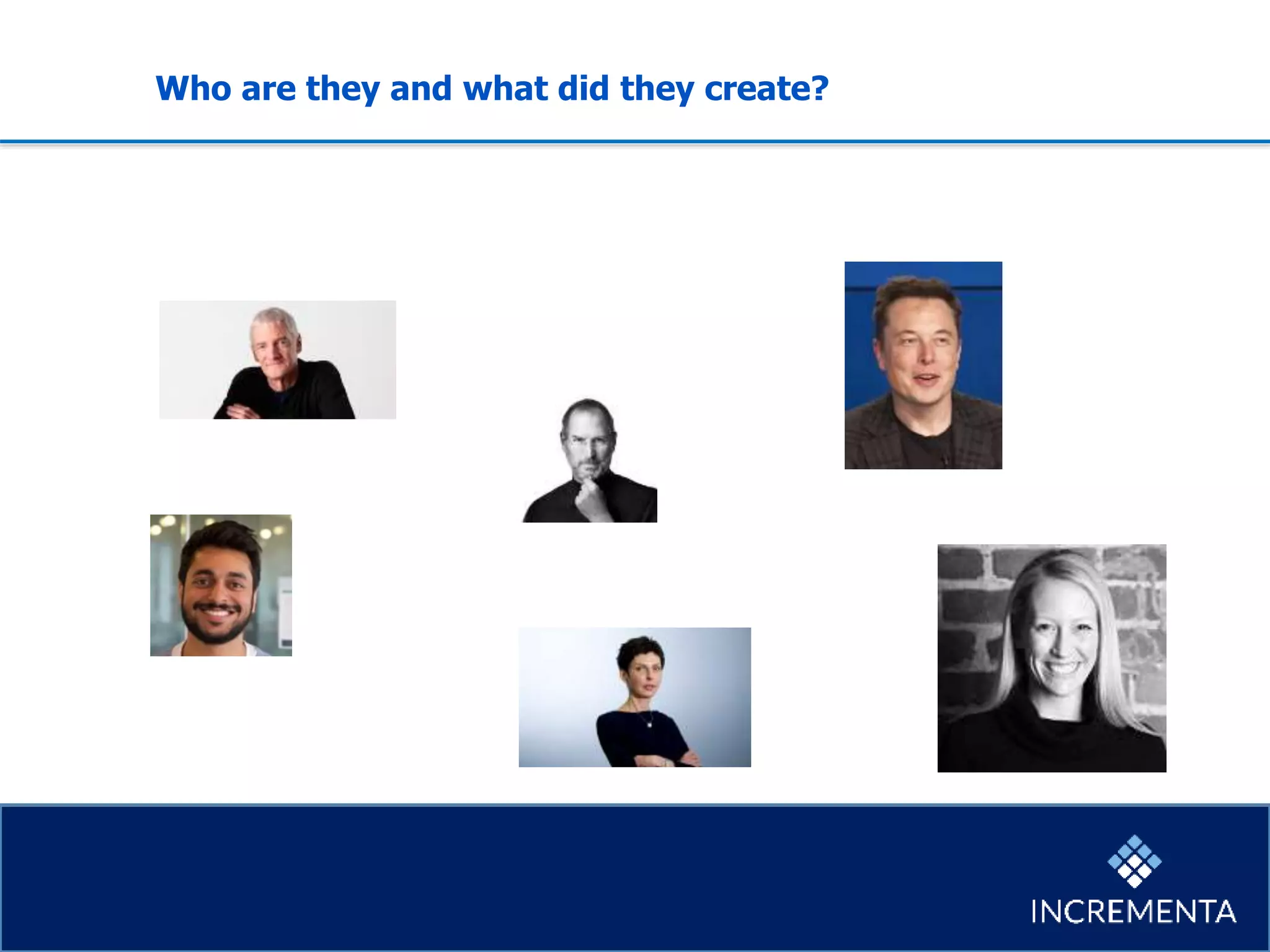
Who are they and what did they create?
“That’s an amazing invention, but
who would ever want to use one of
them?”
(US President Rutherford B. Hayes,
after participating in a trial
telephone conversation between
Washington and Philadelphia in
1876).
“Television won’t be able to hold
onto any market it captures after
the first six months. People will
soon get tired of staring into a box
every night (Darryl F. Zanuck, Head
of 20th Century Fox, 1946)
Don’t believe the experts
“The horse is here to stay, but the
automobile is only a novelty, a fad”
(President of Michigan Savings
Bank, 1903, advising Henry Ford’s
lawyer not to invest in the Ford
Motor Company – disregarding the
advice, he invested $ 5,000 in stock,
which he sold several years later for
$ 12,5 million).
“I think there is a world
market for about five
computers
(Thomas J. Watson Sr.,
Chairman of IBM, 1943)
Don’t believe the experts
Definition
Development of original
products, product
improvements, product
modifications, and new brands
through the firm’s own
R & D efforts
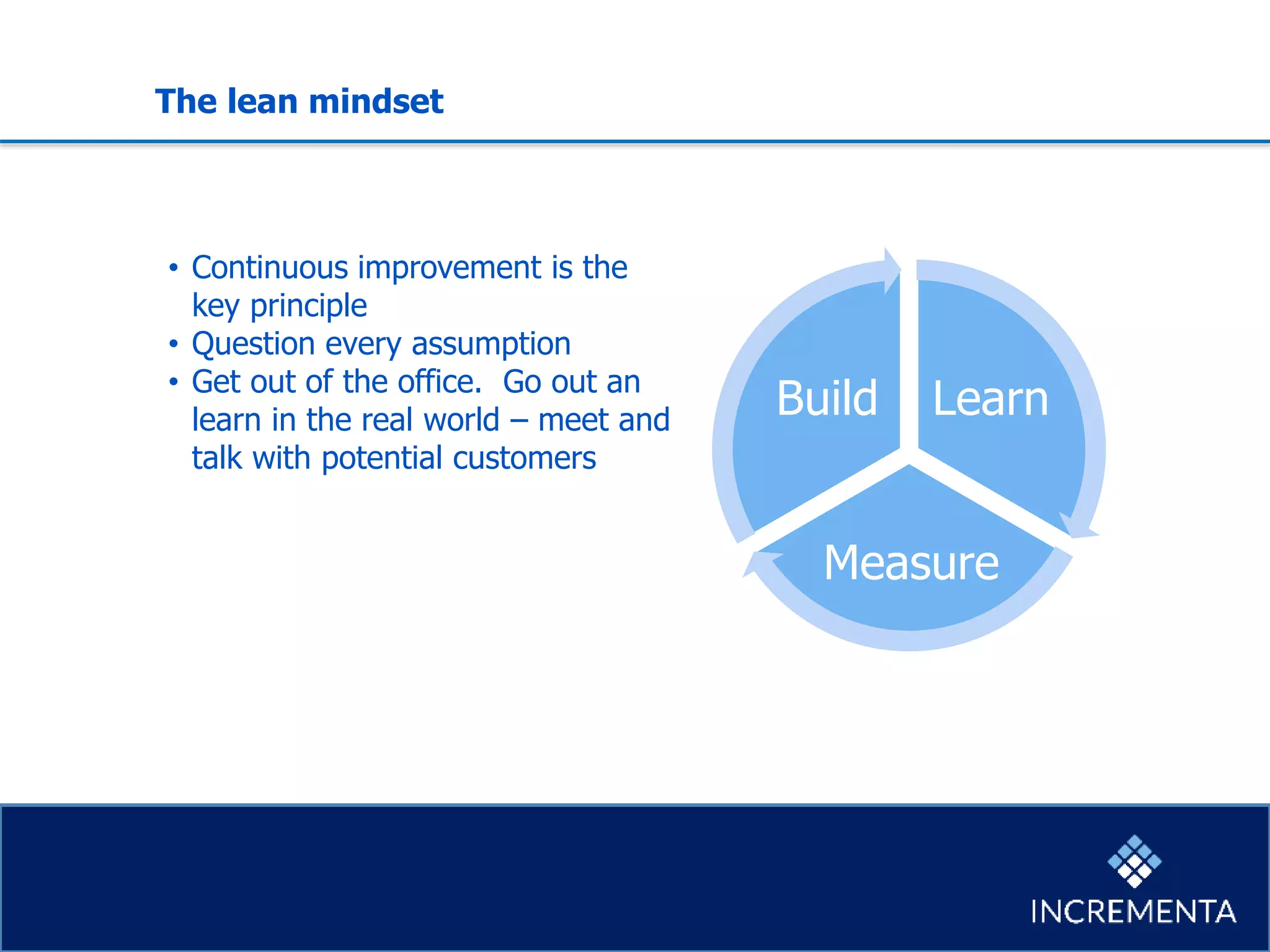
The lean mindset
Learn
Measure
Build
• Continuous improvement is the
key principle
• Question every assumption
• Get out of the office. Go out an
learn in the real world – meet and
talk with potential customers
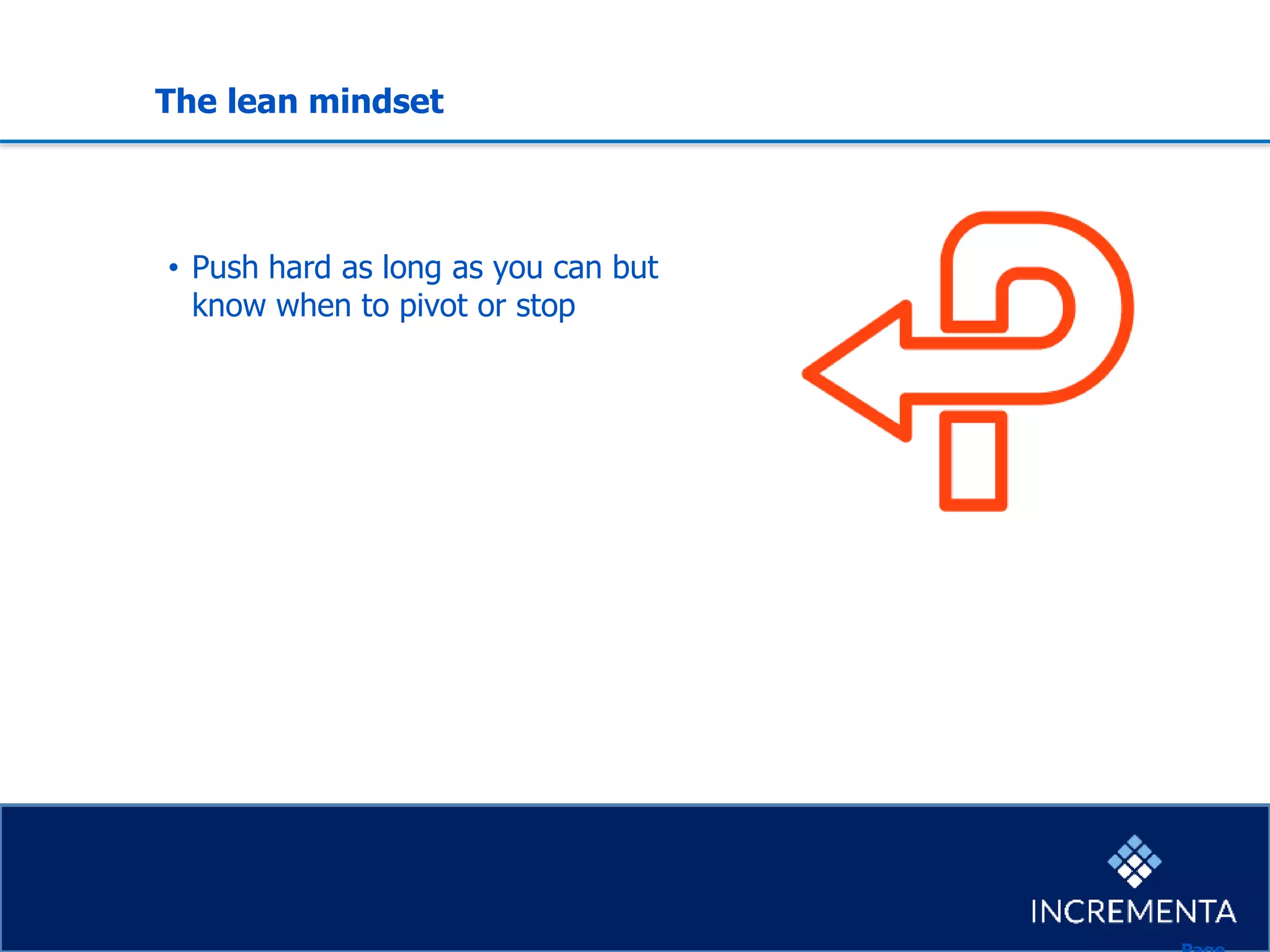
The lean mindset
• Push hard as long as you can but
know when to pivot or stop
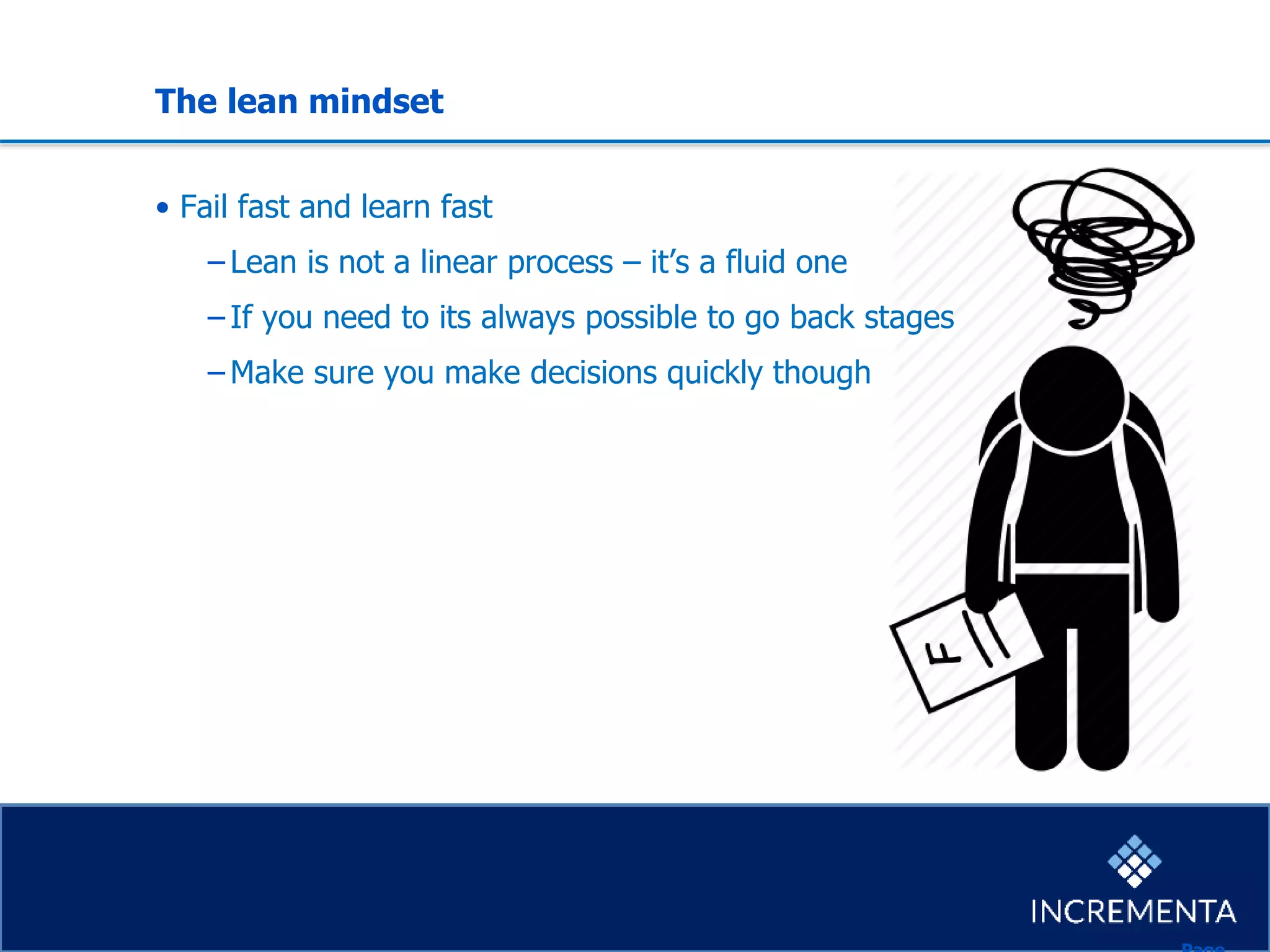
The lean mindset
• Fail fast and learn fast
−Lean is not a linear process – it’s a fluid one
−If you need to its always possible to go back stages
−Make sure you make decisions quickly though
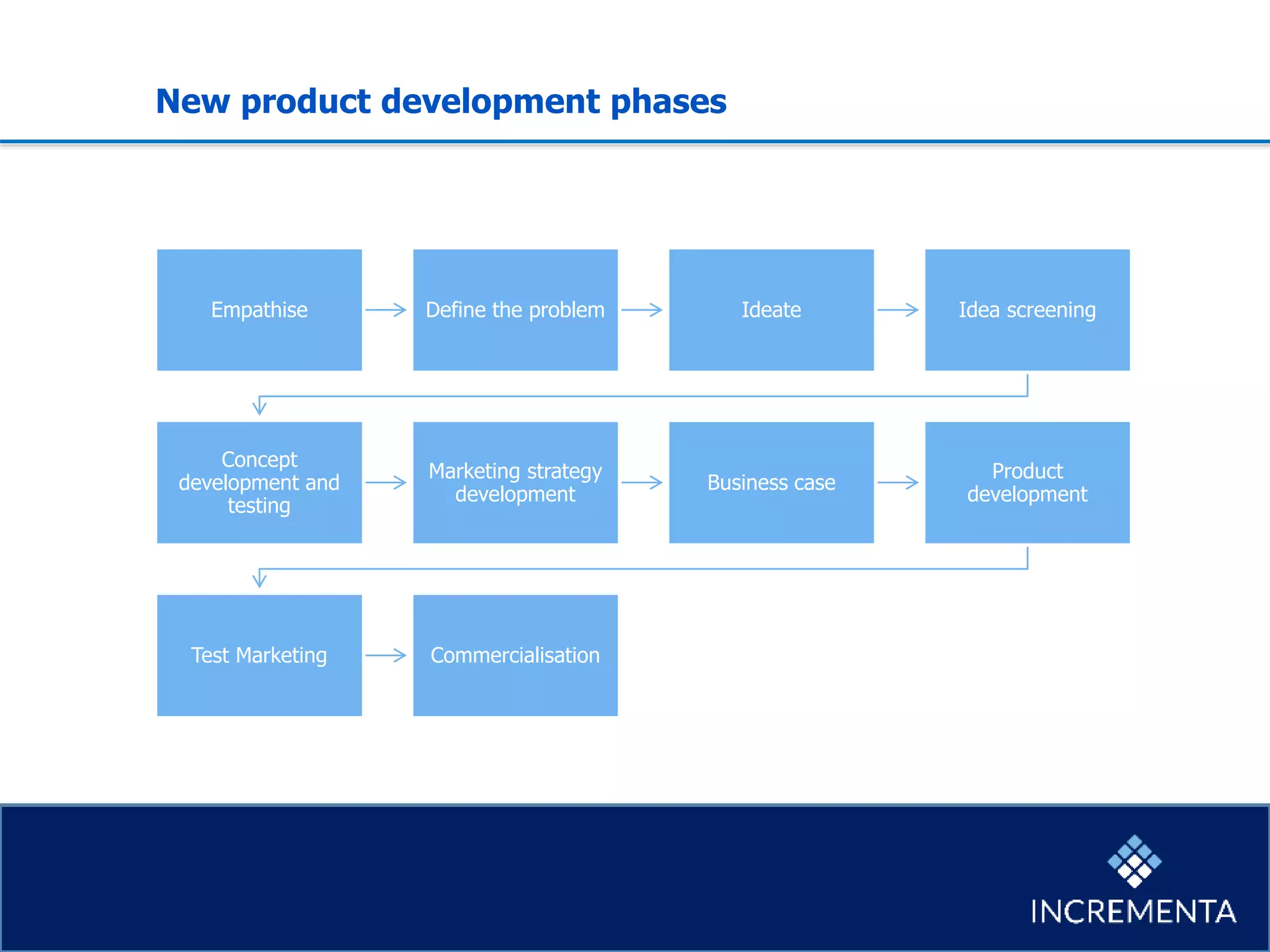
New product development phases
Empathise Define the problem Ideate Idea screening
Concept
development and
testing
Marketing strategy
development
Business case
Product
development
Test Marketing Commercialisation
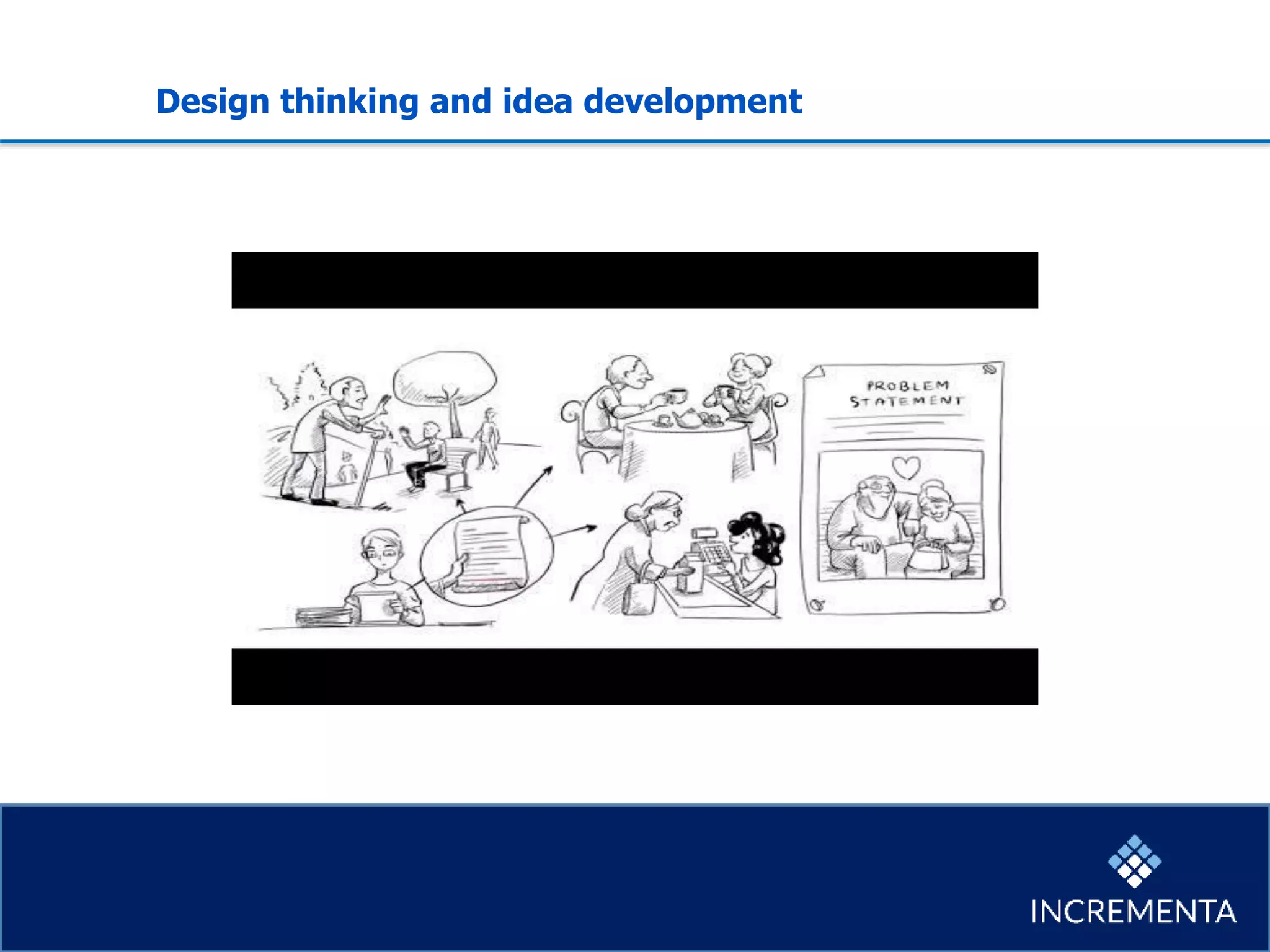
Design thinking and idea development
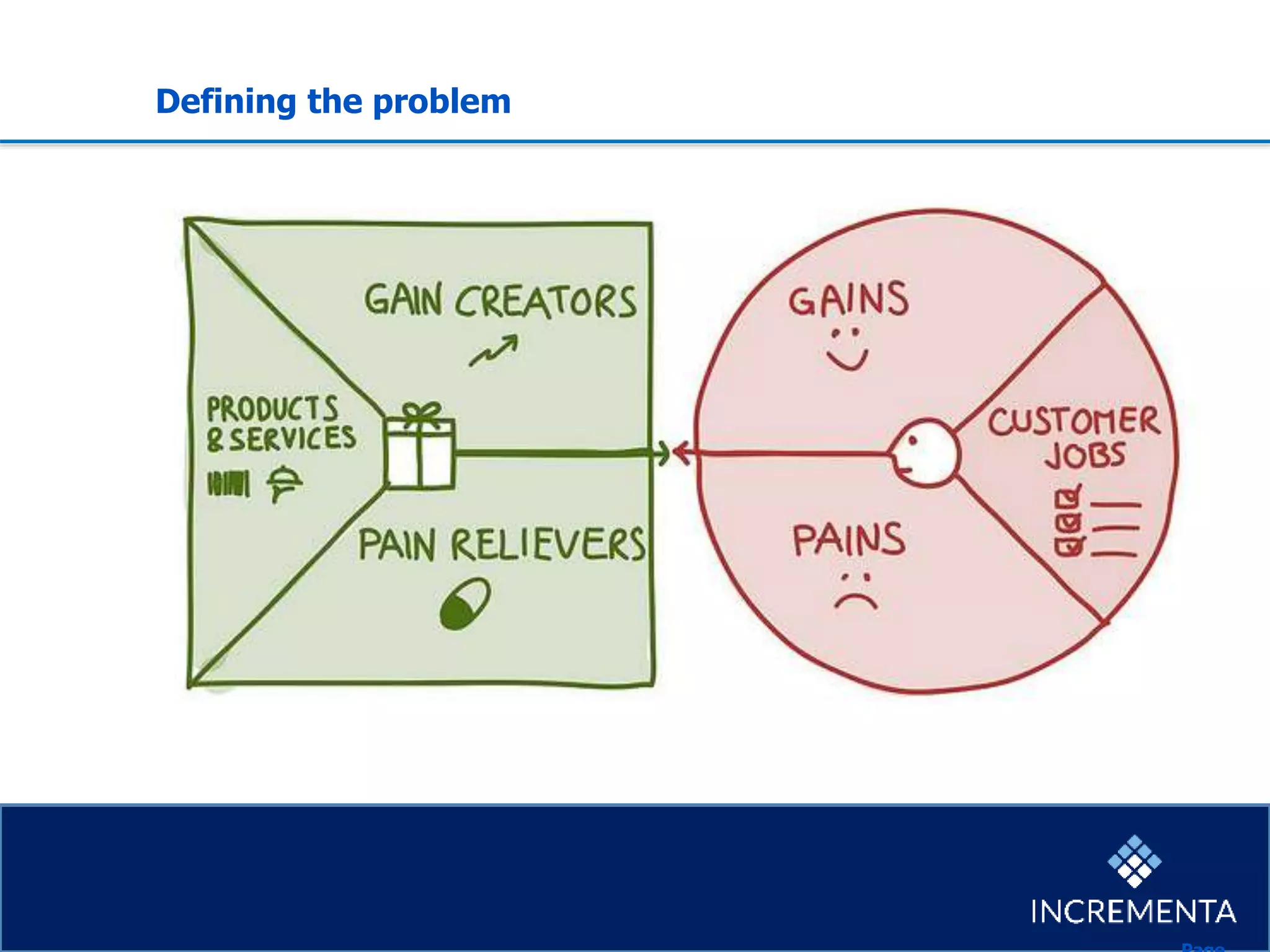
Defining the problem
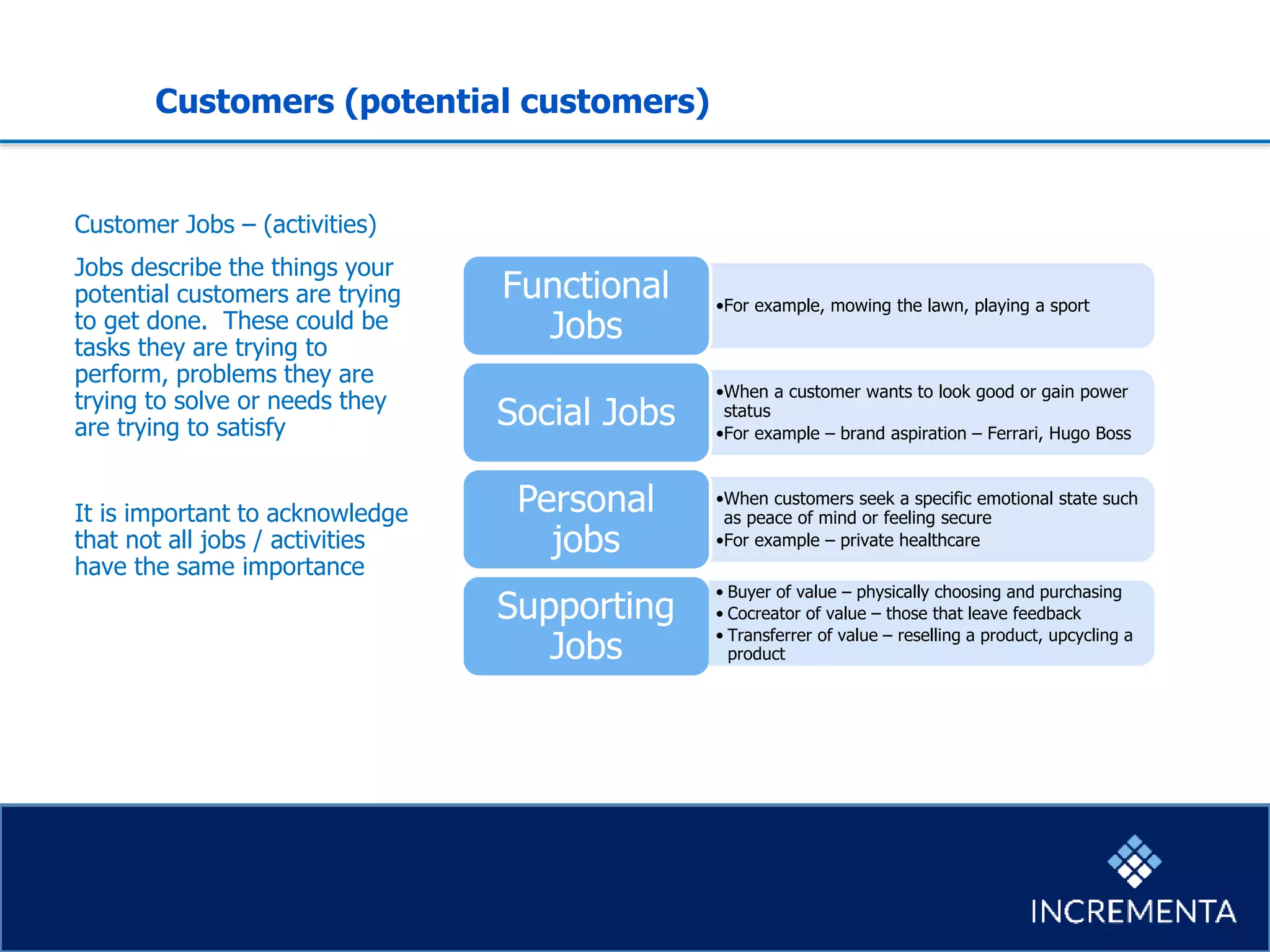
Customers (potential customers)
Customer Jobs – (activities)
Jobs describe the things your
potential customers are trying
to get done. These could be
tasks they are trying to
perform, problems they are
trying to solve or needs they
are trying to satisfy
It is important to acknowledge
that not all jobs / activities
have the same importance
Angle Tip
When carrying out potential customer
research its important to first identify
who your potential customers might
be. Don’t waste your time asking
people their views on products or
services that they will not buy.
•For example, mowing the lawn, playing a sport
Functional
Jobs
•When a customer wants to look good or gain power
status
•For example – brand aspiration – Ferrari, Hugo Boss
Social Jobs
•When customers seek a specific emotional state such
as peace of mind or feeling secure
•For example – private healthcare
Personal
jobs
Supporting
Jobs
• Buyer of value – physically choosing and purchasing
• Cocreator of value – those that leave feedback
• Transferrer of value – reselling a product, upcycling a
product
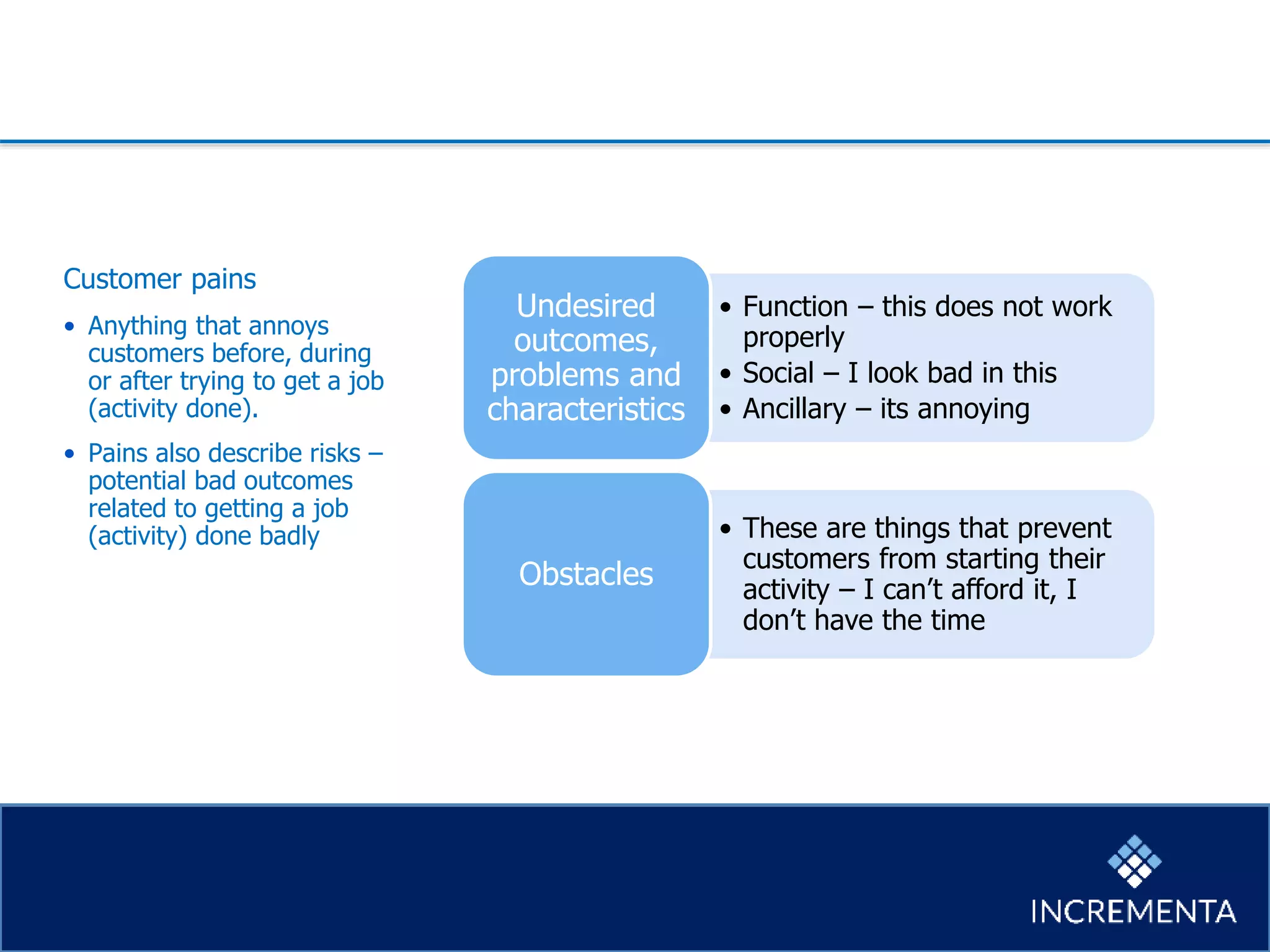
Customer pains
• Anything that annoys
customers before, during
or after trying to get a job
(activity done).
• Pains also describe risks –
potential bad outcomes
related to getting a job
(activity) done badly
• Function – this does not work
properly
• Social – I look bad in this
• Ancillary – its annoying
Undesired
outcomes,
problems and
characteristics
• These are things that prevent
customers from starting their
activity – I can’t afford it, I
don’t have the time
Obstacles
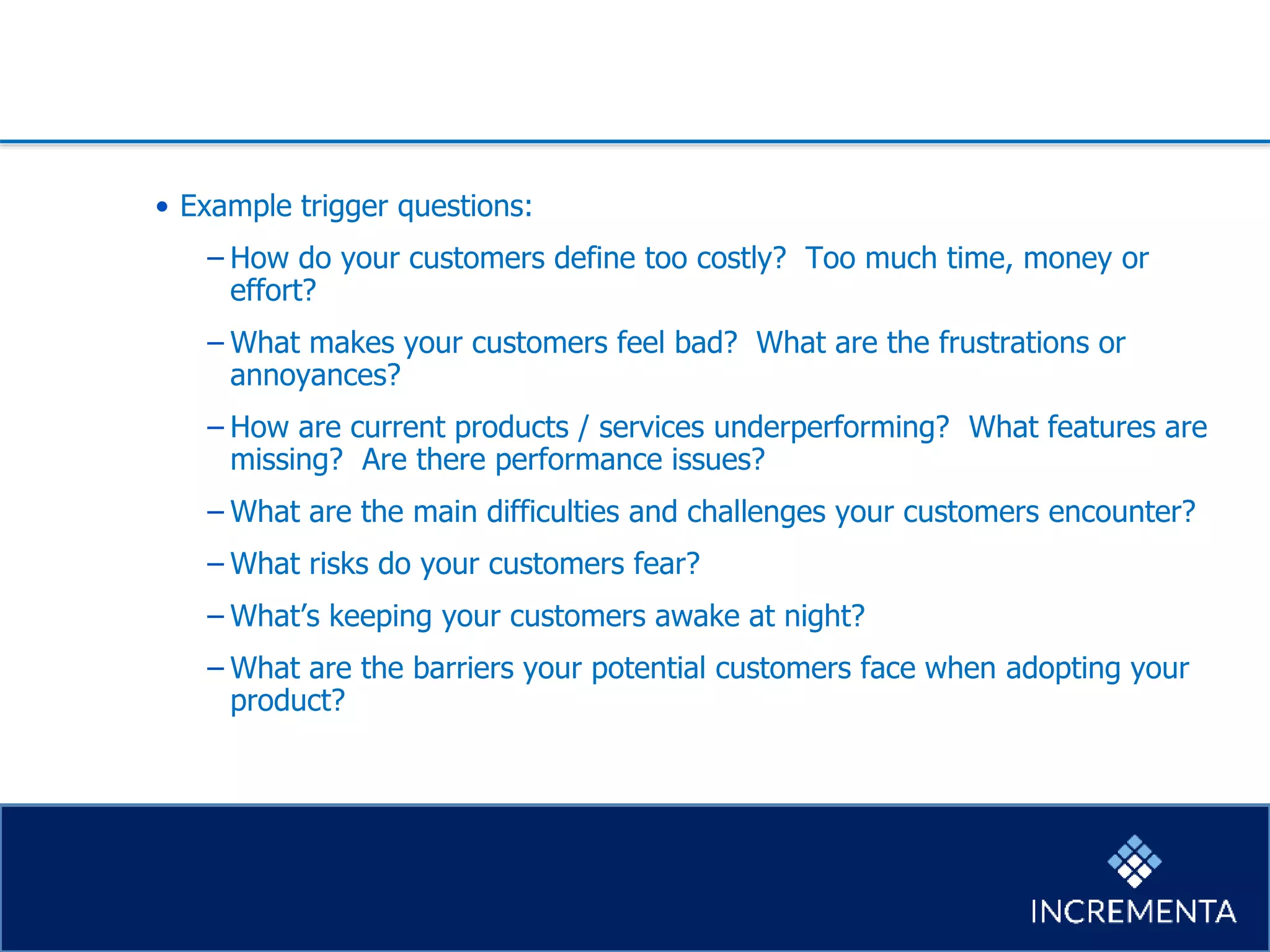
• Example trigger questions:
−How do your customers define too costly? Too much time, money or
effort?
−What makes your customers feel bad? What are the frustrations or
annoyances?
−How are current products / services underperforming? What features are
missing? Are there performance issues?
−What are the main difficulties and challenges your customers encounter?
−What risks do your customers fear?
−What’s keeping your customers awake at night?
−What are the barriers your potential customers face when adopting your
product?
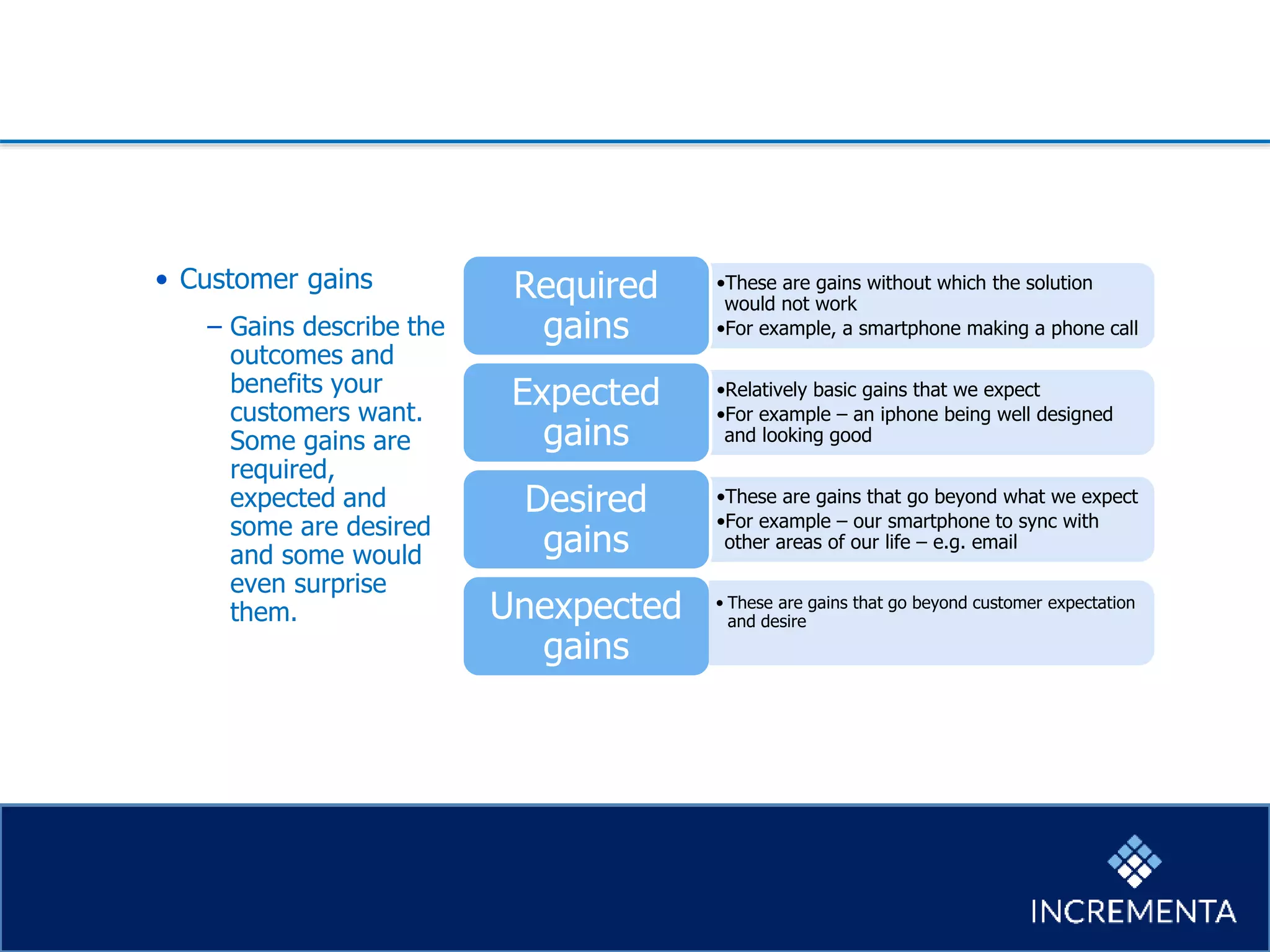
• Customer gains
− Gains describe the
outcomes and
benefits your
customers want.
Some gains are
required,
expected and
some are desired
and some would
even surprise
them.
•These are gains without which the solution
would not work
•For example, a smartphone making a phone call
Required
gains
•Relatively basic gains that we expect
•For example – an iphone being well designed
and looking good
Expected
gains
•These are gains that go beyond what we expect
•For example – our smartphone to sync with
other areas of our life – e.g. email
Desired
gains
Unexpected
gains
• These are gains that go beyond customer expectation
and desire
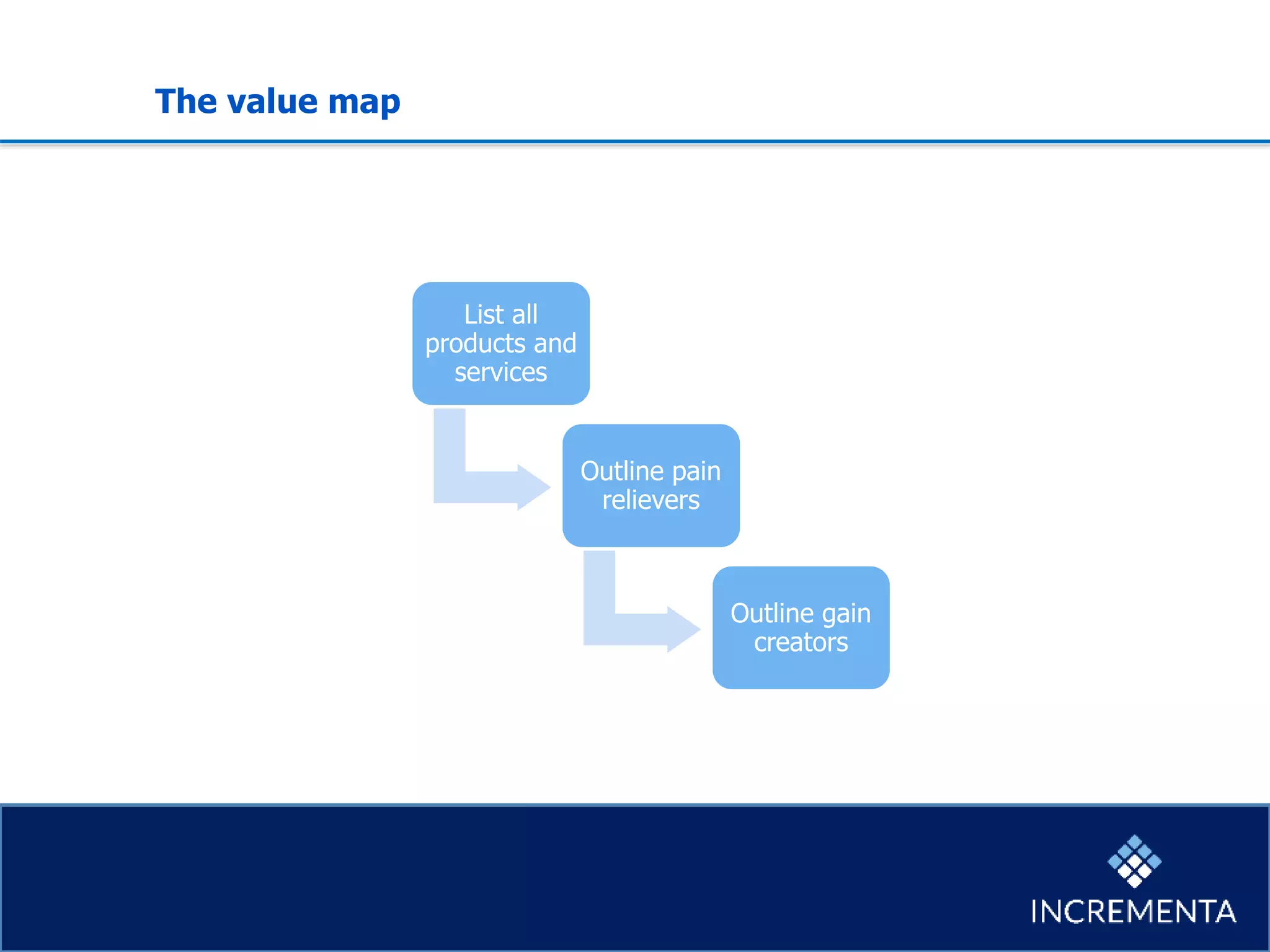
The value map
List all
products and
services
Outline pain
relievers
Outline gain
creators
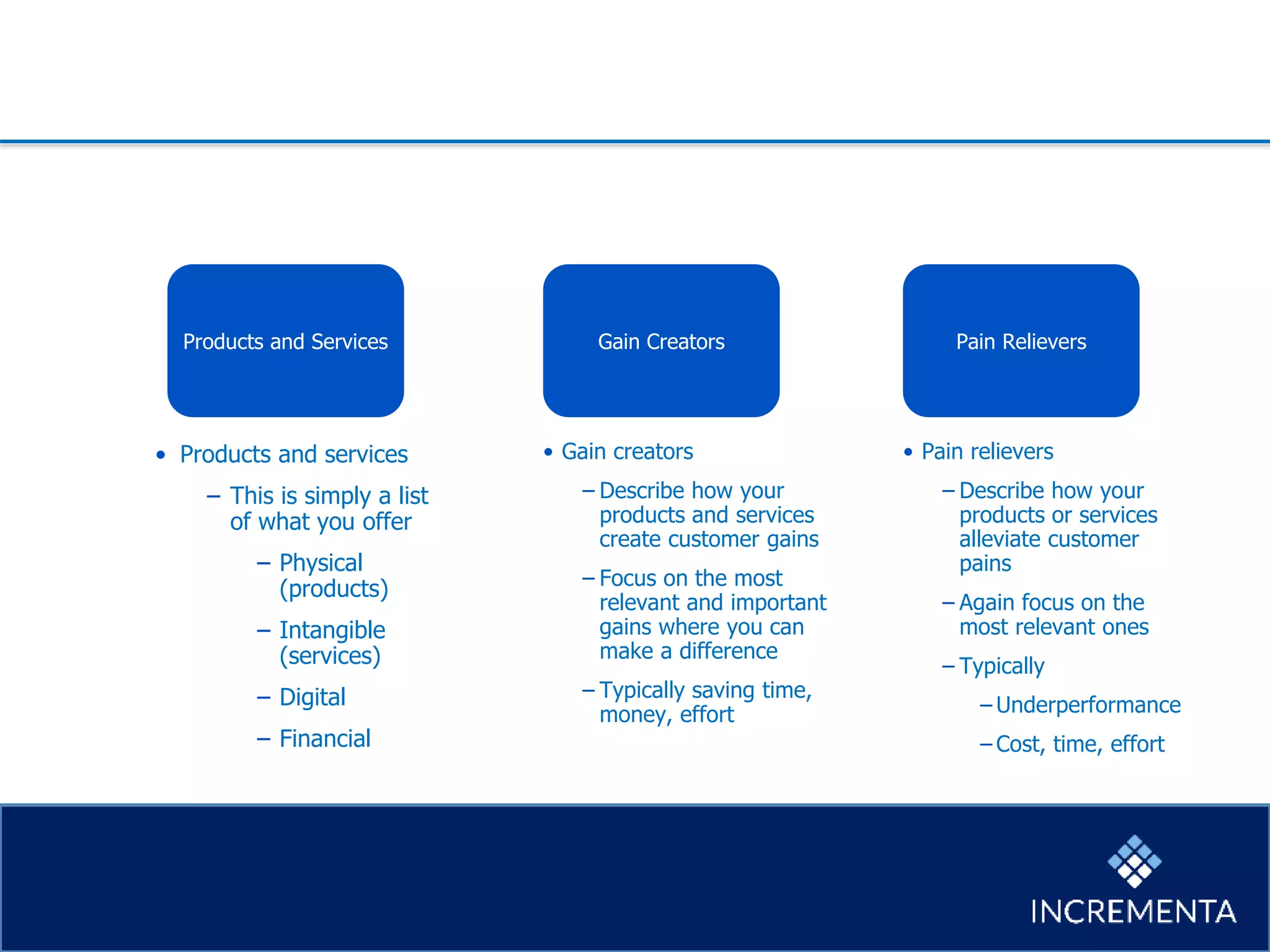
Products and Services Gain Creators Pain Relievers
• Products and services
− This is simply a list
of what you offer
− Physical
(products)
− Intangible
(services)
− Digital
− Financial
• Gain creators
−Describe how your
products and services
create customer gains
−Focus on the most
relevant and important
gains where you can
make a difference
−Typically saving time,
money, effort
• Pain relievers
−Describe how your
products or services
alleviate customer
pains
−Again focus on the
most relevant ones
−Typically
−Underperformance
−Cost, time, effort
SCREENING AND TESTING
Screening the Idea
• Once all viable ideas are gathered and managed, they must be
further developed, examined, prioritized and evaluated so that a
single product idea is selected for further development into a
product concept. This whole process is called screening and is the
main problem to solve in this level using different tools and
techniques.
Screening the Idea
• Two potential risks in screening
• Dropping ideas too early means missed opportunities!
• Developing the "wrong" ideas means wasted resources in terms of
time, financial investments and may risk your activities with your
current portfolio
Early stage product development
Tools and Solutions
Assessing New Product Feasibility
Is there a need?
Is it real?
Will the customers buy?
Will it satisfy the market?
Is the product real?
Can it be made?
Differentiation?
Can we win?
Low cost position?
Industry structure?
Company competitive? Organizational
effectiveness?
Is the return adequate?
Is it worth it?
Is the risk acceptable?
Supports company's
objectives?Satisfy other needs?
Other factors?
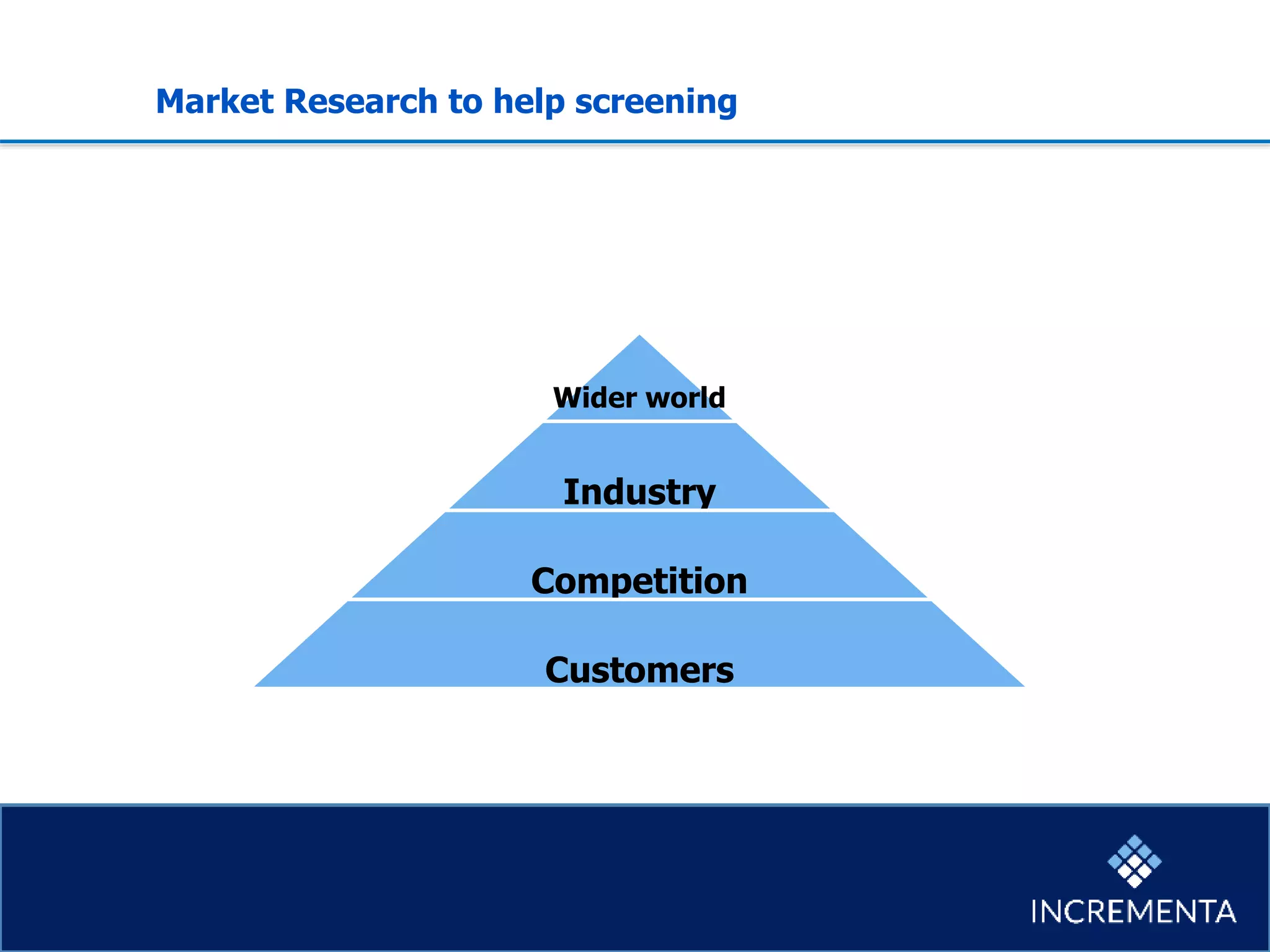
Market Research to help screening
Wider world
Industry
Competition
Customers
PESTLE
Bigger
picture
Political
Economic
Social
Tech
Legal
Environmental
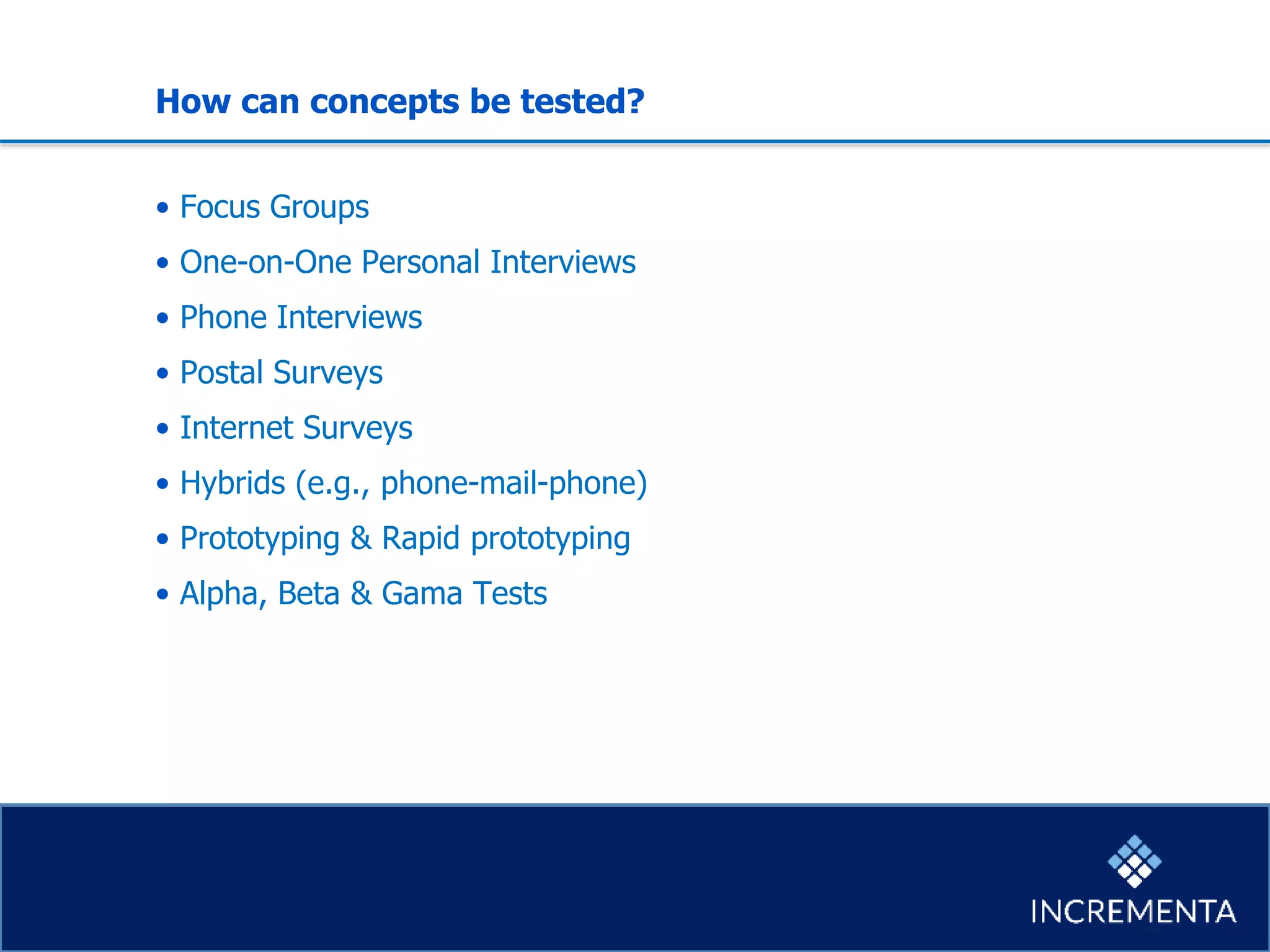
How can concepts be tested?
• Focus Groups
• One-on-One Personal Interviews
• Phone Interviews
• Postal Surveys
• Internet Surveys
• Hybrids (e.g., phone-mail-phone)
• Prototyping & Rapid prototyping
• Alpha, Beta & Gama Tests
The “Mom” test
• Avoid asking customers questions that if they asked their own mum she
would lie to them.
• Instead only ask questions that would mean she would tell the truth
−Stop fishing for compliments – avoid questions like “do you like it”?
−Focus on the customer needs not your product
−Stop pitching – don’t describe the features of your solution as if you
are on a sales call.
−Listen and learn about your customers and their challenges
−Don’t ask questions about the future – questions such as “would you
buy this product” and “how much would you pay” are not very useful.
−Its better to run experiments to test their willingness to pay.
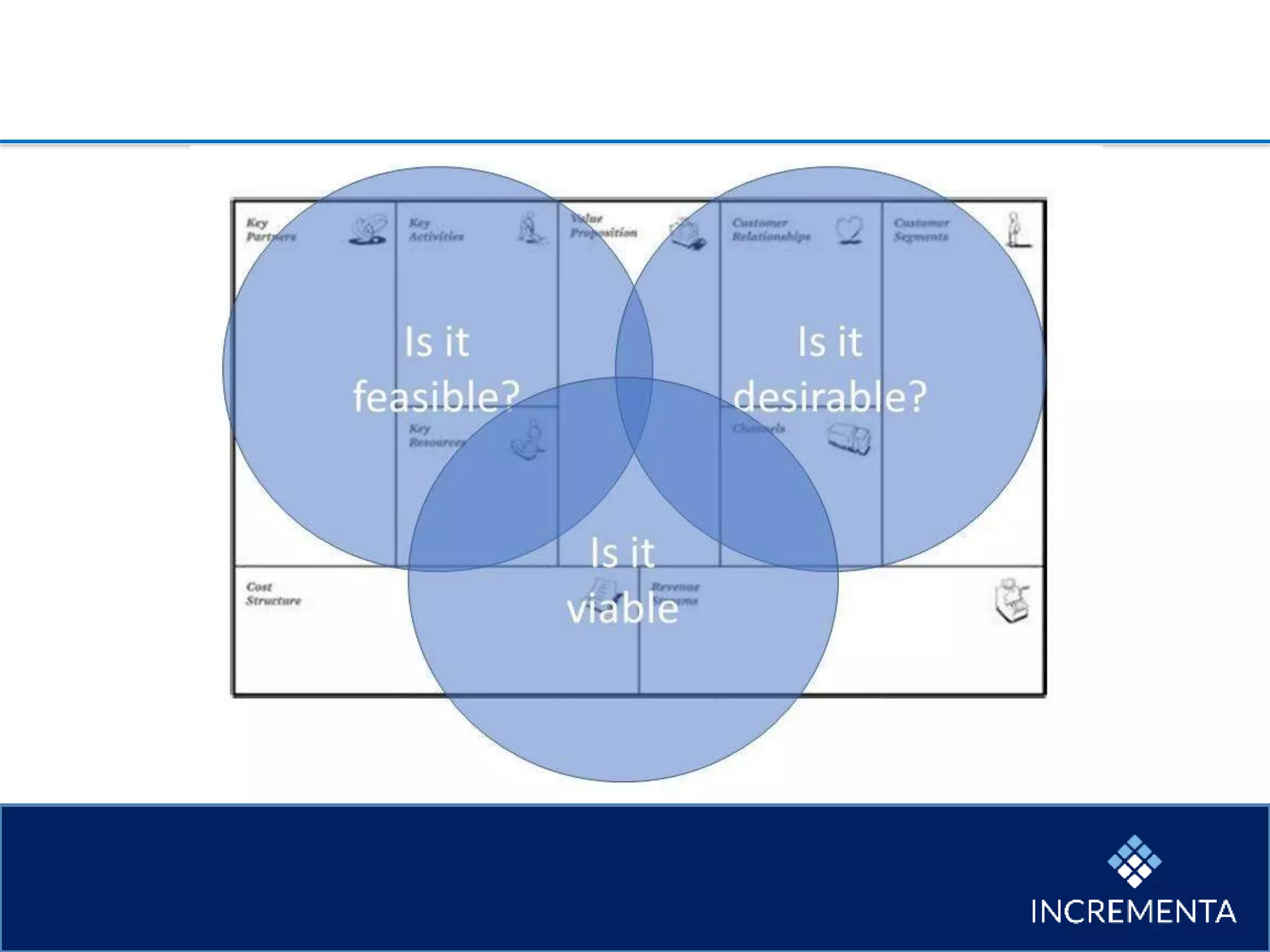
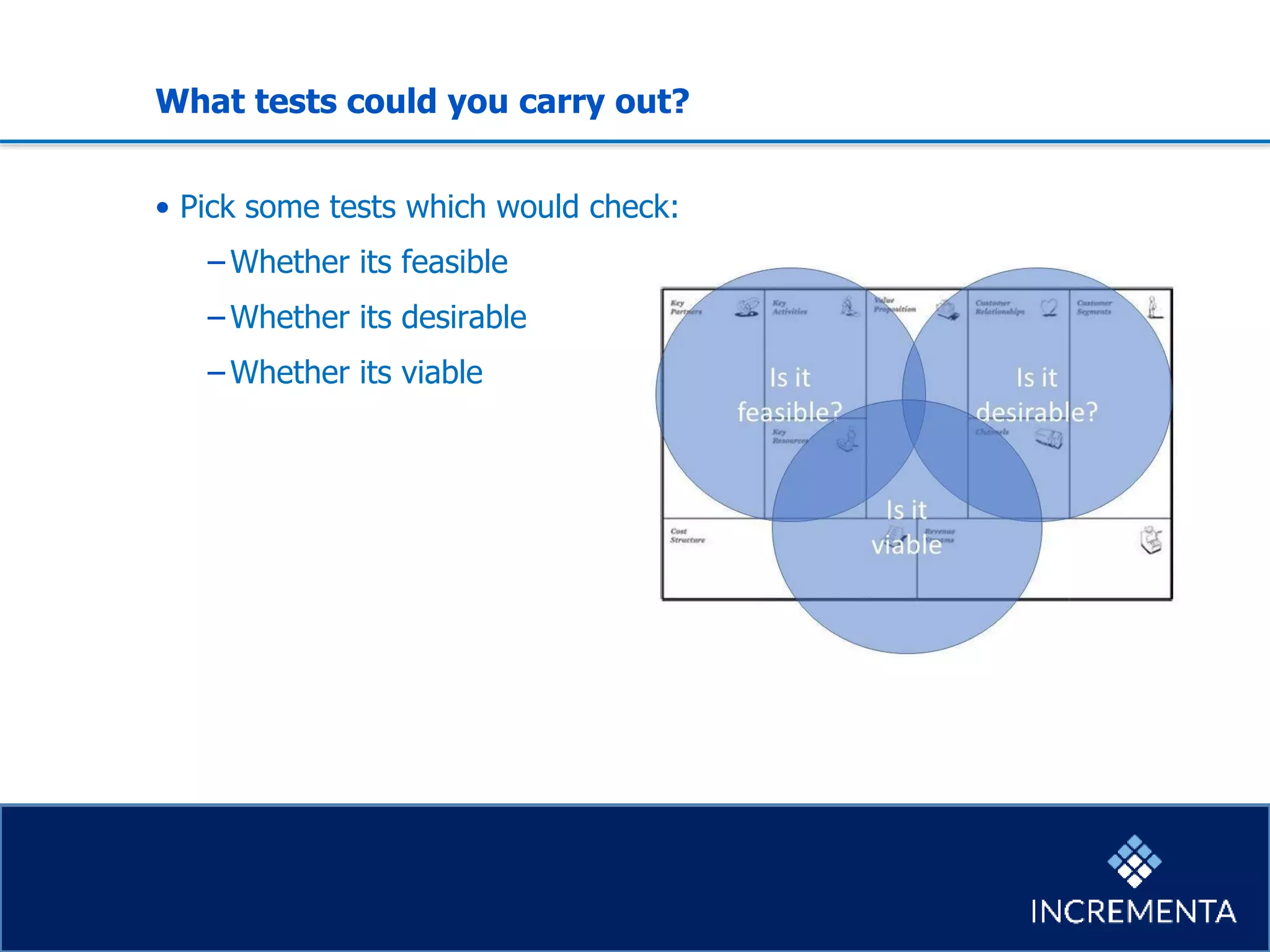
What tests could you carry out?
• Pick some tests which would check:
−Whether its feasible
−Whether its desirable
−Whether its viable
Product development
• What have we learnt
from our customer
discovery and validation
testing?
• How do we improve the
product to make it more
appealable?
• Are we addressing the
right pains and creating
the most important
gains?
Pivot, Persevere, Stop
Seven types of pivot possibility
1. Customer segment pivot – changing your customer focus
2. Customer need pivot – changing the way you potentially market
3. Zoom in pivot – focusing on one specific part of the business
4. Zoom out pivot – creating a wider focus
5. Value chapter pivot – this is a change in the revenue model
6. Channel pivot – a change in how you reach or distribute to your
customers
7. Technology pivot – utilising different technology to deliver the idea
Launch Strategy
Customer has
never heard of
me
Customer has
heard of me
Customer starts
to listen
Customer
makes decision
Customer buys
BUSINESS CASE
Where are
you now?
Where do
you want
to go?
How are
you going
to get
there
The business plan
The business plan
Do you
know?
Who
What
WhyHow
When
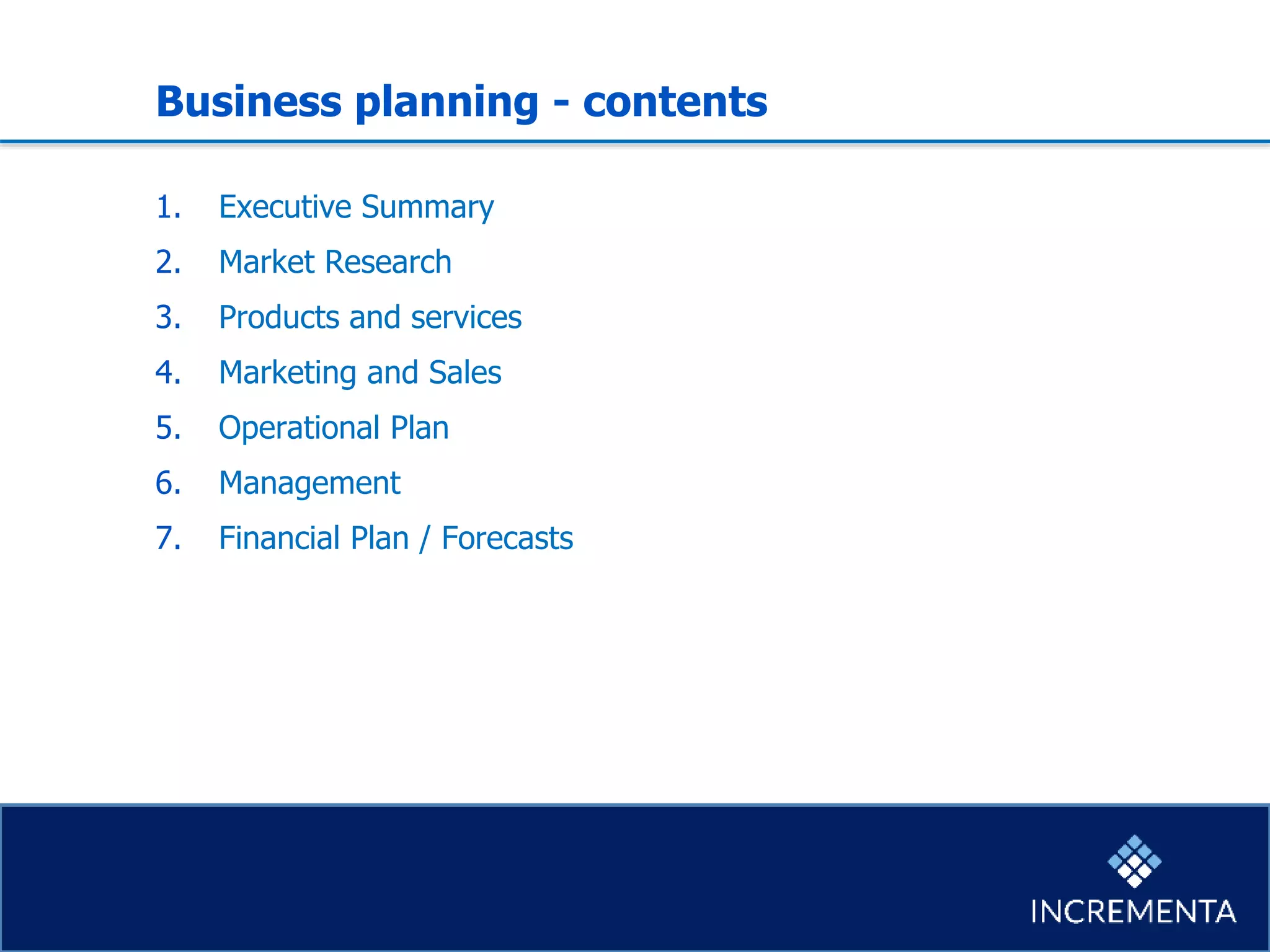
Business planning - contents
1. Executive Summary
2. Market Research
3. Products and services
4. Marketing and Sales
5. Operational Plan
6. Management
7. Financial Plan / Forecasts
YR3
£K
£k
?
?
£k
£k
?
?
?
?
?
?
?
?
?
?
?
?
?
?
?
?
?
?
Curre
nt
year
YR1 YR2
?
?
?
?
?
?
?
?
3
0
?
?
? ? ? ?
?
?
?
?
Gross Margin
Net Profit
Business
Value
Personal
Income
Turnover
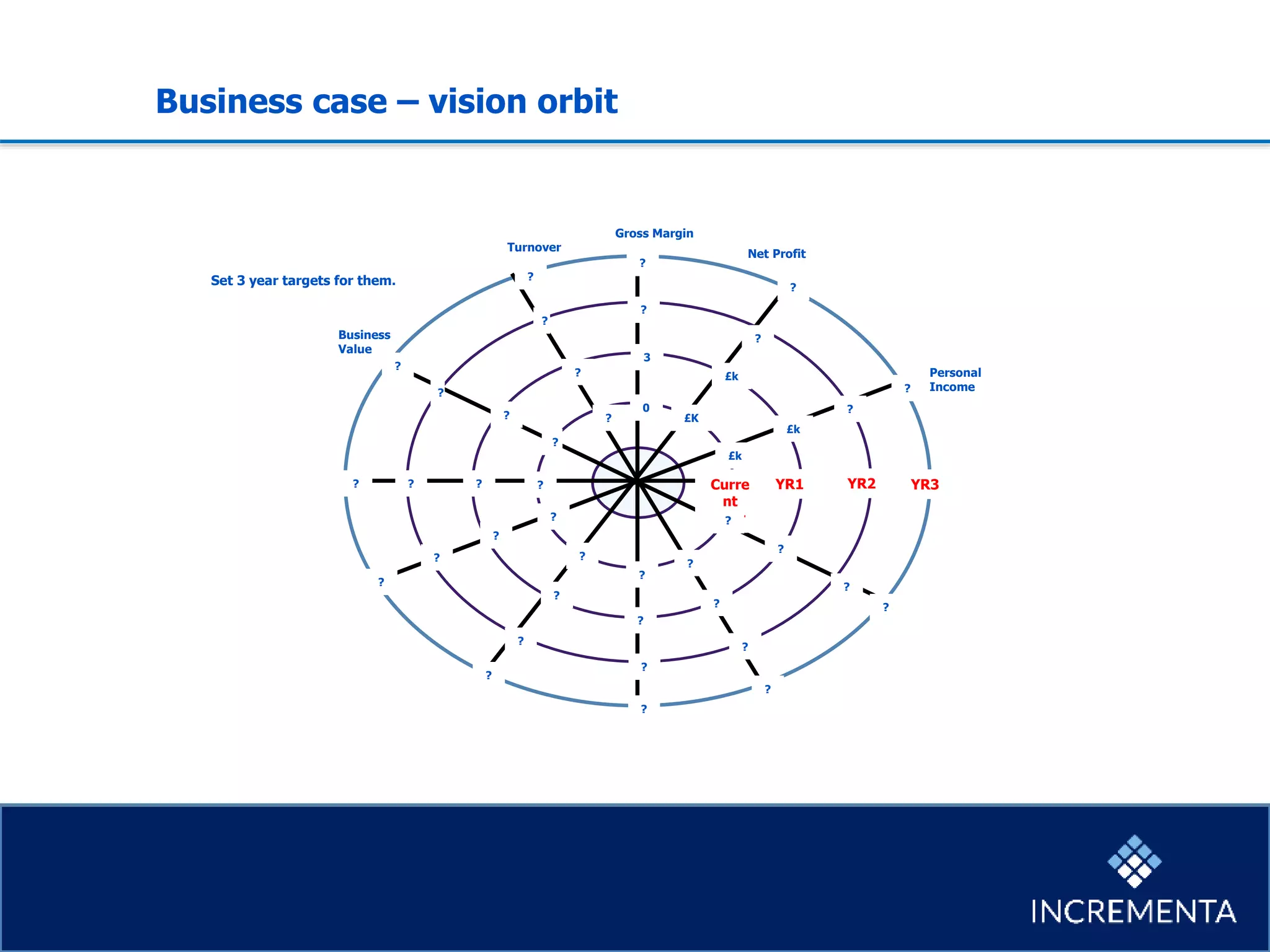
Set 3 year targets for them.
Business case – vision orbit
Business case
• Road mapping
EU
Launch
UK
Launch
Soft
Launch
TestingR&D
Month
1
Month
6
Month
12
Month
18
Month
36
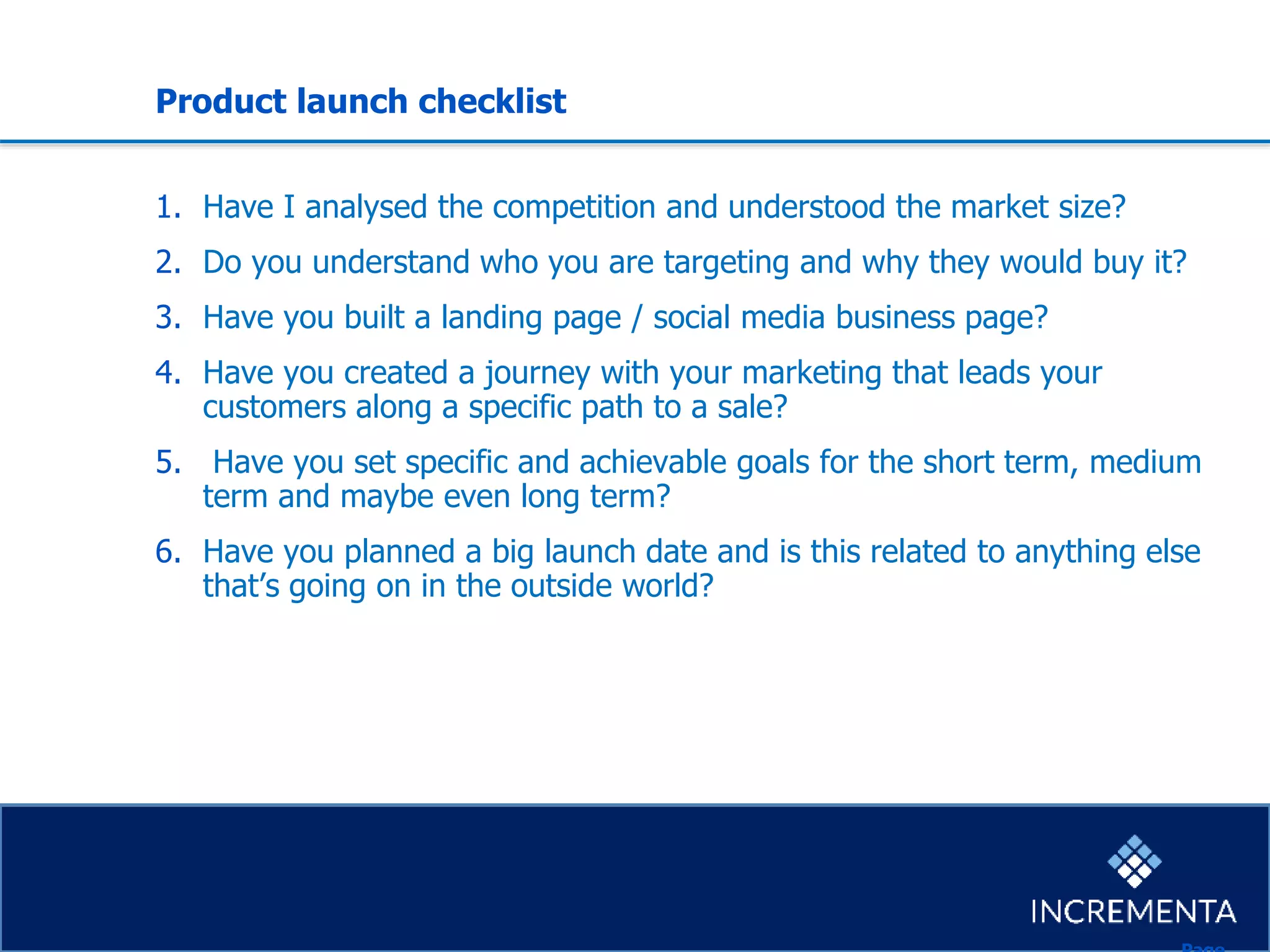
Product launch checklist
1. Have I analysed the competition and understood the market size?
2. Do you understand who you are targeting and why they would buy it?
3. Have you built a landing page / social media business page?
4. Have you created a journey with your marketing that leads your
customers along a specific path to a sale?
5. Have you set specific and achievable goals for the short term, medium
term and maybe even long term?
6. Have you planned a big launch date and is this related to anything else
that’s going on in the outside world?
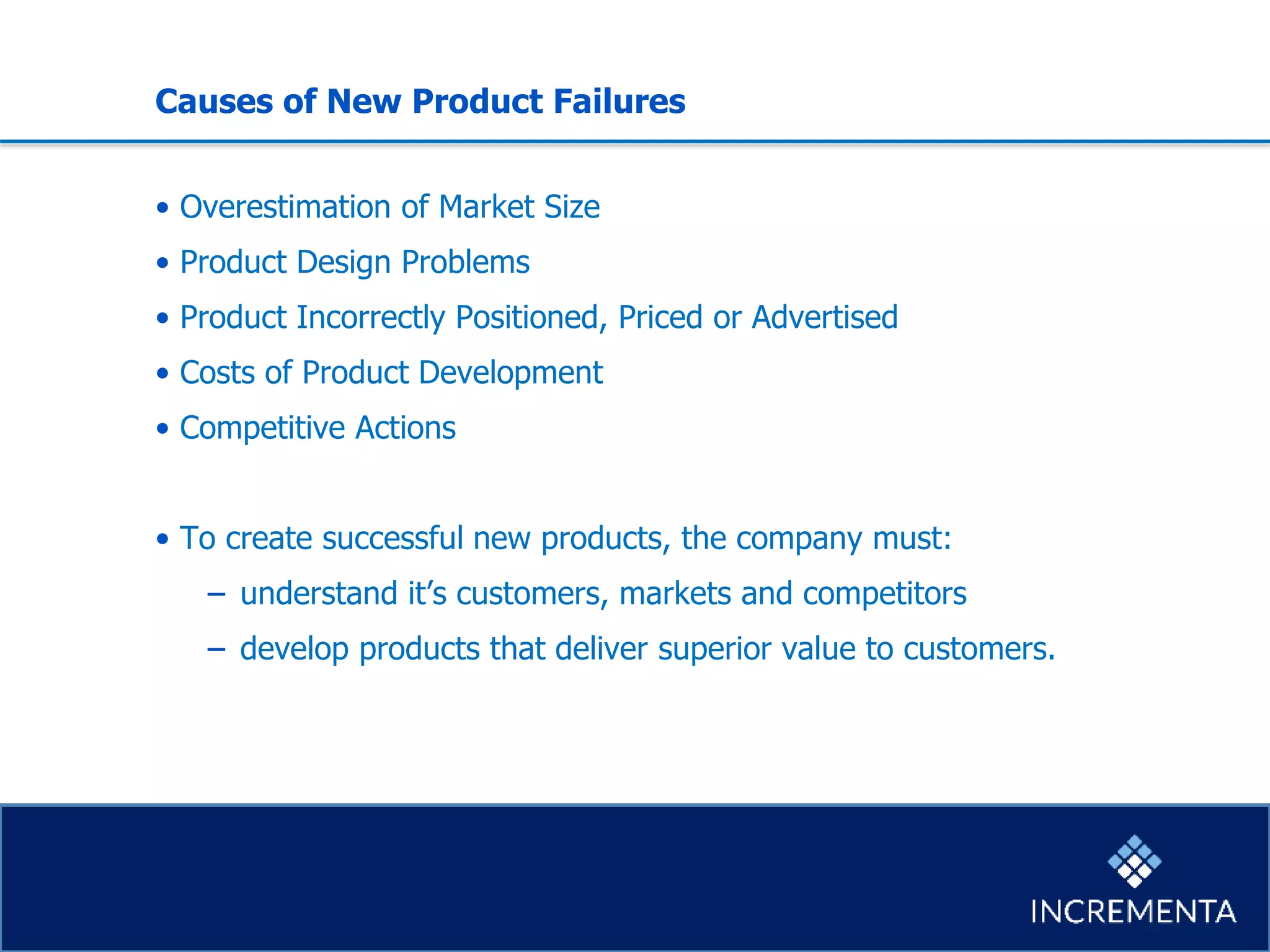
Causes of New Product Failures
• Overestimation of Market Size
• Product Design Problems
• Product Incorrectly Positioned, Priced or Advertised
• Costs of Product Development
• Competitive Actions
• To create successful new products, the company must:
− understand it’s customers, markets and competitors
− develop products that deliver superior value to customers.
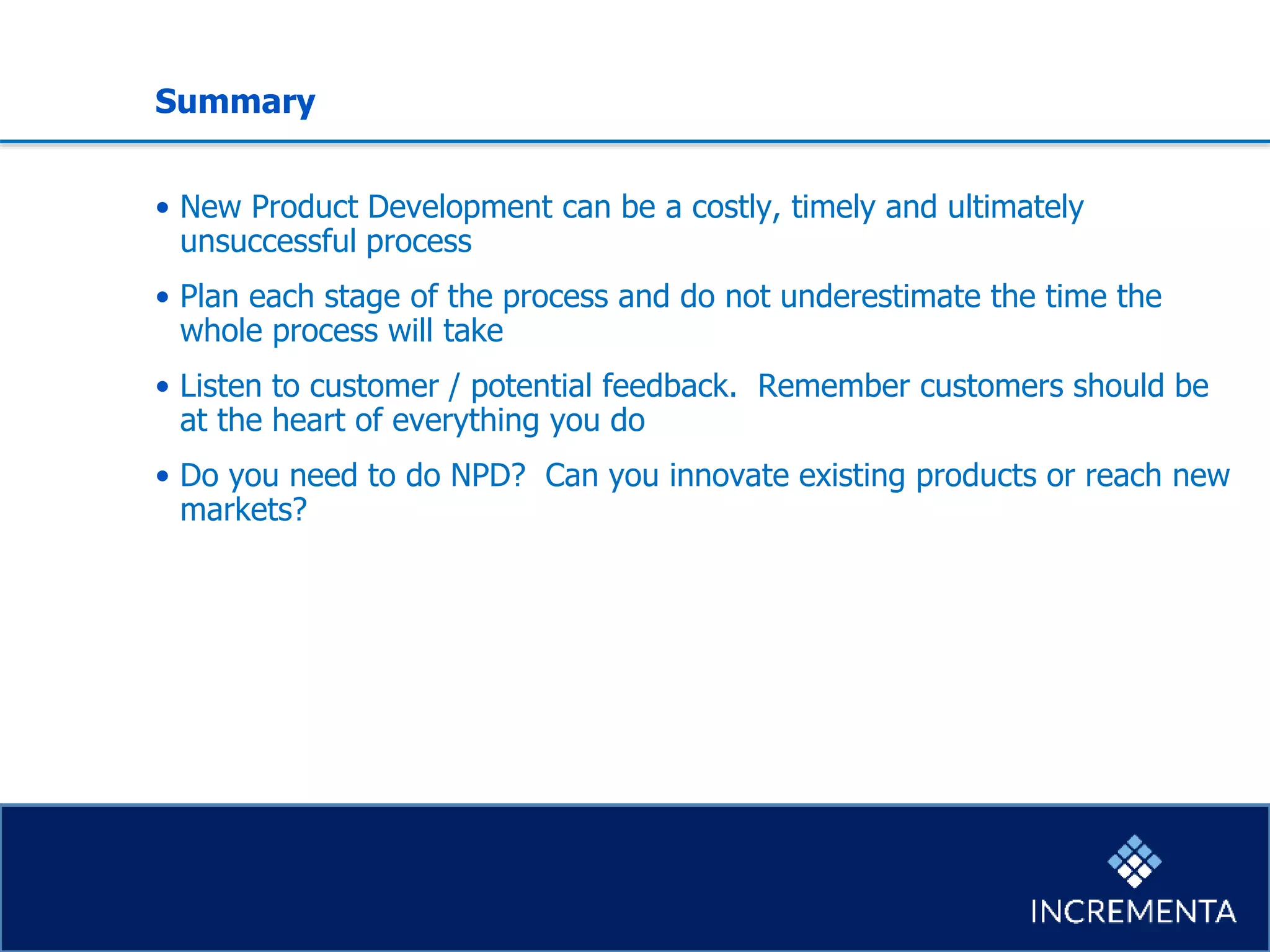
Summary
• New Product Development can be a costly, timely and ultimately
unsuccessful process
• Plan each stage of the process and do not underestimate the time the
whole process will take
• Listen to customer / potential feedback. Remember customers should be
at the heart of everything you do
• Do you need to do NPD? Can you innovate existing products or reach new
markets?

Idea development

  • 1.
  • 2.
    Who are theyand what did they create?
  • 3.
    “That’s an amazinginvention, but who would ever want to use one of them?” (US President Rutherford B. Hayes, after participating in a trial telephone conversation between Washington and Philadelphia in 1876). “Television won’t be able to hold onto any market it captures after the first six months. People will soon get tired of staring into a box every night (Darryl F. Zanuck, Head of 20th Century Fox, 1946) Don’t believe the experts
  • 4.
    “The horse ishere to stay, but the automobile is only a novelty, a fad” (President of Michigan Savings Bank, 1903, advising Henry Ford’s lawyer not to invest in the Ford Motor Company – disregarding the advice, he invested $ 5,000 in stock, which he sold several years later for $ 12,5 million). “I think there is a world market for about five computers (Thomas J. Watson Sr., Chairman of IBM, 1943) Don’t believe the experts
  • 5.
    Definition Development of original products,product improvements, product modifications, and new brands through the firm’s own R & D efforts
  • 6.
    The lean mindset Learn Measure Build •Continuous improvement is the key principle • Question every assumption • Get out of the office. Go out an learn in the real world – meet and talk with potential customers
  • 7.
    The lean mindset •Push hard as long as you can but know when to pivot or stop
  • 8.
    The lean mindset •Fail fast and learn fast −Lean is not a linear process – it’s a fluid one −If you need to its always possible to go back stages −Make sure you make decisions quickly though
  • 9.
    New product developmentphases Empathise Define the problem Ideate Idea screening Concept development and testing Marketing strategy development Business case Product development Test Marketing Commercialisation
  • 10.
    Design thinking andidea development
  • 11.
  • 12.
    Customers (potential customers) CustomerJobs – (activities) Jobs describe the things your potential customers are trying to get done. These could be tasks they are trying to perform, problems they are trying to solve or needs they are trying to satisfy It is important to acknowledge that not all jobs / activities have the same importance Angle Tip When carrying out potential customer research its important to first identify who your potential customers might be. Don’t waste your time asking people their views on products or services that they will not buy. •For example, mowing the lawn, playing a sport Functional Jobs •When a customer wants to look good or gain power status •For example – brand aspiration – Ferrari, Hugo Boss Social Jobs •When customers seek a specific emotional state such as peace of mind or feeling secure •For example – private healthcare Personal jobs Supporting Jobs • Buyer of value – physically choosing and purchasing • Cocreator of value – those that leave feedback • Transferrer of value – reselling a product, upcycling a product
  • 13.
    Customer pains • Anythingthat annoys customers before, during or after trying to get a job (activity done). • Pains also describe risks – potential bad outcomes related to getting a job (activity) done badly • Function – this does not work properly • Social – I look bad in this • Ancillary – its annoying Undesired outcomes, problems and characteristics • These are things that prevent customers from starting their activity – I can’t afford it, I don’t have the time Obstacles
  • 14.
    • Example triggerquestions: −How do your customers define too costly? Too much time, money or effort? −What makes your customers feel bad? What are the frustrations or annoyances? −How are current products / services underperforming? What features are missing? Are there performance issues? −What are the main difficulties and challenges your customers encounter? −What risks do your customers fear? −What’s keeping your customers awake at night? −What are the barriers your potential customers face when adopting your product?
  • 15.
    • Customer gains −Gains describe the outcomes and benefits your customers want. Some gains are required, expected and some are desired and some would even surprise them. •These are gains without which the solution would not work •For example, a smartphone making a phone call Required gains •Relatively basic gains that we expect •For example – an iphone being well designed and looking good Expected gains •These are gains that go beyond what we expect •For example – our smartphone to sync with other areas of our life – e.g. email Desired gains Unexpected gains • These are gains that go beyond customer expectation and desire
  • 16.
    The value map Listall products and services Outline pain relievers Outline gain creators
  • 17.
    Products and ServicesGain Creators Pain Relievers • Products and services − This is simply a list of what you offer − Physical (products) − Intangible (services) − Digital − Financial • Gain creators −Describe how your products and services create customer gains −Focus on the most relevant and important gains where you can make a difference −Typically saving time, money, effort • Pain relievers −Describe how your products or services alleviate customer pains −Again focus on the most relevant ones −Typically −Underperformance −Cost, time, effort
  • 18.
  • 19.
    Screening the Idea •Once all viable ideas are gathered and managed, they must be further developed, examined, prioritized and evaluated so that a single product idea is selected for further development into a product concept. This whole process is called screening and is the main problem to solve in this level using different tools and techniques.
  • 20.
    Screening the Idea •Two potential risks in screening • Dropping ideas too early means missed opportunities! • Developing the "wrong" ideas means wasted resources in terms of time, financial investments and may risk your activities with your current portfolio
  • 21.
  • 23.
    Tools and Solutions AssessingNew Product Feasibility Is there a need? Is it real? Will the customers buy? Will it satisfy the market? Is the product real? Can it be made? Differentiation? Can we win? Low cost position? Industry structure? Company competitive? Organizational effectiveness? Is the return adequate? Is it worth it? Is the risk acceptable? Supports company's objectives?Satisfy other needs? Other factors?
  • 24.
    Market Research tohelp screening Wider world Industry Competition Customers
  • 25.
  • 26.
    How can conceptsbe tested? • Focus Groups • One-on-One Personal Interviews • Phone Interviews • Postal Surveys • Internet Surveys • Hybrids (e.g., phone-mail-phone) • Prototyping & Rapid prototyping • Alpha, Beta & Gama Tests
  • 27.
    The “Mom” test •Avoid asking customers questions that if they asked their own mum she would lie to them. • Instead only ask questions that would mean she would tell the truth −Stop fishing for compliments – avoid questions like “do you like it”? −Focus on the customer needs not your product −Stop pitching – don’t describe the features of your solution as if you are on a sales call. −Listen and learn about your customers and their challenges −Don’t ask questions about the future – questions such as “would you buy this product” and “how much would you pay” are not very useful. −Its better to run experiments to test their willingness to pay.
  • 28.
    What tests couldyou carry out? • Pick some tests which would check: −Whether its feasible −Whether its desirable −Whether its viable
  • 29.
    Product development • Whathave we learnt from our customer discovery and validation testing? • How do we improve the product to make it more appealable? • Are we addressing the right pains and creating the most important gains?
  • 30.
    Pivot, Persevere, Stop Seventypes of pivot possibility 1. Customer segment pivot – changing your customer focus 2. Customer need pivot – changing the way you potentially market 3. Zoom in pivot – focusing on one specific part of the business 4. Zoom out pivot – creating a wider focus 5. Value chapter pivot – this is a change in the revenue model 6. Channel pivot – a change in how you reach or distribute to your customers 7. Technology pivot – utilising different technology to deliver the idea
  • 31.
    Launch Strategy Customer has neverheard of me Customer has heard of me Customer starts to listen Customer makes decision Customer buys
  • 32.
  • 33.
    Where are you now? Wheredo you want to go? How are you going to get there The business plan
  • 34.
    The business plan Doyou know? Who What WhyHow When
  • 35.
    Business planning -contents 1. Executive Summary 2. Market Research 3. Products and services 4. Marketing and Sales 5. Operational Plan 6. Management 7. Financial Plan / Forecasts
  • 36.
    YR3 £K £k ? ? £k £k ? ? ? ? ? ? ? ? ? ? ? ? ? ? ? ? ? ? Curre nt year YR1 YR2 ? ? ? ? ? ? ? ? 3 0 ? ? ? ?? ? ? ? ? ? Gross Margin Net Profit Business Value Personal Income Turnover Set 3 year targets for them. Business case – vision orbit
  • 37.
    Business case • Roadmapping EU Launch UK Launch Soft Launch TestingR&D Month 1 Month 6 Month 12 Month 18 Month 36
  • 38.
    Product launch checklist 1.Have I analysed the competition and understood the market size? 2. Do you understand who you are targeting and why they would buy it? 3. Have you built a landing page / social media business page? 4. Have you created a journey with your marketing that leads your customers along a specific path to a sale? 5. Have you set specific and achievable goals for the short term, medium term and maybe even long term? 6. Have you planned a big launch date and is this related to anything else that’s going on in the outside world?
  • 39.
    Causes of NewProduct Failures • Overestimation of Market Size • Product Design Problems • Product Incorrectly Positioned, Priced or Advertised • Costs of Product Development • Competitive Actions • To create successful new products, the company must: − understand it’s customers, markets and competitors − develop products that deliver superior value to customers.
  • 40.
    Summary • New ProductDevelopment can be a costly, timely and ultimately unsuccessful process • Plan each stage of the process and do not underestimate the time the whole process will take • Listen to customer / potential feedback. Remember customers should be at the heart of everything you do • Do you need to do NPD? Can you innovate existing products or reach new markets?