EVALUATING COMPANY RESOURCES AND COMPETITIVE CAPABILITIES CHAPTER 4  Mohammad Mizenur Rahaman Ph.D Researcher Assistant Professor Shahjalal University of Science & Technology, Sylhet Published by  Lecturesheet.iiuc28a9.com
“ Understand what really makes a company ‘tick’.” “ If a company is not ‘best in world’ at a critical activity, it is sacrificing competitive advantage by performing that activity with its existing technique. ”   Charles R. Scott James Brian Quinn The McGraw-Hill Companies, Inc., 1998 Irwin/McGraw-Hill “ Quote”
Chapter  Outline Determining How Well the a Company’s Present Strategy Is Working SWOT Analysis Resource Strengths and Weaknesses  Opportunities and Threats Facing Firm Strategic Cost Analysis and Value Chains Assessing Firm’s Competitive Position Identifying Strategic Issues
Company  Situation  Analysis:  The  Key  Questions 1.  How well is firm’s present strategy working? 2.  What are the firm’s resource strengths and weaknesses and its external opportunities and threats? 3.  Are firm’s prices and costs competitive? 4.  How strong is firm’s competitive  position relative to rivals? 5.  What strategic issues does firm face?
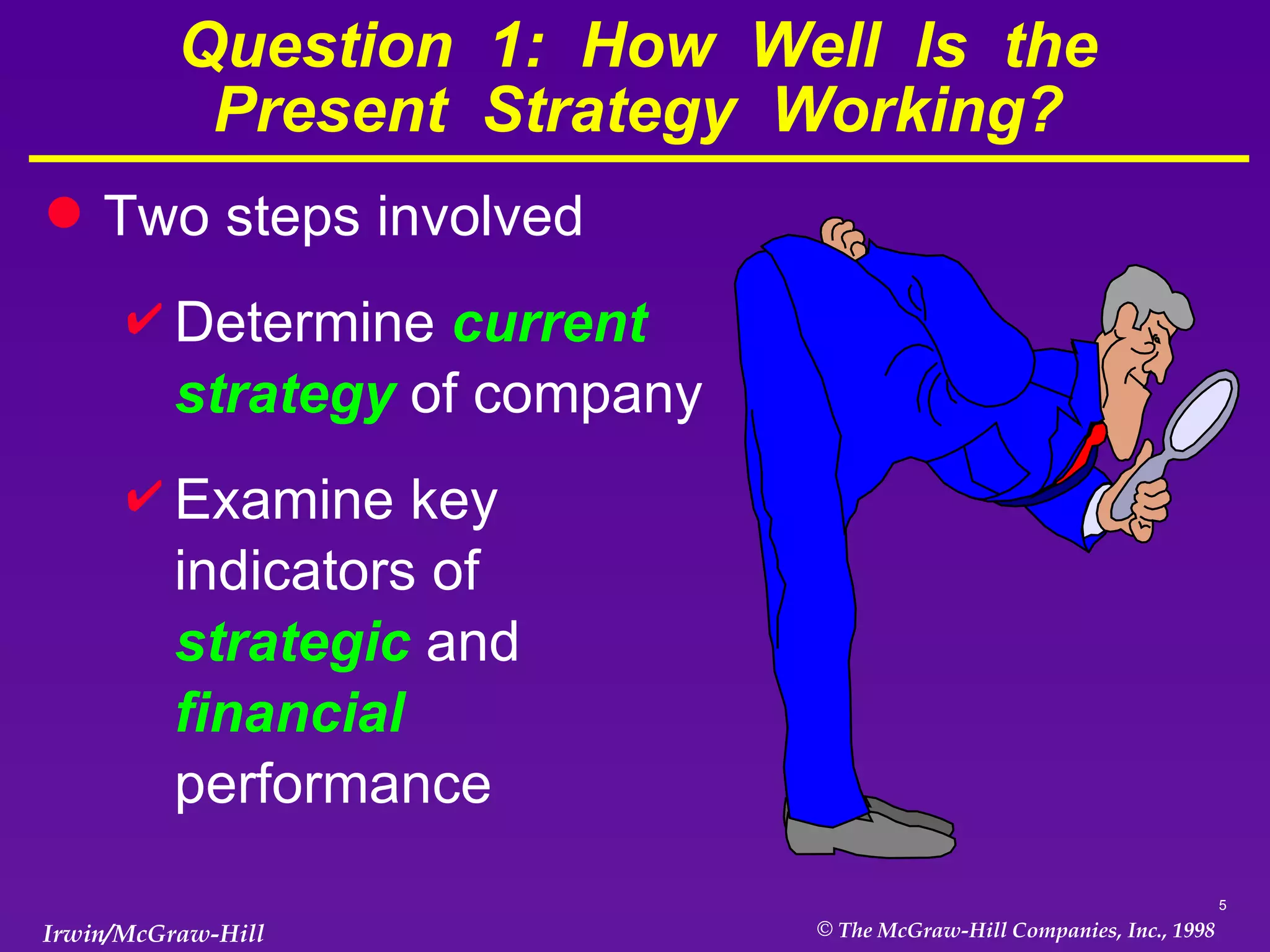
Question  1:  How  Well  Is  the Present  Strategy  Working? Two steps involved Determine  current strategy  of company Examine key indicators of  strategic   and   financial   performance
What  Is  the  Strategy? Identify competitive approach Low-cost leadership Differentiation Focus on a particular market niche Determine competitive scope Stages of industry’s production/distribution chain Geographic coverage Customer base Identify functional strategies Examine recent strategic moves
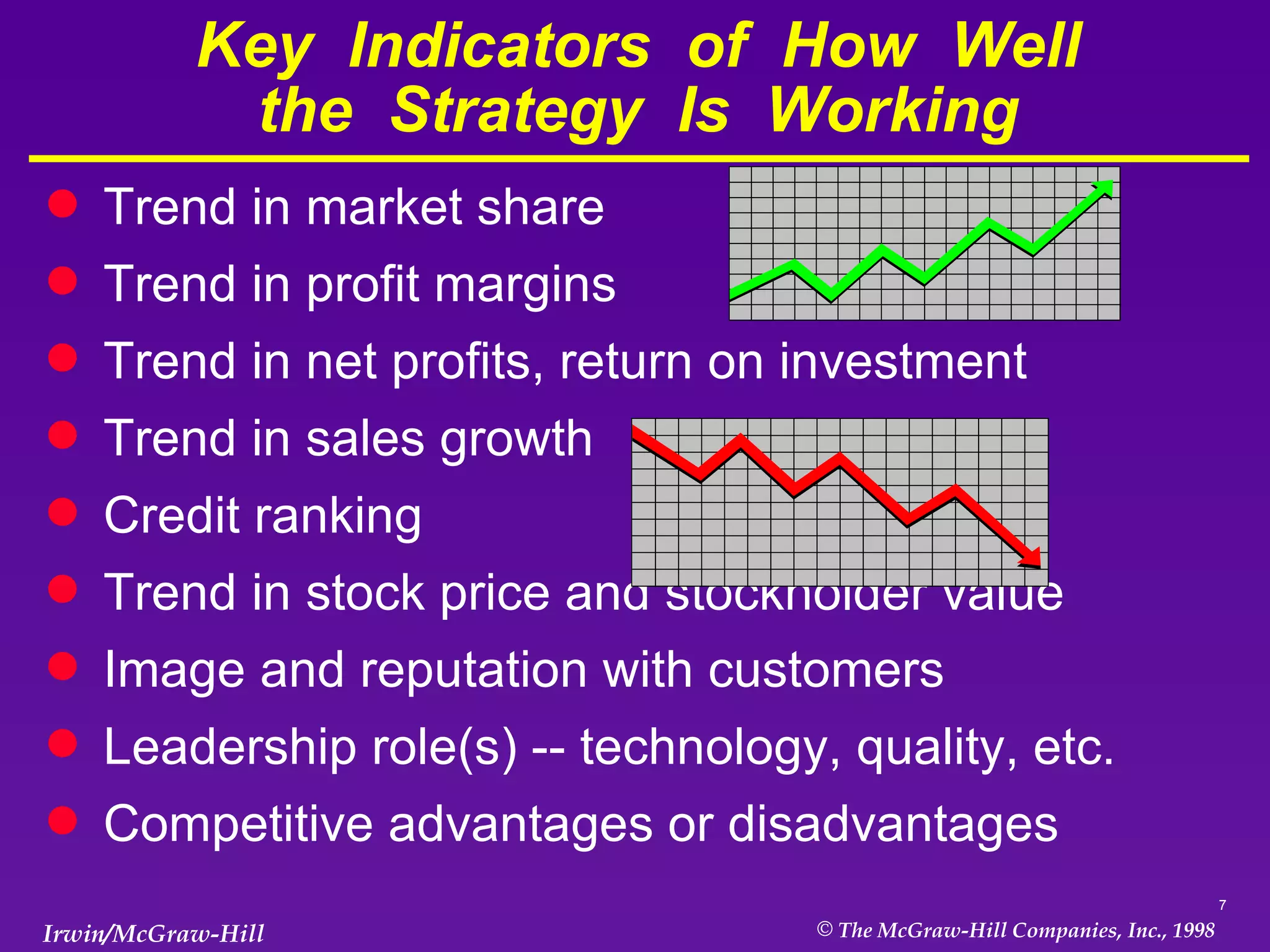
Key  Indicators  of  How  Well the  Strategy  Is  Working Trend in market share Trend in profit margins Trend in net profits, return on investment Trend in sales growth Credit ranking Trend in stock price and stockholder value Image and reputation with customers Leadership role(s) -- technology, quality, etc. Competitive advantages or disadvantages
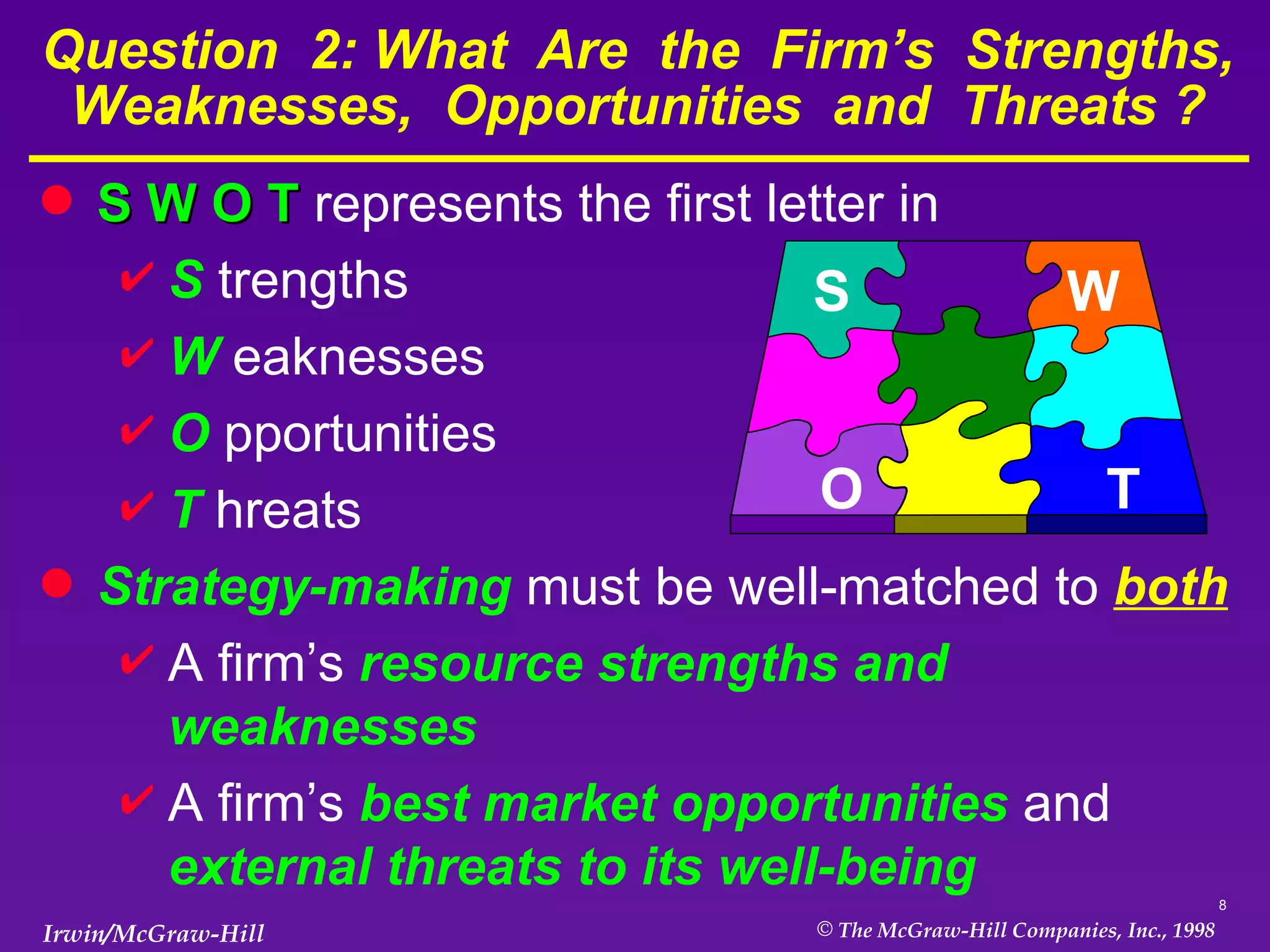
Question  2: What  Are  the  Firm’s  Strengths,  Weaknesses,  Opportunities  and  Threats ?  S W O T  represents the first letter in S  trengths W  eaknesses O  pportunities T  hreats Strategy-making  must be well-matched to  both A firm’s  resource strengths and weaknesses A firm’s  best market opportunities  and  external   threats to its well-being S W O T
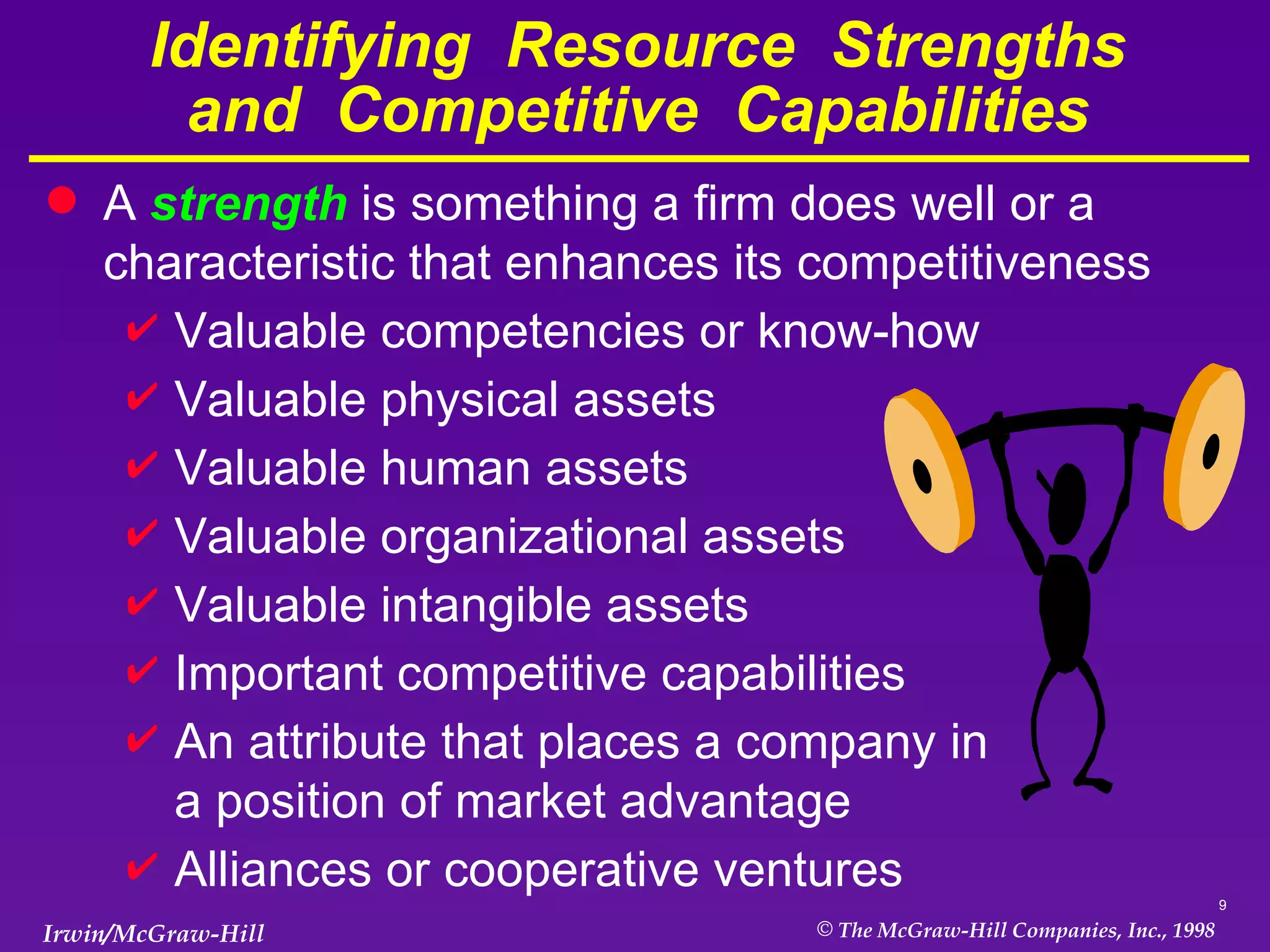
Identifying  Resource  Strengths and  Competitive  Capabilities A  strength  is something a firm does well or a characteristic that enhances its competitiveness Valuable competencies or know-how Valuable physical assets Valuable human assets Valuable organizational assets Valuable intangible assets Important competitive capabilities An attribute that places a company in  a position of market advantage Alliances or cooperative ventures
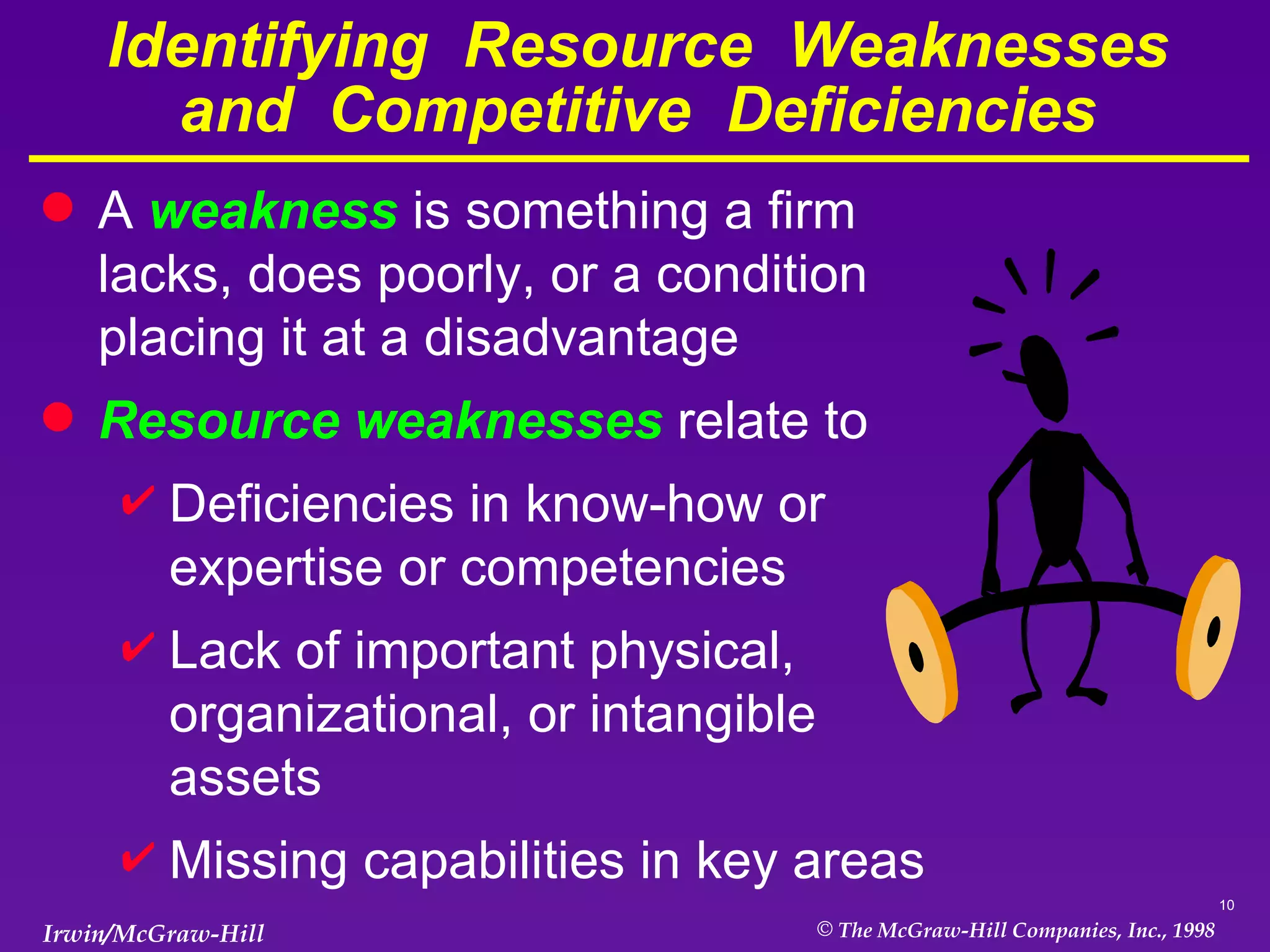
Identifying  Resource  Weaknesses and  Competitive  Deficiencies A  weakness  is something a firm lacks, does poorly, or a condition placing it at a disadvantage Resource weaknesses  relate to Deficiencies in know-how or expertise or competencies Lack of important physical, organizational, or intangible assets Missing capabilities in key areas
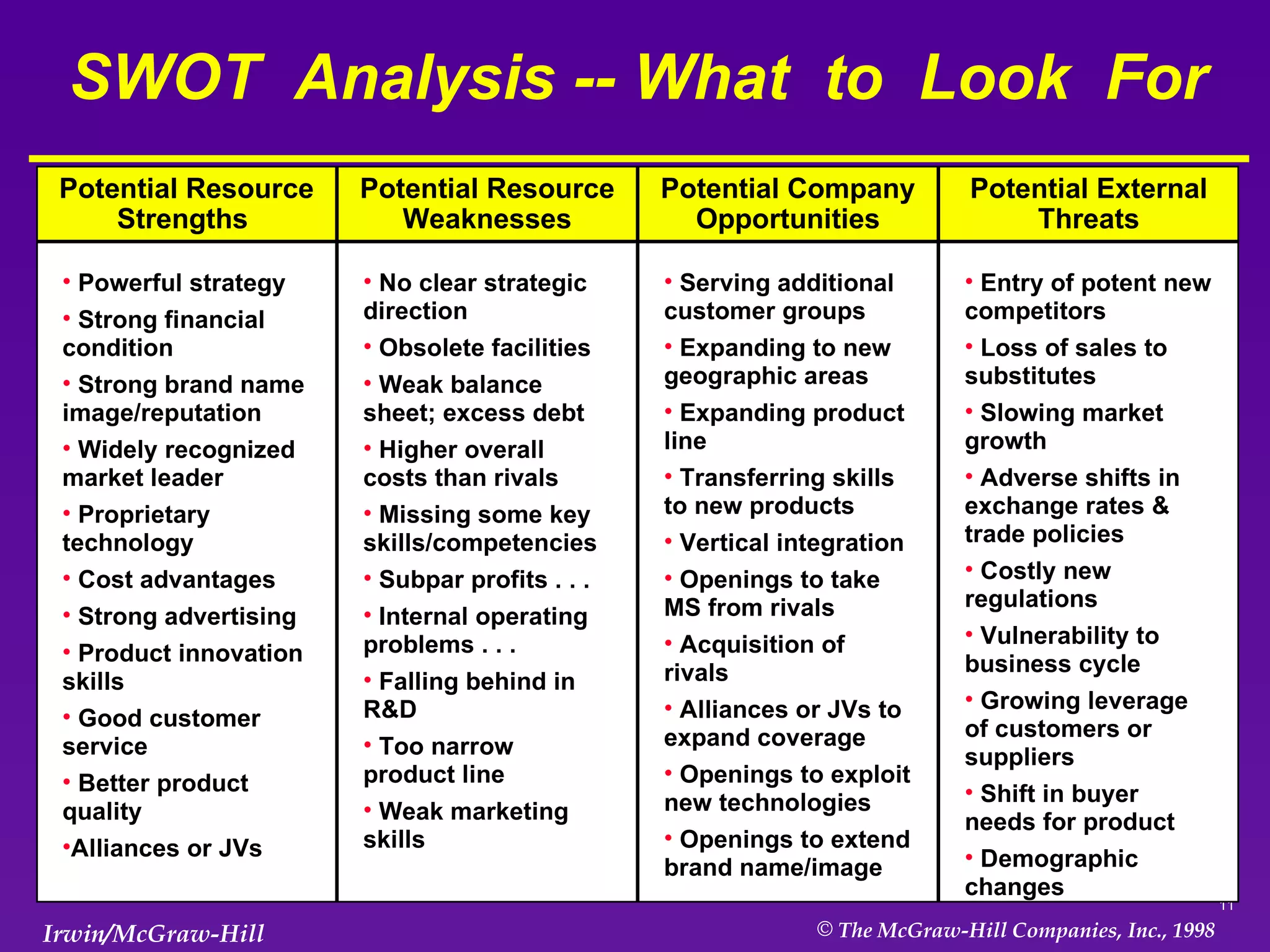
SWOT  Analysis -- What  to  Look  For Potential Resource Strengths  Potential Resource Weaknesses Potential Company Opportunities Potential External Threats Powerful strategy Strong financial  condition Strong brand name image/reputation Widely recognized market leader Proprietary technology Cost advantages Strong advertising Product innovation skills Good customer service Better product quality Alliances or JVs No clear strategic direction Obsolete facilities Weak balance sheet; excess debt Higher overall costs than rivals Missing some key skills/competencies Subpar profits . . . Internal operating problems . . . Falling behind in R&D Too narrow product line Weak marketing skills Serving additional customer groups Expanding to new geographic areas Expanding product line Transferring skills to new products Vertical integration Openings to take MS from rivals Acquisition of rivals Alliances or JVs to expand coverage Openings to exploit new technologies Openings to extend brand name/image Entry of potent new competitors Loss of sales to substitutes Slowing market growth Adverse shifts in exchange rates & trade policies Costly new regulations Vulnerability to business cycle Growing leverage of customers or suppliers Shift in buyer needs for product Demographic changes
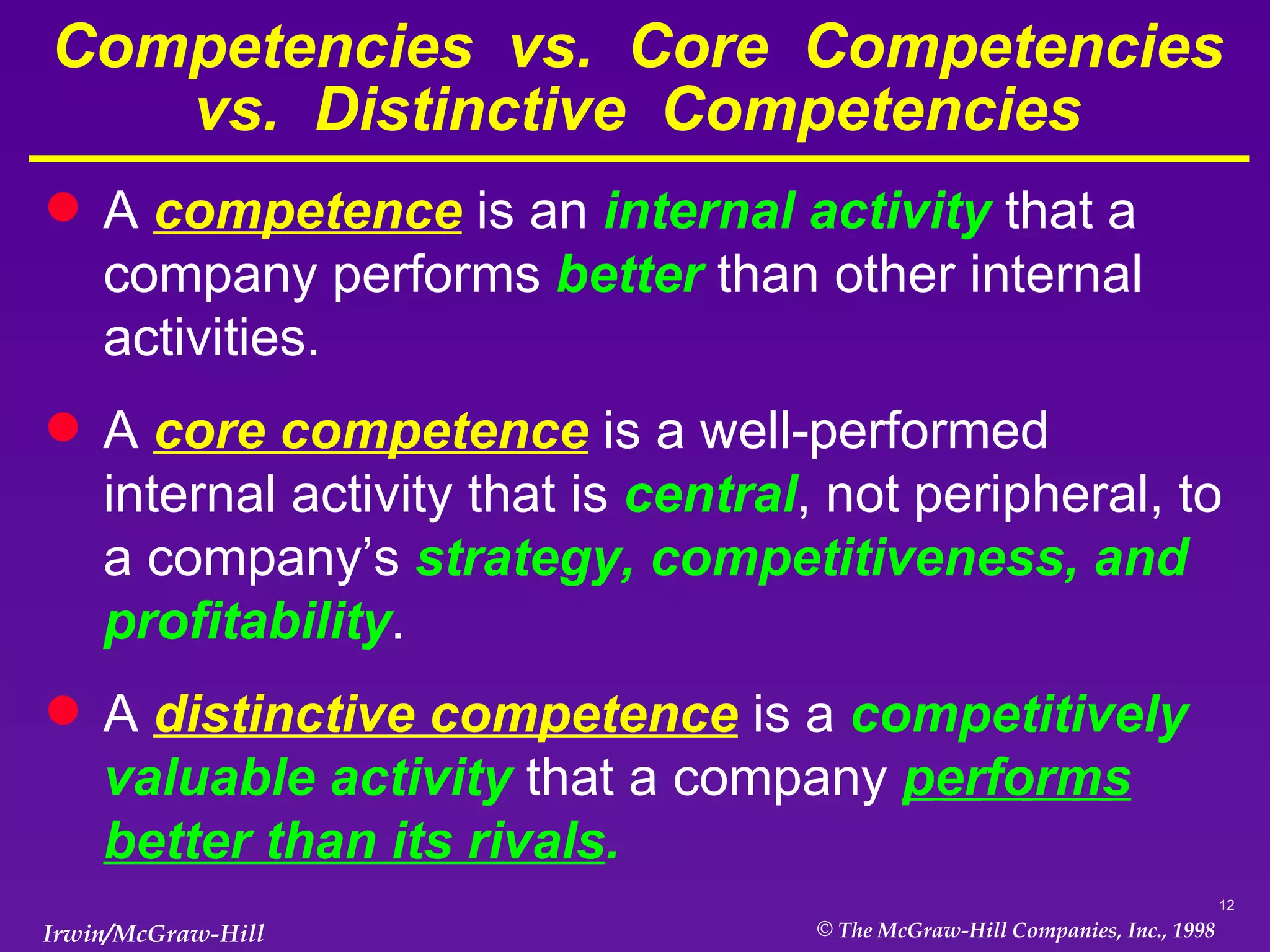
Competencies  vs.  Core  Competencies vs.  Distinctive  Competencies A  competence  is an  internal activity  that a company performs  better  than other internal activities. A  core competence  is a well-performed internal activity that is  central ,   not peripheral, to a company’s  strategy, competitiveness, and profitability . A  distinctive competence  is a  competitively valuable activity  that a company  performs better than its rivals .
Core  Competencies:  A Valuable  Company  Resource  A  competence  becomes a  core competence  when the well-performed activity is  central  to the company’s strategy, competitiveness, and profitability Often, a   core competence results from  collaboration  among different parts  of an organization Typically, core competencies  reside in  a company’s  people , not in its assets on the balance sheet A  core competence  gives a company a potentially valuable  competitive capability
Types  of  Core  Competencies Skills in manufacturing a high quality product System to fill customer orders accurately and swiftly Fast development of new products Better after-sale service capability Superior know-how in selecting good retail locations Innovativeness in developing popular product features Merchandising and product display skills Expertise in an important technology Expertise in integrating multiple technologies to create whole families of new products
A  Distinctive  Competence  --  A Competitively  Superior   Resource A distinctive competence is a competitively significant activity that a company  performs better than its competitors A distinctive competence represents a competitively superior resource strength A distinctive competence  Represents a  competitively   valuable  capability  that rivals do not have   Has potential for being a  cornerstone of strategy Can provide a  competitive edge  in the marketplace # 1
Strategic  Management  Principle A distinctive competence empowers a company to build competitive advantage!
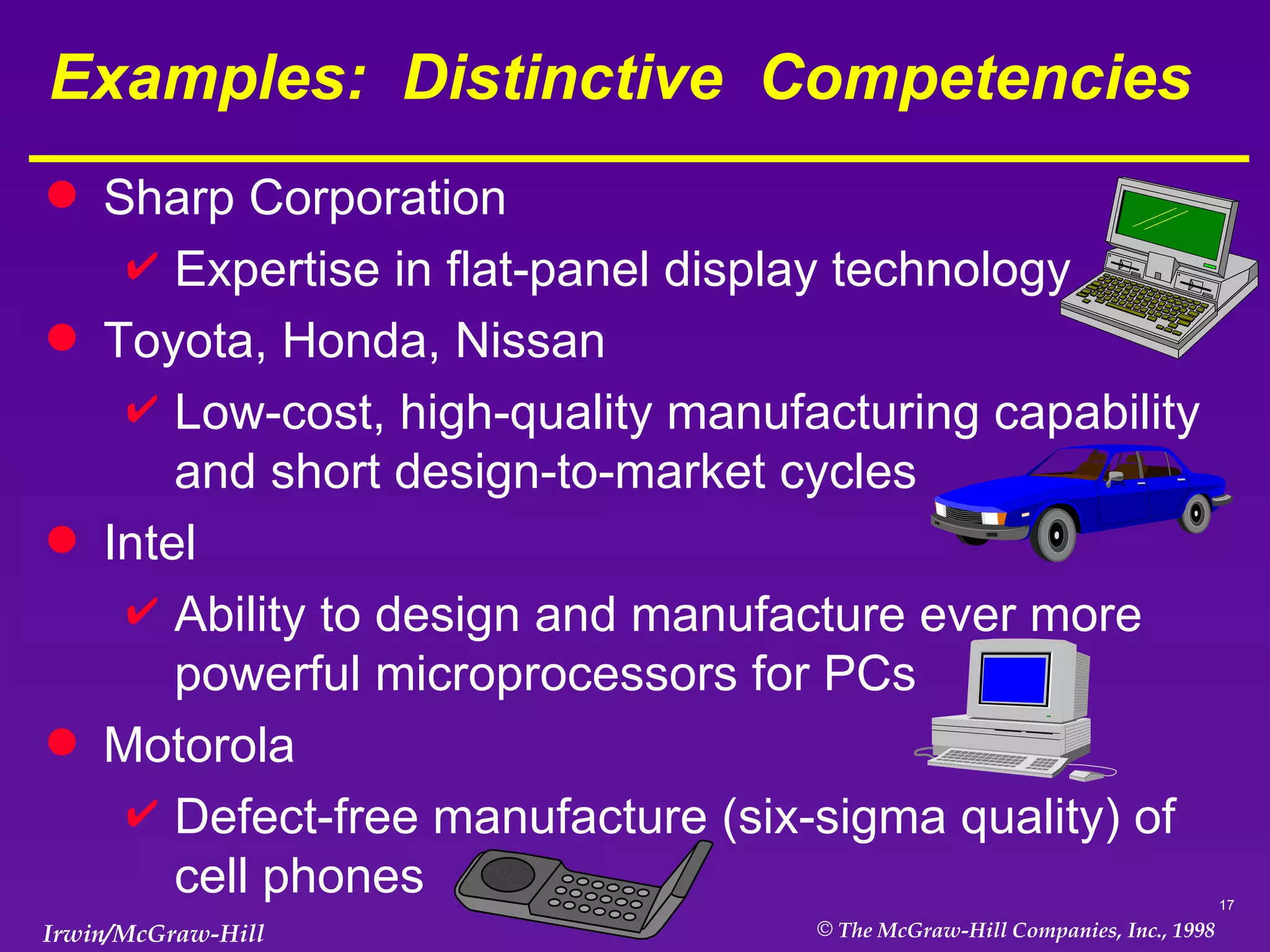
Examples:  Distinctive  Competencies  Sharp Corporation Expertise in flat-panel display technology  Toyota, Honda, Nissan Low-cost, high-quality manufacturing capability and short design-to-market cycles  Intel Ability to design and manufacture ever more powerful microprocessors for PCs Motorola Defect-free manufacture (six-sigma quality) of cell phones
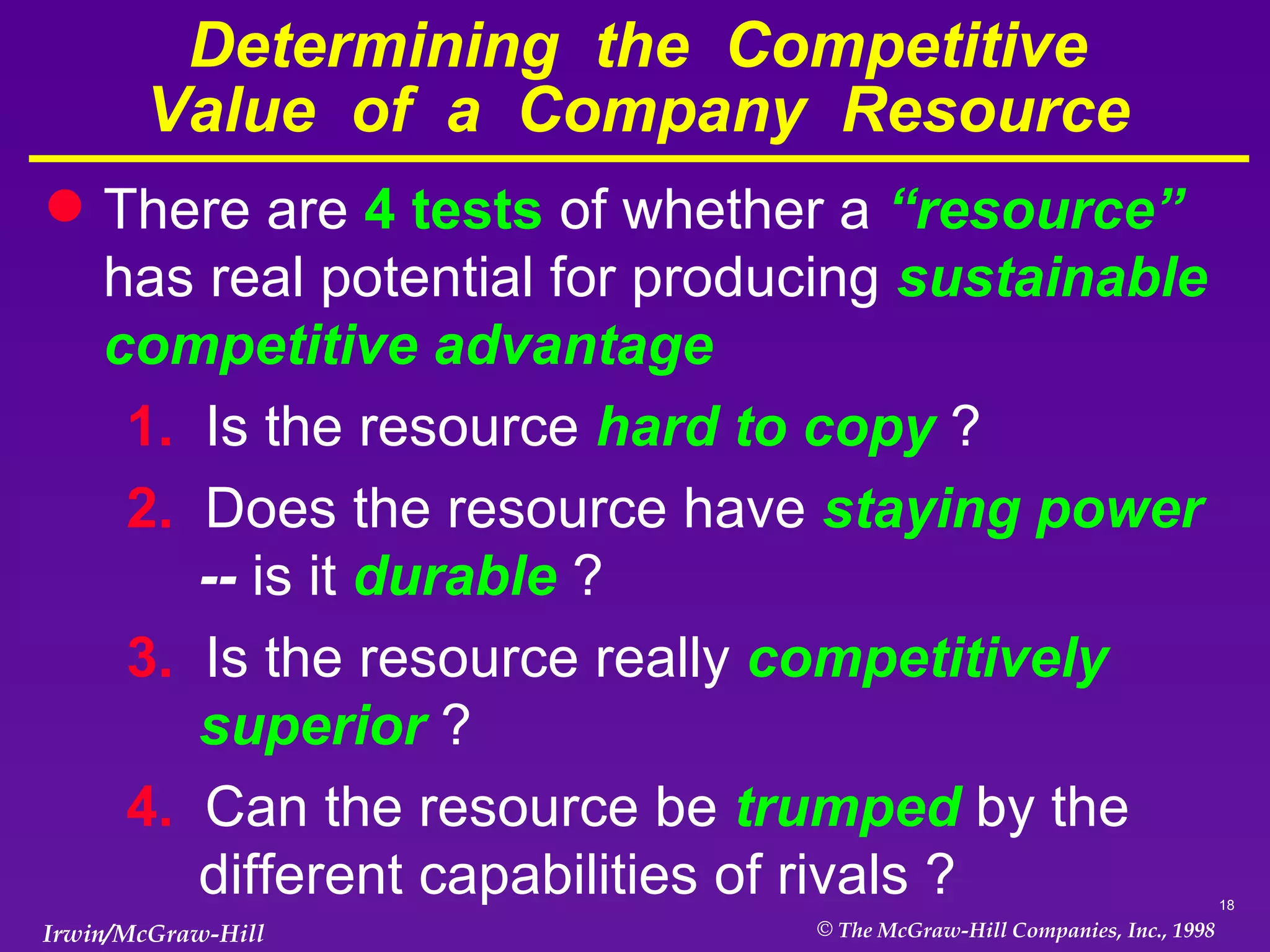
Determining  the  Competitive Value  of  a  Company  Resource There are  4 tests  of whether a  “resource”  has real potential for producing  sustainable competitive advantage 1.  Is the resource  hard to copy  ? 2.  Does the resource have  staying power  --   is it  durable  ? 3.  Is the resource really  competitively superior  ? 4.  Can the resource be  trumped  by the different capabilities of rivals ?
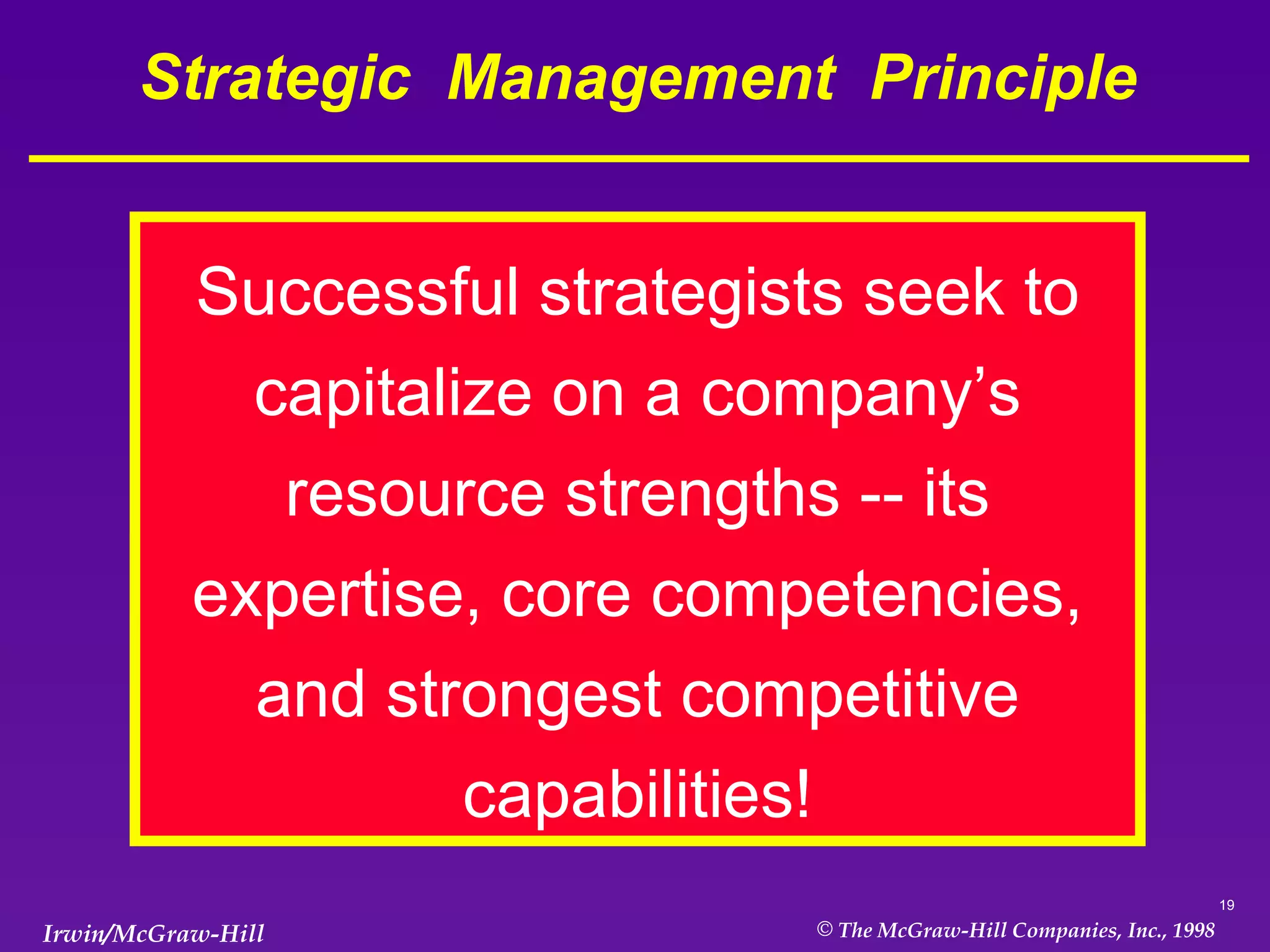
Strategic  Management  Principle Successful strategists seek to capitalize on a company’s resource strengths -- its expertise, core competencies, and strongest competitive capabilities!
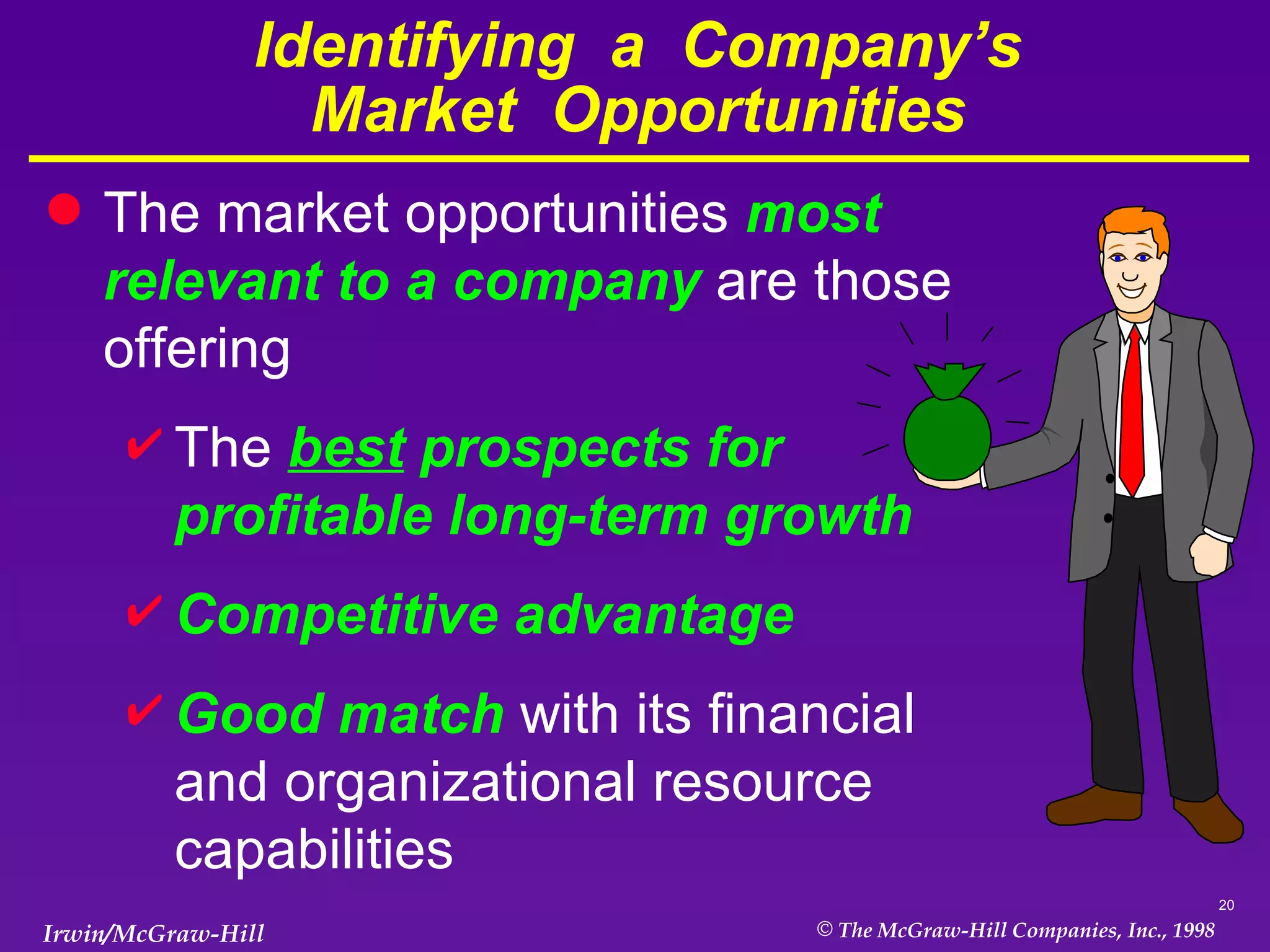
Identifying  a  Company’s Market  Opportunities The   market opportunities  most relevant to a company  are those offering The  best  prospects for profitable long-term growth Competitive advantage Good match  with its financial and organizational resource capabilities
Strategic  Management  Principle A company is well-advised to pass on a particular market opportunity unless it has or can build the resource capabilities to capture it!
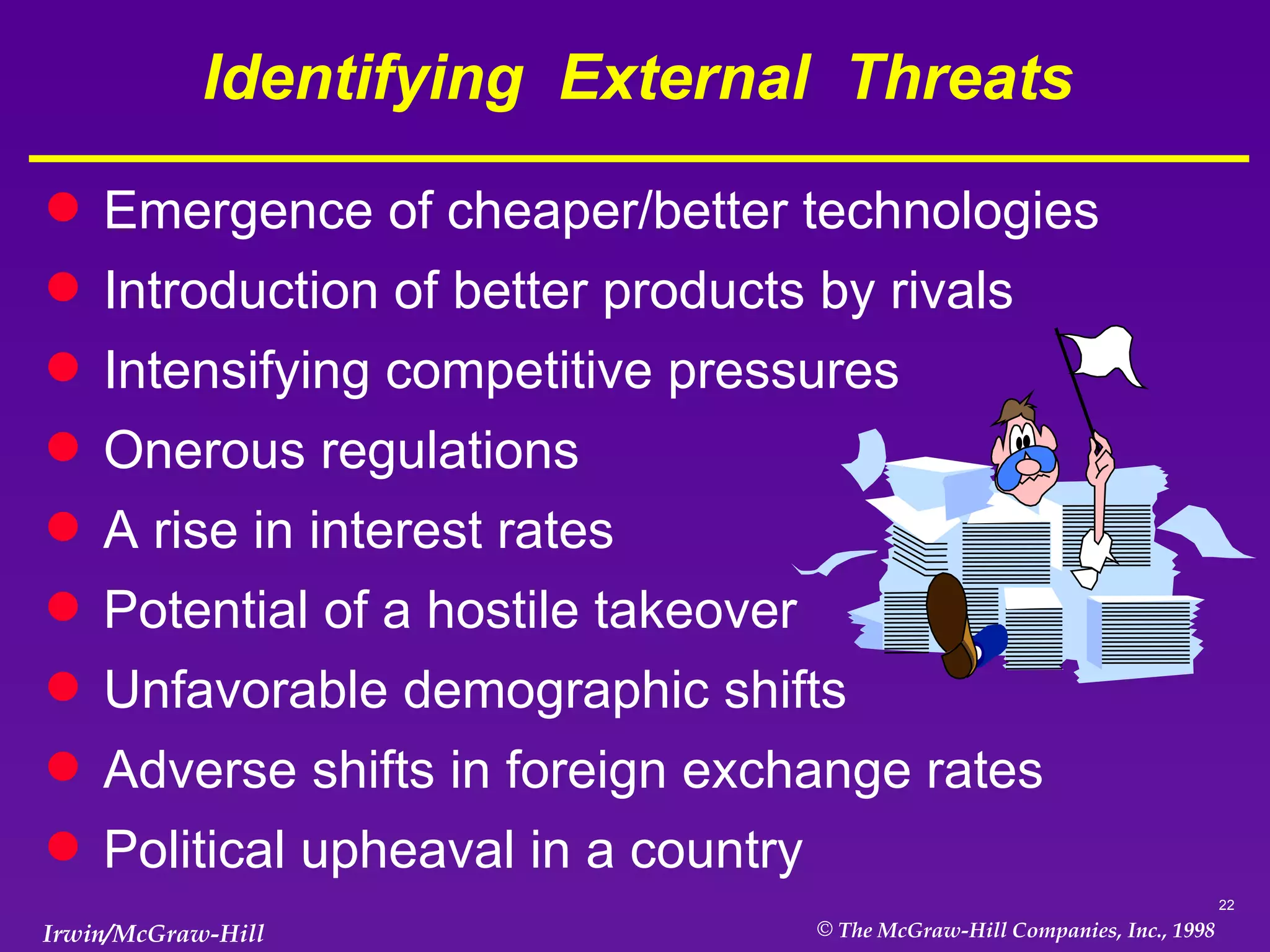
Identifying  External  Threats Emergence of cheaper/better technologies Introduction of better products by rivals Intensifying competitive pressures Onerous regulations A rise in interest rates Potential of a hostile takeover Unfavorable demographic shifts Adverse shifts in foreign exchange rates Political upheaval in a country
Strategic  Management  Principle Successful strategists aim at capturing a company’s best growth opportunities and creating defenses against external threats to its competitive position and future performance!
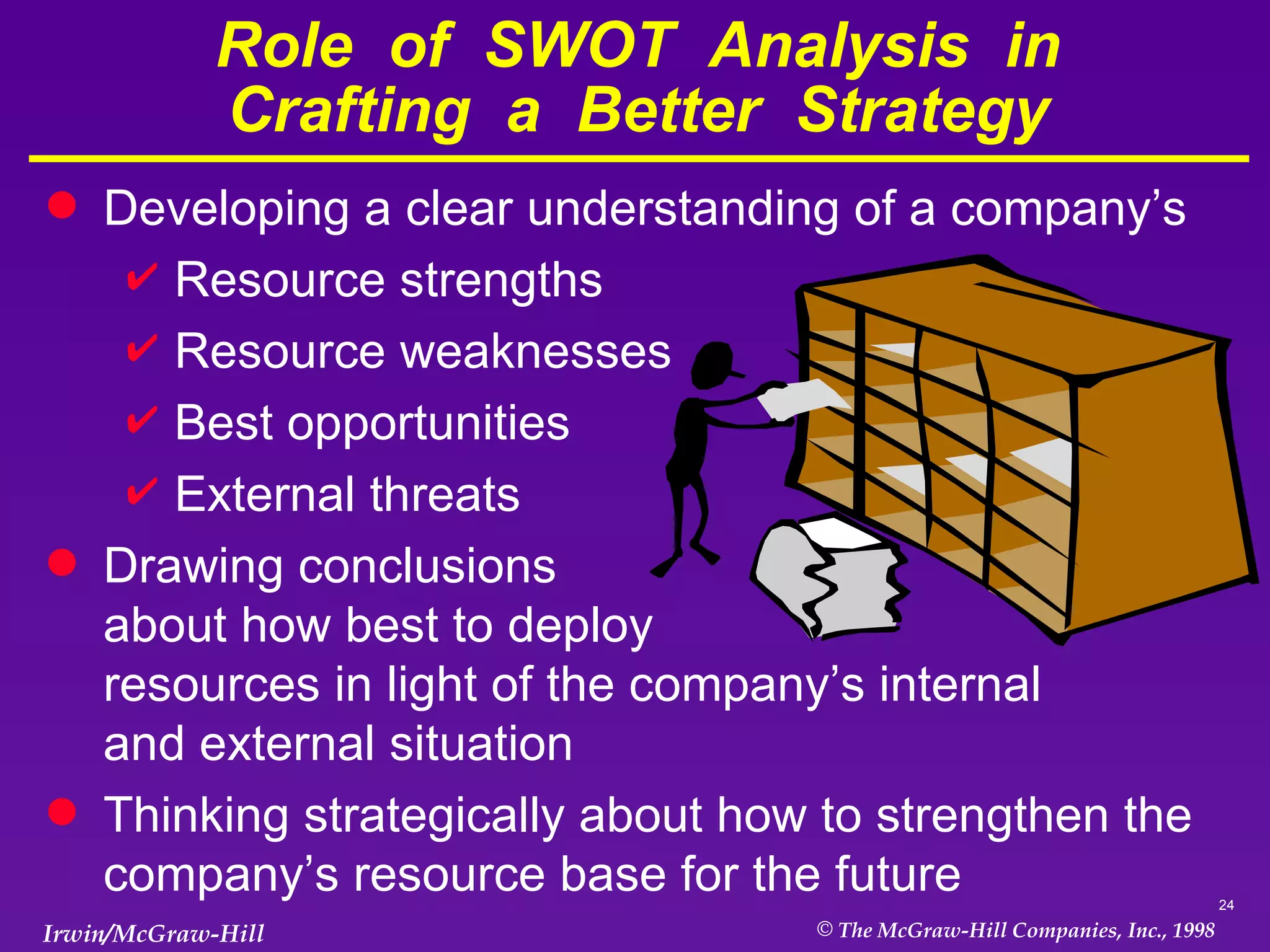
Role  of  SWOT  Analysis  in Crafting  a  Better  Strategy Developing a clear understanding of a company’s Resource strengths Resource weaknesses Best opportunities External threats Drawing conclusions  about how best to deploy  resources in light of the company’s internal  and external situation Thinking strategically about how to strengthen the company’s resource base for the future
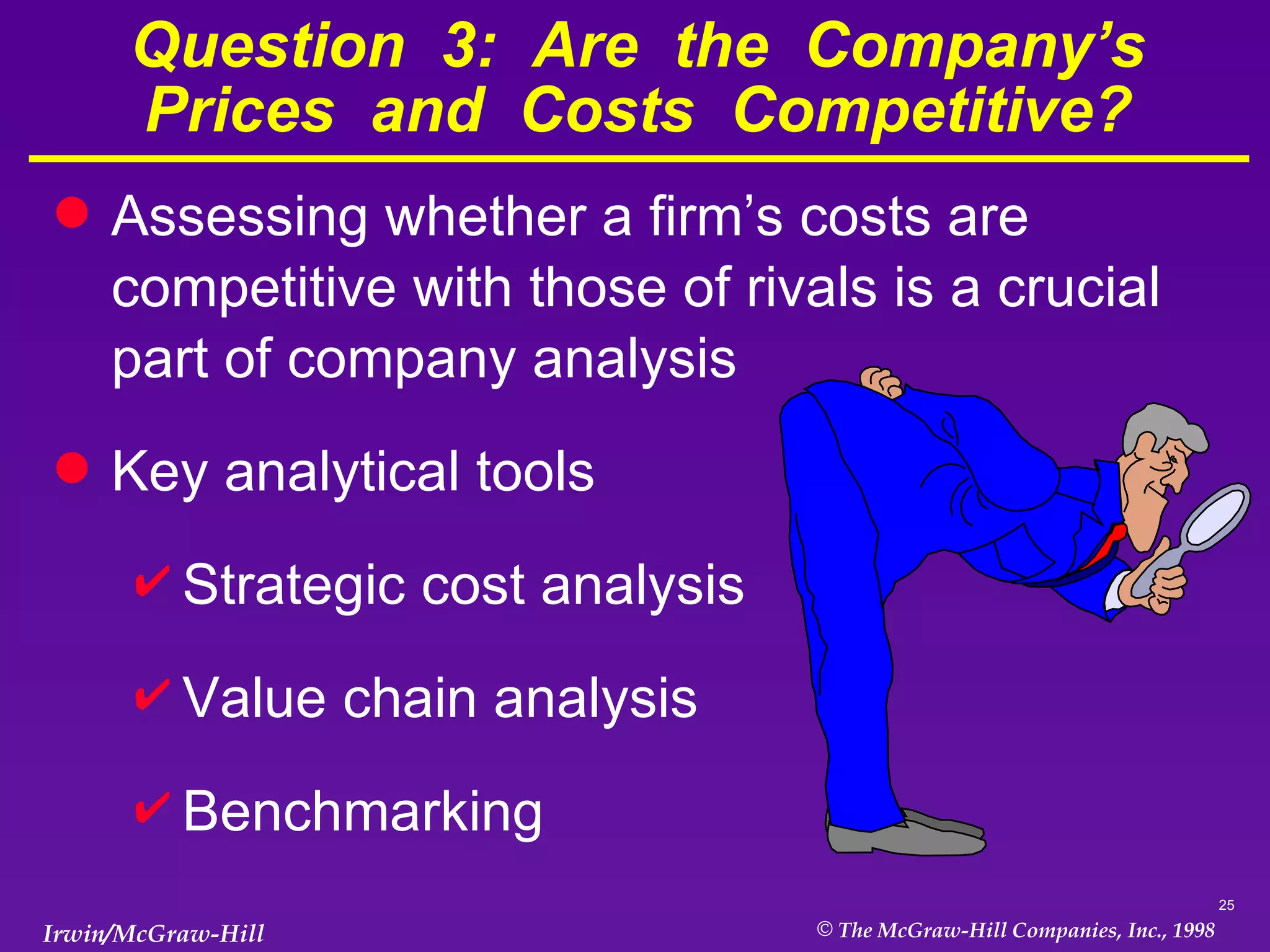
Question  3:  Are  the  Company’s Prices  and  Costs  Competitive? Assessing whether a firm’s costs are competitive with those of rivals is a crucial part of company analysis Key analytical tools Strategic cost analysis Value chain analysis Benchmarking
Why  Rival  Companies Have  Different  Costs Companies do not have the same costs because of differences in Prices paid for raw materials, component parts, energy, and other supplier resources Basic technology and age of plant & equipment Economies of scale and experience curve effects Wage rates and productivity levels Marketing, promotion, and administration costs Inbound and outbound shipping costs Forward channel distribution costs
Principle  of  Competitive  Markets The higher a company’s costs are above those of close rivals, the more competitively vulnerable it becomes!
What  Is  Strategic  Cost  Analysis? Focuses on a firm’s costs  relative  to its rivals Compares a firm’s costs  activity by activity  against costs of key rivals From raw materials purchase  to Price paid by ultimate customer Pinpoints which  internal activities  are a source of cost advantage  or disadvantage
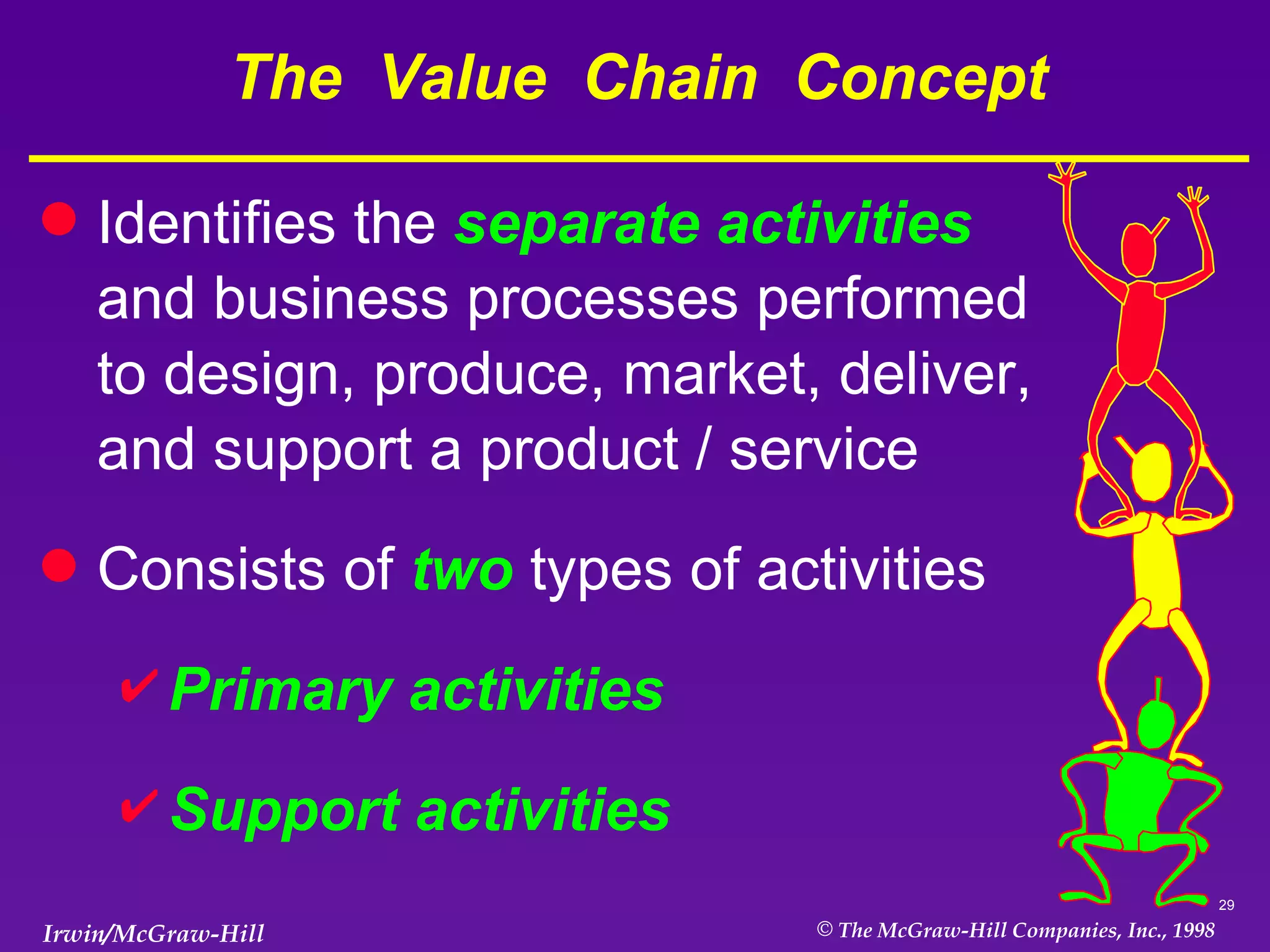
The  Value  Chain  Concept Identifies the  separate activities  and business processes performed  to design, produce, market, deliver,  and support a product / service Consists of  two  types of activities Primary activities   Support activities
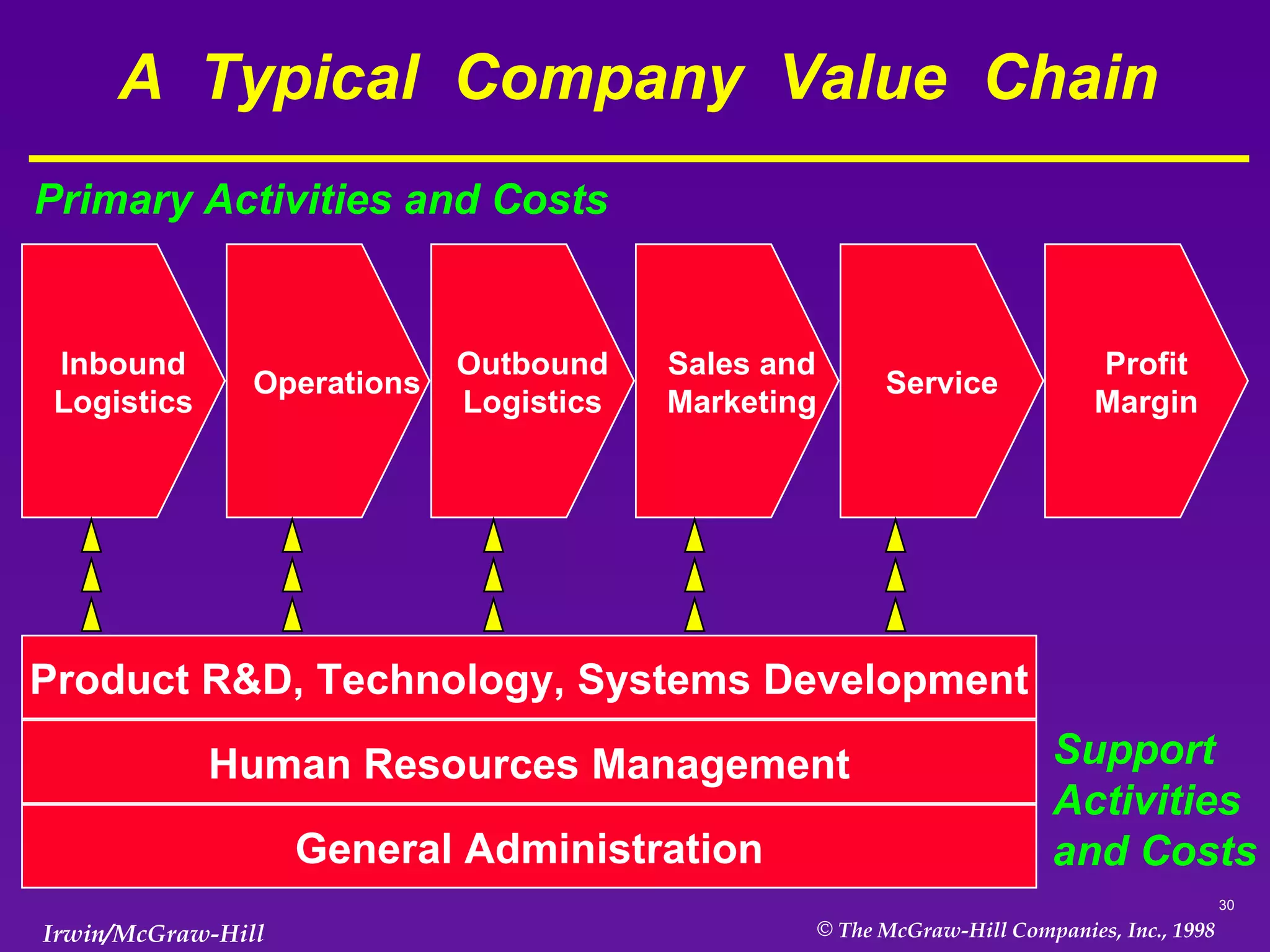
A  Typical  Company  Value  Chain Outbound Logistics Operations Inbound Logistics Sales and Marketing Service Profit Margin Product R&D, Technology, Systems Development Human Resources Management General Administration Primary Activities and Costs Support Activities and Costs
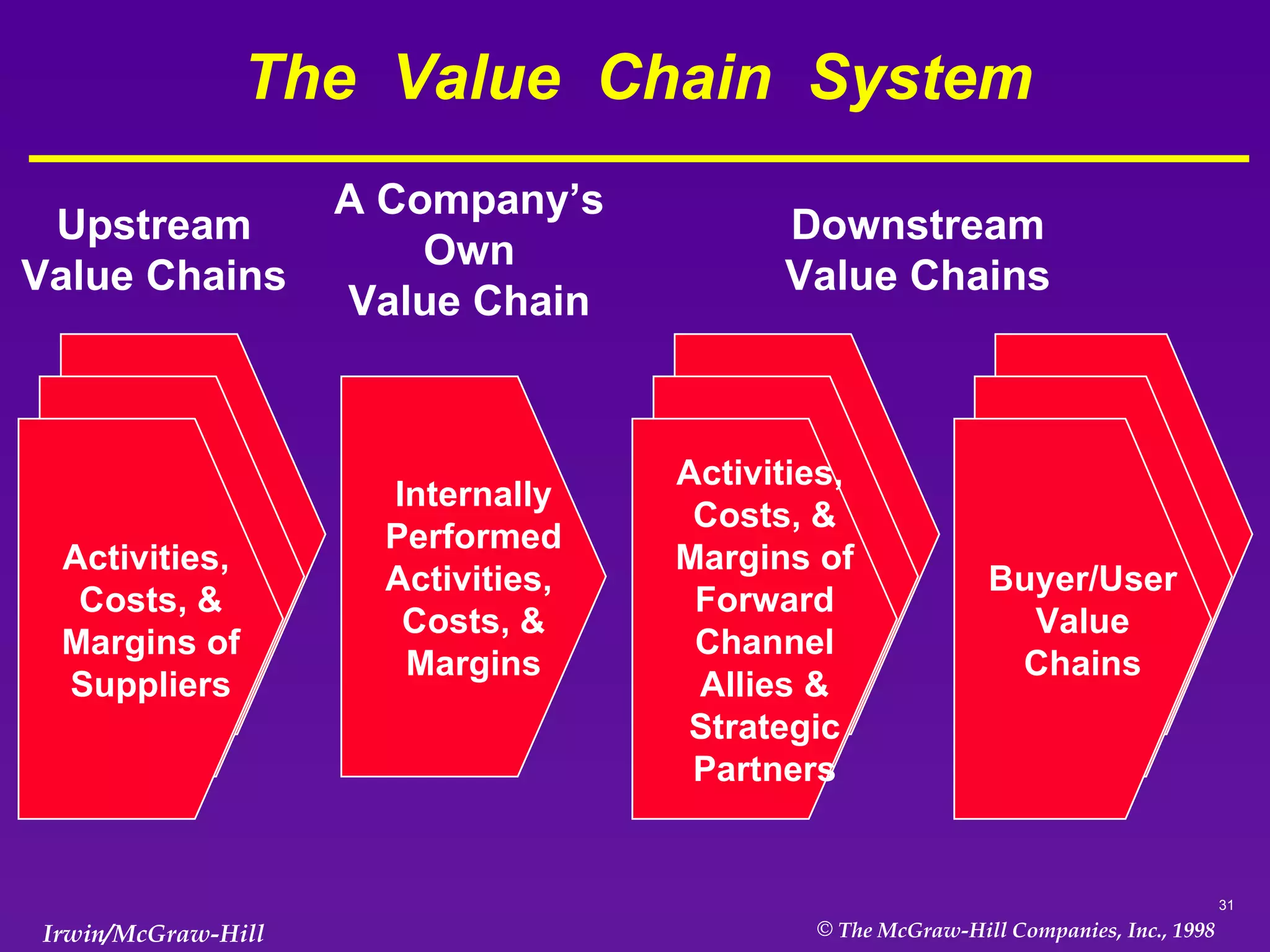
The  Value  Chain  System Upstream Value Chains A Company’s Own Value Chain Downstream Value Chains Internally Performed Activities,  Costs, & Margins Activities,  Costs, & Margins of Forward Channel Allies & Strategic Partners Activities,  Costs, & Margins of Suppliers Buyer/User Value Chains
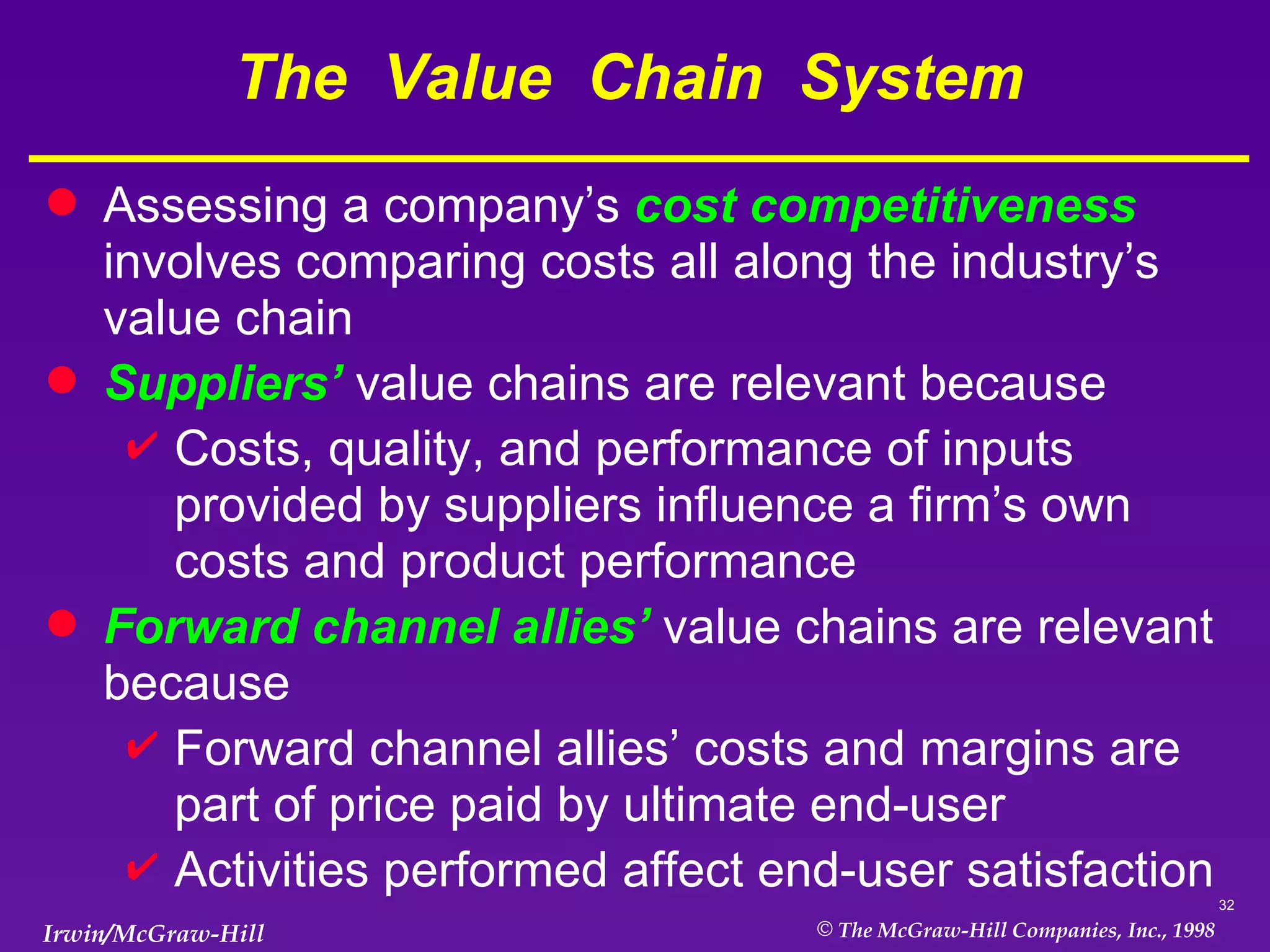
The  Value  Chain  System  Assessing a company’s  cost competitiveness   involves comparing costs all along the industry’s value chain  Suppliers’  value chains are relevant because Costs, quality, and performance of inputs provided by suppliers influence a firm’s own costs and product performance Forward channel allies’  value chains are relevant because  Forward channel allies’ costs and margins are part of price paid by ultimate end-user Activities performed affect end-user satisfaction
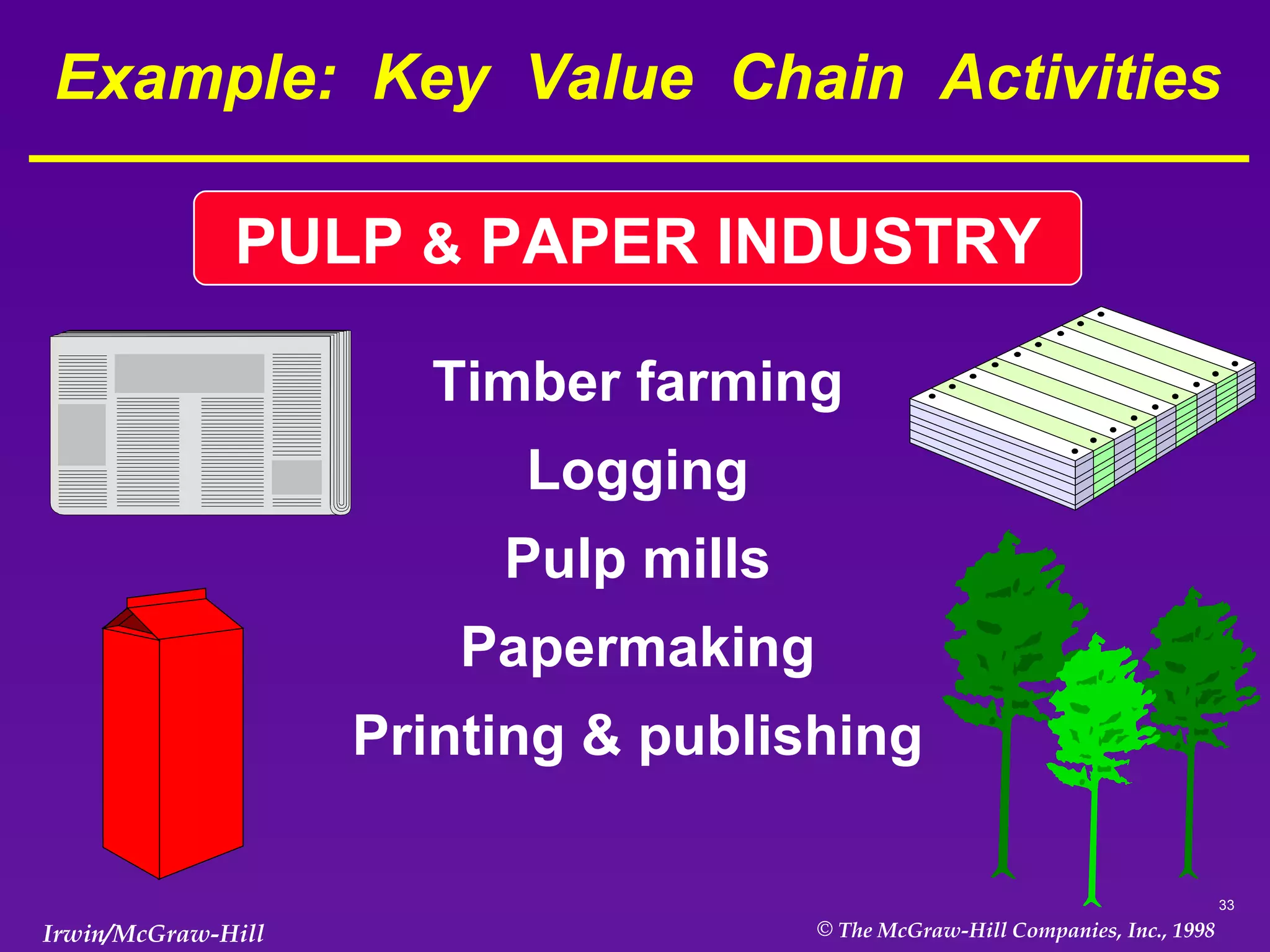
Example:  Key  Value  Chain  Activities Timber farming Logging Pulp mills Papermaking Printing & publishing PULP  &  PAPER INDUSTRY
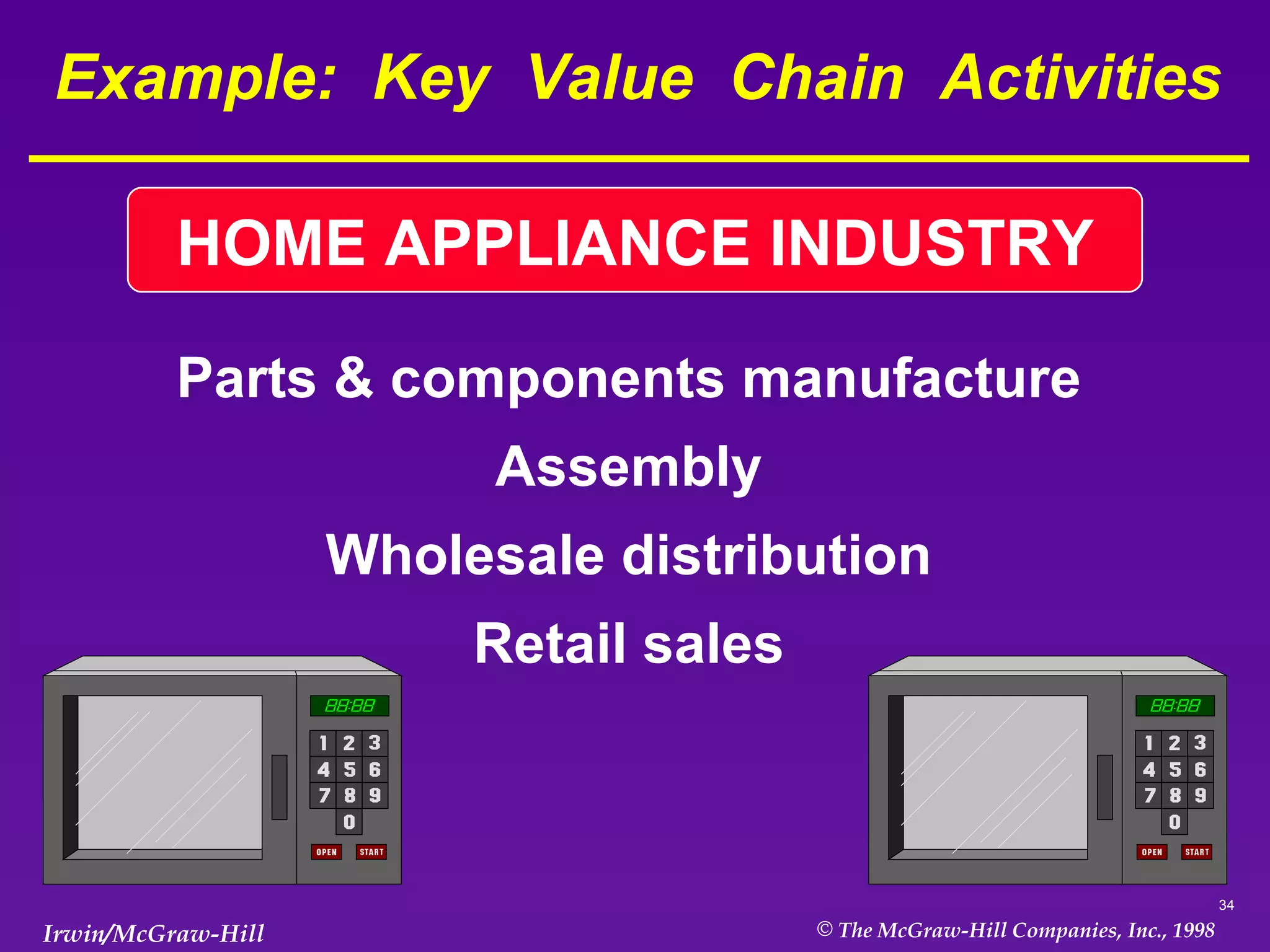
Example:  Key  Value  Chain  Activities Parts & components manufacture Assembly Wholesale distribution Retail sales HOME APPLIANCE INDUSTRY
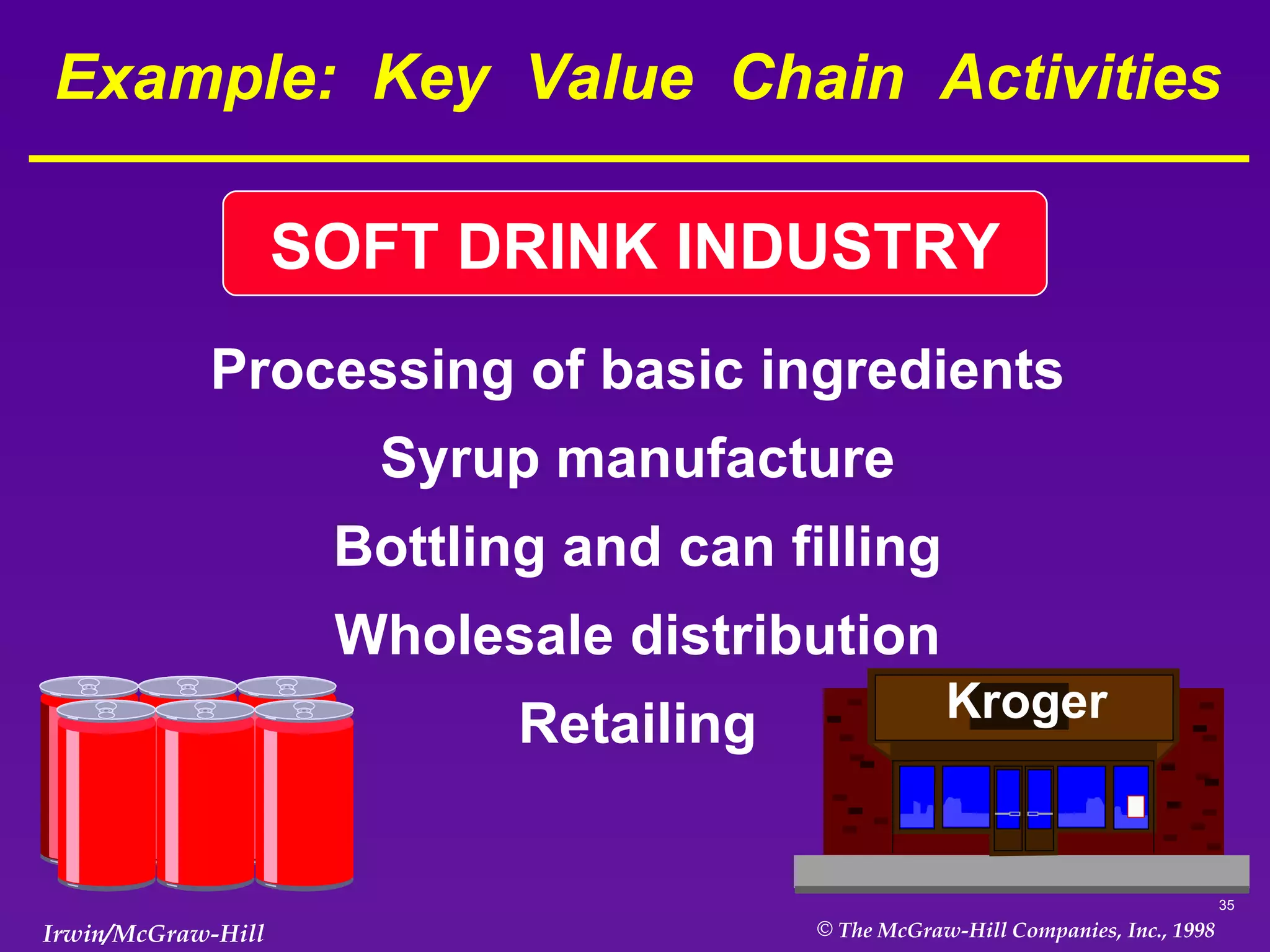
Example:  Key  Value  Chain  Activities Processing of basic ingredients Syrup manufacture Bottling and can filling Wholesale distribution Retailing SOFT DRINK INDUSTRY Kroger
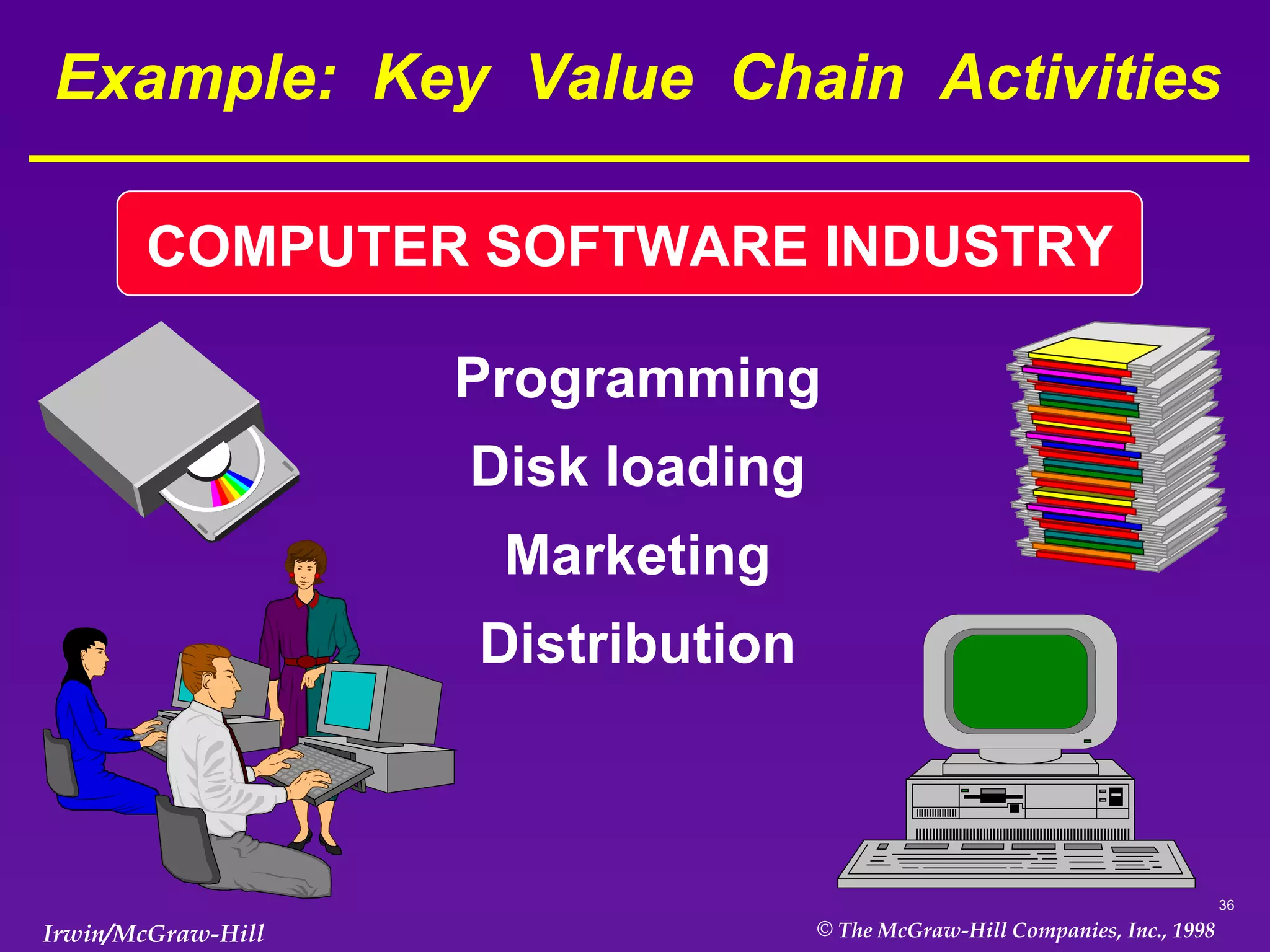
Example:  Key  Value  Chain  Activities Programming Disk loading Marketing Distribution COMPUTER SOFTWARE INDUSTRY
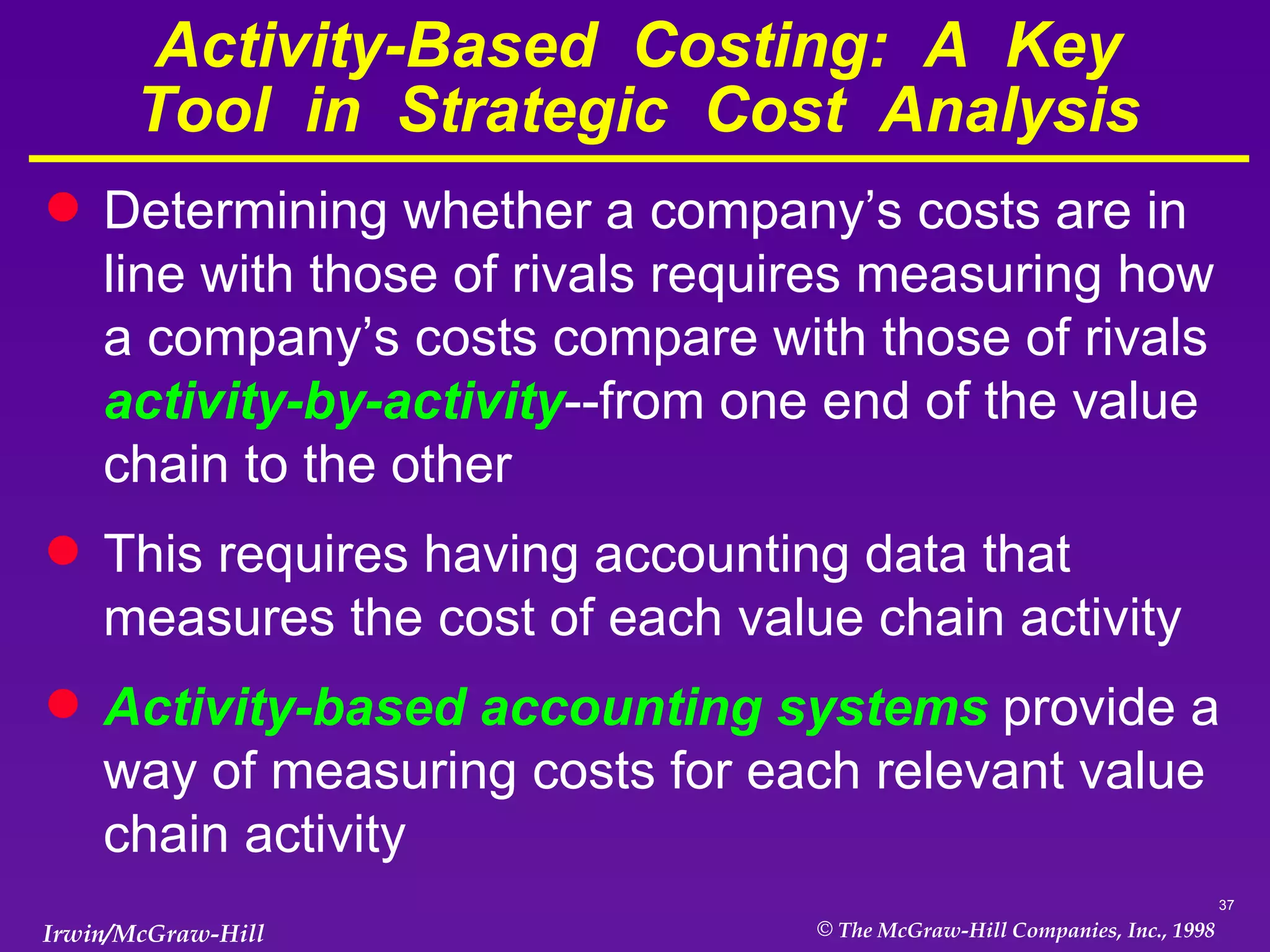
Activity-Based  Costing:  A  Key Tool  in  Strategic  Cost  Analysis Determining whether a company’s costs are in line with those of rivals requires measuring how a company’s costs compare with those of rivals  activity-by-activity --from one end of the value chain to the other This requires having accounting data that measures the cost of each value chain activity Activity-based accounting systems  provide a way of measuring costs for each relevant value chain activity
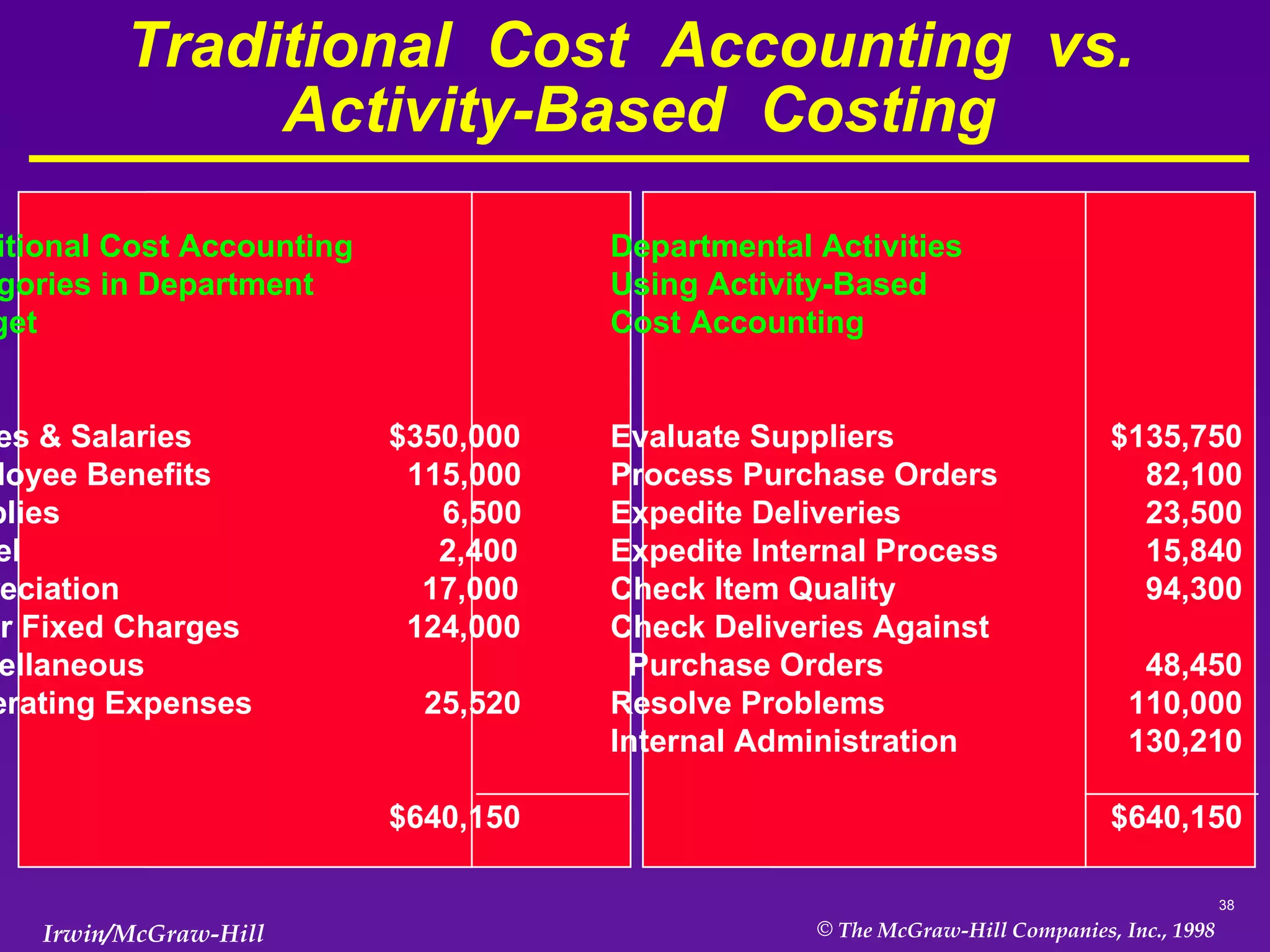
Traditional  Cost  Accounting  vs.  Activity-Based  Costing Traditional Cost Accounting Categories in Department Budget Wages & Salaries   $350,000 Employee Benefits  115,000 Supplies  6,500 Travel  2,400 Depreciation  17,000 Other Fixed Charges   124,000 Miscellaneous Operating Expenses   25,520   $640,150 $135,750 82,100 23,500 15,840 94,300 48,450 110,000 130,210 $640,150 Departmental Activities Using Activity-Based Cost Accounting Evaluate Suppliers Process Purchase Orders Expedite Deliveries Expedite Internal Process Check Item Quality Check Deliveries Against Purchase Orders Resolve Problems Internal Administration
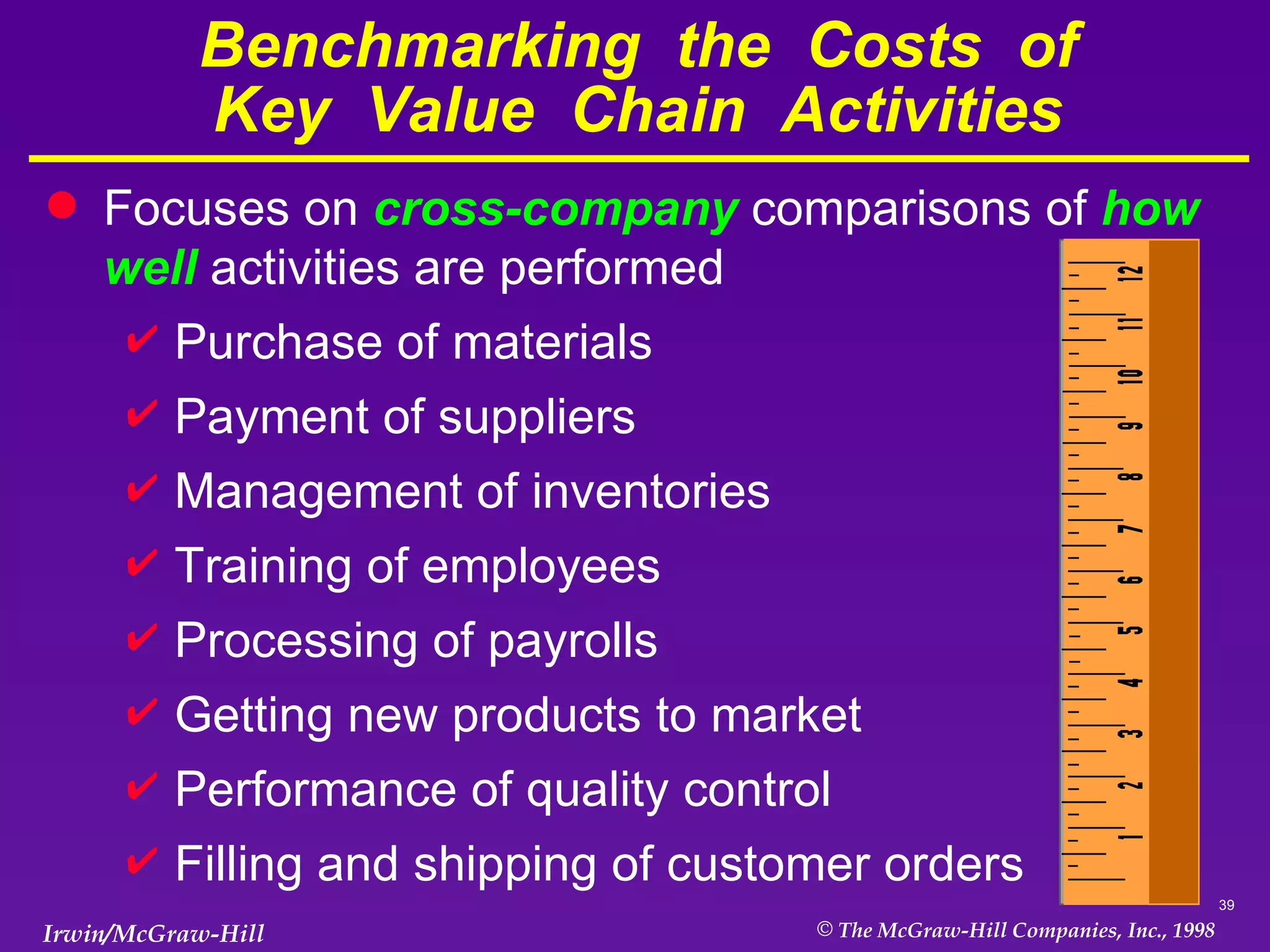
Benchmarking  the  Costs  of Key  Value  Chain  Activities Focuses on  cross-company  comparisons of  how well  activities are performed Purchase of materials Payment of suppliers Management of inventories Training of employees Processing of payrolls Getting new products to market Performance of quality control Filling and shipping of customer orders
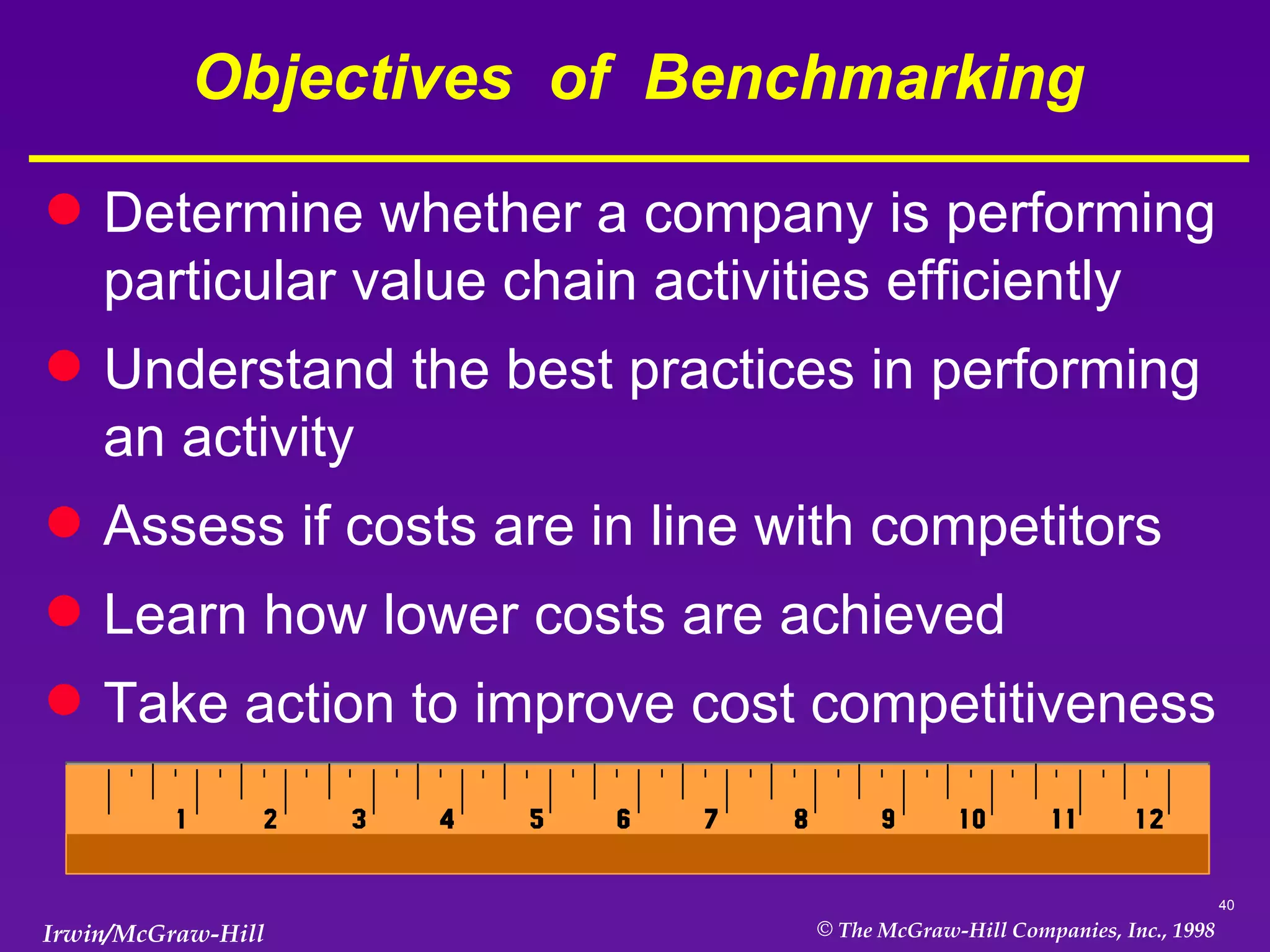
Objectives  of  Benchmarking Determine whether a company is performing particular value chain activities efficiently Understand the best practices in performing an activity  Assess if costs are in line with competitors  Learn how lower costs are achieved Take action to improve cost competitiveness
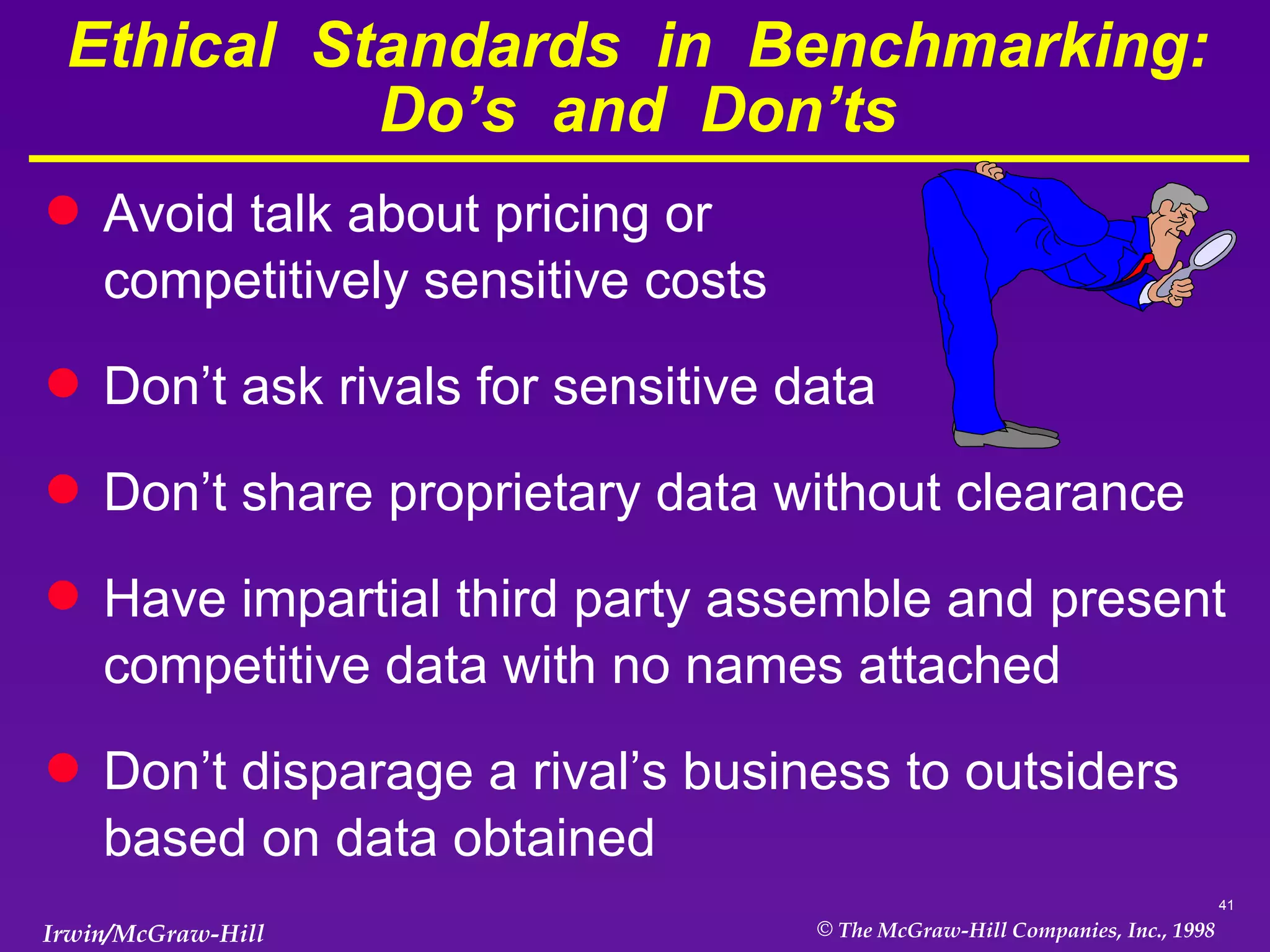
Ethical  Standards  in  Benchmarking: Do’s  and  Don’ts Avoid talk about pricing or  competitively sensitive costs Don’t ask rivals for sensitive data Don’t share proprietary data without clearance Have impartial third party assemble and present competitive data with no names attached Don’t disparage a rival’s business to outsiders based on data obtained
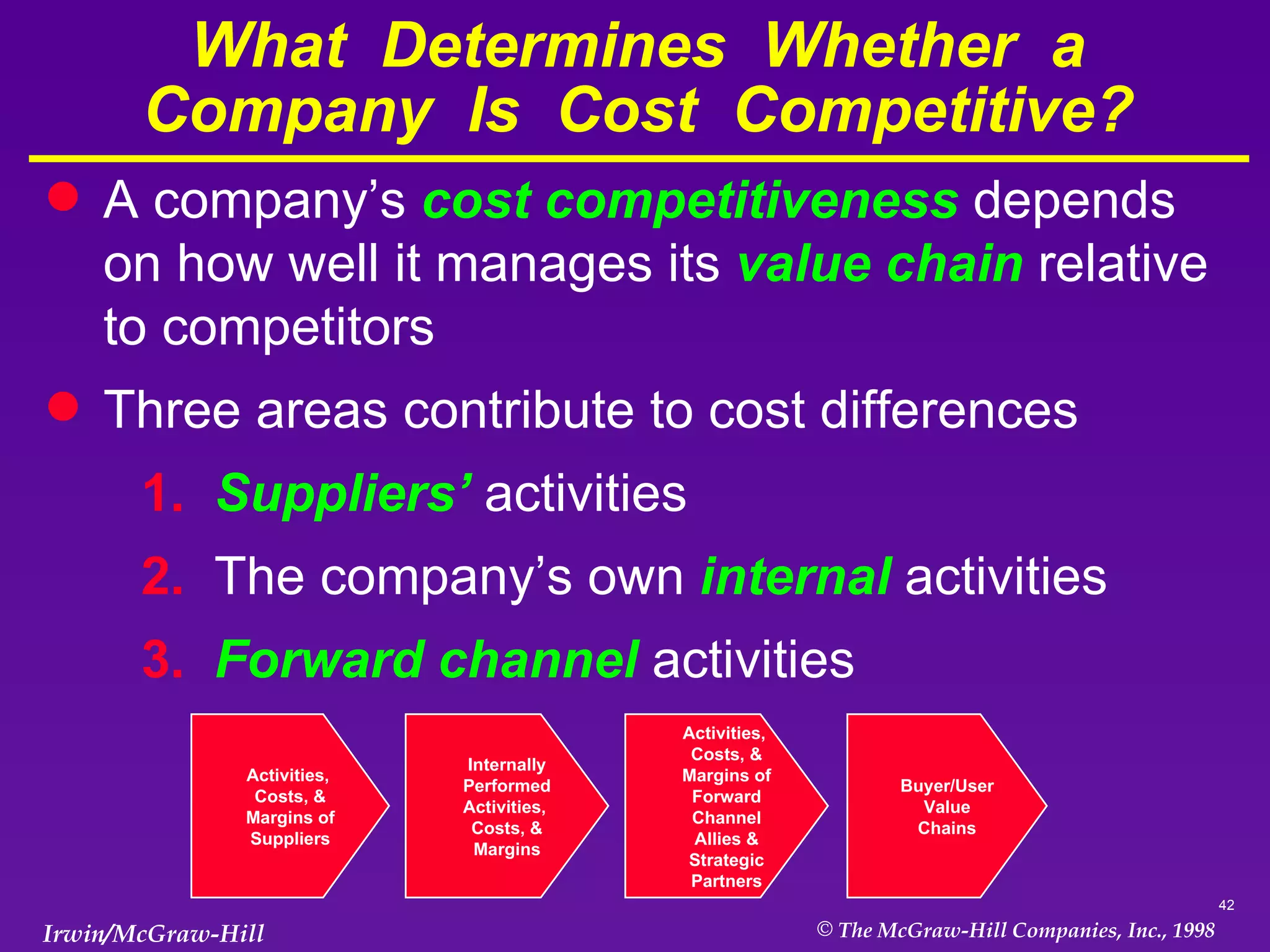
What  Determines  Whether  a Company  Is  Cost  Competitive? A company’s  cost competitiveness  depends on how well it manages its  value chain  relative to competitors Three areas contribute to cost differences 1.  Suppliers’  activities 2.  The company’s own   internal   activities 3.  Forward   channel  activities Activities,  Costs, & Margins of Forward Channel Allies & Strategic Partners Internally Performed Activities,  Costs, & Margins Activities,  Costs, & Margins of Suppliers Buyer/User Value Chains
Correcting  Supplier-Related  Cost  Disadvantages:  The  Options Negotiate more favorable prices with suppliers Work with suppliers to help them achieve lower costs Integrate backward Use lower-priced substitute inputs Do a better job of managing linkages between suppliers’ value chains and firm’s own chain Make up difference by initiating cost savings in other areas of value chain
Correcting  Forward Channel  Cost  Disadvantages:  The  Options Push for more favorable terms with distributors and other forward channel allies Work closely with forward channel allies and customers to identify win-win opportunities to reduce costs Change to a more economical distribution strategy Make up difference by initiating cost savings earlier in value chain
Correcting  Internal  Cost  Disadvantages:  The  Options Reengineer how the high-cost activities or business processes are performed Eliminate some cost-producing activities altogether by revamping value chain system Relocate high-cost activities to lower-cost geographic areas See if high-cost activities can be performed cheaper by outside vendors/suppliers Invest in cost-saving technology Simplify product design Make up difference by achieving savings in backward or forward portions of value chain system
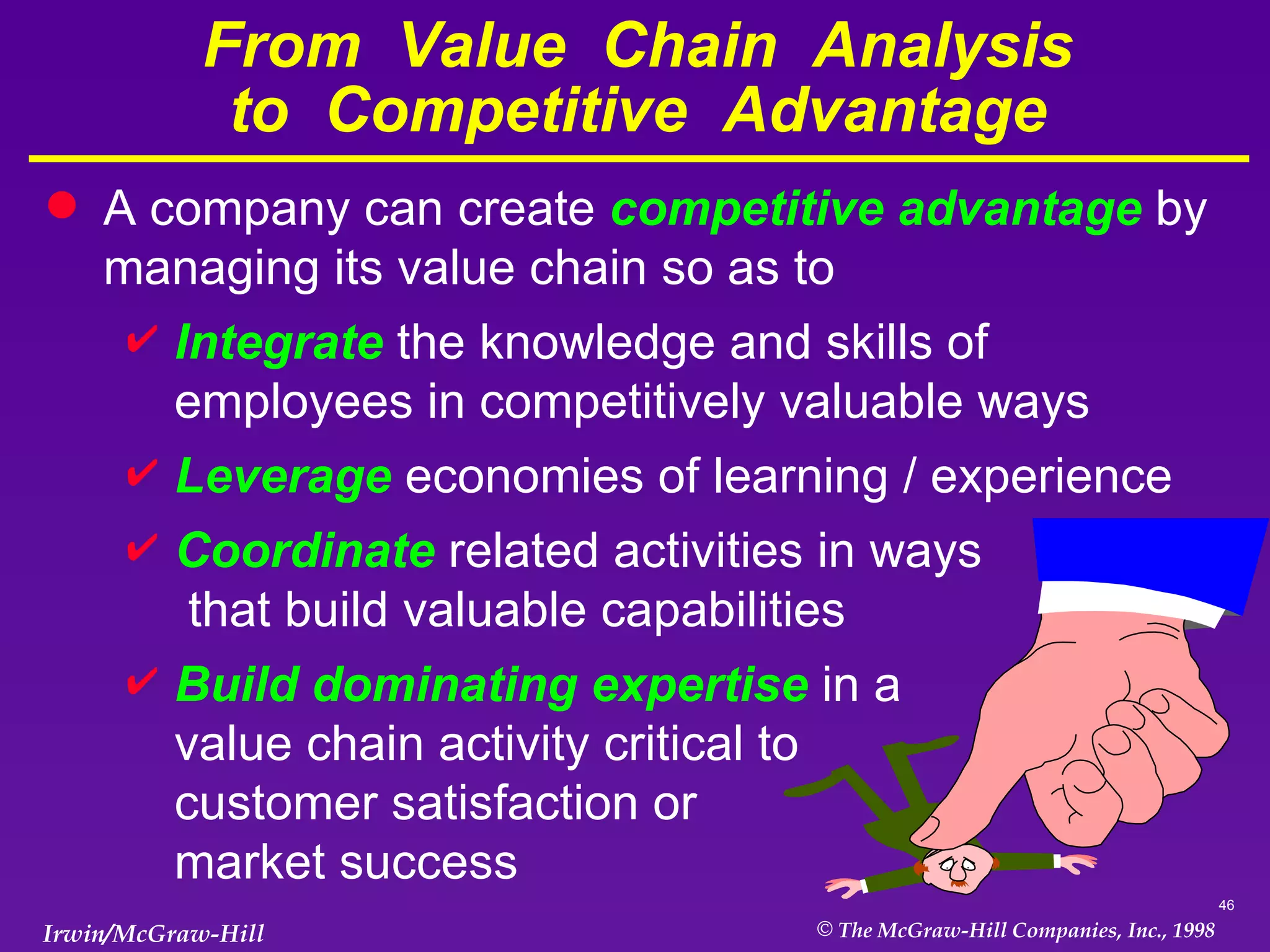
From  Value  Chain  Analysis to  Competitive  Advantage A company can create  competitive advantage  by managing its value chain so as to Integrate  the knowledge and skills of employees in competitively valuable ways Leverage  economies of learning / experience Coordinate  related activities in ways  that build valuable capabilities Build dominating expertise  in a value chain activity critical to  customer satisfaction or market success
From  Value  Chain  Analysis to  Competitive  Advantage The strategy-making lesson of value chain analysis:   Sustainable competitive advantage  can be created by  (1) managing value chain activities better than rivals and (2) developing distinctive capabilities to serve customers!
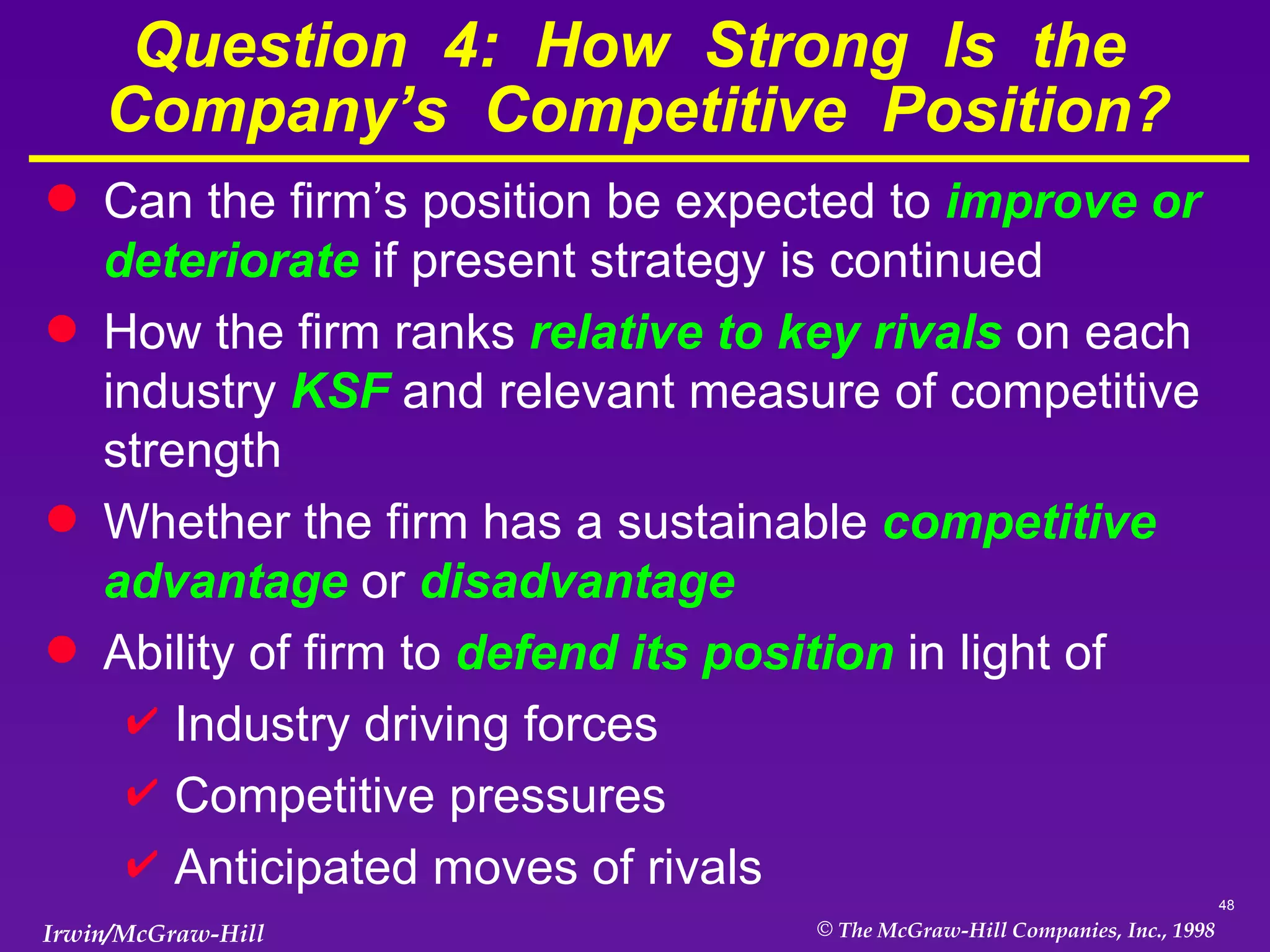
Question  4:  How  Strong  Is  the  Company’s  Competitive  Position? Can the firm’s position be expected to  improve or deteriorate  if present strategy is continued How the firm ranks  relative to key rivals  on each industry  KSF  and relevant measure of competitive strength  Whether the firm has a sustainable  competitive advantage  or  disadvantage Ability of firm to  defend its position  in light of Industry driving forces Competitive pressures Anticipated moves of rivals
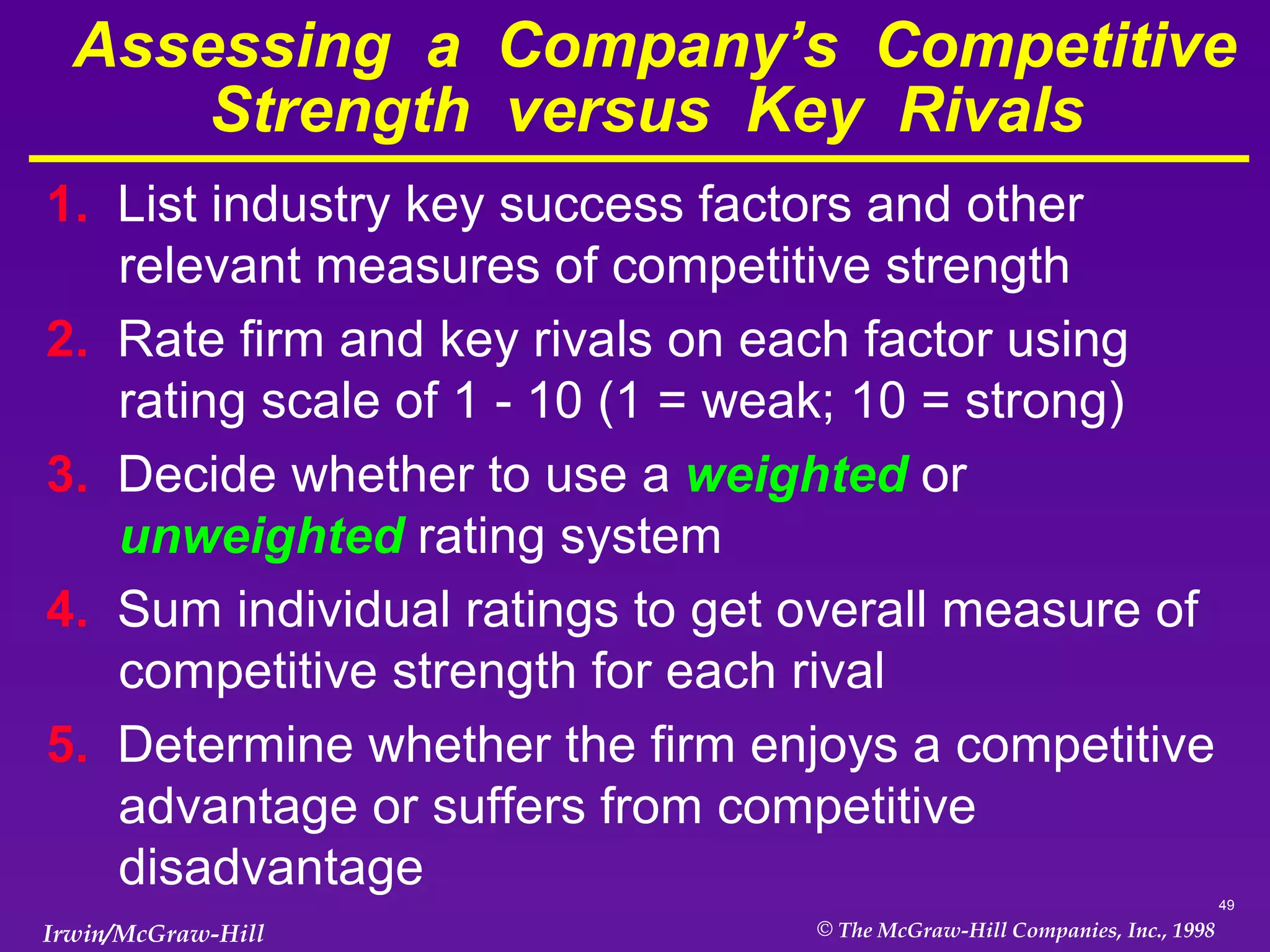
Assessing  a  Company’s  Competitive  Strength  versus  Key  Rivals 1.  List industry key success factors and other relevant measures of competitive strength 2.  Rate firm and key rivals on each factor using rating scale of 1 - 10 (1 = weak; 10 = strong) 3.  Decide whether to use a  weighted  or  unweighted   rating system 4.  Sum individual ratings to get overall measure of competitive strength for each rival 5.  Determine whether the firm enjoys a competitive advantage or suffers from competitive disadvantage
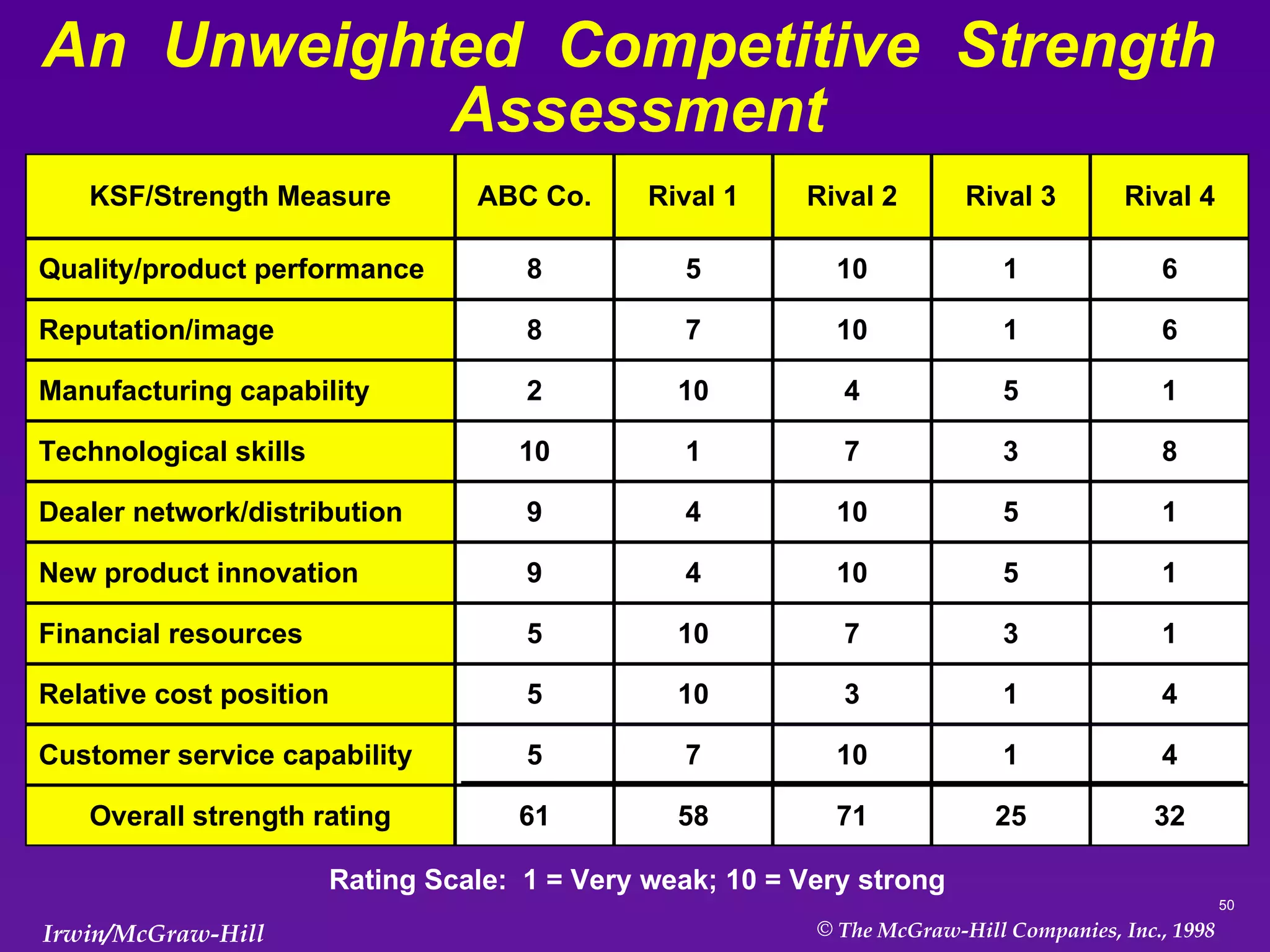
An  Unweighted  Competitive  Strength  Assessment KSF/Strength Measure Quality/product performance Reputation/image Manufacturing capability Technological skills Dealer network/distribution New product innovation Financial resources Relative cost position Customer service capability Overall strength rating ABC Co. Rival 1 Rival 2 8 5 10 8 7 10 2 10 4 10 1 7 9 4 10 9 4 10 5 10 7 5 10 3 5 7 10 61 58 71 Rival 3 1 1 5 3 5 5 3 1 1 25 Rival 4 6 6 1 8 1 1 1 4 4 32 Rating Scale:  1 = Very weak; 10 = Very strong
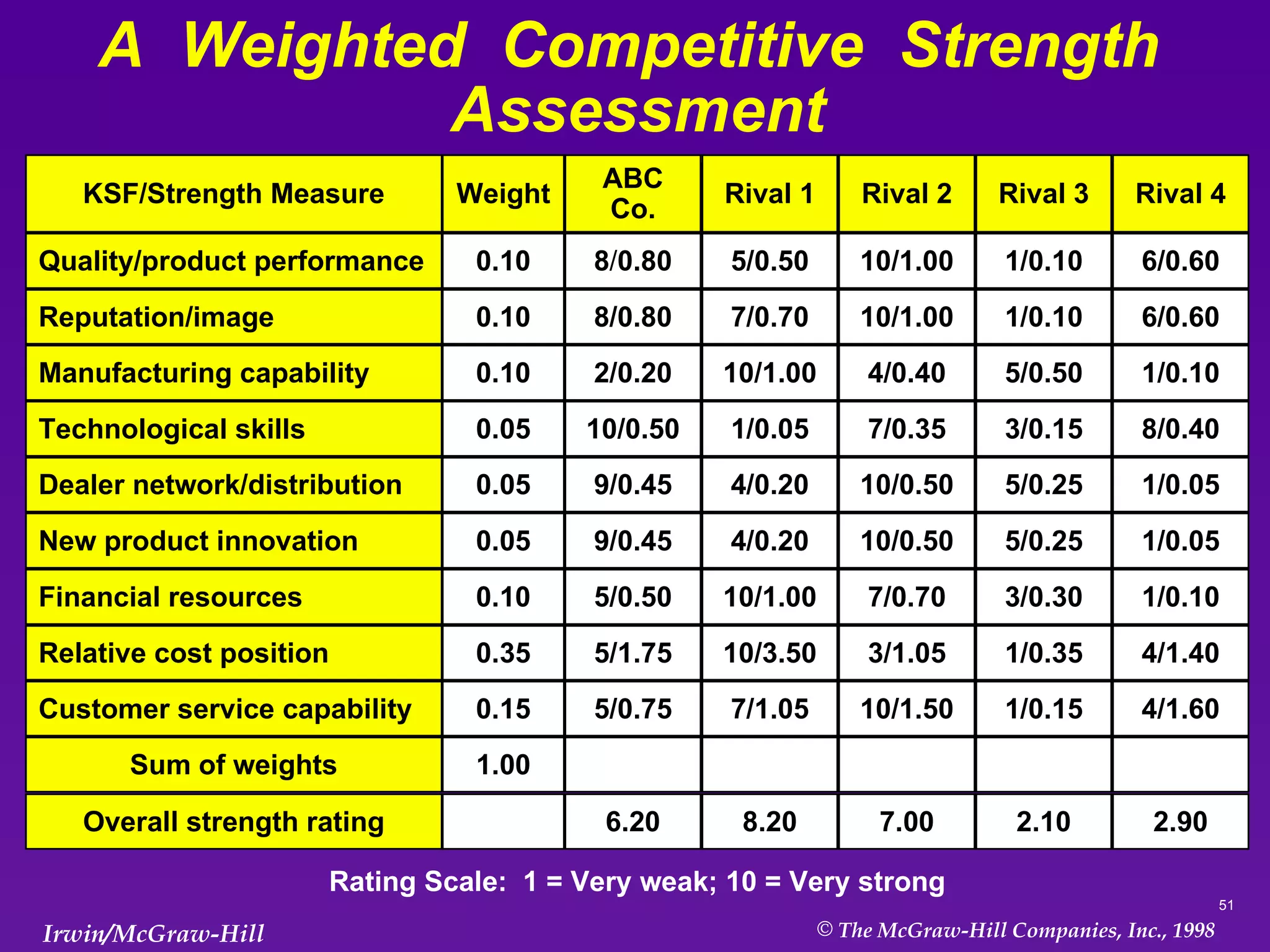
A  Weighted  Competitive  Strength  Assessment KSF/Strength Measure Quality/product performance Reputation/image Manufacturing capability Technological skills Dealer network/distribution New product innovation Financial resources Relative cost position Customer service capability Rival 1 Rival 2 5/0.50 10/1.00 7/0.70 10/1.00 10/1.00 4/0.40 1/0.05 7/0.35 4/0.20 10/0.50 4/0.20 10/0.50 10/1.00 7/0.70 10/3.50 3/1.05 7/1.05 10/1.50 ABC Co. 8 / 0.80 8/0.80 2/0.20 10/0.50 9/0.45 9/0.45 5/0.50 5/1.75 5/0.75 Rival 3 1/0.10 1/0.10 5/0.50 3/0.15 5/0.25 5/0.25 3/0.30 1/0.35 1/0.15 Rival 4 6/0.60 6/0.60 1/0.10 8/0.40 1/0.05 1/0.05 1/0.10 4/1.40 4/1.60 Weight 0.10 0.10 0.10 0.05 0.05 0.05 0.10 0.35 0.15 Rating Scale:  1 = Very weak; 10 = Very strong Sum of weights 1.00 Overall strength rating 6.20 8.20 7.00 2.10 2.90
Why  Do  a  Competitive Strength  Assessment ? Reveals strength of firm’s competitive position Shows how firm stacks up against rivals, measure-by-measure -- pinpoints the company’s competitive strengths and competitive weaknesses Indicates whether firm is at a competitive advantage / disadvantage against each rival Identifies possible offensive attacks (pit company strengths against rivals’ weaknesses)  Identifies possible defensive actions (a need to correct competitive weaknesses)
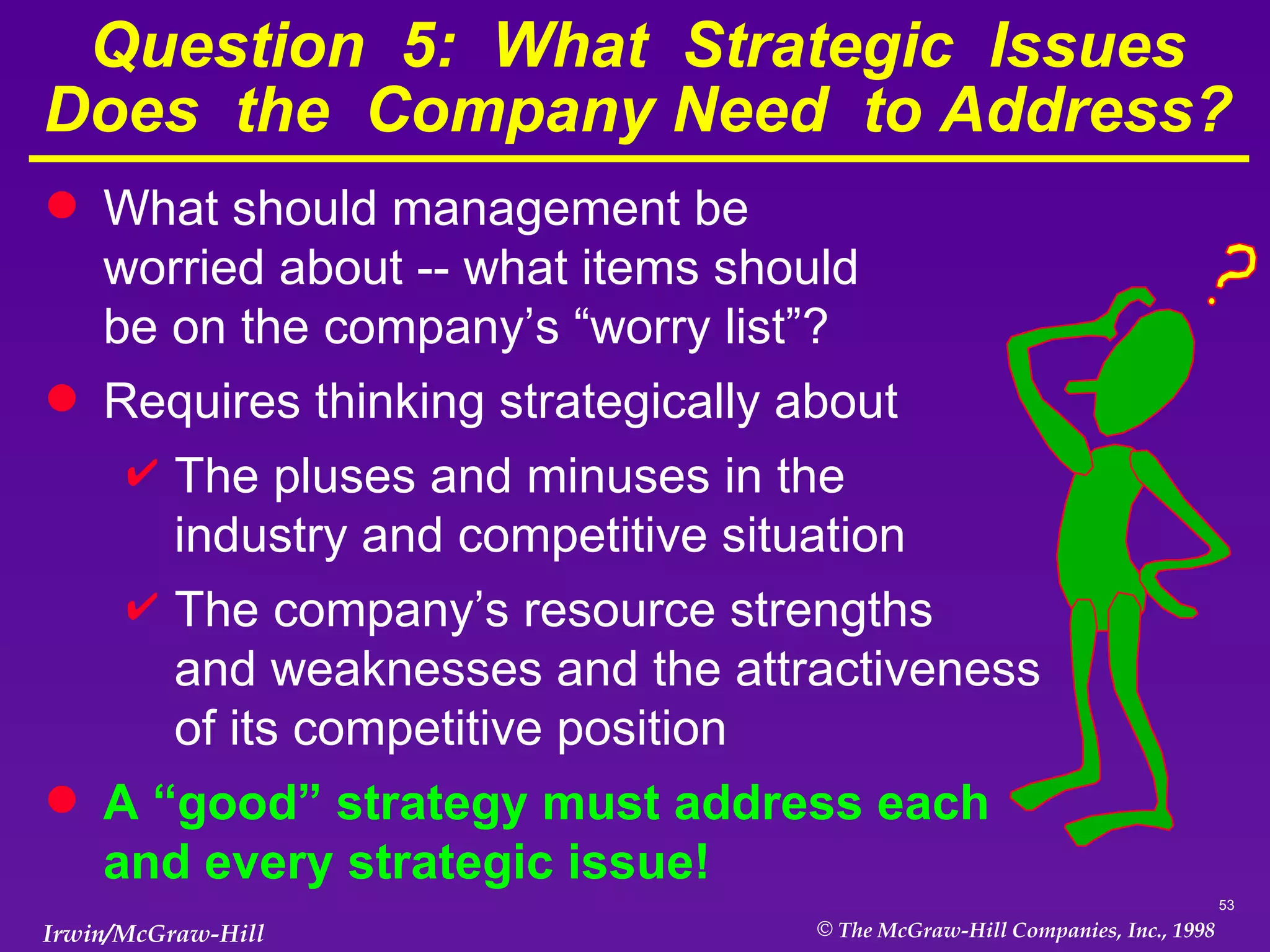
Question  5:  What  Strategic  Issues Does  the  Company Need  to Address?  What should management be worried about -- what items should be on the company’s “worry list”? Requires thinking strategically about The pluses and minuses in the  industry and competitive situation The company’s resource strengths  and weaknesses and the attractiveness  of its competitive position A “good” strategy must address each and every strategic issue!
Identifying  the  Strategic  Issues Is present strategy adequate in light of  competitive pressures and driving forces? Is the strategy well-matched to the industry’s key success factors?  Does the company need new or different resource strengths and competitive capabilities? Does present strategy adequately protect  against external threats and resource deficiencies? Is firm vulnerable to competitive attack by rivals? Where are strong/weak spots in present strategy?
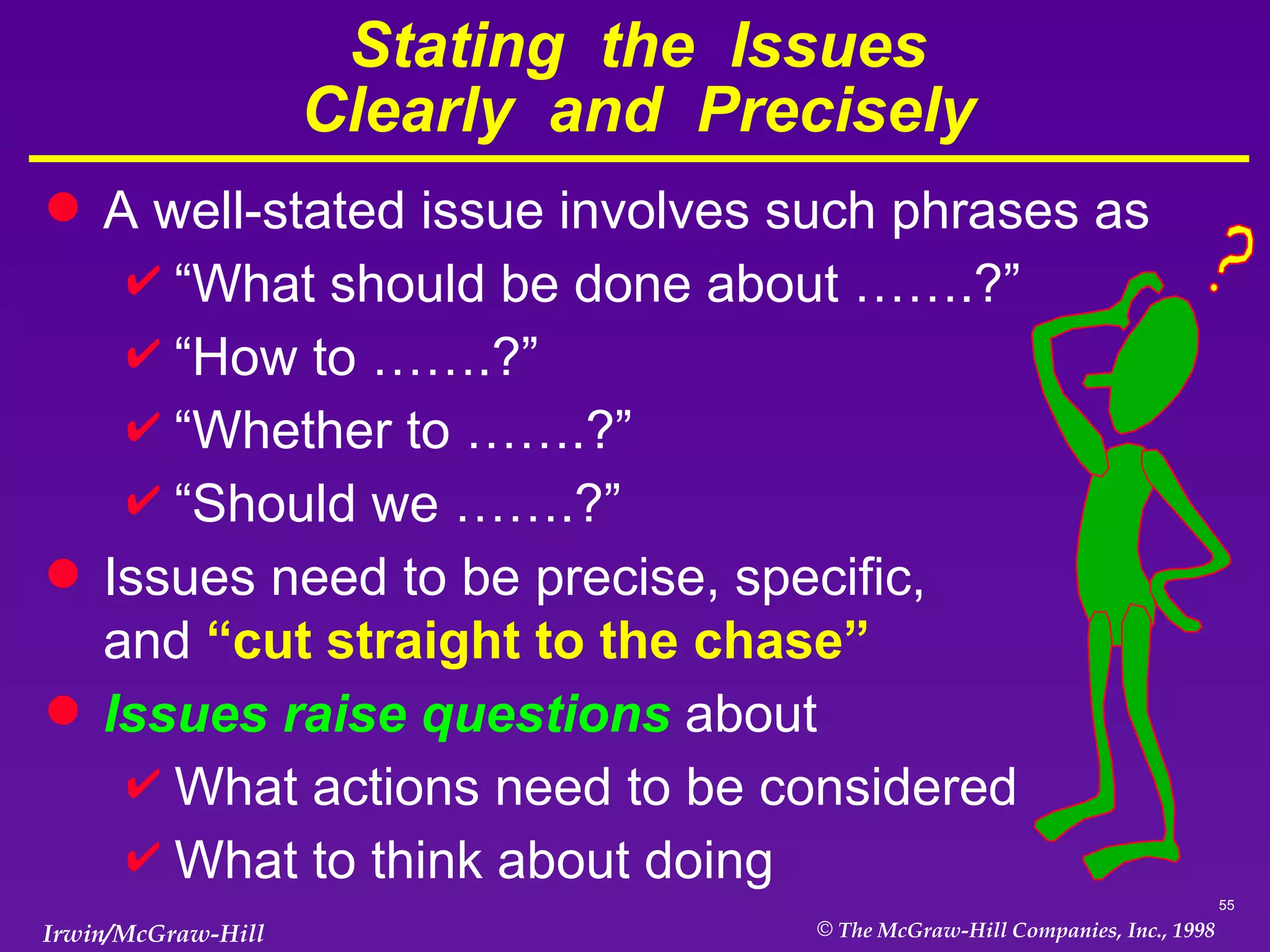
Stating  the  Issues Clearly  and  Precisely A well-stated issue involves such phrases as “ What should be done about …….?” “ How to …….?” “ Whether to …….?” “ Should we …….?” Issues need to be precise, specific,  and  “cut straight to the chase” Issues raise questions  about What actions need to be considered What to think about doing

Chapter 4

  • 1.
    EVALUATING COMPANY RESOURCESAND COMPETITIVE CAPABILITIES CHAPTER 4 Mohammad Mizenur Rahaman Ph.D Researcher Assistant Professor Shahjalal University of Science & Technology, Sylhet Published by Lecturesheet.iiuc28a9.com
  • 2.
    “ Understand whatreally makes a company ‘tick’.” “ If a company is not ‘best in world’ at a critical activity, it is sacrificing competitive advantage by performing that activity with its existing technique. ” Charles R. Scott James Brian Quinn The McGraw-Hill Companies, Inc., 1998 Irwin/McGraw-Hill “ Quote”
  • 3.
    Chapter OutlineDetermining How Well the a Company’s Present Strategy Is Working SWOT Analysis Resource Strengths and Weaknesses Opportunities and Threats Facing Firm Strategic Cost Analysis and Value Chains Assessing Firm’s Competitive Position Identifying Strategic Issues
  • 4.
    Company Situation Analysis: The Key Questions 1. How well is firm’s present strategy working? 2. What are the firm’s resource strengths and weaknesses and its external opportunities and threats? 3. Are firm’s prices and costs competitive? 4. How strong is firm’s competitive position relative to rivals? 5. What strategic issues does firm face?
  • 5.
    Question 1: How Well Is the Present Strategy Working? Two steps involved Determine current strategy of company Examine key indicators of strategic and financial performance
  • 6.
    What Is the Strategy? Identify competitive approach Low-cost leadership Differentiation Focus on a particular market niche Determine competitive scope Stages of industry’s production/distribution chain Geographic coverage Customer base Identify functional strategies Examine recent strategic moves
  • 7.
    Key Indicators of How Well the Strategy Is Working Trend in market share Trend in profit margins Trend in net profits, return on investment Trend in sales growth Credit ranking Trend in stock price and stockholder value Image and reputation with customers Leadership role(s) -- technology, quality, etc. Competitive advantages or disadvantages
  • 8.
    Question 2:What Are the Firm’s Strengths, Weaknesses, Opportunities and Threats ? S W O T represents the first letter in S trengths W eaknesses O pportunities T hreats Strategy-making must be well-matched to both A firm’s resource strengths and weaknesses A firm’s best market opportunities and external threats to its well-being S W O T
  • 9.
    Identifying Resource Strengths and Competitive Capabilities A strength is something a firm does well or a characteristic that enhances its competitiveness Valuable competencies or know-how Valuable physical assets Valuable human assets Valuable organizational assets Valuable intangible assets Important competitive capabilities An attribute that places a company in a position of market advantage Alliances or cooperative ventures
  • 10.
    Identifying Resource Weaknesses and Competitive Deficiencies A weakness is something a firm lacks, does poorly, or a condition placing it at a disadvantage Resource weaknesses relate to Deficiencies in know-how or expertise or competencies Lack of important physical, organizational, or intangible assets Missing capabilities in key areas
  • 11.
    SWOT Analysis-- What to Look For Potential Resource Strengths Potential Resource Weaknesses Potential Company Opportunities Potential External Threats Powerful strategy Strong financial condition Strong brand name image/reputation Widely recognized market leader Proprietary technology Cost advantages Strong advertising Product innovation skills Good customer service Better product quality Alliances or JVs No clear strategic direction Obsolete facilities Weak balance sheet; excess debt Higher overall costs than rivals Missing some key skills/competencies Subpar profits . . . Internal operating problems . . . Falling behind in R&D Too narrow product line Weak marketing skills Serving additional customer groups Expanding to new geographic areas Expanding product line Transferring skills to new products Vertical integration Openings to take MS from rivals Acquisition of rivals Alliances or JVs to expand coverage Openings to exploit new technologies Openings to extend brand name/image Entry of potent new competitors Loss of sales to substitutes Slowing market growth Adverse shifts in exchange rates & trade policies Costly new regulations Vulnerability to business cycle Growing leverage of customers or suppliers Shift in buyer needs for product Demographic changes
  • 12.
    Competencies vs. Core Competencies vs. Distinctive Competencies A competence is an internal activity that a company performs better than other internal activities. A core competence is a well-performed internal activity that is central , not peripheral, to a company’s strategy, competitiveness, and profitability . A distinctive competence is a competitively valuable activity that a company performs better than its rivals .
  • 13.
    Core Competencies: A Valuable Company Resource A competence becomes a core competence when the well-performed activity is central to the company’s strategy, competitiveness, and profitability Often, a core competence results from collaboration among different parts of an organization Typically, core competencies reside in a company’s people , not in its assets on the balance sheet A core competence gives a company a potentially valuable competitive capability
  • 14.
    Types of Core Competencies Skills in manufacturing a high quality product System to fill customer orders accurately and swiftly Fast development of new products Better after-sale service capability Superior know-how in selecting good retail locations Innovativeness in developing popular product features Merchandising and product display skills Expertise in an important technology Expertise in integrating multiple technologies to create whole families of new products
  • 15.
    A Distinctive Competence -- A Competitively Superior Resource A distinctive competence is a competitively significant activity that a company performs better than its competitors A distinctive competence represents a competitively superior resource strength A distinctive competence Represents a competitively valuable capability that rivals do not have Has potential for being a cornerstone of strategy Can provide a competitive edge in the marketplace # 1
  • 16.
    Strategic Management Principle A distinctive competence empowers a company to build competitive advantage!
  • 17.
    Examples: Distinctive Competencies Sharp Corporation Expertise in flat-panel display technology Toyota, Honda, Nissan Low-cost, high-quality manufacturing capability and short design-to-market cycles Intel Ability to design and manufacture ever more powerful microprocessors for PCs Motorola Defect-free manufacture (six-sigma quality) of cell phones
  • 18.
    Determining the Competitive Value of a Company Resource There are 4 tests of whether a “resource” has real potential for producing sustainable competitive advantage 1. Is the resource hard to copy ? 2. Does the resource have staying power -- is it durable ? 3. Is the resource really competitively superior ? 4. Can the resource be trumped by the different capabilities of rivals ?
  • 19.
    Strategic Management Principle Successful strategists seek to capitalize on a company’s resource strengths -- its expertise, core competencies, and strongest competitive capabilities!
  • 20.
    Identifying a Company’s Market Opportunities The market opportunities most relevant to a company are those offering The best prospects for profitable long-term growth Competitive advantage Good match with its financial and organizational resource capabilities
  • 21.
    Strategic Management Principle A company is well-advised to pass on a particular market opportunity unless it has or can build the resource capabilities to capture it!
  • 22.
    Identifying External Threats Emergence of cheaper/better technologies Introduction of better products by rivals Intensifying competitive pressures Onerous regulations A rise in interest rates Potential of a hostile takeover Unfavorable demographic shifts Adverse shifts in foreign exchange rates Political upheaval in a country
  • 23.
    Strategic Management Principle Successful strategists aim at capturing a company’s best growth opportunities and creating defenses against external threats to its competitive position and future performance!
  • 24.
    Role of SWOT Analysis in Crafting a Better Strategy Developing a clear understanding of a company’s Resource strengths Resource weaknesses Best opportunities External threats Drawing conclusions about how best to deploy resources in light of the company’s internal and external situation Thinking strategically about how to strengthen the company’s resource base for the future
  • 25.
    Question 3: Are the Company’s Prices and Costs Competitive? Assessing whether a firm’s costs are competitive with those of rivals is a crucial part of company analysis Key analytical tools Strategic cost analysis Value chain analysis Benchmarking
  • 26.
    Why Rival Companies Have Different Costs Companies do not have the same costs because of differences in Prices paid for raw materials, component parts, energy, and other supplier resources Basic technology and age of plant & equipment Economies of scale and experience curve effects Wage rates and productivity levels Marketing, promotion, and administration costs Inbound and outbound shipping costs Forward channel distribution costs
  • 27.
    Principle of Competitive Markets The higher a company’s costs are above those of close rivals, the more competitively vulnerable it becomes!
  • 28.
    What Is Strategic Cost Analysis? Focuses on a firm’s costs relative to its rivals Compares a firm’s costs activity by activity against costs of key rivals From raw materials purchase to Price paid by ultimate customer Pinpoints which internal activities are a source of cost advantage or disadvantage
  • 29.
    The Value Chain Concept Identifies the separate activities and business processes performed to design, produce, market, deliver, and support a product / service Consists of two types of activities Primary activities Support activities
  • 30.
    A Typical Company Value Chain Outbound Logistics Operations Inbound Logistics Sales and Marketing Service Profit Margin Product R&D, Technology, Systems Development Human Resources Management General Administration Primary Activities and Costs Support Activities and Costs
  • 31.
    The Value Chain System Upstream Value Chains A Company’s Own Value Chain Downstream Value Chains Internally Performed Activities, Costs, & Margins Activities, Costs, & Margins of Forward Channel Allies & Strategic Partners Activities, Costs, & Margins of Suppliers Buyer/User Value Chains
  • 32.
    The Value Chain System Assessing a company’s cost competitiveness involves comparing costs all along the industry’s value chain Suppliers’ value chains are relevant because Costs, quality, and performance of inputs provided by suppliers influence a firm’s own costs and product performance Forward channel allies’ value chains are relevant because Forward channel allies’ costs and margins are part of price paid by ultimate end-user Activities performed affect end-user satisfaction
  • 33.
    Example: Key Value Chain Activities Timber farming Logging Pulp mills Papermaking Printing & publishing PULP & PAPER INDUSTRY
  • 34.
    Example: Key Value Chain Activities Parts & components manufacture Assembly Wholesale distribution Retail sales HOME APPLIANCE INDUSTRY
  • 35.
    Example: Key Value Chain Activities Processing of basic ingredients Syrup manufacture Bottling and can filling Wholesale distribution Retailing SOFT DRINK INDUSTRY Kroger
  • 36.
    Example: Key Value Chain Activities Programming Disk loading Marketing Distribution COMPUTER SOFTWARE INDUSTRY
  • 37.
    Activity-Based Costing: A Key Tool in Strategic Cost Analysis Determining whether a company’s costs are in line with those of rivals requires measuring how a company’s costs compare with those of rivals activity-by-activity --from one end of the value chain to the other This requires having accounting data that measures the cost of each value chain activity Activity-based accounting systems provide a way of measuring costs for each relevant value chain activity
  • 38.
    Traditional Cost Accounting vs. Activity-Based Costing Traditional Cost Accounting Categories in Department Budget Wages & Salaries $350,000 Employee Benefits 115,000 Supplies 6,500 Travel 2,400 Depreciation 17,000 Other Fixed Charges 124,000 Miscellaneous Operating Expenses 25,520 $640,150 $135,750 82,100 23,500 15,840 94,300 48,450 110,000 130,210 $640,150 Departmental Activities Using Activity-Based Cost Accounting Evaluate Suppliers Process Purchase Orders Expedite Deliveries Expedite Internal Process Check Item Quality Check Deliveries Against Purchase Orders Resolve Problems Internal Administration
  • 39.
    Benchmarking the Costs of Key Value Chain Activities Focuses on cross-company comparisons of how well activities are performed Purchase of materials Payment of suppliers Management of inventories Training of employees Processing of payrolls Getting new products to market Performance of quality control Filling and shipping of customer orders
  • 40.
    Objectives of Benchmarking Determine whether a company is performing particular value chain activities efficiently Understand the best practices in performing an activity Assess if costs are in line with competitors Learn how lower costs are achieved Take action to improve cost competitiveness
  • 41.
    Ethical Standards in Benchmarking: Do’s and Don’ts Avoid talk about pricing or competitively sensitive costs Don’t ask rivals for sensitive data Don’t share proprietary data without clearance Have impartial third party assemble and present competitive data with no names attached Don’t disparage a rival’s business to outsiders based on data obtained
  • 42.
    What Determines Whether a Company Is Cost Competitive? A company’s cost competitiveness depends on how well it manages its value chain relative to competitors Three areas contribute to cost differences 1. Suppliers’ activities 2. The company’s own internal activities 3. Forward channel activities Activities, Costs, & Margins of Forward Channel Allies & Strategic Partners Internally Performed Activities, Costs, & Margins Activities, Costs, & Margins of Suppliers Buyer/User Value Chains
  • 43.
    Correcting Supplier-Related Cost Disadvantages: The Options Negotiate more favorable prices with suppliers Work with suppliers to help them achieve lower costs Integrate backward Use lower-priced substitute inputs Do a better job of managing linkages between suppliers’ value chains and firm’s own chain Make up difference by initiating cost savings in other areas of value chain
  • 44.
    Correcting ForwardChannel Cost Disadvantages: The Options Push for more favorable terms with distributors and other forward channel allies Work closely with forward channel allies and customers to identify win-win opportunities to reduce costs Change to a more economical distribution strategy Make up difference by initiating cost savings earlier in value chain
  • 45.
    Correcting Internal Cost Disadvantages: The Options Reengineer how the high-cost activities or business processes are performed Eliminate some cost-producing activities altogether by revamping value chain system Relocate high-cost activities to lower-cost geographic areas See if high-cost activities can be performed cheaper by outside vendors/suppliers Invest in cost-saving technology Simplify product design Make up difference by achieving savings in backward or forward portions of value chain system
  • 46.
    From Value Chain Analysis to Competitive Advantage A company can create competitive advantage by managing its value chain so as to Integrate the knowledge and skills of employees in competitively valuable ways Leverage economies of learning / experience Coordinate related activities in ways that build valuable capabilities Build dominating expertise in a value chain activity critical to customer satisfaction or market success
  • 47.
    From Value Chain Analysis to Competitive Advantage The strategy-making lesson of value chain analysis: Sustainable competitive advantage can be created by (1) managing value chain activities better than rivals and (2) developing distinctive capabilities to serve customers!
  • 48.
    Question 4: How Strong Is the Company’s Competitive Position? Can the firm’s position be expected to improve or deteriorate if present strategy is continued How the firm ranks relative to key rivals on each industry KSF and relevant measure of competitive strength Whether the firm has a sustainable competitive advantage or disadvantage Ability of firm to defend its position in light of Industry driving forces Competitive pressures Anticipated moves of rivals
  • 49.
    Assessing a Company’s Competitive Strength versus Key Rivals 1. List industry key success factors and other relevant measures of competitive strength 2. Rate firm and key rivals on each factor using rating scale of 1 - 10 (1 = weak; 10 = strong) 3. Decide whether to use a weighted or unweighted rating system 4. Sum individual ratings to get overall measure of competitive strength for each rival 5. Determine whether the firm enjoys a competitive advantage or suffers from competitive disadvantage
  • 50.
    An Unweighted Competitive Strength Assessment KSF/Strength Measure Quality/product performance Reputation/image Manufacturing capability Technological skills Dealer network/distribution New product innovation Financial resources Relative cost position Customer service capability Overall strength rating ABC Co. Rival 1 Rival 2 8 5 10 8 7 10 2 10 4 10 1 7 9 4 10 9 4 10 5 10 7 5 10 3 5 7 10 61 58 71 Rival 3 1 1 5 3 5 5 3 1 1 25 Rival 4 6 6 1 8 1 1 1 4 4 32 Rating Scale: 1 = Very weak; 10 = Very strong
  • 51.
    A Weighted Competitive Strength Assessment KSF/Strength Measure Quality/product performance Reputation/image Manufacturing capability Technological skills Dealer network/distribution New product innovation Financial resources Relative cost position Customer service capability Rival 1 Rival 2 5/0.50 10/1.00 7/0.70 10/1.00 10/1.00 4/0.40 1/0.05 7/0.35 4/0.20 10/0.50 4/0.20 10/0.50 10/1.00 7/0.70 10/3.50 3/1.05 7/1.05 10/1.50 ABC Co. 8 / 0.80 8/0.80 2/0.20 10/0.50 9/0.45 9/0.45 5/0.50 5/1.75 5/0.75 Rival 3 1/0.10 1/0.10 5/0.50 3/0.15 5/0.25 5/0.25 3/0.30 1/0.35 1/0.15 Rival 4 6/0.60 6/0.60 1/0.10 8/0.40 1/0.05 1/0.05 1/0.10 4/1.40 4/1.60 Weight 0.10 0.10 0.10 0.05 0.05 0.05 0.10 0.35 0.15 Rating Scale: 1 = Very weak; 10 = Very strong Sum of weights 1.00 Overall strength rating 6.20 8.20 7.00 2.10 2.90
  • 52.
    Why Do a Competitive Strength Assessment ? Reveals strength of firm’s competitive position Shows how firm stacks up against rivals, measure-by-measure -- pinpoints the company’s competitive strengths and competitive weaknesses Indicates whether firm is at a competitive advantage / disadvantage against each rival Identifies possible offensive attacks (pit company strengths against rivals’ weaknesses) Identifies possible defensive actions (a need to correct competitive weaknesses)
  • 53.
    Question 5: What Strategic Issues Does the Company Need to Address? What should management be worried about -- what items should be on the company’s “worry list”? Requires thinking strategically about The pluses and minuses in the industry and competitive situation The company’s resource strengths and weaknesses and the attractiveness of its competitive position A “good” strategy must address each and every strategic issue!
  • 54.
    Identifying the Strategic Issues Is present strategy adequate in light of competitive pressures and driving forces? Is the strategy well-matched to the industry’s key success factors? Does the company need new or different resource strengths and competitive capabilities? Does present strategy adequately protect against external threats and resource deficiencies? Is firm vulnerable to competitive attack by rivals? Where are strong/weak spots in present strategy?
  • 55.
    Stating the Issues Clearly and Precisely A well-stated issue involves such phrases as “ What should be done about …….?” “ How to …….?” “ Whether to …….?” “ Should we …….?” Issues need to be precise, specific, and “cut straight to the chase” Issues raise questions about What actions need to be considered What to think about doing