SWOT Analysis
• Presented by
– Rebekah Samuel
• Submitted to
– Sir Mumtaiz Ali
What is a SWOT analysis
• It links the analysis in terms of advantages and
disadvantages ; and the internal and external
environment of the business.
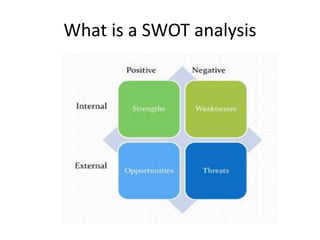
• Environmental factors internal to the firm (within your
control) usually can be classified as strengths (S) or
weaknesses (W).
• The strengths and weaknesses are defined by measures
such as market shares, loyal customers, level of customer
satisfaction and product quality.
• Those external factors to the firm (you can not control)
can be classified as opportunities (O) or threats (T).
• Opportunities are new potential area for business in the
future, such as new markets or new conditions in existing
markets.
What is a SWOT analysis
• Threats describe how the competition, new technology, or
other factors in the business environment may affect the
business’s development.
• SWOT analysis is a powerful technique for understanding your
strengths and weaknesses, and for looking at the
opportunities and threats you face.
• For a business to expand, diversify and sustain in the market
SWOT analysis is must.
purpose
• The swot analysis provide information that is
helpful in matching the firm’s resources and
capabilities to the competitive environment in
which it operates.
• As a basic tool its mastery is a fundamental
requirement for the marketer, entrepreneur of
business person.
• It is a very important and useful tool to use in
marketing management, strategy formulation
and selection.
• Also in other business applications.
Strengths
• What do we do well?
• A firm’s strengths are its resources and capabilities that can be
used for developing a competitive advantage.
• Examples of such strengths includes:
– Patents
– Strong brand name
– Good reputation among customer
– Exclusive access natural resources
– Good access to distribution networks
– Skills, education or connections do you have that others
don’t have
weaknesses
• What is wrong now?
• What should you avoid?
• Be truthful so that weaknesses may be overcomes as quickly as
possible.
• The absence of certain strengths are a weakness. for example, the
following may be consider weaknesses:
– Lack of Patents protection
– A weak brand name
– poor reputation among customers
– High cost structure
– Lack of access to best natural resources
– Lack of access to key distribution channels
weaknesses
• In some cases, a weaknesses may be the flip of
slide of strength.
• For example, a firm has a large amount of
manufacturing capacity.
• While this capacity may be considers a strength
that competitors do not share, it also may b a
considered a weakness if the large investment in
manufacturing capacity prevent firm from
reacting quickly to change in the strategic
environment.
Opportunities
• The external environmental analysis may
reveal certain new opportunities for profit and
growth. Some examples, of such opportunities
include;
– An unfulfilled customer need
– Arrival of new technologies
– Loosening of regulations
– Removal of international trade barriers
threats
• Change in the external environment also may present threats
to the firm. Some examples of such threats includes;
– Shifts in consumer tastes away from the firm’s product
– Emergence of substitute products
– New regulations
– Increased trade barriers
– Other ongoing research or commercialization efforts
– A large existing competitors
– A competitor has a new innovative product or services
– Competitors have superior access to channel of distribution
Simple rules or tips
• Be realistic about the strengths and weaknesses of
your organization or group.
• It should distinguish between where your organization
is today, and where it could be in the future.
• It should always be specific. Avoid grey areas.
• Always apply the tool in relation to your competition
i.e. better than or worse than your competition.
• Keep your audit short and simple. Avoid complexity
and over analysis
• It is subjective.
Thank you !

Sowt analysis

  • 1.
    SWOT Analysis • Presentedby – Rebekah Samuel • Submitted to – Sir Mumtaiz Ali
  • 2.
    What is aSWOT analysis • It links the analysis in terms of advantages and disadvantages ; and the internal and external environment of the business. • Environmental factors internal to the firm (within your control) usually can be classified as strengths (S) or weaknesses (W). • The strengths and weaknesses are defined by measures such as market shares, loyal customers, level of customer satisfaction and product quality. • Those external factors to the firm (you can not control) can be classified as opportunities (O) or threats (T). • Opportunities are new potential area for business in the future, such as new markets or new conditions in existing markets.
  • 3.
    What is aSWOT analysis
  • 4.
    What is aSWOT analysis • Threats describe how the competition, new technology, or other factors in the business environment may affect the business’s development. • SWOT analysis is a powerful technique for understanding your strengths and weaknesses, and for looking at the opportunities and threats you face. • For a business to expand, diversify and sustain in the market SWOT analysis is must.
  • 5.
    purpose • The swotanalysis provide information that is helpful in matching the firm’s resources and capabilities to the competitive environment in which it operates. • As a basic tool its mastery is a fundamental requirement for the marketer, entrepreneur of business person. • It is a very important and useful tool to use in marketing management, strategy formulation and selection. • Also in other business applications.
  • 6.
    Strengths • What dowe do well? • A firm’s strengths are its resources and capabilities that can be used for developing a competitive advantage. • Examples of such strengths includes: – Patents – Strong brand name – Good reputation among customer – Exclusive access natural resources – Good access to distribution networks – Skills, education or connections do you have that others don’t have
  • 7.
    weaknesses • What iswrong now? • What should you avoid? • Be truthful so that weaknesses may be overcomes as quickly as possible. • The absence of certain strengths are a weakness. for example, the following may be consider weaknesses: – Lack of Patents protection – A weak brand name – poor reputation among customers – High cost structure – Lack of access to best natural resources – Lack of access to key distribution channels
  • 8.
    weaknesses • In somecases, a weaknesses may be the flip of slide of strength. • For example, a firm has a large amount of manufacturing capacity. • While this capacity may be considers a strength that competitors do not share, it also may b a considered a weakness if the large investment in manufacturing capacity prevent firm from reacting quickly to change in the strategic environment.
  • 9.
    Opportunities • The externalenvironmental analysis may reveal certain new opportunities for profit and growth. Some examples, of such opportunities include; – An unfulfilled customer need – Arrival of new technologies – Loosening of regulations – Removal of international trade barriers
  • 10.
    threats • Change inthe external environment also may present threats to the firm. Some examples of such threats includes; – Shifts in consumer tastes away from the firm’s product – Emergence of substitute products – New regulations – Increased trade barriers – Other ongoing research or commercialization efforts – A large existing competitors – A competitor has a new innovative product or services – Competitors have superior access to channel of distribution
  • 11.
    Simple rules ortips • Be realistic about the strengths and weaknesses of your organization or group. • It should distinguish between where your organization is today, and where it could be in the future. • It should always be specific. Avoid grey areas. • Always apply the tool in relation to your competition i.e. better than or worse than your competition. • Keep your audit short and simple. Avoid complexity and over analysis • It is subjective.
  • 12.