Submission Date
23-07-2018
Assignment # 5
Submitted To: Mr. Arslan Aslam
Submitted By: OmerIqbal
Roll No: MSTQM 17-53
Class: MS TQM (Section. B)
2nd
Semester
Topics:
1. Porter’s FiveAnalysis
2. TWOSAnalysis
3. StrategicPlanning
1
1. Porter's Five Forces
Understanding Competitive Forces to Maximize Profitability
Porter's Five Forces is a simple but powerful tool for understanding the competitiveness of your
business environment, and for identifying your strategy's potential profitability.
This is useful, because, when you understand the forces in your environment or industry that can
affect your profitability, you'll be able to adjust your strategy accordingly. For example, you could
take fair advantage of a strong position or improve a weak one and avoid taking wrong steps in
future.
In this article and video, we explore each of Porter's Five Forces. We look at how they can help
you to analyze the strengths and weaknesses of your position, and how they can impact your long-
term profitability.
Understanding Porter's Five Forces
The tool was created by Harvard Business School professor Michael Porter, to analyze an
industry's attractiveness and likely profitability. Since its publication in 1979, it has become one
of the most popular and highly regarded business strategy tools.
Porter recognized that organizations likely keep a close watch on their rivals, but he encouraged
them to look beyond the actions of their competitors and examine what other factors could impact
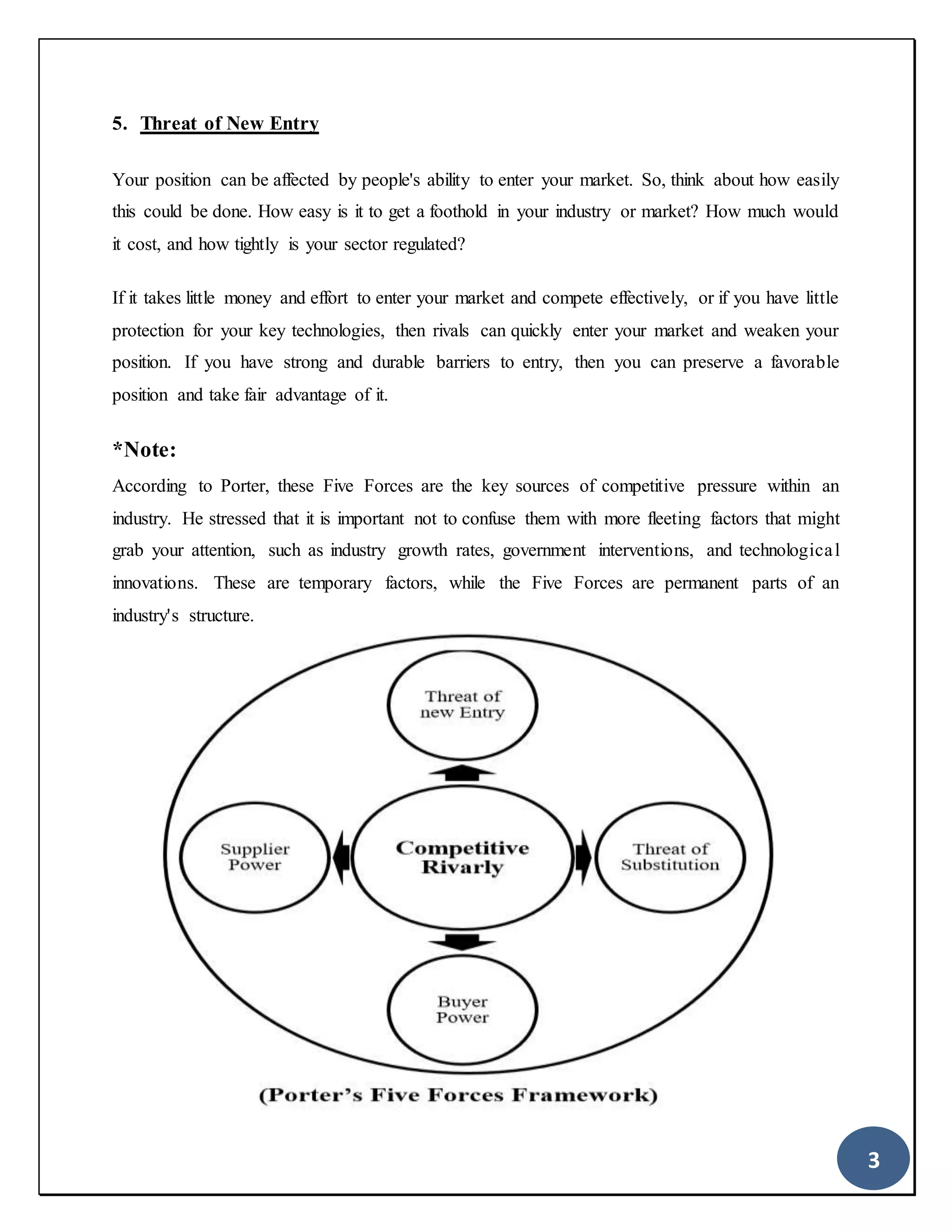
the business environment. He identified five forces that make up the competitive environment, and
which can erode your profitability. These are:
1. Competitive Rivalry
This looks at the number and strength of your competitors. How many rivals do you have? Who
are they, and how does the quality of their products and services compare with yours?
2
Where rivalry is intense, companies can attract customers with aggressive price cuts and high-
impact marketing campaigns. Also, in markets with lots of rivals, your suppliers and buyers can
go elsewhere if they feel that they're not getting a good deal from you.
On the other hand, where competitive rivalry is minimal, and no one else is doing what you do,
then you'll likely have tremendous strength and healthy profits.
2. Supplier Power
This is determined by how easy it is for your suppliers to increase their prices. How many potential
suppliers do you have? How unique is the product or service that they provide, and how expensive
would it be to switch from one supplier to another?
The more you have to choose from, the easier it will be to switch to a cheaper alternative. But the
fewer suppliers there are, and the more you need their help, the stronger their position and their
ability to charge you more. That can impact your profit.
3. Buyer Power
Here, you ask yourself how easy it is for buyers to drive your prices down. How many buyers are
there, and how big are their orders? How much would it cost them to switch from your products
and services to those of a rival? Are your buyers strong enough to dictate terms to you?
When you deal with only a few savvy customers, they have more power, but your power increases
if you have many customers.
4. Threat of Substitution
This refers to the likelihood of your customers finding a different way of doing what you do. For
example, if you supply a unique software product that automates an important process, people may
substitute it by doing the process manually or by outsourcing it. A substitution that is easy and
cheap to make can weaken your position and threaten your profitability.
3
5. Threat of New Entry
Your position can be affected by people's ability to enter your market. So, think about how easily
this could be done. How easy is it to get a foothold in your industry or market? How much would
it cost, and how tightly is your sector regulated?
If it takes little money and effort to enter your market and compete effectively, or if you have little
protection for your key technologies, then rivals can quickly enter your market and weaken your
position. If you have strong and durable barriers to entry, then you can preserve a favorable
position and take fair advantage of it.
*Note:
According to Porter, these Five Forces are the key sources of competitive pressure within an
industry. He stressed that it is important not to confuse them with more fleeting factors that might
grab your attention, such as industry growth rates, government interventions, and technological
innovations. These are temporary factors, while the Five Forces are permanent parts of an
industry's structure.
4
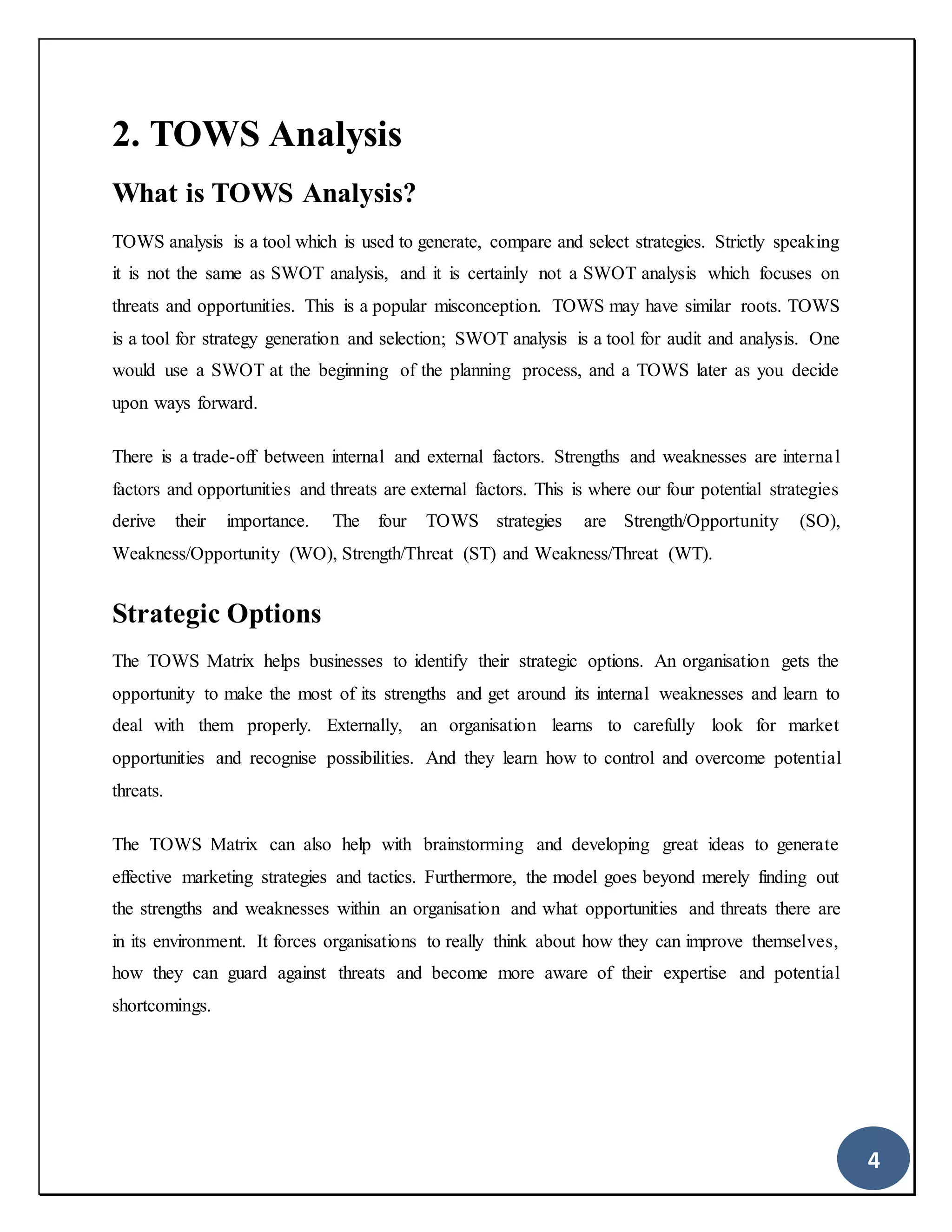
2. TOWS Analysis
What is TOWS Analysis?
TOWS analysis is a tool which is used to generate, compare and select strategies. Strictly speaking
it is not the same as SWOT analysis, and it is certainly not a SWOT analysis which focuses on
threats and opportunities. This is a popular misconception. TOWS may have similar roots. TOWS
is a tool for strategy generation and selection; SWOT analysis is a tool for audit and analysis. One
would use a SWOT at the beginning of the planning process, and a TOWS later as you decide
upon ways forward.
There is a trade-off between internal and external factors. Strengths and weaknesses are internal
factors and opportunities and threats are external factors. This is where our four potential strategies
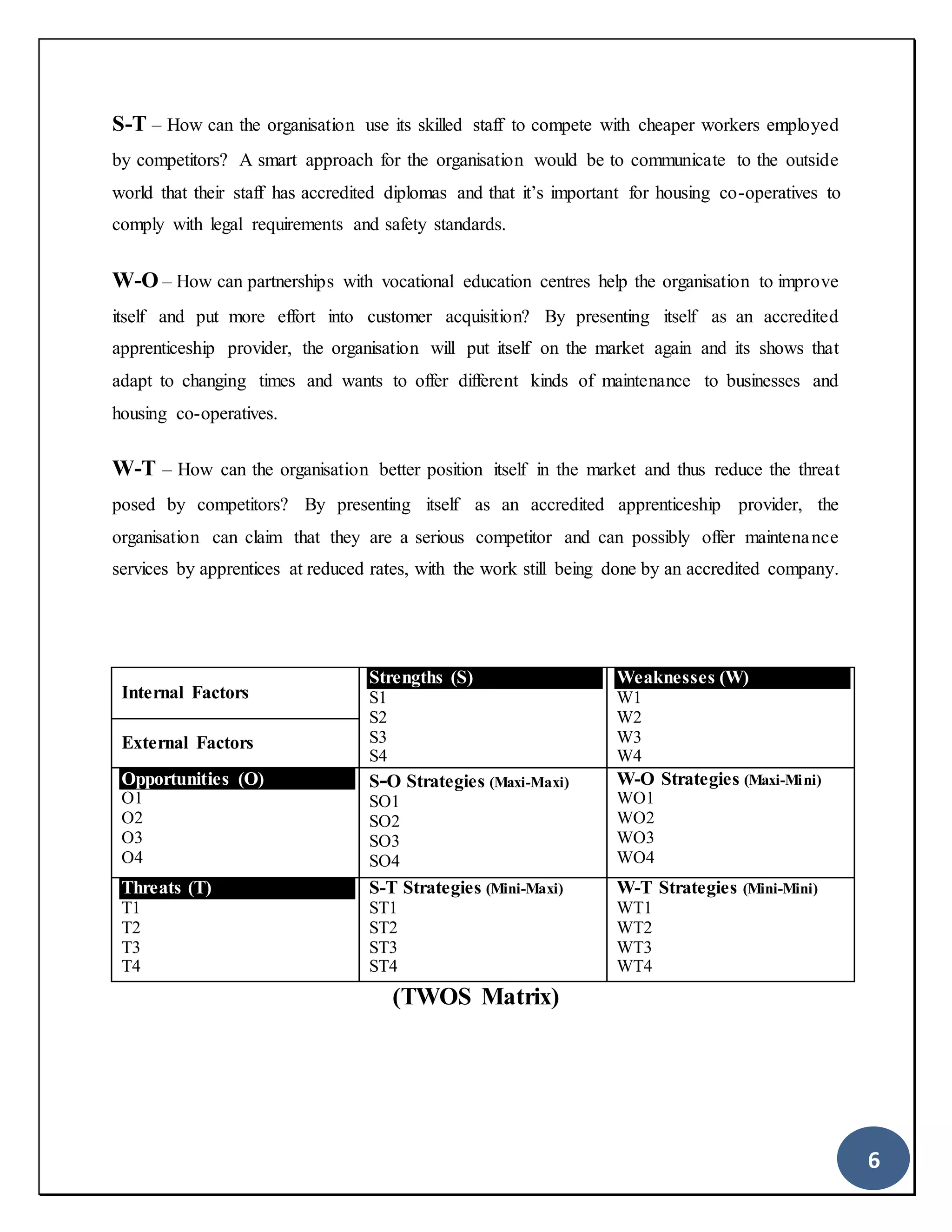
derive their importance. The four TOWS strategies are Strength/Opportunity (SO),
Weakness/Opportunity (WO), Strength/Threat (ST) and Weakness/Threat (WT).
Strategic Options
The TOWS Matrix helps businesses to identify their strategic options. An organisation gets the
opportunity to make the most of its strengths and get around its internal weaknesses and learn to
deal with them properly. Externally, an organisation learns to carefully look for market
opportunities and recognise possibilities. And they learn how to control and overcome potential
threats.
The TOWS Matrix can also help with brainstorming and developing great ideas to generate
effective marketing strategies and tactics. Furthermore, the model goes beyond merely finding out
the strengths and weaknesses within an organisation and what opportunities and threats there are
in its environment. It forces organisations to really think about how they can improve themselves,
how they can guard against threats and become more aware of their expertise and potential
shortcomings.
5
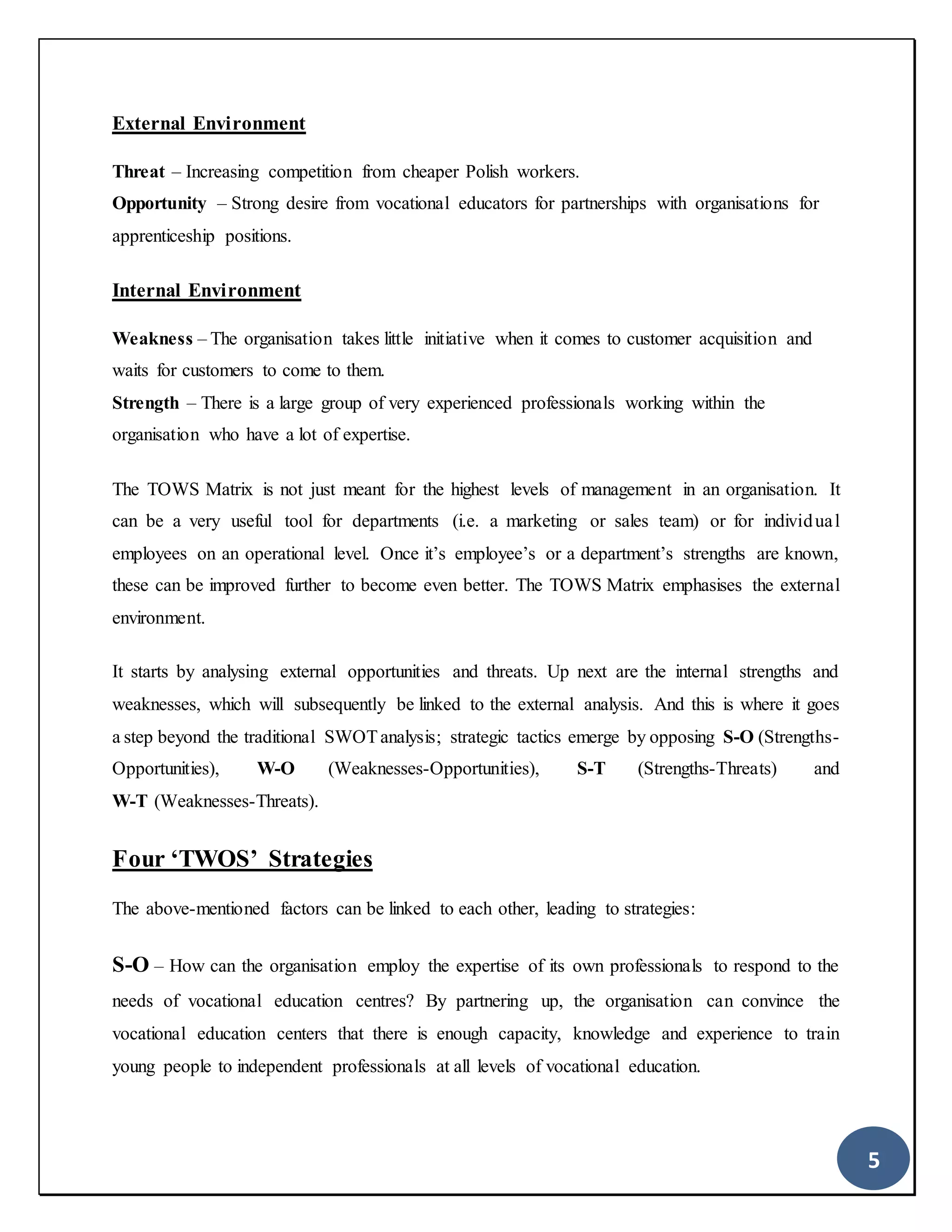
External Environment
Threat – Increasing competition from cheaper Polish workers.
Opportunity – Strong desire from vocational educators for partnerships with organisations for
apprenticeship positions.
Internal Environment
Weakness – The organisation takes little initiative when it comes to customer acquisition and
waits for customers to come to them.
Strength – There is a large group of very experienced professionals working within the
organisation who have a lot of expertise.
The TOWS Matrix is not just meant for the highest levels of management in an organisation. It
can be a very useful tool for departments (i.e. a marketing or sales team) or for individual
employees on an operational level. Once it’s employee’s or a department’s strengths are known,
these can be improved further to become even better. The TOWS Matrix emphasises the external
environment.
It starts by analysing external opportunities and threats. Up next are the internal strengths and
weaknesses, which will subsequently be linked to the external analysis. And this is where it goes
a step beyond the traditional SWOTanalysis; strategic tactics emerge by opposing S-O (Strengths-
Opportunities), W-O (Weaknesses-Opportunities), S-T (Strengths-Threats) and
W-T (Weaknesses-Threats).
Four ‘TWOS’ Strategies
The above-mentioned factors can be linked to each other, leading to strategies:
S-O – How can the organisation employ the expertise of its own professionals to respond to the
needs of vocational education centres? By partnering up, the organisation can convince the
vocational education centers that there is enough capacity, knowledge and experience to train
young people to independent professionals at all levels of vocational education.
6
S-T – How can the organisation use its skilled staff to compete with cheaper workers employed
by competitors? A smart approach for the organisation would be to communicate to the outside
world that their staff has accredited diplomas and that it’s important for housing co-operatives to
comply with legal requirements and safety standards.
W-O – How can partnerships with vocational education centres help the organisation to improve
itself and put more effort into customer acquisition? By presenting itself as an accredited
apprenticeship provider, the organisation will put itself on the market again and its shows that
adapt to changing times and wants to offer different kinds of maintenance to businesses and
housing co-operatives.
W-T – How can the organisation better position itself in the market and thus reduce the threat
posed by competitors? By presenting itself as an accredited apprenticeship provider, the
organisation can claim that they are a serious competitor and can possibly offer maintenance
services by apprentices at reduced rates, with the work still being done by an accredited company.
Internal Factors
Strengths (S)
S1
S2
S3
S4
Weaknesses (W)
W1
W2
W3
W4
External Factors
Opportunities (O)
O1
O2
O3
O4
S-O Strategies (Maxi-Maxi)
SO1
SO2
SO3
SO4
W-O Strategies (Maxi-Mini)
WO1
WO2
WO3
WO4
Threats (T)
T1
T2
T3
T4
S-T Strategies (Mini-Maxi)
ST1
ST2
ST3
ST4
W-T Strategies (Mini-Mini)
WT1
WT2
WT3
WT4
(TWOS Matrix)
7
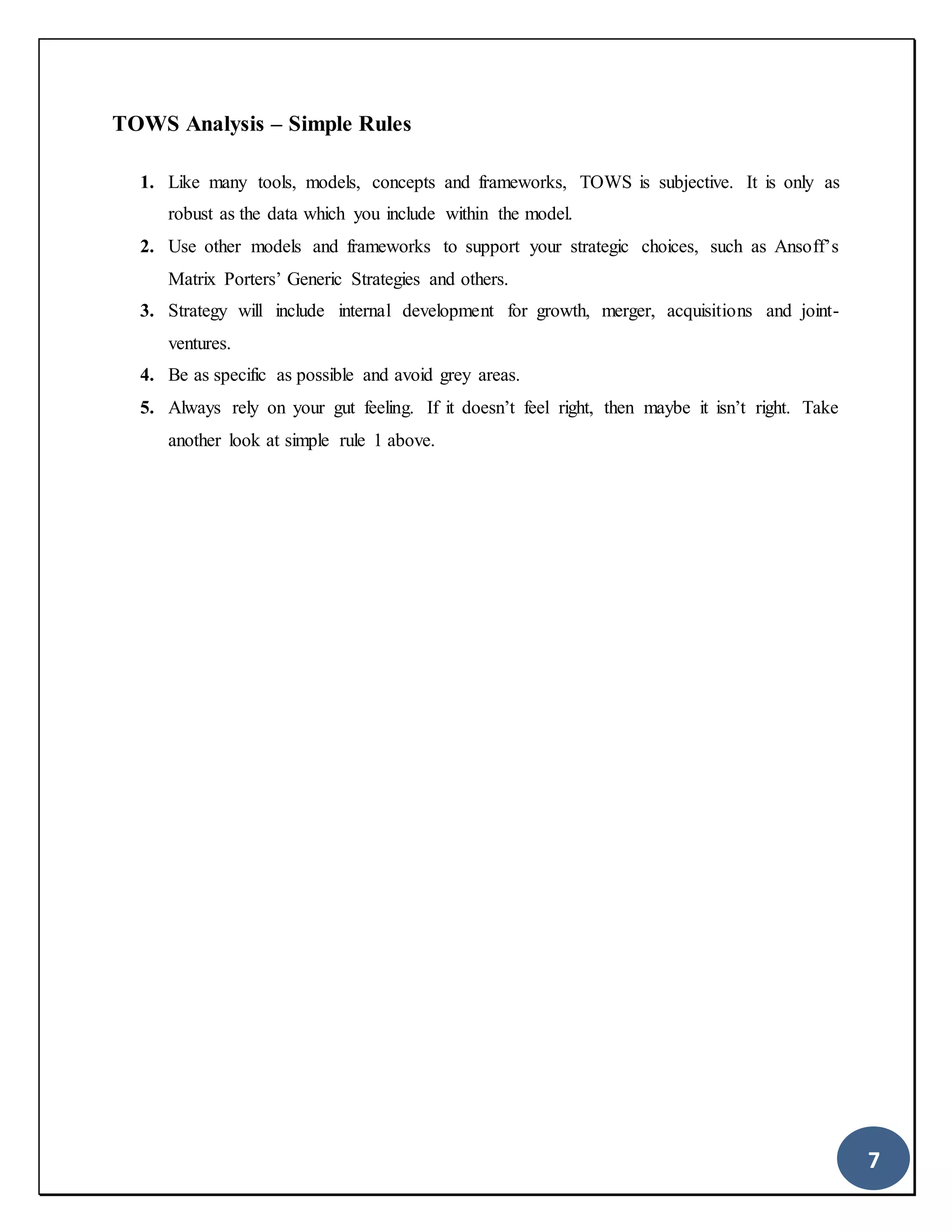
TOWS Analysis – Simple Rules
1. Like many tools, models, concepts and frameworks, TOWS is subjective. It is only as
robust as the data which you include within the model.
2. Use other models and frameworks to support your strategic choices, such as Ansoff’s
Matrix Porters’ Generic Strategies and others.
3. Strategy will include internal development for growth, merger, acquisitions and joint-
ventures.
4. Be as specific as possible and avoid grey areas.
5. Always rely on your gut feeling. If it doesn’t feel right, then maybe it isn’t right. Take
another look at simple rule 1 above.
8
3. Strategic Planning
Strategic planning is a process in which organizational leaders determine their vision for the future
as well as identify their goals and objectives for the organization. The process also includes
establishing the sequence in which those goals should fall so that the organization is enabled to
reach its stated vision.
Strategic planning is an organization's process of defining its strategy, or direction, and making
decisions on allocating its resources to pursue this strategy. It may also extend to control
mechanisms for guiding the implementation of the strategy. Strategic planning became prominent
in corporations during the 1960s and remains an important aspect of strategic management. It is
executed by strategic planners or strategists, who involve many parties and research sources in
their analysis of the organization and its relationship to the environment in which it competes.
Strategy has many definitions, but generally involves setting goals, determining actions to achieve
the goals, and mobilizing resources to execute the actions. A strategy describes how the ends
(goals) will be achieved by the means (resources). The senior leadership of an organization is
generally tasked with determining strategy. Strategy can be planned (intended) or can be observed
as a pattern of activity (emergent) as the organization adapts to its environment or competes.
Strategy includes processes of formulation and implementation; strategic planning helps
coordinate both. However, strategic planning is analytical in nature (i.e., it involves "finding the
dots"); strategy formation itself involves synthesis (i.e., "connecting the dots") via strategic
thinking. As such, strategic planning occurs around the strategy formation activity.
Strategic Planning Process
Organizations generally look three to five years ahead when engaged in strategic planning. The
strategic planning process results in a strategic plan, a document that articulates both the decisions
made about the organization's goals and the ways in which the organization will achieve those
9
goals. The strategic plan is intended to guide the organization's leaders in their decision-making
moving forward.
Overview
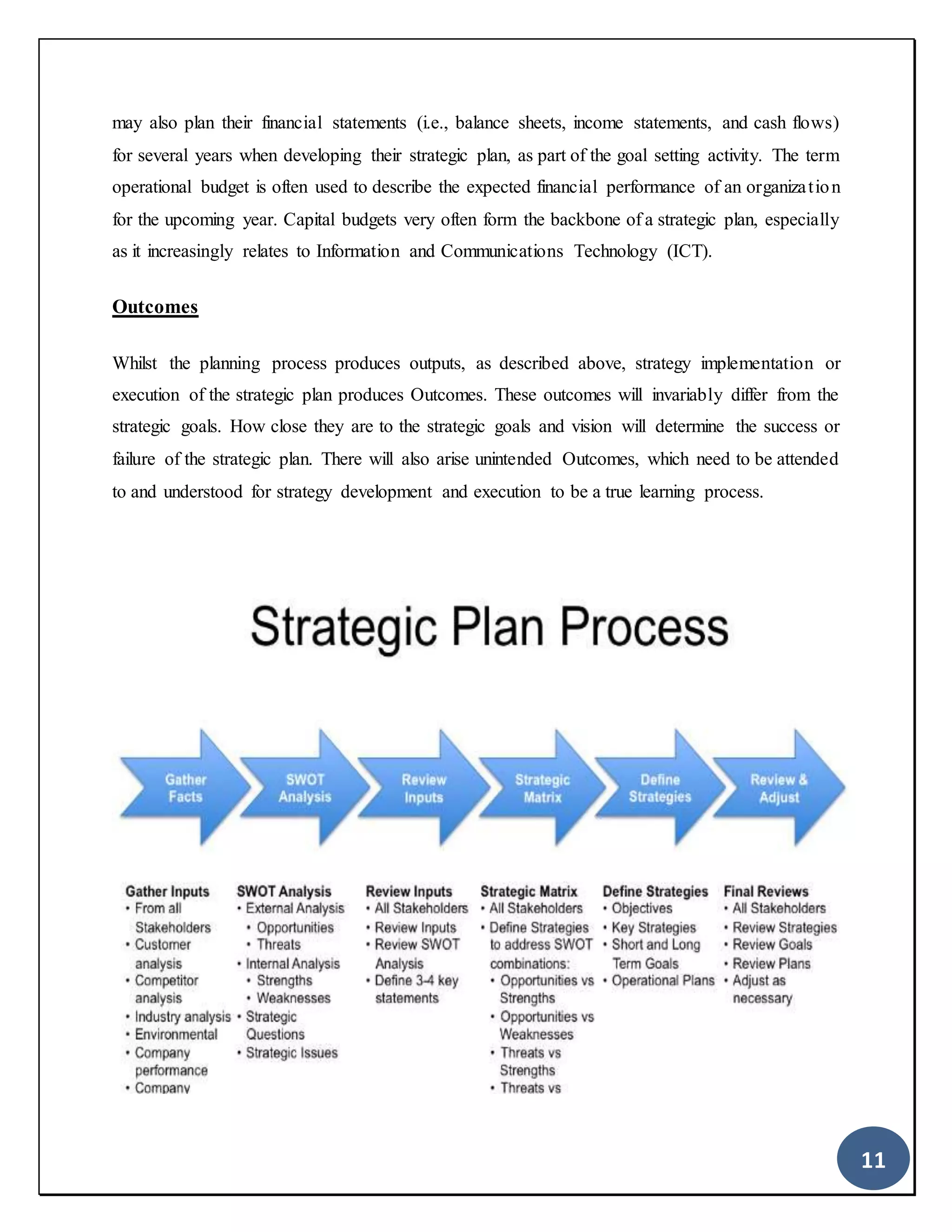
Strategic planning is a process and thus has inputs, activities, outputs and outcomes. This process,
like all processes, has constraints. It may be formal or informal and is typically iterative, with
feedback loops throughout the process. Some elements of the process may be continuous, and
others may be executed as discrete projects with a definitive start and end during a period. Strategic
planning provides inputs for strategic thinking, which guides the actual strategy formation. The
result is the organization's strategy, including a diagnosis of the environment and competitive
situation, a guiding policy on what the organization intends to accomplish, and key initiatives or
action plans for achieving the guiding policy.
Michael Porter wrote in 1980 that formulation of competitive strategy includes consideration of
four key elements:
1. Company strengths and weaknesses
2. Personal values of the key implementers (i.e., management and the board)
3. Industry opportunities and threats
4. Broader societal expectations
The first two elements relate to factors internal to the company (i.e., the internal environment),
while the latter two relate to factors external to the company (i.e., the external environment). These
elements are considered throughout the strategic planning process.
Inputs
Data is gathered from a variety of sources, such as interviews with key executives, review of
publicly available documents on the competition or market, primary research (e.g., visiting or
observing competitor places of business or comparing prices), industry studies, etc. This may be
part of a competitive intelligence program. Inputs are gathered to help support an understanding
of the competitive environment and its opportunities and risks. Other inputs include an
10
understanding of the values of key stakeholders, such as the board, shareholders, and senior
management. These values may be captured in an organization's vision and mission statements.
Activities
Strategic planning activities include meetings and other communication among the organization's
leaders and personnel to develop a common understanding regarding the competitive environment
and what the organization's response to that environment (its strategy) should be. A variety of
strategic planning tools (described in the section below) may be completed as part of strategic
planning activities.
The organization's leaders may have a series of questions they want answered in formulating the
strategy and gathering inputs, such as:
 What is the organization's business or interest?
 What is considered "value" to the customer or constituency?
 Which products and services should be included or excluded from the portfolio of
offerings?
 What is the geographic scope of the organization?
 What differentiates the organization from its competitors in the eyes of customers and other
stakeholders?
 Which skills and resources should be developed within the organization?
Outputs
The output of strategic planning includes documentation and communication describing the
organization's strategy and how it should be implemented, sometimes referred to as the strategic
plan. The strategy may include a diagnosis of the competitive situation, a guiding policy for
achieving the organization's goals, and specific action plans to be implemented. A strategic plan
may cover multiple years and be updated periodically.
The organization may use a variety of methods of measuring and monitoring progress towards the
objectives and measures established, such as a balanced scorecard or strategy map. Companies
11
may also plan their financial statements (i.e., balance sheets, income statements, and cash flows)
for several years when developing their strategic plan, as part of the goal setting activity. The term
operational budget is often used to describe the expected financial performance of an organization
for the upcoming year. Capital budgets very often form the backbone of a strategic plan, especially
as it increasingly relates to Information and Communications Technology (ICT).
Outcomes
Whilst the planning process produces outputs, as described above, strategy implementation or
execution of the strategic plan produces Outcomes. These outcomes will invariably differ from the
strategic goals. How close they are to the strategic goals and vision will determine the success or
failure of the strategic plan. There will also arise unintended Outcomes, which need to be attended
to and understood for strategy development and execution to be a true learning process.

Three Basic Managements Techniques for Analysis and Planning

  • 1.
    Submission Date 23-07-2018 Assignment #5 Submitted To: Mr. Arslan Aslam Submitted By: OmerIqbal Roll No: MSTQM 17-53 Class: MS TQM (Section. B) 2nd Semester Topics: 1. Porter’s FiveAnalysis 2. TWOSAnalysis 3. StrategicPlanning
  • 2.
    1 1. Porter's FiveForces Understanding Competitive Forces to Maximize Profitability Porter's Five Forces is a simple but powerful tool for understanding the competitiveness of your business environment, and for identifying your strategy's potential profitability. This is useful, because, when you understand the forces in your environment or industry that can affect your profitability, you'll be able to adjust your strategy accordingly. For example, you could take fair advantage of a strong position or improve a weak one and avoid taking wrong steps in future. In this article and video, we explore each of Porter's Five Forces. We look at how they can help you to analyze the strengths and weaknesses of your position, and how they can impact your long- term profitability. Understanding Porter's Five Forces The tool was created by Harvard Business School professor Michael Porter, to analyze an industry's attractiveness and likely profitability. Since its publication in 1979, it has become one of the most popular and highly regarded business strategy tools. Porter recognized that organizations likely keep a close watch on their rivals, but he encouraged them to look beyond the actions of their competitors and examine what other factors could impact the business environment. He identified five forces that make up the competitive environment, and which can erode your profitability. These are: 1. Competitive Rivalry This looks at the number and strength of your competitors. How many rivals do you have? Who are they, and how does the quality of their products and services compare with yours?
  • 3.
    2 Where rivalry isintense, companies can attract customers with aggressive price cuts and high- impact marketing campaigns. Also, in markets with lots of rivals, your suppliers and buyers can go elsewhere if they feel that they're not getting a good deal from you. On the other hand, where competitive rivalry is minimal, and no one else is doing what you do, then you'll likely have tremendous strength and healthy profits. 2. Supplier Power This is determined by how easy it is for your suppliers to increase their prices. How many potential suppliers do you have? How unique is the product or service that they provide, and how expensive would it be to switch from one supplier to another? The more you have to choose from, the easier it will be to switch to a cheaper alternative. But the fewer suppliers there are, and the more you need their help, the stronger their position and their ability to charge you more. That can impact your profit. 3. Buyer Power Here, you ask yourself how easy it is for buyers to drive your prices down. How many buyers are there, and how big are their orders? How much would it cost them to switch from your products and services to those of a rival? Are your buyers strong enough to dictate terms to you? When you deal with only a few savvy customers, they have more power, but your power increases if you have many customers. 4. Threat of Substitution This refers to the likelihood of your customers finding a different way of doing what you do. For example, if you supply a unique software product that automates an important process, people may substitute it by doing the process manually or by outsourcing it. A substitution that is easy and cheap to make can weaken your position and threaten your profitability.
  • 4.
    3 5. Threat ofNew Entry Your position can be affected by people's ability to enter your market. So, think about how easily this could be done. How easy is it to get a foothold in your industry or market? How much would it cost, and how tightly is your sector regulated? If it takes little money and effort to enter your market and compete effectively, or if you have little protection for your key technologies, then rivals can quickly enter your market and weaken your position. If you have strong and durable barriers to entry, then you can preserve a favorable position and take fair advantage of it. *Note: According to Porter, these Five Forces are the key sources of competitive pressure within an industry. He stressed that it is important not to confuse them with more fleeting factors that might grab your attention, such as industry growth rates, government interventions, and technological innovations. These are temporary factors, while the Five Forces are permanent parts of an industry's structure.
  • 5.
    4 2. TOWS Analysis Whatis TOWS Analysis? TOWS analysis is a tool which is used to generate, compare and select strategies. Strictly speaking it is not the same as SWOT analysis, and it is certainly not a SWOT analysis which focuses on threats and opportunities. This is a popular misconception. TOWS may have similar roots. TOWS is a tool for strategy generation and selection; SWOT analysis is a tool for audit and analysis. One would use a SWOT at the beginning of the planning process, and a TOWS later as you decide upon ways forward. There is a trade-off between internal and external factors. Strengths and weaknesses are internal factors and opportunities and threats are external factors. This is where our four potential strategies derive their importance. The four TOWS strategies are Strength/Opportunity (SO), Weakness/Opportunity (WO), Strength/Threat (ST) and Weakness/Threat (WT). Strategic Options The TOWS Matrix helps businesses to identify their strategic options. An organisation gets the opportunity to make the most of its strengths and get around its internal weaknesses and learn to deal with them properly. Externally, an organisation learns to carefully look for market opportunities and recognise possibilities. And they learn how to control and overcome potential threats. The TOWS Matrix can also help with brainstorming and developing great ideas to generate effective marketing strategies and tactics. Furthermore, the model goes beyond merely finding out the strengths and weaknesses within an organisation and what opportunities and threats there are in its environment. It forces organisations to really think about how they can improve themselves, how they can guard against threats and become more aware of their expertise and potential shortcomings.
  • 6.
    5 External Environment Threat –Increasing competition from cheaper Polish workers. Opportunity – Strong desire from vocational educators for partnerships with organisations for apprenticeship positions. Internal Environment Weakness – The organisation takes little initiative when it comes to customer acquisition and waits for customers to come to them. Strength – There is a large group of very experienced professionals working within the organisation who have a lot of expertise. The TOWS Matrix is not just meant for the highest levels of management in an organisation. It can be a very useful tool for departments (i.e. a marketing or sales team) or for individual employees on an operational level. Once it’s employee’s or a department’s strengths are known, these can be improved further to become even better. The TOWS Matrix emphasises the external environment. It starts by analysing external opportunities and threats. Up next are the internal strengths and weaknesses, which will subsequently be linked to the external analysis. And this is where it goes a step beyond the traditional SWOTanalysis; strategic tactics emerge by opposing S-O (Strengths- Opportunities), W-O (Weaknesses-Opportunities), S-T (Strengths-Threats) and W-T (Weaknesses-Threats). Four ‘TWOS’ Strategies The above-mentioned factors can be linked to each other, leading to strategies: S-O – How can the organisation employ the expertise of its own professionals to respond to the needs of vocational education centres? By partnering up, the organisation can convince the vocational education centers that there is enough capacity, knowledge and experience to train young people to independent professionals at all levels of vocational education.
  • 7.
    6 S-T – Howcan the organisation use its skilled staff to compete with cheaper workers employed by competitors? A smart approach for the organisation would be to communicate to the outside world that their staff has accredited diplomas and that it’s important for housing co-operatives to comply with legal requirements and safety standards. W-O – How can partnerships with vocational education centres help the organisation to improve itself and put more effort into customer acquisition? By presenting itself as an accredited apprenticeship provider, the organisation will put itself on the market again and its shows that adapt to changing times and wants to offer different kinds of maintenance to businesses and housing co-operatives. W-T – How can the organisation better position itself in the market and thus reduce the threat posed by competitors? By presenting itself as an accredited apprenticeship provider, the organisation can claim that they are a serious competitor and can possibly offer maintenance services by apprentices at reduced rates, with the work still being done by an accredited company. Internal Factors Strengths (S) S1 S2 S3 S4 Weaknesses (W) W1 W2 W3 W4 External Factors Opportunities (O) O1 O2 O3 O4 S-O Strategies (Maxi-Maxi) SO1 SO2 SO3 SO4 W-O Strategies (Maxi-Mini) WO1 WO2 WO3 WO4 Threats (T) T1 T2 T3 T4 S-T Strategies (Mini-Maxi) ST1 ST2 ST3 ST4 W-T Strategies (Mini-Mini) WT1 WT2 WT3 WT4 (TWOS Matrix)
  • 8.
    7 TOWS Analysis –Simple Rules 1. Like many tools, models, concepts and frameworks, TOWS is subjective. It is only as robust as the data which you include within the model. 2. Use other models and frameworks to support your strategic choices, such as Ansoff’s Matrix Porters’ Generic Strategies and others. 3. Strategy will include internal development for growth, merger, acquisitions and joint- ventures. 4. Be as specific as possible and avoid grey areas. 5. Always rely on your gut feeling. If it doesn’t feel right, then maybe it isn’t right. Take another look at simple rule 1 above.
  • 9.
    8 3. Strategic Planning Strategicplanning is a process in which organizational leaders determine their vision for the future as well as identify their goals and objectives for the organization. The process also includes establishing the sequence in which those goals should fall so that the organization is enabled to reach its stated vision. Strategic planning is an organization's process of defining its strategy, or direction, and making decisions on allocating its resources to pursue this strategy. It may also extend to control mechanisms for guiding the implementation of the strategy. Strategic planning became prominent in corporations during the 1960s and remains an important aspect of strategic management. It is executed by strategic planners or strategists, who involve many parties and research sources in their analysis of the organization and its relationship to the environment in which it competes. Strategy has many definitions, but generally involves setting goals, determining actions to achieve the goals, and mobilizing resources to execute the actions. A strategy describes how the ends (goals) will be achieved by the means (resources). The senior leadership of an organization is generally tasked with determining strategy. Strategy can be planned (intended) or can be observed as a pattern of activity (emergent) as the organization adapts to its environment or competes. Strategy includes processes of formulation and implementation; strategic planning helps coordinate both. However, strategic planning is analytical in nature (i.e., it involves "finding the dots"); strategy formation itself involves synthesis (i.e., "connecting the dots") via strategic thinking. As such, strategic planning occurs around the strategy formation activity. Strategic Planning Process Organizations generally look three to five years ahead when engaged in strategic planning. The strategic planning process results in a strategic plan, a document that articulates both the decisions made about the organization's goals and the ways in which the organization will achieve those
  • 10.
    9 goals. The strategicplan is intended to guide the organization's leaders in their decision-making moving forward. Overview Strategic planning is a process and thus has inputs, activities, outputs and outcomes. This process, like all processes, has constraints. It may be formal or informal and is typically iterative, with feedback loops throughout the process. Some elements of the process may be continuous, and others may be executed as discrete projects with a definitive start and end during a period. Strategic planning provides inputs for strategic thinking, which guides the actual strategy formation. The result is the organization's strategy, including a diagnosis of the environment and competitive situation, a guiding policy on what the organization intends to accomplish, and key initiatives or action plans for achieving the guiding policy. Michael Porter wrote in 1980 that formulation of competitive strategy includes consideration of four key elements: 1. Company strengths and weaknesses 2. Personal values of the key implementers (i.e., management and the board) 3. Industry opportunities and threats 4. Broader societal expectations The first two elements relate to factors internal to the company (i.e., the internal environment), while the latter two relate to factors external to the company (i.e., the external environment). These elements are considered throughout the strategic planning process. Inputs Data is gathered from a variety of sources, such as interviews with key executives, review of publicly available documents on the competition or market, primary research (e.g., visiting or observing competitor places of business or comparing prices), industry studies, etc. This may be part of a competitive intelligence program. Inputs are gathered to help support an understanding of the competitive environment and its opportunities and risks. Other inputs include an
  • 11.
    10 understanding of thevalues of key stakeholders, such as the board, shareholders, and senior management. These values may be captured in an organization's vision and mission statements. Activities Strategic planning activities include meetings and other communication among the organization's leaders and personnel to develop a common understanding regarding the competitive environment and what the organization's response to that environment (its strategy) should be. A variety of strategic planning tools (described in the section below) may be completed as part of strategic planning activities. The organization's leaders may have a series of questions they want answered in formulating the strategy and gathering inputs, such as:  What is the organization's business or interest?  What is considered "value" to the customer or constituency?  Which products and services should be included or excluded from the portfolio of offerings?  What is the geographic scope of the organization?  What differentiates the organization from its competitors in the eyes of customers and other stakeholders?  Which skills and resources should be developed within the organization? Outputs The output of strategic planning includes documentation and communication describing the organization's strategy and how it should be implemented, sometimes referred to as the strategic plan. The strategy may include a diagnosis of the competitive situation, a guiding policy for achieving the organization's goals, and specific action plans to be implemented. A strategic plan may cover multiple years and be updated periodically. The organization may use a variety of methods of measuring and monitoring progress towards the objectives and measures established, such as a balanced scorecard or strategy map. Companies
  • 12.
    11 may also plantheir financial statements (i.e., balance sheets, income statements, and cash flows) for several years when developing their strategic plan, as part of the goal setting activity. The term operational budget is often used to describe the expected financial performance of an organization for the upcoming year. Capital budgets very often form the backbone of a strategic plan, especially as it increasingly relates to Information and Communications Technology (ICT). Outcomes Whilst the planning process produces outputs, as described above, strategy implementation or execution of the strategic plan produces Outcomes. These outcomes will invariably differ from the strategic goals. How close they are to the strategic goals and vision will determine the success or failure of the strategic plan. There will also arise unintended Outcomes, which need to be attended to and understood for strategy development and execution to be a true learning process.