Unit I
Introduction to Strategic
Management
What is a Strategy?
 Strategy means a plan of action designed to achieve a specific
goal or outcome.
 It is about deciding what to do, how to do it, and how to
effectively and efficiently use the available resources to succeed.
 Strategy is used in war, politics, business, sports, e.t.c.
Business Strategy
 Business strategy is a clear plan or approach that an organization adopts to
achieve its long-term goals and objectives.
 It involves setting clear objectives, analyzing the internal and external
environment, and allocating resources to maximize the organization's
competitive advantage.
 It helps the company to decide what to do, how to do it, and how to use its
resources in the best way to grow, compete, satisfy customers and succeed.
 Example: Cost leadership, Differentiation, Diversification, etc.
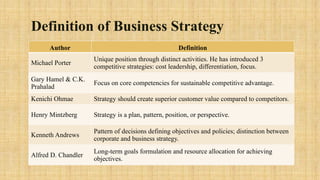
Definition of Business Strategy
Author Definition
Michael Porter
Unique position through distinct activities. He has introduced 3
competitive strategies: cost leadership, differentiation, focus.
Gary Hamel & C.K.
Prahalad
Focus on core competencies for sustainable competitive advantage.
Kenichi Ohmae Strategy should create superior customer value compared to competitors.
Henry Mintzberg Strategy is a plan, pattern, position, or perspective.
Kenneth Andrews
Pattern of decisions defining objectives and policies; distinction between
corporate and business strategy.
Alfred D. Chandler
Long-term goals formulation and resource allocation for achieving
objectives.
Strategic Management:
 Strategic management is the process of setting goals, analyzing the
environment (both internal and external), developing strategies,
implementing them, and monitoring their progress to achieve the long-
term objectives of an organization.
 It involves the development of a strategic plan that outlines the
organization's mission, vision, values, and objectives, and the
formulation and implementation of strategies to achieve those objectives.
Nature of Strategic Management
1. Goal-Oriented: Focuses on achieving long-term objectives.
2. Dynamic Process: Adapts to changes in the environment, such as market
trends or competitor moves.
3. Comprehensive: Involves all areas of the organization, including
marketing, operations, and finance.
4. Forward-Looking: Helps an organization plan for the future rather than
just reacting to the present.
5. Integrative: Ensures all departments work together towards common goals.
6. Continuous Process: Requires ongoing evaluation and adjustment of
strategies
Value/Benefits of Strategic Management
1. Provides Clear Direction: Strategic management helps organizations define where
they want to go and how to get there.
2. Better Decision-Making: Encourages informed decisions by analyzing all aspects of
the business environment.
3. Competitive Advantage: Identifies unique strengths that make the organization
stand out in the market.
4. Enhances Adaptability: Prepares organizations to respond effectively to changes in
the environment.
5. Resource Optimization: Ensures efficient use of resources like time, money, and
manpower.
6. Sustainability: Supports long-term growth by balancing current actions with future
opportunities.
Key Terms in Strategic Management
1. Business Environment
 All external and internal factors that affect a business, such as market trends,
customer preferences, or company culture.
2. SWOT Analysis
 Strengths (internal advantages)
 Weaknesses (internal limitations)
 Opportunities (external potential for growth and success)
 Threats (external challenges)
Strengths (S)
Highly qualified and
experienced faculty
and diverse range
of programs
Weaknesses (W)
Limited funding for
research and
development and
outdated curriculum
Opportunities (O)
Rising demand for
online and hybrid
learning programs
and collaboration
opportunities with
international
universities for
exchange programs
Threats (T)
Competition from
other universities
and economic crisis
leading to reduced
enrollment
An university’s SWOT Analysis:
3. Competitive Advantage
 What makes a business stand out from it’s competitors.
 Can be achieved through cost leadership, differentiation and focus.
 Example: A restaurant using only organic ingredients from it’s own farm
can attract health-conscious customers.
4. Vision Statement
 A big-picture idea of what the organization wants to achieve in the future.
 Example: Tesla’s vision is “To create the most compelling car company
of the 21st century by driving the world’s transition to electric vehicles.”
5. Mission Statement
 Describes the organization's purpose.
 Example: “To accelerate the world’s transition to sustainable energy.”
 6. Goals and Objectives
 Goals: Broad targets that the organization wants to achieve.
 Objectives: Specific, measurable steps to reach those goals.
7. Strategic Planning
 The process of deciding what to achieve.
 Example: A clothing store plans to reach more customers and increase
sales.
8. Strategy Formulation
 Developing a strategy to achieve goals.
 Example: To reach more customers it should go online.
9. Strategy Implementation
 Putting the formulated strategy into action.
 Example: Creating a social media page, hiring content creators,
purchasing best quality camera, doing photoshoots and making engaging
videos and posting it online.
10. Monitoring and Evaluation
 Tracking progress and making adjustments to strategies as needed.
 Example: If sales don’t improve, the company can run social media ads.
Risk of Strategic Management
1. Time-Consuming: Developing and implementing strategies takes time
which might delay action.
2. Costly Process: Involves expenses for brainstorming, research and training,
which can strain budgets.
3. Uncertainty: External factors like political, economic or market changes
can disrupt implementation of strategy.
4. Resistance to Change: Employees or stakeholders may resist new
strategies, slowing progress.
5. Overconfidence in Strategy: Relying too much on strategy without
flexibility can backfire.
Formality in Strategic Management
 Formality in strategic management refers to the level of structure and
procedures that an organization has to follow when planning, formulating,
implementing, and evaluating its strategies.
 Formality in strategic management shows how systematic and organized the
strategic management process is within the organization.
Key Aspects of Formality in Strategic Management
1. Structured Planning:
 Formal strategic management involves clear, detailed plans with specific goals,
timelines, and actions.
2. Defined Processes:
 The organization follows set procedures for analyzing information, making
decisions, and evaluating results.
 These processes may include regular meetings, reviews, and updates.
3. Top-Down Approach:
 In formal strategic management, decisions are often made by top executives or
management teams and then communicated to the lower levels of the
organization.
4. Use of Tools and Frameworks:
 Formal strategies are often developed using analytical tools like SWOT
analysis, PESTEL analysis, or Porter’s Five Forces.
5. Documentation and Reporting:
 Formal strategic management process involves making and maintaining
important documents and reporting it for monitoring and control.
Strategic Management Model
 A strategic management model is a framework or approach used by
organizations to make strategic decisions.
 It helps in aligning the organization's resources, capabilities, and actions
with its long-term objectives.
 It helps to manage the challenges of the business environment and to ensure
that the organization can adapt to changes and grab opportunities.
 Some popular strategic management models include SWOT analysis,
Porter's Five Forces, and the Balanced Scorecard. The choice of model will
depend on the organization's specific needs and goals.
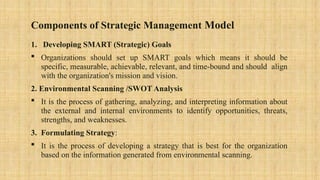
Components of Strategic Management Model
1. Developing SMART (Strategic) Goals
 Organizations should set up SMART goals which means it should be
specific, measurable, achievable, relevant, and time-bound and should align
with the organization's mission and vision.
2. Environmental Scanning /SWOT Analysis
 It is the process of gathering, analyzing, and interpreting information about
the external and internal environments to identify opportunities, threats,
strengths, and weaknesses.
3. Formulating Strategy:
 It is the process of developing a strategy that is best for the organization
based on the information generated from environmental scanning.
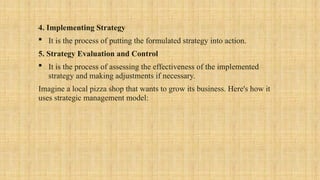
4. Implementing Strategy
 It is the process of putting the formulated strategy into action.
5. Strategy Evaluation and Control
 It is the process of assessing the effectiveness of the implemented
strategy and making adjustments if necessary.
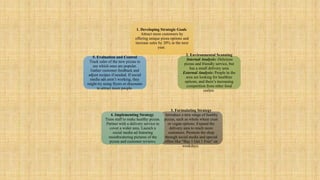
Imagine a local pizza shop that wants to grow its business. Here's how it
uses strategic management model:
1. Developing Strategic Goals
Attract more customers by
offering unique pizza options and
increase sales by 20% in the next
year.
2. Environmental Scanning
Internal Analysis: Delicious
pizzas and friendly service, but
has a small delivery area
External Analysis: People in the
area are looking for healthier
options, and there’s increasing
competition from other food
outlets
3. Formulating Strategy
Introduce a new range of healthy
pizzas, such as whole wheat crust
or vegan options. Expand the
delivery area to reach more
customers. Promote the shop
through social media and special
offers like “Buy 1 Get 1 Free” on
weekdays.
4. Implementing Strategy
Train staff to make healthy pizzas.
Partner with a delivery service to
cover a wider area. Launch a
social media ad featuring
mouthwatering pictures of the
pizzas and customer reviews.
5. Evaluation and Control
Track sales of the new pizzas to
see which ones are popular.
Gather customer feedback and
adjust recipes if needed. If social
media ads aren’t working, they
might try using flyers or discounts
to attract more people.
4. Implementing Strategy

Strategic Enterprise Management - Unit I.pptx

  • 1.
    Unit I Introduction toStrategic Management
  • 2.
    What is aStrategy?  Strategy means a plan of action designed to achieve a specific goal or outcome.  It is about deciding what to do, how to do it, and how to effectively and efficiently use the available resources to succeed.  Strategy is used in war, politics, business, sports, e.t.c.
  • 3.
    Business Strategy  Businessstrategy is a clear plan or approach that an organization adopts to achieve its long-term goals and objectives.  It involves setting clear objectives, analyzing the internal and external environment, and allocating resources to maximize the organization's competitive advantage.  It helps the company to decide what to do, how to do it, and how to use its resources in the best way to grow, compete, satisfy customers and succeed.  Example: Cost leadership, Differentiation, Diversification, etc.
  • 4.
    Definition of BusinessStrategy Author Definition Michael Porter Unique position through distinct activities. He has introduced 3 competitive strategies: cost leadership, differentiation, focus. Gary Hamel & C.K. Prahalad Focus on core competencies for sustainable competitive advantage. Kenichi Ohmae Strategy should create superior customer value compared to competitors. Henry Mintzberg Strategy is a plan, pattern, position, or perspective. Kenneth Andrews Pattern of decisions defining objectives and policies; distinction between corporate and business strategy. Alfred D. Chandler Long-term goals formulation and resource allocation for achieving objectives.
  • 5.
    Strategic Management:  Strategicmanagement is the process of setting goals, analyzing the environment (both internal and external), developing strategies, implementing them, and monitoring their progress to achieve the long- term objectives of an organization.  It involves the development of a strategic plan that outlines the organization's mission, vision, values, and objectives, and the formulation and implementation of strategies to achieve those objectives.
  • 6.
    Nature of StrategicManagement 1. Goal-Oriented: Focuses on achieving long-term objectives. 2. Dynamic Process: Adapts to changes in the environment, such as market trends or competitor moves. 3. Comprehensive: Involves all areas of the organization, including marketing, operations, and finance. 4. Forward-Looking: Helps an organization plan for the future rather than just reacting to the present. 5. Integrative: Ensures all departments work together towards common goals. 6. Continuous Process: Requires ongoing evaluation and adjustment of strategies
  • 7.
    Value/Benefits of StrategicManagement 1. Provides Clear Direction: Strategic management helps organizations define where they want to go and how to get there. 2. Better Decision-Making: Encourages informed decisions by analyzing all aspects of the business environment. 3. Competitive Advantage: Identifies unique strengths that make the organization stand out in the market. 4. Enhances Adaptability: Prepares organizations to respond effectively to changes in the environment. 5. Resource Optimization: Ensures efficient use of resources like time, money, and manpower. 6. Sustainability: Supports long-term growth by balancing current actions with future opportunities.
  • 8.
    Key Terms inStrategic Management 1. Business Environment  All external and internal factors that affect a business, such as market trends, customer preferences, or company culture. 2. SWOT Analysis  Strengths (internal advantages)  Weaknesses (internal limitations)  Opportunities (external potential for growth and success)  Threats (external challenges)
  • 9.
    Strengths (S) Highly qualifiedand experienced faculty and diverse range of programs Weaknesses (W) Limited funding for research and development and outdated curriculum Opportunities (O) Rising demand for online and hybrid learning programs and collaboration opportunities with international universities for exchange programs Threats (T) Competition from other universities and economic crisis leading to reduced enrollment An university’s SWOT Analysis:
  • 10.
    3. Competitive Advantage What makes a business stand out from it’s competitors.  Can be achieved through cost leadership, differentiation and focus.  Example: A restaurant using only organic ingredients from it’s own farm can attract health-conscious customers. 4. Vision Statement  A big-picture idea of what the organization wants to achieve in the future.  Example: Tesla’s vision is “To create the most compelling car company of the 21st century by driving the world’s transition to electric vehicles.” 5. Mission Statement  Describes the organization's purpose.
  • 11.
     Example: “Toaccelerate the world’s transition to sustainable energy.”  6. Goals and Objectives  Goals: Broad targets that the organization wants to achieve.  Objectives: Specific, measurable steps to reach those goals. 7. Strategic Planning  The process of deciding what to achieve.  Example: A clothing store plans to reach more customers and increase sales.
  • 12.
    8. Strategy Formulation Developing a strategy to achieve goals.  Example: To reach more customers it should go online. 9. Strategy Implementation  Putting the formulated strategy into action.  Example: Creating a social media page, hiring content creators, purchasing best quality camera, doing photoshoots and making engaging videos and posting it online. 10. Monitoring and Evaluation  Tracking progress and making adjustments to strategies as needed.  Example: If sales don’t improve, the company can run social media ads.
  • 13.
    Risk of StrategicManagement 1. Time-Consuming: Developing and implementing strategies takes time which might delay action. 2. Costly Process: Involves expenses for brainstorming, research and training, which can strain budgets. 3. Uncertainty: External factors like political, economic or market changes can disrupt implementation of strategy. 4. Resistance to Change: Employees or stakeholders may resist new strategies, slowing progress. 5. Overconfidence in Strategy: Relying too much on strategy without flexibility can backfire.
  • 14.
    Formality in StrategicManagement  Formality in strategic management refers to the level of structure and procedures that an organization has to follow when planning, formulating, implementing, and evaluating its strategies.  Formality in strategic management shows how systematic and organized the strategic management process is within the organization.
  • 15.
    Key Aspects ofFormality in Strategic Management 1. Structured Planning:  Formal strategic management involves clear, detailed plans with specific goals, timelines, and actions. 2. Defined Processes:  The organization follows set procedures for analyzing information, making decisions, and evaluating results.  These processes may include regular meetings, reviews, and updates. 3. Top-Down Approach:  In formal strategic management, decisions are often made by top executives or management teams and then communicated to the lower levels of the organization.
  • 16.
    4. Use ofTools and Frameworks:  Formal strategies are often developed using analytical tools like SWOT analysis, PESTEL analysis, or Porter’s Five Forces. 5. Documentation and Reporting:  Formal strategic management process involves making and maintaining important documents and reporting it for monitoring and control.
  • 17.
    Strategic Management Model A strategic management model is a framework or approach used by organizations to make strategic decisions.  It helps in aligning the organization's resources, capabilities, and actions with its long-term objectives.  It helps to manage the challenges of the business environment and to ensure that the organization can adapt to changes and grab opportunities.  Some popular strategic management models include SWOT analysis, Porter's Five Forces, and the Balanced Scorecard. The choice of model will depend on the organization's specific needs and goals.
  • 18.
    Components of StrategicManagement Model 1. Developing SMART (Strategic) Goals  Organizations should set up SMART goals which means it should be specific, measurable, achievable, relevant, and time-bound and should align with the organization's mission and vision. 2. Environmental Scanning /SWOT Analysis  It is the process of gathering, analyzing, and interpreting information about the external and internal environments to identify opportunities, threats, strengths, and weaknesses. 3. Formulating Strategy:  It is the process of developing a strategy that is best for the organization based on the information generated from environmental scanning.
  • 19.
    4. Implementing Strategy It is the process of putting the formulated strategy into action. 5. Strategy Evaluation and Control  It is the process of assessing the effectiveness of the implemented strategy and making adjustments if necessary. Imagine a local pizza shop that wants to grow its business. Here's how it uses strategic management model:
  • 20.
    1. Developing StrategicGoals Attract more customers by offering unique pizza options and increase sales by 20% in the next year. 2. Environmental Scanning Internal Analysis: Delicious pizzas and friendly service, but has a small delivery area External Analysis: People in the area are looking for healthier options, and there’s increasing competition from other food outlets 3. Formulating Strategy Introduce a new range of healthy pizzas, such as whole wheat crust or vegan options. Expand the delivery area to reach more customers. Promote the shop through social media and special offers like “Buy 1 Get 1 Free” on weekdays. 4. Implementing Strategy Train staff to make healthy pizzas. Partner with a delivery service to cover a wider area. Launch a social media ad featuring mouthwatering pictures of the pizzas and customer reviews. 5. Evaluation and Control Track sales of the new pizzas to see which ones are popular. Gather customer feedback and adjust recipes if needed. If social media ads aren’t working, they might try using flyers or discounts to attract more people.
  • 21.