Strategic Management
Basic Questions
• Why do some organizations succeed while
others fail?
• What is the measure of success?
• How to achieve it?
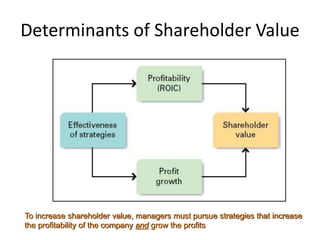
Determinants of Shareholder Value
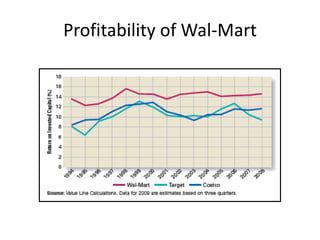
To increase shareholder value, managers must pursue strategies that increase
the profitability of the company and grow the profits
Profitability of Wal-Mart
Three key words
• Superior Performance
“Maximizing shareholder value is the ultimate goal
of profit making companies…”
• Competitive Advantage
“…results when a company’s strategies lead to
superior performance compared to competitors
• Sustained Competitive Advantage
“A company’s… strategies enable it to maintain
above average profitability for a number of years.”
Why some organizations succeed?
• A strategy: is a course of action that managers
take in the effort to attain superior performance.
• Superior performance is equated with
profitability, for profit-seeking enterprises.
• Sustained competitive advantage occurs when a
firm is able to maintain above average
profitability over an extended period of time
• Strategic leadership is about how to most
effectively manage a company’s strategy-making
process to create competitive advantage.
Company’s Business Model
Managers' conception of how the set of strategies their
company pursues should mesh together into a
congruent whole, enabling the company to gain a
competitive advantage and achieve superior
profitability and profit growth.
Encompasses how the company will:
• Select customers
• Define/differentiate product
offerings
• Create value for customers
• Acquire/keep customers
• Produce goods/services
• Lower costs
• Deliver goods/services to market
• Organize activities within
company
• Configure its resources
• Achieve/sustain a high
profitability
• Grow business over time
Strategic Managers
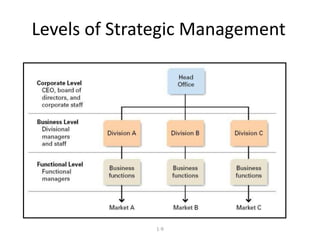
• Corporate-Level Managers
– Oversee development of strategies for whole organization
– CEO is principle general manager who consults with other
senior executives
• Business-Level Managers
– Responsible for business unit that provides product/service to
particular market
• Functional-Managers
– Supervise particular function/operation (e.g. marketing,
operations, accounting, human resources)
1-9
Levels of Strategic Management
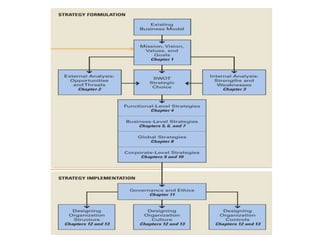
Strategy-making process
Strategy-making is the process by which managers select and then
implement a set of strategies for a company, the aim of which is to
attain competitive advantage.
The process consists of two phases
• The first phase, formulation, includes the
– establishment of corporate mission, values, and goals; analysis of the
external environment;
– analysis of the internal environment; and
– selection of an appropriate functional-, business-, global, or corporate-
level strategy.
• The second phase, implementation, consists of the actions taken to
carry out the chosen strategy such as appropriate governance and
ethics, designing an organizational structure, designing an
organization culture, and designing organization controls.
Strategy-making process
Strategy-making is the process by which
managers select and then implement a set of
strategies for a company, the aim of which is to
attain competitive advantage.
The process consists of two phases
• Formulation
• Implementation
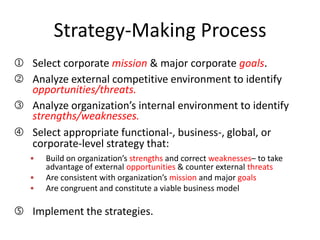
Strategy-Making Process
 Select corporate mission & major corporate goals.
 Analyze external competitive environment to identify
opportunities/threats.
 Analyze organization’s internal environment to identify
strengths/weaknesses.
 Select appropriate functional-, business-, global, or
corporate-level strategy that:
• Build on organization’s strengths and correct weaknesses– to take
advantage of external opportunities & counter external threats
• Are consistent with organization’s mission and major goals
• Are congruent and constitute a viable business model
 Implement the strategies.
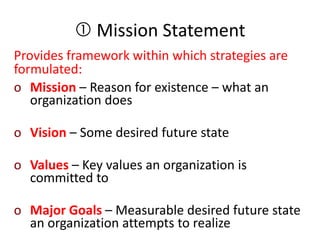
 Mission Statement
Provides framework within which strategies are
formulated:
o Mission – Reason for existence – what an
organization does
o Vision – Some desired future state
o Values – Key values an organization is
committed to
o Major Goals – Measurable desired future state
an organization attempts to realize
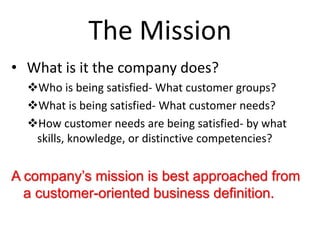
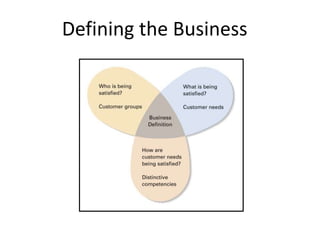
The Mission
• What is it the company does?
Who is being satisfied- What customer groups?
What is being satisfied- What customer needs?
How customer needs are being satisfied- by what
skills, knowledge, or distinctive competencies?
A company’s mission is best approached from
a customer-oriented business definition.
Defining the Business
Mission of Microsoft
• Our mission is to enable people and
businesses throughout the world to realize
their full potential by creating technology that
transforms the way people work, play, and
communicate.
– Extracted from the Microsoft’s Annual Report
2013, p. 9
The Vision
What would company like to achieve?
• A good vision is meant to stretch a company by
articulating an ambitious but attainable future state.
Values
o How managers and employees should conduct
themselves
o How they should do business
o What kind of organization they need to build to help
achieve company’s mission
o Organizational culture
• Set of values, norms, and standards that control
how employees work to achieve organization’s
mission and goals
• Often seen as an important source of competitive
advantage
In high-performance
organizations, values
respect the interests of
key stakeholders.
Major Goals
Goal - precise/measurable desired future
state a company attempts to realize.
Well-constructed goals:
1. Precise and measurable– provide yardstick or
standard to judge performance
2. Address crucial issues– a limited number of key goals
helps maintain focus
3. Challenging but realistic– provide employees with
incentive for improving
4. Specify time period– motivates/injects sense of
urgency into goal attainment
 External Analysis
Identifies strategic opportunities & threats in
organization’s operating environment that will
affect how it pursues its mission.
Requires assessment of:
• Industry environment
– Competitive structure of industry
– Competitive position of the company
– Competitiveness and position of major rivals
• Country/national environments in which company competes
• Wider socioeconomic/ macro environment that may affect company
and its industry
• Social Legal Technological
• Governmental International
 Internal Analysis
Strengths= superior performance
Weaknesses= inferior performance.
Requires assessment of:
• Company’s resources & capabilities
• Company-specific competencies
• SWOT analyses identifies strategies that
align company resources/capabilities to
environment to create/sustain competitive
advantage.
• Functional strategies should be consistent with &
support company business level/global strategies.
o Functional-level strategy – directed at operational
effectiveness
o Business-level strategy – overall competitive theme
o Global strategy – expand/grow/prosper at global level
o Corporate-level strategy – maximize profitability & profit
growth
 SWOT Analysis and Business Model
 Strategy Implementation
Managers put strategies into action:
–Implementation/execution of strategic plans
–Design best organization structure, culture,
control systems
–Governance system for legal/ethical
compliance
–Consistency with maximizing profit & profit
growth
⑥The Feedback Loop
Strategic planning is ongoing
• Monitor strategy execution:
– Determine strategic goals/objectives being
achieved
– Evaluate competitive advantage is being created &
sustained
• Monitor/reevaluate for the next round of
strategy formulation/implementation
Criticisms of Formal Planning
Model
• Unpredictability of real world
• Role lower-level managers can play
• Many strategies result of serendipity
(chance or luck)
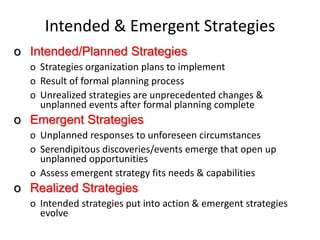
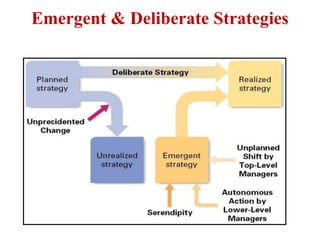
Intended & Emergent Strategies
o Intended/Planned Strategies
o Strategies organization plans to implement
o Result of formal planning process
o Unrealized strategies are unprecedented changes &
unplanned events after formal planning complete
o Emergent Strategies
o Unplanned responses to unforeseen circumstances
o Serendipitous discoveries/events emerge that open up
unplanned opportunities
o Assess emergent strategy fits needs & capabilities
o Realized Strategies
o Intended strategies put into action & emergent strategies
evolve
Emergent & Deliberate Strategies
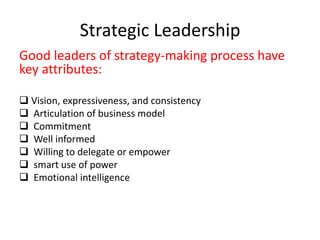
Strategic Leadership
Good leaders of strategy-making process have
key attributes:
 Vision, expressiveness, and consistency
 Articulation of business model
 Commitment
 Well informed
 Willing to delegate or empower
 smart use of power
 Emotional intelligence
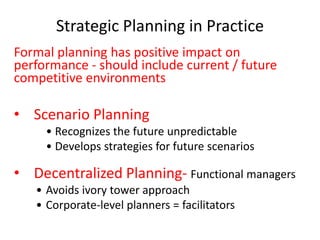
Strategic Planning in Practice
Formal planning has positive impact on
performance - should include current / future
competitive environments
• Scenario Planning
• Recognizes the future unpredictable
• Develops strategies for future scenarios
• Decentralized Planning- Functional managers
• Avoids ivory tower approach
• Corporate-level planners = facilitators
Strategic Decision Making
Companies may adopt poor strategies if errors
intrude into decision-making process.
• Availability error: an error arising from the tendency to
estimate the probability of an outcome based on how
easy the outcome is to imagine.
• Cognitive biases: errors in the way human decision
makers process information and reach decisions. (Rules
of thumb result in errors)
• Escalating commitment: an error in which decision
makers, having already committed significant resources
to a project, commit even more resources even if they
receive feedback that the project is failing.
Decision-making error
• Groupthink: Decision makers embark on course of
action without questioning underlying assumptions
• Illusion of control: characterized by the tendency to
overestimate one’s ability to control events
• Prior hypothesis bias: an error in which decision makers
rely on strong prior beliefs about the relationship between
two variables even when presented with evidence that
their beliefs are wrong
• Reasoning by analogy: an error in which simple
analogies are used to try to make sense of complex
problems
• Representativeness: an error in which decision makers
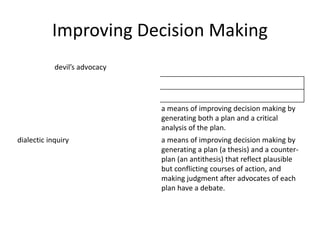
Improving Decision Making
a means of improving decision making by
generating both a plan and a critical
analysis of the plan.
dialectic inquiry a means of improving decision making by
generating a plan (a thesis) and a counter-
plan (an antithesis) that reflect plausible
but conflicting courses of action, and
making judgment after advocates of each
plan have a debate.
devil’s advocacy
Techniques for Improving Decision Making
• Devil’s advocacy
– generate both a plan and a critical analysis of the plan.
• Dialectic inquiry
– Generate a plan (a thesis) and a counter-plan (an antithesis)
that reflect plausible but conflicting courses of action
– Debate (Synthesis), and
– Make judgment after advocates of each plan have a debate.
“The essence of strategy lies in creating
tomorrow’s competitive advantage
faster than competitors mimic the ones
you possess today.”
- Gary Hamel & C. K. Prahalad

1.introduction

  • 1.
  • 2.
    Basic Questions • Whydo some organizations succeed while others fail? • What is the measure of success? • How to achieve it?
  • 3.
    Determinants of ShareholderValue To increase shareholder value, managers must pursue strategies that increase the profitability of the company and grow the profits
  • 4.
  • 5.
    Three key words •Superior Performance “Maximizing shareholder value is the ultimate goal of profit making companies…” • Competitive Advantage “…results when a company’s strategies lead to superior performance compared to competitors • Sustained Competitive Advantage “A company’s… strategies enable it to maintain above average profitability for a number of years.”
  • 6.
    Why some organizationssucceed? • A strategy: is a course of action that managers take in the effort to attain superior performance. • Superior performance is equated with profitability, for profit-seeking enterprises. • Sustained competitive advantage occurs when a firm is able to maintain above average profitability over an extended period of time • Strategic leadership is about how to most effectively manage a company’s strategy-making process to create competitive advantage.
  • 7.
    Company’s Business Model Managers'conception of how the set of strategies their company pursues should mesh together into a congruent whole, enabling the company to gain a competitive advantage and achieve superior profitability and profit growth. Encompasses how the company will: • Select customers • Define/differentiate product offerings • Create value for customers • Acquire/keep customers • Produce goods/services • Lower costs • Deliver goods/services to market • Organize activities within company • Configure its resources • Achieve/sustain a high profitability • Grow business over time
  • 8.
    Strategic Managers • Corporate-LevelManagers – Oversee development of strategies for whole organization – CEO is principle general manager who consults with other senior executives • Business-Level Managers – Responsible for business unit that provides product/service to particular market • Functional-Managers – Supervise particular function/operation (e.g. marketing, operations, accounting, human resources)
  • 9.
  • 10.
    Strategy-making process Strategy-making isthe process by which managers select and then implement a set of strategies for a company, the aim of which is to attain competitive advantage. The process consists of two phases • The first phase, formulation, includes the – establishment of corporate mission, values, and goals; analysis of the external environment; – analysis of the internal environment; and – selection of an appropriate functional-, business-, global, or corporate- level strategy. • The second phase, implementation, consists of the actions taken to carry out the chosen strategy such as appropriate governance and ethics, designing an organizational structure, designing an organization culture, and designing organization controls.
  • 11.
    Strategy-making process Strategy-making isthe process by which managers select and then implement a set of strategies for a company, the aim of which is to attain competitive advantage. The process consists of two phases • Formulation • Implementation
  • 12.
    Strategy-Making Process  Selectcorporate mission & major corporate goals.  Analyze external competitive environment to identify opportunities/threats.  Analyze organization’s internal environment to identify strengths/weaknesses.  Select appropriate functional-, business-, global, or corporate-level strategy that: • Build on organization’s strengths and correct weaknesses– to take advantage of external opportunities & counter external threats • Are consistent with organization’s mission and major goals • Are congruent and constitute a viable business model  Implement the strategies.
  • 14.
     Mission Statement Providesframework within which strategies are formulated: o Mission – Reason for existence – what an organization does o Vision – Some desired future state o Values – Key values an organization is committed to o Major Goals – Measurable desired future state an organization attempts to realize
  • 15.
    The Mission • Whatis it the company does? Who is being satisfied- What customer groups? What is being satisfied- What customer needs? How customer needs are being satisfied- by what skills, knowledge, or distinctive competencies? A company’s mission is best approached from a customer-oriented business definition.
  • 16.
  • 17.
    Mission of Microsoft •Our mission is to enable people and businesses throughout the world to realize their full potential by creating technology that transforms the way people work, play, and communicate. – Extracted from the Microsoft’s Annual Report 2013, p. 9
  • 18.
    The Vision What wouldcompany like to achieve? • A good vision is meant to stretch a company by articulating an ambitious but attainable future state.
  • 19.
    Values o How managersand employees should conduct themselves o How they should do business o What kind of organization they need to build to help achieve company’s mission o Organizational culture • Set of values, norms, and standards that control how employees work to achieve organization’s mission and goals • Often seen as an important source of competitive advantage
  • 20.
    In high-performance organizations, values respectthe interests of key stakeholders.
  • 21.
    Major Goals Goal -precise/measurable desired future state a company attempts to realize. Well-constructed goals: 1. Precise and measurable– provide yardstick or standard to judge performance 2. Address crucial issues– a limited number of key goals helps maintain focus 3. Challenging but realistic– provide employees with incentive for improving 4. Specify time period– motivates/injects sense of urgency into goal attainment
  • 22.
     External Analysis Identifiesstrategic opportunities & threats in organization’s operating environment that will affect how it pursues its mission. Requires assessment of: • Industry environment – Competitive structure of industry – Competitive position of the company – Competitiveness and position of major rivals • Country/national environments in which company competes • Wider socioeconomic/ macro environment that may affect company and its industry • Social Legal Technological • Governmental International
  • 23.
     Internal Analysis Strengths=superior performance Weaknesses= inferior performance. Requires assessment of: • Company’s resources & capabilities • Company-specific competencies
  • 24.
    • SWOT analysesidentifies strategies that align company resources/capabilities to environment to create/sustain competitive advantage. • Functional strategies should be consistent with & support company business level/global strategies. o Functional-level strategy – directed at operational effectiveness o Business-level strategy – overall competitive theme o Global strategy – expand/grow/prosper at global level o Corporate-level strategy – maximize profitability & profit growth  SWOT Analysis and Business Model
  • 25.
     Strategy Implementation Managersput strategies into action: –Implementation/execution of strategic plans –Design best organization structure, culture, control systems –Governance system for legal/ethical compliance –Consistency with maximizing profit & profit growth
  • 26.
    ⑥The Feedback Loop Strategicplanning is ongoing • Monitor strategy execution: – Determine strategic goals/objectives being achieved – Evaluate competitive advantage is being created & sustained • Monitor/reevaluate for the next round of strategy formulation/implementation
  • 27.
    Criticisms of FormalPlanning Model • Unpredictability of real world • Role lower-level managers can play • Many strategies result of serendipity (chance or luck)
  • 28.
    Intended & EmergentStrategies o Intended/Planned Strategies o Strategies organization plans to implement o Result of formal planning process o Unrealized strategies are unprecedented changes & unplanned events after formal planning complete o Emergent Strategies o Unplanned responses to unforeseen circumstances o Serendipitous discoveries/events emerge that open up unplanned opportunities o Assess emergent strategy fits needs & capabilities o Realized Strategies o Intended strategies put into action & emergent strategies evolve
  • 29.
  • 30.
    Strategic Leadership Good leadersof strategy-making process have key attributes:  Vision, expressiveness, and consistency  Articulation of business model  Commitment  Well informed  Willing to delegate or empower  smart use of power  Emotional intelligence
  • 31.
    Strategic Planning inPractice Formal planning has positive impact on performance - should include current / future competitive environments • Scenario Planning • Recognizes the future unpredictable • Develops strategies for future scenarios • Decentralized Planning- Functional managers • Avoids ivory tower approach • Corporate-level planners = facilitators
  • 32.
    Strategic Decision Making Companiesmay adopt poor strategies if errors intrude into decision-making process. • Availability error: an error arising from the tendency to estimate the probability of an outcome based on how easy the outcome is to imagine. • Cognitive biases: errors in the way human decision makers process information and reach decisions. (Rules of thumb result in errors) • Escalating commitment: an error in which decision makers, having already committed significant resources to a project, commit even more resources even if they receive feedback that the project is failing.
  • 33.
    Decision-making error • Groupthink:Decision makers embark on course of action without questioning underlying assumptions • Illusion of control: characterized by the tendency to overestimate one’s ability to control events • Prior hypothesis bias: an error in which decision makers rely on strong prior beliefs about the relationship between two variables even when presented with evidence that their beliefs are wrong • Reasoning by analogy: an error in which simple analogies are used to try to make sense of complex problems • Representativeness: an error in which decision makers
  • 34.
    Improving Decision Making ameans of improving decision making by generating both a plan and a critical analysis of the plan. dialectic inquiry a means of improving decision making by generating a plan (a thesis) and a counter- plan (an antithesis) that reflect plausible but conflicting courses of action, and making judgment after advocates of each plan have a debate. devil’s advocacy
  • 35.
    Techniques for ImprovingDecision Making • Devil’s advocacy – generate both a plan and a critical analysis of the plan. • Dialectic inquiry – Generate a plan (a thesis) and a counter-plan (an antithesis) that reflect plausible but conflicting courses of action – Debate (Synthesis), and – Make judgment after advocates of each plan have a debate.
  • 36.
    “The essence ofstrategy lies in creating tomorrow’s competitive advantage faster than competitors mimic the ones you possess today.” - Gary Hamel & C. K. Prahalad