Strategic Management
Samha Sidhique
• EXPERIENCE CURVE
Experience curve refers to a diagrammatic representation of the
inverse relationship between the total value-added costs of a product
and the company experience in manufacturing and marketing it. The
concept reviews the history of the term and explores the relationship
between production cost and cumulative production quantity.
Introduced by the Boston Consulting Group, Experience Curve is a
concept that states that there is a consistent relationship between the
cumulative production quantity of a company and the cost of
production. The concept implies that the more experienced a company is
in manufacturing a specific product, the lower its cost of production.
• Life Cycle Analysis
Life cycle assessment (LCA) involves the evaluation of some aspects – often
the environmental aspects – of a product system through all stages of its life
cycle. Sometimes also called “life cycle analysis”, “life cycle approach”,
“cradle to grave analysis” or “eco-balance”, it represents a rapidly emerging
family of tools and techniques designed to help in environmental
management and, longer term, in sustainable development.
• The life cycle assessment is a method of appraising the environmental
impact of a service or product over its lifetime,
• the purpose of conducting such an analysis is to compare a product or
service with other products or services in on the market or to evaluate the
potential environmental and economic implications linked to specific
strategic choices and decisions.
Business Portfolio Analysis
Portfolio Analysis is the analysis of a company as a collection of different
business with a view to identify the status and potentials of the various
business with regard to resource use and resource generation.
Objective: help the company to formulate appropriate portfolio strategy
Several Models include:
BCG Matrix
GE Matrix
BCG Matrix
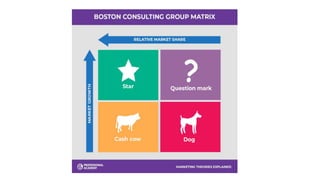
• It is a four cell matrices developed by BCG, USA. It provides a graphic
representation for an organization to examine different businesses in
it’s portfolio on the basis of their related market share and industry
growth rates. It is a comparative analysis of business potential and
the evaluation of environment.
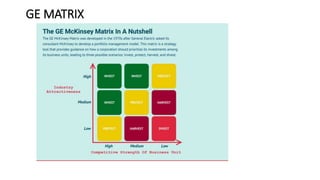
GE Matrix
• Developed in 1970s by the General Electric of USA is a three by three
matrix which rates each SBU against two critical varaiables:
• Industry Attractiveness
• Business Strength
GE MATRIX
Porter’s Generic Strategies
• Propounded by Michael E Porter
• Business Strategies are the course of action adopted by firm for each
of its business separately to serve identified customer groups and
provide value to the customer by a satisfaction of their needs.
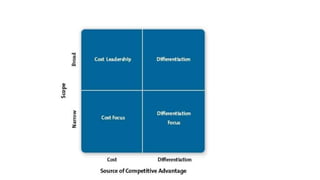
• According to him, Business strategies are of three types:
Cost Leadership Strategy
Differentiation Strategy
Focus Strategy
Strategic Group Analysis
• In competitive markets, firms need to develop competitive
positioning strategies carefully relative to their competitors in order to
achieve enduring competitive success.”- Michael E. Porter
• It looks at players' positions in the competitive environment and the
underlying factors that determine a company's profitability, as well as
the competitive dynamics of an industry.
• Strategic groups are common in most industries. Companies, within
the same industry, that employ similar strategies with similar
resources or have comparable business models, belong to one
strategic group.
• Strategic group analysis is used to examine the competitive
environment and the rivalry among competitors within an industry.
Contingency strategies
• These strategies are devised for a specific situation where
things could go wrong. These strategies prepares the
organization or the person for anything that could happen in
future. They are the back up plans that support the
organization when the actual plan fails.
• In the process of developing a company’s overall strategic
plan, business managers may develop alternative strategies as
a means to accommodate unexpected conditions or events,
such as economic recessions or catastrophic events.
• The primary purpose for a contingency plan provides a strategy for
minimizing the effects of unexpected circumstances. By doing so,
business managers increase the likelihood that a business’ main
operations will continue with minimal losses or damages.
Components of a Contingency Plan
• Recognizing the Disaster
• Responding to Disaster
• Planning for Recovery
Strategies Plan
strategic plan is a document used to communicate within the organization about the
organizations goals , the actions needed to achieve those goals and all of the other
critical elements developed during the planning exercise.
A strategic plan consists of five key components: a vision statement, a mission
statement, goals and objectives, an action plan, and details on how often the strategic
plan will be reviewed and updated.
Strategic planning is an organizational management activity or direction, and making
decisions on allocating its resources to pursue this strategy.
Corporate Level Generic Strategies
• Stability Strategy
• Growth/ Expansion Strategy
• Retrenchment Strategy
• Combination Strategy
Strategic Choice
• Strategic choice is essentially a decision making process. The decision
making process consist of setting objectives , generating alternatives
that will help the organization to achieve its objectives in the best
possible manner and finally implementing the chosen alternative.
Process of strategic choice
• There are four steps in the process of strategic choice as enumerated
below:
• 1. Focusing on strategic alternatives.
• 2.Analysing the strategic alternatives.
• 3.Evaluating the strategic alternatives.
• 4.Choosing from among the strategic alternatives.
1.Focusing on strategic alternatives.
• Focusing on alternatives could be done by visualizing the future state
and working backwards. This done through Gap analysis.
• A company sets objectives for a future period of time, then works
backward to find out where it can reach through the present level of
efforts. By analyzing the difference between the projected and
desired performance, a gap could be found.
• Gap analysis = projected performance – desired performance
2.Analysing the strategic alternatives.
• The Objective Factors- Based on analytical techniques and hard facts
or data.
• For example: the market share, expressed as a percent of the total
market share of a company’s business in its industry.
• The Subjective Factors- Based on one’s personal judgment, collective
or descriptive factors.
• For example: the perception of the company’s top management
regarding the prospects of the business in the next 2 to 3 years.
3.Evaluating the strategic alternatives.
• Evaluation of strategic alternatives basically involves bringing
together the analysis done on the basis of the objective and
subjective factors.
4.Choosing from among the strategic alternatives.
• The evaluation of strategic choice should lead to a clear assessment
of which alternative is the most suitable under the existing
conditions.
• The final step of making the strategic choice.
Subjective factors in strategic choice
• Strategic choice is simply be a rational, systematic process of finding
alternatives, analysis and evaluating them and choosing the best one.
Mainly six types of subjective factors ;
• Consideration for government policies
• Perception of critical success factors and distinctive competencies
• Commitment to past strategic action
• Strategist’s decision styles and attitude to risk
• Internal political considerations
• Timing and competitor considerations
Consideration for government policies
• strategies within organizations are aware of the crucial role that the
government place shutdown policies and priorities.
• This is especially true in the case of industries such as a airlines, banking,
pharmaceuticals, power, railways, or telecommunication, that depend
heavily on government regulations .
Perception of critical success factors and distinctive competencies
While considering several strategic alternatives, strategies could be guided
by the distinctive competency they the organization possesses and they CSF
that ensure success in an Industry.
Commitment to past strategic action
• Having made a serious commitment is difficult to move to areas where
existing resources and person become redundant.

Strategic Management Important topics

  • 1.
  • 2.
    • EXPERIENCE CURVE Experiencecurve refers to a diagrammatic representation of the inverse relationship between the total value-added costs of a product and the company experience in manufacturing and marketing it. The concept reviews the history of the term and explores the relationship between production cost and cumulative production quantity. Introduced by the Boston Consulting Group, Experience Curve is a concept that states that there is a consistent relationship between the cumulative production quantity of a company and the cost of production. The concept implies that the more experienced a company is in manufacturing a specific product, the lower its cost of production.
  • 3.
    • Life CycleAnalysis Life cycle assessment (LCA) involves the evaluation of some aspects – often the environmental aspects – of a product system through all stages of its life cycle. Sometimes also called “life cycle analysis”, “life cycle approach”, “cradle to grave analysis” or “eco-balance”, it represents a rapidly emerging family of tools and techniques designed to help in environmental management and, longer term, in sustainable development. • The life cycle assessment is a method of appraising the environmental impact of a service or product over its lifetime, • the purpose of conducting such an analysis is to compare a product or service with other products or services in on the market or to evaluate the potential environmental and economic implications linked to specific strategic choices and decisions.
  • 5.
    Business Portfolio Analysis PortfolioAnalysis is the analysis of a company as a collection of different business with a view to identify the status and potentials of the various business with regard to resource use and resource generation. Objective: help the company to formulate appropriate portfolio strategy Several Models include: BCG Matrix GE Matrix
  • 6.
    BCG Matrix • Itis a four cell matrices developed by BCG, USA. It provides a graphic representation for an organization to examine different businesses in it’s portfolio on the basis of their related market share and industry growth rates. It is a comparative analysis of business potential and the evaluation of environment.
  • 8.
    GE Matrix • Developedin 1970s by the General Electric of USA is a three by three matrix which rates each SBU against two critical varaiables: • Industry Attractiveness • Business Strength
  • 9.
  • 10.
    Porter’s Generic Strategies •Propounded by Michael E Porter • Business Strategies are the course of action adopted by firm for each of its business separately to serve identified customer groups and provide value to the customer by a satisfaction of their needs. • According to him, Business strategies are of three types: Cost Leadership Strategy Differentiation Strategy Focus Strategy
  • 12.
    Strategic Group Analysis •In competitive markets, firms need to develop competitive positioning strategies carefully relative to their competitors in order to achieve enduring competitive success.”- Michael E. Porter • It looks at players' positions in the competitive environment and the underlying factors that determine a company's profitability, as well as the competitive dynamics of an industry. • Strategic groups are common in most industries. Companies, within the same industry, that employ similar strategies with similar resources or have comparable business models, belong to one strategic group. • Strategic group analysis is used to examine the competitive environment and the rivalry among competitors within an industry.
  • 13.
    Contingency strategies • Thesestrategies are devised for a specific situation where things could go wrong. These strategies prepares the organization or the person for anything that could happen in future. They are the back up plans that support the organization when the actual plan fails. • In the process of developing a company’s overall strategic plan, business managers may develop alternative strategies as a means to accommodate unexpected conditions or events, such as economic recessions or catastrophic events.
  • 14.
    • The primarypurpose for a contingency plan provides a strategy for minimizing the effects of unexpected circumstances. By doing so, business managers increase the likelihood that a business’ main operations will continue with minimal losses or damages. Components of a Contingency Plan • Recognizing the Disaster • Responding to Disaster • Planning for Recovery
  • 15.
    Strategies Plan strategic planis a document used to communicate within the organization about the organizations goals , the actions needed to achieve those goals and all of the other critical elements developed during the planning exercise. A strategic plan consists of five key components: a vision statement, a mission statement, goals and objectives, an action plan, and details on how often the strategic plan will be reviewed and updated. Strategic planning is an organizational management activity or direction, and making decisions on allocating its resources to pursue this strategy.
  • 16.
    Corporate Level GenericStrategies • Stability Strategy • Growth/ Expansion Strategy • Retrenchment Strategy • Combination Strategy
  • 17.
    Strategic Choice • Strategicchoice is essentially a decision making process. The decision making process consist of setting objectives , generating alternatives that will help the organization to achieve its objectives in the best possible manner and finally implementing the chosen alternative.
  • 18.
    Process of strategicchoice • There are four steps in the process of strategic choice as enumerated below: • 1. Focusing on strategic alternatives. • 2.Analysing the strategic alternatives. • 3.Evaluating the strategic alternatives. • 4.Choosing from among the strategic alternatives.
  • 19.
    1.Focusing on strategicalternatives. • Focusing on alternatives could be done by visualizing the future state and working backwards. This done through Gap analysis. • A company sets objectives for a future period of time, then works backward to find out where it can reach through the present level of efforts. By analyzing the difference between the projected and desired performance, a gap could be found. • Gap analysis = projected performance – desired performance
  • 20.
    2.Analysing the strategicalternatives. • The Objective Factors- Based on analytical techniques and hard facts or data. • For example: the market share, expressed as a percent of the total market share of a company’s business in its industry. • The Subjective Factors- Based on one’s personal judgment, collective or descriptive factors. • For example: the perception of the company’s top management regarding the prospects of the business in the next 2 to 3 years.
  • 21.
    3.Evaluating the strategicalternatives. • Evaluation of strategic alternatives basically involves bringing together the analysis done on the basis of the objective and subjective factors.
  • 22.
    4.Choosing from amongthe strategic alternatives. • The evaluation of strategic choice should lead to a clear assessment of which alternative is the most suitable under the existing conditions. • The final step of making the strategic choice.
  • 23.
    Subjective factors instrategic choice • Strategic choice is simply be a rational, systematic process of finding alternatives, analysis and evaluating them and choosing the best one. Mainly six types of subjective factors ; • Consideration for government policies • Perception of critical success factors and distinctive competencies • Commitment to past strategic action • Strategist’s decision styles and attitude to risk • Internal political considerations • Timing and competitor considerations
  • 24.
    Consideration for governmentpolicies • strategies within organizations are aware of the crucial role that the government place shutdown policies and priorities. • This is especially true in the case of industries such as a airlines, banking, pharmaceuticals, power, railways, or telecommunication, that depend heavily on government regulations . Perception of critical success factors and distinctive competencies While considering several strategic alternatives, strategies could be guided by the distinctive competency they the organization possesses and they CSF that ensure success in an Industry. Commitment to past strategic action • Having made a serious commitment is difficult to move to areas where existing resources and person become redundant.