Knowledge management, sensing and
control tools for irrigated broadacre
cropping
Dr Alison McCarthy, Michael Scobie, Dr Malcolm Gillies,
Lidya Agustina and Dr Joseph Foley
National Centre for Engineering in Agriculture
Institute for Agriculture and the Environment
University of Southern Queensland
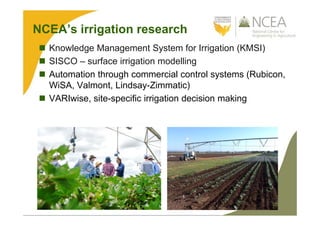
NCEA’s irrigation research
 Knowledge Management System for Irrigation (KMSI)
 SISCO – surface irrigation modelling
 Automation through commercial control systems (Rubicon,
WiSA, Valmont, Lindsay-Zimmatic)
 VARIwise, site-specific irrigation decision making
KMSI
 Suite of tools funded by the Queensland
Government as part of the South East
Queensland Irrigation Futures project
 Centralised online decision support tools for
irrigation, nutrient and energy calculators with
benchmarking function to compare across
catchments, systems and industries
 Also has simple calculator tools with simple
input/output interface
 For growers and industry consultants
kmsi.usq.edu.au
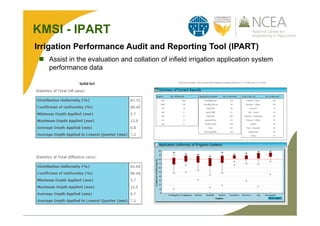
KMSI - IPART
Irrigation Performance Audit and Reporting Tool (IPART)
 Assist in the evaluation and collation of infield irrigation application system
performance data
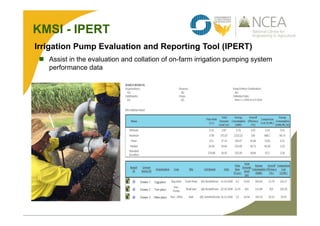
KMSI - IPERT
Irrigation Pump Evaluation and Reporting Tool (IPERT)
 Assist in the evaluation and collation of on-farm irrigation pumping system
performance data
Grower 1 Egg place
Grower 2 Tree place
Grower 3 Other place
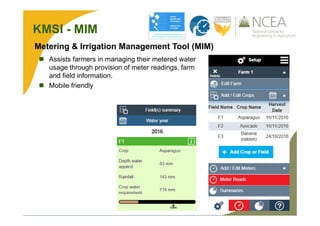
KMSI - MIM
Metering & Irrigation Management Tool (MIM)
 Assists farmers in managing their metered water
usage through provision of meter readings, farm
and field information.
 Mobile friendly
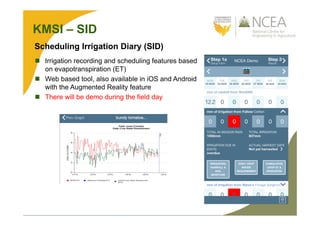
KMSI – SID
Scheduling Irrigation Diary (SID)
 Irrigation recording and scheduling features based
on evapotranspiration (ET)
 Web based tool, also available in iOS and Android
with the Augmented Reality feature
 There will be demo during the field day
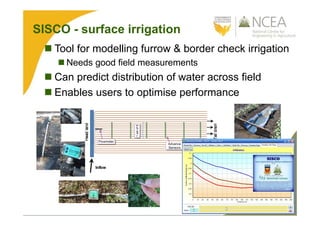
SISCO - surface irrigation
 Tool for modelling furrow & border check irrigation
 Needs good field measurements
 Can predict distribution of water across field
 Enables users to optimise performance
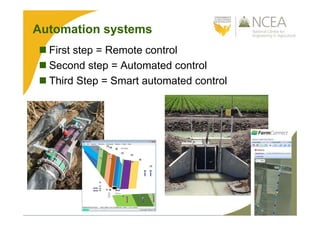
Automation systems
 First step = Remote control
 Second step = Automated control
 Third Step = Smart automated control
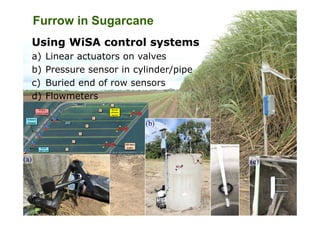
Using WiSA control systems
a) Linear actuators on valves
b) Pressure sensor in cylinder/pipe
c) Buried end of row sensors
d) Flowmeters
(c)
Furrow in Sugarcane
(b)
(a)
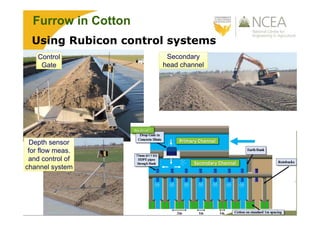
Using Rubicon control systems
Furrow in Cotton
Depth sensor
for flow meas.
and control of
channel system
Control
Gate
Secondary
head channel
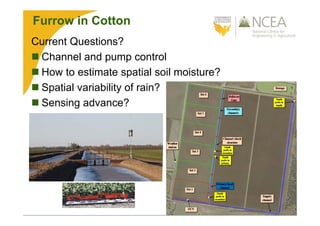
Furrow in Cotton
Current Questions?
 Channel and pump control
 How to estimate spatial soil moisture?
 Spatial variability of rain?
 Sensing advance?
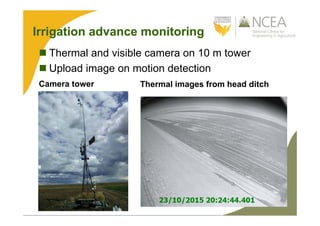
Irrigation advance monitoring
 Thermal and visible camera on 10 m tower
 Upload image on motion detection
Camera tower Thermal images from head ditch
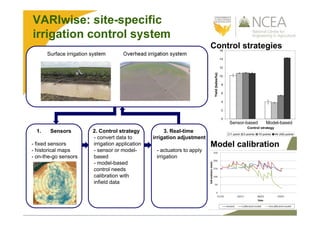
Model-basedSensor-based
VARIwise: site-specific
irrigation control system
2. Control strategy
- convert data to
irrigation application
- sensor or model-
based
- model-based
control needs
calibration with
infield data
Surface irrigation system Overhead irrigation system
1. Sensors
- fixed sensors
- historical maps
- on-the-go sensors
3. Real-time
irrigation adjustment
- actuators to apply
irrigation
Model calibration
Control strategies
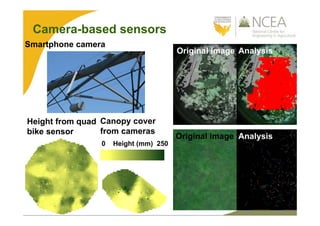
Original image Analysis
Smartphone camera
Height from quad
bike sensor
0 Height (mm) 250
Canopy cover
from cameras
Camera-based sensors
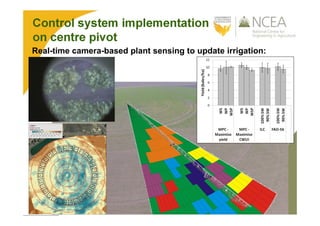
Control system implementation
on centre pivot
Real-time camera-based plant sensing to update irrigation:
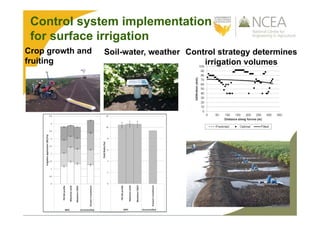
Control system implementation
for surface irrigation
Crop growth and
fruiting
Soil-water, weather Control strategy determines
irrigation volumes
Conclusions
 Tools developed for growers, consultants and
automated irrigation data management and
processing
 Used for manual or automated management
 Next steps:
 Evaluation of SISCO and VARIwise control
strategies at cotton, sugarcane and dairy
pasture over next two years
Acknowledgements
 Cotton Research and Development
Corporation, Federal Government Rural R&D
for Profit Program, Queensland Government,
TIA, Dairy Australia, Sugar Research Australia
and Queensland Department of Natural
Resources for funding support
 Cotton growers Lindsay Evans and Neil and
Lachlan Nass for providing field trial sites

Knowledge Management, sensing and control tools for irrigated broadacre cropping

  • 1.
    Knowledge management, sensingand control tools for irrigated broadacre cropping Dr Alison McCarthy, Michael Scobie, Dr Malcolm Gillies, Lidya Agustina and Dr Joseph Foley National Centre for Engineering in Agriculture Institute for Agriculture and the Environment University of Southern Queensland
  • 2.
    NCEA’s irrigation research Knowledge Management System for Irrigation (KMSI)  SISCO – surface irrigation modelling  Automation through commercial control systems (Rubicon, WiSA, Valmont, Lindsay-Zimmatic)  VARIwise, site-specific irrigation decision making
  • 3.
    KMSI  Suite oftools funded by the Queensland Government as part of the South East Queensland Irrigation Futures project  Centralised online decision support tools for irrigation, nutrient and energy calculators with benchmarking function to compare across catchments, systems and industries  Also has simple calculator tools with simple input/output interface  For growers and industry consultants kmsi.usq.edu.au
  • 4.
    KMSI - IPART IrrigationPerformance Audit and Reporting Tool (IPART)  Assist in the evaluation and collation of infield irrigation application system performance data
  • 5.
    KMSI - IPERT IrrigationPump Evaluation and Reporting Tool (IPERT)  Assist in the evaluation and collation of on-farm irrigation pumping system performance data Grower 1 Egg place Grower 2 Tree place Grower 3 Other place
  • 6.
    KMSI - MIM Metering& Irrigation Management Tool (MIM)  Assists farmers in managing their metered water usage through provision of meter readings, farm and field information.  Mobile friendly
  • 7.
    KMSI – SID SchedulingIrrigation Diary (SID)  Irrigation recording and scheduling features based on evapotranspiration (ET)  Web based tool, also available in iOS and Android with the Augmented Reality feature  There will be demo during the field day
  • 8.
    SISCO - surfaceirrigation  Tool for modelling furrow & border check irrigation  Needs good field measurements  Can predict distribution of water across field  Enables users to optimise performance
  • 9.
    Automation systems  Firststep = Remote control  Second step = Automated control  Third Step = Smart automated control
  • 10.
    Using WiSA controlsystems a) Linear actuators on valves b) Pressure sensor in cylinder/pipe c) Buried end of row sensors d) Flowmeters (c) Furrow in Sugarcane (b) (a)
  • 11.
    Using Rubicon controlsystems Furrow in Cotton Depth sensor for flow meas. and control of channel system Control Gate Secondary head channel
  • 12.
    Furrow in Cotton CurrentQuestions?  Channel and pump control  How to estimate spatial soil moisture?  Spatial variability of rain?  Sensing advance?
  • 13.
    Irrigation advance monitoring Thermal and visible camera on 10 m tower  Upload image on motion detection Camera tower Thermal images from head ditch
  • 14.
    Model-basedSensor-based VARIwise: site-specific irrigation controlsystem 2. Control strategy - convert data to irrigation application - sensor or model- based - model-based control needs calibration with infield data Surface irrigation system Overhead irrigation system 1. Sensors - fixed sensors - historical maps - on-the-go sensors 3. Real-time irrigation adjustment - actuators to apply irrigation Model calibration Control strategies
  • 15.
    Original image Analysis Originalimage Analysis Smartphone camera Height from quad bike sensor 0 Height (mm) 250 Canopy cover from cameras Camera-based sensors
  • 16.
    Control system implementation oncentre pivot Real-time camera-based plant sensing to update irrigation:
  • 17.
    Control system implementation forsurface irrigation Crop growth and fruiting Soil-water, weather Control strategy determines irrigation volumes
  • 18.
    Conclusions  Tools developedfor growers, consultants and automated irrigation data management and processing  Used for manual or automated management  Next steps:  Evaluation of SISCO and VARIwise control strategies at cotton, sugarcane and dairy pasture over next two years
  • 19.
    Acknowledgements  Cotton Researchand Development Corporation, Federal Government Rural R&D for Profit Program, Queensland Government, TIA, Dairy Australia, Sugar Research Australia and Queensland Department of Natural Resources for funding support  Cotton growers Lindsay Evans and Neil and Lachlan Nass for providing field trial sites