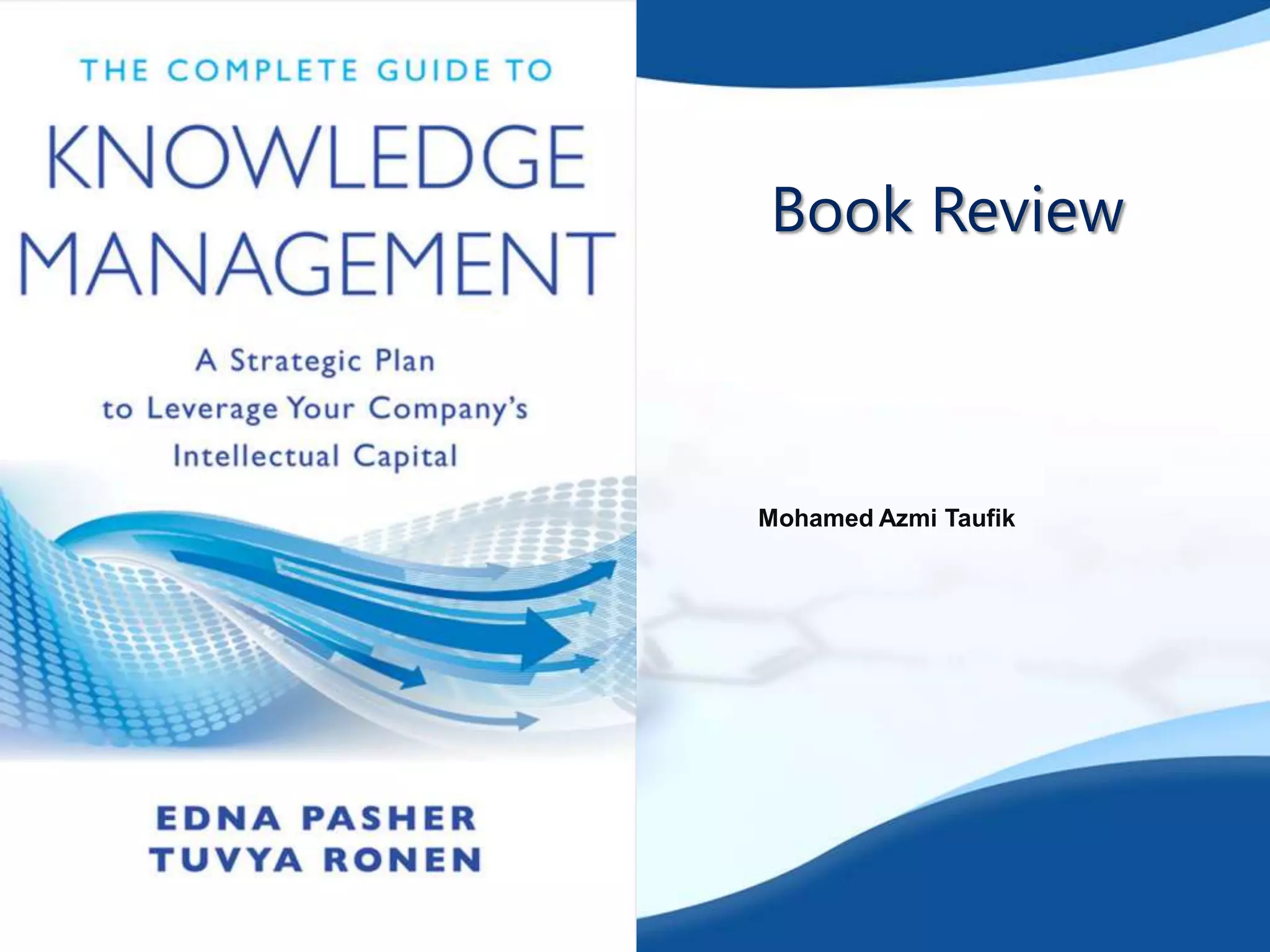

Book Review

Mohamed Azmi Taufik
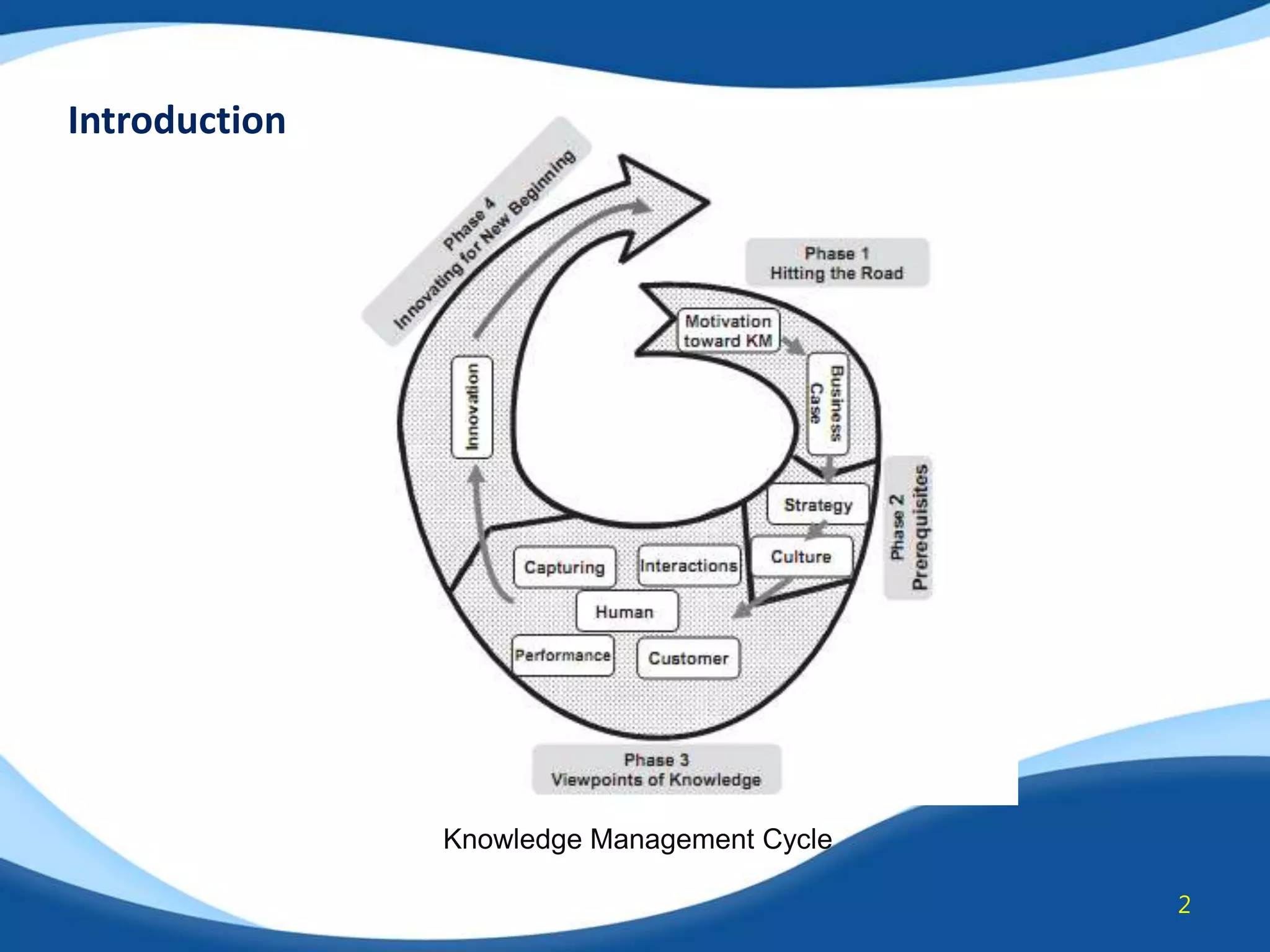
Introduction

Knowledge Management Cycle
2
1. Motivation Toward Knowledge Management
1.

Managers struggling with key tactical problems
New knowledge problems always emerge
•
Ideas rejected
•
Veterans are irreplaceable
•
KWs leaving the organisation

2.

Consultant struggling with key strategic problems
KM not going in parallel with strategic management
•
Core knowledge (competencies) not being constantly developed
•
Limited R&D and innovation
•
Managers not convinced of strategic KM

3.

Typical tactical KM issues
Universal KM problems faced by organisations
•
Are the culture and values right for knowledge creation
•
How can it enhance its knowledge creation
•
How can it preserve its existing knowledge
•
How can it encourage knowledge sharing
•
What are the efficient methods or knowledge dissemination
3
2. Making the business case for managing Intellectual Capital
1.

Quantitative definition of IC
Financial results are not the only factor in determining success of organisation
•
Skill and expertise of a company’s human resources
•
The extent and financing of its R&D investments
•
The efficiency of existing work process
•
IT infrastructure and customer base

2.

IC as basic asset of a knowledge-intensive business
Essential for ensuring sustainable growth & success of organisations
•
Talented employees
•
Retain key personnel

3.

Systematic Management of IC
IC is the most basic asset the need to be carefully managed
•
Human Capital (HC) – knowledge, innovation capabilities & skills
•
Structural Capital (SC) – organisation capabilities & core competencies

4.

Available Tools of IC management
•
•

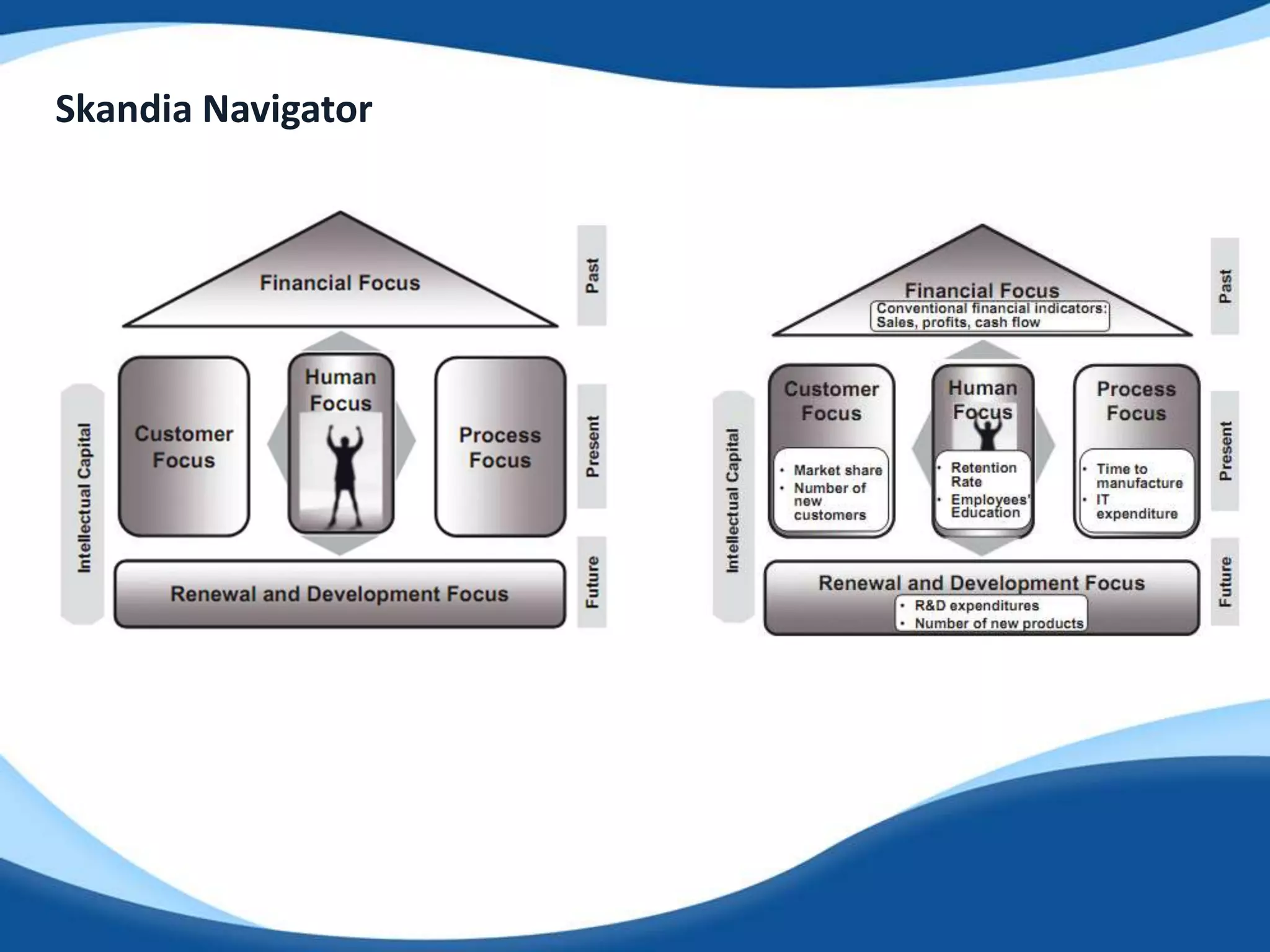
Skandia Navigator
Balance Score Card (BSC)
4
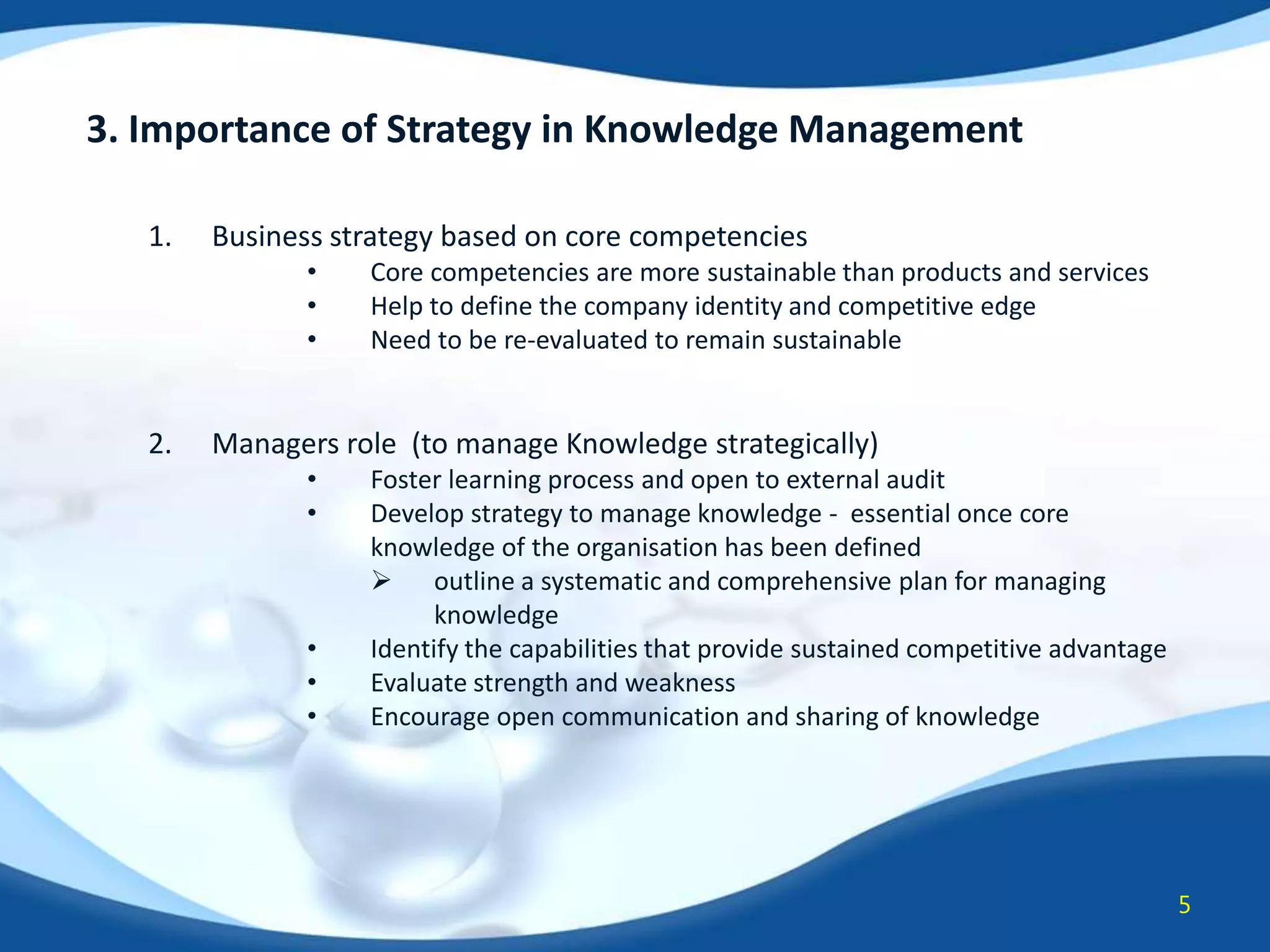
3. Importance of Strategy in Knowledge Management
1.

Business strategy based on core competencies
•
•
•

2.

Core competencies are more sustainable than products and services
Help to define the company identity and competitive edge
Need to be re-evaluated to remain sustainable

Managers role (to manage Knowledge strategically)
•
•

•
•
•

Foster learning process and open to external audit
Develop strategy to manage knowledge - essential once core
knowledge of the organisation has been defined
 outline a systematic and comprehensive plan for managing
knowledge
Identify the capabilities that provide sustained competitive advantage
Evaluate strength and weakness
Encourage open communication and sharing of knowledge

5
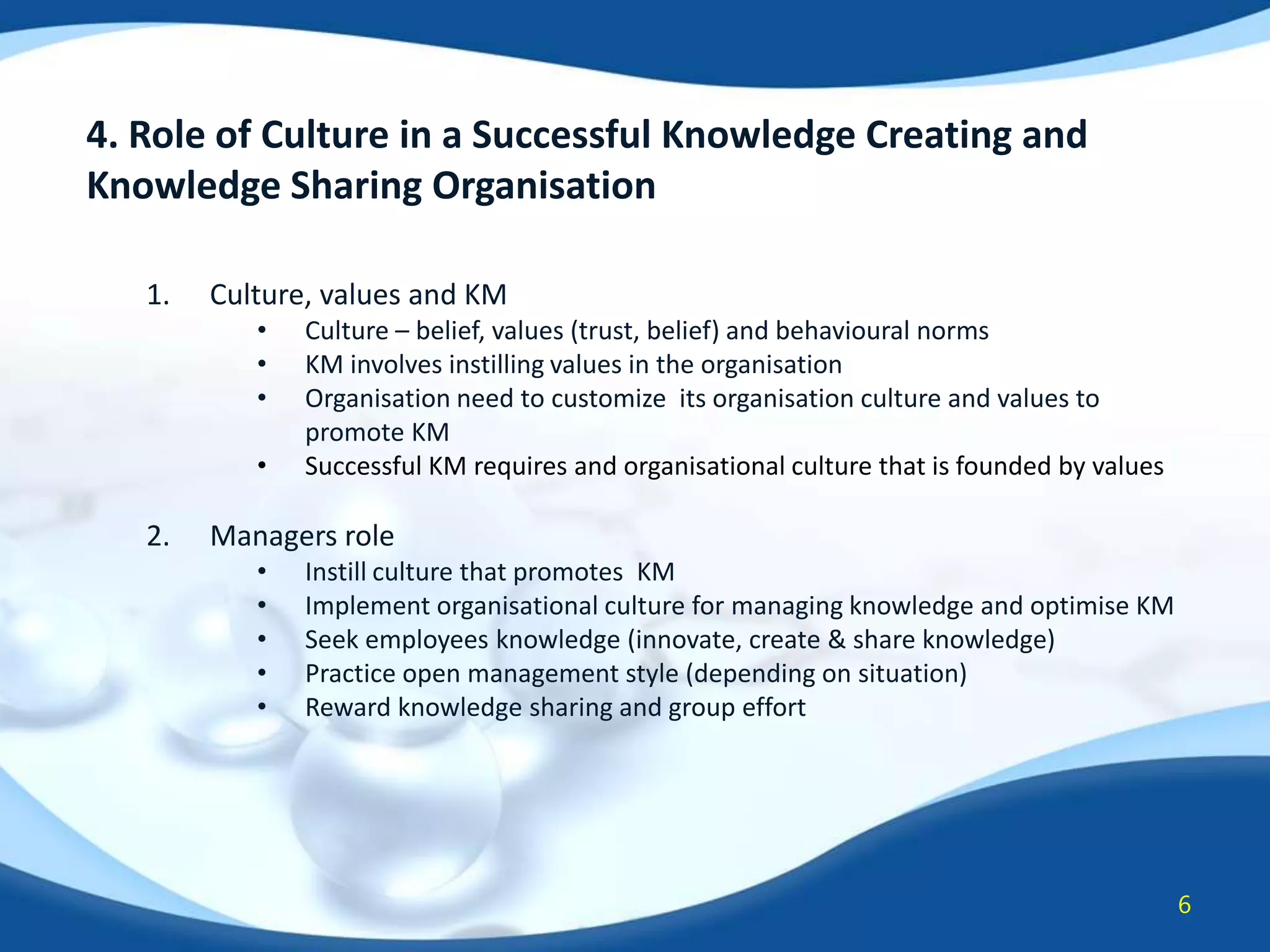
4. Role of Culture in a Successful Knowledge Creating and
Knowledge Sharing Organisation
1.

Culture, values and KM
•
•
•
•

2.

Culture – belief, values (trust, belief) and behavioural norms
KM involves instilling values in the organisation
Organisation need to customize its organisation culture and values to
promote KM
Successful KM requires and organisational culture that is founded by values

Managers role
•
•
•
•
•

Instill culture that promotes KM
Implement organisational culture for managing knowledge and optimise KM
Seek employees knowledge (innovate, create & share knowledge)
Practice open management style (depending on situation)
Reward knowledge sharing and group effort

6
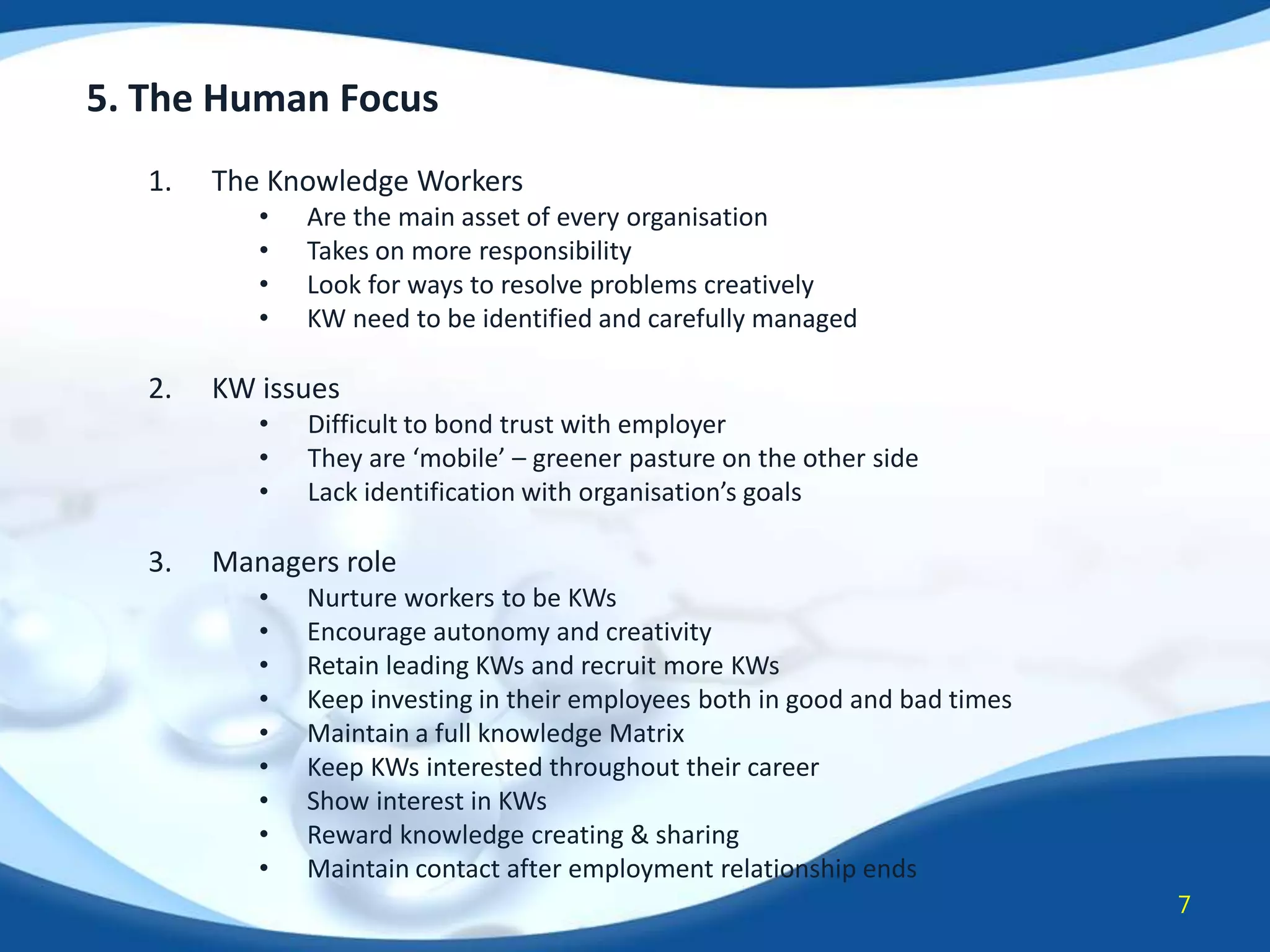
5. The Human Focus
1.

The Knowledge Workers
•
•
•
•

2.

KW issues
•
•
•

3.

Are the main asset of every organisation
Takes on more responsibility
Look for ways to resolve problems creatively
KW need to be identified and carefully managed

Difficult to bond trust with employer
They are ‘mobile’ – greener pasture on the other side
Lack identification with organisation’s goals

Managers role
•
•
•
•
•
•
•
•
•

Nurture workers to be KWs
Encourage autonomy and creativity
Retain leading KWs and recruit more KWs
Keep investing in their employees both in good and bad times
Maintain a full knowledge Matrix
Keep KWs interested throughout their career
Show interest in KWs
Reward knowledge creating & sharing
Maintain contact after employment relationship ends
7
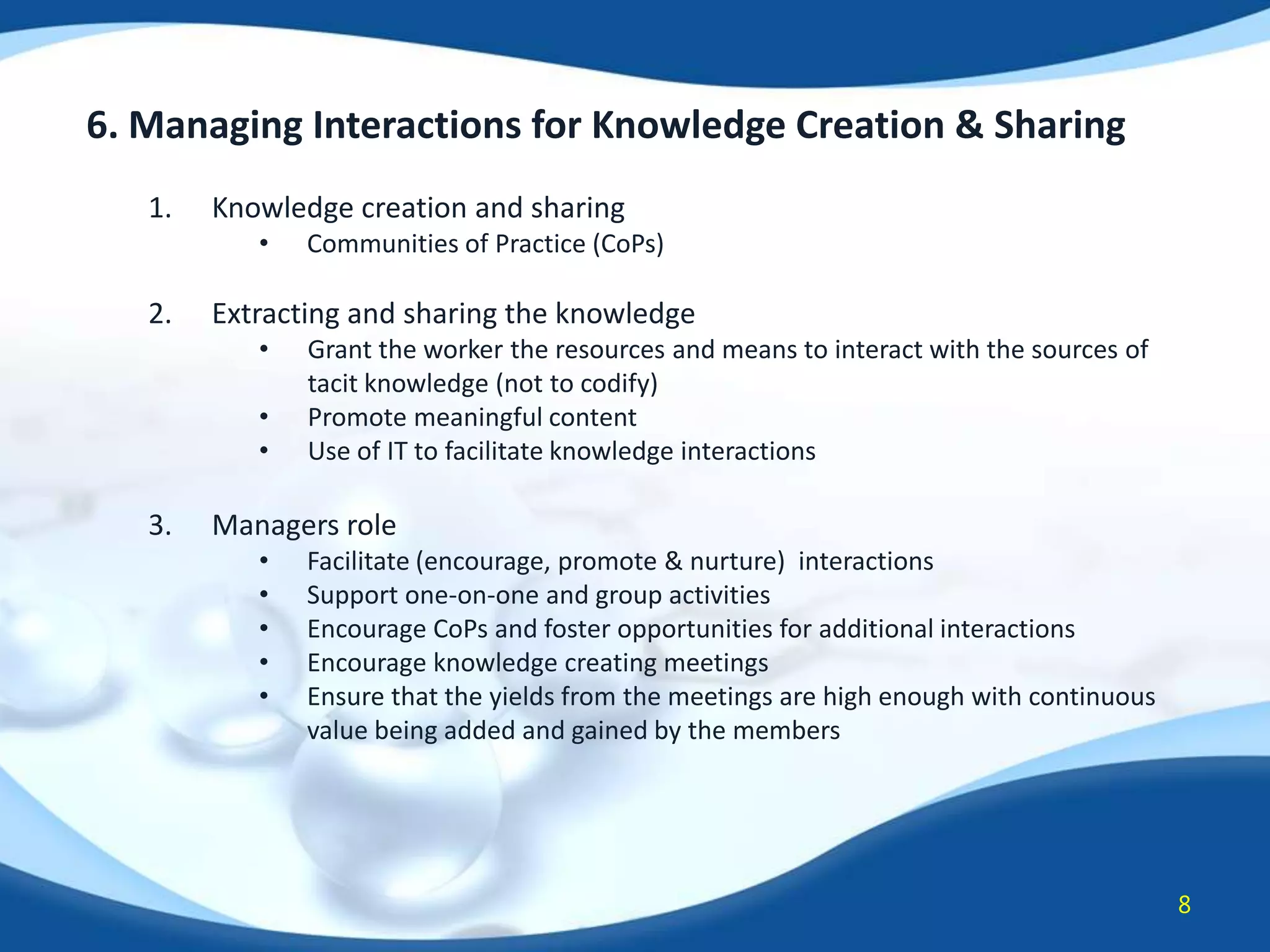
6. Managing Interactions for Knowledge Creation & Sharing
1.

Knowledge creation and sharing
•

2.

Extracting and sharing the knowledge
•
•
•

3.

Communities of Practice (CoPs)

Grant the worker the resources and means to interact with the sources of
tacit knowledge (not to codify)
Promote meaningful content
Use of IT to facilitate knowledge interactions

Managers role
•
•
•
•
•

Facilitate (encourage, promote & nurture) interactions
Support one-on-one and group activities
Encourage CoPs and foster opportunities for additional interactions
Encourage knowledge creating meetings
Ensure that the yields from the meetings are high enough with continuous
value being added and gained by the members

8
7. Capturing and Reusing Existing Knowledge
1.

Documenting knowledge efficiently
•
•
•

2.

Capture and disseminate knowledge
•
•
•

3.

Minimise interference with ongoing work
Documents should be friendly
Create a ‘knowledge map’ (template, links to directories of information,
findings, name of person who had the answers to a particular question, and
some experience gained).

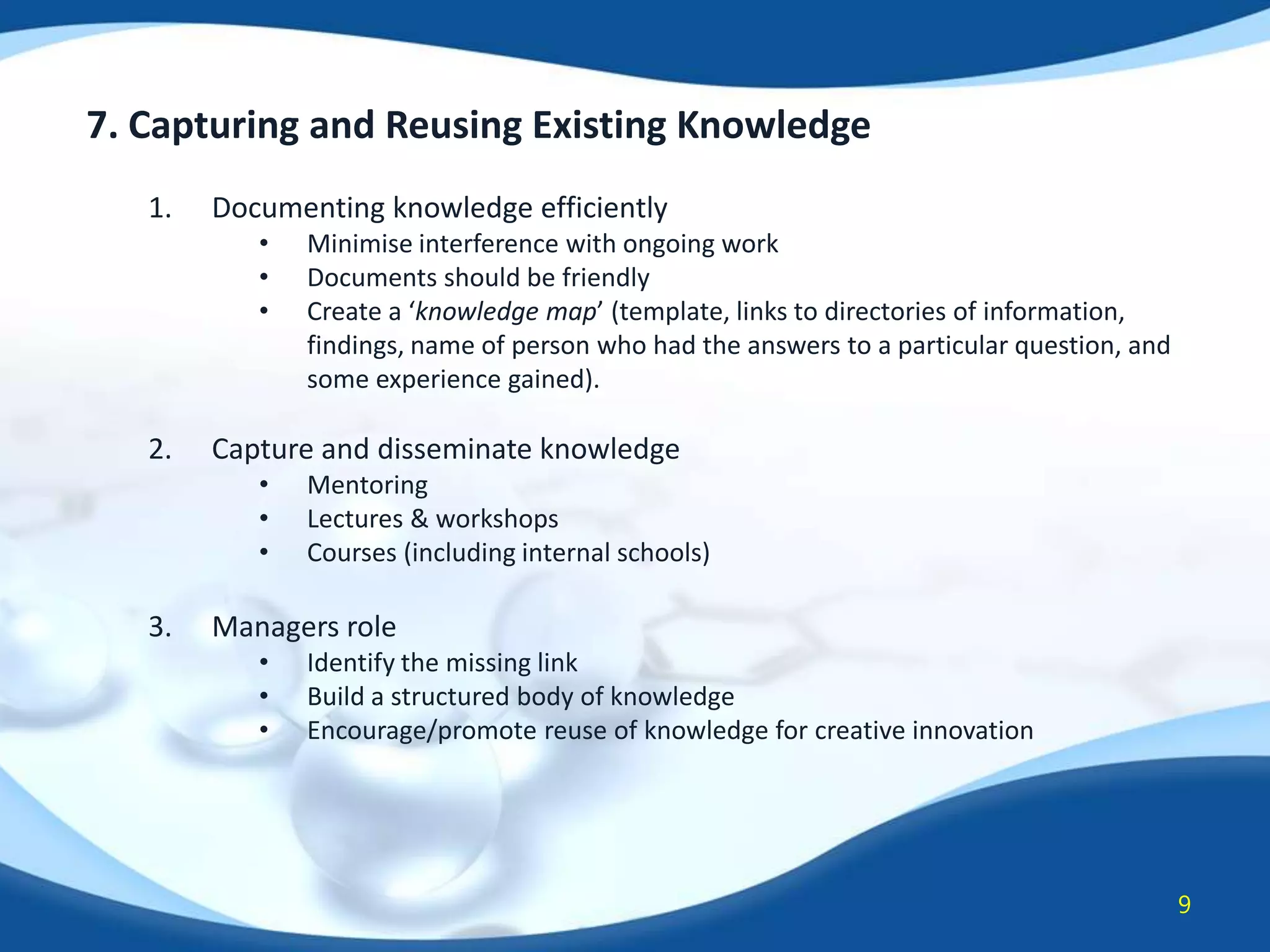
Mentoring
Lectures & workshops
Courses (including internal schools)

Managers role
•
•
•

Identify the missing link
Build a structured body of knowledge
Encourage/promote reuse of knowledge for creative innovation

9
8. Customer Focus
1.

Capture feedback/input from external customers
•
•
•

2.

Not forgetting internal customers
•

3.

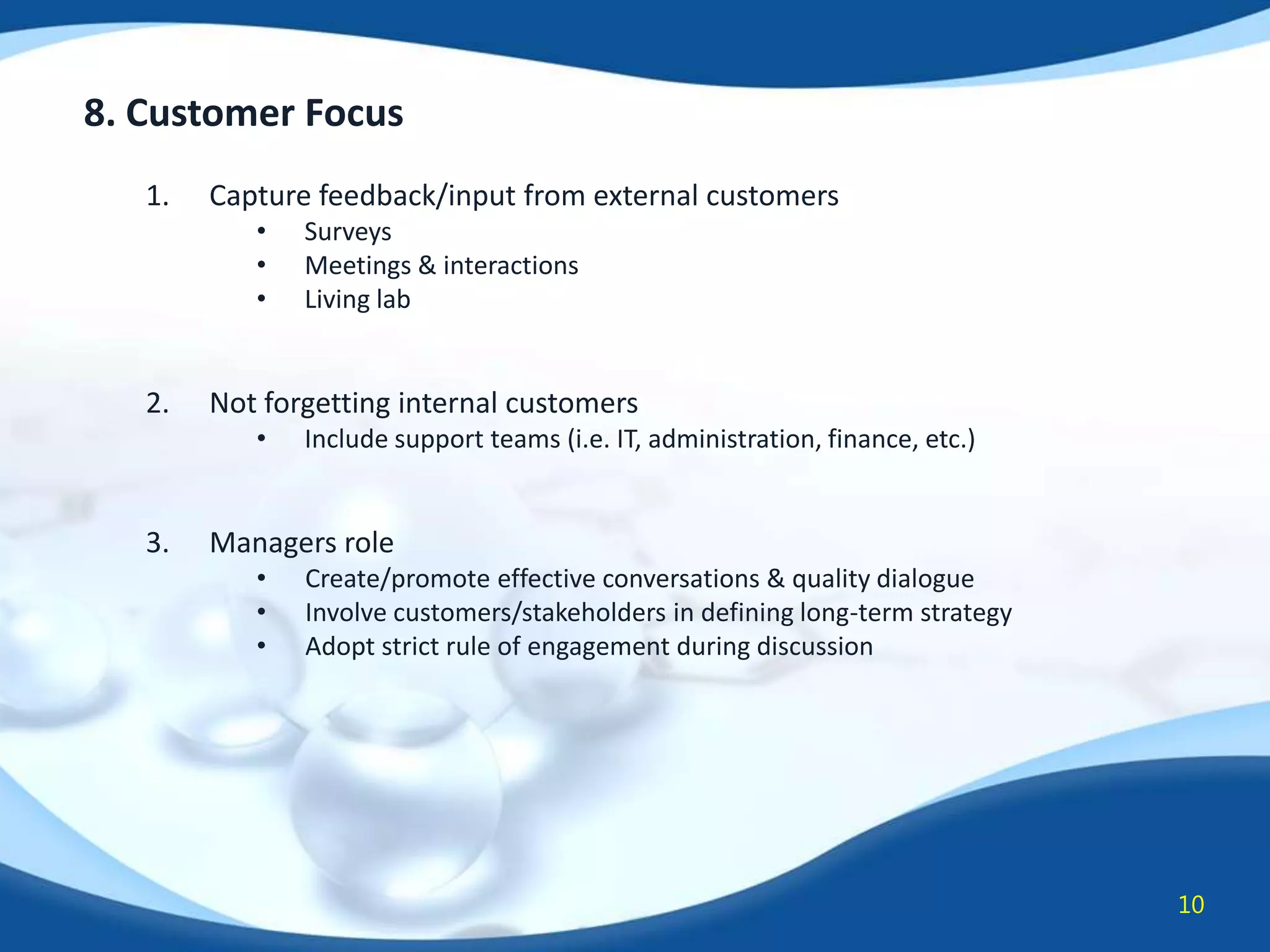
Surveys
Meetings & interactions
Living lab

Include support teams (i.e. IT, administration, finance, etc.)

Managers role
•
•
•

Create/promote effective conversations & quality dialogue
Involve customers/stakeholders in defining long-term strategy
Adopt strict rule of engagement during discussion

10
9. Managing the Performance of Proper Knowledge Work
1.

Focus areas for improvement
•
•
•
•

R&D
Process
Customers
HR

2.

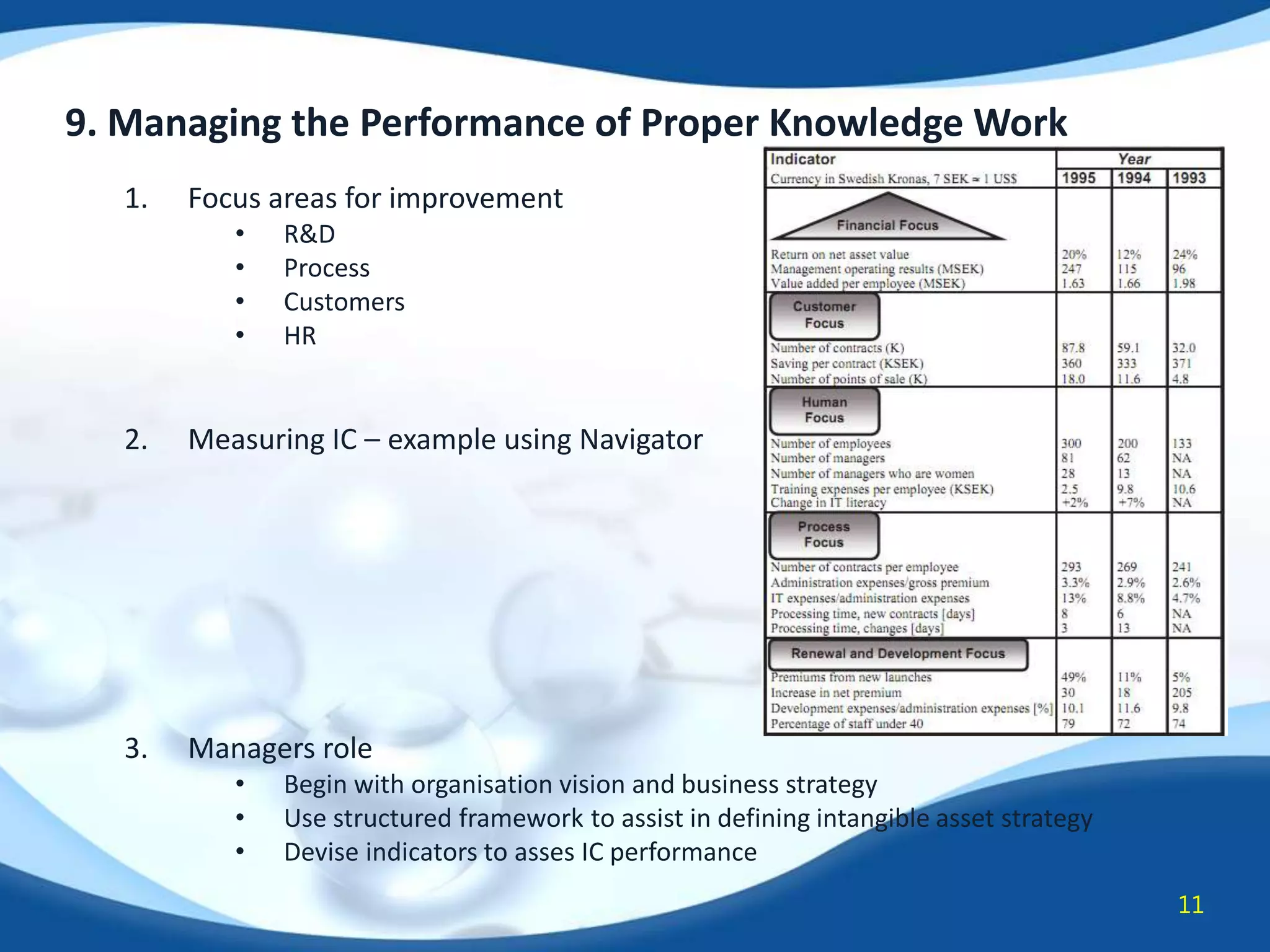
Measuring IC – example using Navigator

3.

Managers role
•
•
•

Begin with organisation vision and business strategy
Use structured framework to assist in defining intangible asset strategy
Devise indicators to asses IC performance
11
10. Innovating for a new beginning
1.

Innovation
•
•
•
•
•

2.

Reuse of existing knowledge, invention of new knowledge & exploitation
Not limited to technology but all business activities
Is the essence of knowledge organisations
Focus on shortening lead time and accelerating new products development,
creating new structures that save money
Innovation is fostered by proper KM and IC

Managers role - enabling innovation
•
•
•
•
•

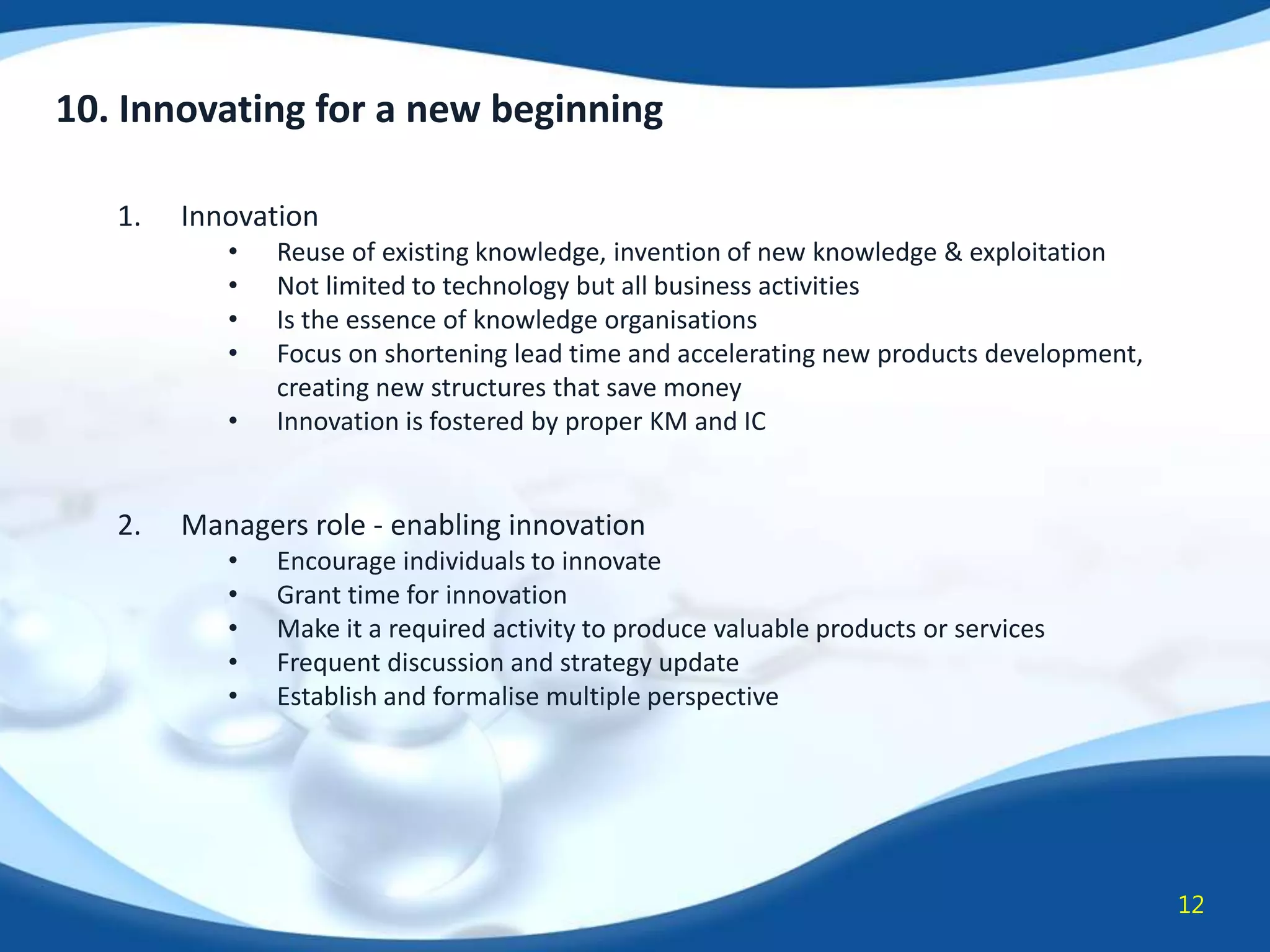
Encourage individuals to innovate
Grant time for innovation
Make it a required activity to produce valuable products or services
Frequent discussion and strategy update
Establish and formalise multiple perspective

12
Takeaways
1.

KM has strong strategic implications. It is about identifying and systematically
managing the IC of knowledge companies.

2.

KM requires a strategy of its own. Organisation which has successful KM process
increases the chances of developing appropriate corporate strategy.

3.

Successful KM requires and organisational culture that is founded by values .

4.

KWs are knowledge creating workers and need intellectual challenge .

5.

The importance of managing knowledge creation and sharing.

6.

Capturing knowledge for future sharing and reuse should be done in an efficient way
to minimise the interference with ongoing work.

7.

KM and IC need to be carefully measured and access for its impact on company
monetary value.

8.

Innovation consist of 3 components – reuse of existing knowledge, invention of new
knowledge & exploitation of overall knowledge. Innovation also include all business
activities i.e. business development, HR, customer relations, marketing and work
process.

9.

The manager should have an in - depth understanding of the organization’s identity,
strategy, and culture before embarking on knowledge management. KM must
contribute to an organization’s core mission.

13
Thank You
Skandia Navigator

Knowledge management book review

  • 1.
  • 2.
  • 3.
    1. Motivation TowardKnowledge Management 1. Managers struggling with key tactical problems New knowledge problems always emerge • Ideas rejected • Veterans are irreplaceable • KWs leaving the organisation 2. Consultant struggling with key strategic problems KM not going in parallel with strategic management • Core knowledge (competencies) not being constantly developed • Limited R&D and innovation • Managers not convinced of strategic KM 3. Typical tactical KM issues Universal KM problems faced by organisations • Are the culture and values right for knowledge creation • How can it enhance its knowledge creation • How can it preserve its existing knowledge • How can it encourage knowledge sharing • What are the efficient methods or knowledge dissemination 3
  • 4.
    2. Making thebusiness case for managing Intellectual Capital 1. Quantitative definition of IC Financial results are not the only factor in determining success of organisation • Skill and expertise of a company’s human resources • The extent and financing of its R&D investments • The efficiency of existing work process • IT infrastructure and customer base 2. IC as basic asset of a knowledge-intensive business Essential for ensuring sustainable growth & success of organisations • Talented employees • Retain key personnel 3. Systematic Management of IC IC is the most basic asset the need to be carefully managed • Human Capital (HC) – knowledge, innovation capabilities & skills • Structural Capital (SC) – organisation capabilities & core competencies 4. Available Tools of IC management • • Skandia Navigator Balance Score Card (BSC) 4
  • 5.
    3. Importance ofStrategy in Knowledge Management 1. Business strategy based on core competencies • • • 2. Core competencies are more sustainable than products and services Help to define the company identity and competitive edge Need to be re-evaluated to remain sustainable Managers role (to manage Knowledge strategically) • • • • • Foster learning process and open to external audit Develop strategy to manage knowledge - essential once core knowledge of the organisation has been defined  outline a systematic and comprehensive plan for managing knowledge Identify the capabilities that provide sustained competitive advantage Evaluate strength and weakness Encourage open communication and sharing of knowledge 5
  • 6.
    4. Role ofCulture in a Successful Knowledge Creating and Knowledge Sharing Organisation 1. Culture, values and KM • • • • 2. Culture – belief, values (trust, belief) and behavioural norms KM involves instilling values in the organisation Organisation need to customize its organisation culture and values to promote KM Successful KM requires and organisational culture that is founded by values Managers role • • • • • Instill culture that promotes KM Implement organisational culture for managing knowledge and optimise KM Seek employees knowledge (innovate, create & share knowledge) Practice open management style (depending on situation) Reward knowledge sharing and group effort 6
  • 7.
    5. The HumanFocus 1. The Knowledge Workers • • • • 2. KW issues • • • 3. Are the main asset of every organisation Takes on more responsibility Look for ways to resolve problems creatively KW need to be identified and carefully managed Difficult to bond trust with employer They are ‘mobile’ – greener pasture on the other side Lack identification with organisation’s goals Managers role • • • • • • • • • Nurture workers to be KWs Encourage autonomy and creativity Retain leading KWs and recruit more KWs Keep investing in their employees both in good and bad times Maintain a full knowledge Matrix Keep KWs interested throughout their career Show interest in KWs Reward knowledge creating & sharing Maintain contact after employment relationship ends 7
  • 8.
    6. Managing Interactionsfor Knowledge Creation & Sharing 1. Knowledge creation and sharing • 2. Extracting and sharing the knowledge • • • 3. Communities of Practice (CoPs) Grant the worker the resources and means to interact with the sources of tacit knowledge (not to codify) Promote meaningful content Use of IT to facilitate knowledge interactions Managers role • • • • • Facilitate (encourage, promote & nurture) interactions Support one-on-one and group activities Encourage CoPs and foster opportunities for additional interactions Encourage knowledge creating meetings Ensure that the yields from the meetings are high enough with continuous value being added and gained by the members 8
  • 9.
    7. Capturing andReusing Existing Knowledge 1. Documenting knowledge efficiently • • • 2. Capture and disseminate knowledge • • • 3. Minimise interference with ongoing work Documents should be friendly Create a ‘knowledge map’ (template, links to directories of information, findings, name of person who had the answers to a particular question, and some experience gained). Mentoring Lectures & workshops Courses (including internal schools) Managers role • • • Identify the missing link Build a structured body of knowledge Encourage/promote reuse of knowledge for creative innovation 9
  • 10.
    8. Customer Focus 1. Capturefeedback/input from external customers • • • 2. Not forgetting internal customers • 3. Surveys Meetings & interactions Living lab Include support teams (i.e. IT, administration, finance, etc.) Managers role • • • Create/promote effective conversations & quality dialogue Involve customers/stakeholders in defining long-term strategy Adopt strict rule of engagement during discussion 10
  • 11.
    9. Managing thePerformance of Proper Knowledge Work 1. Focus areas for improvement • • • • R&D Process Customers HR 2. Measuring IC – example using Navigator 3. Managers role • • • Begin with organisation vision and business strategy Use structured framework to assist in defining intangible asset strategy Devise indicators to asses IC performance 11
  • 12.
    10. Innovating fora new beginning 1. Innovation • • • • • 2. Reuse of existing knowledge, invention of new knowledge & exploitation Not limited to technology but all business activities Is the essence of knowledge organisations Focus on shortening lead time and accelerating new products development, creating new structures that save money Innovation is fostered by proper KM and IC Managers role - enabling innovation • • • • • Encourage individuals to innovate Grant time for innovation Make it a required activity to produce valuable products or services Frequent discussion and strategy update Establish and formalise multiple perspective 12
  • 13.
    Takeaways 1. KM has strongstrategic implications. It is about identifying and systematically managing the IC of knowledge companies. 2. KM requires a strategy of its own. Organisation which has successful KM process increases the chances of developing appropriate corporate strategy. 3. Successful KM requires and organisational culture that is founded by values . 4. KWs are knowledge creating workers and need intellectual challenge . 5. The importance of managing knowledge creation and sharing. 6. Capturing knowledge for future sharing and reuse should be done in an efficient way to minimise the interference with ongoing work. 7. KM and IC need to be carefully measured and access for its impact on company monetary value. 8. Innovation consist of 3 components – reuse of existing knowledge, invention of new knowledge & exploitation of overall knowledge. Innovation also include all business activities i.e. business development, HR, customer relations, marketing and work process. 9. The manager should have an in - depth understanding of the organization’s identity, strategy, and culture before embarking on knowledge management. KM must contribute to an organization’s core mission. 13
  • 14.
  • 15.