Lecture 11
Strategic HRM
4. Flexibility Strategy
1. Outsourcing.
2. Multi-skilling employees.
5. Talent Management Strategy
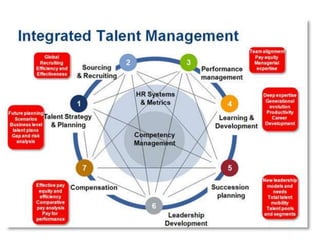
• Talent management strategies deal with the
processes required to ensure that the
organization attracts, retains, motivates and
develops the talented people it needs.
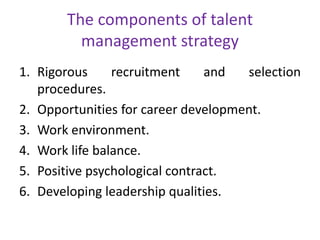
The components of talent
management strategy
1. Rigorous recruitment and selection
procedures.
2. Opportunities for career development.
3. Work environment.
4. Work life balance.
5. Positive psychological contract.
6. Developing leadership qualities.
Individual Assignment
• General Motors
• Case Analysis
• Deadline: 26th April, 2016
Strategies for Managing
Performance
• Strategies for managing performance exist to
develop a high-performance culture and
achieve increased organizational effectiveness,
better results for individuals and teams, and
higher levels of skill, competence,
commitment and motivation.
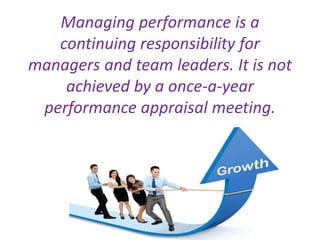
Managing performance is a
continuing responsibility for
managers and team leaders. It is not
achieved by a once-a-year
performance appraisal meeting.
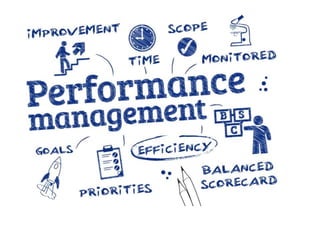
Performance Management
• Performance Management is a continuous
process of identifying, developing and
measuring individuals and teams and aligning
their performance with organizational goals.
Integration in Performance
Management
1. Vertical Integration
2. Functional integration
3. HR Integration
4. Integration of Individual needs
Performance Management Concerns
• Performance Improvement
• Employee development
• Communication and Involvement
• Performance management is a strategic
process because it is forward-looking and
developmental.
• It provides a framework in which managers
can support their team members rather than
dictate to them.
ACR – Annual Confidential Report
• Not a continuous process
• Not a forward looking system, rather
backward looking system.
• Discuss with everyone except the relevant
person.
Problems in ACR System
• Recency effect
• Spill over
• Hollow effect
In ACR, your boss will be your
everything, you will only work to
make him happy.
you are loyal to boss not to
organization
What if you don’t have PMS?
• Organization wont do justice with people.
• Don’t give you rewards you deserve
• Favorable people will get rewards only
• Overall performance of organizations and
individuals decrease
• Less motivation
• High turnover
• High costing because of new hiring
• Misleading information
• Lowered self esteem
• Damaged relationships
• Bad reputation
Why companies don’t go for PMS?
• High Cost
• Fear of losing power
• They think they wont be able to control people.
• Their focus is on controlling people rather than
unleashing them.
Performance Management
Process
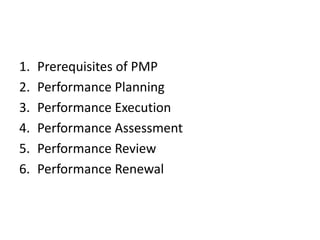
1. Prerequisites of PMP
2. Performance Planning
3. Performance Execution
4. Performance Assessment
5. Performance Review
6. Performance Renewal
1. Prerequisites of PMP
• Starts from Mission and Vision of organization.
• Organizations need to have clarity of vision,
mission, goals and objectives.
• Achieve Vertical Integration
• When you enter the organization, organization
provides you “Job Description”.
• JD contains objectives, tasks, Attitude, skills
and organizational goals.
Where does Job description comes from?
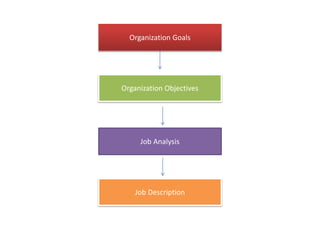
• JD comes from job Analysis (Resourcing
Strategy)
• Importance of job analysis
Organization Goals
Job Description
Job Analysis
Organization Objectives
2. Performance Planning
• Meeting between Employee and supervisor
after hiring.
• Discussion about expected results, behavior
and development plans. (20%, 80%)
• Discuss concerns.
Difference between Performance
Appraisal and Performance
Management
3. Performance Execution
• Employees start performing according to their
job description.
• Employee responsibility are following JD,
alignment with mission, keep communicating
with supervisor, prepare for appraisal
interview.
• Responsibility of Manager: Keep motivating
employees,
• Effective delegation
• Provide resources
4. Performance Assessment
• Self appraisal technique
• 360 degree feedback. Weight age to opinion
of everyone
• Manager’s assessment.
5. Performance Review
• Appraisal meeting
• 45 minutes
• Meeting mode
• Start with good points about employee so that
he opens up.
• Ask him about his self appraisal.
• Identify gaps between desired and real
performance
• After that discuss his weaknesses, ask reasons.
• Find real cause of his bad performance.
• Then manager decides whether he needs any
training, counseling or coaching.
What if employee leave your office
without opening his mouth?
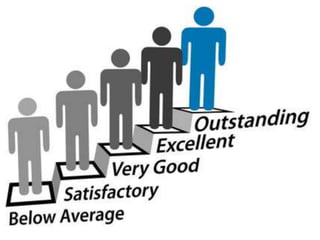
• Grade his performance
• Outstanding
• Satisfactory
• Unsatisfactory
• Decide about rewarding him or anything in
order to motivate him.
6. Performance Renewal
• Improve your system based on people’s
feedback.
• Improve and update yourself
• Exit interviews
Benefits of Performance
Management System
• Transparency
• Merit based rewards
• Chance for improvement (4 Meeting a year)
• Goals accomplishment
• Continuous positive changes
• Timely actions
• High motivation
9 Performance Management
Practices Winners Use
Reading

Strategic Human Resource Management Lecture 11