Performance Appraisals
– Still Relevant?
Neal Chamberlain
So, who is (or was) looking
forward to their performance
appraisal?
Honestly?
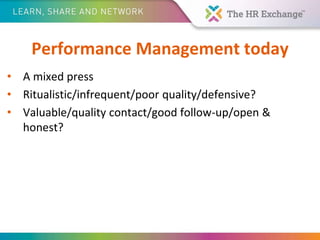
Performance Management today
• A mixed press
• Ritualistic/infrequent/poor quality/defensive?
• Valuable/quality contact/good follow-up/open &
honest?
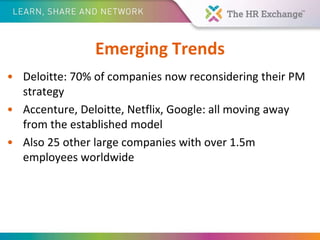
Emerging Trends
• Deloitte: 70% of companies now reconsidering their PM
strategy
• Accenture, Deloitte, Netflix, Google: all moving away
from the established model
• Also 25 other large companies with over 1.5m
employees worldwide
So What’s Happening?
• Global economy – business cycles shortening
• Living in a VUCA world (Volatile, Uncertain, Complex &
Ambiguous)
• Constant change is the new normal
• Needs of Millennials
• Regular, good quality informal contact
Discussion: PM in Your Organisation?
• How you would rate its ‘health’ re. effectiveness?
• Is it valued by staff? Evidence?
• Capability of your managers to deliver it?
Issues with PM: downsides
• The mixed sandwich: start positive, then
developmental/negative feedback/end with positive
• Qualitative & Quantitative
• More left brain organisations will love systems, or ‘if this, then
that’ outcomes – ratings
• More right brain organisations will tend to focus on the quality
of the PM session, on behaviours, on a rounded message
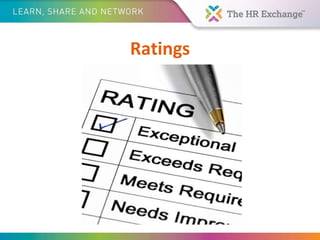
Ratings
Ratings
• Popular in past 20 years
• Clear ‘headline’ message on performance
• A relative measure
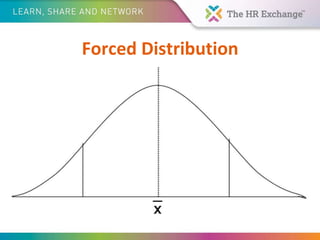
Forced Distribution
Ratings
• Inevitably, most people will be ‘average’, ‘satisfactory’, at
best ‘good’
• Most people are not motivated by being so-described!
• 51 large companies now have removed ratings systems
• Encourages a comparison with others versus a
comparison with self over time
• Research shows this is more effective in motivating to improve
Forced Distribution
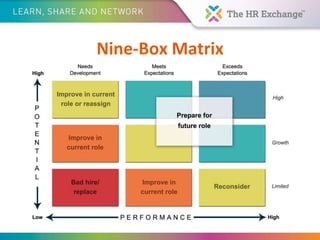
• Ratings can lead to forced distribution, typically in a
nine-box matrix
• Can create a fear culture (‘will you survive next year?’) –
consciously or unconsciously
• Tends to encourage competitive rather than
collaborative behaviours, unless these are specified
• May depend on how adept your manager is in arguing
your case
• But does tend to drive consistency
Nine-Box Matrix
Discussion: To Rate or Not?
• Pros and Cons of ratings
• Managers view?
• Staff view?
• ‘Guide’ or Forced Distribution – experience of either?
• Key learning?
So, What’s the Alternative?
• Strengths-based assessments
• Appreciative Inquiry
• A more coaching-driven approach?
Strengths-based Assessments
• Derived from work of Marcus Buckingham, Gallup ‘Now
Discover your Strengths’ – StrengthsFinder tool
• Emphasizes identifying key strengths & playing to these –
less focus on developmental needs
• May lead to moving on from company if no good fit
(would have happened anyway?)
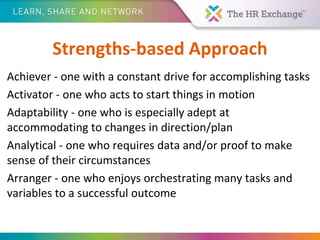
Strengths-based Approach
Achiever - one with a constant drive for accomplishing tasks
Activator - one who acts to start things in motion
Adaptability - one who is especially adept at
accommodating to changes in direction/plan
Analytical - one who requires data and/or proof to make
sense of their circumstances
Arranger - one who enjoys orchestrating many tasks and
variables to a successful outcome
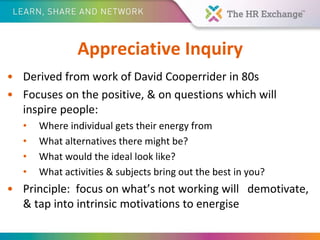
Appreciative Inquiry
• Derived from work of David Cooperrider in 80s
• Focuses on the positive, & on questions which will
inspire people:
• Where individual gets their energy from
• What alternatives there might be?
• What would the ideal look like?
• What activities & subjects bring out the best in you?
• Principle: focus on what’s not working will demotivate,
& tap into intrinsic motivations to energise
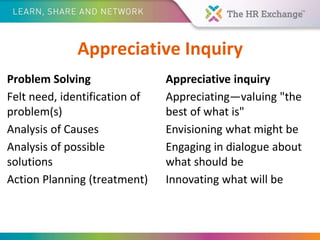
Appreciative Inquiry
Problem Solving
Felt need, identification of
problem(s)
Analysis of Causes
Analysis of possible
solutions
Action Planning (treatment)
Appreciative inquiry
Appreciating—valuing "the
best of what is"
Envisioning what might be
Engaging in dialogue about
what should be
Innovating what will be
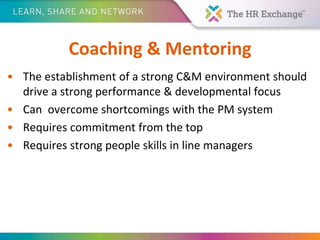
Coaching & Mentoring
• The establishment of a strong C&M environment should
drive a strong performance & developmental focus
• Can overcome shortcomings with the PM system
• Requires commitment from the top
• Requires strong people skills in line managers
But – how to address what’s not working?
• Begin with the individual’s account of performance
• Compare & contrast your own and input from 360
degree feedback/peer ratings?
• Gallup research suggests identified
weaknesses/development areas will often only be
advances to ‘satisfactory’ – i.e. almost never becoming a
strength
Discussion: Alternatives/Add-ons to PM?
• Has your organisation tried any of these, or others?
• How did it go?
• Learning?
• Unintended consequences?
Key Issues with PM
• Probably...the system you use will be determined by the
stage of evolution of the organisation
• Capabilities of line managers – ability/comfort with holding
honest conversations
• What is important in the company/values
• Style of leader
• Current financial performance
Further Issues
• More qualitatively-based reviews
• How to ensure consistency?
• Need to capture key messages in summary document
• HRIS systems which pre-suppose a trad PM system
• Can reconfigure, but at cost
• Priority messages from the top (‘what gets measured...’)
Summary
• Trends emerging which emphasize quality & regular
discussions
• This appears to be in line with needs of younger workers
• Internet-based companies/prof services vs. corporates &
SMEs approach
• Level of development of the enterpirse - & capabilities of
its line managers – may determine the path chosen, &
resulting PM culture
Thank you.
Any questions?
Managing Performance
Peter Byrne
Employment Partner
Taylors Solicitors
Why is managing performance
important?
• Understanding of what business is trying to achieve.
• The employee’s role in achieving goals
• The skills and competencies they need to fulfil their role
• The standards of performance required
• How to develop that performance and contribute to
development
• How they are doing individually
• Identifying performance problems and what to do about
them.
Why is managing performance
important?
• Starts at the recruitment stage – recruit the right people!
• Make clear what the competencies and expectations of
the job are
• Is there a link between performance and pay?
• Can adversely affect the way performance is managed
Why is managing performance
important?
• Employee engagement promotes performance
• Takes pride in their work
• Promotes loyalty to their manager, team and/or the business
• Prepared to go “the extra mile”
• Not just “bottom line” measures such as profit
• Continual management of performance by on-going
dialogue involving both good and bad
• Transmit vision and values
Why is managing performance
important?
• Managers that facilitate and empower rather than control
and restrict
• Show appreciation, respect and commitment to
development
• Reward capabilities
• Allow employees to voice their concerns
• Behaviour throughout the business that is consistent with
stated values leading to trust and integrity.
How to introduce a managing
performance system?
• Get managers fully committed
• Consult with all affected
• Keep people involved
• Make the process fair
• Provide training to those with responsibility to manage
effectively
• Provide clear information about how the scheme
operates
How to introduce a managing
performance system?
• Set out clear objectives in a business plan
• Communicate regularly with employees about the plans
• Clearly identify the role of the line manager.
• Counsel
• Coach
• Check meeting targets
• Putting goals into context
• May need to address sensitive and emotional issues
How to introduce a managing
performance system?
• SMART
• Specific – clear desired outcome
• Measurable – be able to identify the desired outcome
• Achievable – employee should be able to achieve the
outcome
• Relevant –relates to job, team, department
• Timebound – identifies when the outcome is to be
achieved
How to introduce a managing
performance system?
• Examples
• Improve customer satisfaction as far as possible
• Improve overall customer satisfaction by 5% over last
year based upon results of the after sales questionnaire
sent to all customers
• Concentrate on getting as many new customers as you
can
• Recruit 50 new customers before the end of this financial
year
How to introduce a managing
performance system?
• Competencies
• Framework specific to the task in hand, defining what are core
• Knowing the business
• Communicating effectively
• Embracing change
• Focusing on goals
• Developing self and others
• Leadership
• Teamwork
• Creativity
A managing performance system?
• Personal Development Plan
• The development needed
• How this will be achieved
• When it will be achieved
• How it will be measured.
A managing performance system?
• Personal Development plan – opportunities
• Formal training courses
• Further education
• Changing jobs
• Special projects
• Online learning
• Coaching
• Mentoring
• Shadowing
• Helps employees achieve their potential
A managing performance system?
• Performance Reviews
• Regular informal meetings
• Formal interim reviews
• Annual appraisal
• Keep records!!
• Role of self assessment.
• Views of colleagues, subordinates and customers
Underperformance
• Informal Approach
• Regular feedback
• Support and coaching
• Difficult conversations
• Capability/disciplinary action
Underperformance
• Formal action
• Set out in writing
• The performance problem
• The required improvement
• The timescale for improvement
• A review date
• Any support to be provided to assist the employee
• Consequences of failure to improve
Linking pay and rewards to
performance
• Encourages employees to perform at the highest level
• Basic pay rise
• Accelerated progression up a salary scale
• A one-off bonus
• Share options
• Recognition awards
• Development opportunities
• Very sector specific
Linking pay and rewards to
performance
• Vital to ensure that employees do not focus on short term
goals
• Looks back on achievements in the past rather than the
future
• Employees unlikely to admit weaknesses and
development needs if it impacts on pay.
• Make it objective and measurable and well documented
Conclusion
• Develop a system that is right for your business
• Designed to help managers to manage
• Improves performance of individuals and teams
• Essence is the relationship between employee and
manager
• Both should know what needs to be done to meet their
own goals and contribute to those of the business.
Employment Law Update
Nigel Crebbin
Employment Partner
Taylors Solicitors
Unfair dismissal: monitoring
employee’s use of the internet (1)
Barbulescu v Romania
• Barbulescu was an engineer using his employer’s business
Yahoo Messenger to send personal messages
• In breach of his employment contract
• Employer discovered the use accidentally, but then
dismissed him
• Barbulescu argued that evidence of personal messages
infringed his right to privacy
Unfair dismissal: monitoring
employee’s use of the internet (2)
Barbulescu v Romania
• Article 8 was engaged – but court could look at the
evidence in deciding whether the dismissal was fair
• Precise content of personal messages not considered
• Only relied on the fact that they were personal messages
• Need for employers to verify employees completing
professional tasks during working hours
Disability discrimination – meaning of
“day to day” activities
Banaszczyk v Booker
• Claimant was a picker in a distribution centre
• Had long-term back condition
• Required to lift items up to 25kg as part of his job
• Employment Tribunal originally found that this was not a
“normal day to day activity”
• EAT disagreed
• Scope of day to day activities extends to work
Discrimination – instruction to speak
English (1)
Kelly v Covance Laboratories Limited
• Russian born Claimant instructed not to speak Russian at
work
• Left her work station and spoke in Russian on her phone
• Employer concerned she was an animal rights infiltrator
• Company’s language policy operated in the context that
managers needed to understand conversations for
security purposes
Discrimination – instruction to speak
English (2)
Kelly v Covance Laboratories Limited
• Employment Tribunal found the policy was not applied
for reasons of the claimant’s race or national origin
• Was in the context of her behaviour at work in this
particular working environment
• Therefore was not direct discrimination nor harassment
• A comparator speaking any language other than English
would have been treated the same
• No link to national origin - EAT
Holiday pay calculations – part-time
workers increasing hours (1)
Greenfield v The Care Bureau Limited
• Claimant worked varied hours and took 7 days leave
when she was working 1 day a week
• Came back and changed to new hours – 12 days on and 2
off each fortnight
• After employment ended, she claimed a payment for
accrued but untaken annual leave
Holiday pay calculations – part-time
workers increasing hours (2)
Greenfield v The Care Bureau Limited
• ECJ stated annual leave must be calculated in accordance
with work patterns and the hours and days actually
worked
• The taking of leave accrued during one period had no
connection to the working hours in the later period when
the leave is actually taken
• Employer must calculate the leave accrued in each period
Holiday pay calculations – include
results-based commission
British Gas Trading Limited v Lock
• EAT followed approach of EAT in Bear Scotland Limited v
Fulton (which related to holiday pay and overtime) and
decided that the Working Time Regulations should be
interpreted so as to conform with EU law to include
results-based commission in statutory holiday pay
• Bear Scotland was not manifestly wrong and so the EAT
should follow that earlier ruling
Vicarious liability (1)
Mohamud v WM Morrison Supermarkets plc
• Supreme Court decided that Morrisons was vicariously
liable for an employee’s unprovoked violent assault on a
customer
• The Court upheld use of the “close connection” test
• Was there a sufficient connection between the
employee’s position and the employee’s wrongful
conduct to make it right for the employer to be liable?
Vicarious liability (2)
Cox v Ministry of Justice
• Principle of vicarious liability extends beyond the
traditional employer/employee relationship
• Defendant liable where individual carries out activities for
defendant’s benefit as an integral part of its business and
where the defendant, in assigning those activities to the
individual, has created a risk of the tort (i.e. the wrongful
act) being committed
ACAS early conciliation (1)
• When a claim is amended at the Employment Tribunal, is
fresh early conciliation required?
• Science Warehouse Limited v Mills – no, as the claim was
new but related
• Does an error in the identity of the respondent prevent
claim being accepted?
• Mist v Derby Community NHS Trust - no, as the
Employment Tribunal can decide that the claim should
not be rejected
ACAS early conciliation (2)
• Is an Employment Tribunal prevented from adding a
respondent not named on ACAS certificate?
• Drake International Systems Limited v Blue Arrow
Limited
• No – the addition of subsidiary companies is a case
management decision in which the Employment Tribunal
has a discretion
Mitigation of loss
Cooper Contracting v Lindsey
• Carpenter was unfairly dismissed
• Awarded compensation based upon commencing true
self-employment when there were better opportunities
available
• EAT decided that burden of proof is on the wrongdoer
• Claimant has to be shown to have acted unreasonably –
question of fact taking account of the claimant’s views
and wishes
• Losses were not the claimant’s fault
Unpaid awards and settlements
• Penalty notices come into force April 2016
• Government will issue a warning notice
• If still unpaid, employer will be subject to a penalty notice
of 50% of the outstanding amount
• Minimum £100 – maximum £5,000
• Payable to the Secretary of State – not the employee
Disclaimer
The laws in relation to this
presentation are complex and the
presentation, slides and any
accompanying hand-outs are not
legal advice.
Please get in touch…
Peter Byrne
Employment Partner
peter.byrne@taylors.co.uk
07739 945189
01254 297920
Nigel Crebbin
Employment Partner
nigel.crebbin@taylors.co.uk
07967 753663
0161 200 5695
Or find us on LinkedIn

HR-Exchange-presentation-17-03-16.ppt

  • 2.
    Performance Appraisals – StillRelevant? Neal Chamberlain
  • 3.
    So, who is(or was) looking forward to their performance appraisal? Honestly?
  • 4.
    Performance Management today •A mixed press • Ritualistic/infrequent/poor quality/defensive? • Valuable/quality contact/good follow-up/open & honest?
  • 5.
    Emerging Trends • Deloitte:70% of companies now reconsidering their PM strategy • Accenture, Deloitte, Netflix, Google: all moving away from the established model • Also 25 other large companies with over 1.5m employees worldwide
  • 6.
    So What’s Happening? •Global economy – business cycles shortening • Living in a VUCA world (Volatile, Uncertain, Complex & Ambiguous) • Constant change is the new normal • Needs of Millennials • Regular, good quality informal contact
  • 7.
    Discussion: PM inYour Organisation? • How you would rate its ‘health’ re. effectiveness? • Is it valued by staff? Evidence? • Capability of your managers to deliver it?
  • 8.
    Issues with PM:downsides • The mixed sandwich: start positive, then developmental/negative feedback/end with positive • Qualitative & Quantitative • More left brain organisations will love systems, or ‘if this, then that’ outcomes – ratings • More right brain organisations will tend to focus on the quality of the PM session, on behaviours, on a rounded message
  • 9.
  • 10.
    Ratings • Popular inpast 20 years • Clear ‘headline’ message on performance • A relative measure
  • 11.
  • 12.
    Ratings • Inevitably, mostpeople will be ‘average’, ‘satisfactory’, at best ‘good’ • Most people are not motivated by being so-described! • 51 large companies now have removed ratings systems • Encourages a comparison with others versus a comparison with self over time • Research shows this is more effective in motivating to improve
  • 13.
    Forced Distribution • Ratingscan lead to forced distribution, typically in a nine-box matrix • Can create a fear culture (‘will you survive next year?’) – consciously or unconsciously • Tends to encourage competitive rather than collaborative behaviours, unless these are specified • May depend on how adept your manager is in arguing your case • But does tend to drive consistency
  • 14.
  • 15.
    Discussion: To Rateor Not? • Pros and Cons of ratings • Managers view? • Staff view? • ‘Guide’ or Forced Distribution – experience of either? • Key learning?
  • 16.
    So, What’s theAlternative? • Strengths-based assessments • Appreciative Inquiry • A more coaching-driven approach?
  • 17.
    Strengths-based Assessments • Derivedfrom work of Marcus Buckingham, Gallup ‘Now Discover your Strengths’ – StrengthsFinder tool • Emphasizes identifying key strengths & playing to these – less focus on developmental needs • May lead to moving on from company if no good fit (would have happened anyway?)
  • 18.
    Strengths-based Approach Achiever -one with a constant drive for accomplishing tasks Activator - one who acts to start things in motion Adaptability - one who is especially adept at accommodating to changes in direction/plan Analytical - one who requires data and/or proof to make sense of their circumstances Arranger - one who enjoys orchestrating many tasks and variables to a successful outcome
  • 19.
    Appreciative Inquiry • Derivedfrom work of David Cooperrider in 80s • Focuses on the positive, & on questions which will inspire people: • Where individual gets their energy from • What alternatives there might be? • What would the ideal look like? • What activities & subjects bring out the best in you? • Principle: focus on what’s not working will demotivate, & tap into intrinsic motivations to energise
  • 20.
    Appreciative Inquiry Problem Solving Feltneed, identification of problem(s) Analysis of Causes Analysis of possible solutions Action Planning (treatment) Appreciative inquiry Appreciating—valuing "the best of what is" Envisioning what might be Engaging in dialogue about what should be Innovating what will be
  • 21.
    Coaching & Mentoring •The establishment of a strong C&M environment should drive a strong performance & developmental focus • Can overcome shortcomings with the PM system • Requires commitment from the top • Requires strong people skills in line managers
  • 22.
    But – howto address what’s not working? • Begin with the individual’s account of performance • Compare & contrast your own and input from 360 degree feedback/peer ratings? • Gallup research suggests identified weaknesses/development areas will often only be advances to ‘satisfactory’ – i.e. almost never becoming a strength
  • 23.
    Discussion: Alternatives/Add-ons toPM? • Has your organisation tried any of these, or others? • How did it go? • Learning? • Unintended consequences?
  • 24.
    Key Issues withPM • Probably...the system you use will be determined by the stage of evolution of the organisation • Capabilities of line managers – ability/comfort with holding honest conversations • What is important in the company/values • Style of leader • Current financial performance
  • 25.
    Further Issues • Morequalitatively-based reviews • How to ensure consistency? • Need to capture key messages in summary document • HRIS systems which pre-suppose a trad PM system • Can reconfigure, but at cost • Priority messages from the top (‘what gets measured...’)
  • 26.
    Summary • Trends emergingwhich emphasize quality & regular discussions • This appears to be in line with needs of younger workers • Internet-based companies/prof services vs. corporates & SMEs approach • Level of development of the enterpirse - & capabilities of its line managers – may determine the path chosen, & resulting PM culture
  • 27.
  • 28.
  • 29.
    Why is managingperformance important? • Understanding of what business is trying to achieve. • The employee’s role in achieving goals • The skills and competencies they need to fulfil their role • The standards of performance required • How to develop that performance and contribute to development • How they are doing individually • Identifying performance problems and what to do about them.
  • 30.
    Why is managingperformance important? • Starts at the recruitment stage – recruit the right people! • Make clear what the competencies and expectations of the job are • Is there a link between performance and pay? • Can adversely affect the way performance is managed
  • 31.
    Why is managingperformance important? • Employee engagement promotes performance • Takes pride in their work • Promotes loyalty to their manager, team and/or the business • Prepared to go “the extra mile” • Not just “bottom line” measures such as profit • Continual management of performance by on-going dialogue involving both good and bad • Transmit vision and values
  • 32.
    Why is managingperformance important? • Managers that facilitate and empower rather than control and restrict • Show appreciation, respect and commitment to development • Reward capabilities • Allow employees to voice their concerns • Behaviour throughout the business that is consistent with stated values leading to trust and integrity.
  • 33.
    How to introducea managing performance system? • Get managers fully committed • Consult with all affected • Keep people involved • Make the process fair • Provide training to those with responsibility to manage effectively • Provide clear information about how the scheme operates
  • 34.
    How to introducea managing performance system? • Set out clear objectives in a business plan • Communicate regularly with employees about the plans • Clearly identify the role of the line manager. • Counsel • Coach • Check meeting targets • Putting goals into context • May need to address sensitive and emotional issues
  • 35.
    How to introducea managing performance system? • SMART • Specific – clear desired outcome • Measurable – be able to identify the desired outcome • Achievable – employee should be able to achieve the outcome • Relevant –relates to job, team, department • Timebound – identifies when the outcome is to be achieved
  • 36.
    How to introducea managing performance system? • Examples • Improve customer satisfaction as far as possible • Improve overall customer satisfaction by 5% over last year based upon results of the after sales questionnaire sent to all customers • Concentrate on getting as many new customers as you can • Recruit 50 new customers before the end of this financial year
  • 37.
    How to introducea managing performance system? • Competencies • Framework specific to the task in hand, defining what are core • Knowing the business • Communicating effectively • Embracing change • Focusing on goals • Developing self and others • Leadership • Teamwork • Creativity
  • 38.
    A managing performancesystem? • Personal Development Plan • The development needed • How this will be achieved • When it will be achieved • How it will be measured.
  • 39.
    A managing performancesystem? • Personal Development plan – opportunities • Formal training courses • Further education • Changing jobs • Special projects • Online learning • Coaching • Mentoring • Shadowing • Helps employees achieve their potential
  • 40.
    A managing performancesystem? • Performance Reviews • Regular informal meetings • Formal interim reviews • Annual appraisal • Keep records!! • Role of self assessment. • Views of colleagues, subordinates and customers
  • 41.
    Underperformance • Informal Approach •Regular feedback • Support and coaching • Difficult conversations • Capability/disciplinary action
  • 42.
    Underperformance • Formal action •Set out in writing • The performance problem • The required improvement • The timescale for improvement • A review date • Any support to be provided to assist the employee • Consequences of failure to improve
  • 43.
    Linking pay andrewards to performance • Encourages employees to perform at the highest level • Basic pay rise • Accelerated progression up a salary scale • A one-off bonus • Share options • Recognition awards • Development opportunities • Very sector specific
  • 44.
    Linking pay andrewards to performance • Vital to ensure that employees do not focus on short term goals • Looks back on achievements in the past rather than the future • Employees unlikely to admit weaknesses and development needs if it impacts on pay. • Make it objective and measurable and well documented
  • 45.
    Conclusion • Develop asystem that is right for your business • Designed to help managers to manage • Improves performance of individuals and teams • Essence is the relationship between employee and manager • Both should know what needs to be done to meet their own goals and contribute to those of the business.
  • 46.
    Employment Law Update NigelCrebbin Employment Partner Taylors Solicitors
  • 47.
    Unfair dismissal: monitoring employee’suse of the internet (1) Barbulescu v Romania • Barbulescu was an engineer using his employer’s business Yahoo Messenger to send personal messages • In breach of his employment contract • Employer discovered the use accidentally, but then dismissed him • Barbulescu argued that evidence of personal messages infringed his right to privacy
  • 48.
    Unfair dismissal: monitoring employee’suse of the internet (2) Barbulescu v Romania • Article 8 was engaged – but court could look at the evidence in deciding whether the dismissal was fair • Precise content of personal messages not considered • Only relied on the fact that they were personal messages • Need for employers to verify employees completing professional tasks during working hours
  • 49.
    Disability discrimination –meaning of “day to day” activities Banaszczyk v Booker • Claimant was a picker in a distribution centre • Had long-term back condition • Required to lift items up to 25kg as part of his job • Employment Tribunal originally found that this was not a “normal day to day activity” • EAT disagreed • Scope of day to day activities extends to work
  • 50.
    Discrimination – instructionto speak English (1) Kelly v Covance Laboratories Limited • Russian born Claimant instructed not to speak Russian at work • Left her work station and spoke in Russian on her phone • Employer concerned she was an animal rights infiltrator • Company’s language policy operated in the context that managers needed to understand conversations for security purposes
  • 51.
    Discrimination – instructionto speak English (2) Kelly v Covance Laboratories Limited • Employment Tribunal found the policy was not applied for reasons of the claimant’s race or national origin • Was in the context of her behaviour at work in this particular working environment • Therefore was not direct discrimination nor harassment • A comparator speaking any language other than English would have been treated the same • No link to national origin - EAT
  • 52.
    Holiday pay calculations– part-time workers increasing hours (1) Greenfield v The Care Bureau Limited • Claimant worked varied hours and took 7 days leave when she was working 1 day a week • Came back and changed to new hours – 12 days on and 2 off each fortnight • After employment ended, she claimed a payment for accrued but untaken annual leave
  • 53.
    Holiday pay calculations– part-time workers increasing hours (2) Greenfield v The Care Bureau Limited • ECJ stated annual leave must be calculated in accordance with work patterns and the hours and days actually worked • The taking of leave accrued during one period had no connection to the working hours in the later period when the leave is actually taken • Employer must calculate the leave accrued in each period
  • 54.
    Holiday pay calculations– include results-based commission British Gas Trading Limited v Lock • EAT followed approach of EAT in Bear Scotland Limited v Fulton (which related to holiday pay and overtime) and decided that the Working Time Regulations should be interpreted so as to conform with EU law to include results-based commission in statutory holiday pay • Bear Scotland was not manifestly wrong and so the EAT should follow that earlier ruling
  • 55.
    Vicarious liability (1) Mohamudv WM Morrison Supermarkets plc • Supreme Court decided that Morrisons was vicariously liable for an employee’s unprovoked violent assault on a customer • The Court upheld use of the “close connection” test • Was there a sufficient connection between the employee’s position and the employee’s wrongful conduct to make it right for the employer to be liable?
  • 56.
    Vicarious liability (2) Coxv Ministry of Justice • Principle of vicarious liability extends beyond the traditional employer/employee relationship • Defendant liable where individual carries out activities for defendant’s benefit as an integral part of its business and where the defendant, in assigning those activities to the individual, has created a risk of the tort (i.e. the wrongful act) being committed
  • 57.
    ACAS early conciliation(1) • When a claim is amended at the Employment Tribunal, is fresh early conciliation required? • Science Warehouse Limited v Mills – no, as the claim was new but related • Does an error in the identity of the respondent prevent claim being accepted? • Mist v Derby Community NHS Trust - no, as the Employment Tribunal can decide that the claim should not be rejected
  • 58.
    ACAS early conciliation(2) • Is an Employment Tribunal prevented from adding a respondent not named on ACAS certificate? • Drake International Systems Limited v Blue Arrow Limited • No – the addition of subsidiary companies is a case management decision in which the Employment Tribunal has a discretion
  • 59.
    Mitigation of loss CooperContracting v Lindsey • Carpenter was unfairly dismissed • Awarded compensation based upon commencing true self-employment when there were better opportunities available • EAT decided that burden of proof is on the wrongdoer • Claimant has to be shown to have acted unreasonably – question of fact taking account of the claimant’s views and wishes • Losses were not the claimant’s fault
  • 60.
    Unpaid awards andsettlements • Penalty notices come into force April 2016 • Government will issue a warning notice • If still unpaid, employer will be subject to a penalty notice of 50% of the outstanding amount • Minimum £100 – maximum £5,000 • Payable to the Secretary of State – not the employee
  • 61.
    Disclaimer The laws inrelation to this presentation are complex and the presentation, slides and any accompanying hand-outs are not legal advice.
  • 62.
    Please get intouch… Peter Byrne Employment Partner peter.byrne@taylors.co.uk 07739 945189 01254 297920 Nigel Crebbin Employment Partner nigel.crebbin@taylors.co.uk 07967 753663 0161 200 5695 Or find us on LinkedIn