SUBMITTED BY
S.SAIHARITHA
148949
INTRODUCTION
Organisation development is a systematic ,integrated
&planned approach to improve effectiveness of the enterprise
It is to designed to solve problems that adversely effect the
operational efficiency at all levels
OD encompasses the a collection of planned-changed
interventions built on humanistic democratic value seek to
improve effectiveness &employee well being
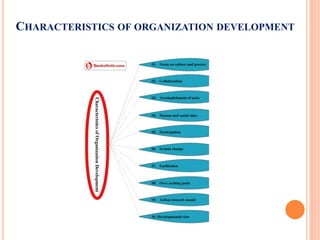
CHARACTERISTICS OF ORGANIZATION DEVELOPMENT
OBJECTIVES OF OD:
 Improve organisational performance as measured by
profitability, market share, innovativeness, etc.
 Make organisations better adaptive to its environment which
always keeps on changing.
 Make the members willing face organisational problems and
contribute creative solutions to the organisational problems.
 Improve internal behaviour patterns such as interpersonal
relations, intergroup relations, level of trust and support among
the role players.
 Understand own self and others, openness and meaningful
communication and involvement in planning for organisational
development.
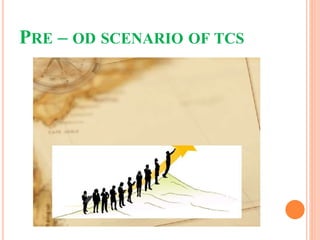
PRE – OD SCENARIO OF TCS
STRENGTHS
 In the yr 1998-99,Tcs has grown into the largest
Indian software company
 Racing towards achieving its vision of being
global top ten.
 On time delivery,
 Premier position in the industry in terms of
revenues,
 Focus on training programs,Quality initiatives,
 Use of good technical tools and procedures and
 Encouragement of individual excellence in
performance.
DIAGONISED PROBLEMS
 Mounting revenue pressures.
 Selectivity in projects.
 Focus on specialization.
 Efforts on Experimentation & Innovation.
 Rewards and Recognitions.
 Inter group co-ordination & knowledge sharing.
 Branding and PR.
ALIGNMENT AND ATTUNEMENT
 Integrating and balancing out the four voices:
 Voice of Shareholders
 Voice of Employee
 Voice of Customer
 Voice of Technology
OD INTERVENTIONS
 A team that refers to a set of sequenced ,planned
actions or events intended to help an organization
to increase it’s effectiveness .Intervention.s
purposely disrupts the Status quo
INDIVIDUAL INTERVENTIONS
 Coaching
 Training and Development
 Process Consultation and Team Building
 Third-party Interventions (Conflict Resolution)
 Organization Confrontation Meeting
 Intergroup Relationships
 Large-group Interventions
INDIVIDUAL INTERVENTIONS AT TCS
 Internal organization workshop was conducted with top
management for scenario building. Focused at a larger level,
on the “The TCS that can be”.
 Aim:
 To challenge the conventional ways of thinking and to give
shape to the key drivers of change .
 Realistic listening and dialoguing.
 Dissemination and communication of the scenarios with
teams.
 To develop a new language for the organization,consistent
with the envisaged future scenario.
INDIVIDUAL INTERVENTIONS AT TCS
 Participants:
 Representatives of senior management.
 Theme of Scenarios:
 The nature of the struggle the organization would go
through and etched out realistic possibilities based on
present factors.
 Factors:
 Wealth creation
 Enhanced productivity factors
 Feeling of being valued
 Resource allocation and team-work
 Membership criteria and norms of the group
 Learning opportunities for individuals and teams
PROPEL – THE CASE OF A LARGE
RELATIONSHIP AT TCS
 Team alignment initiative
 Aim:
 To set up a dialogue among associates to reflect ,
build and channel potent restlessness into a
convergent blueprint of responsiveness by redefining
desirable role behaviours.
GOAL ALIGNMENT & BALANCED SCORECARD
 A Teach-Train-Transfer workshop on Goal alignment
was conducted, with help fromexpert OD consultants:
 To build the context.
 To think through goal setting at TCS with a systems
perspective to goal alignment.
 To explore means of institutionalizing goal-oriented
performance management within the organization.
DARPAN - REFLECT AND IMPROVE
 Darpan – Associate Satisfaction Survey for
large relationship.
 The Questionnaire to capture associate feedback
across 5categories:
 Career & Job, Communication, Culture &
Pride, Leadership, Supervisor.
 Analysis was done for the overall relationship, as
well as individual Business Units within the
relationship.
 Results shared with the entire team and actionable
evolved through a series of camps and
confluences.
OUTCOMES FROM DARPAN : THECULTURAL
PERSPECTIVE
 ASI increase in Darpan 06 &
correspondingincrease in CSI.
 91 % of the team felt proud of being part of
therelationship.
 90% of the team felt that they can see the big
picture -how their contributions add value
to customer.
 90% of the team felt that their supervisors are
approachable & enable them to do their job better
OTHER OD INTERVENTIONS
 Nakshatra award:Reward and Recognition
initiative within the relationship.
 Awarded to encourage star performers for
eachmonth within each business unit
 In Touch:Any employee can walk in to meet the
lead anddiscuss out any problems/ suggestions
for improvement in the relationship.
 Toast MasterClub/Lets Talk:To enhance
personality/communication abilityof associates in
the relationship .
 To help them gain confidence through sessions by
certified facilitators.
POST OD SCENARIO FROM A CULTURE PERSPECTIVE
 Organizational Development interventions have been
instrumental in terms of enhancing value to the customer &
employee at Tata Consultancy Services.
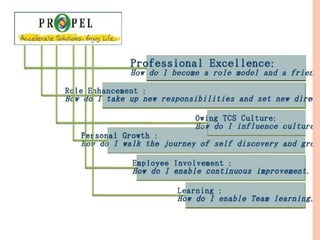
 PROPEL
 - encouraged sharing of ownership and empowerment to
change, as also the sharing of success stories and best
practices across the organization.
 Valuing of employees was institutionalized through
establishing processes that enable and enhance individual
performance, and lead to empowered project teams.
 Issue based mentoring was facilitated, with camps and
confluences as enabling frameworks.
 Confluences invested in personal transformation for the
employee, camps invested in improving the workspace.
 Through Scenario building, a collective transformation of
dreams and concernsinto response capabilities was
envisaged.
POST OD SCENARIO FROM A CULTURE
PERSPECTIVE
 The earlier tendency of self-sacrificing hard work
was replaced bya shift of focus to teamwork and
valuing of the employee.
 Helped push self imposed boundaries and
limitations through challenging organizational
boundaries and limitations constantly.
 Continuously scanning for environment
opportunities are looked at
CONCLUSION
 OD interventions at TCS have helped build aculture of
fostering systems thinking.
 Creating forums for dialogue.
 Encouraging leadership at all levels.
REFERECES
 http://www.slideshare.net/DarylTabogoc/od-
interventions-19344070
 http://www.yourarticlelibrary.com/organization/organ
isation-development-meaning-characteristics-and-
objectives/35318/
 http://www.slideshare.net/manumelwin/the-od-
journey-of-tcs-case-study
Presentation1 ocd

Presentation1 ocd

  • 1.
  • 2.
    INTRODUCTION Organisation development isa systematic ,integrated &planned approach to improve effectiveness of the enterprise It is to designed to solve problems that adversely effect the operational efficiency at all levels OD encompasses the a collection of planned-changed interventions built on humanistic democratic value seek to improve effectiveness &employee well being
  • 3.
  • 4.
    OBJECTIVES OF OD: Improve organisational performance as measured by profitability, market share, innovativeness, etc.  Make organisations better adaptive to its environment which always keeps on changing.  Make the members willing face organisational problems and contribute creative solutions to the organisational problems.  Improve internal behaviour patterns such as interpersonal relations, intergroup relations, level of trust and support among the role players.  Understand own self and others, openness and meaningful communication and involvement in planning for organisational development.
  • 5.
    PRE – ODSCENARIO OF TCS
  • 6.
    STRENGTHS  In theyr 1998-99,Tcs has grown into the largest Indian software company  Racing towards achieving its vision of being global top ten.  On time delivery,  Premier position in the industry in terms of revenues,  Focus on training programs,Quality initiatives,  Use of good technical tools and procedures and  Encouragement of individual excellence in performance.
  • 7.
    DIAGONISED PROBLEMS  Mountingrevenue pressures.  Selectivity in projects.  Focus on specialization.  Efforts on Experimentation & Innovation.  Rewards and Recognitions.  Inter group co-ordination & knowledge sharing.  Branding and PR.
  • 8.
    ALIGNMENT AND ATTUNEMENT Integrating and balancing out the four voices:  Voice of Shareholders  Voice of Employee  Voice of Customer  Voice of Technology
  • 9.
    OD INTERVENTIONS  Ateam that refers to a set of sequenced ,planned actions or events intended to help an organization to increase it’s effectiveness .Intervention.s purposely disrupts the Status quo
  • 10.
    INDIVIDUAL INTERVENTIONS  Coaching Training and Development  Process Consultation and Team Building  Third-party Interventions (Conflict Resolution)  Organization Confrontation Meeting  Intergroup Relationships  Large-group Interventions
  • 11.
    INDIVIDUAL INTERVENTIONS ATTCS  Internal organization workshop was conducted with top management for scenario building. Focused at a larger level, on the “The TCS that can be”.  Aim:  To challenge the conventional ways of thinking and to give shape to the key drivers of change .  Realistic listening and dialoguing.  Dissemination and communication of the scenarios with teams.  To develop a new language for the organization,consistent with the envisaged future scenario.
  • 12.
    INDIVIDUAL INTERVENTIONS ATTCS  Participants:  Representatives of senior management.  Theme of Scenarios:  The nature of the struggle the organization would go through and etched out realistic possibilities based on present factors.  Factors:  Wealth creation  Enhanced productivity factors  Feeling of being valued  Resource allocation and team-work  Membership criteria and norms of the group  Learning opportunities for individuals and teams
  • 14.
    PROPEL – THECASE OF A LARGE RELATIONSHIP AT TCS  Team alignment initiative  Aim:  To set up a dialogue among associates to reflect , build and channel potent restlessness into a convergent blueprint of responsiveness by redefining desirable role behaviours.
  • 15.
    GOAL ALIGNMENT &BALANCED SCORECARD  A Teach-Train-Transfer workshop on Goal alignment was conducted, with help fromexpert OD consultants:  To build the context.  To think through goal setting at TCS with a systems perspective to goal alignment.  To explore means of institutionalizing goal-oriented performance management within the organization.
  • 16.
    DARPAN - REFLECTAND IMPROVE  Darpan – Associate Satisfaction Survey for large relationship.  The Questionnaire to capture associate feedback across 5categories:  Career & Job, Communication, Culture & Pride, Leadership, Supervisor.  Analysis was done for the overall relationship, as well as individual Business Units within the relationship.  Results shared with the entire team and actionable evolved through a series of camps and confluences.
  • 17.
    OUTCOMES FROM DARPAN: THECULTURAL PERSPECTIVE  ASI increase in Darpan 06 & correspondingincrease in CSI.  91 % of the team felt proud of being part of therelationship.  90% of the team felt that they can see the big picture -how their contributions add value to customer.  90% of the team felt that their supervisors are approachable & enable them to do their job better
  • 18.
    OTHER OD INTERVENTIONS Nakshatra award:Reward and Recognition initiative within the relationship.  Awarded to encourage star performers for eachmonth within each business unit  In Touch:Any employee can walk in to meet the lead anddiscuss out any problems/ suggestions for improvement in the relationship.  Toast MasterClub/Lets Talk:To enhance personality/communication abilityof associates in the relationship .  To help them gain confidence through sessions by certified facilitators.
  • 19.
    POST OD SCENARIOFROM A CULTURE PERSPECTIVE  Organizational Development interventions have been instrumental in terms of enhancing value to the customer & employee at Tata Consultancy Services.  PROPEL  - encouraged sharing of ownership and empowerment to change, as also the sharing of success stories and best practices across the organization.  Valuing of employees was institutionalized through establishing processes that enable and enhance individual performance, and lead to empowered project teams.  Issue based mentoring was facilitated, with camps and confluences as enabling frameworks.  Confluences invested in personal transformation for the employee, camps invested in improving the workspace.  Through Scenario building, a collective transformation of dreams and concernsinto response capabilities was envisaged.
  • 20.
    POST OD SCENARIOFROM A CULTURE PERSPECTIVE  The earlier tendency of self-sacrificing hard work was replaced bya shift of focus to teamwork and valuing of the employee.  Helped push self imposed boundaries and limitations through challenging organizational boundaries and limitations constantly.  Continuously scanning for environment opportunities are looked at
  • 21.
    CONCLUSION  OD interventionsat TCS have helped build aculture of fostering systems thinking.  Creating forums for dialogue.  Encouraging leadership at all levels.
  • 22.