Strategies for Change

Evolution
Encourages a continuous learning environment

The evolutionary model emphasises small incremental changes.
It is a learning organisation with the capability of creating something new in a step by
step process.
Change in general can cause confusion and can be resisted if the culture of the
organisation is familiar with incremental change only.

The workers are not given enough opportunity to apply their learning

‘all but incremental change is resisted’.(Pettigrew,1985)
What is Kaizen?
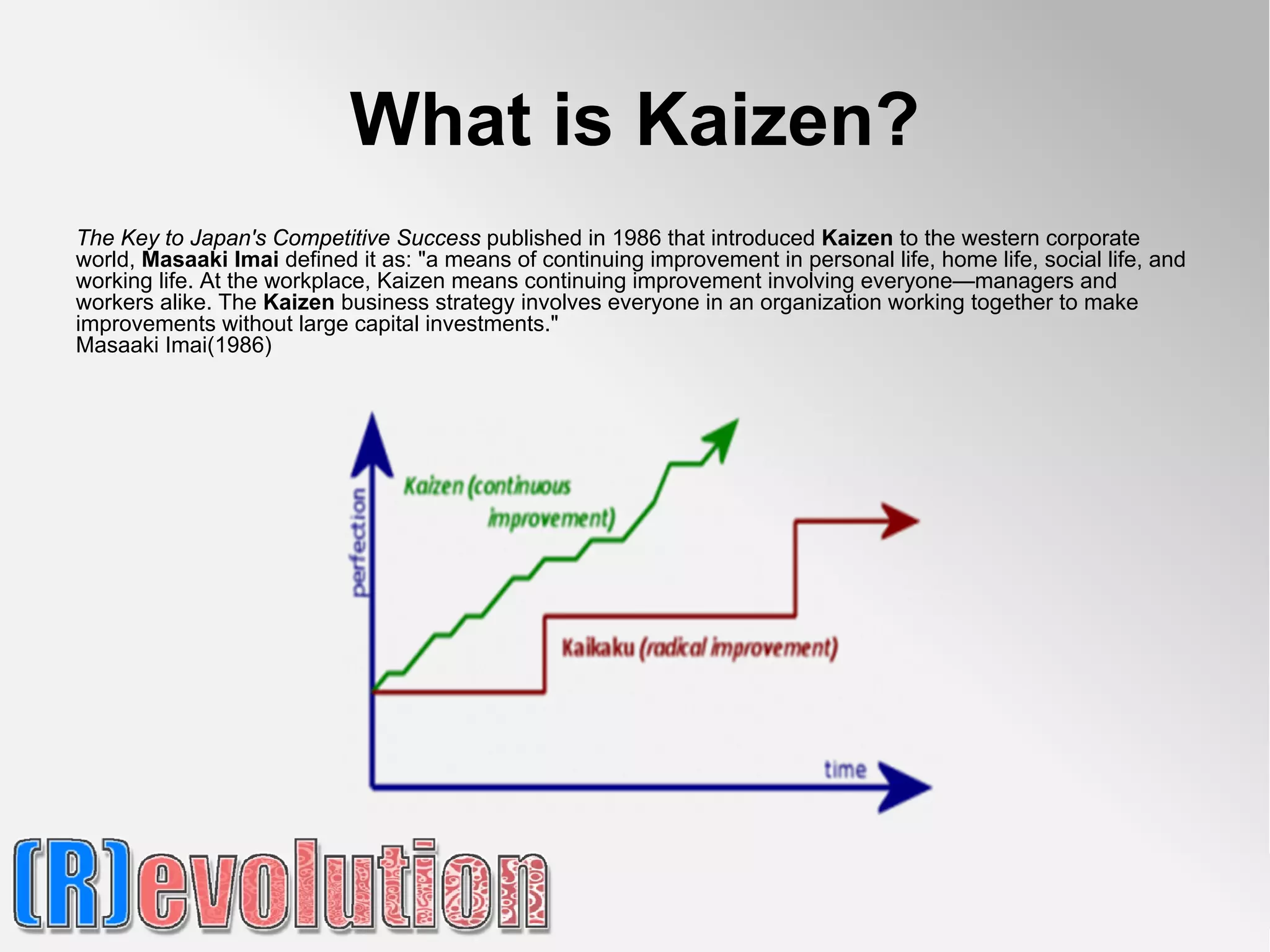
The Key to Japan's Competitive Success published in 1986 that introduced Kaizen to the western corporate
world, Masaaki Imai defined it as: "a means of continuing improvement in personal life, home life, social life, and
working life. At the workplace, Kaizen means continuing improvement involving everyone—managers and
workers alike. The Kaizen business strategy involves everyone in an organization working together to make
improvements without large capital investments."
Masaaki Imai(1986)
The Evolutionary Change Process

• The firm is the starting point
• Evolution is a constant stream process of gradual changes
• It is a metamorphosis of long-term organisational learning
• Learning is a slow process which can be new skills, processes,
  experiment, test and discuss
• Organisational learning power is dispersed
• Management recognise that the firm has to continuously learn
  and adapt
• Management do not have the absolute power to impose
  dramatic revolutionary change but must continue with the
  evolutionary change process
Kaizen

Kaizen is a system that involves every employee - from
upper management to the cleaning crew. Everyone is
encouraged to come up with small improvement
suggestions on a regular basis. This is not a once a
month or once a year activity. It is continuous. Japanese
companies, such as Toyota and Canon, a total of 60 to 70
suggestions per employee per year are written down,
shared and implemented.
Perspectives On Strategic Change

• Evolutionary change is necessary to ensure continuity
  in the renewal process
• Gradual mutation and selection
• Continuous renewal is a marathon and not won by
  good sprinters
• Continuous renewal in a long-term approach
• Requires commitment from motivated employees
  willing to learn and adapt to gradual change
What are the Kaizen Principles

• Human resources are a company's most
  important asset
• Processes must evolve by gradual improvement
  rather than by radical change
• Improvement must be based on a quantitative
  evaluation of the performance of different
  processes. It is aimed at management
Kaizen 5S’s
• The Five S's relate to the visual workplace
• Sort – Clean up and organise and throw away items
  not required
• Set in order: Organise, identify and arrange
  everything in a work area
• Shine- Regular cleaning and maintenance
• Standardise- Make it easy to maintain - simplify and
  standardise
• Sustain -Maintain what has been accomplished
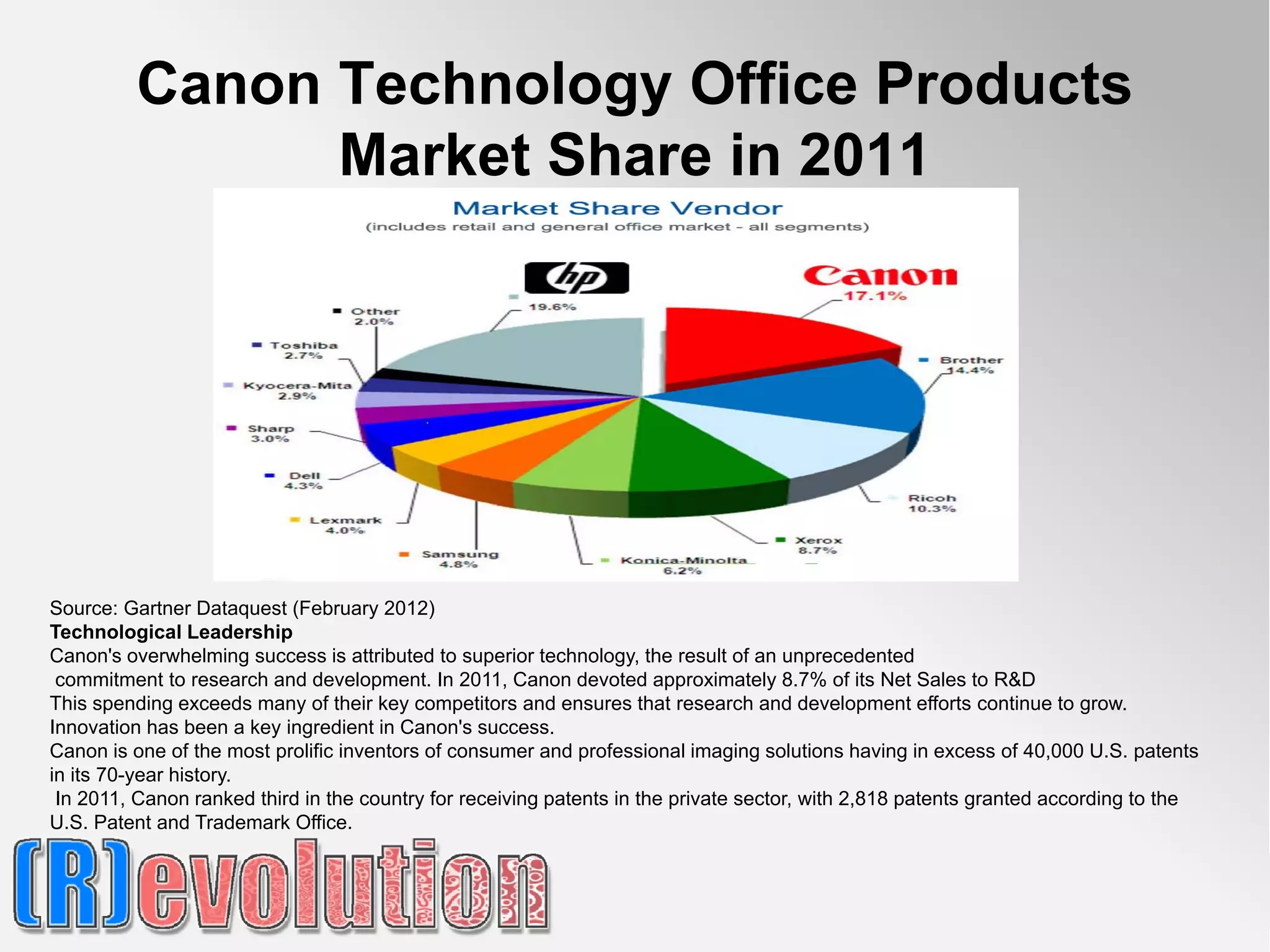
Canon Technology Office Products
               Market Share in 2011


Source: Gartner Dataquest (February 2012)
Technological Leadership
Canon's overwhelming success is attributed to superior technology, the result of an unprecedented
 commitment to research and development. In 2011, Canon devoted approximately 8.7% of its Net Sales to R&D
This spending exceeds many of their key competitors and ensures that research and development efforts continue to grow.
Innovation has been a key ingredient in Canon's success.
Canon is one of the most prolific inventors of consumer and professional imaging solutions having in excess of 40,000 U.S. patents
in its 70-year history.
 In 2011, Canon ranked third in the country for receiving patents in the private sector, with 2,818 patents granted according to the
U.S. Patent and Trademark Office.
Management & Kaizen
• Kaizen Event” where managers and employees work together to fine-tune and
  revise the current standards. Once a more efficient and superior system is
  achieved, it is then standardized and integrated into current policies, rules, and
  Standard Operating Procedures (SOPs).
• When you implement Kaizen into the workplace, you should aspire to make
  changes to your current operating standards by breaking down each process in
  detail, monitoring the results, and then making adjustments accordingly (“If it ain’t
  broke, Do fix it”).
• Your management team should ensure that the current SOPs are being followed.
  Management must “go and see” operations, or MBWA (management by walking
  around), in order to achieve efficient operations and take corrective actions when
  required. That is the only way they can fully understand their current business
  climate and make educated adjustments.
Advantages of Kaizen
These continual small improvements add up to major benefits. They result in improved
 productivity, improved quality, better safety, faster delivery, lower costs, and greater customer
 satisfaction. On top of these benefits to the company, employees working in Kaizen-based
 companies generally find work to be easier and more enjoyable—resulting in higher employee
 moral and job satisfaction, and lower turn-over.

With every employee looking for ways to make improvements, you can expect results such as:

• Kaizen Reduces Waste in areas such as inventory, waiting times, transportation, worker
  motion, employee skills, over production, excess quality and in processes.
• Kaizen Improves space utilization, product quality, use of capital, communications, production
  capacity and employee retention.
• Kaizen Provides immediate results. Instead of focusing on large, capital intensive
  improvements, Kaizen focuses on creative investments that continually solve large numbers of
  small problems. Large, capital projects and major changes will still be needed, and Kaizen will
  also improve the capital projects process, but the real power of Kaizen is in the on-going
  process of continually making small improvements that improve processes and reduce waste.
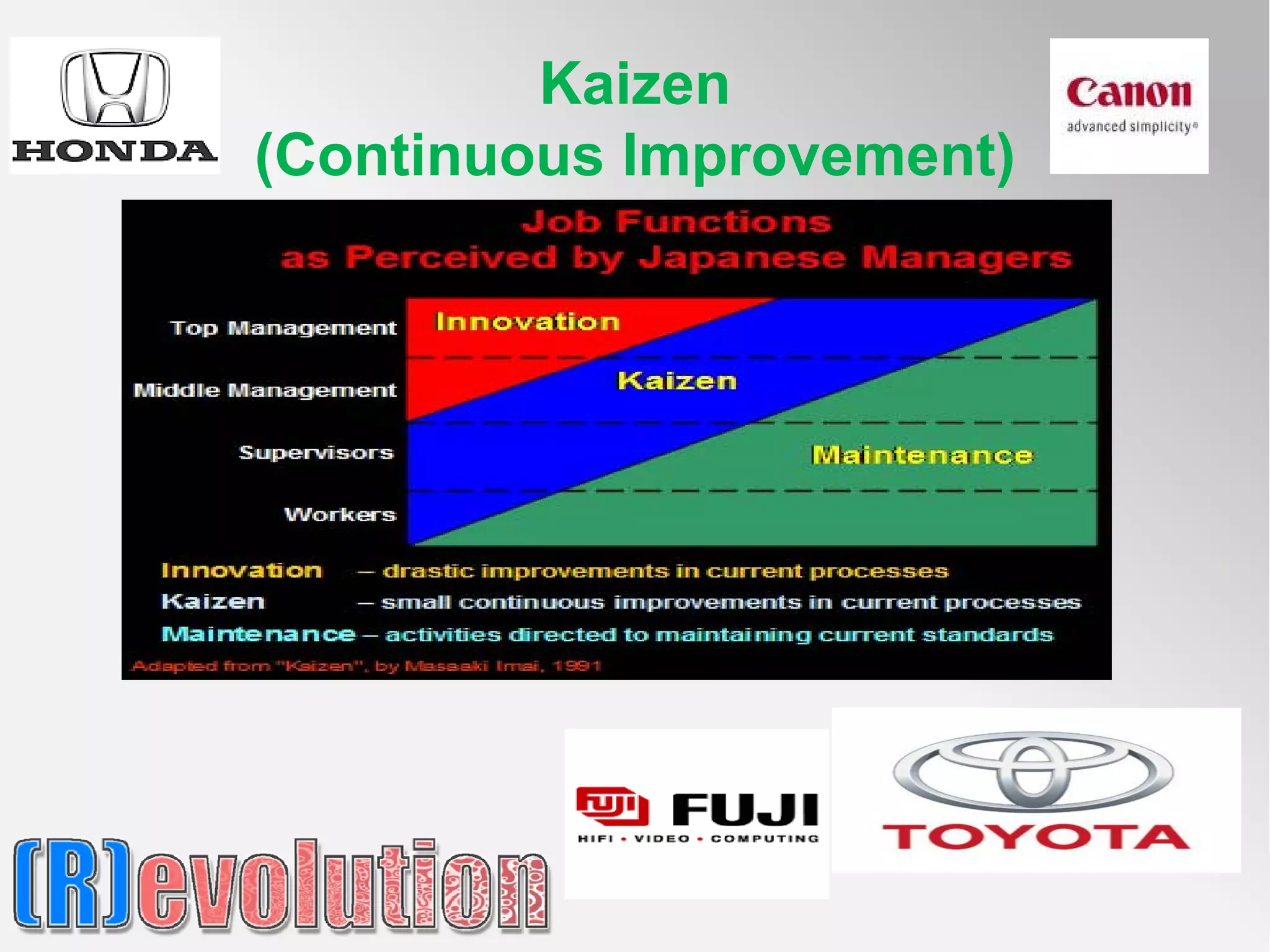
Kaizen
(Continuous Improvement)
Kaizen
Patterns
• Human Effort
• Material
• Machine
• Scientific Method Based
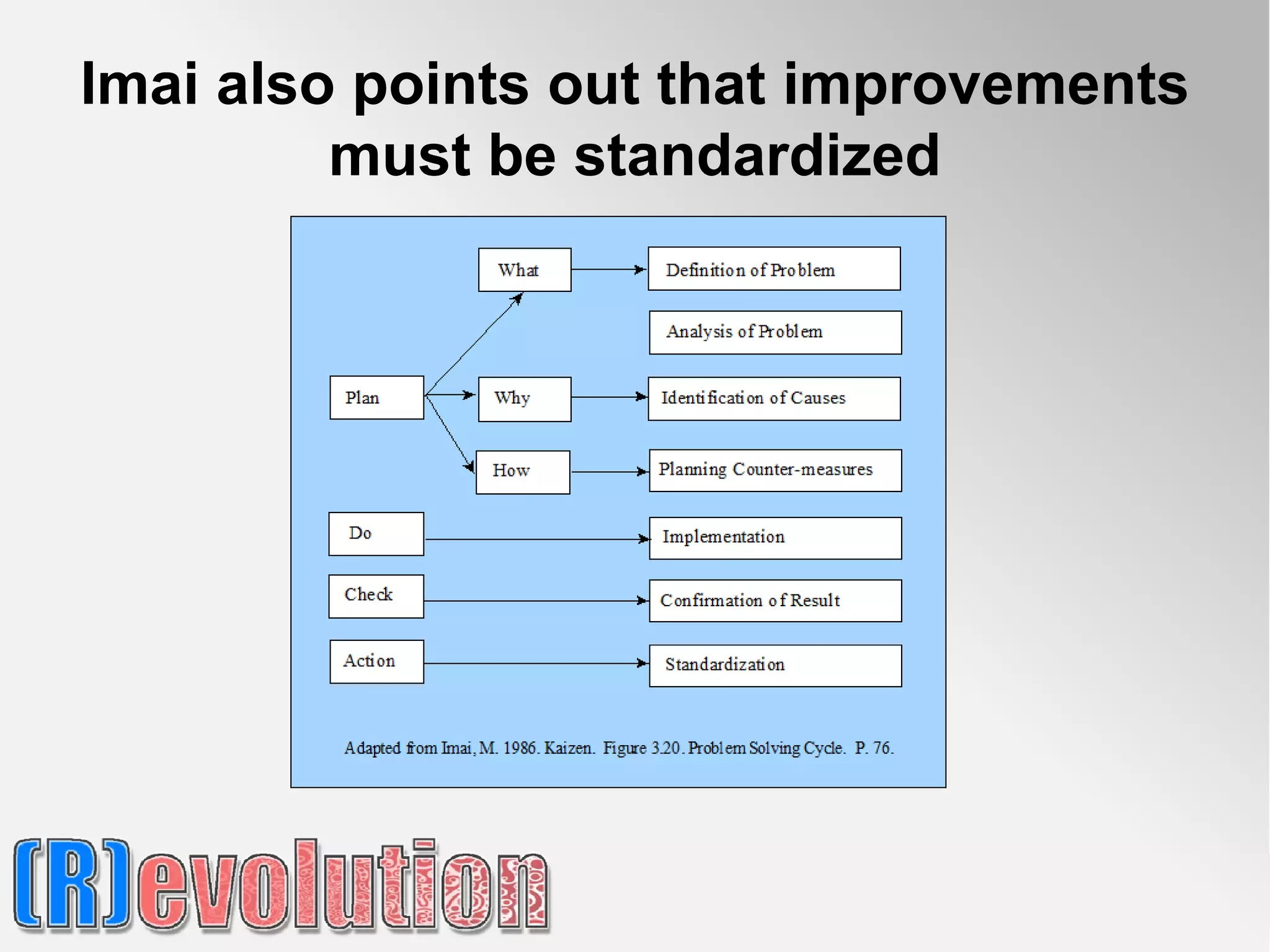
Imai also points out that improvements
         must be standardized
Kanban Video Clip
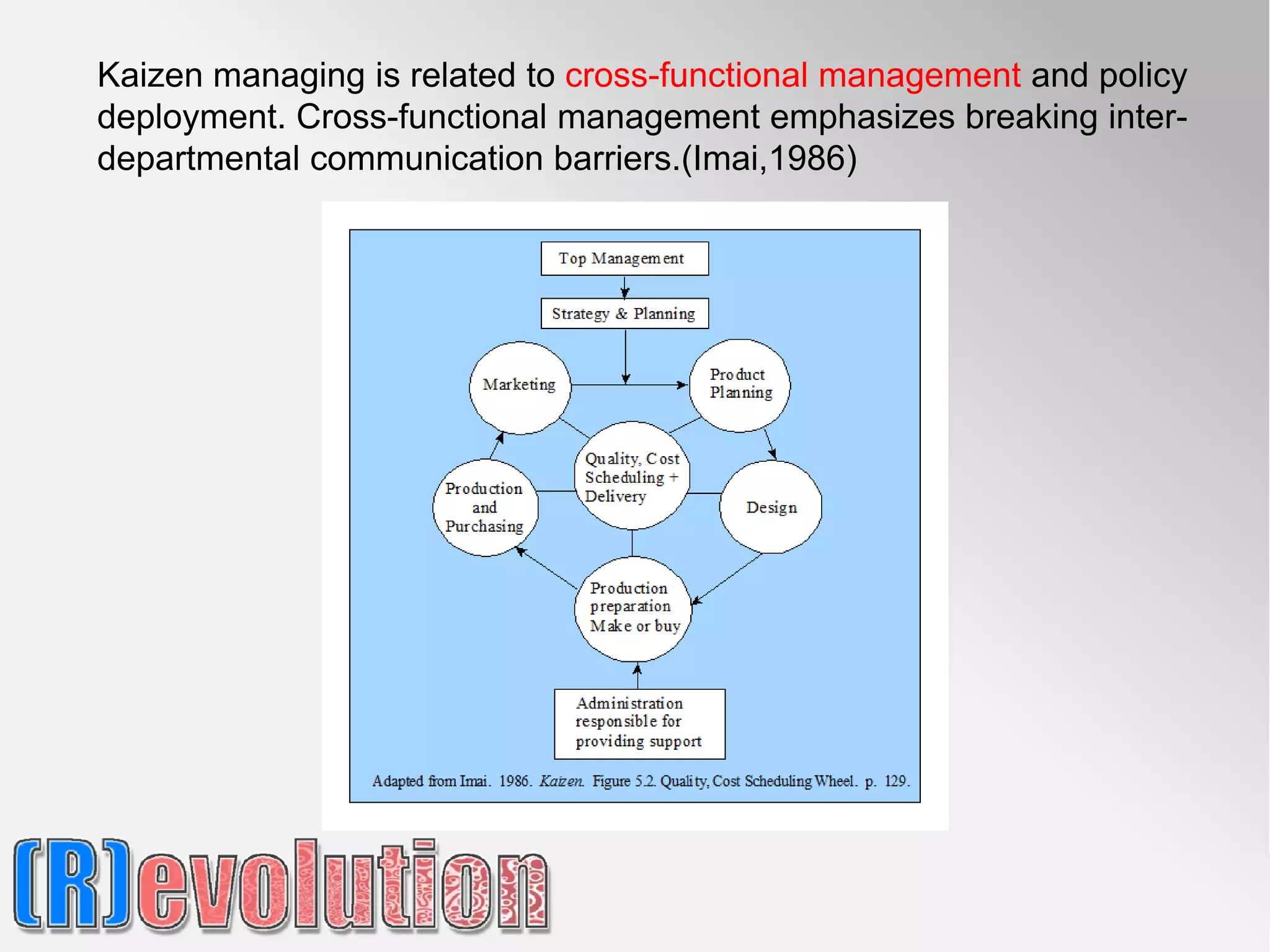
Kaizen managing is related to cross-functional management and policy
deployment. Cross-functional management emphasizes breaking inter-
departmental communication barriers.(Imai,1986)
Kaizen Culture

• Culture means constant efforts to improve
  industrial relations
• Training workers and developing leaders among
  the workers
• Bringing discipline to the workshop

Strategic Change - Evolution

  • 1.
    Strategies for Change Evolution Encouragesa continuous learning environment The evolutionary model emphasises small incremental changes. It is a learning organisation with the capability of creating something new in a step by step process. Change in general can cause confusion and can be resisted if the culture of the organisation is familiar with incremental change only. The workers are not given enough opportunity to apply their learning ‘all but incremental change is resisted’.(Pettigrew,1985)
  • 2.
    What is Kaizen? TheKey to Japan's Competitive Success published in 1986 that introduced Kaizen to the western corporate world, Masaaki Imai defined it as: "a means of continuing improvement in personal life, home life, social life, and working life. At the workplace, Kaizen means continuing improvement involving everyone—managers and workers alike. The Kaizen business strategy involves everyone in an organization working together to make improvements without large capital investments." Masaaki Imai(1986)
  • 3.
    The Evolutionary ChangeProcess • The firm is the starting point • Evolution is a constant stream process of gradual changes • It is a metamorphosis of long-term organisational learning • Learning is a slow process which can be new skills, processes, experiment, test and discuss • Organisational learning power is dispersed • Management recognise that the firm has to continuously learn and adapt • Management do not have the absolute power to impose dramatic revolutionary change but must continue with the evolutionary change process
  • 4.
    Kaizen Kaizen is asystem that involves every employee - from upper management to the cleaning crew. Everyone is encouraged to come up with small improvement suggestions on a regular basis. This is not a once a month or once a year activity. It is continuous. Japanese companies, such as Toyota and Canon, a total of 60 to 70 suggestions per employee per year are written down, shared and implemented.
  • 5.
    Perspectives On StrategicChange • Evolutionary change is necessary to ensure continuity in the renewal process • Gradual mutation and selection • Continuous renewal is a marathon and not won by good sprinters • Continuous renewal in a long-term approach • Requires commitment from motivated employees willing to learn and adapt to gradual change
  • 6.
    What are theKaizen Principles • Human resources are a company's most important asset • Processes must evolve by gradual improvement rather than by radical change • Improvement must be based on a quantitative evaluation of the performance of different processes. It is aimed at management
  • 7.
    Kaizen 5S’s • TheFive S's relate to the visual workplace • Sort – Clean up and organise and throw away items not required • Set in order: Organise, identify and arrange everything in a work area • Shine- Regular cleaning and maintenance • Standardise- Make it easy to maintain - simplify and standardise • Sustain -Maintain what has been accomplished
  • 8.
    Canon Technology OfficeProducts Market Share in 2011 Source: Gartner Dataquest (February 2012) Technological Leadership Canon's overwhelming success is attributed to superior technology, the result of an unprecedented commitment to research and development. In 2011, Canon devoted approximately 8.7% of its Net Sales to R&D This spending exceeds many of their key competitors and ensures that research and development efforts continue to grow. Innovation has been a key ingredient in Canon's success. Canon is one of the most prolific inventors of consumer and professional imaging solutions having in excess of 40,000 U.S. patents in its 70-year history. In 2011, Canon ranked third in the country for receiving patents in the private sector, with 2,818 patents granted according to the U.S. Patent and Trademark Office.
  • 9.
    Management & Kaizen •Kaizen Event” where managers and employees work together to fine-tune and revise the current standards. Once a more efficient and superior system is achieved, it is then standardized and integrated into current policies, rules, and Standard Operating Procedures (SOPs). • When you implement Kaizen into the workplace, you should aspire to make changes to your current operating standards by breaking down each process in detail, monitoring the results, and then making adjustments accordingly (“If it ain’t broke, Do fix it”). • Your management team should ensure that the current SOPs are being followed. Management must “go and see” operations, or MBWA (management by walking around), in order to achieve efficient operations and take corrective actions when required. That is the only way they can fully understand their current business climate and make educated adjustments.
  • 10.
    Advantages of Kaizen Thesecontinual small improvements add up to major benefits. They result in improved productivity, improved quality, better safety, faster delivery, lower costs, and greater customer satisfaction. On top of these benefits to the company, employees working in Kaizen-based companies generally find work to be easier and more enjoyable—resulting in higher employee moral and job satisfaction, and lower turn-over. With every employee looking for ways to make improvements, you can expect results such as: • Kaizen Reduces Waste in areas such as inventory, waiting times, transportation, worker motion, employee skills, over production, excess quality and in processes. • Kaizen Improves space utilization, product quality, use of capital, communications, production capacity and employee retention. • Kaizen Provides immediate results. Instead of focusing on large, capital intensive improvements, Kaizen focuses on creative investments that continually solve large numbers of small problems. Large, capital projects and major changes will still be needed, and Kaizen will also improve the capital projects process, but the real power of Kaizen is in the on-going process of continually making small improvements that improve processes and reduce waste.
  • 11.
  • 12.
    Kaizen Patterns • Human Effort •Material • Machine • Scientific Method Based
  • 13.
    Imai also pointsout that improvements must be standardized
  • 14.
  • 15.
    Kaizen managing isrelated to cross-functional management and policy deployment. Cross-functional management emphasizes breaking inter- departmental communication barriers.(Imai,1986)
  • 16.
    Kaizen Culture • Culturemeans constant efforts to improve industrial relations • Training workers and developing leaders among the workers • Bringing discipline to the workshop