
Interactive Storytelling
Design of Computer Games
Martin Sillaots
Aug 8 2019
# 10
Content
• Objectives
• Concepts
• Writing process
• Structure of the story
• Dialogues
Objectives of Storytelling
• Entertainment
• Attract audience
• Keep interest
• Sell game
• Support character
• Express reality
• Additional emotions
• Differentiation
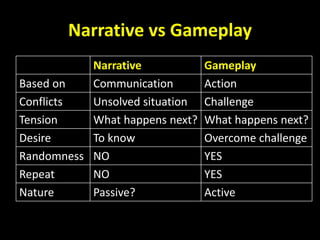
Narrative vs Gameplay
Narrative Gameplay
Based on Communication Action
Conflicts Unsolved situation Challenge
Tension What happens next? What happens next?
Desire To know Overcome challenge
Randomness NO YES
Repeat NO YES
Nature Passive? Active
Storytelling Concepts
• Story – series of events
• Interactive story – player chose or cause events
• Narrative – narrated events player can't control
• Dialogue is not narrative – talking with NPC
Game Events
• Player events - user actions
• In-game events - initiated by core mechanics
• Narrative events - can't be changed by player
Narrative
Formats
• Prologue
• Briefing
• Cut scenes
• Epilogue
Media
• Movie
• Animation
• Scrolling text
• Voice over
• Monologue
Story Writing Process
• Start from the end
• List game challenges *
• Use story models
Structure of the Story
• Story branches
• Story phases
• Story units
Story Branches
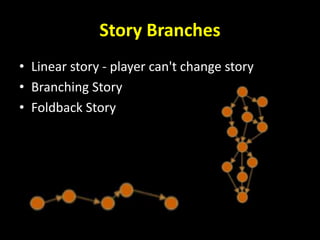
• Linear story - player can't change story
• Branching Story
• Foldback Story
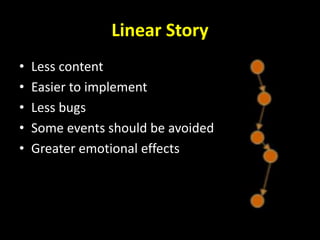
Linear Story
• Less content
• Easier to implement
• Less bugs
• Some events should be avoided
• Greater emotional effects
Branching Story
• Branches don't go back
• Branches can merge
• More then one ending
• More then one starting point
• Expensive to implement
• Critical events should have separated tree
• Repeating play to see all content
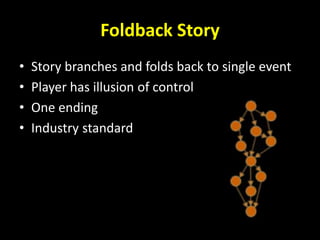
Foldback Story
• Story branches and folds back to single event
• Player has illusion of control
• One ending
• Industry standard
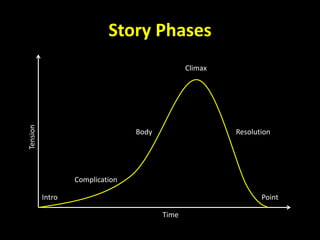
Story Phases
Time
Tension
Intro
Complication
Body
Climax
Resolution
Point
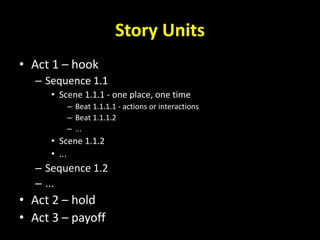
Story Units
• Act 1 – hook
– Sequence 1.1
• Scene 1.1.1 - one place, one time
– Beat 1.1.1.1 - actions or interactions
– Beat 1.1.1.2
– ...
• Scene 1.1.2
• ...
– Sequence 1.2
– ...
• Act 2 – hold
• Act 3 – payoff
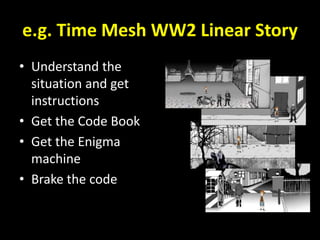
e.g. Time Mesh WW2 Linear Story
• Understand the
situation and get
instructions
• Get the Code Book
• Get the Enigma
machine
• Brake the code
Revealing the Content
• Series of challenges or choices
• Journey - arriving to spot
• Drama – time passes with the story
Episodic Delivery
• Unlimited series - independent stories, order not
important
• Limited series
Story Generator
• Automated storytelling
• Story developed by player actions and game
events
• Anything can happen if game rules permit it
• No prewritten narrative blocs
• Core mechanics is complicated
Dialogues
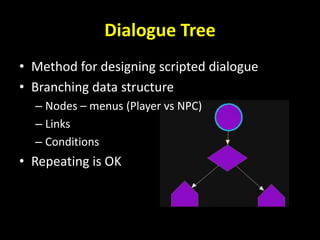
Dialogue Tree
• Method for designing scripted dialogue
• Branching data structure
– Nodes – menus (Player vs NPC)
– Links
– Conditions
• Repeating is OK
Dialogue Database
• List of options that changes dynamically
• Options are added and deleted from list based
on conversation
• Options stored in database
• Less duplications
• Conditions easier to create
• Harder to read (on paper)
Mission # 10
Tell a story of your game
even if your game is not story based
what’s the story around the game?
Story Mission Details
• How the story ends (what’s the point)?
• Overall structure of the story
• Descriptions of the story nodes
• Connections between nodes (conditions?)
• If your game does not have a story what is the
story around the game?
Story

Story

  • 1.
    Interactive Storytelling Design ofComputer Games Martin Sillaots Aug 8 2019 # 10
  • 2.
    Content • Objectives • Concepts •Writing process • Structure of the story • Dialogues
  • 3.
    Objectives of Storytelling •Entertainment • Attract audience • Keep interest • Sell game • Support character • Express reality • Additional emotions • Differentiation
  • 4.
    Narrative vs Gameplay NarrativeGameplay Based on Communication Action Conflicts Unsolved situation Challenge Tension What happens next? What happens next? Desire To know Overcome challenge Randomness NO YES Repeat NO YES Nature Passive? Active
  • 5.
    Storytelling Concepts • Story– series of events • Interactive story – player chose or cause events • Narrative – narrated events player can't control • Dialogue is not narrative – talking with NPC
  • 6.
    Game Events • Playerevents - user actions • In-game events - initiated by core mechanics • Narrative events - can't be changed by player
  • 7.
    Narrative Formats • Prologue • Briefing •Cut scenes • Epilogue Media • Movie • Animation • Scrolling text • Voice over • Monologue
  • 8.
    Story Writing Process •Start from the end • List game challenges * • Use story models
  • 9.
    Structure of theStory • Story branches • Story phases • Story units
  • 10.
    Story Branches • Linearstory - player can't change story • Branching Story • Foldback Story
  • 11.
    Linear Story • Lesscontent • Easier to implement • Less bugs • Some events should be avoided • Greater emotional effects
  • 12.
    Branching Story • Branchesdon't go back • Branches can merge • More then one ending • More then one starting point • Expensive to implement • Critical events should have separated tree • Repeating play to see all content
  • 13.
    Foldback Story • Storybranches and folds back to single event • Player has illusion of control • One ending • Industry standard
  • 14.
  • 17.
    Story Units • Act1 – hook – Sequence 1.1 • Scene 1.1.1 - one place, one time – Beat 1.1.1.1 - actions or interactions – Beat 1.1.1.2 – ... • Scene 1.1.2 • ... – Sequence 1.2 – ... • Act 2 – hold • Act 3 – payoff
  • 18.
    e.g. Time MeshWW2 Linear Story • Understand the situation and get instructions • Get the Code Book • Get the Enigma machine • Brake the code
  • 19.
    Revealing the Content •Series of challenges or choices • Journey - arriving to spot • Drama – time passes with the story
  • 20.
    Episodic Delivery • Unlimitedseries - independent stories, order not important • Limited series
  • 21.
    Story Generator • Automatedstorytelling • Story developed by player actions and game events • Anything can happen if game rules permit it • No prewritten narrative blocs • Core mechanics is complicated
  • 22.
  • 23.
    Dialogue Tree • Methodfor designing scripted dialogue • Branching data structure – Nodes – menus (Player vs NPC) – Links – Conditions • Repeating is OK
  • 24.
    Dialogue Database • Listof options that changes dynamically • Options are added and deleted from list based on conversation • Options stored in database • Less duplications • Conditions easier to create • Harder to read (on paper)
  • 25.
    Mission # 10 Tella story of your game even if your game is not story based what’s the story around the game?
  • 26.
    Story Mission Details •How the story ends (what’s the point)? • Overall structure of the story • Descriptions of the story nodes • Connections between nodes (conditions?) • If your game does not have a story what is the story around the game?

Editor's Notes

  • #2 Gameplay Comes First If you start from story - to many different actions - story is easy to change (few words), compared to gameplay (weeks of balancing) and technology (months of coding) After defining primary gameplay mode During the production stage Iterative process together with level design (moment by moment sequence) - between levels - in levels Some genres require it: adventure games action-adventures games Some genres don't: action simulations puzzles ? strategy ? role-playing games ?
  • #4 SKIP Entertainment - story gives a content to competition, progress in dramatic way Attract audience - casual players (hardcore players ignore the story) Keep interest - creates variety in longer games Sell game - advertising materials Support character Express reality - except simulators Additional emotions - not only pleasure from success and frustration from failure Differentiation - from similar games
  • #5 Frustrated author syndrome - wanting to write interactive story, outcome is linear - large narrative, small gameplay - e.g. The Longest Journey - 20 min monologue from NPC - Game is not an movie or book - Player is the star, not NPC's or designers - Let players act - Don't control avatar by the narrative Different views: - Gameplay will destroy good story - Story ruin gameplay (hardcore players don't care about story) - Gameplay + story = good experience Differences and similarities Story and game(play) have same goal - create an experience (they are connected). Different verbs - story is for communication, game is for action Avoid unavoidable events on game – no tragic stories. Non-Interactive story and Interactive story - Non-interactive story is not passive - it makes you think and ask: what happens next? - Interactive story - player can take action They are similar - both create desire to act in the reader's/player's mind. Let them to act (or not).
  • #6 Story - credible - believe the story (fantasy in suitable conditions) - dramatically meaningful - something to care about, identify with - coherent - connected whole Interactive story - takes place now Narrative - Non-interactive - Interruptible Dialogue different game play mode all other actions are not available Selecting prewritten lines
  • #7 Player events part of the story In-game events response to players action player can cause them or avoid them Interaction Narrative events - not interactive
  • #8 Story events that are narrated (part of the story)
  • #9 End - what is the point of your story? List - sequence of your gameplay and story
  • #10 Different ways how to structure the story
  • #11 Linear Less content Easier to implement Less bugs Greater emotional effects Branching Story Looks like tree Combinatorial explosion More then one starting point - avatar based OK More then one ending - Players: is it right end? Expensive - each branch need a content (and sub –story) - not used in commercial games Repeating – player need to play the game several times to see the content of other branches – players don’t like it Foldback Story Compromise between linear and branching stories Story branches and folds back to single ending Player has illusion of control Industry standard
  • #12 Limitations - e.g. cant break car in car race - e.g. Avatar can't die in the middle of the game (not part of the story) Endings critical emotional moment Failure is not ending (of the story). it can be the end of the game - Challenges - one end is enough - Choices - different endings
  • #13 Tree Combinatorial explosion Multi-start - avatar based, random Expensive - each branch and branching point need content - not used in commercial games Critical - NPC can live or die) Repeating Difficult to see the alternative content players don't like it Multi-ending – is it riht end?
  • #14 Multilinear stories Compromise between linear and branching stories e.g. Monkey Island (adventure games)
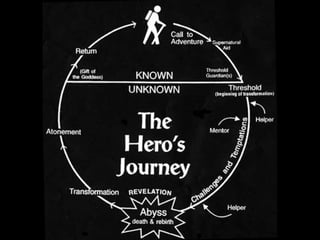
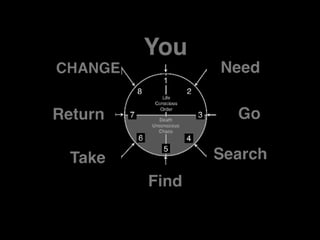
  • #15 Intro – introducing the character and the context Complication – introducing the problem Body - Series of smaller events and challenges Climax – solving the main problem – Big Boss, culmination Resolution – Series of smaller challenges resolved Point – moral of the story is revealed Alternative The Hero’s Journey: need – go – search – find – fight – take – return – change
  • #18 Three Act Structure - classical Hollywood story 1 Hook - e.g beginning - exposition – meet 2 Hold- e.g. middle - confrontation – lose 3 Payoff - e.g. end - resolution - get - happy ending Unlimited - e.g. CSI (most of the games, versions) Limited – e.g. Game of thrones - levels
  • #19 Understand the situation and get instructions - Hook; Intro + Compilation; Need + go Get the Code Book - Hold; Body; Search + find + take Get the Enigma machine - Hold; Body; Search + find + take Brake the code - Payoff; Climax + Resolution; Return + change
  • #20 In book - as a reader reds In game - different triggers Journey - arriving to some area, triggers part of the story - provides novelty - new visual sites - player controls tempo of the story - e.g adventure games - challenges + journey Drama does not matter does player take some action - e.g. Night Trap - e.g. Façade
  • #21 e.g. TV series - 1 hour entertainment per day Unlimited - e.g. CSI (most of the games, versions) Limited – e.g. Bold and Beautiful  - levels
  • #22 Emergent Narrative game world, simulator, not story - gameplay e.g. Sims - like authoring tool e.g. Jussi game of kingdoms
  • #23 - additional way how to present the characteristic of character
  • #24 Natural language vs programming language Tool – Spreadsheet
  • #25 Alternative to Tree player vs NPC