Introduction to Level Design
Rico Lemba
Game Designer & Programmer
@stellarnull
@ricolemba
Game Development
Ideas
• Concept Art
• Gameplay concept
• Story concept
• Gimmick
Execution
• Balancing
• Pacing
• Level Design
• Controls
• Physics
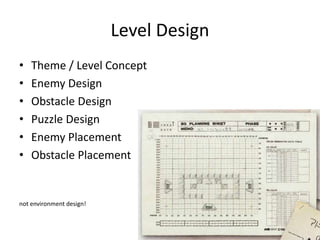
Level Design
• Theme / Level Concept
• Enemy Design
• Obstacle Design
• Puzzle Design
• Enemy Placement
• Obstacle Placement
not environment design!
WHY IS IT IMPORTANT?
Level Design
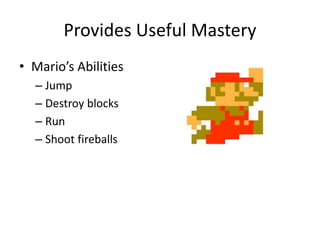
Provides Useful Mastery
• Mario’s Abilities
– Jump
– Destroy blocks
– Run
– Shoot fireballs
Provides Useful Mastery
• No level design, no mastery
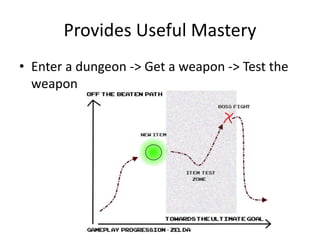
Provides Useful Mastery
• Enter a dungeon -> Get a weapon -> Test the
weapon
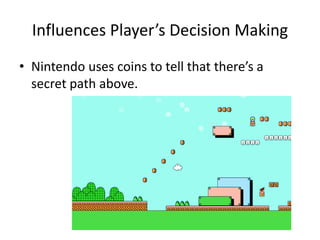
Influences Player’s Decision Making
• Nintendo uses coins to tell that there’s a
secret path above.
Teaches Player About Game’s
Mechanics
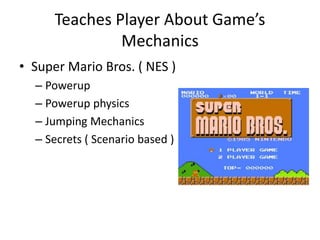
• Super Mario Bros. ( NES )
– Powerup
– Powerup physics
– Jumping Mechanics
– Secrets ( Scenario based )
Teaches Player About Game’s
Mechanics
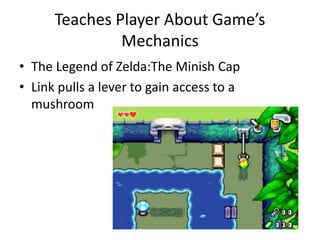
• The Legend of Zelda:The Minish Cap
• Link pulls a lever to gain access to a
mushroom
Teaches Player About Game’s
Mechanics
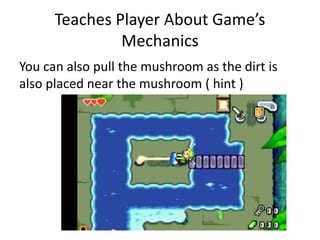
You can also pull the mushroom as the dirt is
also placed near the mushroom ( hint )
Teaches Player About Game’s
Mechanics
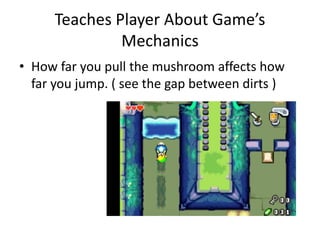
• How far you pull the mushroom affects how
far you jump. ( see the gap between dirts )
Teaches Player About Game’s
Mechanics
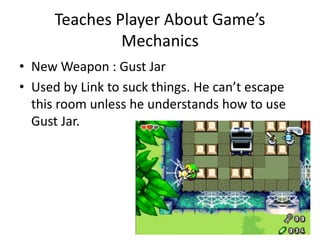
• New Weapon : Gust Jar
• Used by Link to suck things. He can’t escape
this room unless he understands how to use
Gust Jar.
Teaches Player About Game’s
Mechanics
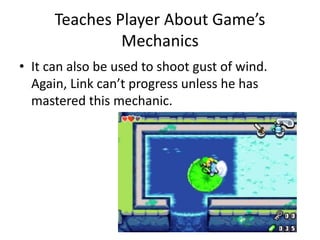
• It can also be used to shoot gust of wind.
Again, Link can’t progress unless he has
mastered this mechanic.
Teaches Player About Game’s
Mechanics
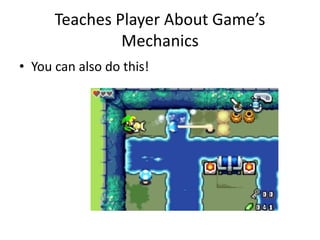
• You can also do this!
Good Level Design?
• Reduces amount of tutorials
• Balance between difference in scale and
difference in kind
• Driven by core mechanics
Difference in Scale
• Scales a variable from game’s mechanics (
enemy’s hp, game speed, number of blocks,
etc ).
• Easy way to provide variety.
Difference In Scale
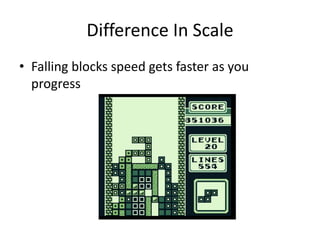
• Falling blocks speed gets faster as you
progress
Difference In Scale
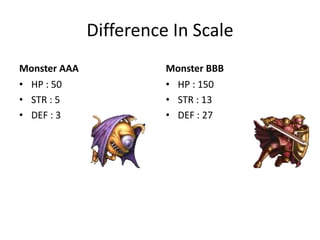
Monster AAA
• HP : 50
• STR : 5
• DEF : 3
Monster BBB
• HP : 150
• STR : 13
• DEF : 27
Difference In Scale
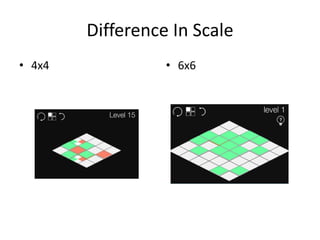
• 4x4 • 6x6
Difference In Kind
• Variety in Behavior
• Encourages or Challenges player to think
differently.
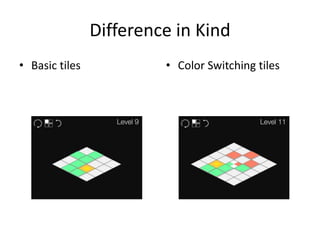
Difference in Kind
• Basic tiles • Color Switching tiles
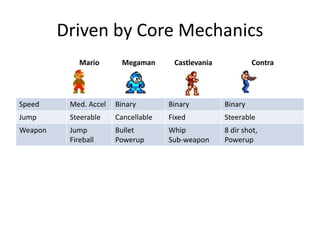
Driven by Core Mechanics
Mario Megaman Castlevania Contra
Speed Med. Accel Binary Binary Binary
Jump Steerable Cancellable Fixed Steerable
Weapon Jump
Fireball
Bullet
Powerup
Whip
Sub-weapon
8 dir shot,
Powerup
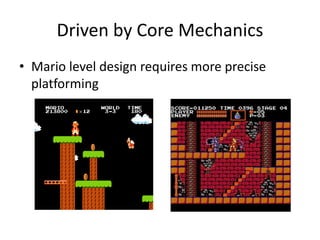
Driven by Core Mechanics
• Mario level design requires more precise
platforming
Kishōtenketsu
起承転結
Four Step Level Design
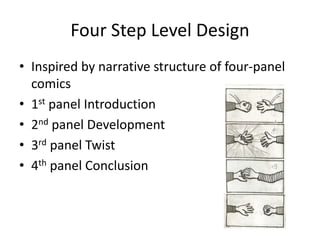
• Used by Koichi Hayashida ( Nintendo EAD ) to
design levels in Mario 3D Land and 3D World.
• Inspired by narrative structure of four-panel
comics
• 1st panel Introduction
• 2nd panel Development
• 3rd panel Twist
• 4th panel Conclusion
Four Step Level Design
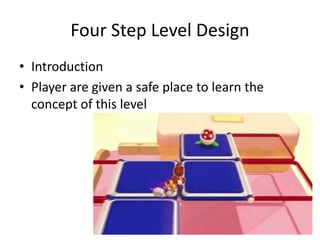
• Introduction
• Player are given a safe place to learn the
concept of this level
Four Step Level Design
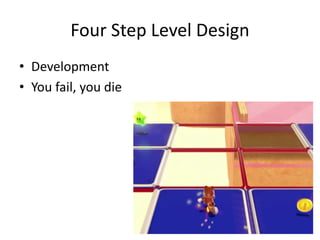
• Development
• You fail, you die
Four Step Level Design
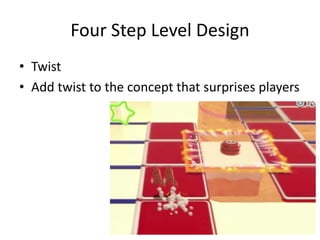
• Twist
• Add twist to the concept that surprises players
Four Step Level Design
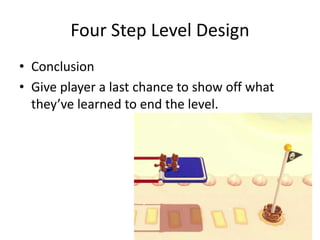
• Conclusion
• Give player one last chance to show off what
they’ve learned to end the level.
• Games are about processes, not things. It's
the processes in games that you interact with,
and coming up with interesting processes is
really the heart of game design.
• - Chris Crawford
Thank You

Introduction to Level Design

  • 1.
    Introduction to LevelDesign Rico Lemba Game Designer & Programmer @stellarnull @ricolemba
  • 2.
    Game Development Ideas • ConceptArt • Gameplay concept • Story concept • Gimmick Execution • Balancing • Pacing • Level Design • Controls • Physics
  • 3.
    Level Design • Theme/ Level Concept • Enemy Design • Obstacle Design • Puzzle Design • Enemy Placement • Obstacle Placement not environment design!
  • 4.
    WHY IS ITIMPORTANT? Level Design
  • 5.
    Provides Useful Mastery •Mario’s Abilities – Jump – Destroy blocks – Run – Shoot fireballs
  • 6.
    Provides Useful Mastery •No level design, no mastery
  • 7.
    Provides Useful Mastery •Enter a dungeon -> Get a weapon -> Test the weapon
  • 8.
    Influences Player’s DecisionMaking • Nintendo uses coins to tell that there’s a secret path above.
  • 9.
    Teaches Player AboutGame’s Mechanics • Super Mario Bros. ( NES ) – Powerup – Powerup physics – Jumping Mechanics – Secrets ( Scenario based )
  • 10.
    Teaches Player AboutGame’s Mechanics • The Legend of Zelda:The Minish Cap • Link pulls a lever to gain access to a mushroom
  • 11.
    Teaches Player AboutGame’s Mechanics You can also pull the mushroom as the dirt is also placed near the mushroom ( hint )
  • 12.
    Teaches Player AboutGame’s Mechanics • How far you pull the mushroom affects how far you jump. ( see the gap between dirts )
  • 13.
    Teaches Player AboutGame’s Mechanics • New Weapon : Gust Jar • Used by Link to suck things. He can’t escape this room unless he understands how to use Gust Jar.
  • 14.
    Teaches Player AboutGame’s Mechanics • It can also be used to shoot gust of wind. Again, Link can’t progress unless he has mastered this mechanic.
  • 15.
    Teaches Player AboutGame’s Mechanics • You can also do this!
  • 16.
    Good Level Design? •Reduces amount of tutorials • Balance between difference in scale and difference in kind • Driven by core mechanics
  • 17.
    Difference in Scale •Scales a variable from game’s mechanics ( enemy’s hp, game speed, number of blocks, etc ). • Easy way to provide variety.
  • 18.
    Difference In Scale •Falling blocks speed gets faster as you progress
  • 19.
    Difference In Scale MonsterAAA • HP : 50 • STR : 5 • DEF : 3 Monster BBB • HP : 150 • STR : 13 • DEF : 27
  • 20.
  • 21.
    Difference In Kind •Variety in Behavior • Encourages or Challenges player to think differently.
  • 22.
    Difference in Kind •Basic tiles • Color Switching tiles
  • 23.
    Driven by CoreMechanics Mario Megaman Castlevania Contra Speed Med. Accel Binary Binary Binary Jump Steerable Cancellable Fixed Steerable Weapon Jump Fireball Bullet Powerup Whip Sub-weapon 8 dir shot, Powerup
  • 24.
    Driven by CoreMechanics • Mario level design requires more precise platforming
  • 25.
  • 26.
    Four Step LevelDesign • Used by Koichi Hayashida ( Nintendo EAD ) to design levels in Mario 3D Land and 3D World. • Inspired by narrative structure of four-panel comics • 1st panel Introduction • 2nd panel Development • 3rd panel Twist • 4th panel Conclusion
  • 27.
    Four Step LevelDesign • Introduction • Player are given a safe place to learn the concept of this level
  • 28.
    Four Step LevelDesign • Development • You fail, you die
  • 29.
    Four Step LevelDesign • Twist • Add twist to the concept that surprises players
  • 30.
    Four Step LevelDesign • Conclusion • Give player one last chance to show off what they’ve learned to end the level.
  • 31.
    • Games areabout processes, not things. It's the processes in games that you interact with, and coming up with interesting processes is really the heart of game design. • - Chris Crawford
  • 32.