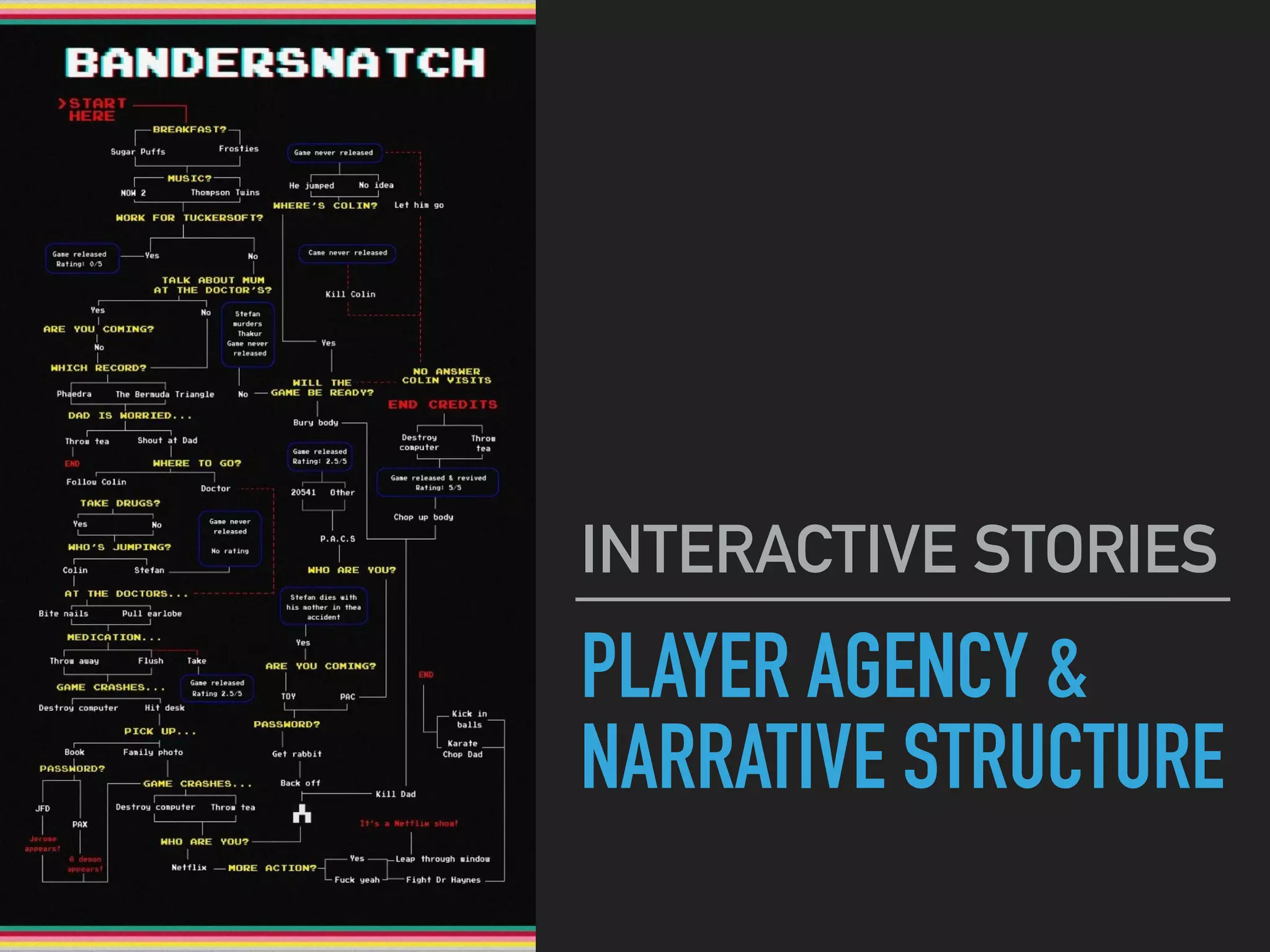
PLAYER AGENCY &
NARRATIVE STRUCTURE
INTERACTIVE STORIES
AN INTERACTIVE STORY IS A STORY THAT THE
PLAYER INTERACTS WITH BY CONTRIBUTING
ACTIONS TO IT. A STORY MAY BE INTERACTIVE
EVEN IF THE PLAYER’S ACTIONS CANNOT
CHANGE THE DIRECTION OF THE PLOT.
Ernest Adams, Fundamentals of Game Design
WHAT IS AN INTERACTIVE STORY?
INTERACTIVE STORIES
INTERACTIVE STORIES
Interactive stories usually include
three kinds of events:
▸ Player events: actions performed
directly by the player
▸ In-game events: events initiated
by mechanics of game (can be
responses to player action or
independent of player action)
▸ Narrative events: events whose
content the player cannot change
PLAYER AGENCY
The illusion of control.
Making the player feel like
they’re driving the events of
the story.
AGENCY IN GAMES
WHAT IS PLAYER AGENCY?
▸ Not just choice, participation, activity, or interaction
▸ Agency is a sense, an experience, a pleasure. A feeling
of having some degree of control over events.
▸ Agency is an aesthetic and narrative pleasure
▸ Experience of agency can be enhanced through
narrative design
JANET MURRAY, HAMLET ON THE HOLODECK
FOUR ESSENTIAL PROPERTIES OF
DIGITAL ENVIRONMENTS
▸ Procedurality: games are software
run on a computer (they execute a
series of rules)
▸ Participatory: responsive to input
▸ Spatial: represent space we move
through. Have power to represent
“navigable space.”
▸ Encyclopedic: data intensive;
infinite resources
GAME NARRATIVE
THREE BROAD CATEGORIES OF GAME NARRATIVES
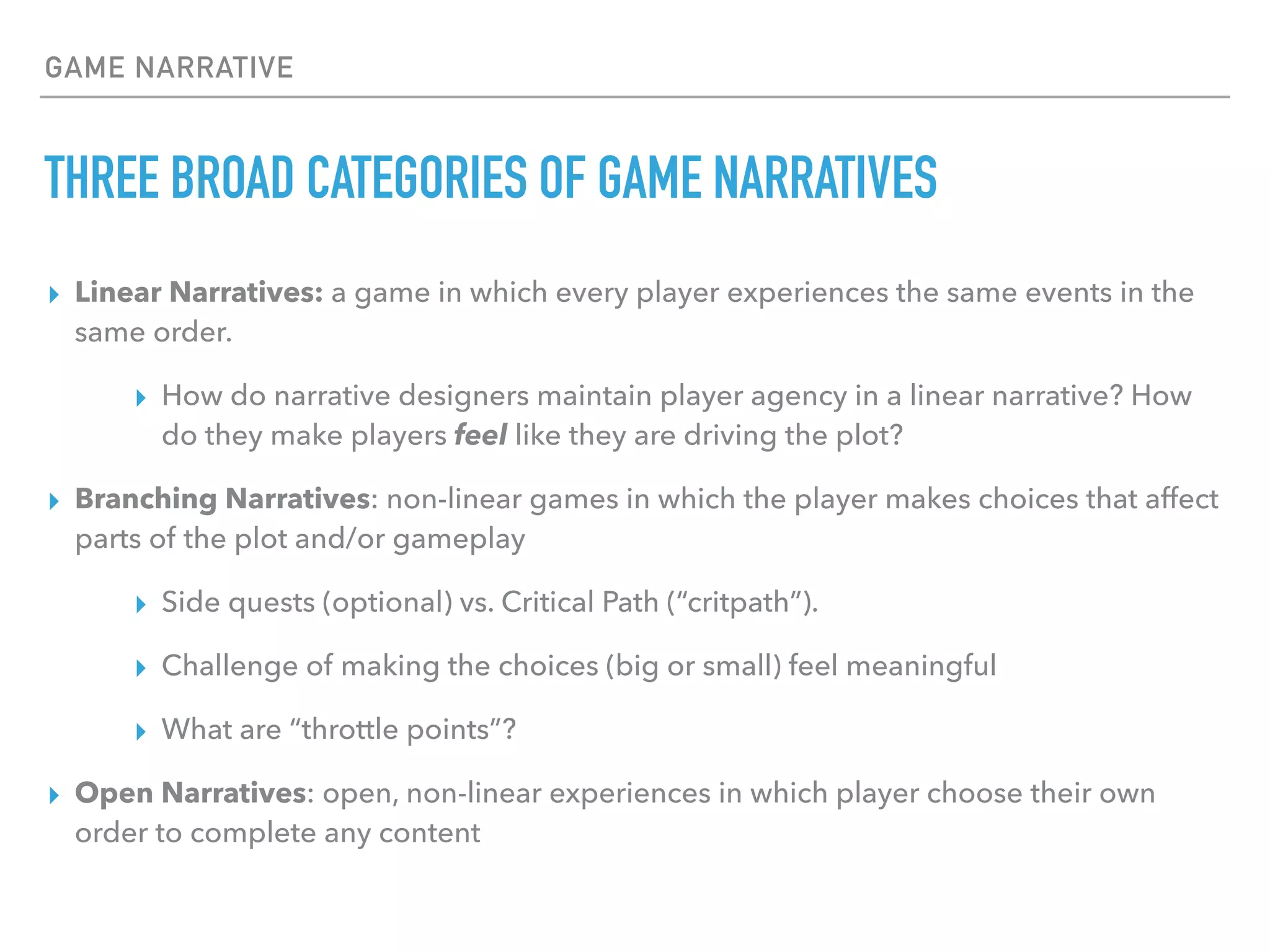
▸ Linear Narratives: a game in which every player experiences the same events in the
same order.
▸ How do narrative designers maintain player agency in a linear narrative? How
do they make players feel like they are driving the plot?
▸ Branching Narratives: non-linear games in which the player makes choices that affect
parts of the plot and/or gameplay
▸ Side quests (optional) vs. Critical Path (“critpath”).
▸ Challenge of making the choices (big or small) feel meaningful
▸ What are “throttle points”?
▸ Open Narratives: open, non-linear experiences in which player choose their own
order to complete any content
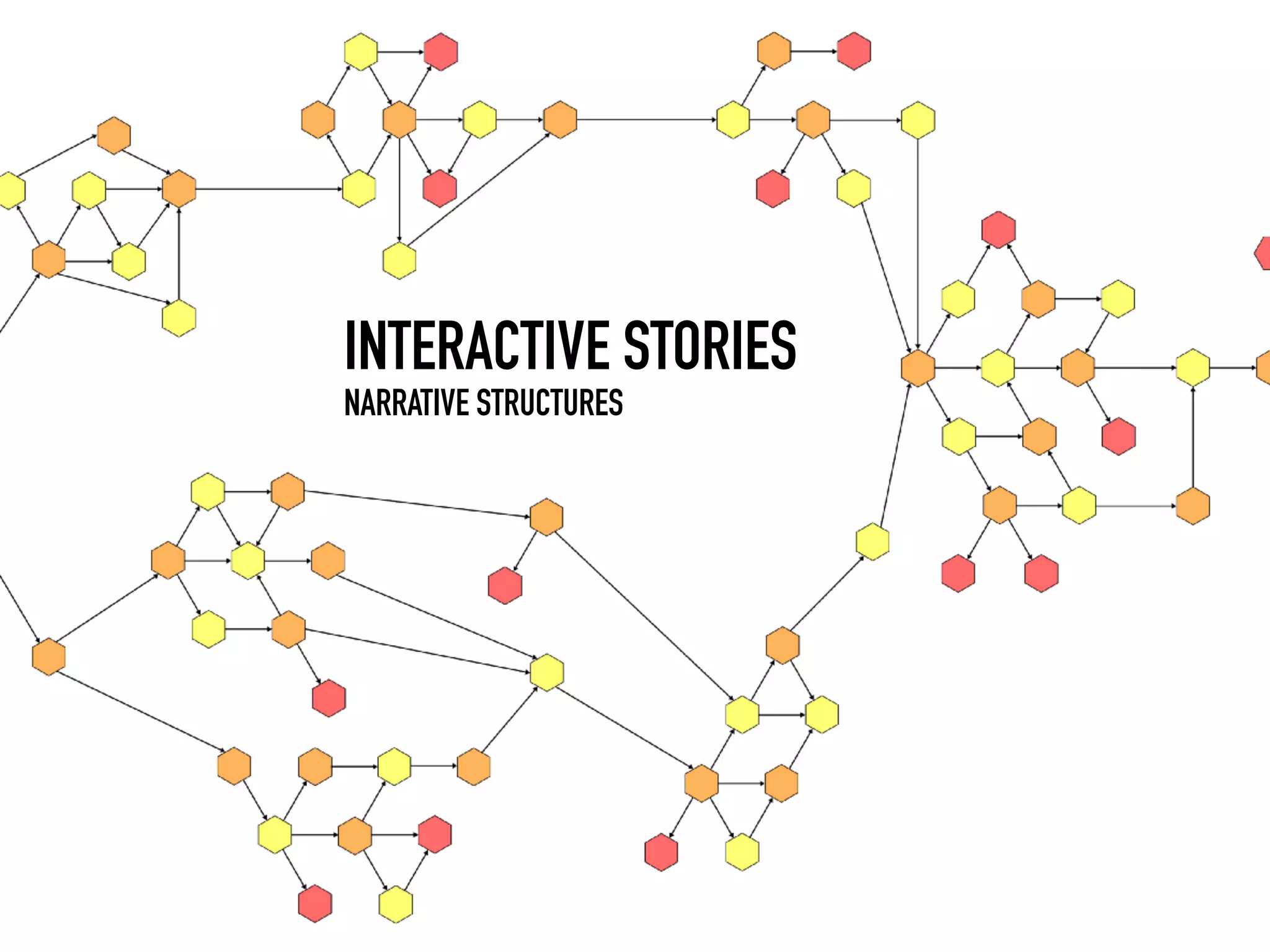
INTERACTIVE STORIES
NARRATIVE STRUCTURES
Basic-Linear Narrative
Straight-forward story progression of starting at A, going to B and ending at C.
The Trial Narrative
Expanded version of the basic-linear narrative. A few splits that branch off, creating minimal challenges and
pitfalls for the player (i.e., trials)
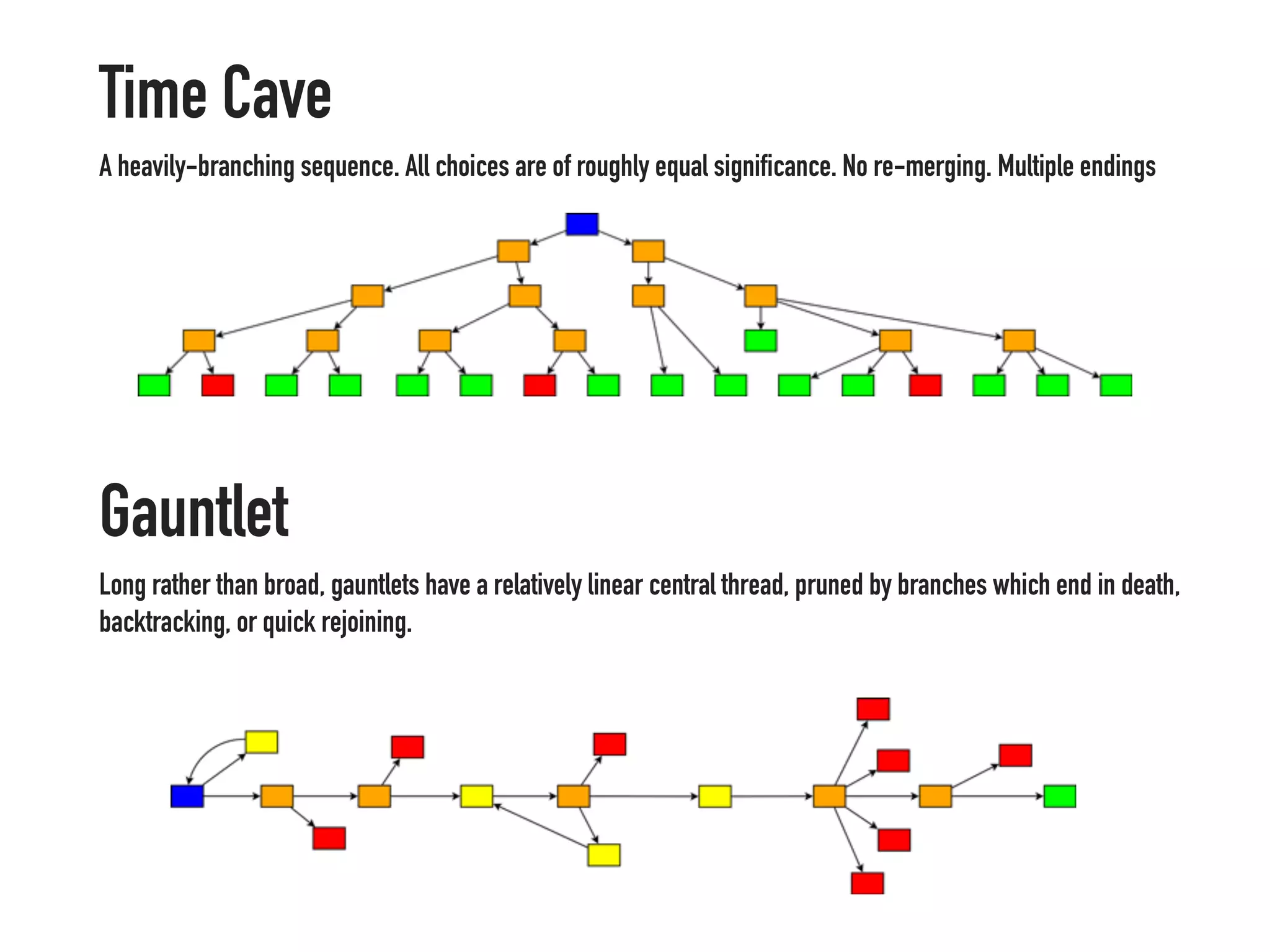
Time Cave
A heavily-branching sequence. All choices are of roughly equal significance. No re-merging. Multiple endings
Gauntlet
Long rather than broad, gauntlets have a relatively linear central thread, pruned by branches which end in death,
backtracking, or quick rejoining.
Branch & Bottleneck
The game branches, but the branches regularly rejoin, usually around events that are common to all versions of
the story
Quest
The quest structure forms distinct branches, though they tend to rejoin to reach a relatively small number of
winning endings (often only one)
Open Map
Often modeled on literal geography or architecture
in the game. Built-in direction to one’s travels.
Loop & Grow
The game has a central thread of some kind,
which loops around, over and over, to the same
point:
THE ESSENTIAL TWO STORIES
MULTILEVEL STORYTELLING
▸ Interactive stories always consist of at
least two stories:
▸ The Player Story: what the player
experiences through his or her
actions and imagination
▸ The World Story: everything created
by the designers to support the
player’s experience (environment,
plot, dialogue, etc.)
▸ Narrative designers can’t control the
player story, but they can structure the
events of world story in specific ways
BREAKING DOWN GAME STORIES
WHY TASKS, MISSIONS, QUESTS?
▸ Where does this language come
from? What do these terms mean?
▸ What are possible alternatives to
these common ways of describing
stories?
▸ Alternative terms to describe the
organization of narrative tasks?
▸ Episodes? Vignettes?
Scenes? Acts?
NARRATIVE TRIGGERS
MECHANISMS FOR ADVANCING THE PLOT
▸ Different games use different mechanisms to trigger the
storytelling engine to move forward
▸ Common triggers to advance the story:
▸ Meeting a challenge, solving a puzzle, making a choice or
decision, entering a certain area, clicking a device,
interacting with an object or character, etc.
▸ Other common techniques:
▸ Present the story as a journey or symbolic drama (where
the narrative are organized to reflect journey/drama)
NARRATIVE PRACTICE
DISCUSSION QUESTIONS (GAME ANALYSIS)
▸ What mechanisms are used to advance the plot? (Travel,
events, time, some combination)
▸ How and when are the narrative events interwoven with
game events and player actions?
▸ What form does the narrative material take? (Text, cut-
scenes, voice over, monologues, etc.)
▸ What actions does the player take that are story actions?

Interactive Stories

  • 1.
    PLAYER AGENCY & NARRATIVESTRUCTURE INTERACTIVE STORIES
  • 2.
    AN INTERACTIVE STORYIS A STORY THAT THE PLAYER INTERACTS WITH BY CONTRIBUTING ACTIONS TO IT. A STORY MAY BE INTERACTIVE EVEN IF THE PLAYER’S ACTIONS CANNOT CHANGE THE DIRECTION OF THE PLOT. Ernest Adams, Fundamentals of Game Design WHAT IS AN INTERACTIVE STORY?
  • 3.
    INTERACTIVE STORIES INTERACTIVE STORIES Interactivestories usually include three kinds of events: ▸ Player events: actions performed directly by the player ▸ In-game events: events initiated by mechanics of game (can be responses to player action or independent of player action) ▸ Narrative events: events whose content the player cannot change
  • 4.
    PLAYER AGENCY The illusionof control. Making the player feel like they’re driving the events of the story.
  • 5.
    AGENCY IN GAMES WHATIS PLAYER AGENCY? ▸ Not just choice, participation, activity, or interaction ▸ Agency is a sense, an experience, a pleasure. A feeling of having some degree of control over events. ▸ Agency is an aesthetic and narrative pleasure ▸ Experience of agency can be enhanced through narrative design
  • 6.
    JANET MURRAY, HAMLETON THE HOLODECK FOUR ESSENTIAL PROPERTIES OF DIGITAL ENVIRONMENTS ▸ Procedurality: games are software run on a computer (they execute a series of rules) ▸ Participatory: responsive to input ▸ Spatial: represent space we move through. Have power to represent “navigable space.” ▸ Encyclopedic: data intensive; infinite resources
  • 7.
    GAME NARRATIVE THREE BROADCATEGORIES OF GAME NARRATIVES ▸ Linear Narratives: a game in which every player experiences the same events in the same order. ▸ How do narrative designers maintain player agency in a linear narrative? How do they make players feel like they are driving the plot? ▸ Branching Narratives: non-linear games in which the player makes choices that affect parts of the plot and/or gameplay ▸ Side quests (optional) vs. Critical Path (“critpath”). ▸ Challenge of making the choices (big or small) feel meaningful ▸ What are “throttle points”? ▸ Open Narratives: open, non-linear experiences in which player choose their own order to complete any content
  • 8.
  • 9.
    Basic-Linear Narrative Straight-forward storyprogression of starting at A, going to B and ending at C. The Trial Narrative Expanded version of the basic-linear narrative. A few splits that branch off, creating minimal challenges and pitfalls for the player (i.e., trials)
  • 10.
    Time Cave A heavily-branchingsequence. All choices are of roughly equal significance. No re-merging. Multiple endings Gauntlet Long rather than broad, gauntlets have a relatively linear central thread, pruned by branches which end in death, backtracking, or quick rejoining.
  • 11.
    Branch & Bottleneck Thegame branches, but the branches regularly rejoin, usually around events that are common to all versions of the story Quest The quest structure forms distinct branches, though they tend to rejoin to reach a relatively small number of winning endings (often only one)
  • 12.
    Open Map Often modeledon literal geography or architecture in the game. Built-in direction to one’s travels. Loop & Grow The game has a central thread of some kind, which loops around, over and over, to the same point:
  • 13.
    THE ESSENTIAL TWOSTORIES MULTILEVEL STORYTELLING ▸ Interactive stories always consist of at least two stories: ▸ The Player Story: what the player experiences through his or her actions and imagination ▸ The World Story: everything created by the designers to support the player’s experience (environment, plot, dialogue, etc.) ▸ Narrative designers can’t control the player story, but they can structure the events of world story in specific ways
  • 14.
    BREAKING DOWN GAMESTORIES WHY TASKS, MISSIONS, QUESTS? ▸ Where does this language come from? What do these terms mean? ▸ What are possible alternatives to these common ways of describing stories? ▸ Alternative terms to describe the organization of narrative tasks? ▸ Episodes? Vignettes? Scenes? Acts?
  • 15.
    NARRATIVE TRIGGERS MECHANISMS FORADVANCING THE PLOT ▸ Different games use different mechanisms to trigger the storytelling engine to move forward ▸ Common triggers to advance the story: ▸ Meeting a challenge, solving a puzzle, making a choice or decision, entering a certain area, clicking a device, interacting with an object or character, etc. ▸ Other common techniques: ▸ Present the story as a journey or symbolic drama (where the narrative are organized to reflect journey/drama)
  • 16.
    NARRATIVE PRACTICE DISCUSSION QUESTIONS(GAME ANALYSIS) ▸ What mechanisms are used to advance the plot? (Travel, events, time, some combination) ▸ How and when are the narrative events interwoven with game events and player actions? ▸ What form does the narrative material take? (Text, cut- scenes, voice over, monologues, etc.) ▸ What actions does the player take that are story actions?