Introduction to  Good Storage Practices
1- Routine Warehouse or Storeroom Management Tasks
Daily/Weekly Monitor storage conditions Clean receiving, storage, packing, and shipping areas Sweep or scrub floors Remove garbage Clean bins, shelves, and cupboards, if needed
Daily/Weekly Ensure that aisles are clear Ensure adequate ventilation and cooling Ensure that products are protected from direct sunlight
Daily/Weekly Monitor store security and safety Check the store roof for leaks, especially during the rainy season and during or after a storm Monitor product quality (visually inspect commodities and check expiration dates)
Daily/Weekly Ensure that products are stacked correctly (are the lower cartons being crushed?) Update stock records and maintain files If cycle counting, conduct physical inventory and update stock-keeping records
Daily/Weekly Monitor stock levels, stock quantities, and safety stocks Submit emergency order (as needed, using local guidelines) Update back-up file for computerized inventory control records
Daily/Weekly Update bin cards Separate expired stocks and move to secure area
Monthly Conduct physical inventory or cycle count, and update stock keeping records Run generator to ensure the system is working correctly; check the level of fuel and add fuel, if needed
Monthly Check for signs of rodents, insects, or roof leaks Inspect the storage structure for damage, including the walls, floors, roof, windows, and doors
Every 3 Months  (Quarterly) Conduct physical inventory or cycle count, and update stock keeping records Use established procedures to dispose of expired or damaged products
Every 3 Months  (Quarterly) Visually inspect fire extinguishers to ensure that pressures are maintained and extinguishers are ready for use
Tasks According to Reorder Interval  & Reporting Schedule  (Usually Monthly or Quarterly) Assess stock situation Complete and submit requisition form (indent or “pull” systems) Determine issue quantity and issue products (“push” systems)
Tasks According to Reorder Interval  & Reporting Schedule  (Usually Monthly or Quarterly) Receive products Store products using correct procedures; rearrange commodities to facilitate the  first-to-expire, first-out (FEFO)  policy Complete required reporting and documentation
Every 6 Months Conduct fire drills and review fire safety procedures Inspect trees near the medical store and cut down or trim any trees with weak branches
Every 12 Months Service fire extinguishers and smoke detectors Conduct complete physical inventory and update stock keeping records Reassess maximum/minimum stock levels, and adjust if needed
2-  Receiving  & Arranging Commodities
When You Receive Health Commodities….!!! Ensure there is sufficient storage space Prepare and clean the areas used for receiving and storing the products Inspect packages for damaged or expired products
If Products are Damaged or Expired…. Separate the damaged or expired stock from the usable stock If damage or expiry is discovered while the delivery truck is still at your site, refuse to accept the products and note the problem(s) on the delivery note
If Products are Damaged or Expired…. If damage or expiry is discovered after the delivery truck has departed, follow your facility’s procedures for handling damaged or expired stock
If Products are  NOT  damaged or expired…. Count the number of units for each product received and compare to issue voucher Record the date and quantity received on stock card and bin card (if applicable)
If Products are  NOT  damaged or expired…. Ensure the expiry date is visibly marked on every package or unit Arrange products in the storage area to facilitate the first-to-expire, first-out (FEFO) procedure
3- Arranging Commodities
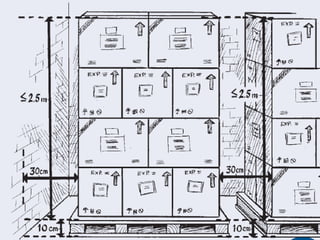
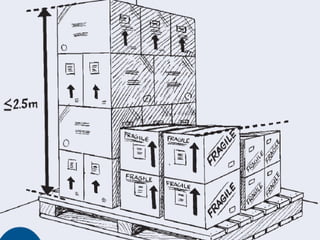
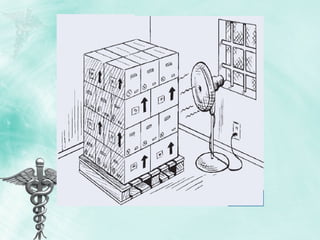
Arrange the Storeroom & Shelves as follows: If using pallets, stack cartons on pallets…. At least 10 cm (4 inches) off the floor At least 30 cm (1 foot) away from the walls and other stacks No more than 2.5 m (8 feet) high (general rule)
 
Arrange the Storeroom & Shelves as follows: For all storage: Follow the manufacturer or shipper’s directions when stacking, and follow labels for storage conditions Place liquid products on the lower shelves or on bottom of stacks
Arrange the Storeroom & Shelves as follows: For all storage: Store products that require cold storage in appropriate temperature controlled zones Store high security/high value products in appropriate security zones
Arrange the Storeroom & Shelves as follows: For all storage: Separate damaged or expired products from the usable stock without delay, and dispose of using established disposal procedures Always store all commodities in a manner that facilitates  FEFO  policy for stock management
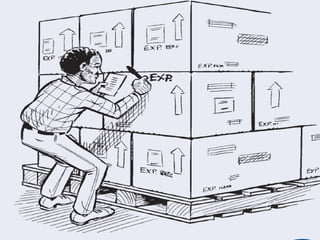
Arrange the Storeroom & Shelves as follows: For all storage: Arrange cartons so arrows point up and identification labels, expiry dates, and manufacturing dates are  visible   If this is not possible, write the product name and expiry date  clearly  on the visible side
 
4- Stock Rotation (FEFO Policy)
Stock Rotation Following FEFO minimizes wastage from product expiry Always issue products that will expire first, ensuring they are not too close to or past their expiration date
Stock Rotation The shelf life remaining must be sufficient for the product to be used before the expiry date
Stock Rotation To facilitate FEFO, place products that will expire first in front of products with a later expiry date Write expiry dates on stock cards, so stocks can be sent to facilities at least 6 months before they expire
Stock Rotation Remember, the order in which you received products is  NOT  necessarily the order in which they will expire Products you received most recently may expire sooner than the products you received earlier
Stock Rotation So, it is extremely important to always check the expiration dates and to make sure the dates are  visible  while the products are in storage
Orderly Arrangement of Essential Medicines Medical stores must have a system for classifying or organizing medicines, and must ensure that all employees know the system being used
Some Common Systems for Arranging Medicines Include…. Alphabetical order by generic name  Therapeutic or pharmacologic category  Dosage form  System level Frequency of use Random bin Commodity coding
5- Special Storage Conditions
Special Storage Conditions Some products need storage in an access-controlled environment It is important to identify products that are at risk of theft or abuse or have the potential for addiction, and to provide increased security for those items
This includes products that are in high demand or have the potential for resale (black market value) Usually, National Essential Medicines Lists (NEML) include several narcotics and psychotropic medicines; one or two will be on facility lists  Special Storage Conditions
Typical examples are Narcotics Other opioid & strong analgesics Psychotropic drugs Special Storage Conditions
Some of the medicines mentioned earlier are controlled substances, which are medicines handled under international control These medicines need greater attention Special Storage Conditions
There are specific procedures in place for the procurement, reception, storage, dispensing, and administration of controlled substances Special ordering forms should be used Special Storage Conditions
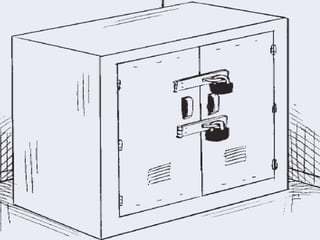
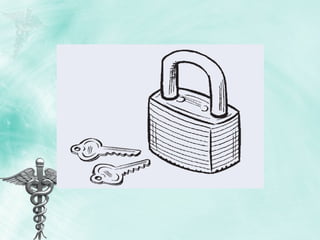
Examples of  Access-Controlled Storage This will probably include storing the products in a separate locked room, cabinet, or safe, or a locked wire cage within the storage facility
Examples of  Access-Controlled Storage Ideally a warning light or bell will be activated if the products are accessed improperly Entry to the location of the access -controlled products must be limited to the most senior storekeeper or pharmacist and one other staff member
Examples of  Access-Controlled Storage Limit the number of keys made for the controlled location and keep a list of people who have keys
 
Flammables  Some flammable liquids commonly found in health facilities include acetone, anesthetic ether, alcohols (before dilution), and kerosene
Flammables  Store large supplies of flammables in a separate location away from the  main storeroom, preferably outside the main storeroom but on the premises and not less than 20 m away from the other buildings
Flammables  Fire fighting equipment should be easily available
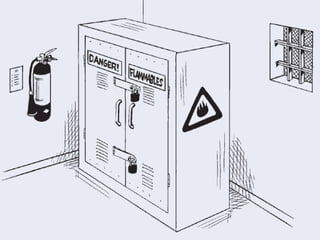
Flammables  Large supplies of flammables should never be stored in the same areas as medicines A small stock of flammables may be kept in a steel cabinet in a well-ventilated area, away from open flames and electrical appliances
Flammables  Mark the cabinets to indicate that they contain highly flammable liquids, and display the international hazard symbol
Flammables  In addition, the shelves of the cabinet should be designed to contain and isolate spillage
Flammables  Always store flammables in their original container
Flammables  Flammable liquids each have a flash point, which is the minimum temperature at which the liquid gives off vapor in sufficient concentration to form an ignitable mixture with air near the surface of the liquid
Flammables  Always store flammables in their original container
Flammables  Flammable liquids each have a flash point, which is the minimum temperature at which the liquid gives off vapor in sufficient concentration to form an ignitable mixture with air near the surface of the liquid
Flammables  The flash point indicates the susceptibility to ignition
Flammables  It is not necessary to store flammables below their flash point, but it is very important to store them in the coolest location possible and never in direct sunlight
Flammables  It is important to control the evaporation rate and avoid the build-up of pressure
 
Corrosives Corrosive or oxidant substances commonly found in hospitals or other high-level health facilities include trichloracetic acid, glacial acetic acid, concentrated ammonia solutions, silver nitrate, sodium nitrate, and sodium hydroxide pellets
Corrosives Always store corrosive substances away from flammables, ideally in a separate steel cabinet to prevent leakage Use appropriate industrial-type protective gloves and eyeglasses when handling these items
4- Keeping Track of Products in Your Storeroom
Standard List Of Stock Items Each medical store should maintain a standard list of stock items that includes all products they handle, with their specifications, including: form,  strength, and  quantity per package
Standard List Of Stock Items The list should be regularly updated and distributed to sub-stores and units Do not order products that are not on the standard list unless you have special permission
Standard List Of Stock Items You should not accept deliveries of products not on the list unless special circumstances have been identified Inventory records should be maintained for all products on the list
Stock Records
The minimal information that should be collected on stock records for medicines and other health products includes: Product name/ description (including the form [e.g., capsule, tablet, liquid suspension, etc.] and strength) Stock on hand/ beginning stock balance
The minimal information that should be collected on stock records for medicines and other health products includes: Receipts Issues Losses/adjustments
The minimal information that should be collected on stock records for medicines and other health products includes: Closing/ending balance Transaction reference (e.g., issue voucher number or name of supplier or recipient)
Depending on the system, stock records might also include additional product information such as: Special storage conditions (e.g., 2°–8°C) Unit prices
Depending on the system, stock records might also include additional product information such as: Lot numbers/bin locations Item codes Expiry dates
Stock Records Stock records might also include certain calculated data items. These are determined by mathematical formulas, that depend on system design parameters (e.g., how often orders are placed)
Calculated Data Items Include: Consumption data, such as average monthly consumption (AMC) Lead times for ordering/requisition Maximum and minimum stock levels Emergency order point
Stock Records A storage and distribution system may not necessarily use all these forms, but it will need forms to record stock-keeping data and product transactions
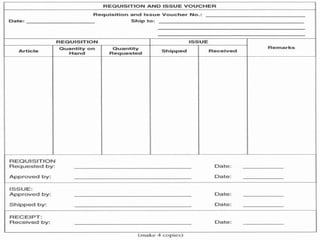
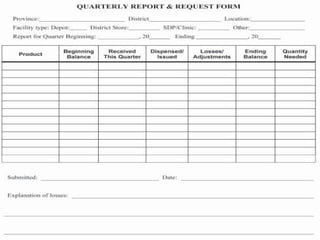
Standard Forms Used for Inventory Control Include: Stock cards Bin cards Requisition/issue vouchers
Standard Forms Used for Inventory Control Include: Receiving forms (packing slip/freight bill) Delivery/issue vouchers
Standard Forms Used for Inventory Control Include: Expired stock disposal forms Physical inventory forms List of approved medicines and prices
A logistics information system must have three different types of records:  stock-keeping  records,  transaction  records, &  consumptions  records Stock Records
 
 
Physical Inventory
Physical Inventory A physical inventory is the process of counting by hand the number of each type of product in your store at any given time
Physical Inventory A physical inventory helps ensure that the stock on hand balances recorded on stock-keeping records match the quantities of products actually in the store
Physical Inventory When conducting a physical inventory, count each product individually by generic name, dosage form, and strength
There are Two Kinds of Physical Inventory: Complete physical inventory Cyclic or random physical inventory
Complete Physical Inventory All products are counted at the same time A complete inventory should be taken at least once a year
Complete Physical Inventory More frequent inventory (quarterly or monthly) is recommended For large warehouses, this may require closing the storage facility for a day or longer
Cyclic or Random Physical Inventory Selected products are counted and checked against the stock-keeping records on a rotating or regular basis throughout the year
Cyclic or Random Physical Inventory This process is also called cycle counting A complete physical inventory is easier to conduct regularly at facilities that manage smaller quantities of products
Cyclic or Random Physical Inventory Cyclic or random physical inventory is usually appropriate at facilities that manage larger quantities of products
Cyclic Physical Inventory can be Organized in Many Ways: Dosage form:  Count tablets in January, capsules in February, liquids in March, etc Location in the storeroom:  Count shelves 1–4 in January, 5–8 in February, etc
Cyclic Physical Inventory can be Organized in Many Ways: Time availability:  Count a few items each day whenever staff have time
Cyclic Physical Inventory can be Organized in Many Ways: Stock on hand:  On a periodic basis, count each item for which stock on hand is at or below the minimum inventory level. This method may be faster, since there are smaller quantities to count
Cyclic Physical Inventory can be Organized in Many Ways: If cyclic physical inventory is used, count each product at least once during the year Count fast-moving items and full supply products more frequently
Steps in Conducting a Physical Inventory
1- Plan For a complete physical inventory, schedule the day(s) and time For a cyclic or random physical inventory, identify which products will be counted and the corresponding time period for those products
2- Assign Staff
3- Organize the Storeroom Arrange products according to FEFO Make sure open cartons and boxes are visible Separate damaged or expired products
4- Count the Usable Products Count products according to the units by which they are issued (e.g., tablet or piece) not by the carton or box
4- Count the Usable Products Estimate quantities in open containers for products packaged in bulk If a bottle of 1,000 capsules is 2/3 full, estimate 650 or 700 capsules. If you have a one liter bottle of syrup that is 1/2 full, estimate 0.5 liters
5- Update the Stock-keeping Records Write the date of the physical inventory and the words “Physical Inventory.” Using a different color ink, write the quantity of the product that you counted during stocktaking
6- Take Action Based on the Results of the Physical Inventory If the results of the physical inventory differ from the balance on the stock/bin card, update the balance by adding or subtracting the excess or missing quantities
6- Take Action Based on the Results of the Physical Inventory Dispose of damaged or expired products found during the physical inventory For either of the above, identify, document, and correct the cause of the problem
6- Discuss the Findings of The Inventory with the Facility Staff Congratulate the staff, if appropriate Take corrective actions, if required
5- Maintaining the Quality of Your Products
Monitoring Product Quality Indicators of quality problems: Products of different types show damage in different ways
Damage Indicators in All Products Broken or ripped packaging (vials, bottles, boxes, etc.) Missing, incomplete, or unreadable label(s)
Damage Indicators in Liquids Discoloration Cloudiness Sediment
Damage Indicators in Liquids Broken seal on bottle Cracks in ampoule, bottle, or vial Dampness or moisture in the packaging
Damage Indicators in  Light-sensitive Products  (such as x-ray film) Torn or ripped packaging
Damage Indicators in Latex Products Dry Brittle Cracked
Damage Indicators in Lubricated Latex Products Sticky packaging Discolored product or lubricant Stained packaging Leakage of the lubricant (moist or damp packaging)
Damage Indicators in Pills (tablets) Discoloration Crumbled pills Missing pills (from blister pack) Stickiness (especially coated tablets) Unusual smell
Damage Indicators in Injectables Liquid does not return to suspension after shaking
Damage Indicators in Sterile Products (including IUDs) Torn or ripped packaging Missing parts Broken or bent parts Moisture inside the packaging Stained packaging
Damage Indicators in Capsules Discoloration Stickiness Crushed capsules
Damage Indicators in Tubes Sticky tube(s) Leaking contents Perforations or holes in the tube
Damage Indicators of Foil Packs Perforation(s) in packaging
Damage Indicators in Chemical Reagents Discoloration
How to Deal with Damaged Products ???? Damaged products should never be issued to facilities or dispensed to clients If you are not sure if a product is damaged, check with someone who knows
How to Deal with Damaged Products ???? Do not issue or dispense products that you suspect are damaged Report any defects and send the defective products back to the facility that issued them to you If an inspector visits your facility, report any problems to him or her
Preventing  Physical Damage Avoid crushing products stored in bulk Products should be stacked no more than 2.5 m (8 feet) high, as a general rule
Preventing  Physical Damage Heavier or fragile Items (such as those packaged in glass) should be placed in smaller stacks Bind sharp edges or corners in the store with tape
Preventing  Physical Damage Most important, ensure that nothing in the store can fall and injure members of the staff
 
Preventing Contamination with Dirt Write and post the schedule and instructions for cleaning the storeroom in multiple locations around the facility Sweep and mop or scrub the floors of the storeroom regularly
Preventing Contamination with Dirt Wipe down the shelves and products to remove dust and dirt Dispose of garbage and other waste often, in a manner that avoids attracting pests Store garbage in covered receptacles
Storeroom Infrastructure Ensure the storeroom has easy access to a water outlet for cleaning If no running water is available, set up a system using, for example, several 55 gallon drums on an elevated platform connected to pipes running into the store
Storeroom Infrastructure Refill the drums regularly
Storeroom Infrastructure When rehabilitating an existing storage facility or constructing a new structure, install water outlets in several locations inside the structure so water is easily available from any location in the storeroom
Cleaning Materials !!!! Keep a budget for buying cleaning materials Use industrial detergents when possible, particularly for larger facilities, although imported detergents can be expensive
Cleaning Materials !!!! Try to use locally available detergents, particularly for smaller or more remote facilities Clean with chlorine bleach regularly (once a month, for example)
Outside the Facility !!!! Burn garden rubbish and cardboard cartons, etc. , when garbage collection is not available
Outside the Facility !!!! Use the necessary precautions to keep the fire under control, and do not burn materials close to the building Make sure the wind is not blowing toward the building
Protecting Against Fire
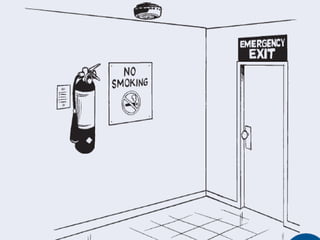
To Prevent Damage to Products from Fire Make standard fire extinguishers available in every storage facility according to national regulations
To Prevent Damage to Products from Fire Visually inspect fire extinguishers every 2–3 months to ensure that pressures are maintained and the extinguisher is ready for use
To Prevent Damage to Products from Fire Service fire extinguishers at least every 12 months Place smoke detectors throughout the storage facility and check them every 2–3 months to ensure that they are working properly
 
 
To Prevent Damage to Products from Fire Strictly prohibit smoking in the store Conduct fire drills for personnel every 6 months
To Prevent Damage to Products from Fire Clearly mark emergency exits and check regularly to be sure they are not blocked or inaccessible
To Prevent Damage to Products from Fire Display fire precaution signs in appropriate places in the storage facility (especially locations where flammables are stored)
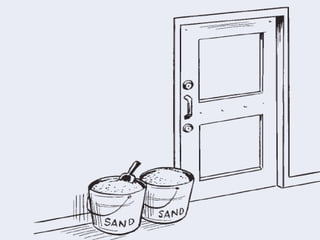
To Prevent Damage to Products from Fire Use sand to extinguish fires where there are no fire extinguishers Place buckets of sand near the door
Four Main Types of Fire Extinguishers
Dry Chemical Extinguishers They contain an extinguishing agent such as potassium bicarbonate (similar to baking soda), and use a compressed gas as a propellant
Dry Chemical Extinguishers They are effective for multiple types of fire including combustible solids like wood or paper, combustible liquids like gasoline or grease, and electrical fires
2- Water Extinguishers They contain water and compressed gas and should only be used on ordinary combustibles, such as paper and wood Never use water on fires caused by liquids (such as gasoline or kerosene) or electrical fires
3- Carbon dioxide (CO2) Extinguishers They are most effective on fires caused by liquids (such as gasoline or kerosene) and electrical fires, but not on fires caused by combustibles like paper, cardboard, or lumber
3- Carbon dioxide (CO2) Extinguishers The gas disperses quickly and does not leave any harmful residue
4- Halon Extinguishers They are often used in areas with computer equipment or other machinery because they leave no residue They can be used on common combustibles, flammable liquids, and electrical fires
4- Halon Extinguishers However, halon is dangerous to inhale and harmful to the environment They are most effective in confined spaces, but remember that the area will need to be ventilated before it can be reoccupied
Be sure medical store staff are trained in how to use fire extinguishers: P.A.S.S.  is a simple method used to teach fire extinguisher use
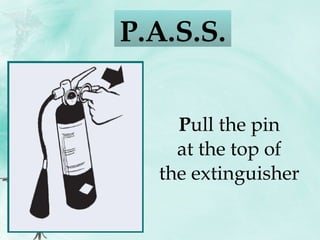
P ull the pin at the top of the extinguisher P.A.S.S.
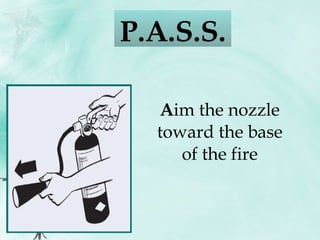
A im the nozzle toward the base of the fire P.A.S.S.
S queeze the handle to discharge the extinguisher (stand approximately 2.5 m [8 ft] away) P.A.S.S.
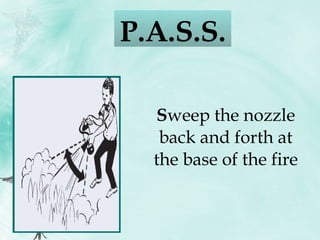
S weep the nozzle back and forth at the base of the fire P.A.S.S.
The P.A.S.S method is accepted for dry chemical and CO2 extinguishers; however, other methods are needed when using water and other extinguishers and with special fires, such as flammable liquids P.A.S.S.
Additionally, the P.A.S.S. method may not be appropriate for all dry chemical and CO2 extinguishers Be sure to carefully read the instructions for the extinguishers in your facility P.A.S.S.
Protection Against Pests !!
Prevention of Pests Inside the Storage Facility Design or modify the storeroom to facilitate cleaning and prevent moisture
Prevention of Pests Inside the Storage Facility Maintain a clean environment to prevent conditions that favor pests. For example, store garbage in covered garbage bins Regularly clean floors and shelves
Prevention of Pests Inside the Storage Facility Keep the interior of the building as dry as possible Paint or varnish wood, as needed Use pallets and shelving
Prevention of Pests Inside the Storage Facility Prevent pests from entering the facility Inspect the storage facility regularly for evidence of pests
Prevention of Pests Inside the Storage Facility Packaging and shipping cartons can be treated to prevent pest infestation For example, cartons can be shrink-wrapped or non-toxic desiccating (dehydrating) agents can be added
Regularly inspect and clean the outside premises of the storage facility, especially areas where garbage is stored Check for any rodent burrows, and be sure that garbage and other waste is stored in covered containers Prevention of Pests Outside the Storage Facility
Check for still or stagnant pools of water in and around the premises, and be sure that there are no buckets, old tires, or other items holding water Treat wood frame facilities with water sealant, as needed Prevention of Pests Outside the Storage Facility
Use mercury vapor lighting where possible, and locate lighting away from the building to minimize the attraction of pests Prevention of Pests Outside the Storage Facility
Strategies for Specific Pests
Strategies for Rodents Rodent problems are best solved by prohibiting rodent entry and maintaining a dry, clean facility
Strategies for Rodents Other alternatives include: Keeping cats;  Traditional, spring-loaded snap traps baited with food;  Glue boards, which are disposable plastic or wood trays partially filled with nontoxic, adhesive glue;
Strategies for Rodents Other alternatives include: Bait boxes, which are shoe-sized boxes with lids and holes on each end containing toxic rodenticide packets;  Electronic ultrasonic devices, which emit high-frequency sounds, causing rodents to avoid the area;  or rat poison
Strategies for Birds or bats If the facility has space between the ceiling and the roof, cover all the openings with fine wire mesh to prevent birds or bats from entering the storeroom
Strategies for Flying pests The best prevention is to keep all doors and windows of the storage facility closed or screened off from the outside Make sure there are no holes in the walls, floor, or ceiling
Strategies for Flying pests Insect electrocuting light traps (“bug zappers,” hanging electric grids that attract flying insects via a bright fluorescent or ultraviolet light) may be appropriate in some situations
Strategies for Flying pests However, they should be placed away from supplies, since ultraviolet light damages a number of products (especially latex products, such as male condoms)
Strategies for Reptiles Most snake species are innocuous and can be managed with noisemakers and by keeping the outside of the facility clear of bushes If snakes are an especially difficult problem in your area, you can construct a snake-proof fence around the perimeter of the facility
Strategies for Reptiles The fence should be made with heavy, galvanized screen with 6 mm wire mesh The fence should be 90 cm tall with the lower end buried at least 10–16 cm in the ground
Strategies for Reptiles The above ground portion of the fence should be slanted at a 30° angle outward from the base and away from the building, using supporting stakes inside the fence
Strategies for Termites/structural Pests:  There are two primary treatments for subterranean termites, but both are expensive and require a specialist The first treatment involves injecting a termiticide into the soil in the ground beneath the facility
Strategies for Termites/structural Pests:  If the problem is severe, or if the first treatment is not feasible, the building must be fumigated All stored goods must be removed from the site during fumigation. Replace wood severely damaged by structural pests
Strategies for Termites/structural Pests:  There are alternative methods of controlling structural pests Use nontoxic heat or liquid nitrogen treatments
Strategies for Termites/structural Pests:  There are alternative methods of controlling structural pests Build metal barriers into the foundation of a new building. Sheets of metal protrude from between the foundation and walls of the building. The sheets are bent downward at an angle, but not touching the ground. When termites or ants attempt to climb up the foundation, they encounter the metal barrier that they cannot climb around
Strategies for Termites/structural Pests:  There are alternative methods of controlling structural pests Construct sand barriers around the building as a preventative measure. However, the grains of sand must be a specific size, so this method can be expensive
Controlling Temperature !!!
1- Humidity When product labels say “protect from moisture,” store the product in a space with no more than 60% relative humidity
To Reduce the Effects of Humidity Ventilation:  Open the windows or air vents of the storeroom to allow air circulation Ensure all windows have screens to keep out insects and birds, and either have bars or are not open wide enough for anyone to climb in Put boxes on pallets and ensure there is space between pallets and the walls of the storeroom
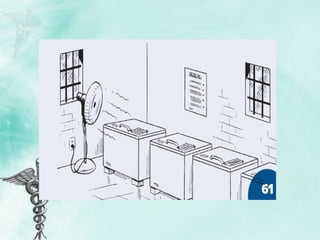
Packaging:  Secure all lids. Never open a new container unless necessary Circulation:  Use a fan to circulate fresh (outside) air In bigger storerooms you may need a ceiling fan Standing fans are more useful in smaller storerooms. This requires electricity and some maintenance To Reduce the Effects of Humidity
2- Sunlight Some health products are photosensitive and will be damaged if exposed to light. These include multiple vitamins, furosemide, chloropheniramine maleate, hydrocortisone, latex products (such as male condoms), and x-ray film
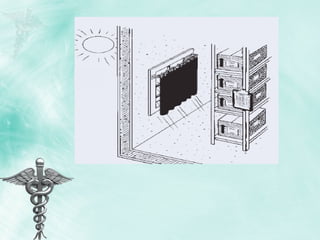
To Protect Products from Sunlight: Shade the windows or use curtains, if they are in direct sunlight Keep products in cartons  Do not store or pack products in sunlight. Use opaque plastic or dark glass bottles for products that require them
To Protect Products from Sunlight: Maintain trees on the premises around the facility to help provide shade, but check them regularly to ensure that there aren’t any branches that can damage the facilities
3- Heat Remember that heat will affect many products. It melts ointments and creams and causes other products to become useless Following the guidelines listed earlier for protecting products from humidity and sunlight will also help protect products from heat
3- Heat It is important to have thermometers in various parts of the storeroom to monitor temperature (see section on monitoring temperature) But, even if you do not have thermometers, you can still monitor the heat If you feel hot, your products are probably hot, too
4- Monitoring Consistently monitor the temperature of the different areas within the storeroom Keep thermometers in various places for monitoring Keep direct sunlight out of the storeroom
4- Monitoring Keep the storeroom well ventilated (see section on humidity) For better ventilation, store boxes on pallets and leave room between rows of stacked boxes (see section on arranging products)
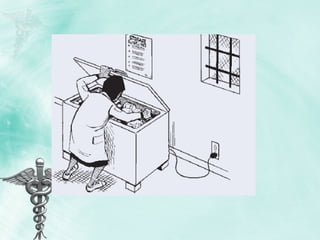
Refrigerators & Freezers Refrigerators that open on the top are more efficient than vertical ones, because hot air rises while cold air falls The coldest part of vertical refrigerators is at the bottom Store products that are sensitive to freezing or very low temperatures on the upper shelves
Refrigerators & Freezers Always have enough frozen icepacks to transport items requiring cold storage in cold boxes and/or vaccine carriers Use only icepacks filled with water
Refrigerators & Freezers Do not use icepacks prefilled with other liquids, which are usually blue or green When ordering cold chain equipment, larger facilities should reassess the needs for icepacks and icepack freezer space
Refrigerators & Freezers If there is enough space, place a few plastic bottles of water in the refrigerator. This will help maintain the temperature for a longer period of time if the power is cut off Place refrigerators and freezers with space between and about an arm’s length away from the wall. This will increase the air circulation
Refrigerators & Freezers Under ideal conditions, rooms with multiple refrigerators and/or freezers should have air conditioning Refrigerators and freezers generate large amounts of heat, which can damage the equipment over time
Refrigerators & Freezers If it is not possible to have air conditioning, install fans around the equipment to increase air flow If installing fans, remember to place the fans so the air also flows in the spaces behind the refrigerators
Refrigerators & Freezers Ideally, larger facilities should have a cold room rather than numerous refrigerators
Power Supply Arrange for a solar panel generator or alternative supply of electricity for cold rooms and refrigerators if the main source of electricity is not reliable
Power Supply If the generator is not solar-powered, maintain a stock of fuel sufficient to run the generator for at least a few days (see section on storing flammables)
Power Supply Run the generator on a regular basis (at least once a month) to ensure the system is working properly Larger facilities may want to contract out the maintenance of the generator and electrical system
Power Supply If your electricity supply is unreliable, use kerosene or solar powered refrigerators
Power Supply Kerosene appliances require frequent maintenance. Trim the wick regularly so the flame is not too high, clean the chimney monthly, and keep a backup supply of kerosene (see section on storing flammables)
Power Supply Place the refrigerator away from the wall on a balanced and level surface. The appliance must be placed on a level surface or it will not function properly
Power Supply Monitor the temperature regularly. The flame on a kerosene appliance should always be blue; if it is yellow, trim the wick
The following terms relate to temperature and medical supplies It is important to follow the manufacturer’s recommended storage conditions for all products
Common Terms Store frozen:  Some products, such as certain vaccines, need to be transported within a cold chain and stored at –20°C (4°F) Frozen storage is normally for longer-term storage at higher level facilities
Common Terms Store at 2°–8°C (36°–46°F):  Some products are very heat sensitive but must not be frozen These are usually kept in the first and second part of the refrigerator (never the freezer) This temperature is appropriate for storing vaccines for a short period of time
Common Terms Keep cool:  Store between 8°–15°C (45°–59°F) Store at room temperature:  Store at 15°–25°C (59°–77°F)
Common Terms Store at ambient temperature:  Store at the surrounding temperature This term is not widely used due to significant variation in ambient temperatures It means “room temperature” or normal storage conditions, which means storage in a dry, clean, well ventilated area at room temperatures between 15° to 25°C (59°–77°F) or up to 30°C, depending on climatic conditions


Protecting Against Theft
During Transport !! Verify documents Ensure packing seals are used Use strong boxes/containers Provide reliable/well-maintained vehicles Ensure drivers are reliable Ensure rapid clearance at air and sea ports and through on-land borders
At Storage Facilities Limit access to only designated staff Limit the number of keys made for the facility; keep a list of people who have keys Secure all locks and doors Make unannounced spot checks Provide independent stock count/inventory control
In Health Centers Lock the storeroom/cupboards Have inventory control cards for each product Set maximum dispensing quantities
In Health Centers Have dispensers record individual prescriptions and maintain prescription or dispensing registers Limit dispensing to authorized staff members only
Monitor Selected Products As additional protection against theft, monitor items that are fast moving, chronically in short supply, in high demand by customers, expensive, life saving, and easy to hide or disguise
Two Techniques for Monitoring Medicines Select medicines likely to be stolen or misused (e.g., antibiotics, narcotics, psychotropics, antiretrovirals)
Two Techniques for Monitoring Medicines Check inventory records for stock on hand. Then, conduct a physical inventory (physically count the quantities on hand) and compare the results
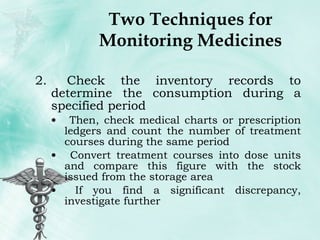
Two Techniques for Monitoring Medicines Check the inventory records to determine the consumption during a specified period Then, check medical charts or prescription ledgers and count the number of treatment courses during the same period Convert treatment courses into dose units and compare this figure with the stock issued from the storage area If you find a significant discrepancy, investigate further
 
Waste Management
Considering Waste Management Storage facility grounds, including the area around health centers, must remain free of health care waste and other garbage
Considering Waste Management Maintaining a clean environment where pharmaceuticals and other health supplies are stored will reduce the number of pests—insects and rodents—and reduce the number of people, including children, who may be injured by used medical equipment or discarded medicines
Considering Waste Management Check with local officials about laws that pertain to health care waste management and environmental protection before instituting a disposal technique
Considering Waste Management Plan storage, transportation, and disposal techniques that are practical and simple Monitor disposal practices on a regular, frequent basis
Non-medical Waste Garden rubbish:  Compost leaves, sticks, weeds, and trimmings from shrubs and trees, if feasible. Designate a separate area for composting Cardboard cartons:  If possible, recycle cardboard; otherwise, treat like ordinary rubbish
Non-medical Waste Ordinary rubbish:  Where municipal solid waste facilities exist, dispose of ordinary rubbish in the municipal dump. Otherwise, burn or bury it Human waste:  Use pit latrines or other toileting facilities to dispose of all human waste
Health Care Waste Sharps waste:  Single-use disposable needles, needles from auto-disable syringes, scalpel blades, disposable trocars, sharp instruments requiring disposal, and sharps waste from laboratory procedures
Health Care Waste Other hazardous medical waste:  Waste contaminated with blood, body fluids, human tissue; compounds such as mercury; pressurized containers; and wastes with high heavy metal content
Health Care Waste Pharmaceuticals:  Expired, damaged, or otherwise unusable medicines and items contaminated by or containing medicinal substances
Pharmaceutical Disposal It is very important to dispose of pharmaceuticals properly because there can be very negative consequences to improper disposal
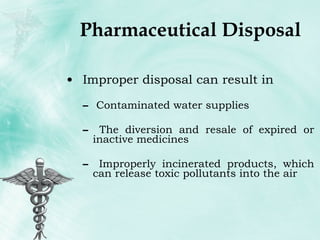
Pharmaceutical Disposal Improper disposal can result in Contaminated water supplies The diversion and resale of expired or inactive medicines Improperly incinerated products, which can release toxic pollutants into the air
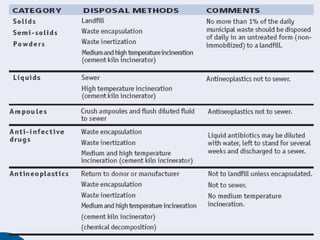
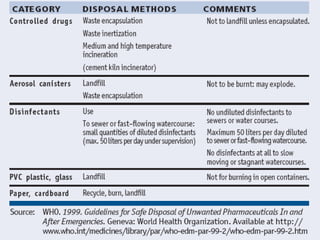
Pharmaceutical Disposal Always  follow your facility’s procedures for handling damaged or expired medicines In most cases, this will mean that you should send the products back to the facility that provides you with your supplies The disposal methods for various categories of pharmaceuticals are identified in the following table
 
 
Pharmaceutical Disposal Particular attention must be given to disposal of the following categories of pharmaceuticals Controlled substances, such as narcotics and psychotropic medicines Anti-infective drugs Antineoplastics Cytotoxic anti-cancer drugs, toxic drugs Antiseptics and disinfectants
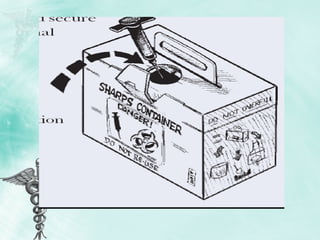
Safety Boxes Safety boxes or sharps containers are puncture- and water-resistant, impermeable containers. When used correctly, they reduce the risk of skin-puncture injuries that may spread disease
Safety Boxes Do not recap syringes before disposal Place the syringe and needle in the sharps box  immediately  after use Keep the sharps box where the injections are given Do not overfill the sharps containers (about Âľ full)
Safety Boxes When Âľ full, close box tab completely to cover the opening and tape it shut Store the box in a safe and secure location until ready for final disposal Do not empty and refill sharps boxes. Fill once and discard immediately
 
Thank You

Introduction to good storage practices full

  • 1.
    Introduction to Good Storage Practices
  • 2.
    1- Routine Warehouseor Storeroom Management Tasks
  • 3.
    Daily/Weekly Monitor storageconditions Clean receiving, storage, packing, and shipping areas Sweep or scrub floors Remove garbage Clean bins, shelves, and cupboards, if needed
  • 4.
    Daily/Weekly Ensure thataisles are clear Ensure adequate ventilation and cooling Ensure that products are protected from direct sunlight
  • 5.
    Daily/Weekly Monitor storesecurity and safety Check the store roof for leaks, especially during the rainy season and during or after a storm Monitor product quality (visually inspect commodities and check expiration dates)
  • 6.
    Daily/Weekly Ensure thatproducts are stacked correctly (are the lower cartons being crushed?) Update stock records and maintain files If cycle counting, conduct physical inventory and update stock-keeping records
  • 7.
    Daily/Weekly Monitor stocklevels, stock quantities, and safety stocks Submit emergency order (as needed, using local guidelines) Update back-up file for computerized inventory control records
  • 8.
    Daily/Weekly Update bincards Separate expired stocks and move to secure area
  • 9.
    Monthly Conduct physicalinventory or cycle count, and update stock keeping records Run generator to ensure the system is working correctly; check the level of fuel and add fuel, if needed
  • 10.
    Monthly Check forsigns of rodents, insects, or roof leaks Inspect the storage structure for damage, including the walls, floors, roof, windows, and doors
  • 11.
    Every 3 Months (Quarterly) Conduct physical inventory or cycle count, and update stock keeping records Use established procedures to dispose of expired or damaged products
  • 12.
    Every 3 Months (Quarterly) Visually inspect fire extinguishers to ensure that pressures are maintained and extinguishers are ready for use
  • 13.
    Tasks According toReorder Interval & Reporting Schedule (Usually Monthly or Quarterly) Assess stock situation Complete and submit requisition form (indent or “pull” systems) Determine issue quantity and issue products (“push” systems)
  • 14.
    Tasks According toReorder Interval & Reporting Schedule (Usually Monthly or Quarterly) Receive products Store products using correct procedures; rearrange commodities to facilitate the first-to-expire, first-out (FEFO) policy Complete required reporting and documentation
  • 15.
    Every 6 MonthsConduct fire drills and review fire safety procedures Inspect trees near the medical store and cut down or trim any trees with weak branches
  • 16.
    Every 12 MonthsService fire extinguishers and smoke detectors Conduct complete physical inventory and update stock keeping records Reassess maximum/minimum stock levels, and adjust if needed
  • 17.
    2- Receiving & Arranging Commodities
  • 18.
    When You ReceiveHealth Commodities….!!! Ensure there is sufficient storage space Prepare and clean the areas used for receiving and storing the products Inspect packages for damaged or expired products
  • 19.
    If Products areDamaged or Expired…. Separate the damaged or expired stock from the usable stock If damage or expiry is discovered while the delivery truck is still at your site, refuse to accept the products and note the problem(s) on the delivery note
  • 20.
    If Products areDamaged or Expired…. If damage or expiry is discovered after the delivery truck has departed, follow your facility’s procedures for handling damaged or expired stock
  • 21.
    If Products are NOT damaged or expired…. Count the number of units for each product received and compare to issue voucher Record the date and quantity received on stock card and bin card (if applicable)
  • 22.
    If Products are NOT damaged or expired…. Ensure the expiry date is visibly marked on every package or unit Arrange products in the storage area to facilitate the first-to-expire, first-out (FEFO) procedure
  • 23.
  • 24.
    Arrange the Storeroom& Shelves as follows: If using pallets, stack cartons on pallets…. At least 10 cm (4 inches) off the floor At least 30 cm (1 foot) away from the walls and other stacks No more than 2.5 m (8 feet) high (general rule)
  • 25.
  • 26.
    Arrange the Storeroom& Shelves as follows: For all storage: Follow the manufacturer or shipper’s directions when stacking, and follow labels for storage conditions Place liquid products on the lower shelves or on bottom of stacks
  • 27.
    Arrange the Storeroom& Shelves as follows: For all storage: Store products that require cold storage in appropriate temperature controlled zones Store high security/high value products in appropriate security zones
  • 28.
    Arrange the Storeroom& Shelves as follows: For all storage: Separate damaged or expired products from the usable stock without delay, and dispose of using established disposal procedures Always store all commodities in a manner that facilitates FEFO policy for stock management
  • 29.
    Arrange the Storeroom& Shelves as follows: For all storage: Arrange cartons so arrows point up and identification labels, expiry dates, and manufacturing dates are visible If this is not possible, write the product name and expiry date clearly on the visible side
  • 30.
  • 31.
    4- Stock Rotation(FEFO Policy)
  • 32.
    Stock Rotation FollowingFEFO minimizes wastage from product expiry Always issue products that will expire first, ensuring they are not too close to or past their expiration date
  • 33.
    Stock Rotation Theshelf life remaining must be sufficient for the product to be used before the expiry date
  • 34.
    Stock Rotation Tofacilitate FEFO, place products that will expire first in front of products with a later expiry date Write expiry dates on stock cards, so stocks can be sent to facilities at least 6 months before they expire
  • 35.
    Stock Rotation Remember,the order in which you received products is NOT necessarily the order in which they will expire Products you received most recently may expire sooner than the products you received earlier
  • 36.
    Stock Rotation So,it is extremely important to always check the expiration dates and to make sure the dates are visible while the products are in storage
  • 37.
    Orderly Arrangement ofEssential Medicines Medical stores must have a system for classifying or organizing medicines, and must ensure that all employees know the system being used
  • 38.
    Some Common Systemsfor Arranging Medicines Include…. Alphabetical order by generic name Therapeutic or pharmacologic category Dosage form System level Frequency of use Random bin Commodity coding
  • 39.
  • 40.
    Special Storage ConditionsSome products need storage in an access-controlled environment It is important to identify products that are at risk of theft or abuse or have the potential for addiction, and to provide increased security for those items
  • 41.
    This includes productsthat are in high demand or have the potential for resale (black market value) Usually, National Essential Medicines Lists (NEML) include several narcotics and psychotropic medicines; one or two will be on facility lists Special Storage Conditions
  • 42.
    Typical examples areNarcotics Other opioid & strong analgesics Psychotropic drugs Special Storage Conditions
  • 43.
    Some of themedicines mentioned earlier are controlled substances, which are medicines handled under international control These medicines need greater attention Special Storage Conditions
  • 44.
    There are specificprocedures in place for the procurement, reception, storage, dispensing, and administration of controlled substances Special ordering forms should be used Special Storage Conditions
  • 45.
    Examples of Access-Controlled Storage This will probably include storing the products in a separate locked room, cabinet, or safe, or a locked wire cage within the storage facility
  • 46.
    Examples of Access-Controlled Storage Ideally a warning light or bell will be activated if the products are accessed improperly Entry to the location of the access -controlled products must be limited to the most senior storekeeper or pharmacist and one other staff member
  • 47.
    Examples of Access-Controlled Storage Limit the number of keys made for the controlled location and keep a list of people who have keys
  • 48.
  • 49.
    Flammables Someflammable liquids commonly found in health facilities include acetone, anesthetic ether, alcohols (before dilution), and kerosene
  • 50.
    Flammables Storelarge supplies of flammables in a separate location away from the main storeroom, preferably outside the main storeroom but on the premises and not less than 20 m away from the other buildings
  • 51.
    Flammables Firefighting equipment should be easily available
  • 52.
    Flammables Largesupplies of flammables should never be stored in the same areas as medicines A small stock of flammables may be kept in a steel cabinet in a well-ventilated area, away from open flames and electrical appliances
  • 53.
    Flammables Markthe cabinets to indicate that they contain highly flammable liquids, and display the international hazard symbol
  • 54.
    Flammables Inaddition, the shelves of the cabinet should be designed to contain and isolate spillage
  • 55.
    Flammables Alwaysstore flammables in their original container
  • 56.
    Flammables Flammableliquids each have a flash point, which is the minimum temperature at which the liquid gives off vapor in sufficient concentration to form an ignitable mixture with air near the surface of the liquid
  • 57.
    Flammables Alwaysstore flammables in their original container
  • 58.
    Flammables Flammableliquids each have a flash point, which is the minimum temperature at which the liquid gives off vapor in sufficient concentration to form an ignitable mixture with air near the surface of the liquid
  • 59.
    Flammables Theflash point indicates the susceptibility to ignition
  • 60.
    Flammables Itis not necessary to store flammables below their flash point, but it is very important to store them in the coolest location possible and never in direct sunlight
  • 61.
    Flammables Itis important to control the evaporation rate and avoid the build-up of pressure
  • 62.
  • 63.
    Corrosives Corrosive oroxidant substances commonly found in hospitals or other high-level health facilities include trichloracetic acid, glacial acetic acid, concentrated ammonia solutions, silver nitrate, sodium nitrate, and sodium hydroxide pellets
  • 64.
    Corrosives Always storecorrosive substances away from flammables, ideally in a separate steel cabinet to prevent leakage Use appropriate industrial-type protective gloves and eyeglasses when handling these items
  • 65.
    4- Keeping Trackof Products in Your Storeroom
  • 66.
    Standard List OfStock Items Each medical store should maintain a standard list of stock items that includes all products they handle, with their specifications, including: form, strength, and quantity per package
  • 67.
    Standard List OfStock Items The list should be regularly updated and distributed to sub-stores and units Do not order products that are not on the standard list unless you have special permission
  • 68.
    Standard List OfStock Items You should not accept deliveries of products not on the list unless special circumstances have been identified Inventory records should be maintained for all products on the list
  • 69.
  • 70.
    The minimal informationthat should be collected on stock records for medicines and other health products includes: Product name/ description (including the form [e.g., capsule, tablet, liquid suspension, etc.] and strength) Stock on hand/ beginning stock balance
  • 71.
    The minimal informationthat should be collected on stock records for medicines and other health products includes: Receipts Issues Losses/adjustments
  • 72.
    The minimal informationthat should be collected on stock records for medicines and other health products includes: Closing/ending balance Transaction reference (e.g., issue voucher number or name of supplier or recipient)
  • 73.
    Depending on thesystem, stock records might also include additional product information such as: Special storage conditions (e.g., 2°–8°C) Unit prices
  • 74.
    Depending on thesystem, stock records might also include additional product information such as: Lot numbers/bin locations Item codes Expiry dates
  • 75.
    Stock Records Stockrecords might also include certain calculated data items. These are determined by mathematical formulas, that depend on system design parameters (e.g., how often orders are placed)
  • 76.
    Calculated Data ItemsInclude: Consumption data, such as average monthly consumption (AMC) Lead times for ordering/requisition Maximum and minimum stock levels Emergency order point
  • 77.
    Stock Records Astorage and distribution system may not necessarily use all these forms, but it will need forms to record stock-keeping data and product transactions
  • 78.
    Standard Forms Usedfor Inventory Control Include: Stock cards Bin cards Requisition/issue vouchers
  • 79.
    Standard Forms Usedfor Inventory Control Include: Receiving forms (packing slip/freight bill) Delivery/issue vouchers
  • 80.
    Standard Forms Usedfor Inventory Control Include: Expired stock disposal forms Physical inventory forms List of approved medicines and prices
  • 81.
    A logistics informationsystem must have three different types of records: stock-keeping records, transaction records, & consumptions records Stock Records
  • 82.
  • 83.
  • 84.
  • 85.
    Physical Inventory Aphysical inventory is the process of counting by hand the number of each type of product in your store at any given time
  • 86.
    Physical Inventory Aphysical inventory helps ensure that the stock on hand balances recorded on stock-keeping records match the quantities of products actually in the store
  • 87.
    Physical Inventory Whenconducting a physical inventory, count each product individually by generic name, dosage form, and strength
  • 88.
    There are TwoKinds of Physical Inventory: Complete physical inventory Cyclic or random physical inventory
  • 89.
    Complete Physical InventoryAll products are counted at the same time A complete inventory should be taken at least once a year
  • 90.
    Complete Physical InventoryMore frequent inventory (quarterly or monthly) is recommended For large warehouses, this may require closing the storage facility for a day or longer
  • 91.
    Cyclic or RandomPhysical Inventory Selected products are counted and checked against the stock-keeping records on a rotating or regular basis throughout the year
  • 92.
    Cyclic or RandomPhysical Inventory This process is also called cycle counting A complete physical inventory is easier to conduct regularly at facilities that manage smaller quantities of products
  • 93.
    Cyclic or RandomPhysical Inventory Cyclic or random physical inventory is usually appropriate at facilities that manage larger quantities of products
  • 94.
    Cyclic Physical Inventorycan be Organized in Many Ways: Dosage form: Count tablets in January, capsules in February, liquids in March, etc Location in the storeroom: Count shelves 1–4 in January, 5–8 in February, etc
  • 95.
    Cyclic Physical Inventorycan be Organized in Many Ways: Time availability: Count a few items each day whenever staff have time
  • 96.
    Cyclic Physical Inventorycan be Organized in Many Ways: Stock on hand: On a periodic basis, count each item for which stock on hand is at or below the minimum inventory level. This method may be faster, since there are smaller quantities to count
  • 97.
    Cyclic Physical Inventorycan be Organized in Many Ways: If cyclic physical inventory is used, count each product at least once during the year Count fast-moving items and full supply products more frequently
  • 98.
    Steps in Conductinga Physical Inventory
  • 99.
    1- Plan Fora complete physical inventory, schedule the day(s) and time For a cyclic or random physical inventory, identify which products will be counted and the corresponding time period for those products
  • 100.
  • 101.
    3- Organize theStoreroom Arrange products according to FEFO Make sure open cartons and boxes are visible Separate damaged or expired products
  • 102.
    4- Count theUsable Products Count products according to the units by which they are issued (e.g., tablet or piece) not by the carton or box
  • 103.
    4- Count theUsable Products Estimate quantities in open containers for products packaged in bulk If a bottle of 1,000 capsules is 2/3 full, estimate 650 or 700 capsules. If you have a one liter bottle of syrup that is 1/2 full, estimate 0.5 liters
  • 104.
    5- Update theStock-keeping Records Write the date of the physical inventory and the words “Physical Inventory.” Using a different color ink, write the quantity of the product that you counted during stocktaking
  • 105.
    6- Take ActionBased on the Results of the Physical Inventory If the results of the physical inventory differ from the balance on the stock/bin card, update the balance by adding or subtracting the excess or missing quantities
  • 106.
    6- Take ActionBased on the Results of the Physical Inventory Dispose of damaged or expired products found during the physical inventory For either of the above, identify, document, and correct the cause of the problem
  • 107.
    6- Discuss theFindings of The Inventory with the Facility Staff Congratulate the staff, if appropriate Take corrective actions, if required
  • 108.
    5- Maintaining theQuality of Your Products
  • 109.
    Monitoring Product QualityIndicators of quality problems: Products of different types show damage in different ways
  • 110.
    Damage Indicators inAll Products Broken or ripped packaging (vials, bottles, boxes, etc.) Missing, incomplete, or unreadable label(s)
  • 111.
    Damage Indicators inLiquids Discoloration Cloudiness Sediment
  • 112.
    Damage Indicators inLiquids Broken seal on bottle Cracks in ampoule, bottle, or vial Dampness or moisture in the packaging
  • 113.
    Damage Indicators in Light-sensitive Products (such as x-ray film) Torn or ripped packaging
  • 114.
    Damage Indicators inLatex Products Dry Brittle Cracked
  • 115.
    Damage Indicators inLubricated Latex Products Sticky packaging Discolored product or lubricant Stained packaging Leakage of the lubricant (moist or damp packaging)

  • 116.
    Damage Indicators inPills (tablets) Discoloration Crumbled pills Missing pills (from blister pack) Stickiness (especially coated tablets) Unusual smell
  • 117.
    Damage Indicators inInjectables Liquid does not return to suspension after shaking
  • 118.
    Damage Indicators inSterile Products (including IUDs) Torn or ripped packaging Missing parts Broken or bent parts Moisture inside the packaging Stained packaging
  • 119.
    Damage Indicators inCapsules Discoloration Stickiness Crushed capsules
  • 120.
    Damage Indicators inTubes Sticky tube(s) Leaking contents Perforations or holes in the tube
  • 121.
    Damage Indicators ofFoil Packs Perforation(s) in packaging
  • 122.
    Damage Indicators inChemical Reagents Discoloration
  • 123.
    How to Dealwith Damaged Products ???? Damaged products should never be issued to facilities or dispensed to clients If you are not sure if a product is damaged, check with someone who knows
  • 124.
    How to Dealwith Damaged Products ???? Do not issue or dispense products that you suspect are damaged Report any defects and send the defective products back to the facility that issued them to you If an inspector visits your facility, report any problems to him or her
  • 125.
    Preventing PhysicalDamage Avoid crushing products stored in bulk Products should be stacked no more than 2.5 m (8 feet) high, as a general rule
  • 126.
    Preventing PhysicalDamage Heavier or fragile Items (such as those packaged in glass) should be placed in smaller stacks Bind sharp edges or corners in the store with tape
  • 127.
    Preventing PhysicalDamage Most important, ensure that nothing in the store can fall and injure members of the staff
  • 128.
  • 129.
    Preventing Contamination withDirt Write and post the schedule and instructions for cleaning the storeroom in multiple locations around the facility Sweep and mop or scrub the floors of the storeroom regularly
  • 130.
    Preventing Contamination withDirt Wipe down the shelves and products to remove dust and dirt Dispose of garbage and other waste often, in a manner that avoids attracting pests Store garbage in covered receptacles
  • 131.
    Storeroom Infrastructure Ensurethe storeroom has easy access to a water outlet for cleaning If no running water is available, set up a system using, for example, several 55 gallon drums on an elevated platform connected to pipes running into the store
  • 132.
  • 133.
    Storeroom Infrastructure Whenrehabilitating an existing storage facility or constructing a new structure, install water outlets in several locations inside the structure so water is easily available from any location in the storeroom
  • 134.
    Cleaning Materials !!!!Keep a budget for buying cleaning materials Use industrial detergents when possible, particularly for larger facilities, although imported detergents can be expensive
  • 135.
    Cleaning Materials !!!!Try to use locally available detergents, particularly for smaller or more remote facilities Clean with chlorine bleach regularly (once a month, for example)
  • 136.
    Outside the Facility!!!! Burn garden rubbish and cardboard cartons, etc. , when garbage collection is not available
  • 137.
    Outside the Facility!!!! Use the necessary precautions to keep the fire under control, and do not burn materials close to the building Make sure the wind is not blowing toward the building
  • 138.
  • 139.
    To Prevent Damageto Products from Fire Make standard fire extinguishers available in every storage facility according to national regulations
  • 140.
    To Prevent Damageto Products from Fire Visually inspect fire extinguishers every 2–3 months to ensure that pressures are maintained and the extinguisher is ready for use
  • 141.
    To Prevent Damageto Products from Fire Service fire extinguishers at least every 12 months Place smoke detectors throughout the storage facility and check them every 2–3 months to ensure that they are working properly
  • 142.
  • 143.
  • 144.
    To Prevent Damageto Products from Fire Strictly prohibit smoking in the store Conduct fire drills for personnel every 6 months
  • 145.
    To Prevent Damageto Products from Fire Clearly mark emergency exits and check regularly to be sure they are not blocked or inaccessible
  • 146.
    To Prevent Damageto Products from Fire Display fire precaution signs in appropriate places in the storage facility (especially locations where flammables are stored)
  • 147.
    To Prevent Damageto Products from Fire Use sand to extinguish fires where there are no fire extinguishers Place buckets of sand near the door
  • 148.
    Four Main Typesof Fire Extinguishers
  • 149.
    Dry Chemical ExtinguishersThey contain an extinguishing agent such as potassium bicarbonate (similar to baking soda), and use a compressed gas as a propellant
  • 150.
    Dry Chemical ExtinguishersThey are effective for multiple types of fire including combustible solids like wood or paper, combustible liquids like gasoline or grease, and electrical fires
  • 151.
    2- Water ExtinguishersThey contain water and compressed gas and should only be used on ordinary combustibles, such as paper and wood Never use water on fires caused by liquids (such as gasoline or kerosene) or electrical fires
  • 152.
    3- Carbon dioxide(CO2) Extinguishers They are most effective on fires caused by liquids (such as gasoline or kerosene) and electrical fires, but not on fires caused by combustibles like paper, cardboard, or lumber
  • 153.
    3- Carbon dioxide(CO2) Extinguishers The gas disperses quickly and does not leave any harmful residue
  • 154.
    4- Halon ExtinguishersThey are often used in areas with computer equipment or other machinery because they leave no residue They can be used on common combustibles, flammable liquids, and electrical fires
  • 155.
    4- Halon ExtinguishersHowever, halon is dangerous to inhale and harmful to the environment They are most effective in confined spaces, but remember that the area will need to be ventilated before it can be reoccupied
  • 156.
    Be sure medicalstore staff are trained in how to use fire extinguishers: P.A.S.S. is a simple method used to teach fire extinguisher use
  • 157.
    P ull thepin at the top of the extinguisher P.A.S.S.
  • 158.
    A im thenozzle toward the base of the fire P.A.S.S.
  • 159.
    S queeze thehandle to discharge the extinguisher (stand approximately 2.5 m [8 ft] away) P.A.S.S.
  • 160.
    S weep thenozzle back and forth at the base of the fire P.A.S.S.
  • 161.
    The P.A.S.S methodis accepted for dry chemical and CO2 extinguishers; however, other methods are needed when using water and other extinguishers and with special fires, such as flammable liquids P.A.S.S.
  • 162.
    Additionally, the P.A.S.S.method may not be appropriate for all dry chemical and CO2 extinguishers Be sure to carefully read the instructions for the extinguishers in your facility P.A.S.S.
  • 163.
  • 164.
    Prevention of PestsInside the Storage Facility Design or modify the storeroom to facilitate cleaning and prevent moisture
  • 165.
    Prevention of PestsInside the Storage Facility Maintain a clean environment to prevent conditions that favor pests. For example, store garbage in covered garbage bins Regularly clean floors and shelves
  • 166.
    Prevention of PestsInside the Storage Facility Keep the interior of the building as dry as possible Paint or varnish wood, as needed Use pallets and shelving
  • 167.
    Prevention of PestsInside the Storage Facility Prevent pests from entering the facility Inspect the storage facility regularly for evidence of pests
  • 168.
    Prevention of PestsInside the Storage Facility Packaging and shipping cartons can be treated to prevent pest infestation For example, cartons can be shrink-wrapped or non-toxic desiccating (dehydrating) agents can be added
  • 169.
    Regularly inspect andclean the outside premises of the storage facility, especially areas where garbage is stored Check for any rodent burrows, and be sure that garbage and other waste is stored in covered containers Prevention of Pests Outside the Storage Facility
  • 170.
    Check for stillor stagnant pools of water in and around the premises, and be sure that there are no buckets, old tires, or other items holding water Treat wood frame facilities with water sealant, as needed Prevention of Pests Outside the Storage Facility
  • 171.
    Use mercury vaporlighting where possible, and locate lighting away from the building to minimize the attraction of pests Prevention of Pests Outside the Storage Facility
  • 172.
  • 173.
    Strategies for RodentsRodent problems are best solved by prohibiting rodent entry and maintaining a dry, clean facility
  • 174.
    Strategies for RodentsOther alternatives include: Keeping cats; Traditional, spring-loaded snap traps baited with food; Glue boards, which are disposable plastic or wood trays partially filled with nontoxic, adhesive glue;
  • 175.
    Strategies for RodentsOther alternatives include: Bait boxes, which are shoe-sized boxes with lids and holes on each end containing toxic rodenticide packets; Electronic ultrasonic devices, which emit high-frequency sounds, causing rodents to avoid the area; or rat poison
  • 176.
    Strategies for Birdsor bats If the facility has space between the ceiling and the roof, cover all the openings with fine wire mesh to prevent birds or bats from entering the storeroom
  • 177.
    Strategies for Flyingpests The best prevention is to keep all doors and windows of the storage facility closed or screened off from the outside Make sure there are no holes in the walls, floor, or ceiling
  • 178.
    Strategies for Flyingpests Insect electrocuting light traps (“bug zappers,” hanging electric grids that attract flying insects via a bright fluorescent or ultraviolet light) may be appropriate in some situations
  • 179.
    Strategies for Flyingpests However, they should be placed away from supplies, since ultraviolet light damages a number of products (especially latex products, such as male condoms)
  • 180.
    Strategies for ReptilesMost snake species are innocuous and can be managed with noisemakers and by keeping the outside of the facility clear of bushes If snakes are an especially difficult problem in your area, you can construct a snake-proof fence around the perimeter of the facility
  • 181.
    Strategies for ReptilesThe fence should be made with heavy, galvanized screen with 6 mm wire mesh The fence should be 90 cm tall with the lower end buried at least 10–16 cm in the ground
  • 182.
    Strategies for ReptilesThe above ground portion of the fence should be slanted at a 30° angle outward from the base and away from the building, using supporting stakes inside the fence
  • 183.
    Strategies for Termites/structuralPests: There are two primary treatments for subterranean termites, but both are expensive and require a specialist The first treatment involves injecting a termiticide into the soil in the ground beneath the facility
  • 184.
    Strategies for Termites/structuralPests: If the problem is severe, or if the first treatment is not feasible, the building must be fumigated All stored goods must be removed from the site during fumigation. Replace wood severely damaged by structural pests
  • 185.
    Strategies for Termites/structuralPests: There are alternative methods of controlling structural pests Use nontoxic heat or liquid nitrogen treatments
  • 186.
    Strategies for Termites/structuralPests: There are alternative methods of controlling structural pests Build metal barriers into the foundation of a new building. Sheets of metal protrude from between the foundation and walls of the building. The sheets are bent downward at an angle, but not touching the ground. When termites or ants attempt to climb up the foundation, they encounter the metal barrier that they cannot climb around
  • 187.
    Strategies for Termites/structuralPests: There are alternative methods of controlling structural pests Construct sand barriers around the building as a preventative measure. However, the grains of sand must be a specific size, so this method can be expensive
  • 188.
  • 189.
    1- Humidity Whenproduct labels say “protect from moisture,” store the product in a space with no more than 60% relative humidity
  • 190.
    To Reduce theEffects of Humidity Ventilation: Open the windows or air vents of the storeroom to allow air circulation Ensure all windows have screens to keep out insects and birds, and either have bars or are not open wide enough for anyone to climb in Put boxes on pallets and ensure there is space between pallets and the walls of the storeroom
  • 191.
    Packaging: Secureall lids. Never open a new container unless necessary Circulation: Use a fan to circulate fresh (outside) air In bigger storerooms you may need a ceiling fan Standing fans are more useful in smaller storerooms. This requires electricity and some maintenance To Reduce the Effects of Humidity
  • 192.
    2- Sunlight Somehealth products are photosensitive and will be damaged if exposed to light. These include multiple vitamins, furosemide, chloropheniramine maleate, hydrocortisone, latex products (such as male condoms), and x-ray film
  • 193.
    To Protect Productsfrom Sunlight: Shade the windows or use curtains, if they are in direct sunlight Keep products in cartons Do not store or pack products in sunlight. Use opaque plastic or dark glass bottles for products that require them
  • 194.
    To Protect Productsfrom Sunlight: Maintain trees on the premises around the facility to help provide shade, but check them regularly to ensure that there aren’t any branches that can damage the facilities
  • 195.
    3- Heat Rememberthat heat will affect many products. It melts ointments and creams and causes other products to become useless Following the guidelines listed earlier for protecting products from humidity and sunlight will also help protect products from heat
  • 196.
    3- Heat Itis important to have thermometers in various parts of the storeroom to monitor temperature (see section on monitoring temperature) But, even if you do not have thermometers, you can still monitor the heat If you feel hot, your products are probably hot, too
  • 197.
    4- Monitoring Consistentlymonitor the temperature of the different areas within the storeroom Keep thermometers in various places for monitoring Keep direct sunlight out of the storeroom
  • 198.
    4- Monitoring Keepthe storeroom well ventilated (see section on humidity) For better ventilation, store boxes on pallets and leave room between rows of stacked boxes (see section on arranging products)
  • 199.
    Refrigerators & FreezersRefrigerators that open on the top are more efficient than vertical ones, because hot air rises while cold air falls The coldest part of vertical refrigerators is at the bottom Store products that are sensitive to freezing or very low temperatures on the upper shelves
  • 200.
    Refrigerators & FreezersAlways have enough frozen icepacks to transport items requiring cold storage in cold boxes and/or vaccine carriers Use only icepacks filled with water
  • 201.
    Refrigerators & FreezersDo not use icepacks prefilled with other liquids, which are usually blue or green When ordering cold chain equipment, larger facilities should reassess the needs for icepacks and icepack freezer space
  • 202.
    Refrigerators & FreezersIf there is enough space, place a few plastic bottles of water in the refrigerator. This will help maintain the temperature for a longer period of time if the power is cut off Place refrigerators and freezers with space between and about an arm’s length away from the wall. This will increase the air circulation
  • 203.
    Refrigerators & FreezersUnder ideal conditions, rooms with multiple refrigerators and/or freezers should have air conditioning Refrigerators and freezers generate large amounts of heat, which can damage the equipment over time
  • 204.
    Refrigerators & FreezersIf it is not possible to have air conditioning, install fans around the equipment to increase air flow If installing fans, remember to place the fans so the air also flows in the spaces behind the refrigerators
  • 205.
    Refrigerators & FreezersIdeally, larger facilities should have a cold room rather than numerous refrigerators
  • 206.
    Power Supply Arrangefor a solar panel generator or alternative supply of electricity for cold rooms and refrigerators if the main source of electricity is not reliable
  • 207.
    Power Supply Ifthe generator is not solar-powered, maintain a stock of fuel sufficient to run the generator for at least a few days (see section on storing flammables)
  • 208.
    Power Supply Runthe generator on a regular basis (at least once a month) to ensure the system is working properly Larger facilities may want to contract out the maintenance of the generator and electrical system
  • 209.
    Power Supply Ifyour electricity supply is unreliable, use kerosene or solar powered refrigerators
  • 210.
    Power Supply Keroseneappliances require frequent maintenance. Trim the wick regularly so the flame is not too high, clean the chimney monthly, and keep a backup supply of kerosene (see section on storing flammables)
  • 211.
    Power Supply Placethe refrigerator away from the wall on a balanced and level surface. The appliance must be placed on a level surface or it will not function properly
  • 212.
    Power Supply Monitorthe temperature regularly. The flame on a kerosene appliance should always be blue; if it is yellow, trim the wick
  • 213.
    The following termsrelate to temperature and medical supplies It is important to follow the manufacturer’s recommended storage conditions for all products
  • 214.
    Common Terms Storefrozen: Some products, such as certain vaccines, need to be transported within a cold chain and stored at –20°C (4°F) Frozen storage is normally for longer-term storage at higher level facilities
  • 215.
    Common Terms Storeat 2°–8°C (36°–46°F): Some products are very heat sensitive but must not be frozen These are usually kept in the first and second part of the refrigerator (never the freezer) This temperature is appropriate for storing vaccines for a short period of time
  • 216.
    Common Terms Keepcool: Store between 8°–15°C (45°–59°F) Store at room temperature: Store at 15°–25°C (59°–77°F)
  • 217.
    Common Terms Storeat ambient temperature: Store at the surrounding temperature This term is not widely used due to significant variation in ambient temperatures It means “room temperature” or normal storage conditions, which means storage in a dry, clean, well ventilated area at room temperatures between 15° to 25°C (59°–77°F) or up to 30°C, depending on climatic conditions
  • 218.
  • 219.
  • 220.
  • 221.
  • 222.
  • 223.
  • 224.
    During Transport !!Verify documents Ensure packing seals are used Use strong boxes/containers Provide reliable/well-maintained vehicles Ensure drivers are reliable Ensure rapid clearance at air and sea ports and through on-land borders
  • 225.
    At Storage FacilitiesLimit access to only designated staff Limit the number of keys made for the facility; keep a list of people who have keys Secure all locks and doors Make unannounced spot checks Provide independent stock count/inventory control
  • 226.
    In Health CentersLock the storeroom/cupboards Have inventory control cards for each product Set maximum dispensing quantities
  • 227.
    In Health CentersHave dispensers record individual prescriptions and maintain prescription or dispensing registers Limit dispensing to authorized staff members only
  • 228.
    Monitor Selected ProductsAs additional protection against theft, monitor items that are fast moving, chronically in short supply, in high demand by customers, expensive, life saving, and easy to hide or disguise
  • 229.
    Two Techniques forMonitoring Medicines Select medicines likely to be stolen or misused (e.g., antibiotics, narcotics, psychotropics, antiretrovirals)
  • 230.
    Two Techniques forMonitoring Medicines Check inventory records for stock on hand. Then, conduct a physical inventory (physically count the quantities on hand) and compare the results
  • 231.
    Two Techniques forMonitoring Medicines Check the inventory records to determine the consumption during a specified period Then, check medical charts or prescription ledgers and count the number of treatment courses during the same period Convert treatment courses into dose units and compare this figure with the stock issued from the storage area If you find a significant discrepancy, investigate further
  • 232.
  • 233.
  • 234.
    Considering Waste ManagementStorage facility grounds, including the area around health centers, must remain free of health care waste and other garbage
  • 235.
    Considering Waste ManagementMaintaining a clean environment where pharmaceuticals and other health supplies are stored will reduce the number of pests—insects and rodents—and reduce the number of people, including children, who may be injured by used medical equipment or discarded medicines
  • 236.
    Considering Waste ManagementCheck with local officials about laws that pertain to health care waste management and environmental protection before instituting a disposal technique
  • 237.
    Considering Waste ManagementPlan storage, transportation, and disposal techniques that are practical and simple Monitor disposal practices on a regular, frequent basis
  • 238.
    Non-medical Waste Gardenrubbish: Compost leaves, sticks, weeds, and trimmings from shrubs and trees, if feasible. Designate a separate area for composting Cardboard cartons: If possible, recycle cardboard; otherwise, treat like ordinary rubbish
  • 239.
    Non-medical Waste Ordinaryrubbish: Where municipal solid waste facilities exist, dispose of ordinary rubbish in the municipal dump. Otherwise, burn or bury it Human waste: Use pit latrines or other toileting facilities to dispose of all human waste
  • 240.
    Health Care WasteSharps waste: Single-use disposable needles, needles from auto-disable syringes, scalpel blades, disposable trocars, sharp instruments requiring disposal, and sharps waste from laboratory procedures
  • 241.
    Health Care WasteOther hazardous medical waste: Waste contaminated with blood, body fluids, human tissue; compounds such as mercury; pressurized containers; and wastes with high heavy metal content
  • 242.
    Health Care WastePharmaceuticals: Expired, damaged, or otherwise unusable medicines and items contaminated by or containing medicinal substances
  • 243.
    Pharmaceutical Disposal Itis very important to dispose of pharmaceuticals properly because there can be very negative consequences to improper disposal
  • 244.
    Pharmaceutical Disposal Improperdisposal can result in Contaminated water supplies The diversion and resale of expired or inactive medicines Improperly incinerated products, which can release toxic pollutants into the air
  • 245.
    Pharmaceutical Disposal Always follow your facility’s procedures for handling damaged or expired medicines In most cases, this will mean that you should send the products back to the facility that provides you with your supplies The disposal methods for various categories of pharmaceuticals are identified in the following table
  • 246.
  • 247.
  • 248.
    Pharmaceutical Disposal Particularattention must be given to disposal of the following categories of pharmaceuticals Controlled substances, such as narcotics and psychotropic medicines Anti-infective drugs Antineoplastics Cytotoxic anti-cancer drugs, toxic drugs Antiseptics and disinfectants
  • 249.
    Safety Boxes Safetyboxes or sharps containers are puncture- and water-resistant, impermeable containers. When used correctly, they reduce the risk of skin-puncture injuries that may spread disease
  • 250.
    Safety Boxes Donot recap syringes before disposal Place the syringe and needle in the sharps box immediately after use Keep the sharps box where the injections are given Do not overfill the sharps containers (about Âľ full)
  • 251.
    Safety Boxes WhenÂľ full, close box tab completely to cover the opening and tape it shut Store the box in a safe and secure location until ready for final disposal Do not empty and refill sharps boxes. Fill once and discard immediately
  • 252.
  • 253.