DRUG DISTRIBUTION
11/6/2022 1
Objectives
• Explain drug distribution cycle
• Discuss the concept and principles of stock
management
11/6/2022 2
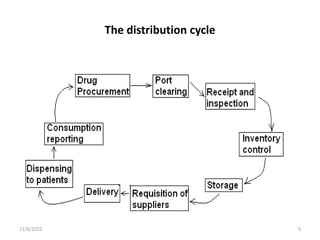
• Drug distribution is a continuous process of receiving
drugs from the supplier and moving them
safely/securely, expeditiously to the many point in
the health care system at which the drugs will be
dispensed to patients.
• A well-run distribution system should:
– Maintain a constant supply of drugs
– Keep drugs in good condition
11/6/2022 3
– Minimize drug loses due to spoilage and expiry
– Rationalize drug storage costs
– Use available transport as efficiently as possible
– Reduce theft and fraud
– Provide information for forecasting drug needs
11/6/2022 4
The distribution cycle
11/6/2022 5
Stock Management
A. Medical storage
• Proper storage practice is the safe keeping of products
until ultimately reaches the consumer
• Generally pharmaceuticals should be protected from:
– Moisture
– Heat
– Sunlight
– Physical damage
– Dirt….
11/6/2022 6
Characteristics of a well managed stores operation
• Store divided into zones
• Stocks arranged within each zone in some order
system
• Stocks stored on pallets on the floor or on shelves
• Store products based on manufacturer’ specification
• Liquid and heavy products kept at the lower shelves
11/6/2022 7
• Products arranged to facilitate first expiry first out
• Damaged/expired products stored separately
• Report products with near expiry
• Good housekeeping- cleaning and inspection
• Clearly defined management structure
• Staffs appropriately qualified, trained, disciplined and
rewarded
11/6/2022 8
Location and design of store
• Location
• Design
– Size
– Height of the wall
– Roof
11/6/2022 9
Storage conditions
• There are two main types of storage conditions:
– Normal storage condition
– Special storage condition
• Cold storage condition
• Separate storage
11/6/2022 10
Storage temperature and environment
– Dry place ……………………. <5% relative humidity
– Protect from heat ……………. not >30oC
– At room temperature ………… 15oC – 30oC
– Cool place …………………… 8oC – 15oC
– Cold place (refrigeration)-not >8oC (usually 2-8 oC)
– In deep freezer ………………. -20oC – 0oC
11/6/2022 11
B. Arrangement of drugs
• Arranging drugs properly enables to control shelf life
and simplify accessibility.
• Types:
– Pharmaco-therapeutic
– Alphabetic
– Pharmaceutic order/dosage form
11/6/2022 12
C. Stock rotation
• First Expiry First Out (FEFO):
– Involves arranging drugs with the earliest expiration
date in front/on top and drugs with the latest
expiration date in the back/below so that drugs with
near expiry will be issued and/or dispensed first.
• Other approaches: First In First Out(FIFO), Last In
First Out (LIFO)
11/6/2022 13
D. Inventory control/inventory management
• Inventory is the stock on hand at any given time.
• Inventory control is the process of maintaining of
stock properly at all times.
• It is a process of assuring that the right volume and
movement are secured in order to ensure that the
obtained drugs have reached to the final consumer
correctly.
11/6/2022 14
• Inventory control helps to:
– Maintain appropriate stock
– Avoid over-stocking
– Monitor shortage of drugs
– Check the movement of stocks
– Prevent expiry of drug before being used
– Balance the merits and demerits of inventory keeping
11/6/2022 15
• Effective inventory control involves:
– Stock recording
– Determining different stock levels
– Physical inventory (physical count)
11/6/2022 16
Types of Maximum –Minimum Inventory Control
1.Forced Ordering
2. Continuous Review
3. Standard max-min
1. Forced ordering
• Review all stock levels at the end of each Review
Period.
• Order (or issue, in a push system) enough stock to
bring stock levels up to Max.
11/6/2022 17
Cont.….
2. Continuous Review Version
• Review the stock level for each item every time an issue
is made. If the stock level is at or has fallen below Min,
order enough stock to bring the level up to Max.
3. Standard Max-min System
• It combines the decision rules of both forced ordering
and continuous review
• Review all stock levels at the end of each Review Period
11/6/2022 18
Cont.…
• For products which are at or have fallen below Min,
order (or issue, in a push system) enough stock to
bring stock levels up to Max.
• If the stock level for any item falls below the
Emergency Order Point before the end of the Review
Period, place an emergency order
11/6/2022 19
1. Stock recording
• Stock records and reports form the foundation of an
effective inventory management and overall drug
supply management.
Information to be included:
• Minimal information
– product name/description including the form and strength
– beginning stock balance
– receipts
– issues
– losses/adjustments
– closing/ending balance
– transaction reference (e.g., issue voucher number or name
of supplier or recipient).
11/6/2022 20
• Additional information
– special storage conditions
– unit prices
– lot numbers/bin locations
– item codes
– expiry dates
– calculated data items: average monthly consumption
(AMC), lead times for ordering/requisition, maximum
and minimum stock levels, emergency order point
11/6/2022 21
• Standard forms used for inventory control:
– Stock cards
– Bin cards
– Requisition/issue vouchers
– Expired stock disposal forms
– Physical inventory forms
– list of approved medicines and prices
11/6/2022 22
Stock cards: Can be used:
– As the base for requisition and issuing of products
– To know fluctuation of price of drugs
– To control shelf life
Bin cards
– Remain with each item in the store
– Filled by the store keeper
– Are used as an easy reference on stock levels and
expiry dates
11/6/2022 23
2. Determination of stock levels
• The main types of stock levels are:
– Minimum stock level
– safety/reserve/ stock level
– Maximum stock level
11/6/2022 24
Safety (reserve) stock level
• A level used to protect shortages which could
occur when
– Deliveries are delayed
– Working stock is consumed at an unexpectedly
high rate/increasing demand
• It is determined based on the lead time
11/6/2022 25
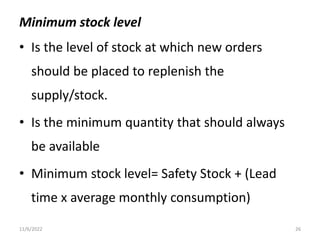
Minimum stock level
• Is the level of stock at which new orders
should be placed to replenish the
supply/stock.
• Is the minimum quantity that should always
be available
• Minimum stock level= Safety Stock + (Lead
time x average monthly consumption)
11/6/2022 26
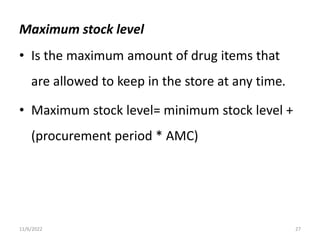
Maximum stock level
• Is the maximum amount of drug items that
are allowed to keep in the store at any time.
• Maximum stock level= minimum stock level +
(procurement period * AMC)
11/6/2022 27
3. Physical inventory
• It is the process of counting by hand the number
of each type of product in a store at any given
time
• It is used to:
– Know whether the actual quantity on hand balances
the recorded stock on the stock keeping records
– Identify surplus, expired and obsolete (outdated)
stock
– Promote periodic evaluation of storage conditions and
the adequacy of storage facilities, layout and stock
management.
11/6/2022 28
There are two kinds of physical inventory:
• Complete physical inventory:
– All products are counted at the same time.
– A complete inventory should be taken at least once a year.
– More frequent inventory (quarterly or monthly) is
recommended.
– For large warehouses, this may require closing the storage
facility for a day or longer.
– It is easier to conduct regularly at facilities that manage
smaller quantities of products.
11/6/2022 29
• Cyclic or random physical inventory:
– Selected products are counted and checked
against the stock keeping records on a rotating or
regular basis throughout the year.
– It is usually appropriate at facilities that manage
larger quantities of products.
11/6/2022 30

distribution (1).pptx

  • 1.
  • 2.
    Objectives • Explain drugdistribution cycle • Discuss the concept and principles of stock management 11/6/2022 2
  • 3.
    • Drug distributionis a continuous process of receiving drugs from the supplier and moving them safely/securely, expeditiously to the many point in the health care system at which the drugs will be dispensed to patients. • A well-run distribution system should: – Maintain a constant supply of drugs – Keep drugs in good condition 11/6/2022 3
  • 4.
    – Minimize drugloses due to spoilage and expiry – Rationalize drug storage costs – Use available transport as efficiently as possible – Reduce theft and fraud – Provide information for forecasting drug needs 11/6/2022 4
  • 5.
  • 6.
    Stock Management A. Medicalstorage • Proper storage practice is the safe keeping of products until ultimately reaches the consumer • Generally pharmaceuticals should be protected from: – Moisture – Heat – Sunlight – Physical damage – Dirt…. 11/6/2022 6
  • 7.
    Characteristics of awell managed stores operation • Store divided into zones • Stocks arranged within each zone in some order system • Stocks stored on pallets on the floor or on shelves • Store products based on manufacturer’ specification • Liquid and heavy products kept at the lower shelves 11/6/2022 7
  • 8.
    • Products arrangedto facilitate first expiry first out • Damaged/expired products stored separately • Report products with near expiry • Good housekeeping- cleaning and inspection • Clearly defined management structure • Staffs appropriately qualified, trained, disciplined and rewarded 11/6/2022 8
  • 9.
    Location and designof store • Location • Design – Size – Height of the wall – Roof 11/6/2022 9
  • 10.
    Storage conditions • Thereare two main types of storage conditions: – Normal storage condition – Special storage condition • Cold storage condition • Separate storage 11/6/2022 10
  • 11.
    Storage temperature andenvironment – Dry place ……………………. <5% relative humidity – Protect from heat ……………. not >30oC – At room temperature ………… 15oC – 30oC – Cool place …………………… 8oC – 15oC – Cold place (refrigeration)-not >8oC (usually 2-8 oC) – In deep freezer ………………. -20oC – 0oC 11/6/2022 11
  • 12.
    B. Arrangement ofdrugs • Arranging drugs properly enables to control shelf life and simplify accessibility. • Types: – Pharmaco-therapeutic – Alphabetic – Pharmaceutic order/dosage form 11/6/2022 12
  • 13.
    C. Stock rotation •First Expiry First Out (FEFO): – Involves arranging drugs with the earliest expiration date in front/on top and drugs with the latest expiration date in the back/below so that drugs with near expiry will be issued and/or dispensed first. • Other approaches: First In First Out(FIFO), Last In First Out (LIFO) 11/6/2022 13
  • 14.
    D. Inventory control/inventorymanagement • Inventory is the stock on hand at any given time. • Inventory control is the process of maintaining of stock properly at all times. • It is a process of assuring that the right volume and movement are secured in order to ensure that the obtained drugs have reached to the final consumer correctly. 11/6/2022 14
  • 15.
    • Inventory controlhelps to: – Maintain appropriate stock – Avoid over-stocking – Monitor shortage of drugs – Check the movement of stocks – Prevent expiry of drug before being used – Balance the merits and demerits of inventory keeping 11/6/2022 15
  • 16.
    • Effective inventorycontrol involves: – Stock recording – Determining different stock levels – Physical inventory (physical count) 11/6/2022 16
  • 17.
    Types of Maximum–Minimum Inventory Control 1.Forced Ordering 2. Continuous Review 3. Standard max-min 1. Forced ordering • Review all stock levels at the end of each Review Period. • Order (or issue, in a push system) enough stock to bring stock levels up to Max. 11/6/2022 17
  • 18.
    Cont.…. 2. Continuous ReviewVersion • Review the stock level for each item every time an issue is made. If the stock level is at or has fallen below Min, order enough stock to bring the level up to Max. 3. Standard Max-min System • It combines the decision rules of both forced ordering and continuous review • Review all stock levels at the end of each Review Period 11/6/2022 18
  • 19.
    Cont.… • For productswhich are at or have fallen below Min, order (or issue, in a push system) enough stock to bring stock levels up to Max. • If the stock level for any item falls below the Emergency Order Point before the end of the Review Period, place an emergency order 11/6/2022 19
  • 20.
    1. Stock recording •Stock records and reports form the foundation of an effective inventory management and overall drug supply management. Information to be included: • Minimal information – product name/description including the form and strength – beginning stock balance – receipts – issues – losses/adjustments – closing/ending balance – transaction reference (e.g., issue voucher number or name of supplier or recipient). 11/6/2022 20
  • 21.
    • Additional information –special storage conditions – unit prices – lot numbers/bin locations – item codes – expiry dates – calculated data items: average monthly consumption (AMC), lead times for ordering/requisition, maximum and minimum stock levels, emergency order point 11/6/2022 21
  • 22.
    • Standard formsused for inventory control: – Stock cards – Bin cards – Requisition/issue vouchers – Expired stock disposal forms – Physical inventory forms – list of approved medicines and prices 11/6/2022 22
  • 23.
    Stock cards: Canbe used: – As the base for requisition and issuing of products – To know fluctuation of price of drugs – To control shelf life Bin cards – Remain with each item in the store – Filled by the store keeper – Are used as an easy reference on stock levels and expiry dates 11/6/2022 23
  • 24.
    2. Determination ofstock levels • The main types of stock levels are: – Minimum stock level – safety/reserve/ stock level – Maximum stock level 11/6/2022 24
  • 25.
    Safety (reserve) stocklevel • A level used to protect shortages which could occur when – Deliveries are delayed – Working stock is consumed at an unexpectedly high rate/increasing demand • It is determined based on the lead time 11/6/2022 25
  • 26.
    Minimum stock level •Is the level of stock at which new orders should be placed to replenish the supply/stock. • Is the minimum quantity that should always be available • Minimum stock level= Safety Stock + (Lead time x average monthly consumption) 11/6/2022 26
  • 27.
    Maximum stock level •Is the maximum amount of drug items that are allowed to keep in the store at any time. • Maximum stock level= minimum stock level + (procurement period * AMC) 11/6/2022 27
  • 28.
    3. Physical inventory •It is the process of counting by hand the number of each type of product in a store at any given time • It is used to: – Know whether the actual quantity on hand balances the recorded stock on the stock keeping records – Identify surplus, expired and obsolete (outdated) stock – Promote periodic evaluation of storage conditions and the adequacy of storage facilities, layout and stock management. 11/6/2022 28
  • 29.
    There are twokinds of physical inventory: • Complete physical inventory: – All products are counted at the same time. – A complete inventory should be taken at least once a year. – More frequent inventory (quarterly or monthly) is recommended. – For large warehouses, this may require closing the storage facility for a day or longer. – It is easier to conduct regularly at facilities that manage smaller quantities of products. 11/6/2022 29
  • 30.
    • Cyclic orrandom physical inventory: – Selected products are counted and checked against the stock keeping records on a rotating or regular basis throughout the year. – It is usually appropriate at facilities that manage larger quantities of products. 11/6/2022 30