Kiran Goushika
Index
Embryology
Anatomy
Histology
Physiology
Diseases
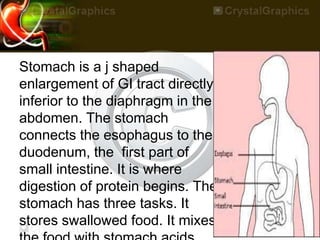
Stomach is a j shaped
enlargement of GI tract directly
inferior to the diaphragm in the
abdomen. The stomach
connects the esophagus to the
duodenum, the first part of
small intestine. It is where
digestion of protein begins. The
stomach has three tasks. It
stores swallowed food. It mixes
EMBRYOLOGY
DEVELOPMENT DURING
THE FETAL PERIOD
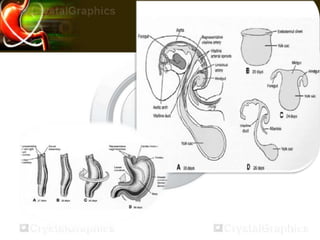
The stomach begins to form as
fusiform(spindle-shaped) dilation in the
foregut during the 4th week.
The developing stomach is attached to the
body walls by dorsal and ventral
mesenteries.
The dorsal wall of stomach grow faster
than the ventral wall.
The differentiation start from the greater
and lesser curvatures of stomach.
During 7th week , the stomach rotates 90
degrees cloackwise about a longitudinal
axis this produce a space behind called
lesser sac (omental bursa).
During the 8th week the stomach and
duodenum rotate about ventrodorsal (A-P)
axis , pulling the end of stomach upward
and attain a C-shaped. Postnatal position
of stomach and deudenum is attained
ANATOMY
ANATOMY
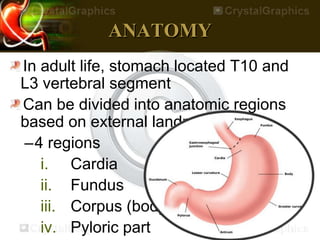
In adult life, stomach located T10 and
L3 vertebral segment
Can be divided into anatomic regions
based on external landmarks
–4 regions
i. Cardia
ii. Fundus
iii. Corpus (body)
iv. Pyloric part
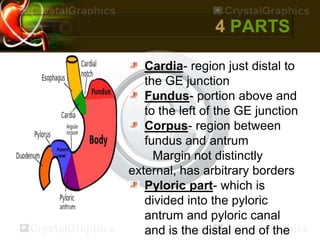
4 PARTS
Cardia- region just distal to
the GE junction
Fundus- portion above and
to the left of the GE junction
Corpus- region between
fundus and antrum
Margin not distinctly
external, has arbitrary borders
Pyloric part- which is
divided into the pyloric
antrum and pyloric canal
and is the distal end of the
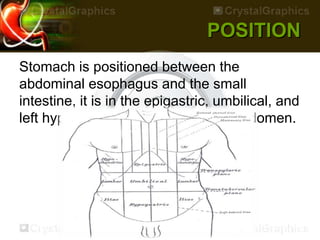
Stomach is positioned between the
abdominal esophagus and the small
intestine, it is in the epigastric, umbilical, and
left hypochondrium regions of the abdomen.
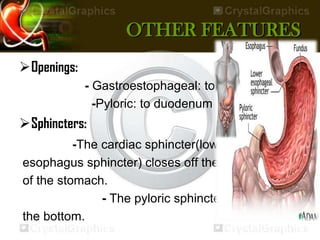
OTHER FEATURES
Openings:
- Gastroestophageal: to esophagus
-Pyloric: to duodenum
Sphincters:
-The cardiac sphincter(lower
esophagus sphincter) closes off the top end
of the stomach.
- The pyloric sphincter closes of
the bottom.
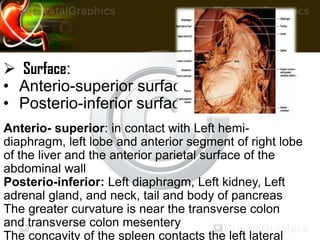
Anterio- superior: in contact with Left hemi-
diaphragm, left lobe and anterior segment of right lobe
of the liver and the anterior parietal surface of the
abdominal wall
Posterio-inferior: Left diaphragm, Left kidney, Left
adrenal gland, and neck, tail and body of pancreas
The greater curvature is near the transverse colon
and transverse colon mesentery
The concavity of the spleen contacts the left lateral
 Surface:
• Anterio-superior surface
• Posterio-inferior surface
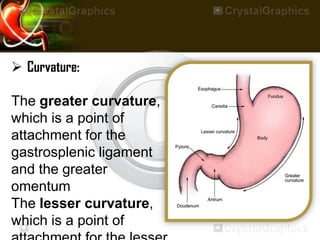
 Curvature:
The greater curvature,
which is a point of
attachment for the
gastrosplenic ligament
and the greater
omentum
The lesser curvature,
which is a point of
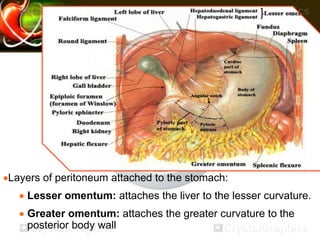
Layers of peritoneum attached to the stomach:
Lesser omentum: attaches the liver to the lesser curvature.
Greater omentum: attaches the greater curvature to the
posterior body wall
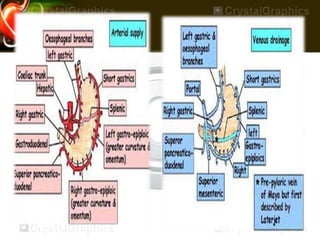
VASCULATURE
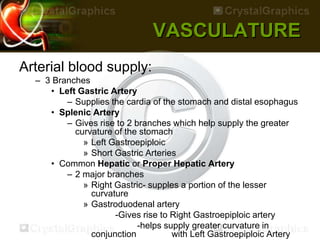
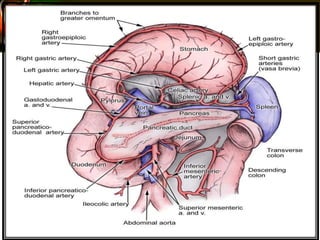
Arterial blood supply:
– 3 Branches
• Left Gastric Artery
– Supplies the cardia of the stomach and distal esophagus
• Splenic Artery
– Gives rise to 2 branches which help supply the greater
curvature of the stomach
» Left Gastroepiploic
» Short Gastric Arteries
• Common Hepatic or Proper Hepatic Artery
– 2 major branches
» Right Gastric- supples a portion of the lesser
curvature
» Gastroduodenal artery
-Gives rise to Right Gastroepiploic artery
-helps supply greater curvature in
conjunction with Left Gastroepiploic Artery
Venous Drainage
Parallels arterial supply
Rt &Lt gastric veins drain to the
portal
Rt gastroepiploic drains to the
SMV
Lt gastroepiploic drains to the
splenic
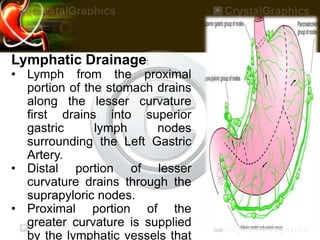
Lymphatic Drainage:
• Lymph from the proximal
portion of the stomach drains
along the lesser curvature
first drains into superior
gastric lymph nodes
surrounding the Left Gastric
Artery.
• Distal portion of lesser
curvature drains through the
suprapyloric nodes.
• Proximal portion of the
greater curvature is supplied
by the lymphatic vessels that
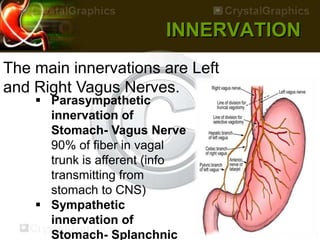
INNERVATION
The main innervations are Left
and Right Vagus Nerves.
 Parasympathetic
innervation of
Stomach- Vagus Nerve
90% of fiber in vagal
trunk is afferent (info
transmitting from
stomach to CNS)
 Sympathetic
innervation of
Stomach- Splanchnic
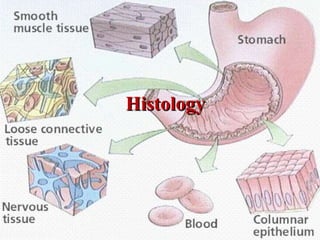
Histology
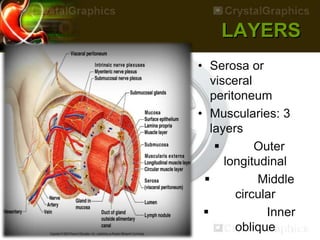
LAYERS
• Serosa or
visceral
peritoneum
• Muscularies: 3
layers
 Outer
longitudinal
 Middle
circular
 Inner
oblique
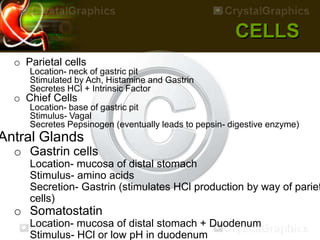
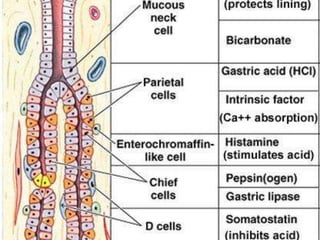
CELLS
o Parietal cells
Location- neck of gastric pit
Stimulated by Ach, Histamine and Gastrin
Secretes HCl + Intrinsic Factor
o Chief Cells
Location- base of gastric pit
Stimulus- Vagal
Secretes Pepsinogen (eventually leads to pepsin- digestive enzyme)
Antral Glands
o Gastrin cells
Location- mucosa of distal stomach
Stimulus- amino acids
Secretion- Gastrin (stimulates HCl production by way of pariet
cells)
o Somatostatin
Location- mucosa of distal stomach + Duodenum
Stimulus- HCl or low pH in duodenum
PHYSIOLOGY
OVERVIEW
Gastric motility
Gastric secretions
Gastric Motor Activity
 Main function of gastric motility
-Accommodate and store ingested meal
-Grind down solid particles(tituration)
-Empty all constituents of the meal in a
carefully controlled and regulated fashion
into the
duodenum.
Gastric Anatomy
 3 Distinct regions
1. Proximal- cardiac, fundus, proximal
body
2. Distal- distal body and antrum
3. Pylorus
Electrophysiology
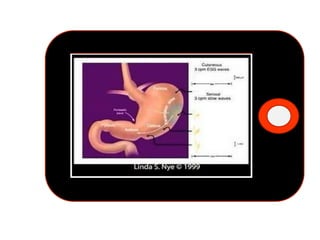
Slow wave – omnipresent, highly
regular and recurring electrical pattern
in GI tract
Does not lead to contractions, but
maximal frequency of contractile
activity is directly related to slow wave
frequency
Contractions are related to spike
potentials
Slow waves thought to originate in
“gastric pacemaker” site along the
greater curvature in the proximal to
middle body
Migrate in both circumferential and
longitudinal directions
Electrical signals do not traverse the
pylorus
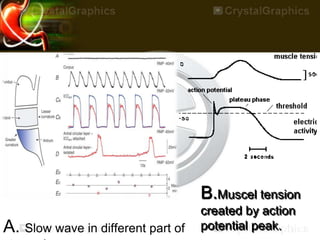
B.Muscel tension
created by action
potential peak.A. Slow wave in different part of
Fundic smooth muscle cells are electrically
silent – resting membrane potential is already
above the mechanical threshold
Generates tone – AP not generated – neural
and hormonal input modulates tone
rather than generating peristaltic contractions
GI Motor Activity
• Motor activity is highly organized into a
distinct and cyclically recurring sequence
of events known as MMC (migrating motor
complex)
• 3 distinct phases of motor activity
– I – quiescence
– II – random and irregular contractions
– III – burst of uninterrupted phasic contractions
• Patterns of MMC activity commence and
end simultaneously at all sites
Fasted Stomach
• Phase III
– Basal tone in LES in increased and exhibits
superimposed phasic contractions
– Tone increases in proximal stomach
– One cycle/min high-amplitude waves develop in body
– Distal antrum 3-5 cycles/min
– Antropyloroduodenal coordination increases and
high-amplitude contractions propagate through the
antrum across the pylorus
• Extrinsic nerves (vagus) and hormonal factors
(motilin) are involved
– Phase III – may be induced by motilin released from
Fed Stomach
• Initiation of swallow – fundus undergoes vagally
mediated receptive relaxation
• As meal enters stomach tone and phasic
contractions in proximal stomach are inhibited
– Accommodation – 2-3 fold increase in gastric volume
• Fundic tone – balance between cholingeric
• ( excitatory) and nitrergic (inhibitory) input
• Fasting – cholinergic dominates
• Meal – accommodation response triggered by
distention-induced stimulation of
mechanoreceptors
• NO is primary inhibitor of fundic tone
• Other factors modulate fundic tone
-Relaxation
• Antral distention (gastrogastric reflex)
• Duodenal acidification
• Lipid and protein (duodenogastric reflex)
• Colonic distention (cologastric reflex)
• Food ingested results in abolition of cyclical pattern of MMC
• Replaced by random contractions called fed pattern
• May last 2.5-8 hours
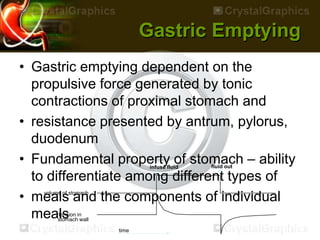
Gastric Emptying
• Gastric emptying dependent on the
propulsive force generated by tonic
contractions of proximal stomach and
• resistance presented by antrum, pylorus,
duodenum
• Fundamental property of stomach – ability
to differentiate among different types of
• meals and the components of individual
meals
infuse fluid fluid out
time
volume of stomach
tension in
stomach wall
i. liquids
• Liquids rapidly disperse and begin to empty
without lag period
• Non-nutrient liquids empty rapidly
• Nutrient containing liquids are retained longer
and empty more slowly
• Liquids
• Emptying of liquids follows a simple, exponential
pattern
• Rate influenced by volume, nutrient content and
osmolarity
• Rate of emptying determined by gastric volume
ii. solids
• 2 phases – initial lag phase followed by a linear emptying
phase
• Solid component is first retained in proximal stomach
• As liquid empties, solid moves to antrum and is emptied
• Essential component of normal response is ability of
antropyloric region to discriminate solid particles by size
and restrict emptying of particles >1mm in diameter
• Antropyloric mill grinds down (titurates) larger particles
to smaller ones
• During tituration, solid emptying does not occur
• Duration of lag phase is directly related to size and
consistency of solid component of the meal
– Typical solid-liquid meal - ~60min
• Tituration – coordinated high-amplitude
waves originate in proximal antrum and are
propagated to pylorus
• Pylorus opens and duodenal contractions
are inhibited permitting trans-pyloric flow of
liquids and suspended or liquefied solid
particles
• When liquids and solids reach distal antrum,
pylorus closes promoting retropulsion of
particles too large to have been exited
• Pylorus regulates passage of material
• Relatively narrow and fixed lumen
• Maintenance of pyloric tone
iii. Fatty food & indigestible
food
• Liquid at body temperature
• Float on top of liquid layer but empty more
slowly
• Products of fat digestion in duodenum are
potent inhibitors of gastric motor events
and gastric emptying
Indigestible Solids
• Not emptied in immediate post-prandial
period
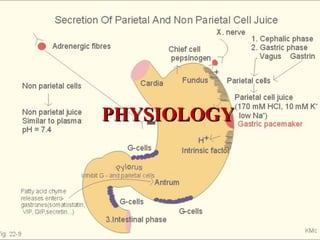
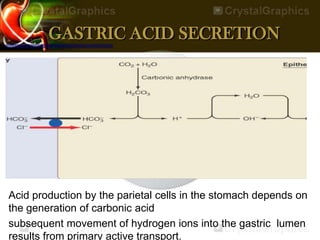
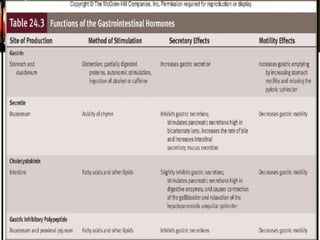
GASTRIC ACID SECRETION
Acid production by the parietal cells in the stomach depends on
the generation of carbonic acid
subsequent movement of hydrogen ions into the gastric lumen
results from primary active transport.
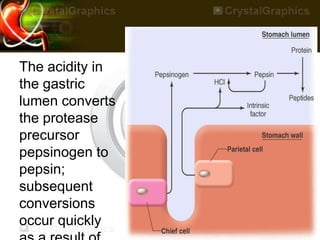
The acidity in
the gastric
lumen converts
the protease
precursor
pepsinogen to
pepsin;
subsequent
conversions
occur quickly
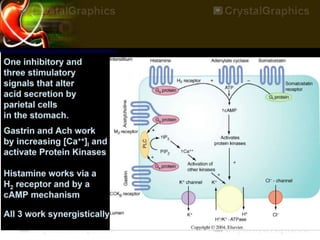
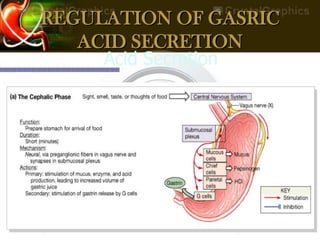
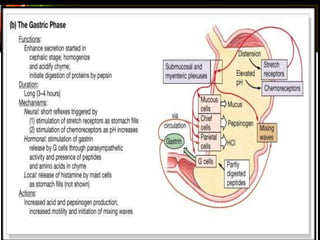
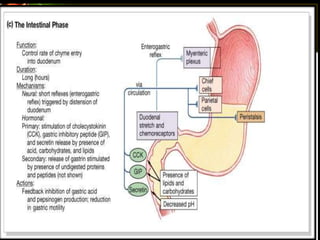
REGULATION OF GASRIC
ACID SECRETION
DISEASES
COMMON DISEAESES
• Peptic ulcer
A lesion in the lining of the digestive tract,
typically in the stomach or duodenum, caused
by the digestive action of pepsin and stomach
acid
• Gastritis
Inflammation of the lining of the stomach
• Gastroparesis
Condition consisting of a paresis of the
Stomach cancer
Gastric cancer can develop in any part of the
stomach and may spread throughout the
stomach and to other organs; particularly the
esophagus, lungs, lymph nodes, and the
liver. stomach cancer causes about 800,000
deaths worldwide per year.
Peptic ulcer disease
An ulcer of an area of the gastrointestinal
tract that is usua
• 17 18 19 20 32 33 34 35 41 42 43 47 48
50
• Good 36 38
Stomach by kp [autosaved]

Stomach by kp [autosaved]

  • 1.
  • 2.
  • 3.
    Stomach is aj shaped enlargement of GI tract directly inferior to the diaphragm in the abdomen. The stomach connects the esophagus to the duodenum, the first part of small intestine. It is where digestion of protein begins. The stomach has three tasks. It stores swallowed food. It mixes
  • 4.
  • 5.
    DEVELOPMENT DURING THE FETALPERIOD The stomach begins to form as fusiform(spindle-shaped) dilation in the foregut during the 4th week. The developing stomach is attached to the body walls by dorsal and ventral mesenteries. The dorsal wall of stomach grow faster than the ventral wall. The differentiation start from the greater and lesser curvatures of stomach.
  • 6.
    During 7th week, the stomach rotates 90 degrees cloackwise about a longitudinal axis this produce a space behind called lesser sac (omental bursa). During the 8th week the stomach and duodenum rotate about ventrodorsal (A-P) axis , pulling the end of stomach upward and attain a C-shaped. Postnatal position of stomach and deudenum is attained
  • 8.
  • 9.
    ANATOMY In adult life,stomach located T10 and L3 vertebral segment Can be divided into anatomic regions based on external landmarks –4 regions i. Cardia ii. Fundus iii. Corpus (body) iv. Pyloric part
  • 10.
    4 PARTS Cardia- regionjust distal to the GE junction Fundus- portion above and to the left of the GE junction Corpus- region between fundus and antrum Margin not distinctly external, has arbitrary borders Pyloric part- which is divided into the pyloric antrum and pyloric canal and is the distal end of the
  • 11.
    Stomach is positionedbetween the abdominal esophagus and the small intestine, it is in the epigastric, umbilical, and left hypochondrium regions of the abdomen.
  • 12.
    OTHER FEATURES Openings: - Gastroestophageal:to esophagus -Pyloric: to duodenum Sphincters: -The cardiac sphincter(lower esophagus sphincter) closes off the top end of the stomach. - The pyloric sphincter closes of the bottom.
  • 13.
    Anterio- superior: incontact with Left hemi- diaphragm, left lobe and anterior segment of right lobe of the liver and the anterior parietal surface of the abdominal wall Posterio-inferior: Left diaphragm, Left kidney, Left adrenal gland, and neck, tail and body of pancreas The greater curvature is near the transverse colon and transverse colon mesentery The concavity of the spleen contacts the left lateral  Surface: • Anterio-superior surface • Posterio-inferior surface
  • 14.
     Curvature: The greatercurvature, which is a point of attachment for the gastrosplenic ligament and the greater omentum The lesser curvature, which is a point of
  • 15.
    Layers of peritoneumattached to the stomach: Lesser omentum: attaches the liver to the lesser curvature. Greater omentum: attaches the greater curvature to the posterior body wall
  • 16.
    VASCULATURE Arterial blood supply: –3 Branches • Left Gastric Artery – Supplies the cardia of the stomach and distal esophagus • Splenic Artery – Gives rise to 2 branches which help supply the greater curvature of the stomach » Left Gastroepiploic » Short Gastric Arteries • Common Hepatic or Proper Hepatic Artery – 2 major branches » Right Gastric- supples a portion of the lesser curvature » Gastroduodenal artery -Gives rise to Right Gastroepiploic artery -helps supply greater curvature in conjunction with Left Gastroepiploic Artery
  • 17.
    Venous Drainage Parallels arterialsupply Rt &Lt gastric veins drain to the portal Rt gastroepiploic drains to the SMV Lt gastroepiploic drains to the splenic
  • 20.
    Lymphatic Drainage: • Lymphfrom the proximal portion of the stomach drains along the lesser curvature first drains into superior gastric lymph nodes surrounding the Left Gastric Artery. • Distal portion of lesser curvature drains through the suprapyloric nodes. • Proximal portion of the greater curvature is supplied by the lymphatic vessels that
  • 21.
    INNERVATION The main innervationsare Left and Right Vagus Nerves.  Parasympathetic innervation of Stomach- Vagus Nerve 90% of fiber in vagal trunk is afferent (info transmitting from stomach to CNS)  Sympathetic innervation of Stomach- Splanchnic
  • 22.
  • 23.
    LAYERS • Serosa or visceral peritoneum •Muscularies: 3 layers  Outer longitudinal  Middle circular  Inner oblique
  • 24.
    CELLS o Parietal cells Location-neck of gastric pit Stimulated by Ach, Histamine and Gastrin Secretes HCl + Intrinsic Factor o Chief Cells Location- base of gastric pit Stimulus- Vagal Secretes Pepsinogen (eventually leads to pepsin- digestive enzyme) Antral Glands o Gastrin cells Location- mucosa of distal stomach Stimulus- amino acids Secretion- Gastrin (stimulates HCl production by way of pariet cells) o Somatostatin Location- mucosa of distal stomach + Duodenum Stimulus- HCl or low pH in duodenum
  • 26.
  • 27.
  • 28.
    Gastric Motor Activity Main function of gastric motility -Accommodate and store ingested meal -Grind down solid particles(tituration) -Empty all constituents of the meal in a carefully controlled and regulated fashion into the duodenum.
  • 29.
    Gastric Anatomy  3Distinct regions 1. Proximal- cardiac, fundus, proximal body 2. Distal- distal body and antrum 3. Pylorus
  • 30.
    Electrophysiology Slow wave –omnipresent, highly regular and recurring electrical pattern in GI tract Does not lead to contractions, but maximal frequency of contractile activity is directly related to slow wave frequency Contractions are related to spike potentials
  • 31.
    Slow waves thoughtto originate in “gastric pacemaker” site along the greater curvature in the proximal to middle body Migrate in both circumferential and longitudinal directions Electrical signals do not traverse the pylorus
  • 33.
    B.Muscel tension created byaction potential peak.A. Slow wave in different part of
  • 34.
    Fundic smooth musclecells are electrically silent – resting membrane potential is already above the mechanical threshold Generates tone – AP not generated – neural and hormonal input modulates tone rather than generating peristaltic contractions
  • 35.
    GI Motor Activity •Motor activity is highly organized into a distinct and cyclically recurring sequence of events known as MMC (migrating motor complex) • 3 distinct phases of motor activity – I – quiescence – II – random and irregular contractions – III – burst of uninterrupted phasic contractions • Patterns of MMC activity commence and end simultaneously at all sites
  • 36.
    Fasted Stomach • PhaseIII – Basal tone in LES in increased and exhibits superimposed phasic contractions – Tone increases in proximal stomach – One cycle/min high-amplitude waves develop in body – Distal antrum 3-5 cycles/min – Antropyloroduodenal coordination increases and high-amplitude contractions propagate through the antrum across the pylorus • Extrinsic nerves (vagus) and hormonal factors (motilin) are involved – Phase III – may be induced by motilin released from
  • 37.
    Fed Stomach • Initiationof swallow – fundus undergoes vagally mediated receptive relaxation • As meal enters stomach tone and phasic contractions in proximal stomach are inhibited – Accommodation – 2-3 fold increase in gastric volume • Fundic tone – balance between cholingeric • ( excitatory) and nitrergic (inhibitory) input • Fasting – cholinergic dominates • Meal – accommodation response triggered by distention-induced stimulation of mechanoreceptors
  • 38.
    • NO isprimary inhibitor of fundic tone • Other factors modulate fundic tone -Relaxation • Antral distention (gastrogastric reflex) • Duodenal acidification • Lipid and protein (duodenogastric reflex) • Colonic distention (cologastric reflex) • Food ingested results in abolition of cyclical pattern of MMC • Replaced by random contractions called fed pattern • May last 2.5-8 hours
  • 39.
    Gastric Emptying • Gastricemptying dependent on the propulsive force generated by tonic contractions of proximal stomach and • resistance presented by antrum, pylorus, duodenum • Fundamental property of stomach – ability to differentiate among different types of • meals and the components of individual meals infuse fluid fluid out time volume of stomach tension in stomach wall
  • 40.
    i. liquids • Liquidsrapidly disperse and begin to empty without lag period • Non-nutrient liquids empty rapidly • Nutrient containing liquids are retained longer and empty more slowly • Liquids • Emptying of liquids follows a simple, exponential pattern • Rate influenced by volume, nutrient content and osmolarity • Rate of emptying determined by gastric volume
  • 41.
    ii. solids • 2phases – initial lag phase followed by a linear emptying phase • Solid component is first retained in proximal stomach • As liquid empties, solid moves to antrum and is emptied • Essential component of normal response is ability of antropyloric region to discriminate solid particles by size and restrict emptying of particles >1mm in diameter • Antropyloric mill grinds down (titurates) larger particles to smaller ones • During tituration, solid emptying does not occur • Duration of lag phase is directly related to size and consistency of solid component of the meal – Typical solid-liquid meal - ~60min
  • 42.
    • Tituration –coordinated high-amplitude waves originate in proximal antrum and are propagated to pylorus • Pylorus opens and duodenal contractions are inhibited permitting trans-pyloric flow of liquids and suspended or liquefied solid particles • When liquids and solids reach distal antrum, pylorus closes promoting retropulsion of particles too large to have been exited • Pylorus regulates passage of material • Relatively narrow and fixed lumen • Maintenance of pyloric tone
  • 43.
    iii. Fatty food& indigestible food • Liquid at body temperature • Float on top of liquid layer but empty more slowly • Products of fat digestion in duodenum are potent inhibitors of gastric motor events and gastric emptying Indigestible Solids • Not emptied in immediate post-prandial period
  • 44.
    GASTRIC ACID SECRETION Acidproduction by the parietal cells in the stomach depends on the generation of carbonic acid subsequent movement of hydrogen ions into the gastric lumen results from primary active transport.
  • 46.
    The acidity in thegastric lumen converts the protease precursor pepsinogen to pepsin; subsequent conversions occur quickly
  • 47.
  • 51.
  • 52.
    COMMON DISEAESES • Pepticulcer A lesion in the lining of the digestive tract, typically in the stomach or duodenum, caused by the digestive action of pepsin and stomach acid • Gastritis Inflammation of the lining of the stomach • Gastroparesis Condition consisting of a paresis of the
  • 53.
    Stomach cancer Gastric cancercan develop in any part of the stomach and may spread throughout the stomach and to other organs; particularly the esophagus, lungs, lymph nodes, and the liver. stomach cancer causes about 800,000 deaths worldwide per year. Peptic ulcer disease An ulcer of an area of the gastrointestinal tract that is usua
  • 54.
    • 17 1819 20 32 33 34 35 41 42 43 47 48 50 • Good 36 38