Peritonium
General features
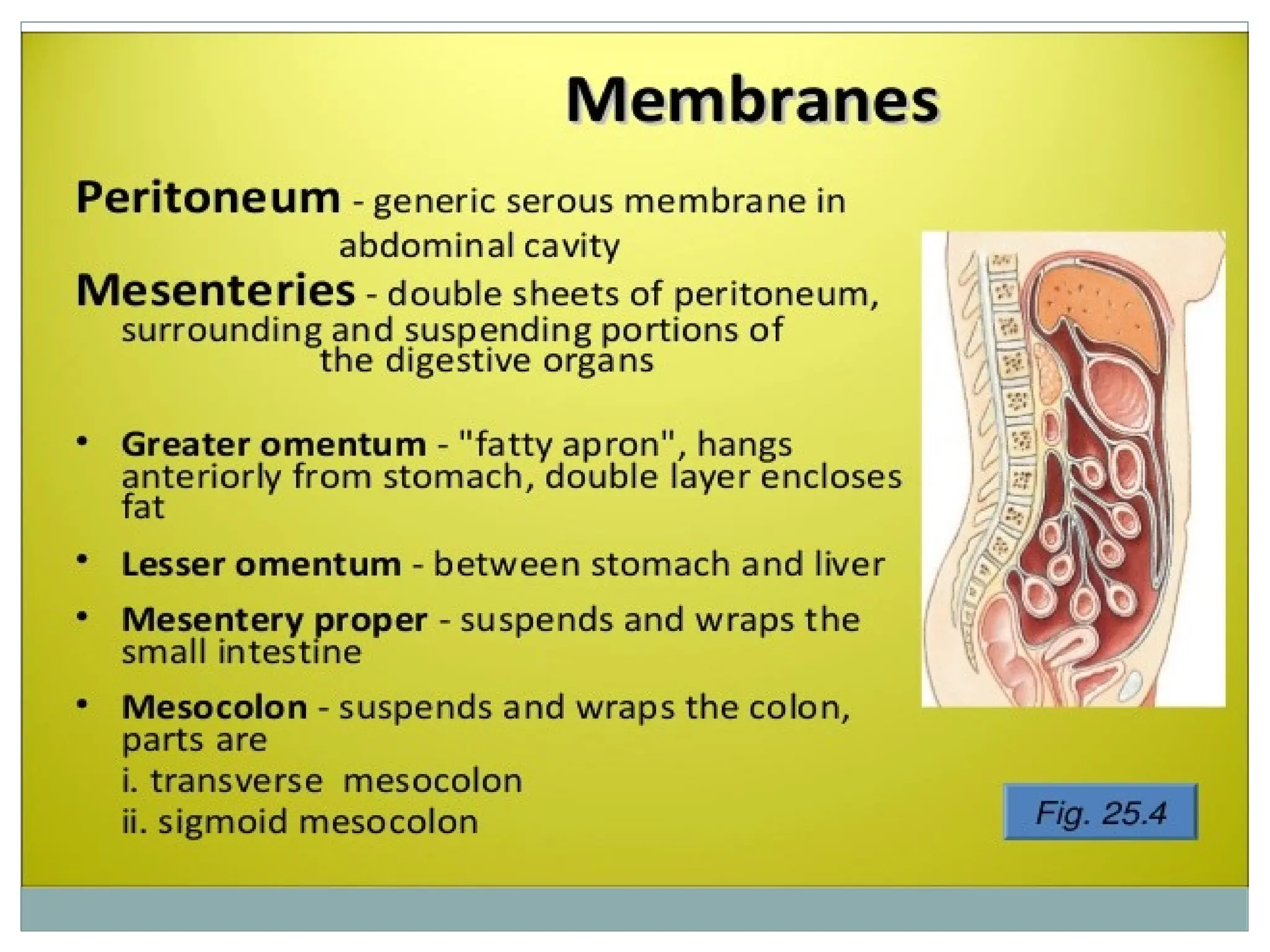
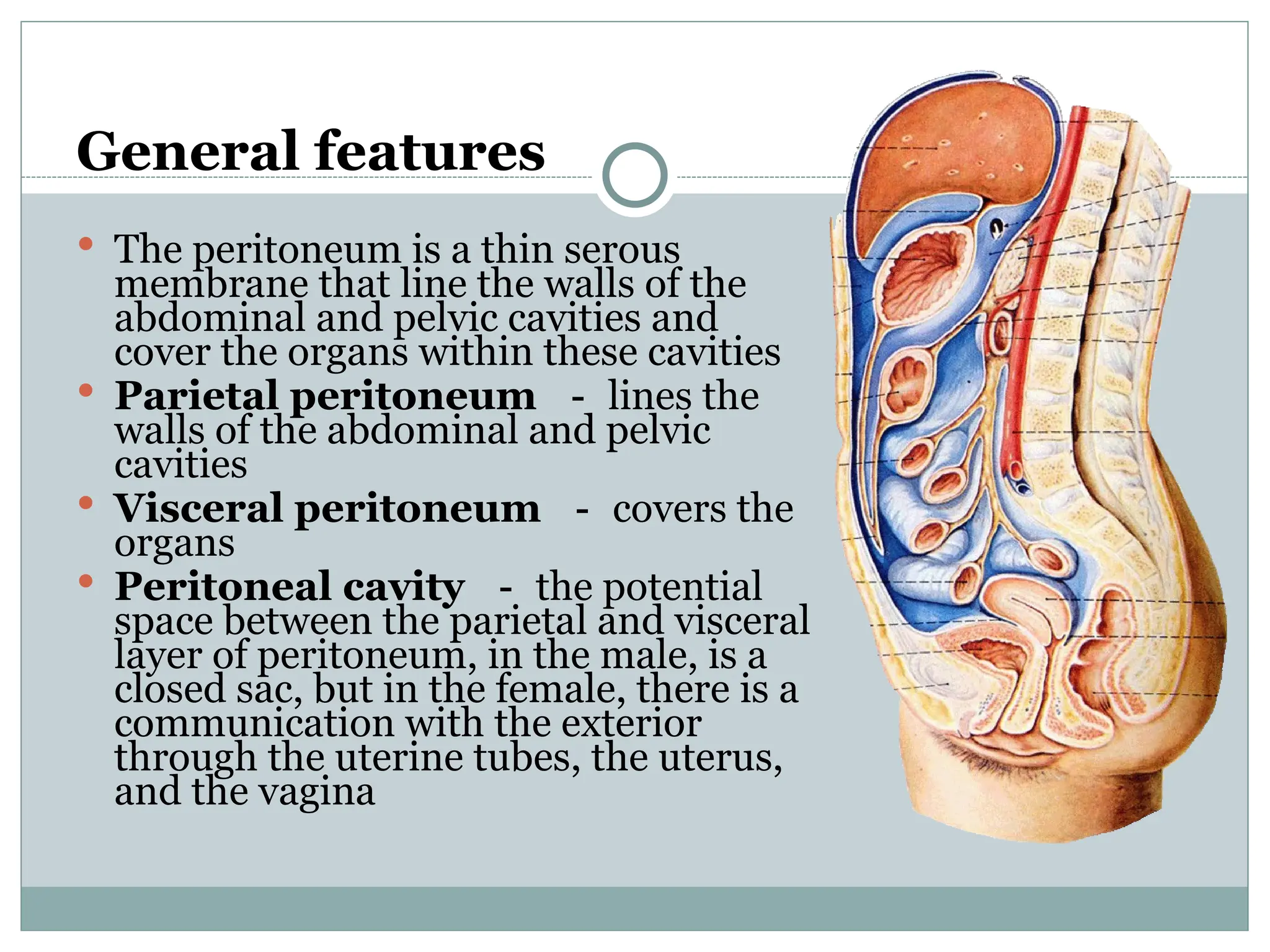
 The peritoneum is a thin serous
membrane that line the walls of the
abdominal and pelvic cavities and
cover the organs within these cavities
 Parietal peritoneum - lines the
walls of the abdominal and pelvic
cavities
 Visceral peritoneum - covers the
organs
 Peritoneal cavity - the potential
space between the parietal and visceral
layer of peritoneum, in the male, is a
closed sac, but in the female, there is a
communication with the exterior
through the uterine tubes, the uterus,
and the vagina
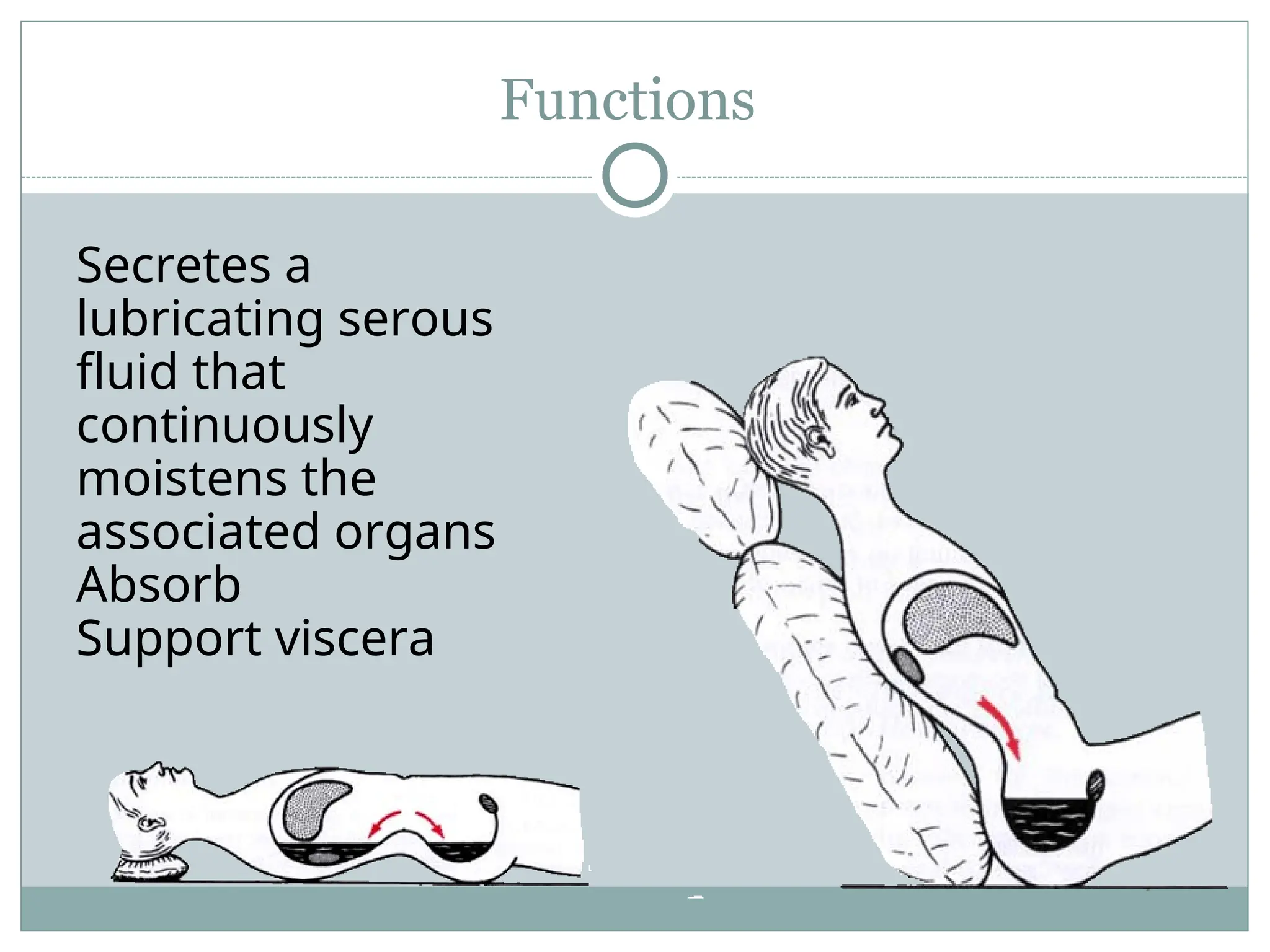
Functions
Secretes a
lubricating serous
fluid that
continuously
moistens the
associated organs
Absorb
Support viscera
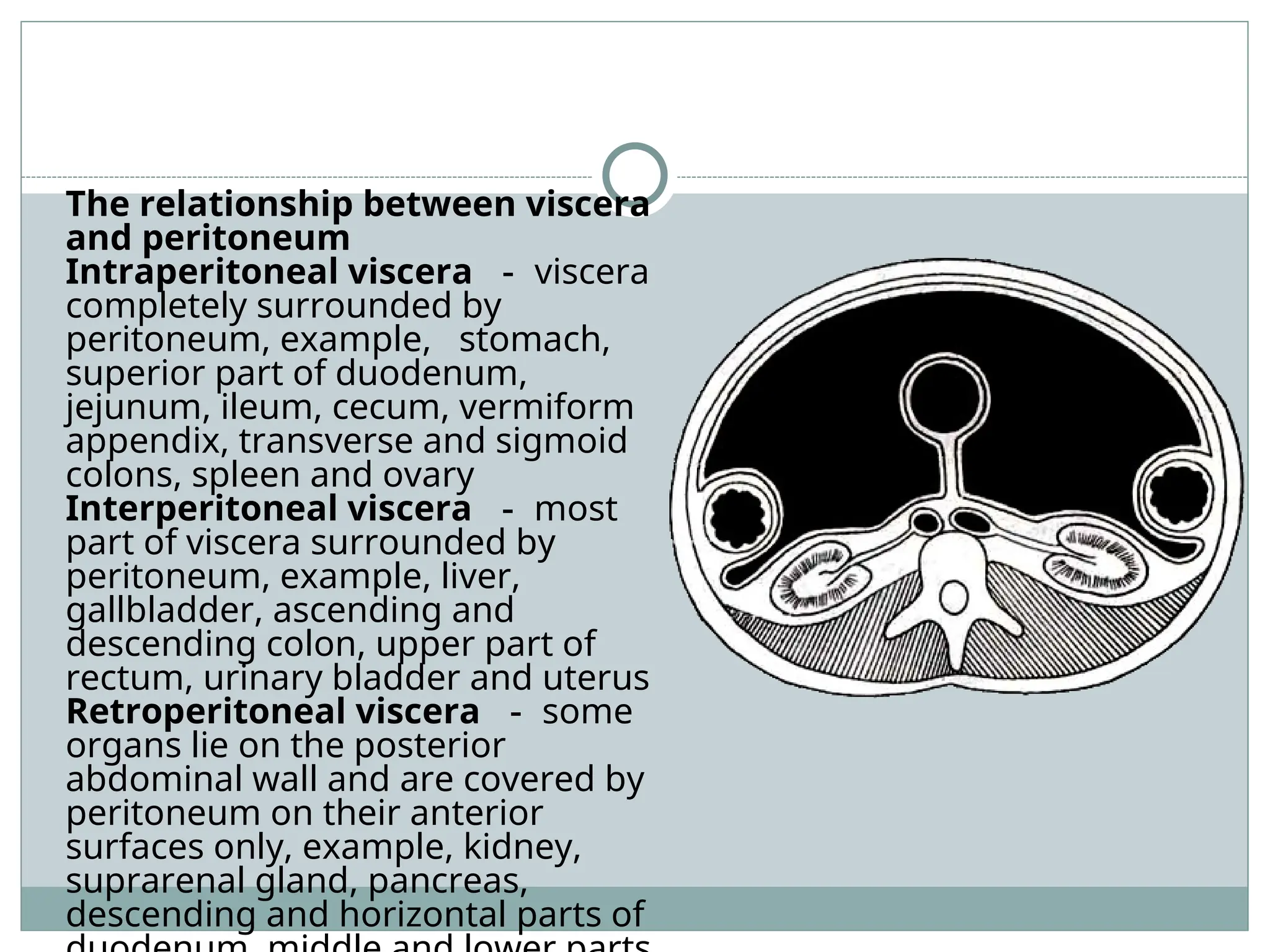
The relationship between viscera
and peritoneum
Intraperitoneal viscera - viscera
completely surrounded by
peritoneum, example, stomach,
superior part of duodenum,
jejunum, ileum, cecum, vermiform
appendix, transverse and sigmoid
colons, spleen and ovary
Interperitoneal viscera - most
part of viscera surrounded by
peritoneum, example, liver,
gallbladder, ascending and
descending colon, upper part of
rectum, urinary bladder and uterus
Retroperitoneal viscera - some
organs lie on the posterior
abdominal wall and are covered by
peritoneum on their anterior
surfaces only, example, kidney,
suprarenal gland, pancreas,
descending and horizontal parts of
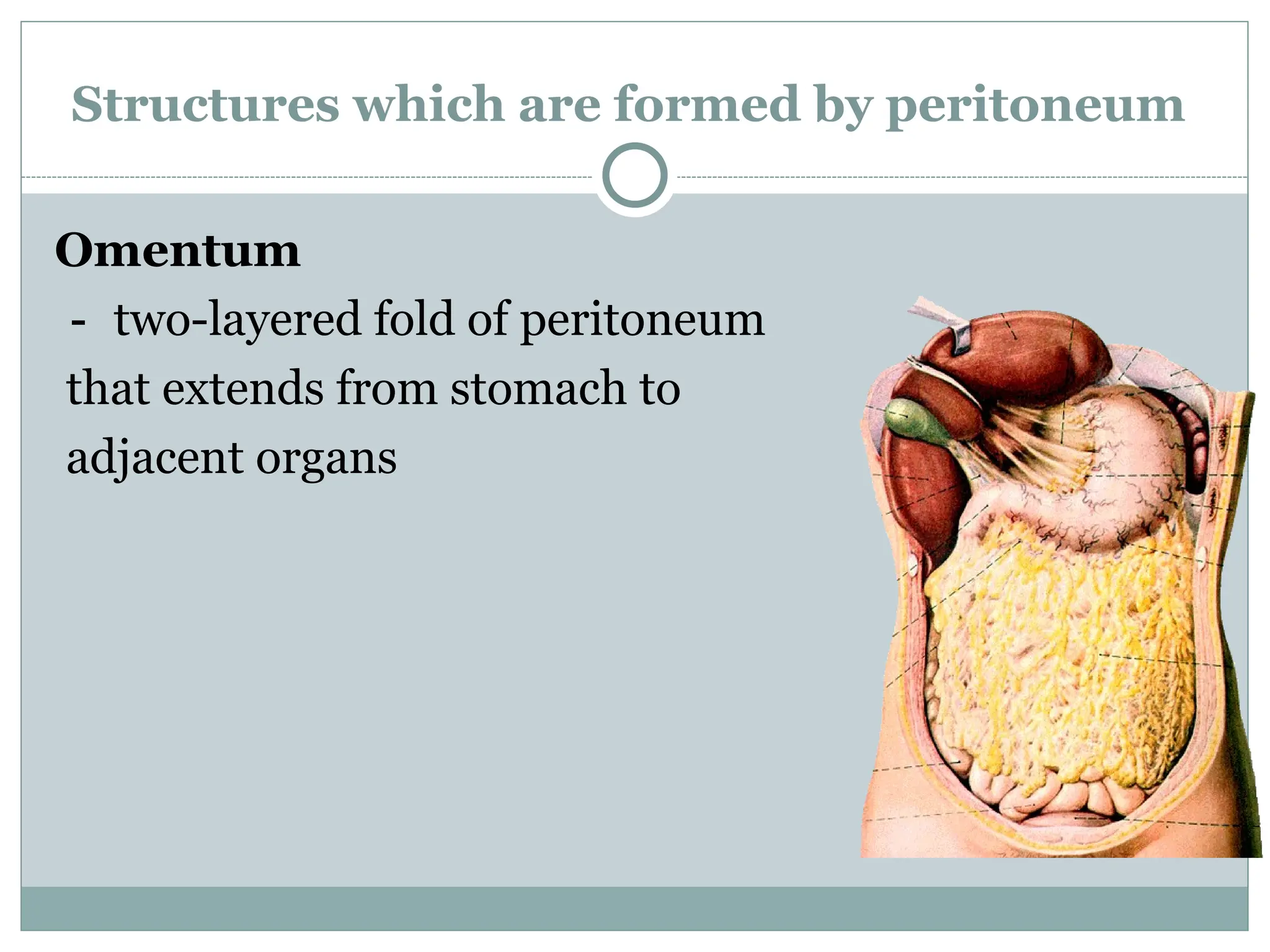
Structures which are formed by peritoneum
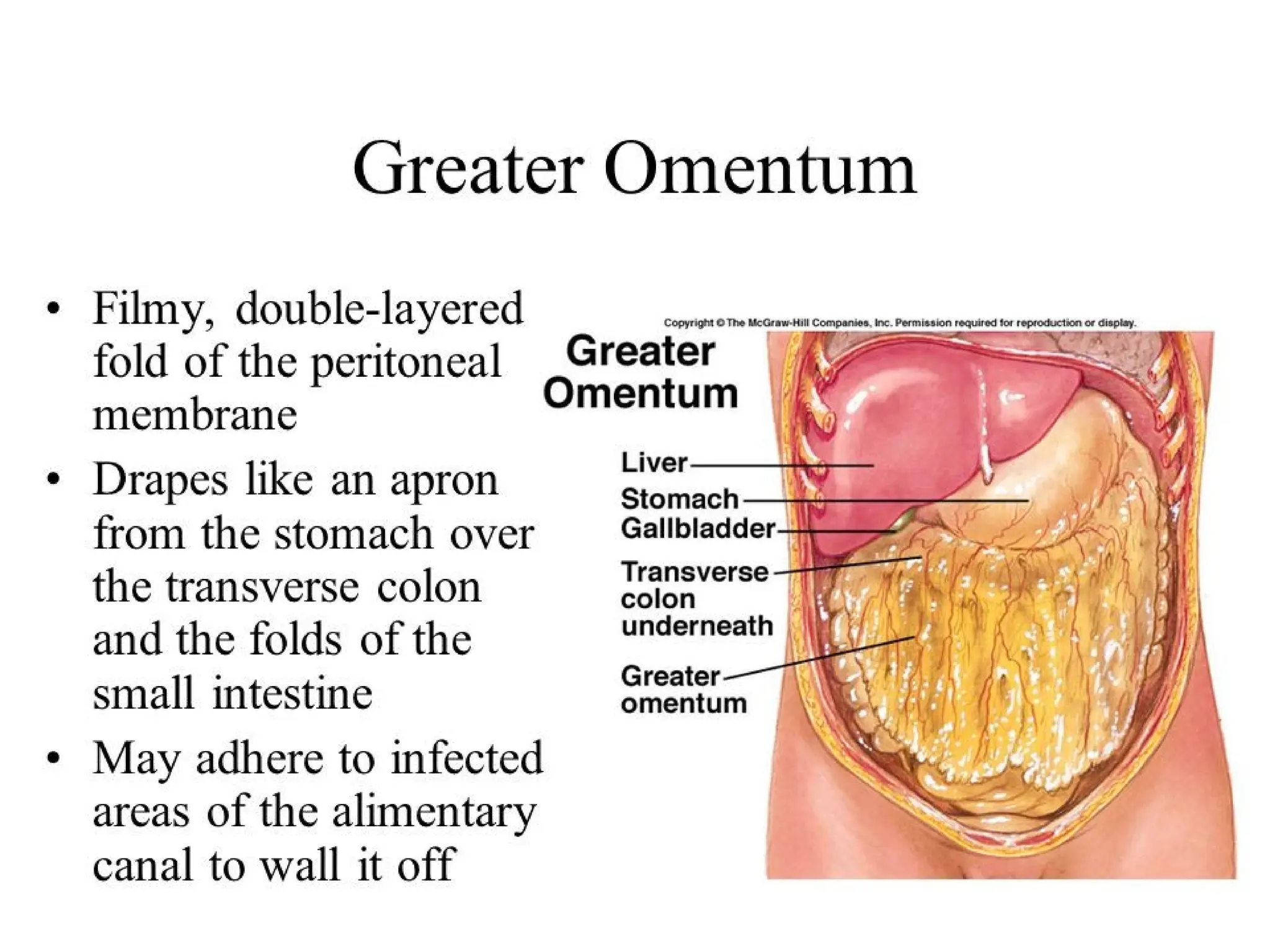
Omentum
- two-layered fold of peritoneum
that extends from stomach to
adjacent organs
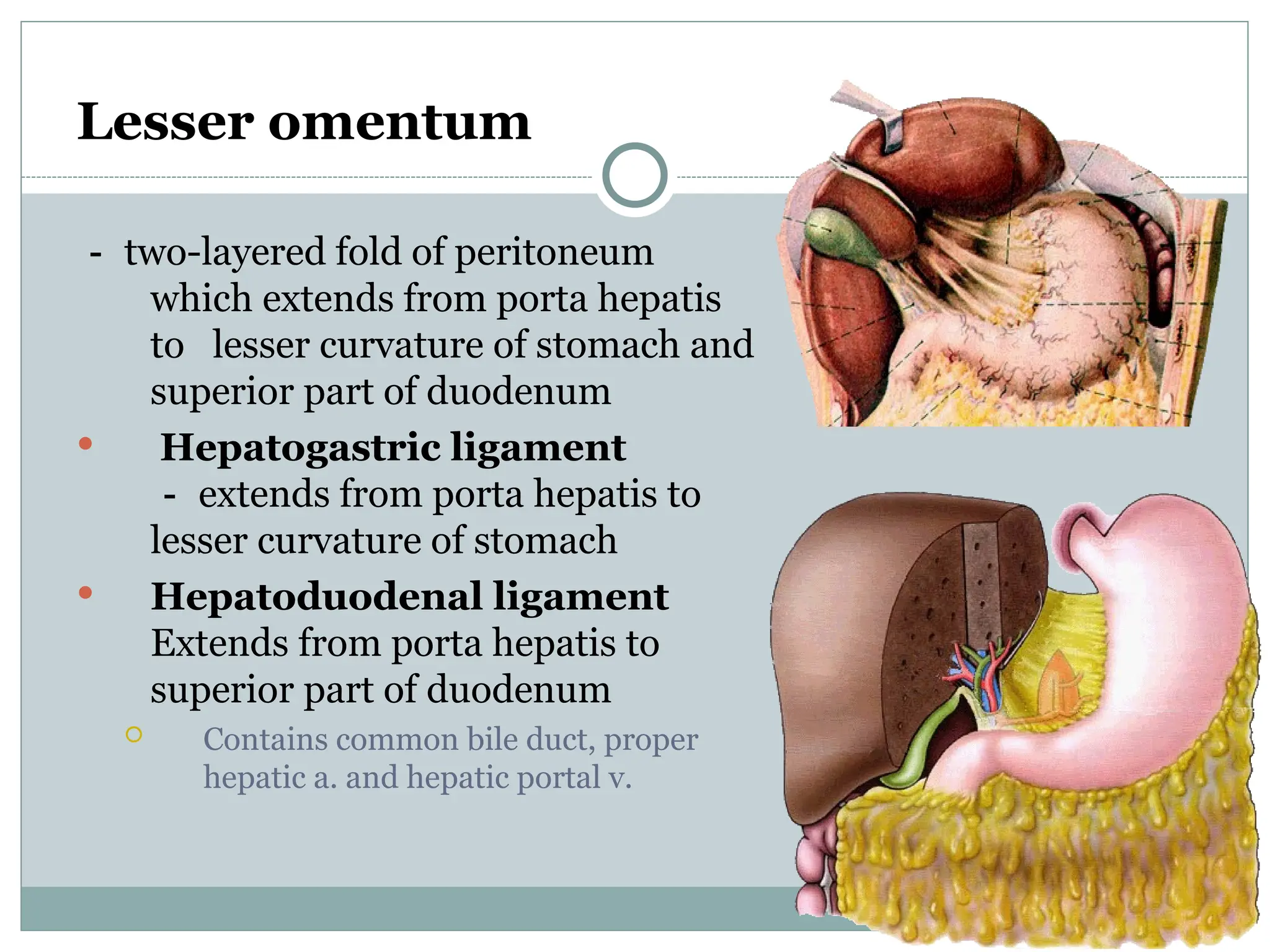
Lesser omentum
- two-layered fold of peritoneum
which extends from porta hepatis
to lesser curvature of stomach and
superior part of duodenum
 Hepatogastric ligament
- extends from porta hepatis to
lesser curvature of stomach
 Hepatoduodenal ligament
Extends from porta hepatis to
superior part of duodenum
 Contains common bile duct, proper
hepatic a. and hepatic portal v.
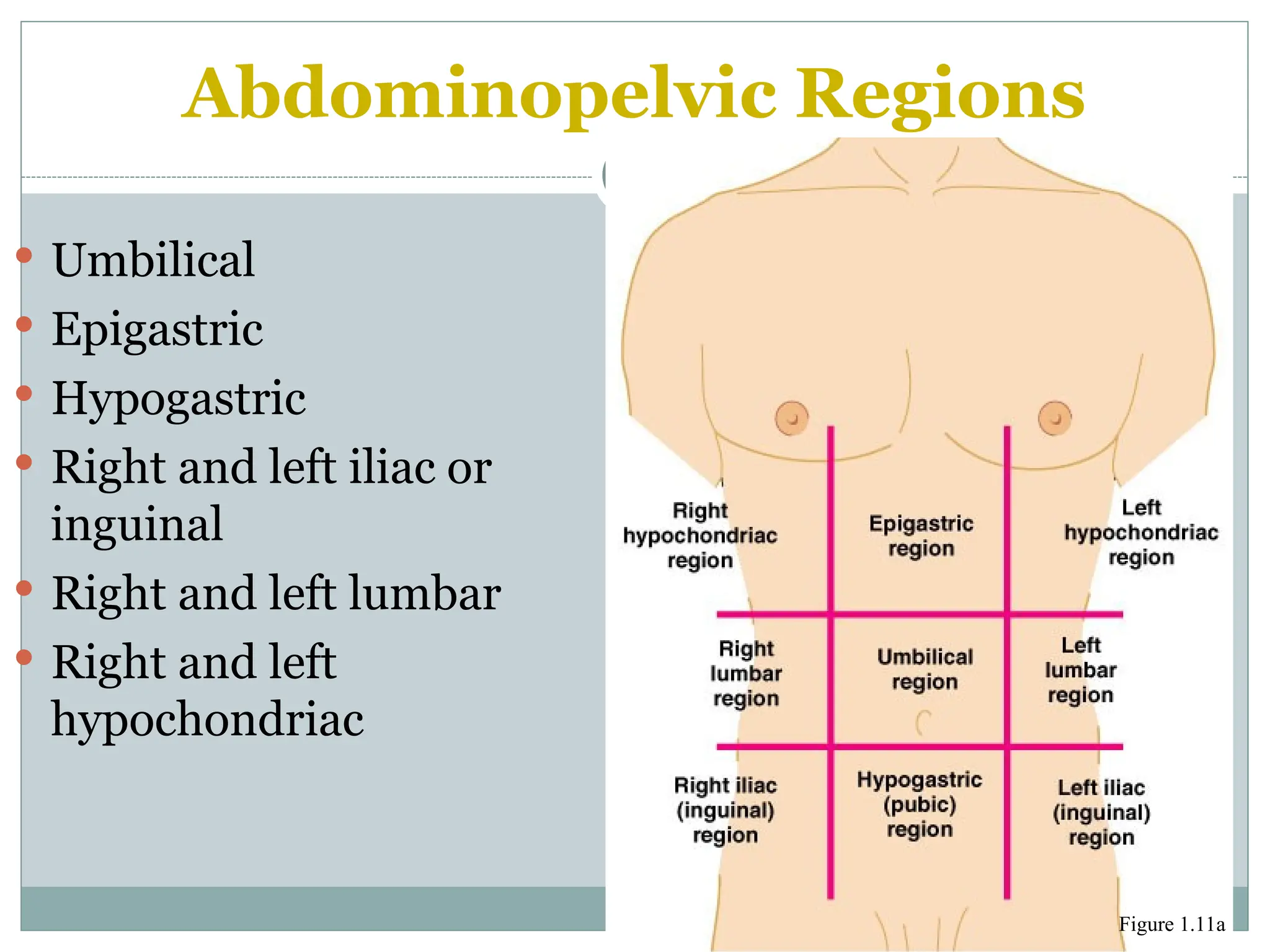
Abdominopelvic Regions
 Umbilical
 Epigastric
 Hypogastric
 Right and left iliac or
inguinal
 Right and left lumbar
 Right and left
hypochondriac
Figure 1.11a
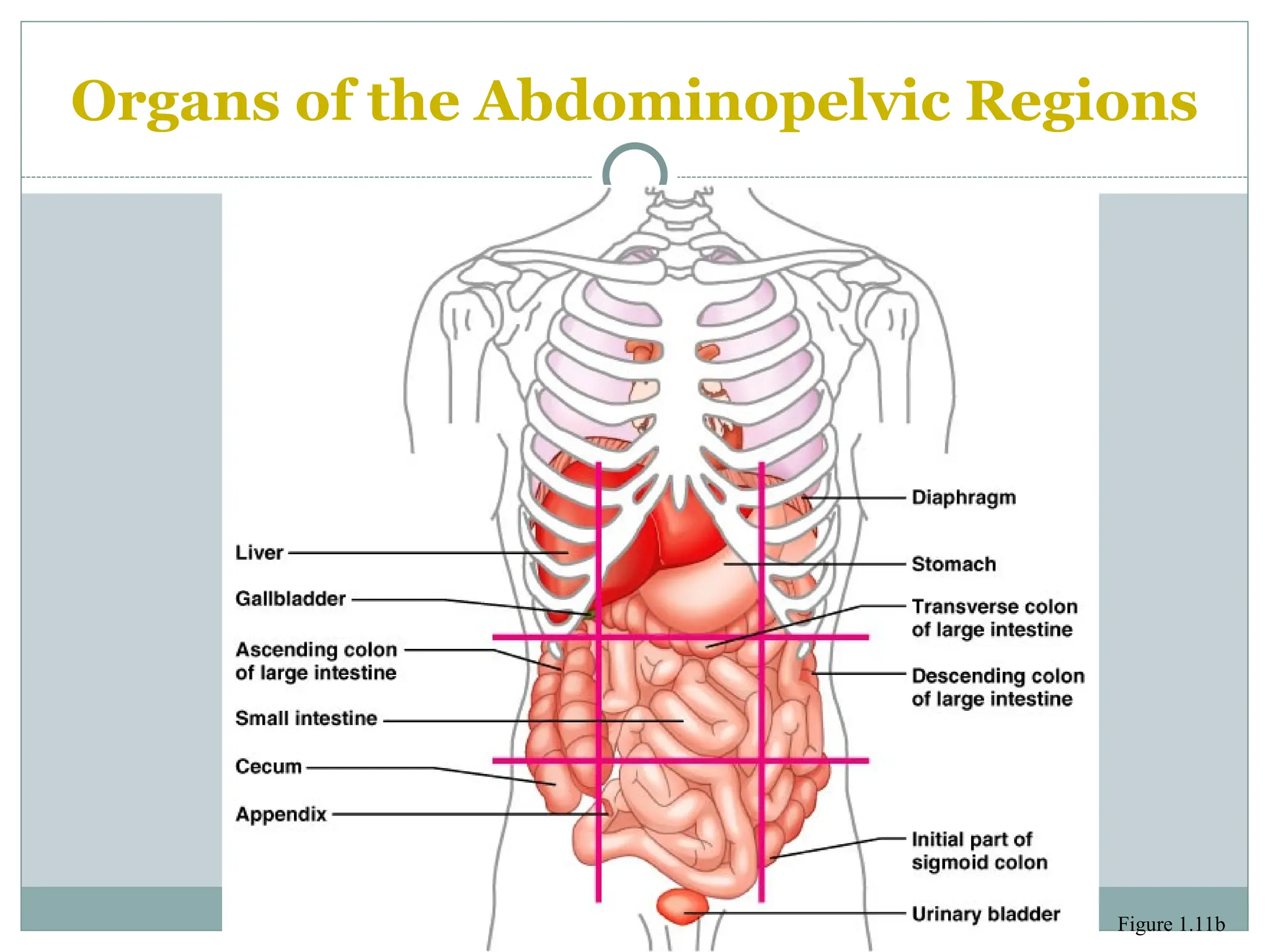
Organs of the Abdominopelvic Regions
Figure 1.11b
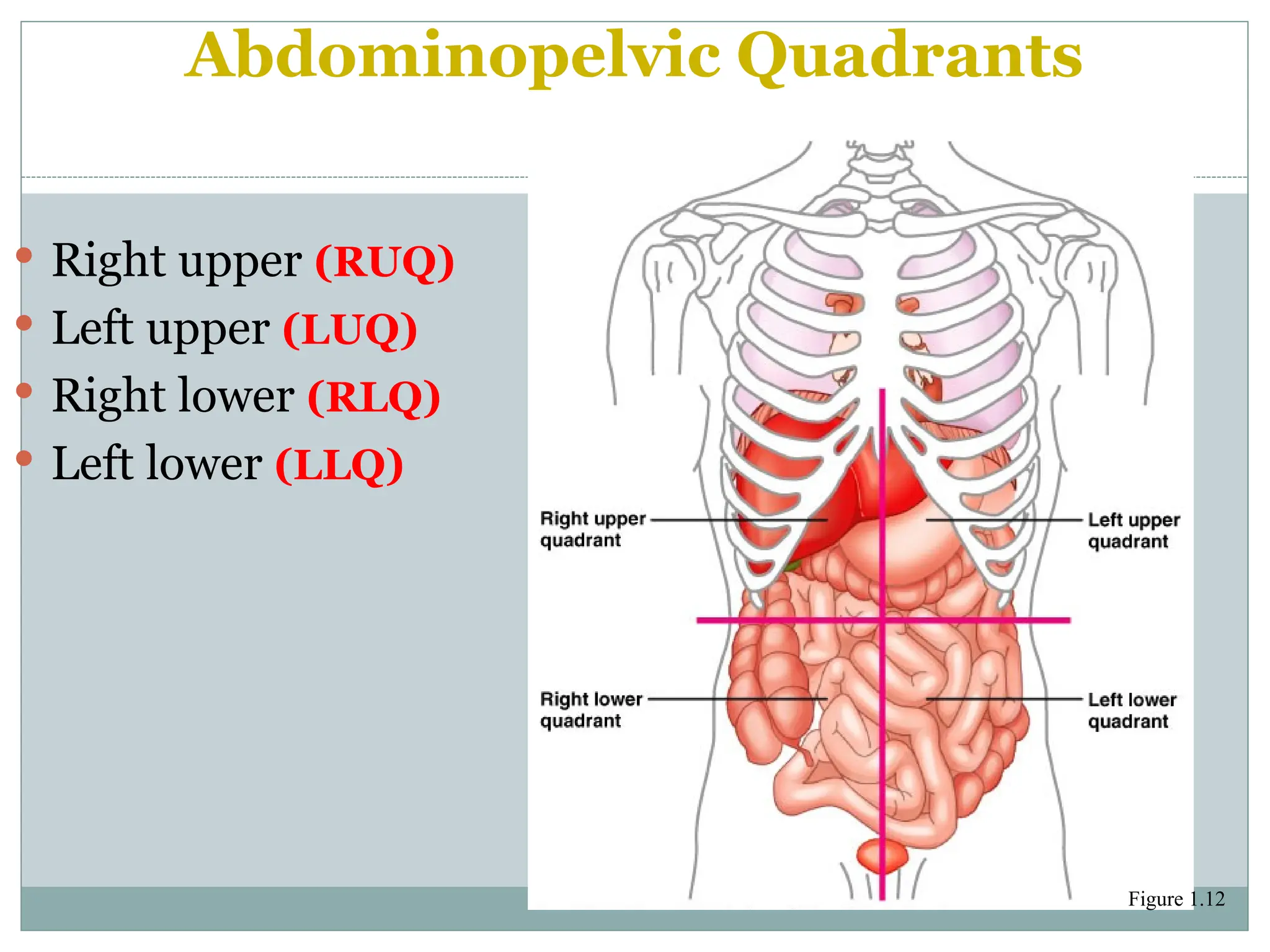
Abdominopelvic Quadrants
 Right upper (RUQ)
 Left upper (LUQ)
 Right lower (RLQ)
 Left lower (LLQ)
Figure 1.12
ESOPHAGUS
AND STOMACH
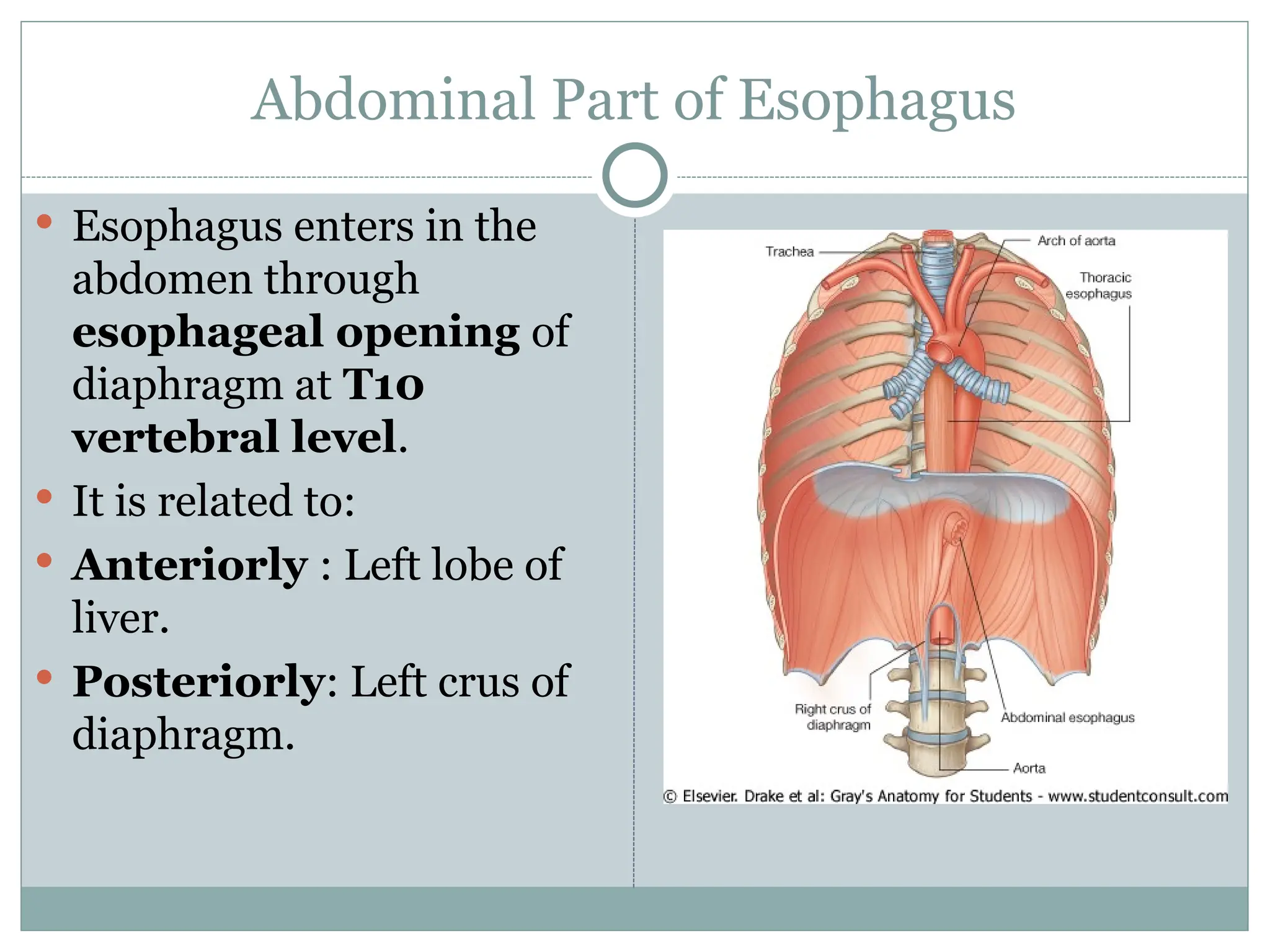
Abdominal Part of Esophagus
 Esophagus enters in the
abdomen through
esophageal opening of
diaphragm at T10
vertebral level.
 It is related to:
 Anteriorly : Left lobe of
liver.
 Posteriorly: Left crus of
diaphragm.
Blood supply and Nerve supply of Abdominal
Part of Esophagus
 Blood supply:
 Arterial supply: Left
gastric artery from
Coeliac trunk.
 Venous drainage: Left
gastric vein tributary of
Portal vein
 Lymphatic drainage: Left
gastric and coeliac lymph
nodes
 Nerve Supply:
 Parasympathetic: Vagus
nerves
 Sympathetic: Thoracic
sympathetic chain
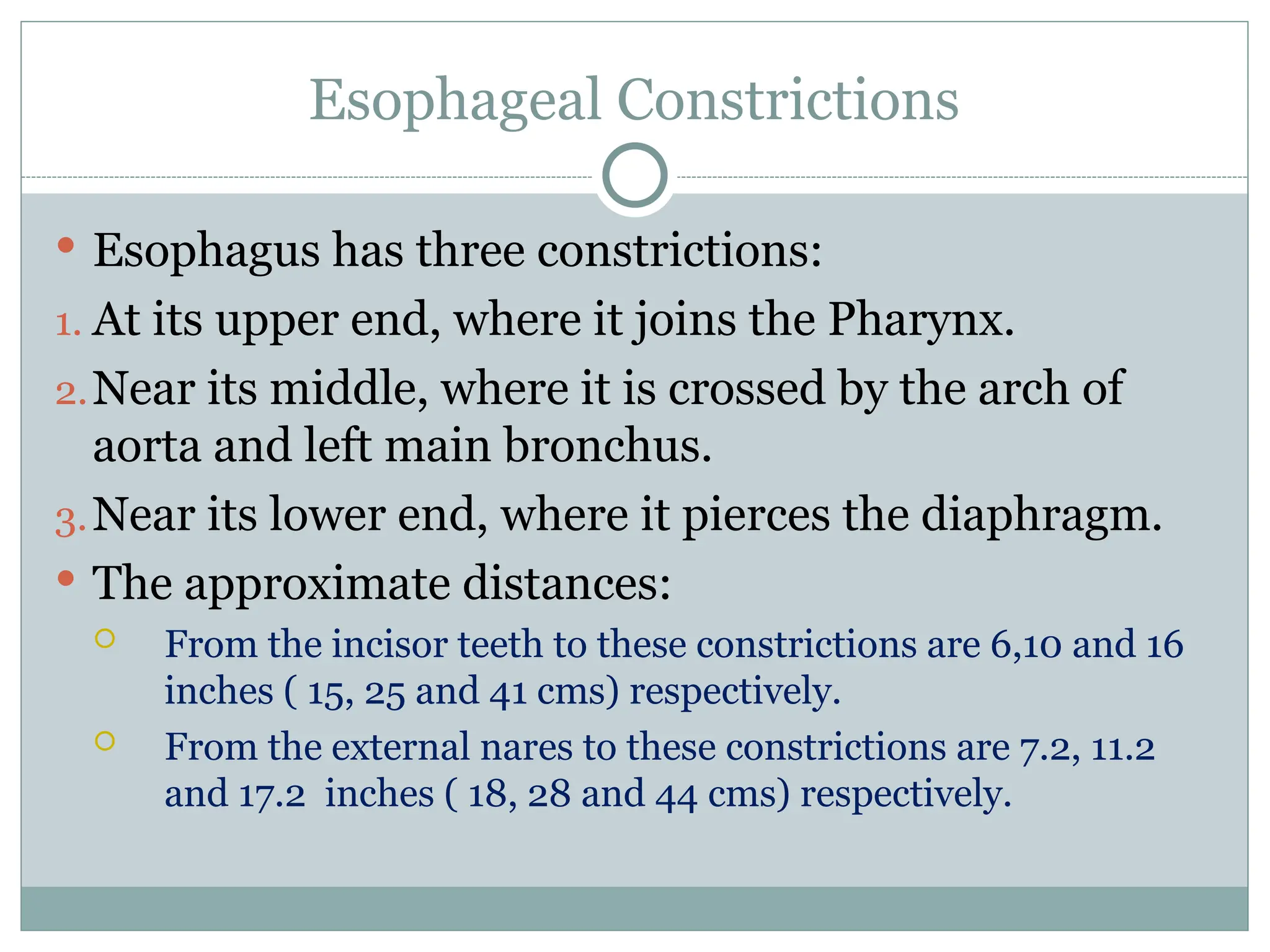
Clinical Aspect of Esophagus
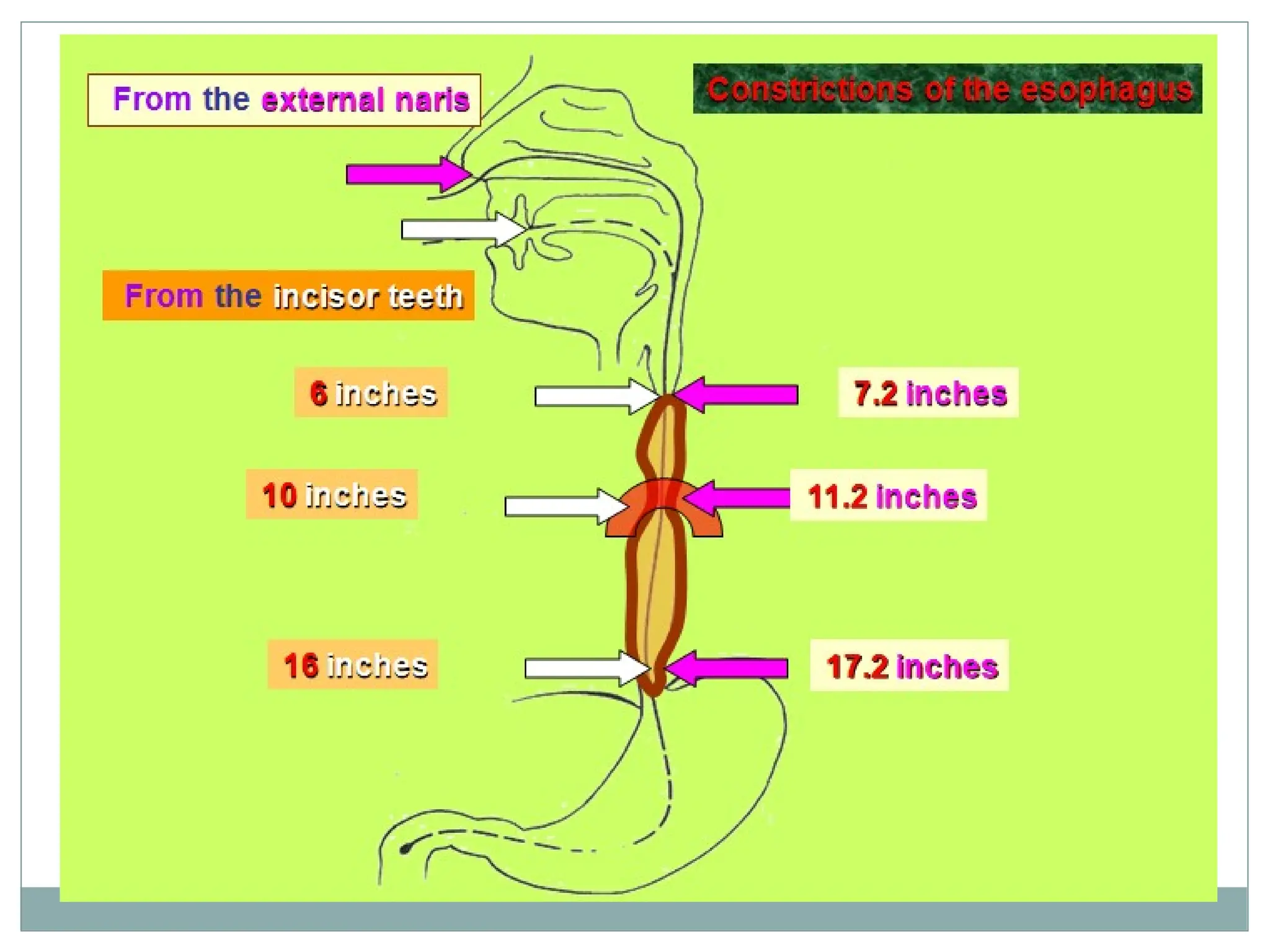
Esophageal Constrictions
 Esophagus has three constrictions:
1. At its upper end, where it joins the Pharynx.
2.Near its middle, where it is crossed by the arch of
aorta and left main bronchus.
3.Near its lower end, where it pierces the diaphragm.
 The approximate distances:
 From the incisor teeth to these constrictions are 6,10 and 16
inches ( 15, 25 and 41 cms) respectively.
 From the external nares to these constrictions are 7.2, 11.2
and 17.2 inches ( 18, 28 and 44 cms) respectively.
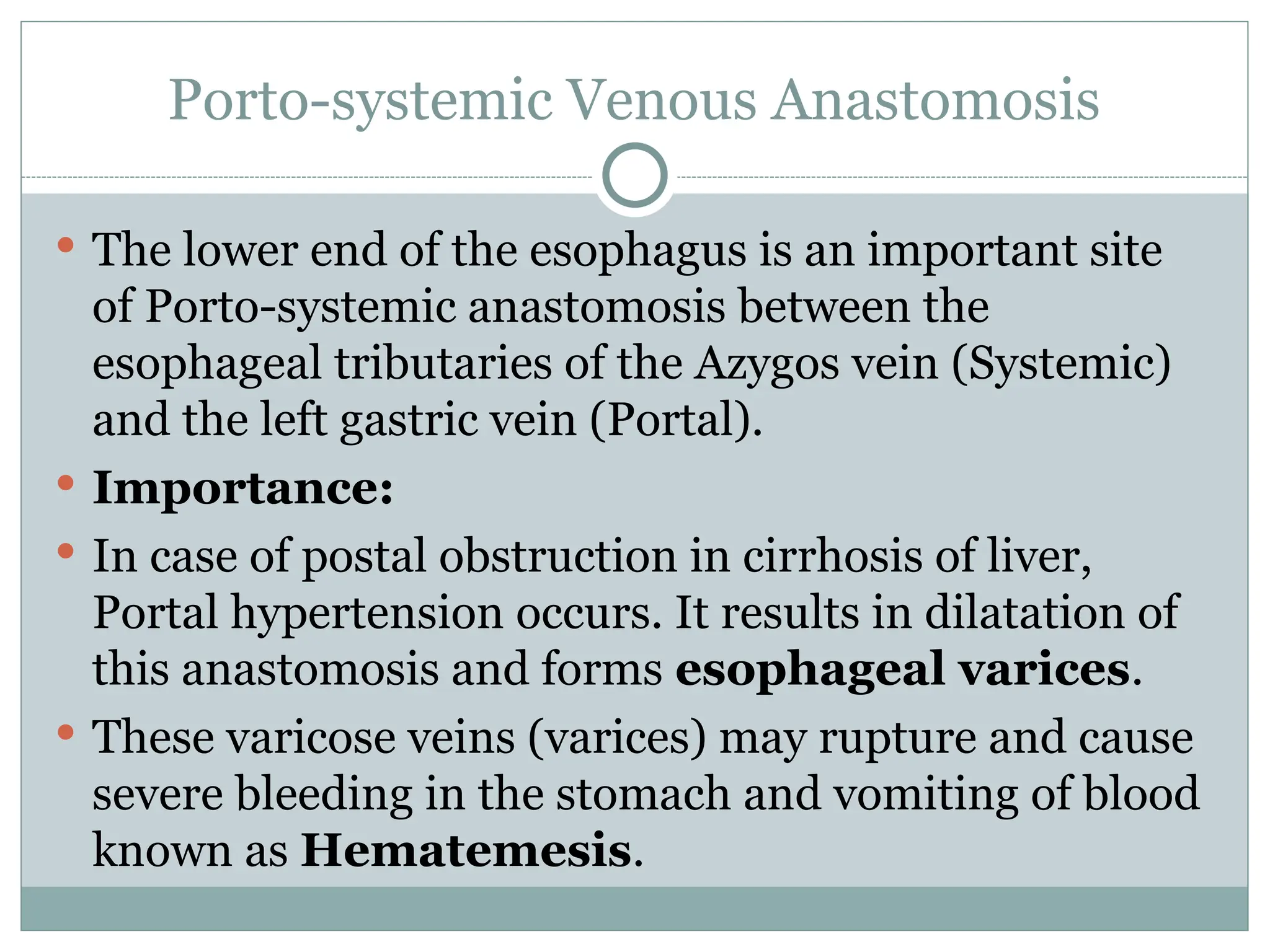
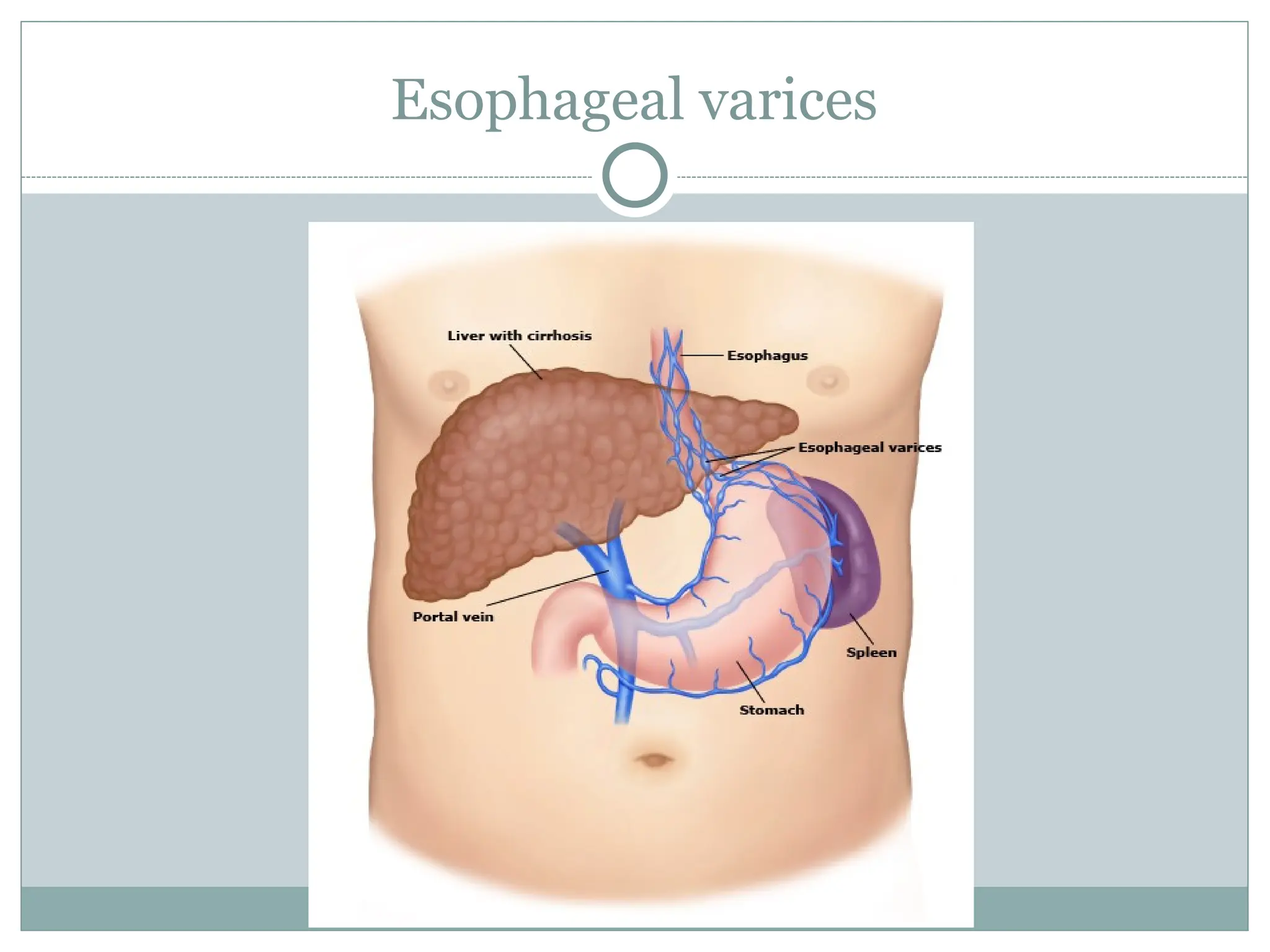
Porto-systemic Venous Anastomosis
 The lower end of the esophagus is an important site
of Porto-systemic anastomosis between the
esophageal tributaries of the Azygos vein (Systemic)
and the left gastric vein (Portal).
 Importance:
 In case of postal obstruction in cirrhosis of liver,
Portal hypertension occurs. It results in dilatation of
this anastomosis and forms esophageal varices.
 These varicose veins (varices) may rupture and cause
severe bleeding in the stomach and vomiting of blood
known as Hematemesis.
Esophageal varices
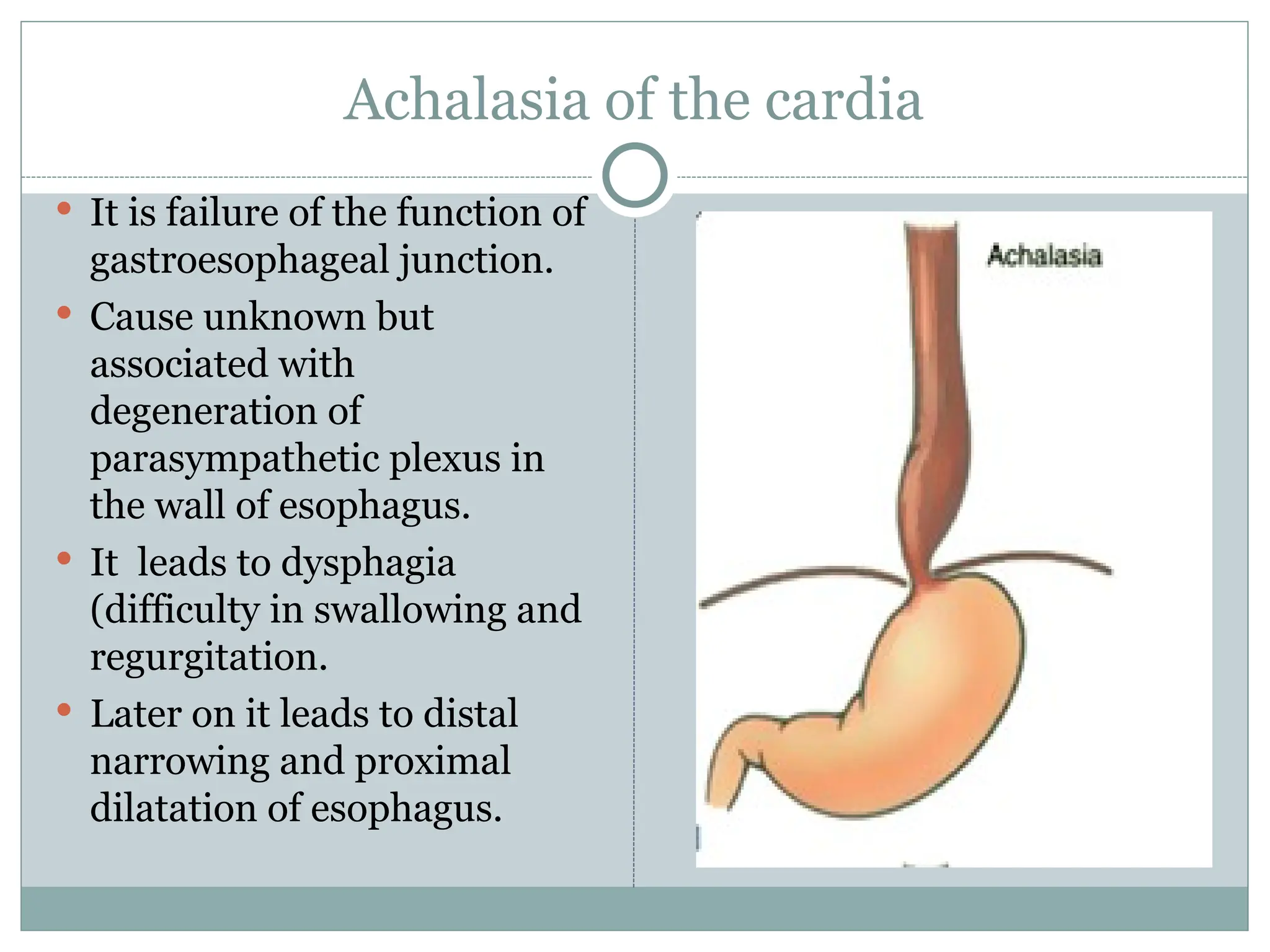
Achalasia of the cardia
 It is failure of the function of
gastroesophageal junction.
 Cause unknown but
associated with
degeneration of
parasympathetic plexus in
the wall of esophagus.
 It leads to dysphagia
(difficulty in swallowing and
regurgitation.
 Later on it leads to distal
narrowing and proximal
dilatation of esophagus.
STOMACH
Position and Shape
 Stomach is dilated part of GIT responsible for
storage and mixing of food.
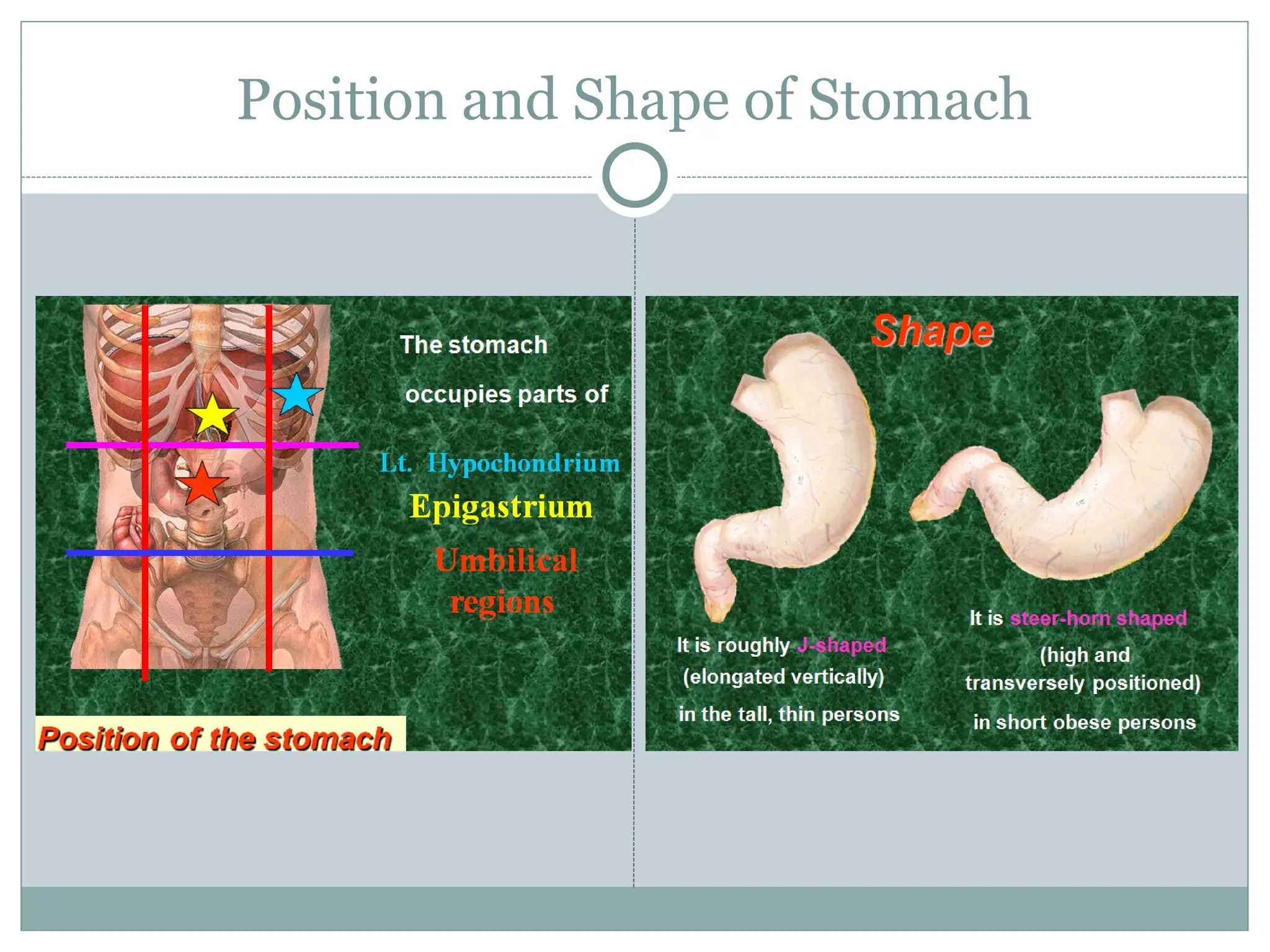
 Position: Occupy Left hypochondrium, epigastrium
and umbilical regions.
 Shape:
 In tall and thin persons: J-Shaped (Elongated
vertically.
 In short obese persons: Steer-horn shape (High and
transversely placed)
Position and Shape of Stomach
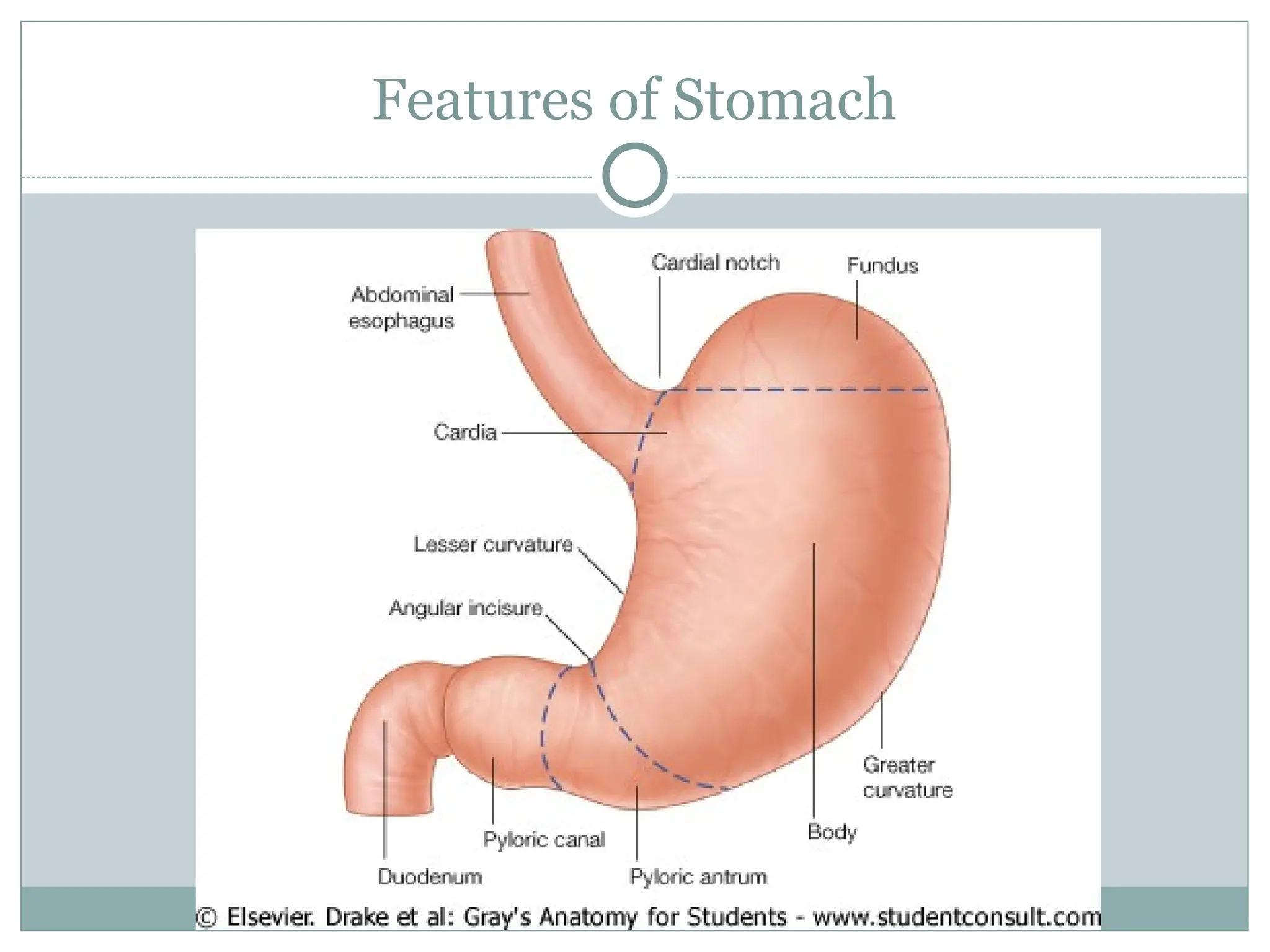
Features of Stomach
Features of stomach
 Ends (Openings):
 Cardiac End (Opening): Upper end at the junction with the
esophagus.
 Pyloric End (Opening): Lower end at the junction with the first
part of Duodenum.
 Borders (Curvatures):
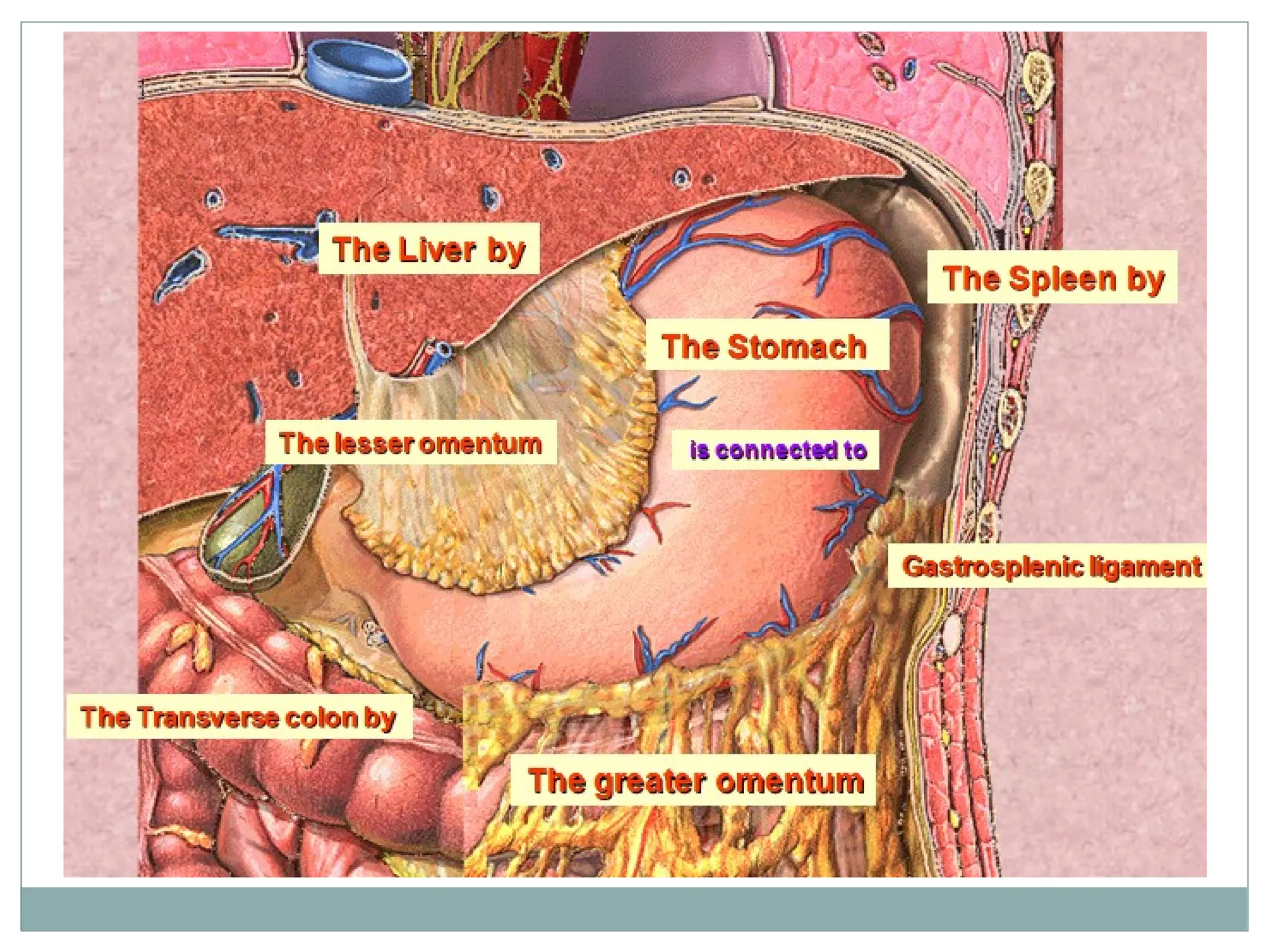
 Lesser Curvature (Right Border): Extends from right side of
cardiac end to pyloric end. It is concave. Its maximum concavity is
known as Angular notch (Incisura angularis). It is attached to liver by
lesser omentum.
 Greater Curvature (Left Border): Extends from Left side of
cardiac end, follow fundus of stomach to pyloric end. It is convex. It is
attached to spleen by gastrosplenic ligament in upper part and to
transverse colon by greater omentum in the rest of the part.
Features of stomach
 Surfaces:
 Anterior surface: Between lesser and greater curvature facing
anteriorly.
 Posterior surface: Between lesser and greater curvature facing
posteriorly.
Relations of Stomach
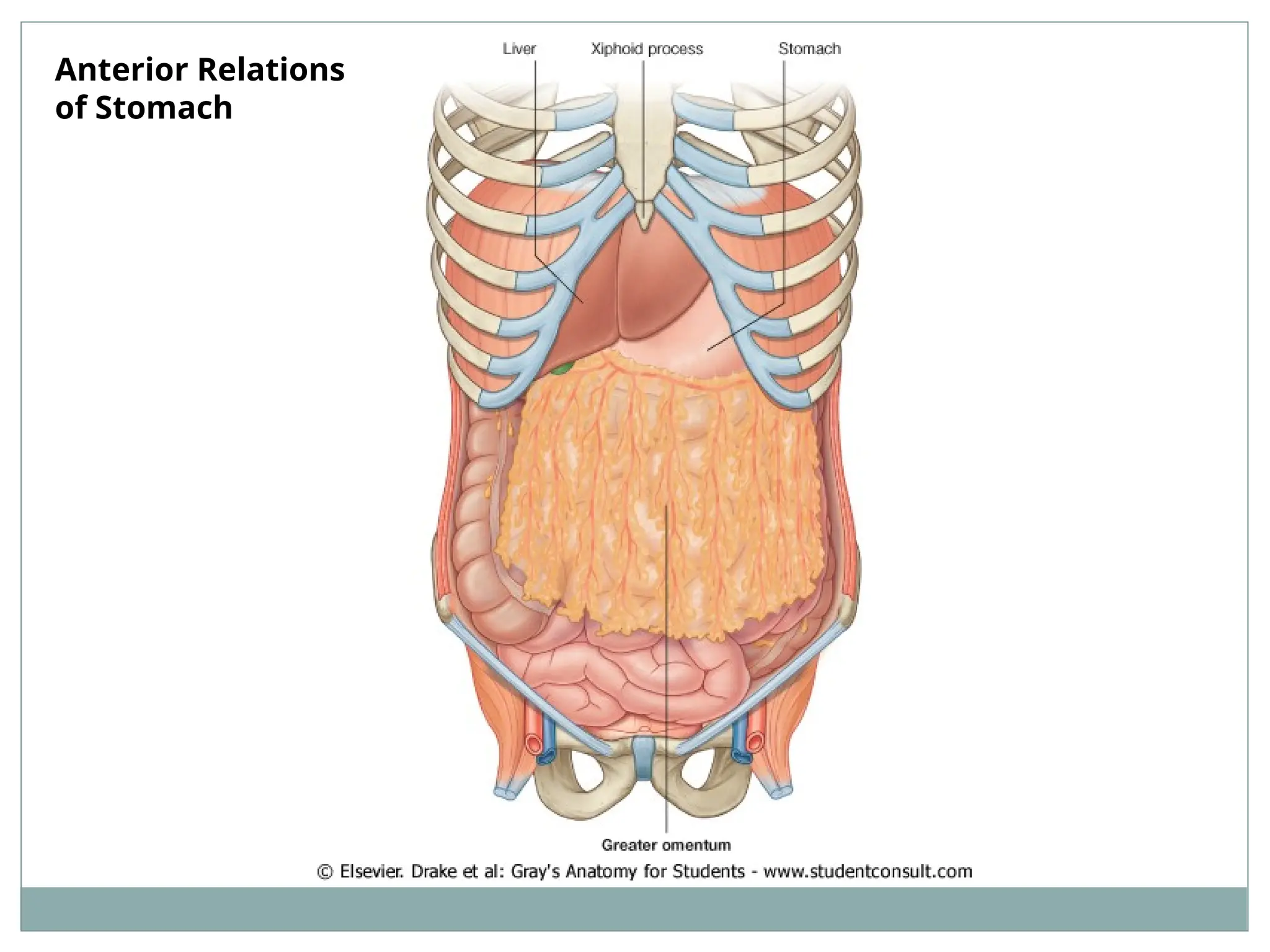
 Anterior Surface: covered by peritoneum of
greater sac.
 Related to:
 Liver ( left lobe and quadrate lobe)
 Spleen
 Anterior abdominal wall
 Diaphragm which separates stomach from left pleura
Anterior Relations
of Stomach
Relations of Stomach
 Structures related to posterior surface also known as Stomach bed and
separated by cavity of lesser sac)
 Structures forming stomach bed (Posterior relations):
 Left crus of diaphragm
 Abdominal aorta
 Body of pancreas
 Left kidney and left suprarenal gland
 Transverse colon and transverse mesocolon
 Spleen (separated by cavity of greater sac)
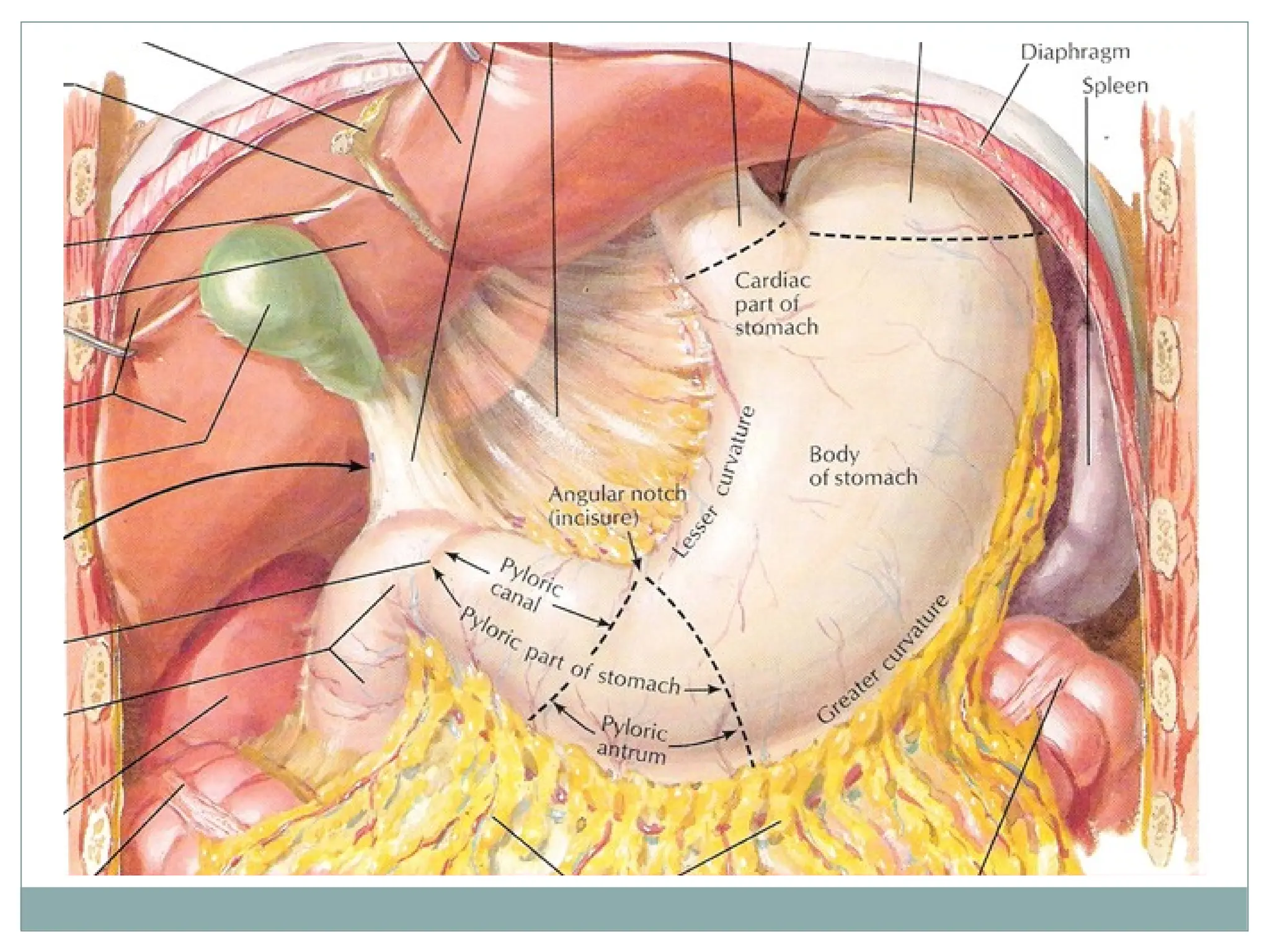
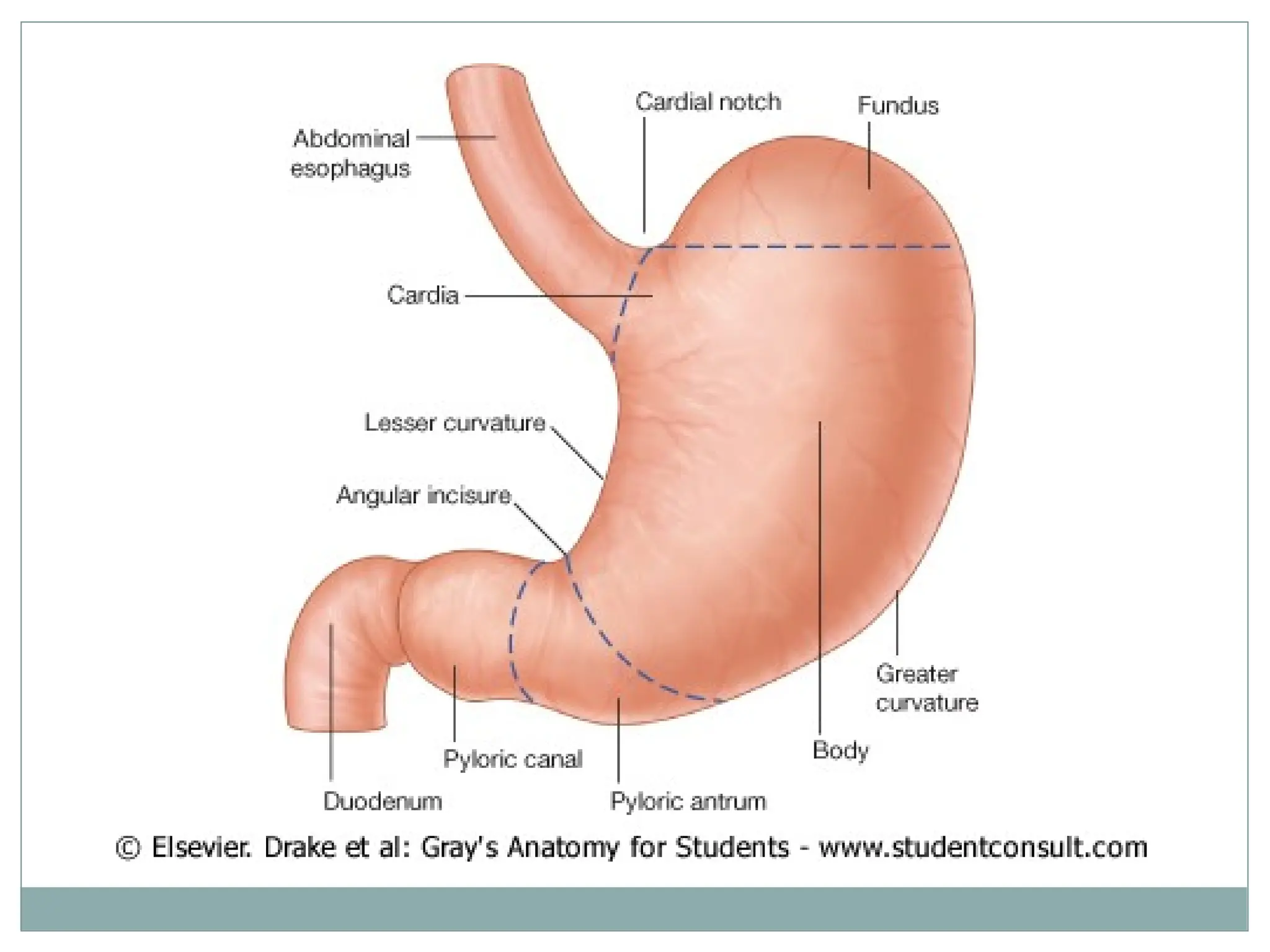
Divisions of stomach
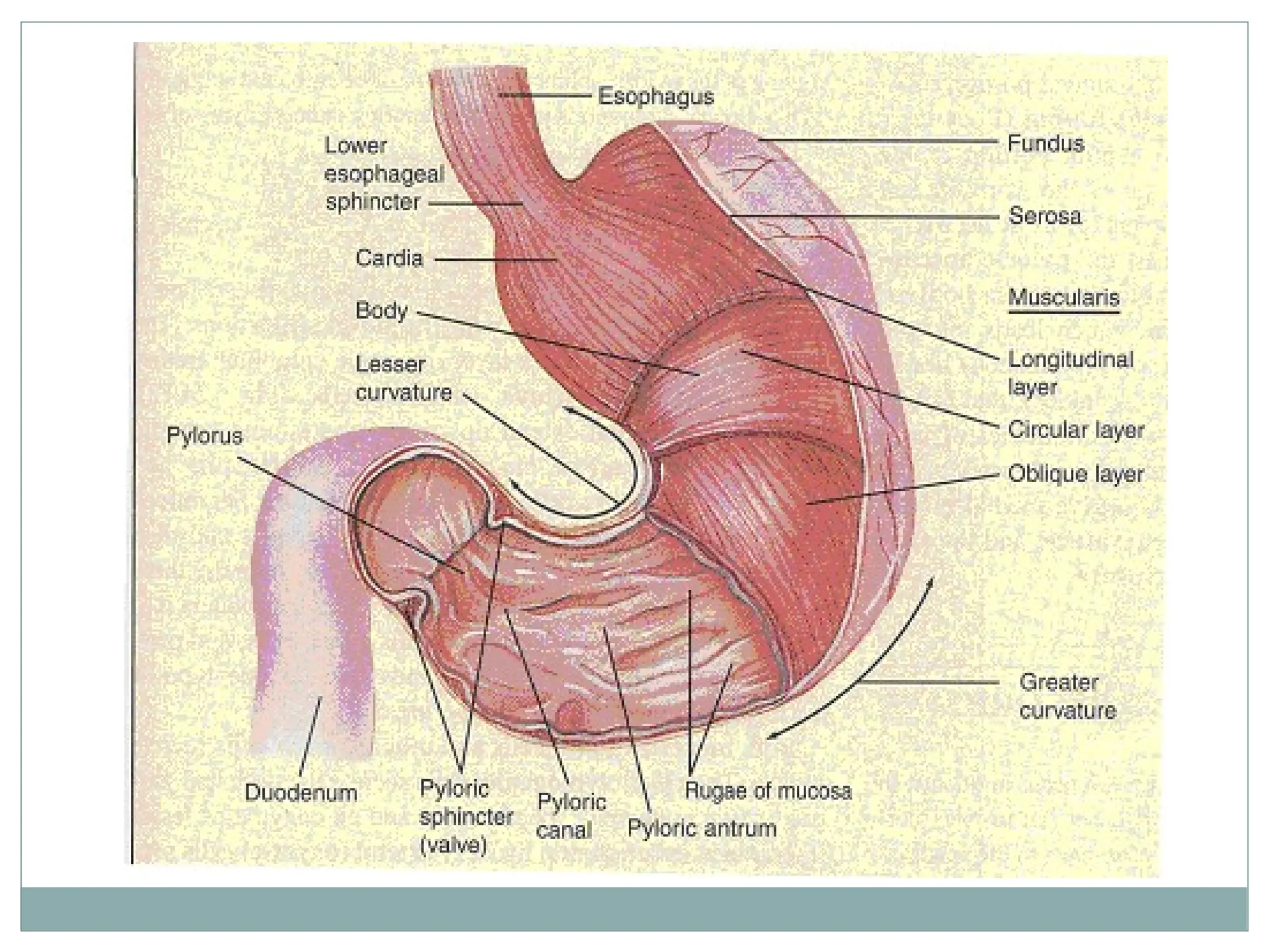
 Stomach is divided into two portions by line extending from angular notch of
lesser curvature to the bulge on the greater curvature.
 Two portions are:
 1. Cardiac portion
 2. Pyloric portion
 Cardiac portion is subdivided in to two parts by transverse line passing
through cardiac end.
 The two parts are:
 The fundus: lies above the transverse line and dome shaped.
 The body: between transverse line and line from angular notch.
 Pyloric portion is subdivided in to two parts by constriction.
 The two parts are:
 The pyloric antrum: between line from angular notch to constriction.
 The pyloric canal (pylorus): Terminal part. 1 inch long. In the wall
contains circular muscle fibers which form pyloric sphincter.
Structure of Stomach
 Mucous membrane: thick, vascular and thrown into
folds known as Rugae. Space at the lesser curvature
between prominent longitudinal fold is known as
gastric canal.
 Muscular wall: Formed by three layers:
 Longitudinal: superficial layer
 Circular layer: Middle layer. At pylorus forms pyloric
sphincter.
 Oblique: Innermost layer.
Arterial Supply of Stomach
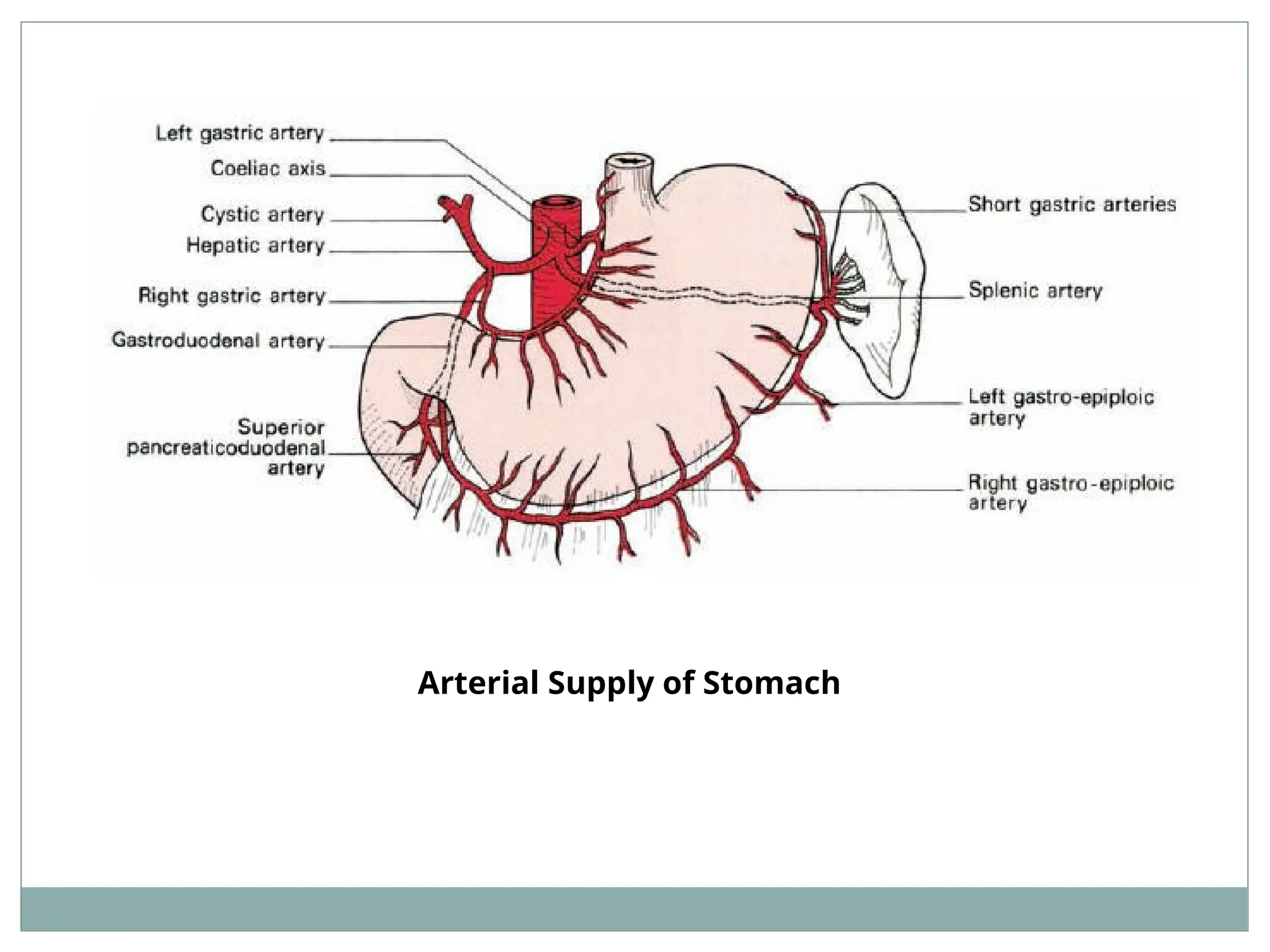
 The stomach is a part of foregut. Hence it is supplied
by branches of Coeliac artery , a branch of
abdomonal aorta.
 .
Arterial Supply of Stomach
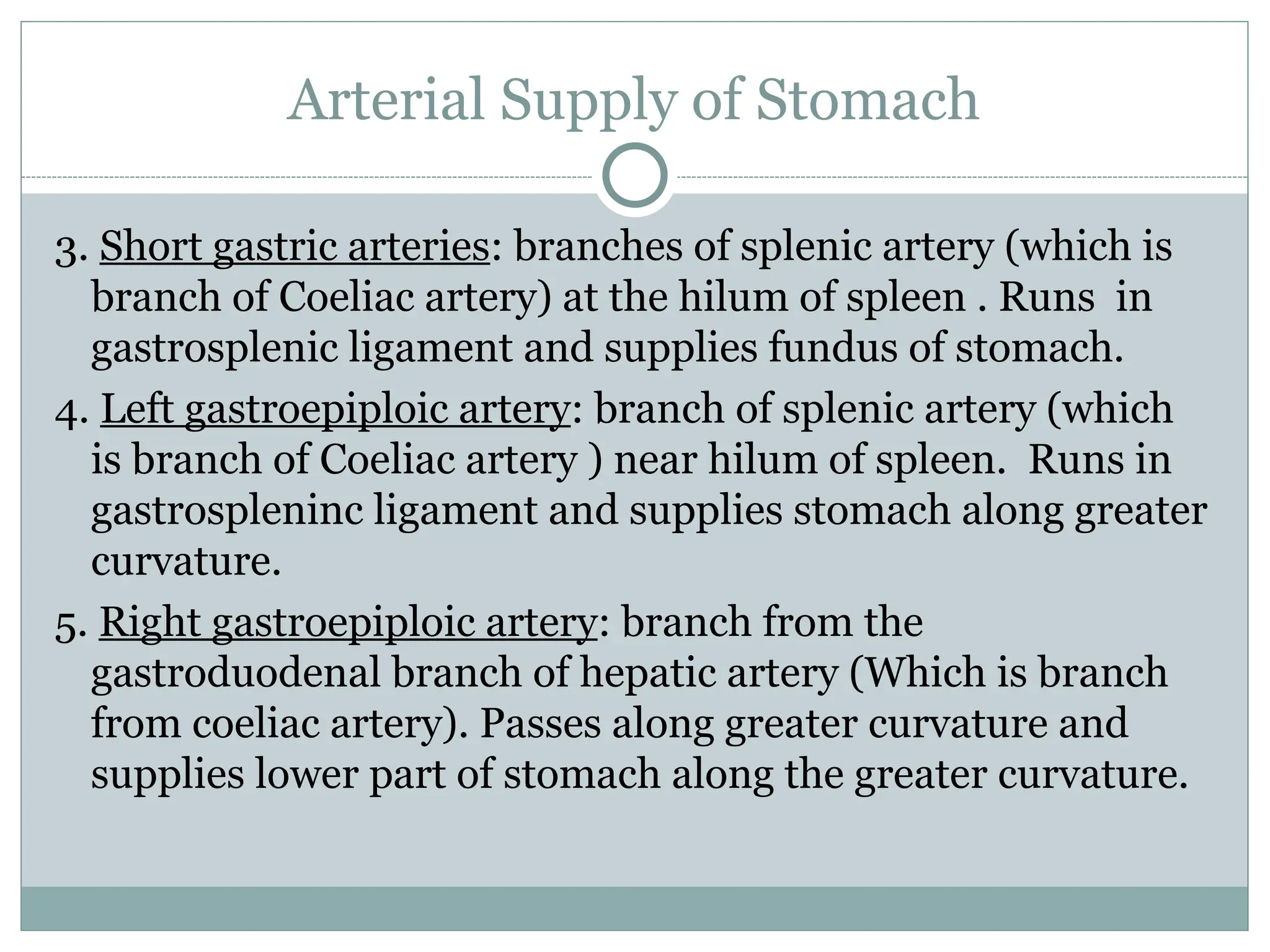
3. Short gastric arteries: branches of splenic artery (which is
branch of Coeliac artery) at the hilum of spleen . Runs in
gastrosplenic ligament and supplies fundus of stomach.
4. Left gastroepiploic artery: branch of splenic artery (which
is branch of Coeliac artery ) near hilum of spleen. Runs in
gastrospleninc ligament and supplies stomach along greater
curvature.
5. Right gastroepiploic artery: branch from the
gastroduodenal branch of hepatic artery (Which is branch
from coeliac artery). Passes along greater curvature and
supplies lower part of stomach along the greater curvature.
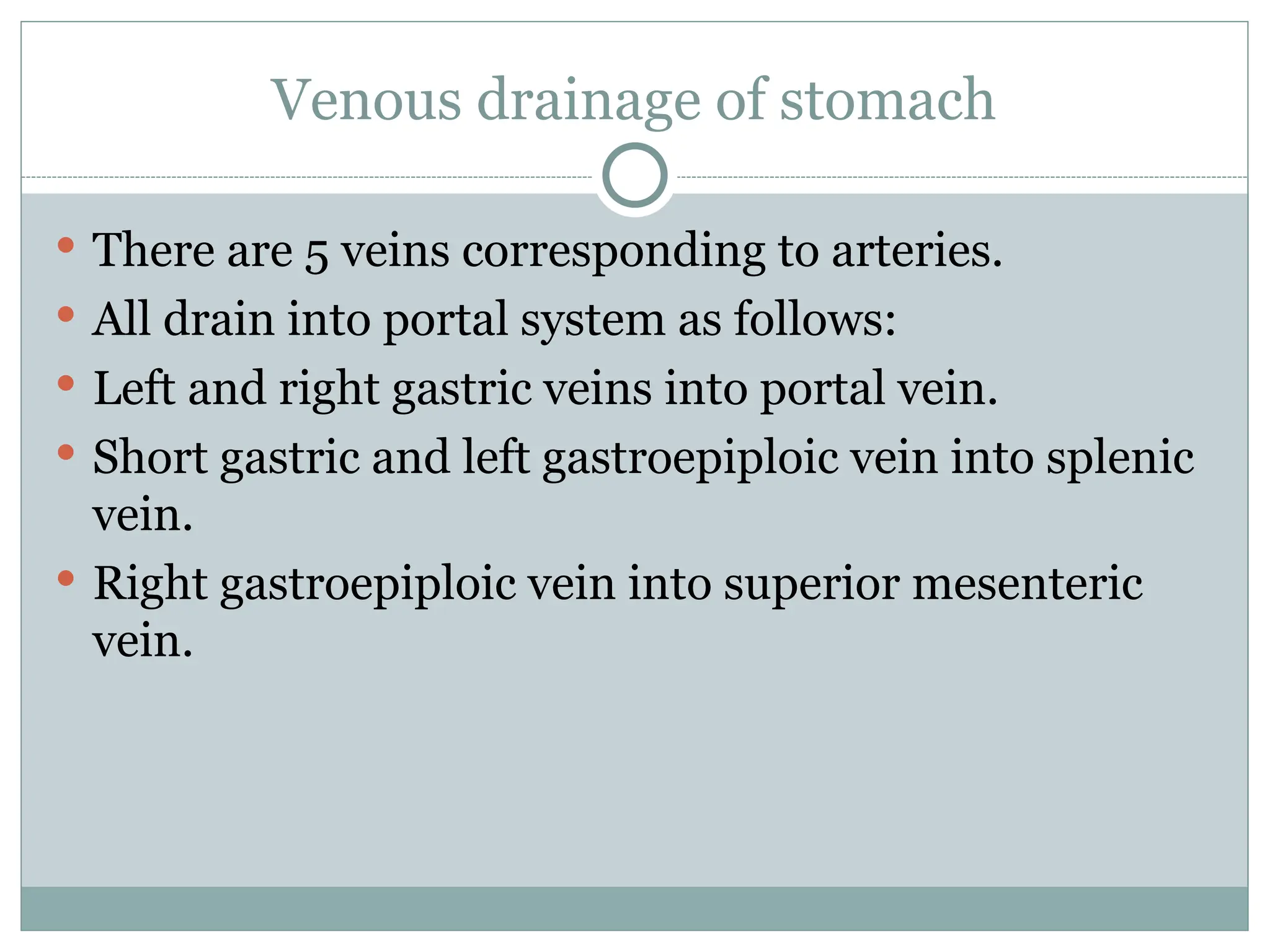
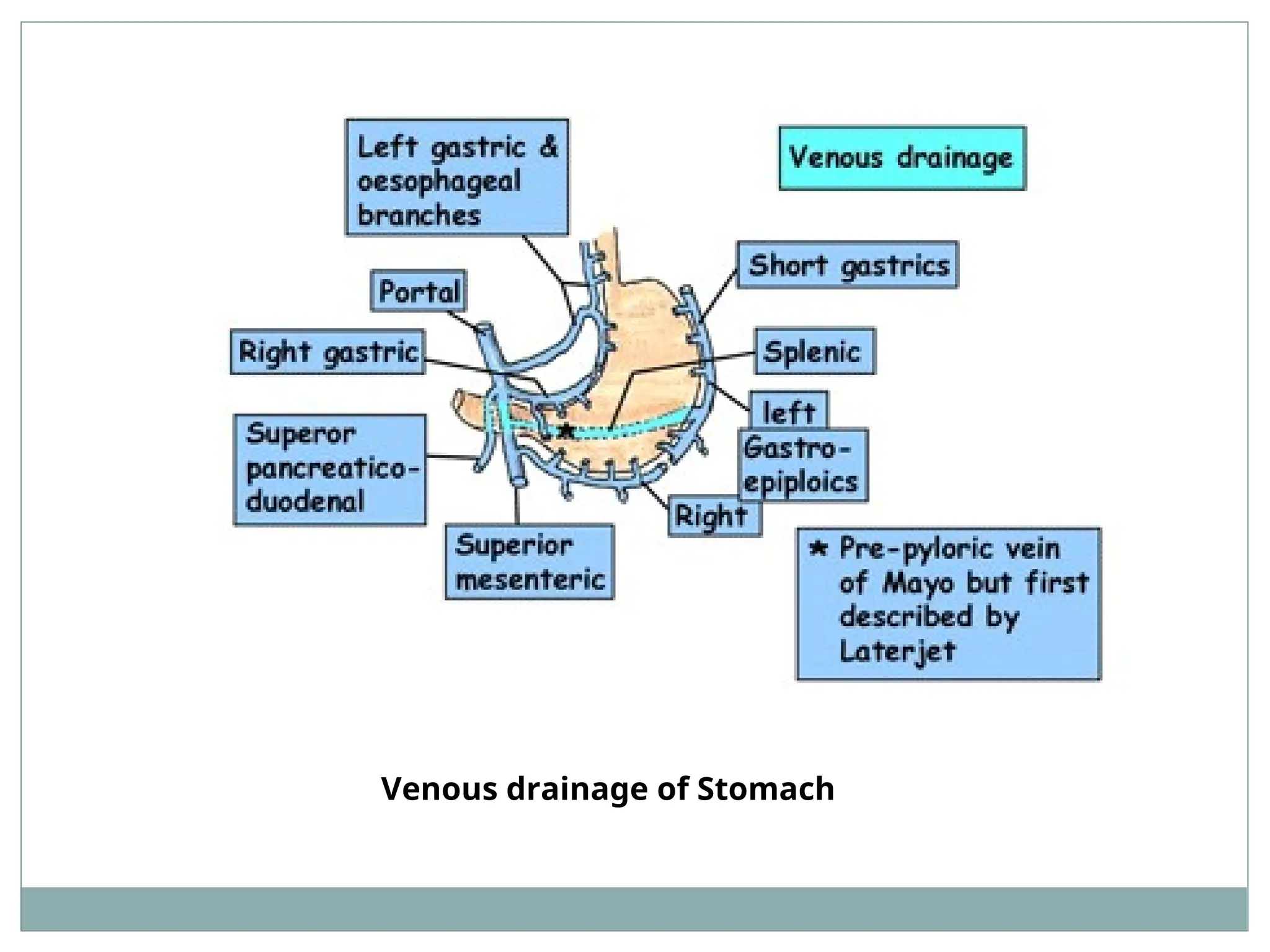
Venous drainage of Stomach
Venous drainage of stomach
 There are 5 veins corresponding to arteries.
 All drain into portal system as follows:
 Left and right gastric veins into portal vein.
 Short gastric and left gastroepiploic vein into splenic
vein.
 Right gastroepiploic vein into superior mesenteric
vein.
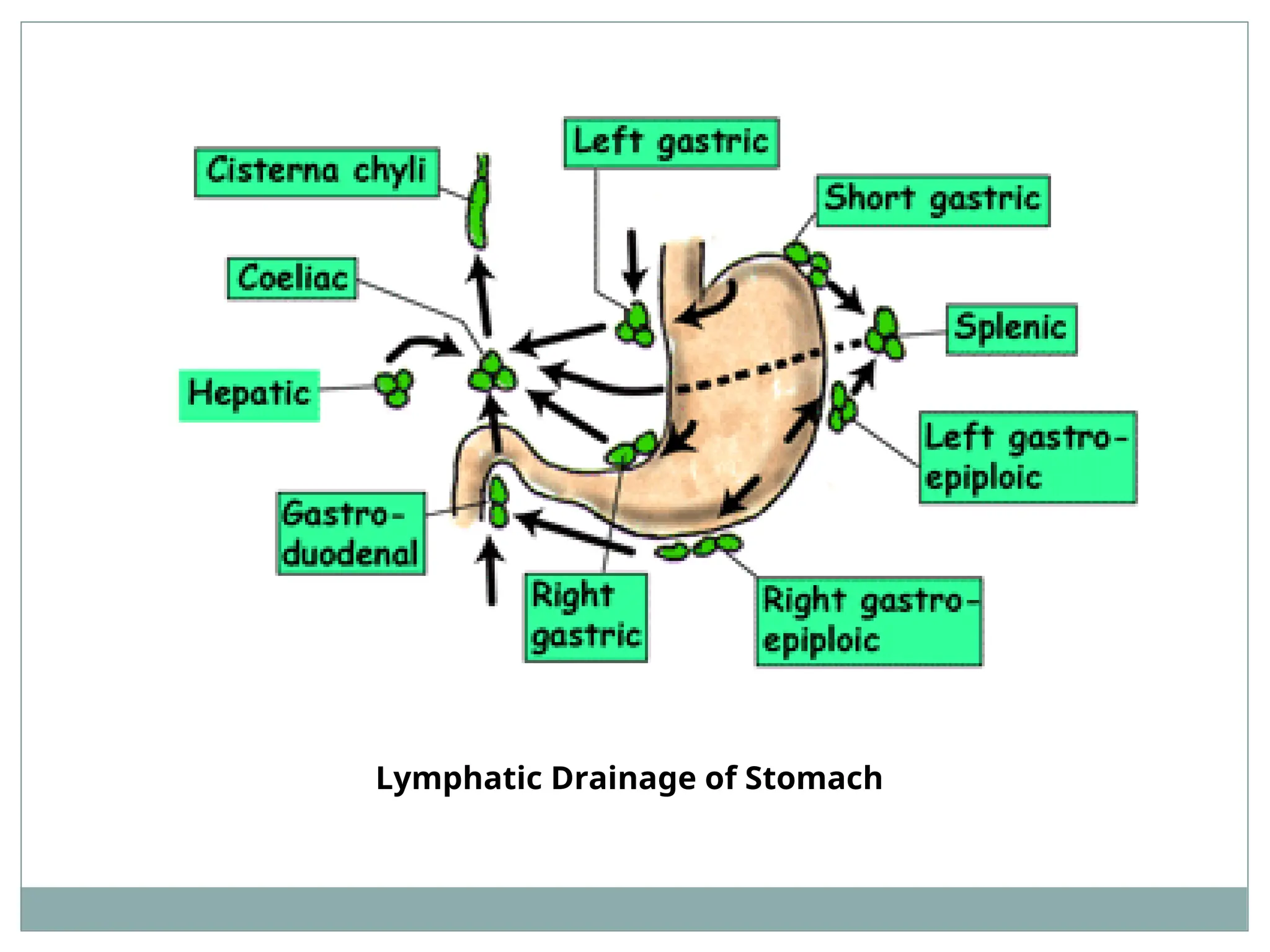
Lymphatic Drainage of Stomach
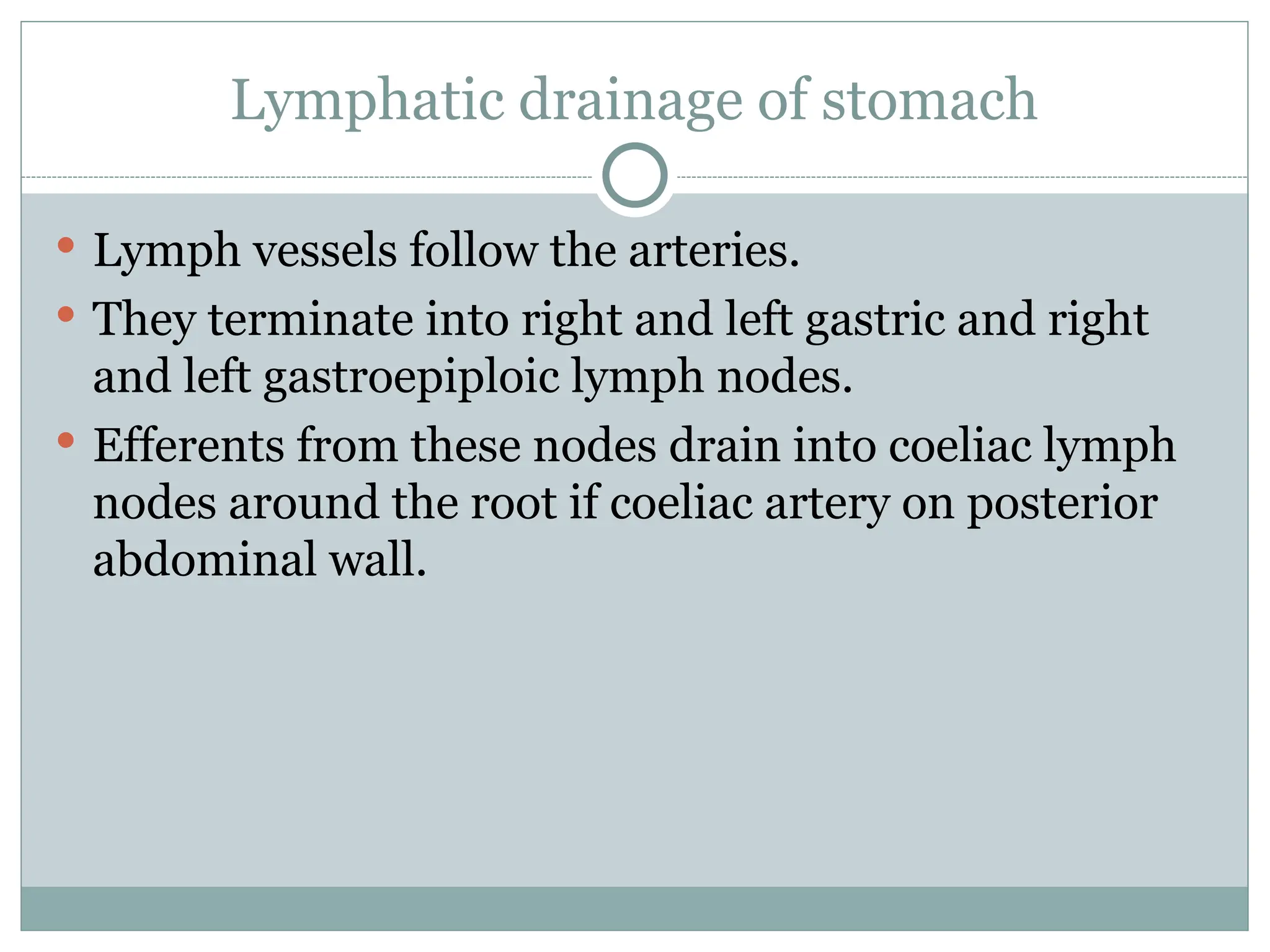
Lymphatic drainage of stomach
 Lymph vessels follow the arteries.
 They terminate into right and left gastric and right
and left gastroepiploic lymph nodes.
 Efferents from these nodes drain into coeliac lymph
nodes around the root if coeliac artery on posterior
abdominal wall.
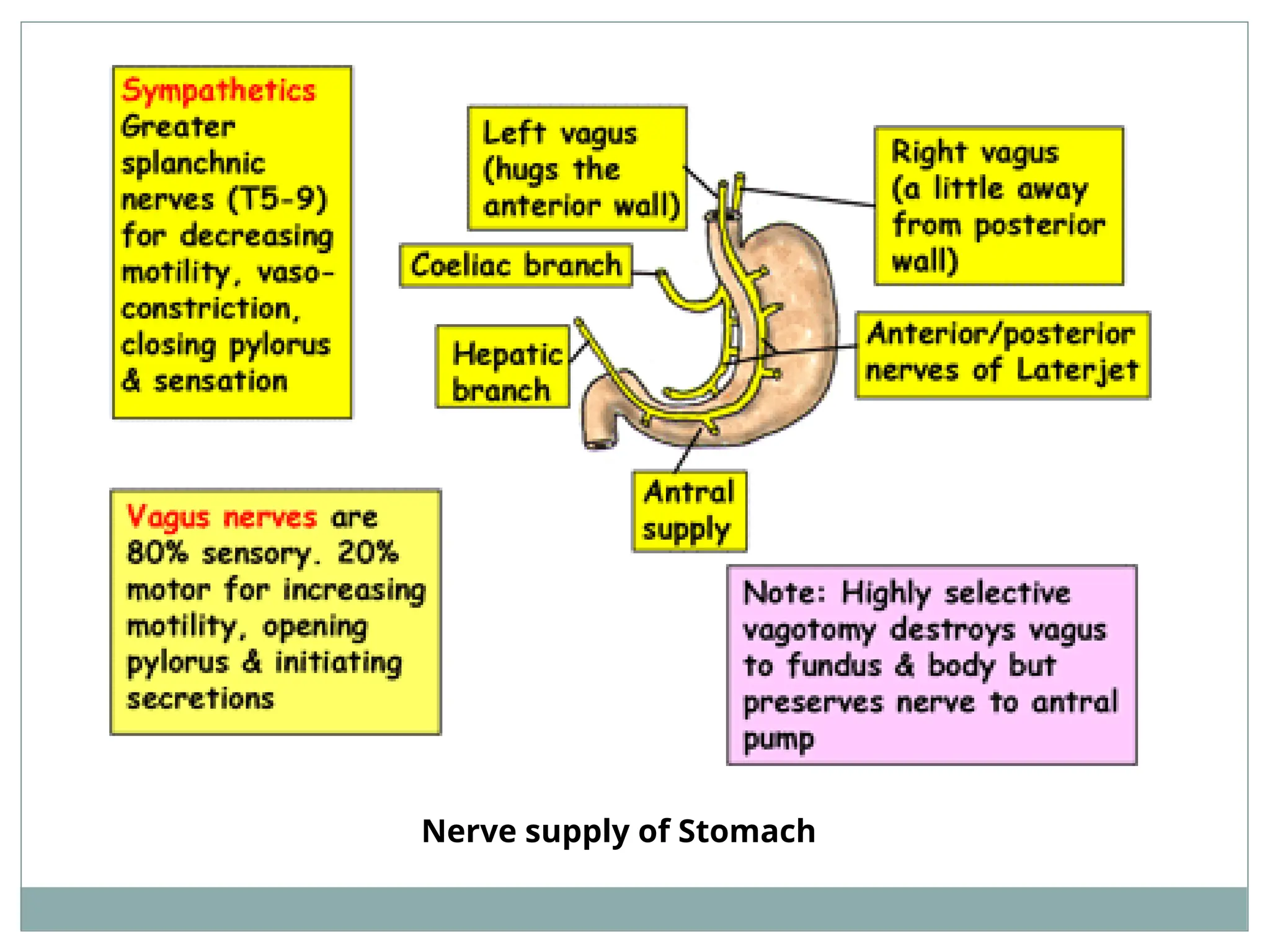
Nerve supply of Stomach
Clinical Aspect of stomach
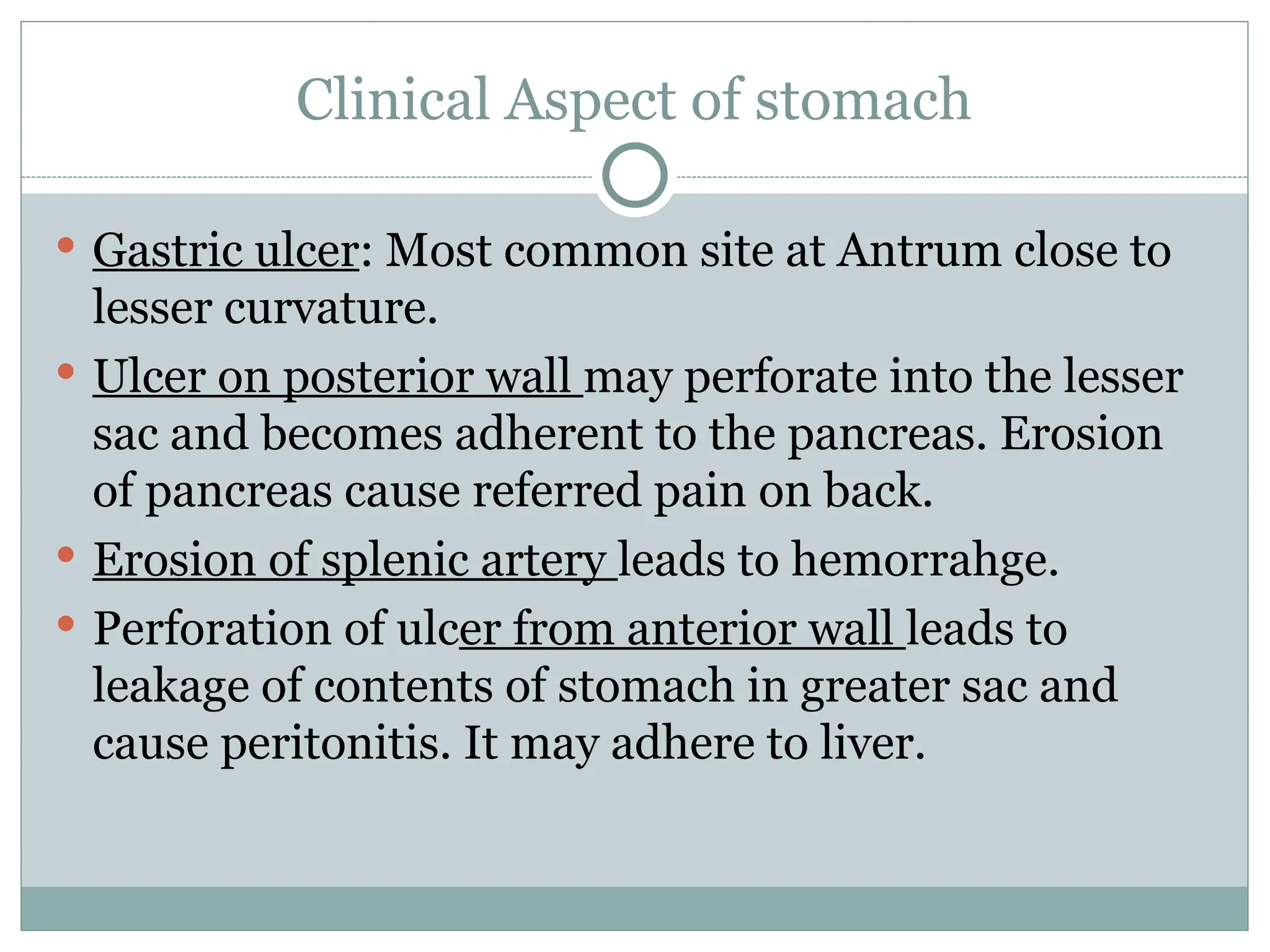
 Gastric ulcer: Most common site at Antrum close to
lesser curvature.
 Ulcer on posterior wall may perforate into the lesser
sac and becomes adherent to the pancreas. Erosion
of pancreas cause referred pain on back.
 Erosion of splenic artery leads to hemorrahge.
 Perforation of ulcer from anterior wall leads to
leakage of contents of stomach in greater sac and
cause peritonitis. It may adhere to liver.
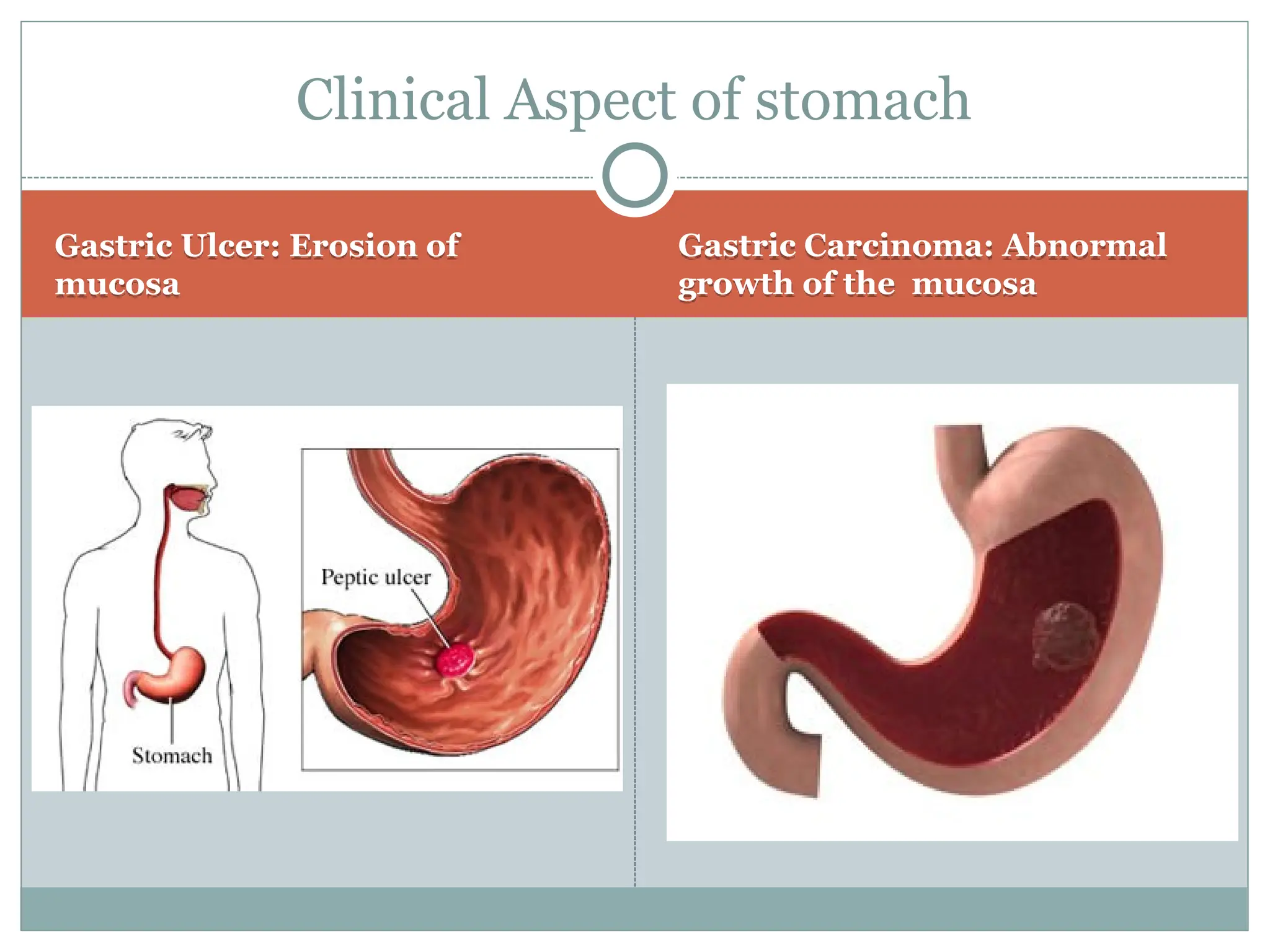
Gastric Ulcer: Erosion of
mucosa
Gastric Carcinoma: Abnormal
growth of the mucosa
Clinical Aspect of stomach
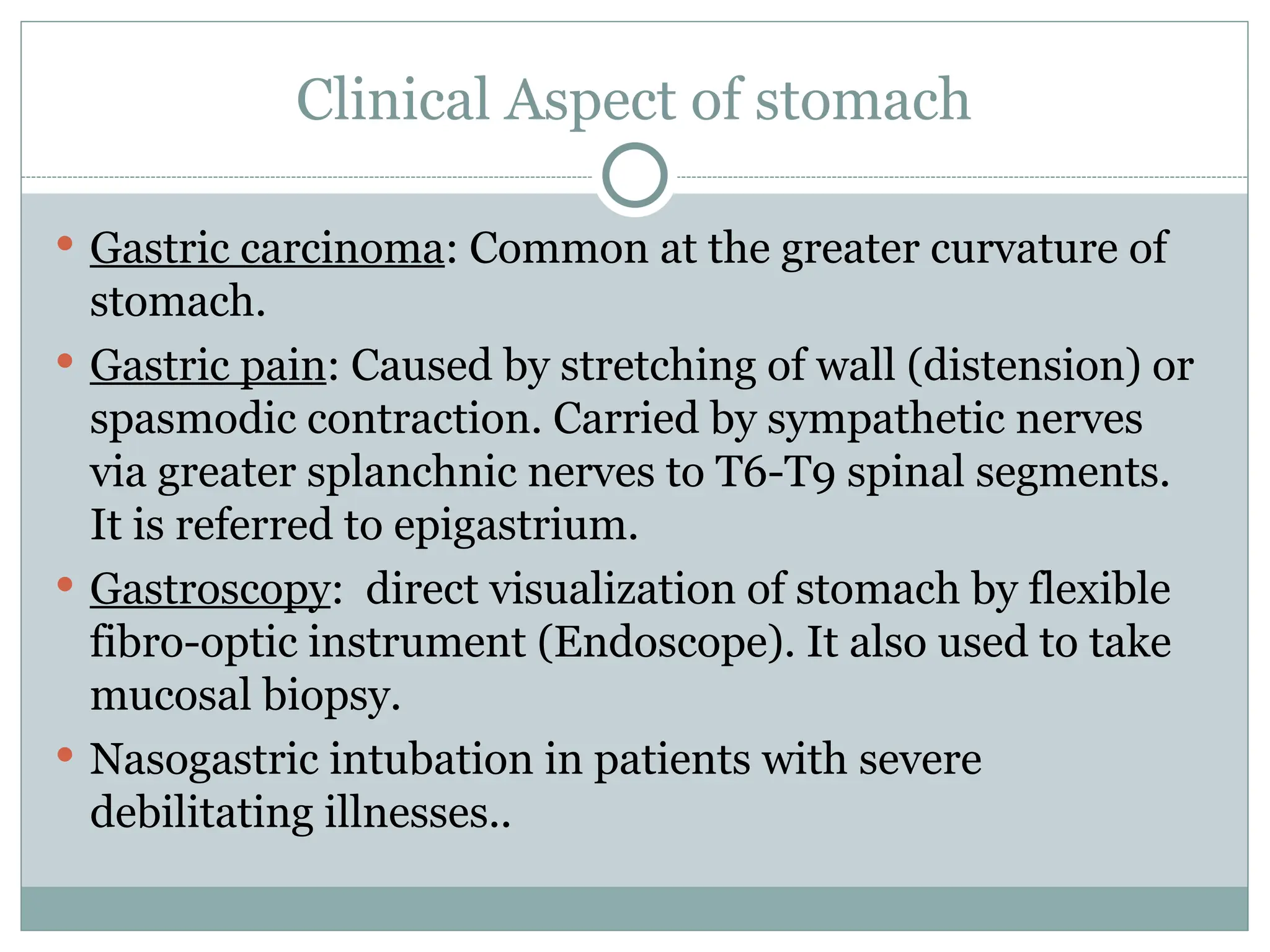
 Gastric carcinoma: Common at the greater curvature of
stomach.
 Gastric pain: Caused by stretching of wall (distension) or
spasmodic contraction. Carried by sympathetic nerves
via greater splanchnic nerves to T6-T9 spinal segments.
It is referred to epigastrium.
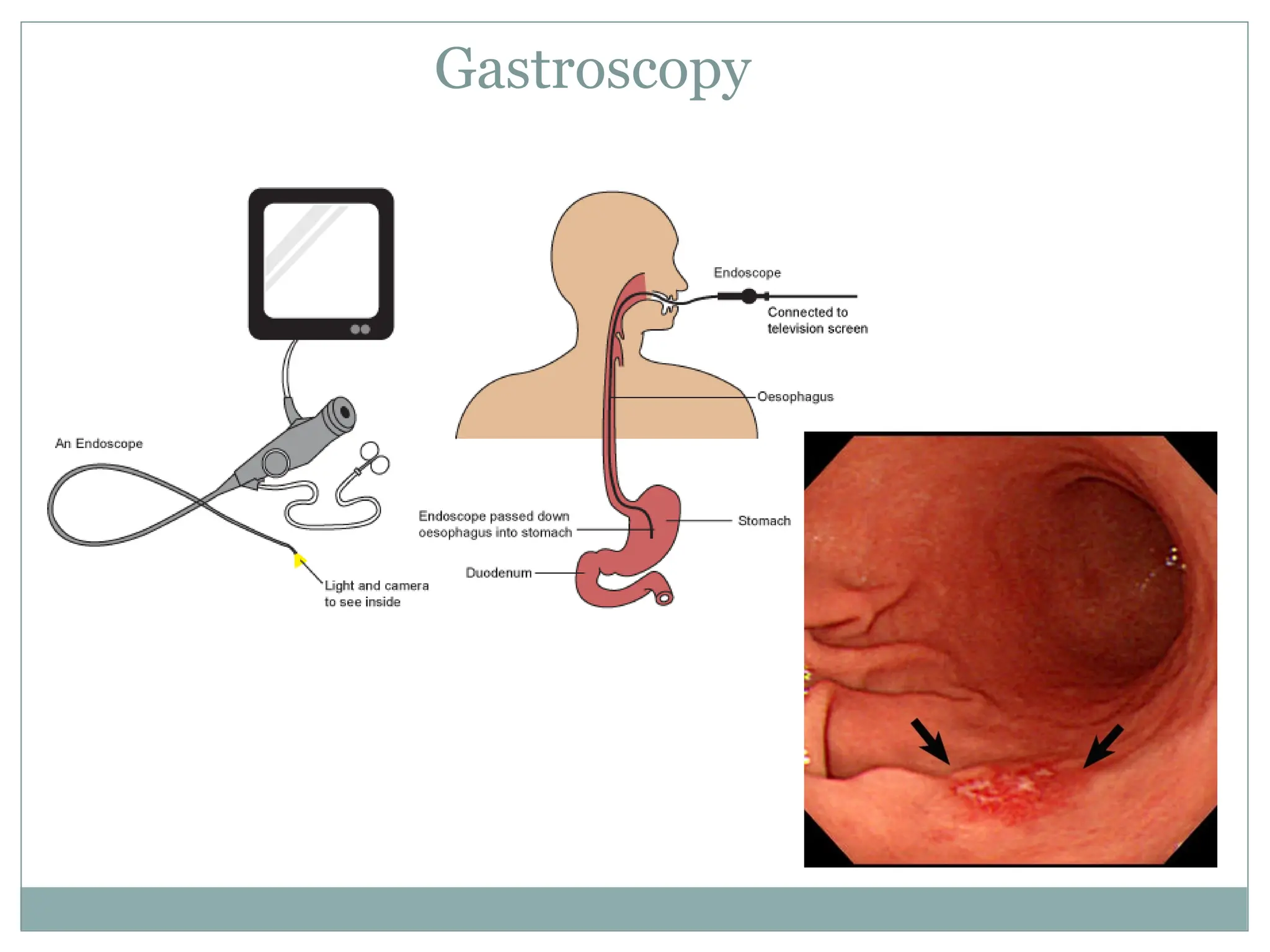
 Gastroscopy: direct visualization of stomach by flexible
fibro-optic instrument (Endoscope). It also used to take
mucosal biopsy.
 Nasogastric intubation in patients with severe
debilitating illnesses..
Gastroscopy
…..Thanks…..

lecture 4 ANATOMY OF esophagus-stomach.ppt

  • 1.
  • 2.
    General features  Theperitoneum is a thin serous membrane that line the walls of the abdominal and pelvic cavities and cover the organs within these cavities  Parietal peritoneum - lines the walls of the abdominal and pelvic cavities  Visceral peritoneum - covers the organs  Peritoneal cavity - the potential space between the parietal and visceral layer of peritoneum, in the male, is a closed sac, but in the female, there is a communication with the exterior through the uterine tubes, the uterus, and the vagina
  • 3.
    Functions Secretes a lubricating serous fluidthat continuously moistens the associated organs Absorb Support viscera
  • 4.
    The relationship betweenviscera and peritoneum Intraperitoneal viscera - viscera completely surrounded by peritoneum, example, stomach, superior part of duodenum, jejunum, ileum, cecum, vermiform appendix, transverse and sigmoid colons, spleen and ovary Interperitoneal viscera - most part of viscera surrounded by peritoneum, example, liver, gallbladder, ascending and descending colon, upper part of rectum, urinary bladder and uterus Retroperitoneal viscera - some organs lie on the posterior abdominal wall and are covered by peritoneum on their anterior surfaces only, example, kidney, suprarenal gland, pancreas, descending and horizontal parts of
  • 6.
    Structures which areformed by peritoneum Omentum - two-layered fold of peritoneum that extends from stomach to adjacent organs
  • 7.
    Lesser omentum - two-layeredfold of peritoneum which extends from porta hepatis to lesser curvature of stomach and superior part of duodenum  Hepatogastric ligament - extends from porta hepatis to lesser curvature of stomach  Hepatoduodenal ligament Extends from porta hepatis to superior part of duodenum  Contains common bile duct, proper hepatic a. and hepatic portal v.
  • 9.
    Abdominopelvic Regions  Umbilical Epigastric  Hypogastric  Right and left iliac or inguinal  Right and left lumbar  Right and left hypochondriac Figure 1.11a
  • 10.
    Organs of theAbdominopelvic Regions Figure 1.11b
  • 11.
    Abdominopelvic Quadrants  Rightupper (RUQ)  Left upper (LUQ)  Right lower (RLQ)  Left lower (LLQ) Figure 1.12
  • 12.
  • 13.
    Abdominal Part ofEsophagus  Esophagus enters in the abdomen through esophageal opening of diaphragm at T10 vertebral level.  It is related to:  Anteriorly : Left lobe of liver.  Posteriorly: Left crus of diaphragm.
  • 14.
    Blood supply andNerve supply of Abdominal Part of Esophagus  Blood supply:  Arterial supply: Left gastric artery from Coeliac trunk.  Venous drainage: Left gastric vein tributary of Portal vein  Lymphatic drainage: Left gastric and coeliac lymph nodes  Nerve Supply:  Parasympathetic: Vagus nerves  Sympathetic: Thoracic sympathetic chain
  • 15.
  • 16.
    Esophageal Constrictions  Esophagushas three constrictions: 1. At its upper end, where it joins the Pharynx. 2.Near its middle, where it is crossed by the arch of aorta and left main bronchus. 3.Near its lower end, where it pierces the diaphragm.  The approximate distances:  From the incisor teeth to these constrictions are 6,10 and 16 inches ( 15, 25 and 41 cms) respectively.  From the external nares to these constrictions are 7.2, 11.2 and 17.2 inches ( 18, 28 and 44 cms) respectively.
  • 18.
    Porto-systemic Venous Anastomosis The lower end of the esophagus is an important site of Porto-systemic anastomosis between the esophageal tributaries of the Azygos vein (Systemic) and the left gastric vein (Portal).  Importance:  In case of postal obstruction in cirrhosis of liver, Portal hypertension occurs. It results in dilatation of this anastomosis and forms esophageal varices.  These varicose veins (varices) may rupture and cause severe bleeding in the stomach and vomiting of blood known as Hematemesis.
  • 19.
  • 20.
    Achalasia of thecardia  It is failure of the function of gastroesophageal junction.  Cause unknown but associated with degeneration of parasympathetic plexus in the wall of esophagus.  It leads to dysphagia (difficulty in swallowing and regurgitation.  Later on it leads to distal narrowing and proximal dilatation of esophagus.
  • 21.
  • 22.
    Position and Shape Stomach is dilated part of GIT responsible for storage and mixing of food.  Position: Occupy Left hypochondrium, epigastrium and umbilical regions.  Shape:  In tall and thin persons: J-Shaped (Elongated vertically.  In short obese persons: Steer-horn shape (High and transversely placed)
  • 23.
  • 24.
  • 25.
    Features of stomach Ends (Openings):  Cardiac End (Opening): Upper end at the junction with the esophagus.  Pyloric End (Opening): Lower end at the junction with the first part of Duodenum.  Borders (Curvatures):  Lesser Curvature (Right Border): Extends from right side of cardiac end to pyloric end. It is concave. Its maximum concavity is known as Angular notch (Incisura angularis). It is attached to liver by lesser omentum.  Greater Curvature (Left Border): Extends from Left side of cardiac end, follow fundus of stomach to pyloric end. It is convex. It is attached to spleen by gastrosplenic ligament in upper part and to transverse colon by greater omentum in the rest of the part.
  • 28.
    Features of stomach Surfaces:  Anterior surface: Between lesser and greater curvature facing anteriorly.  Posterior surface: Between lesser and greater curvature facing posteriorly.
  • 29.
    Relations of Stomach Anterior Surface: covered by peritoneum of greater sac.  Related to:  Liver ( left lobe and quadrate lobe)  Spleen  Anterior abdominal wall  Diaphragm which separates stomach from left pleura
  • 30.
  • 31.
    Relations of Stomach Structures related to posterior surface also known as Stomach bed and separated by cavity of lesser sac)  Structures forming stomach bed (Posterior relations):  Left crus of diaphragm  Abdominal aorta  Body of pancreas  Left kidney and left suprarenal gland  Transverse colon and transverse mesocolon  Spleen (separated by cavity of greater sac)
  • 32.
    Divisions of stomach Stomach is divided into two portions by line extending from angular notch of lesser curvature to the bulge on the greater curvature.  Two portions are:  1. Cardiac portion  2. Pyloric portion  Cardiac portion is subdivided in to two parts by transverse line passing through cardiac end.  The two parts are:  The fundus: lies above the transverse line and dome shaped.  The body: between transverse line and line from angular notch.  Pyloric portion is subdivided in to two parts by constriction.  The two parts are:  The pyloric antrum: between line from angular notch to constriction.  The pyloric canal (pylorus): Terminal part. 1 inch long. In the wall contains circular muscle fibers which form pyloric sphincter.
  • 34.
    Structure of Stomach Mucous membrane: thick, vascular and thrown into folds known as Rugae. Space at the lesser curvature between prominent longitudinal fold is known as gastric canal.  Muscular wall: Formed by three layers:  Longitudinal: superficial layer  Circular layer: Middle layer. At pylorus forms pyloric sphincter.  Oblique: Innermost layer.
  • 36.
    Arterial Supply ofStomach  The stomach is a part of foregut. Hence it is supplied by branches of Coeliac artery , a branch of abdomonal aorta.  .
  • 37.
  • 38.
    Arterial Supply ofStomach 3. Short gastric arteries: branches of splenic artery (which is branch of Coeliac artery) at the hilum of spleen . Runs in gastrosplenic ligament and supplies fundus of stomach. 4. Left gastroepiploic artery: branch of splenic artery (which is branch of Coeliac artery ) near hilum of spleen. Runs in gastrospleninc ligament and supplies stomach along greater curvature. 5. Right gastroepiploic artery: branch from the gastroduodenal branch of hepatic artery (Which is branch from coeliac artery). Passes along greater curvature and supplies lower part of stomach along the greater curvature.
  • 39.
  • 40.
    Venous drainage ofstomach  There are 5 veins corresponding to arteries.  All drain into portal system as follows:  Left and right gastric veins into portal vein.  Short gastric and left gastroepiploic vein into splenic vein.  Right gastroepiploic vein into superior mesenteric vein.
  • 41.
  • 42.
    Lymphatic drainage ofstomach  Lymph vessels follow the arteries.  They terminate into right and left gastric and right and left gastroepiploic lymph nodes.  Efferents from these nodes drain into coeliac lymph nodes around the root if coeliac artery on posterior abdominal wall.
  • 43.
  • 44.
    Clinical Aspect ofstomach  Gastric ulcer: Most common site at Antrum close to lesser curvature.  Ulcer on posterior wall may perforate into the lesser sac and becomes adherent to the pancreas. Erosion of pancreas cause referred pain on back.  Erosion of splenic artery leads to hemorrahge.  Perforation of ulcer from anterior wall leads to leakage of contents of stomach in greater sac and cause peritonitis. It may adhere to liver.
  • 45.
    Gastric Ulcer: Erosionof mucosa Gastric Carcinoma: Abnormal growth of the mucosa Clinical Aspect of stomach
  • 46.
    Clinical Aspect ofstomach  Gastric carcinoma: Common at the greater curvature of stomach.  Gastric pain: Caused by stretching of wall (distension) or spasmodic contraction. Carried by sympathetic nerves via greater splanchnic nerves to T6-T9 spinal segments. It is referred to epigastrium.  Gastroscopy: direct visualization of stomach by flexible fibro-optic instrument (Endoscope). It also used to take mucosal biopsy.  Nasogastric intubation in patients with severe debilitating illnesses..
  • 47.
  • 48.