Gastric Anatomy & Physiology
Dr Ashish Tripathi
PGY 3, General Surgery
ASHISH TRIPATHI, RTIICS11/17/17
Anatomy
In adult life, stomach located T10 and
L3 vertebral segment
Can be divided into anatomic regions
based on external landmarks
4 regions
Cardia
Fundus
Corpus (body)
Antrum
ASHISH TRIPATHI, RTIICS11/17/17
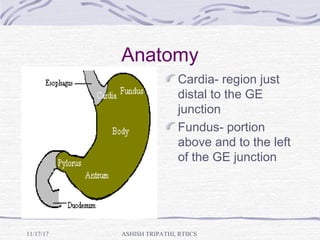
Anatomy
Cardia- region just
distal to the GE
junction
Fundus- portion
above and to the left
of the GE junction
ASHISH TRIPATHI, RTIICS11/17/17
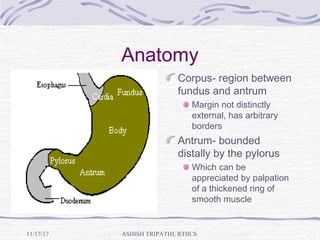
Anatomy
Corpus- region between
fundus and antrum
Margin not distinctly
external, has arbitrary
borders
Antrum- bounded
distally by the pylorus
Which can be
appreciated by palpation
of a thickened ring of
smooth muscle
ASHISH TRIPATHI, RTIICS11/17/17
Anatomy
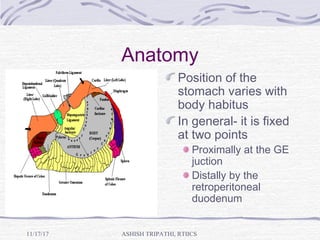
Position of the
stomach varies with
body habitus
In general- it is fixed
at two points
Proximally at the GE
juction
Distally by the
retroperitoneal
duodenum
ASHISH TRIPATHI, RTIICS11/17/17
Anatomy
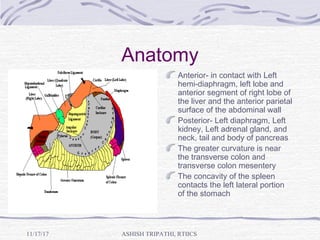
Anterior- in contact with Left
hemi-diaphragm, left lobe and
anterior segment of right lobe of
the liver and the anterior parietal
surface of the abdominal wall
Posterior- Left diaphragm, Left
kidney, Left adrenal gland, and
neck, tail and body of pancreas
The greater curvature is near
the transverse colon and
transverse colon mesentery
The concavity of the spleen
contacts the left lateral portion
of the stomach
ASHISH TRIPATHI, RTIICS11/17/17
11/17/17 ASHISH TRIPATHI, RTIICS
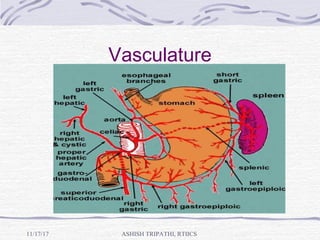
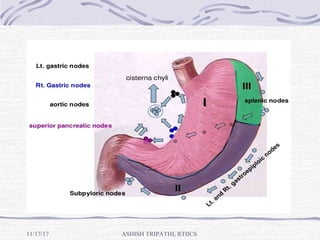
Vasculature
ASHISH TRIPATHI, RTIICS11/17/17
11/17/17 ASHISH TRIPATHI, RTIICS
Anatomy
Nerve Supply
Left and Right Vagus Nerves descend
parallel to the esophagus within the thorax
before forming a peri-esophageal plexus
between the tracheal bifurcation and the
diaphragm
From this plexus, two vagal trunks
coalesce before passing through the
esophageal hiatus of the diaphragm
ASHISH TRIPATHI, RTIICS11/17/17
Anatomy
Parasympathetic innervation of
Stomach- Vagus Nerve
90% of fiber in vagal trunk is afferent (info
transmitting from stomach to CNS)
Sympathetic innervation of Stomach-
Splanchnic Nerve
Derived from spinal segement T5-T10
ASHISH TRIPATHI, RTIICS11/17/17
Anatomy
Microscopic Anatomy
Glandular portions of stomach
Lined by simple columnar epithelium
This luminal surface is interrupted at intervals by gastric
pits
Opening into these gastric pits are one or more gastric
glands that have functional significance
Mucosa has three types of gastric glands
-Cardiac
-Oxyntic
-Antral
ASHISH TRIPATHI, RTIICS11/17/17
Microscopic Anatomy
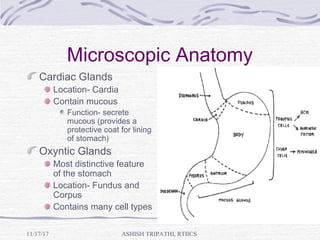
Cardiac Glands
Location- Cardia
Contain mucous
Function- secrete
mucous (provides a
protective coat for lining
of stomach)
Oxyntic Glands
Most distinctive feature
of the stomach
Location- Fundus and
Corpus
Contains many cell types
ASHISH TRIPATHI, RTIICS11/17/17
Microscopic Anatomy
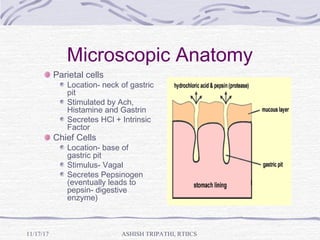
Parietal cells
Location- neck of gastric
pit
Stimulated by Ach,
Histamine and Gastrin
Secretes HCl + Intrinsic
Factor
Chief Cells
Location- base of
gastric pit
Stimulus- Vagal
Secretes Pepsinogen
(eventually leads to
pepsin- digestive
enzyme)
ASHISH TRIPATHI, RTIICS11/17/17
Microscopic Anatomy
Antral Glands
Gastrin cells
Location- mucosa of distal stomach
Stimulus- amino acids
Secretion- Gastrin (stimulates HCl production by way of
parietal cells)
Somatostatin
Location- mucosa of distal stomach + Duodenum
Stimulus- HCl or low pH in duodenum
Actions- Inhibits gastric emptying, Pancreatic secretions,
and gallbladder contraction
ASHISH TRIPATHI, RTIICS11/17/17
Physiology
The stomach contains a number of
biologically active peptides in nerves and
endocrine cells
Ex. Gastrin, somatostatin, vasoactive intestinal
peptide (VIP), substance P, and glucagon, etc
The two peptides of greatest importance to human
disease and clinical surgery are
Gastrin
Somatostatin
ASHISH TRIPATHI, RTIICS11/17/17
Physiology
Gastrin
Most important stimulus is a meal
amino acids that results from proteolysis
Fat and carbohydrates are not stimuli for gastrin
secretion
Gastric distention that occurs from a meal will stimulate
cholinergic neurons thereby releasing gastrin
Gastrin will then prompt Parietal cell to secrete HCl
Once Gastric distention diminishes, VIP-containing
neurons are activated causing stimulation of
somatostatin, thus attenuating Gastrin secretion
Overall, a lumen pH >3.0 will potentiate gastrin
release, whereas a pH <3.0 will inhibit its release
ASHISH TRIPATHI, RTIICS11/17/17
Physiology
Somatostain
Like Gastrin, plays an integral role in gastric
physiology
Also, used for important therapeutic applications in
treatment of digestive diseases
Main stimulus is a low or acidic (<3.0)luminal pH
Many peptides have shown to release somatostatin
Ex. Secretin, Cholecystokinin and gastrin
In contrast, stimulation of Vagal nerves along with
cholinergic neurons inhibit somatostatin
Overall, the most important gastric function of
somatostatin is to regulate acid secretion and
gastrin release
ASHISH TRIPATHI, RTIICS11/17/17
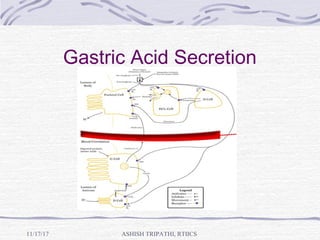
Gastric Acid Secretion
ASHISH TRIPATHI, RTIICS11/17/17
Gastric Acid Secretion
Basolateral membrane of the parietal cell
contains specific receptors for the three major
stimulants of acid production
Histamine
Gastrin
Acetylcholine
Each stimulant has its own 2nd
messenger
system which allows for stimulation of the
parietal cell
ASHISH TRIPATHI, RTIICS11/17/17
Gastric Acid Secretion
Humans normally secrete 2 to 5 mEq/h of HCl
in the fasting state, constituting basal acid
secretion
Both Vagal tone and ambient Histamine secretion
are presumed to regulate basal acid secretion
Gastrin is not thought to play a role in basal acid
secretion
Therefore, a Vagotomy or use of H2 blockers (ex.
Cimetidine) will decrease basal acid production
ASHISH TRIPATHI, RTIICS11/17/17
Gastric Acid Secretion
Stimulated acid secretion begins with
Cephalic phase
Thought, sight or smell of food stimulates acid
secretion
Mediated by Vagal stimulation
Vagal discharge
Directs the cholinergic mechanism for stimulation
Can be inhibited by Atropine (anticholinergic)
Inhibits release of somatostatin
Vagal effects inhibit tonic inhibition that is
provided by somatostatin
ASHISH TRIPATHI, RTIICS11/17/17
Gastric Acid Secretion
Gastric Phase
Begins when food enters the stomach
The following are responsible for stimulation of acid
secretion
Presence of partially hydrolyzed food constituents
Gastric distention
Gastrin is the most important mediator of this phase
Ends when Antral muscosa is exposed to acid
When luminal pH is <2.0 in the antrum, gastrin release
stops
Somatostatin release is increased
Entry of digestive products into the intestine begins the
intestinal-phase inhibition of gastric acid secretion
ASHISH TRIPATHI, RTIICS11/17/17
Gastric Acid Secretion
Intestinal Phase
Also, releases HCl by way of Gastrin
Releases secretin to inhibit Gastrin
which ultimately decreases Acid
production
ASHISH TRIPATHI, RTIICS11/17/17
Other Factors
Pepsin
Secreted from gastric chief cells
Contributes to the overall coordination of
the digestive process
Main function is to initiate protein digestion,
usually is incomplete
Partially hydrolyzed protein by pepsin are
important signals for release of
Gastrin
Cholecystokinin
ASHISH TRIPATHI, RTIICS11/17/17
Other Factors
Intrinsic Factor (IF)
Located in the parietal cells (oxyntic gland)
Main function is to absorb cobalamin
(Vitamin B12) form ileal mucosa and then
transported to the liver
Secretion of IF is similar to acid secretion
stimulated
Ach
Histamine
Gastrin
ASHISH TRIPATHI, RTIICS11/17/17
Other Factors
Bicarbonate
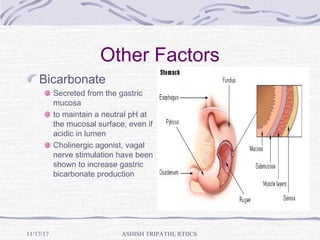
Secreted from the gastric
mucosa
to maintain a neutral pH at
the mucosal surface, even if
acidic in lumen
Cholinergic agonist, vagal
nerve stimulation have been
shown to increase gastric
bicarbonate production
ASHISH TRIPATHI, RTIICS11/17/17
Gastric Motility
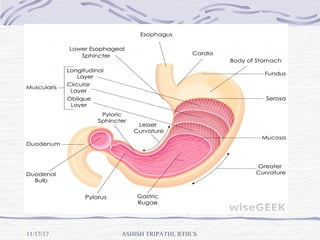
To understand gastric motility the stomach is divided
into two functional terms as two different regions
which have distinctive smooth muscle
Proximal 1/3
3 layers of smooth muscle
Outer longitudinal
Middle Circular
Inner Oblique
Distal 2/3
Only a distinctive outer longitudinal layer
Gastric smooth muscle ends at the pylorus, a septum
of connective tissue marks the change from pylorus
to the duodenum
ASHISH TRIPATHI, RTIICS11/17/17
Gastric Motility
Proximal 1/3
Have prolonged and tonic gastric contractions
No action potentials or pacesetter
Thus no peristalsis
Distal 2/3
In general, gastric smooth muscle exhibit
myoelectric activity based on a highly regular
pattern, called slow waves
Slow waves set a maximum rate at which contrations
can occur (3 contractions/min); they do not cause
contractions
ASHISH TRIPATHI, RTIICS11/17/17
Thanks You
11/17/17 ASHISH TRIPATHI, RTIICS

Stomach anatomy and physiology

  • 1.
    Gastric Anatomy &Physiology Dr Ashish Tripathi PGY 3, General Surgery ASHISH TRIPATHI, RTIICS11/17/17
  • 2.
    Anatomy In adult life,stomach located T10 and L3 vertebral segment Can be divided into anatomic regions based on external landmarks 4 regions Cardia Fundus Corpus (body) Antrum ASHISH TRIPATHI, RTIICS11/17/17
  • 3.
    Anatomy Cardia- region just distalto the GE junction Fundus- portion above and to the left of the GE junction ASHISH TRIPATHI, RTIICS11/17/17
  • 4.
    Anatomy Corpus- region between fundusand antrum Margin not distinctly external, has arbitrary borders Antrum- bounded distally by the pylorus Which can be appreciated by palpation of a thickened ring of smooth muscle ASHISH TRIPATHI, RTIICS11/17/17
  • 5.
    Anatomy Position of the stomachvaries with body habitus In general- it is fixed at two points Proximally at the GE juction Distally by the retroperitoneal duodenum ASHISH TRIPATHI, RTIICS11/17/17
  • 6.
    Anatomy Anterior- in contactwith Left hemi-diaphragm, left lobe and anterior segment of right lobe of the liver and the anterior parietal surface of the abdominal wall Posterior- Left diaphragm, Left kidney, Left adrenal gland, and neck, tail and body of pancreas The greater curvature is near the transverse colon and transverse colon mesentery The concavity of the spleen contacts the left lateral portion of the stomach ASHISH TRIPATHI, RTIICS11/17/17
  • 7.
  • 8.
  • 9.
  • 10.
    Anatomy Nerve Supply Left andRight Vagus Nerves descend parallel to the esophagus within the thorax before forming a peri-esophageal plexus between the tracheal bifurcation and the diaphragm From this plexus, two vagal trunks coalesce before passing through the esophageal hiatus of the diaphragm ASHISH TRIPATHI, RTIICS11/17/17
  • 11.
    Anatomy Parasympathetic innervation of Stomach-Vagus Nerve 90% of fiber in vagal trunk is afferent (info transmitting from stomach to CNS) Sympathetic innervation of Stomach- Splanchnic Nerve Derived from spinal segement T5-T10 ASHISH TRIPATHI, RTIICS11/17/17
  • 12.
    Anatomy Microscopic Anatomy Glandular portionsof stomach Lined by simple columnar epithelium This luminal surface is interrupted at intervals by gastric pits Opening into these gastric pits are one or more gastric glands that have functional significance Mucosa has three types of gastric glands -Cardiac -Oxyntic -Antral ASHISH TRIPATHI, RTIICS11/17/17
  • 13.
    Microscopic Anatomy Cardiac Glands Location-Cardia Contain mucous Function- secrete mucous (provides a protective coat for lining of stomach) Oxyntic Glands Most distinctive feature of the stomach Location- Fundus and Corpus Contains many cell types ASHISH TRIPATHI, RTIICS11/17/17
  • 14.
    Microscopic Anatomy Parietal cells Location-neck of gastric pit Stimulated by Ach, Histamine and Gastrin Secretes HCl + Intrinsic Factor Chief Cells Location- base of gastric pit Stimulus- Vagal Secretes Pepsinogen (eventually leads to pepsin- digestive enzyme) ASHISH TRIPATHI, RTIICS11/17/17
  • 15.
    Microscopic Anatomy Antral Glands Gastrincells Location- mucosa of distal stomach Stimulus- amino acids Secretion- Gastrin (stimulates HCl production by way of parietal cells) Somatostatin Location- mucosa of distal stomach + Duodenum Stimulus- HCl or low pH in duodenum Actions- Inhibits gastric emptying, Pancreatic secretions, and gallbladder contraction ASHISH TRIPATHI, RTIICS11/17/17
  • 16.
    Physiology The stomach containsa number of biologically active peptides in nerves and endocrine cells Ex. Gastrin, somatostatin, vasoactive intestinal peptide (VIP), substance P, and glucagon, etc The two peptides of greatest importance to human disease and clinical surgery are Gastrin Somatostatin ASHISH TRIPATHI, RTIICS11/17/17
  • 17.
    Physiology Gastrin Most important stimulusis a meal amino acids that results from proteolysis Fat and carbohydrates are not stimuli for gastrin secretion Gastric distention that occurs from a meal will stimulate cholinergic neurons thereby releasing gastrin Gastrin will then prompt Parietal cell to secrete HCl Once Gastric distention diminishes, VIP-containing neurons are activated causing stimulation of somatostatin, thus attenuating Gastrin secretion Overall, a lumen pH >3.0 will potentiate gastrin release, whereas a pH <3.0 will inhibit its release ASHISH TRIPATHI, RTIICS11/17/17
  • 18.
    Physiology Somatostain Like Gastrin, playsan integral role in gastric physiology Also, used for important therapeutic applications in treatment of digestive diseases Main stimulus is a low or acidic (<3.0)luminal pH Many peptides have shown to release somatostatin Ex. Secretin, Cholecystokinin and gastrin In contrast, stimulation of Vagal nerves along with cholinergic neurons inhibit somatostatin Overall, the most important gastric function of somatostatin is to regulate acid secretion and gastrin release ASHISH TRIPATHI, RTIICS11/17/17
  • 19.
    Gastric Acid Secretion ASHISHTRIPATHI, RTIICS11/17/17
  • 20.
    Gastric Acid Secretion Basolateralmembrane of the parietal cell contains specific receptors for the three major stimulants of acid production Histamine Gastrin Acetylcholine Each stimulant has its own 2nd messenger system which allows for stimulation of the parietal cell ASHISH TRIPATHI, RTIICS11/17/17
  • 21.
    Gastric Acid Secretion Humansnormally secrete 2 to 5 mEq/h of HCl in the fasting state, constituting basal acid secretion Both Vagal tone and ambient Histamine secretion are presumed to regulate basal acid secretion Gastrin is not thought to play a role in basal acid secretion Therefore, a Vagotomy or use of H2 blockers (ex. Cimetidine) will decrease basal acid production ASHISH TRIPATHI, RTIICS11/17/17
  • 22.
    Gastric Acid Secretion Stimulatedacid secretion begins with Cephalic phase Thought, sight or smell of food stimulates acid secretion Mediated by Vagal stimulation Vagal discharge Directs the cholinergic mechanism for stimulation Can be inhibited by Atropine (anticholinergic) Inhibits release of somatostatin Vagal effects inhibit tonic inhibition that is provided by somatostatin ASHISH TRIPATHI, RTIICS11/17/17
  • 23.
    Gastric Acid Secretion GastricPhase Begins when food enters the stomach The following are responsible for stimulation of acid secretion Presence of partially hydrolyzed food constituents Gastric distention Gastrin is the most important mediator of this phase Ends when Antral muscosa is exposed to acid When luminal pH is <2.0 in the antrum, gastrin release stops Somatostatin release is increased Entry of digestive products into the intestine begins the intestinal-phase inhibition of gastric acid secretion ASHISH TRIPATHI, RTIICS11/17/17
  • 24.
    Gastric Acid Secretion IntestinalPhase Also, releases HCl by way of Gastrin Releases secretin to inhibit Gastrin which ultimately decreases Acid production ASHISH TRIPATHI, RTIICS11/17/17
  • 25.
    Other Factors Pepsin Secreted fromgastric chief cells Contributes to the overall coordination of the digestive process Main function is to initiate protein digestion, usually is incomplete Partially hydrolyzed protein by pepsin are important signals for release of Gastrin Cholecystokinin ASHISH TRIPATHI, RTIICS11/17/17
  • 26.
    Other Factors Intrinsic Factor(IF) Located in the parietal cells (oxyntic gland) Main function is to absorb cobalamin (Vitamin B12) form ileal mucosa and then transported to the liver Secretion of IF is similar to acid secretion stimulated Ach Histamine Gastrin ASHISH TRIPATHI, RTIICS11/17/17
  • 27.
    Other Factors Bicarbonate Secreted fromthe gastric mucosa to maintain a neutral pH at the mucosal surface, even if acidic in lumen Cholinergic agonist, vagal nerve stimulation have been shown to increase gastric bicarbonate production ASHISH TRIPATHI, RTIICS11/17/17
  • 28.
    Gastric Motility To understandgastric motility the stomach is divided into two functional terms as two different regions which have distinctive smooth muscle Proximal 1/3 3 layers of smooth muscle Outer longitudinal Middle Circular Inner Oblique Distal 2/3 Only a distinctive outer longitudinal layer Gastric smooth muscle ends at the pylorus, a septum of connective tissue marks the change from pylorus to the duodenum ASHISH TRIPATHI, RTIICS11/17/17
  • 29.
    Gastric Motility Proximal 1/3 Haveprolonged and tonic gastric contractions No action potentials or pacesetter Thus no peristalsis Distal 2/3 In general, gastric smooth muscle exhibit myoelectric activity based on a highly regular pattern, called slow waves Slow waves set a maximum rate at which contrations can occur (3 contractions/min); they do not cause contractions ASHISH TRIPATHI, RTIICS11/17/17
  • 30.