PRODUCTION ANALYSIS
TOTAL PRODUCT The total quantity of goods produced by a firm( or a factor) during a specified period of time is called its “Total Production”
MARGINAL PRODUCT AVERAGE PRODUCT Average Product = Total Product/Number of units of variables factor
LAW OF VARIABLE PROPORTIONS
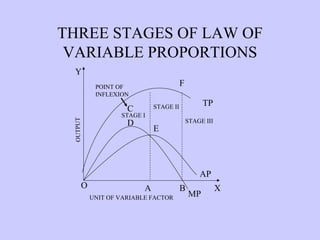
THREE STAGES OF LAW OF VARIABLE PROPORTIONS O Y X B A MP AP TP C E D F POINT OF  INFLEXION STAGE III STAGE II STAGE I UNIT OF VARIABLE FACTOR OUTPUT
CAUSES FOR INCRESING RETURNS Indivisibility Specialization
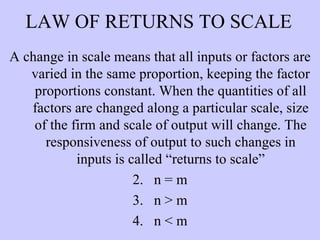
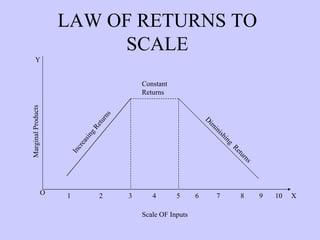
LAW OF RETURNS TO SCALE A change in scale means that all inputs or factors are varied in the same proportion, keeping the factor proportions constant. When the quantities of all factors are changed along a particular scale, size of the firm and scale of output will change. The responsiveness of output to such changes in inputs is called “returns to scale” n = m n > m n < m
LAW OF RETURNS TO SCALE Constant  Returns Increasing Returns Diminishing  Returns O Scale OF Inputs 5 6 7 8 9 10 1 2 3 4 Marginal Products Y X
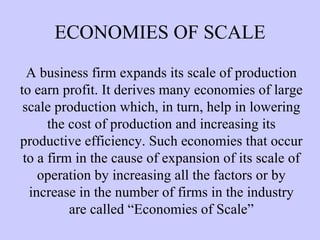
ECONOMIES OF SCALE A business firm expands its scale of production to earn profit. It derives many economies of large scale production which, in turn, help in lowering the cost of production and increasing its productive efficiency. Such economies that occur to a firm in the cause of expansion of its scale of operation by increasing all the factors or by increase in the number of firms in the industry are called “Economies of Scale”
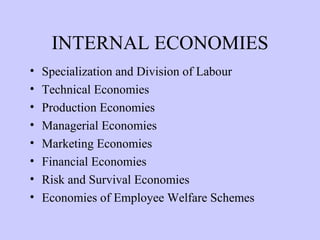
INTERNAL ECONOMIES Specialization and Division of Labour Technical Economies Production Economies Managerial Economies Marketing Economies Financial Economies Risk and Survival Economies Economies of Employee Welfare Schemes
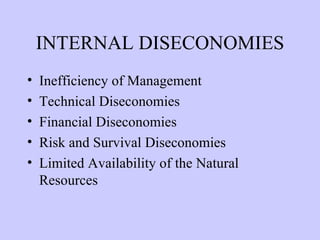
INTERNAL DISECONOMIES Inefficiency of Management Technical Diseconomies Financial Diseconomies Risk and Survival Diseconomies Limited Availability of the Natural Resources
EXTERNAL ECONOMIES AND (DISECONOMIES) When many firms expand in a particular area, each member firm secures a number of economies advantages, which are known as “External Economies” . These advantages are generated outside the firm. These advantages will arise, whether the industry consists of a few large firms or many small firms.
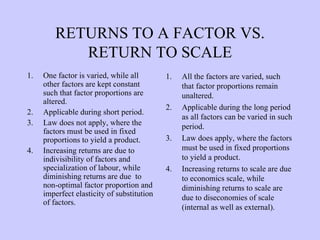
RETURNS TO A FACTOR VS. RETURN TO SCALE One factor is varied, while all other factors are kept constant such that factor proportions are altered. Applicable during short period. Law does not apply, where the factors must be used in fixed proportions to yield a product. Increasing returns are due to indivisibility of factors and specialization of labour, while diminishing returns are due  to non-optimal factor proportion and imperfect elasticity of substitution of factors. All the factors are varied, such that factor proportions remain unaltered. Applicable during the long period as all factors can be varied in such period. Law does apply, where the factors must be used in fixed proportions to yield a product. Increasing returns to scale are due to economics scale, while diminishing returns to scale are due to diseconomies of scale (internal as well as external).
RETURNS TO SCALE AND ISOQUANTS
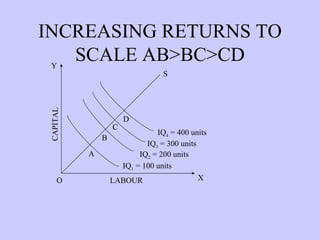
INCREASING RETURNS TO SCALE AB>BC>CD IQ 1  = 100 units IQ 2  = 200 units IQ 3  = 300 units IQ 4  = 400 units CAPITAL O A X Y S D C B LABOUR
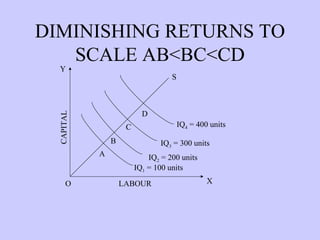
DIMINISHING RETURNS TO SCALE AB<BC<CD IQ 1  = 100 units IQ 2  = 200 units IQ 3  = 300 units IQ 4  = 400 units CAPITAL O A X Y S D C B LABOUR
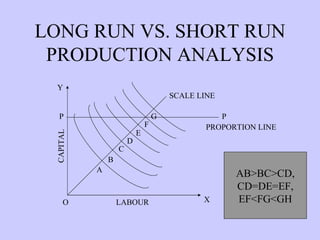
LONG RUN VS. SHORT RUN PRODUCTION ANALYSIS AB>BC>CD, CD=DE=EF, EF<FG<GH CAPITAL O A X Y SCALE LINE D C B LABOUR E F G P P PROPORTION LINE

Production analysis 3

  • 1.
  • 2.
    TOTAL PRODUCT Thetotal quantity of goods produced by a firm( or a factor) during a specified period of time is called its “Total Production”
  • 3.
    MARGINAL PRODUCT AVERAGEPRODUCT Average Product = Total Product/Number of units of variables factor
  • 4.
    LAW OF VARIABLEPROPORTIONS
  • 5.
    THREE STAGES OFLAW OF VARIABLE PROPORTIONS O Y X B A MP AP TP C E D F POINT OF INFLEXION STAGE III STAGE II STAGE I UNIT OF VARIABLE FACTOR OUTPUT
  • 6.
    CAUSES FOR INCRESINGRETURNS Indivisibility Specialization
  • 7.
    LAW OF RETURNSTO SCALE A change in scale means that all inputs or factors are varied in the same proportion, keeping the factor proportions constant. When the quantities of all factors are changed along a particular scale, size of the firm and scale of output will change. The responsiveness of output to such changes in inputs is called “returns to scale” n = m n > m n < m
  • 8.
    LAW OF RETURNSTO SCALE Constant Returns Increasing Returns Diminishing Returns O Scale OF Inputs 5 6 7 8 9 10 1 2 3 4 Marginal Products Y X
  • 9.
    ECONOMIES OF SCALEA business firm expands its scale of production to earn profit. It derives many economies of large scale production which, in turn, help in lowering the cost of production and increasing its productive efficiency. Such economies that occur to a firm in the cause of expansion of its scale of operation by increasing all the factors or by increase in the number of firms in the industry are called “Economies of Scale”
  • 10.
    INTERNAL ECONOMIES Specializationand Division of Labour Technical Economies Production Economies Managerial Economies Marketing Economies Financial Economies Risk and Survival Economies Economies of Employee Welfare Schemes
  • 11.
    INTERNAL DISECONOMIES Inefficiencyof Management Technical Diseconomies Financial Diseconomies Risk and Survival Diseconomies Limited Availability of the Natural Resources
  • 12.
    EXTERNAL ECONOMIES AND(DISECONOMIES) When many firms expand in a particular area, each member firm secures a number of economies advantages, which are known as “External Economies” . These advantages are generated outside the firm. These advantages will arise, whether the industry consists of a few large firms or many small firms.
  • 13.
    RETURNS TO AFACTOR VS. RETURN TO SCALE One factor is varied, while all other factors are kept constant such that factor proportions are altered. Applicable during short period. Law does not apply, where the factors must be used in fixed proportions to yield a product. Increasing returns are due to indivisibility of factors and specialization of labour, while diminishing returns are due to non-optimal factor proportion and imperfect elasticity of substitution of factors. All the factors are varied, such that factor proportions remain unaltered. Applicable during the long period as all factors can be varied in such period. Law does apply, where the factors must be used in fixed proportions to yield a product. Increasing returns to scale are due to economics scale, while diminishing returns to scale are due to diseconomies of scale (internal as well as external).
  • 14.
    RETURNS TO SCALEAND ISOQUANTS
  • 15.
    INCREASING RETURNS TOSCALE AB>BC>CD IQ 1 = 100 units IQ 2 = 200 units IQ 3 = 300 units IQ 4 = 400 units CAPITAL O A X Y S D C B LABOUR
  • 16.
    DIMINISHING RETURNS TOSCALE AB<BC<CD IQ 1 = 100 units IQ 2 = 200 units IQ 3 = 300 units IQ 4 = 400 units CAPITAL O A X Y S D C B LABOUR
  • 17.
    LONG RUN VS.SHORT RUN PRODUCTION ANALYSIS AB>BC>CD, CD=DE=EF, EF<FG<GH CAPITAL O A X Y SCALE LINE D C B LABOUR E F G P P PROPORTION LINE