Chapter 7
Inflation, Yield Curves, and
Duration
Introduction
 Are the differences in interest rates on
U.S. Treasury bills, Treasury bonds,
municipal bonds, corporate bonds,
personal loans, etc. purely random?
 Understanding the factors that cause
interest rates to differ is an
indispensable aid to the investor and
saver in choosing financial assets for a
portfolio.
7-2
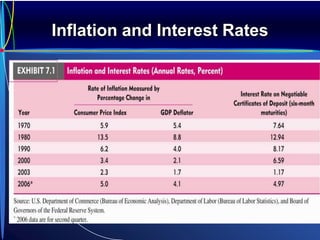
Inflation and Interest Rates
 Inflation is the percentage increase in
the average price level for all goods
and services
7-3
Inflation and Interest Rates
Correlation in recent years between
the rate of inflation in the U.S. and
interest rates appear to be fairly
strong.
Figure shows 2 popular measure of
Inflation – Consumer Price Index, and
GNP Deflator and Interest rate in
Negotiable certificate of Deposit.
Inflation and Interest Rates
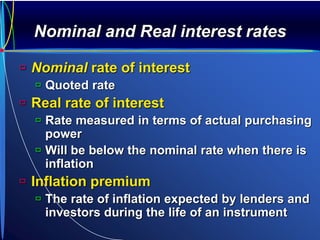
Nominal and Real interest rates
 Nominal rate of interest
 Quoted rate
 Real rate of interest
 Rate measured in terms of actual purchasing
power
 Will be below the nominal rate when there is
inflation
 Inflation premium
 The rate of inflation expected by lenders and
investors during the life of an instrument
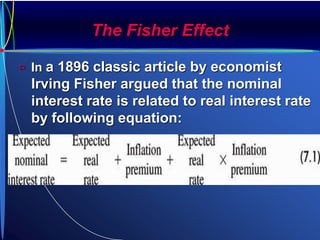
The Fisher Effect
 In a 1896 classic article by economist
Irving Fisher argued that the nominal
interest rate is related to real interest rate
by following equation:
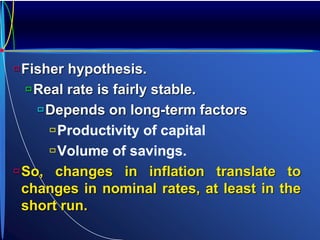
Fisher hypothesis.
Real rate is fairly stable.
Depends on long-term factors
Productivity of capital
Volume of savings.
So, changes in inflation translate to
changes in nominal rates, at least in the
short run.
It suggests a method of judging the
direction of future interest rate
changes.
 To the extent that a rise in the actual
rate of inflation causes the investors
to expect greater inflation in future,
higher nominal interest rate will soon
result and vice versa.
The Harrod-Keynes Effect of inflation
 Developed by British Economist Sir Ray
Harrod.
 Based upon Keynesian liquidity preference
theory of interest rate.
 Argues that the expected nominal interest
rate is the same regardless of inflationary
expectations
 Unless inflation affects money demand or supply
A rise in inflationary expectations will
lower the real rate of interest
In liquidity preference theory, real rate
measures the inflation adjusted return
on bonds.
However, conventional bonds like
money are not a hedge against inflation
as their rate of return is fixed by
contract.
Therefore, rise in inflation lowers
investors’ expected real return from
holding bonds.
If the nominal rate of return on bonds
remain unchanged, the expected real
rate must be squeezed by
expectations of rising prices.
2 other groups of assets in the
economy act as hedge hedge
instruments like common stocks and
real estate.
Proponents of Harrod-Keynes view
argued that an increase in the rate of
inflation causes the demand for them
to rise as well.
Real estate and stock price rise and
their nominal rates of return fall until
an equilibrium set of returns on
bonds, stocks, real estate and other
assets is achieved.
Anticipated versus Unanticipated
inflation
 Fisher effect had a major drawback
 It failed to distinguish between
anticipated (or expected) and
unanticipated (or unexpected) inflation
 Fisher assumes all inflation
anticipated
 There is no way to be certain about
what the equilibrium nominal interest
rate will be if this is violated
Lenders set rates based on anticipated
inflation
 Anticipated over life of loan
 Based on desired real rate
Unanticipated inflation
 Impacts the real rate of outstanding fixed-
income securities
 Impacts the nominal rate of other securities
 Non-fixed-income securities
 New issuances of fixed-income securities
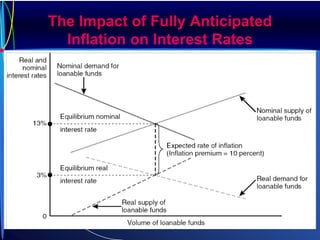
The Impact of Fully Anticipated
Inflation on Interest Rates
The
Inflation-
Caused
Wealth
Effect
The
Inflation-
Caused
Income
Effect
The Inflation-
Caused
Depreciation
Effect
Conclusions
 The inflation-nominal interest rate
relationship appears to be positive:
higher rates of inflation mostly lead to
higher nominal interest rates
 However, nominal interest rates tend to
change by less than the expected
change in the inflation rate
 Note that, this topic is plagued by
numerous measurement problems
Relationship between Inflation and
Stock Prices
 There are several conflicting arguments
on the inflation-stock price relationship
 Conventional wisdom says it is +ve.
 Common stock is widely viewed as a
hedge against inflation.
 One way to view the issue is to decide
what factors determine price of corporate
stock and see if this factors are likely to
be affected by inflation.

 Stock Valuation Formula……
 Research shows conflicting view…
Fully anticipated inflation adjusts
nominal returns but not real returns.
Nominal stock price may rise but not
the real stock price.
If inflation is only partly expected, but
expected to continue
 Shareholders may capture unexpected
inflation, as opposed to debt-holder, in
the form of increased earnings and the
real stock price will rise.

Impact of Depreciation Effect
 More rapid inflation tend to lower
stock price
 Study by Ammer (1994), Solnik (1983)
and others find a negative
relationship in several countries.
Inflation and Stock Prices
Another View Regarding Nominal
Contracts.
Another argument suggested that the
impact will vary
 From firm to firm
 From industry to industry
 Depending on the actual inflation
rate and the terms of existing
nominal contracts
Proxy effect
Fama (1981), Gaske and Roll (1983)
Negative relation between inflation
and stock prices
Relationship is spurious not real
Happens because of
 Decline in expected output in the
economy
 Monetary Policy of Govt.
Yield Curve and Term Structure of
Interest Rate.
The relationship between the
rates of return (yields) on
financial instruments and their
maturity is called Term Structure
of Interest Rate.
And graphical representation is
Yield Curve.
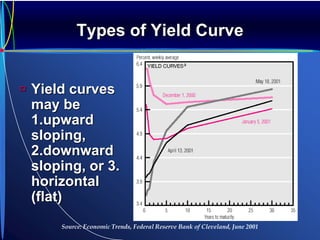
Source: Economic Trends, Federal Reserve Bank of Cleveland, June 2001
Types of Yield Curve
 Yield curves
may be
1.upward
sloping,
2.downward
sloping, or 3.
horizontal
(flat)
Unbiased Expectations hypothesis
 The unbiased expectations hypothesis
argues that investor expectations
regarding future changes in short-term
rates determine the shape of the curve.
 If the hypothesis is true, the yield curve is
an important forecasting tool, because, it
suggests the direction of future
movements in short term interest rate as
viewed by financial market today.
Assumptions
Investors are profit maximizes over
their planned holding period.
Have No maturity Preference.
No transaction cost.
All securities in a given risk class,
regardless of maturity are perfect
substitute for each other.
 Investors are risk neutral.
 Profit maximizing behavior on the part of
thousand of investors interacting in the
marketplace ensure that HPY on all
securities move towards equality.
 Once equilibrium is achieved, assuming no
Transaction Cost, the investors should
earn same yield from buying a long term
security as from purchasing a series of
short term securities whose combined
maturities equal that of Long Term
security.
If the rate of return on LT securities
rise above or falls below the return
the investors expect to receive from
buying or selling several short term
securities , forces are quickly set in
motion to restore equilibrium.
Investors at the margin will practice
arbitrage until LT yields balance with
ST yields.
The Role of Expectations in Shaping
Yield Curve.
How can a factor as intangible
as expectations determine the
shape of Yield Curve??
Policy Implication of Unbiased
Expectations Hypothesis.
Implies that changes in the relative
amounts of long term Vs short term
securities do not influence the shape
of Yield Curve unless investor
expectations also are affected.
Example…………………………..
US Treasury Bond decided to
refinance $ 100 b of its maturing
short term IOUs by issuing $ 100 b
long term bonds.
Would this action of GOVT affect
Shape of Yield Curve?
The supply of Long-term bonds
would be significantly increased,
while the supply of short term
securities would be reduced.
However, according to UEH, yield
curve itself would not be changed
unless investors altered their
expectations about future course of
short term interest rates.
Uses of the Yield Curve
 Forecasting interest rates – a downward-sloping
yield curve suggests near-term declines in rates
 Identifying portfolio management strategies – a
rising yield curve favors short-term borrowing and
long-term lending.
 Detecting over- and under-priced financial assets
 Indicating trade-offs between maturity and yield
 “Riding” the yield curve – active investors may
gain by timely portfolio switching.
Duration: A Different Approach to
Maturity.

The Price
Elasticity of
a Debt
Security

Inflation Yield Curve and duration.ppt

  • 1.
    Chapter 7 Inflation, YieldCurves, and Duration
  • 2.
    Introduction  Are thedifferences in interest rates on U.S. Treasury bills, Treasury bonds, municipal bonds, corporate bonds, personal loans, etc. purely random?  Understanding the factors that cause interest rates to differ is an indispensable aid to the investor and saver in choosing financial assets for a portfolio. 7-2
  • 3.
    Inflation and InterestRates  Inflation is the percentage increase in the average price level for all goods and services 7-3
  • 4.
    Inflation and InterestRates Correlation in recent years between the rate of inflation in the U.S. and interest rates appear to be fairly strong. Figure shows 2 popular measure of Inflation – Consumer Price Index, and GNP Deflator and Interest rate in Negotiable certificate of Deposit.
  • 5.
  • 6.
    Nominal and Realinterest rates  Nominal rate of interest  Quoted rate  Real rate of interest  Rate measured in terms of actual purchasing power  Will be below the nominal rate when there is inflation  Inflation premium  The rate of inflation expected by lenders and investors during the life of an instrument
  • 7.
    The Fisher Effect In a 1896 classic article by economist Irving Fisher argued that the nominal interest rate is related to real interest rate by following equation:
  • 8.
    Fisher hypothesis. Real rateis fairly stable. Depends on long-term factors Productivity of capital Volume of savings. So, changes in inflation translate to changes in nominal rates, at least in the short run.
  • 9.
    It suggests amethod of judging the direction of future interest rate changes.  To the extent that a rise in the actual rate of inflation causes the investors to expect greater inflation in future, higher nominal interest rate will soon result and vice versa.
  • 10.
    The Harrod-Keynes Effectof inflation  Developed by British Economist Sir Ray Harrod.  Based upon Keynesian liquidity preference theory of interest rate.  Argues that the expected nominal interest rate is the same regardless of inflationary expectations  Unless inflation affects money demand or supply
  • 11.
    A rise ininflationary expectations will lower the real rate of interest In liquidity preference theory, real rate measures the inflation adjusted return on bonds. However, conventional bonds like money are not a hedge against inflation as their rate of return is fixed by contract. Therefore, rise in inflation lowers investors’ expected real return from holding bonds.
  • 12.
    If the nominalrate of return on bonds remain unchanged, the expected real rate must be squeezed by expectations of rising prices. 2 other groups of assets in the economy act as hedge hedge instruments like common stocks and real estate. Proponents of Harrod-Keynes view argued that an increase in the rate of inflation causes the demand for them to rise as well.
  • 13.
    Real estate andstock price rise and their nominal rates of return fall until an equilibrium set of returns on bonds, stocks, real estate and other assets is achieved.
  • 14.
    Anticipated versus Unanticipated inflation Fisher effect had a major drawback  It failed to distinguish between anticipated (or expected) and unanticipated (or unexpected) inflation  Fisher assumes all inflation anticipated  There is no way to be certain about what the equilibrium nominal interest rate will be if this is violated
  • 15.
    Lenders set ratesbased on anticipated inflation  Anticipated over life of loan  Based on desired real rate Unanticipated inflation  Impacts the real rate of outstanding fixed- income securities  Impacts the nominal rate of other securities  Non-fixed-income securities  New issuances of fixed-income securities
  • 16.
    The Impact ofFully Anticipated Inflation on Interest Rates
  • 17.
  • 18.
  • 19.
  • 20.
    Conclusions  The inflation-nominalinterest rate relationship appears to be positive: higher rates of inflation mostly lead to higher nominal interest rates  However, nominal interest rates tend to change by less than the expected change in the inflation rate  Note that, this topic is plagued by numerous measurement problems
  • 21.
    Relationship between Inflationand Stock Prices  There are several conflicting arguments on the inflation-stock price relationship  Conventional wisdom says it is +ve.  Common stock is widely viewed as a hedge against inflation.  One way to view the issue is to decide what factors determine price of corporate stock and see if this factors are likely to be affected by inflation. 
  • 22.
     Stock ValuationFormula……  Research shows conflicting view… Fully anticipated inflation adjusts nominal returns but not real returns. Nominal stock price may rise but not the real stock price.
  • 23.
    If inflation isonly partly expected, but expected to continue  Shareholders may capture unexpected inflation, as opposed to debt-holder, in the form of increased earnings and the real stock price will rise. 
  • 24.
    Impact of DepreciationEffect  More rapid inflation tend to lower stock price  Study by Ammer (1994), Solnik (1983) and others find a negative relationship in several countries.
  • 25.
    Inflation and StockPrices Another View Regarding Nominal Contracts. Another argument suggested that the impact will vary  From firm to firm  From industry to industry  Depending on the actual inflation rate and the terms of existing nominal contracts
  • 26.
    Proxy effect Fama (1981),Gaske and Roll (1983) Negative relation between inflation and stock prices Relationship is spurious not real Happens because of  Decline in expected output in the economy  Monetary Policy of Govt.
  • 27.
    Yield Curve andTerm Structure of Interest Rate. The relationship between the rates of return (yields) on financial instruments and their maturity is called Term Structure of Interest Rate. And graphical representation is Yield Curve.
  • 28.
    Source: Economic Trends,Federal Reserve Bank of Cleveland, June 2001 Types of Yield Curve  Yield curves may be 1.upward sloping, 2.downward sloping, or 3. horizontal (flat)
  • 29.
    Unbiased Expectations hypothesis The unbiased expectations hypothesis argues that investor expectations regarding future changes in short-term rates determine the shape of the curve.  If the hypothesis is true, the yield curve is an important forecasting tool, because, it suggests the direction of future movements in short term interest rate as viewed by financial market today.
  • 30.
    Assumptions Investors are profitmaximizes over their planned holding period. Have No maturity Preference. No transaction cost. All securities in a given risk class, regardless of maturity are perfect substitute for each other.  Investors are risk neutral.
  • 31.
     Profit maximizingbehavior on the part of thousand of investors interacting in the marketplace ensure that HPY on all securities move towards equality.  Once equilibrium is achieved, assuming no Transaction Cost, the investors should earn same yield from buying a long term security as from purchasing a series of short term securities whose combined maturities equal that of Long Term security.
  • 32.
    If the rateof return on LT securities rise above or falls below the return the investors expect to receive from buying or selling several short term securities , forces are quickly set in motion to restore equilibrium. Investors at the margin will practice arbitrage until LT yields balance with ST yields.
  • 33.
    The Role ofExpectations in Shaping Yield Curve. How can a factor as intangible as expectations determine the shape of Yield Curve??
  • 34.
    Policy Implication ofUnbiased Expectations Hypothesis. Implies that changes in the relative amounts of long term Vs short term securities do not influence the shape of Yield Curve unless investor expectations also are affected.
  • 35.
    Example………………………….. US Treasury Bonddecided to refinance $ 100 b of its maturing short term IOUs by issuing $ 100 b long term bonds. Would this action of GOVT affect Shape of Yield Curve?
  • 36.
    The supply ofLong-term bonds would be significantly increased, while the supply of short term securities would be reduced. However, according to UEH, yield curve itself would not be changed unless investors altered their expectations about future course of short term interest rates.
  • 37.
    Uses of theYield Curve  Forecasting interest rates – a downward-sloping yield curve suggests near-term declines in rates  Identifying portfolio management strategies – a rising yield curve favors short-term borrowing and long-term lending.  Detecting over- and under-priced financial assets  Indicating trade-offs between maturity and yield  “Riding” the yield curve – active investors may gain by timely portfolio switching.
  • 38.
    Duration: A DifferentApproach to Maturity. The Price Elasticity of a Debt Security