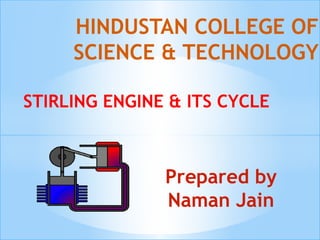
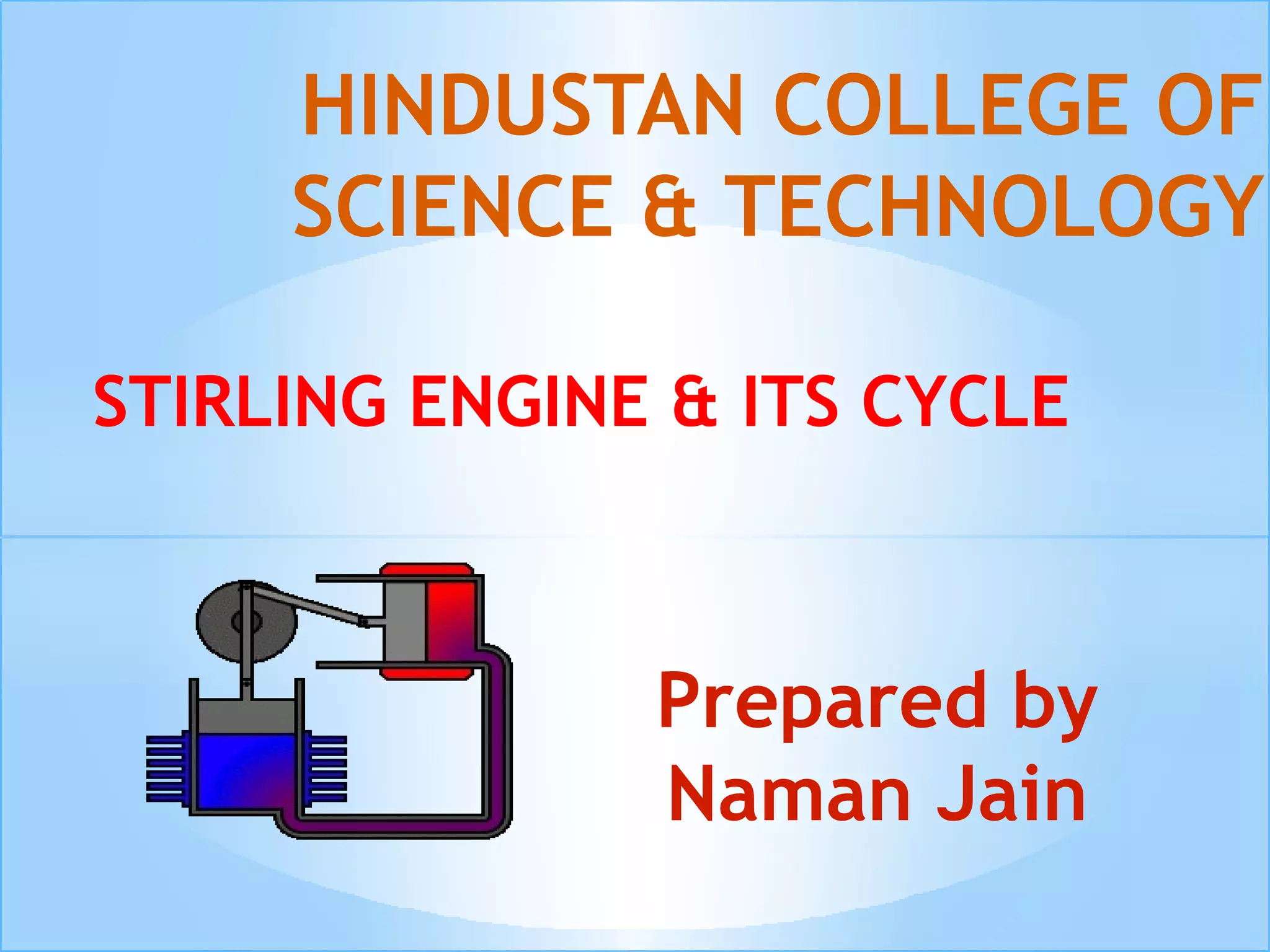

STIRLING ENGINE & ITS CYCLE
HINDUSTAN COLLEGE OF
SCIENCE & TECHNOLOGY
Prepared by
Naman Jain
INTRODUCTION
*Stirling engine was invented, developed and patented in 1816
by Reverend Dr. Robert Stirling .
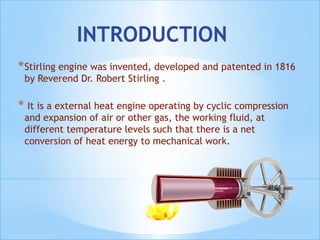
* It is a external heat engine operating by cyclic compression
and expansion of air or other gas, the working fluid, at
different temperature levels such that there is a net
conversion of heat energy to mechanical work.
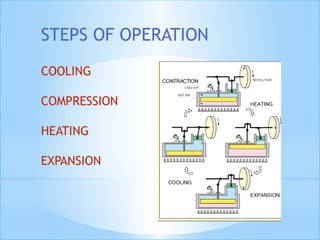
STEPS OF OPERATION
COOLING
COMPRESSION
HEATING
EXPANSION
PRINCIPLE OF STIRLING
ENGINESTIRLING CYCLE
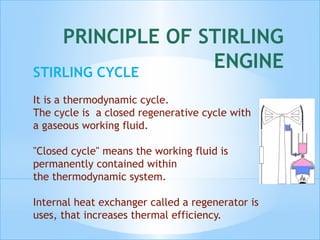
It is a thermodynamic cycle.
The cycle is a closed regenerative cycle with
a gaseous working fluid.
"Closed cycle" means the working fluid is
permanently contained within
the thermodynamic system.
Internal heat exchanger called a regenerator is
uses, that increases thermal efficiency.
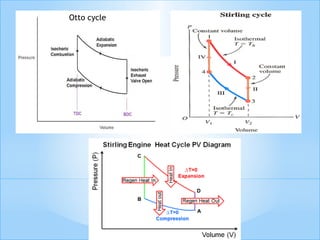
Otto cycle
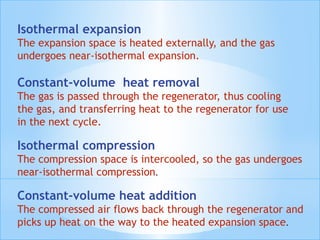
Isothermal expansion
The expansion space is heated externally, and the gas
undergoes near-isothermal expansion.
Constant-volume  heat removal
The gas is passed through the regenerator, thus cooling
the gas, and transferring heat to the regenerator for use
in the next cycle.
Isothermal compression
The compression space is intercooled, so the gas undergoes
near-isothermal compression.
Constant-volume heat addition
The compressed air flows back through the regenerator and
picks up heat on the way to the heated expansion space.
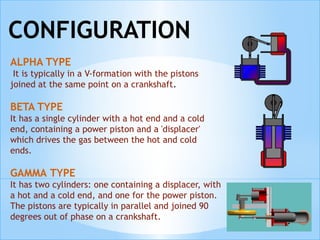
ALPHA TYPE
It is typically in a V-formation with the pistons
joined at the same point on a crankshaft.
BETA TYPE
It has a single cylinder with a hot end and a cold
end, containing a power piston and a 'displacer'
which drives the gas between the hot and cold
ends. 
GAMMA TYPE
It has two cylinders: one containing a displacer, with
a hot and a cold end, and one for the power piston.
The pistons are typically in parallel and joined 90
degrees out of phase on a crankshaft.
 
CONFIGURATION
ADVANTAGES
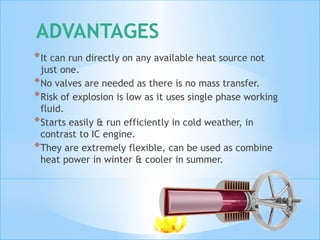
*It can run directly on any available heat source not
just one.
*No valves are needed as there is no mass transfer.
*Risk of explosion is low as it uses single phase working
fluid.
*Starts easily & run efficiently in cold weather, in
contrast to IC engine.
*They are extremely flexible, can be used as combine
heat power in winter & cooler in summer.
DISADVANTAGES
*Size and cost issue.
*Power and torque issue.
*Gas choice issue.
APPLICATIONS
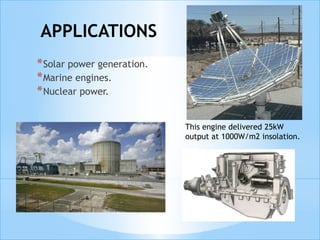
*Solar power generation.
*Marine engines.
*Nuclear power.
This engine delivered 25kW
output at 1000W/m2 insolation.
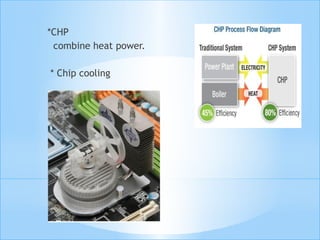
*CHP
combine heat power.
* Chip cooling
THANK YOU
Queries Invited

stirling engine and its cycle (seminar)

  • 1.
    STIRLING ENGINE &ITS CYCLE HINDUSTAN COLLEGE OF SCIENCE & TECHNOLOGY Prepared by Naman Jain
  • 2.
    INTRODUCTION *Stirling engine wasinvented, developed and patented in 1816 by Reverend Dr. Robert Stirling . * It is a external heat engine operating by cyclic compression and expansion of air or other gas, the working fluid, at different temperature levels such that there is a net conversion of heat energy to mechanical work.
  • 3.
  • 4.
    PRINCIPLE OF STIRLING ENGINESTIRLINGCYCLE It is a thermodynamic cycle. The cycle is a closed regenerative cycle with a gaseous working fluid. "Closed cycle" means the working fluid is permanently contained within the thermodynamic system. Internal heat exchanger called a regenerator is uses, that increases thermal efficiency.
  • 5.
  • 6.
    Isothermal expansion The expansion spaceis heated externally, and the gas undergoes near-isothermal expansion. Constant-volume  heat removal The gas is passed through the regenerator, thus cooling the gas, and transferring heat to the regenerator for use in the next cycle. Isothermal compression The compression space is intercooled, so the gas undergoes near-isothermal compression. Constant-volume heat addition The compressed air flows back through the regenerator and picks up heat on the way to the heated expansion space.
  • 7.
    ALPHA TYPE It istypically in a V-formation with the pistons joined at the same point on a crankshaft. BETA TYPE It has a single cylinder with a hot end and a cold end, containing a power piston and a 'displacer' which drives the gas between the hot and cold ends.  GAMMA TYPE It has two cylinders: one containing a displacer, with a hot and a cold end, and one for the power piston. The pistons are typically in parallel and joined 90 degrees out of phase on a crankshaft.   CONFIGURATION
  • 8.
    ADVANTAGES *It can rundirectly on any available heat source not just one. *No valves are needed as there is no mass transfer. *Risk of explosion is low as it uses single phase working fluid. *Starts easily & run efficiently in cold weather, in contrast to IC engine. *They are extremely flexible, can be used as combine heat power in winter & cooler in summer.
  • 9.
    DISADVANTAGES *Size and costissue. *Power and torque issue. *Gas choice issue.
  • 10.
    APPLICATIONS *Solar power generation. *Marineengines. *Nuclear power. This engine delivered 25kW output at 1000W/m2 insolation.
  • 11.
  • 12.