Government Polytechnic, Nashik
(An Autonomous Institute of Govt. of Maharashtra State)
SEMINAR TOPIC
POLLUTION LESS ENGINE
(STIRLING ENGINE)
Name: Tejas Santosh Chandre
Roll No: 208106
Guide: Prof. T.G. Chavan sir
Contents:
■ What is Stirling Engine ?
■ History
■ Types Of Stirling Engine
■ Parts of Stirling Engine
■ Stirling Cycle
■ Advantages
■ Disadvantages
■ Applications
■ Conclusion
What is Stirling Engine ?
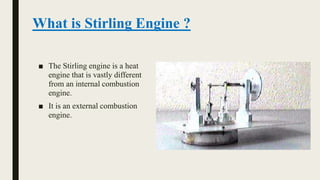
■ The Stirling engine is a heat
engine that is vastly different
from an internal combustion
engine.
■ It is an external combustion
engine.
■ Inventor Of Stirling Engine :
Robert Stirling (1790-1878)
■ Invented Stirling Engine In 1816
Which could not explode And
Produce more power Then Steam
Engine Used.
History:
Types Of Stirling Engine :
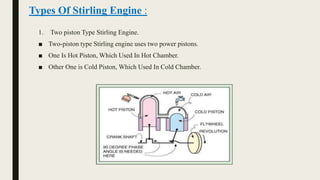
1. Two piston Type Stirling Engine.
■ Two-piston type Stirling engine uses two power pistons.
■ One Is Hot Piston, Which Used In Hot Chamber.
■ Other One is Cold Piston, Which Used In Cold Chamber.
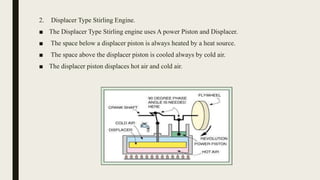
2. Displacer Type Stirling Engine.
■ The Displacer Type Stirling engine uses A power Piston and Displacer.
■ The space below a displacer piston is always heated by a heat source.
■ The space above the displacer piston is cooled always by cold air.
■ The displacer piston displaces hot air and cold air.
■ Main Chamber
■ Output Shaft
■ Displacer
■ Crankshaft
■ Regenerator
Parts of Stirling Engine:
■ The key principle of Stirling engine is that a fixed amount of gas is sealed
inside the engine.
■ The Stirling cycle involves a series of events that change the pressure of
gas inside the engine , causing it to work.
■ Stirling engine uses two cylinders, one cylinder is heated by an external
heat source and the other is cooled by an external cooling source.
Stirling Cycle :
■ There are 4 Steps Of Stirling Cycle as Follows:
1. Expansion
2. Transfer
3. Contraction
4. Transfer
Advantages:
 Gas Inside The engine Never Leaves The Engine.
 These Engines are quiter In Operation.
 No combustion Takes place inside Cylinder Of Engine.
 Hence, There Is No Explosion
Disadvantages:
 Greater Volume and Greater Weight.
 Higher Economic Cost of The engine.
 The Stirling engine have Slower Start.
 More Dangerous.
Applications:
■ Water pump stations
■ Combined heat and power plant
■ Solar power generation
■ Stirling cyrocoolers
■ Heat pump
■ Marine engines
■ Nuclear power
■ Aircraft engines
■ Micro CHP
Conclusion:
■ The Stirling engine, types, parts; working cycle, advantages along with recent
applications has been empounded in this paper
■ The expansion and contraction of the gas, using heat from external source, creates the
useful work.
■ This engine can work on any type of fuel whether it is conventional or non-conventional
fuel. And the basic advantage of this engine is that the amount of gas inside the chamber
remains fixed that is there is no exhaust and hence this engine is pollution less.
Pollution less engine.

Pollution less engine.

  • 1.
    Government Polytechnic, Nashik (AnAutonomous Institute of Govt. of Maharashtra State)
  • 2.
    SEMINAR TOPIC POLLUTION LESSENGINE (STIRLING ENGINE) Name: Tejas Santosh Chandre Roll No: 208106 Guide: Prof. T.G. Chavan sir
  • 3.
    Contents: ■ What isStirling Engine ? ■ History ■ Types Of Stirling Engine ■ Parts of Stirling Engine ■ Stirling Cycle ■ Advantages ■ Disadvantages ■ Applications ■ Conclusion
  • 4.
    What is StirlingEngine ? ■ The Stirling engine is a heat engine that is vastly different from an internal combustion engine. ■ It is an external combustion engine.
  • 5.
    ■ Inventor OfStirling Engine : Robert Stirling (1790-1878) ■ Invented Stirling Engine In 1816 Which could not explode And Produce more power Then Steam Engine Used. History:
  • 6.
    Types Of StirlingEngine : 1. Two piston Type Stirling Engine. ■ Two-piston type Stirling engine uses two power pistons. ■ One Is Hot Piston, Which Used In Hot Chamber. ■ Other One is Cold Piston, Which Used In Cold Chamber.
  • 7.
    2. Displacer TypeStirling Engine. ■ The Displacer Type Stirling engine uses A power Piston and Displacer. ■ The space below a displacer piston is always heated by a heat source. ■ The space above the displacer piston is cooled always by cold air. ■ The displacer piston displaces hot air and cold air.
  • 8.
    ■ Main Chamber ■Output Shaft ■ Displacer ■ Crankshaft ■ Regenerator Parts of Stirling Engine:
  • 9.
    ■ The keyprinciple of Stirling engine is that a fixed amount of gas is sealed inside the engine. ■ The Stirling cycle involves a series of events that change the pressure of gas inside the engine , causing it to work. ■ Stirling engine uses two cylinders, one cylinder is heated by an external heat source and the other is cooled by an external cooling source. Stirling Cycle :
  • 10.
    ■ There are4 Steps Of Stirling Cycle as Follows: 1. Expansion 2. Transfer 3. Contraction 4. Transfer
  • 11.
    Advantages:  Gas InsideThe engine Never Leaves The Engine.  These Engines are quiter In Operation.  No combustion Takes place inside Cylinder Of Engine.  Hence, There Is No Explosion
  • 12.
    Disadvantages:  Greater Volumeand Greater Weight.  Higher Economic Cost of The engine.  The Stirling engine have Slower Start.  More Dangerous.
  • 13.
    Applications: ■ Water pumpstations ■ Combined heat and power plant ■ Solar power generation ■ Stirling cyrocoolers ■ Heat pump ■ Marine engines ■ Nuclear power ■ Aircraft engines ■ Micro CHP
  • 14.
    Conclusion: ■ The Stirlingengine, types, parts; working cycle, advantages along with recent applications has been empounded in this paper ■ The expansion and contraction of the gas, using heat from external source, creates the useful work. ■ This engine can work on any type of fuel whether it is conventional or non-conventional fuel. And the basic advantage of this engine is that the amount of gas inside the chamber remains fixed that is there is no exhaust and hence this engine is pollution less.