A PROJECT REPORT ON
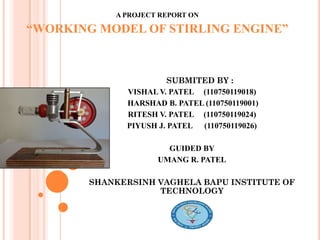
“WORKING MODEL OF STIRLING ENGINE”
SUBMITED BY :
VISHAL V. PATEL (110750119018)
HARSHAD B. PATEL (110750119001)
RITESH V. PATEL (110750119024)
PIYUSH J. PATEL (110750119026)
GUIDED BY
UMANG R. PATEL
SHANKERSINH VAGHELA BAPU INSTITUTE OF
TECHNOLOGY
CONTENTS
 ABSTRACT……………………………………..1
 INTRODUCTION………………………………3
 LITERATURE REVIEW………………………6
 METHODOLOGY……………………………...10
 SETUPAND PREPARATION………………....14
 CONCLUSION………………………………….24
ABSTRACT
1
ABSTRACT
Worldwide attempts are being made to increase
the use of our renewable energy sources as well as to use our
current fossil fuel energy sources more efficiently. Waste heat
recovery forms a substantial part of the latter and is the focus
of this project.
The aim of this project was to design, build, and
review of Stirling engine capable of generating power. This
project provided a great opportunity to gain experience with
mechanical design, manufacturing, and the fundamentals of
Stirling engines.
We applied our knowledge of thermodynamics
to the design of the engine, and developed formulas to predict
its power output at different temperature differentials.
2
INTRODUCTION
3
HISTORY
The Stirling Engine is one
of the hot air engines. It was
invented by Robert Stirling
(1790-1878) and his brother
James. His father was interesting
in engine and he inherited it. He
became a minister of the church at
Scotland in 1816. At this period,
he found the steam engines are
dangerous for the workers. He
decided to improve the design of
an existing air engine. He hope it
wound be safer alternative.
Robert Stirling
Earlier Stirling Engine 4
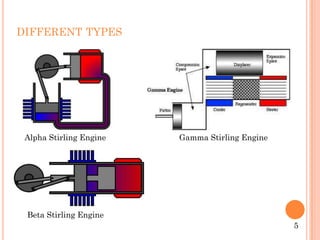
DIFFERENT TYPES
Alpha Stirling Engine Gamma Stirling Engine
Beta Stirling Engine
5
LITERATURE REVIEW
6
 Author: DaWei Tanga, Zhigang Lia 20 July 2011
 Title : Development and test of a Stirling
engine driven by waste gases for the
micro-CHP system.
 Remark : The test results confirm the fact that
Stirling engines driven by mid-high
temperature waste gases are able to
achieve a valuable output power for
engineering application.
7
 Author: Halit Karabuluta, Hüseyin Serdar 30
October 2007
 Title : An experimental study on the development of
b-type Stirling engine for low and moderate
temperature heat sources
 Remark : Experimental results presented in this paper
were obtained by testing the engine with air
as working fluid. The hot end of the
displacer cylinder was heated with a LPG
flame and kept about 200 C constant
temperature throughout the testing period.
8
 Author: Chin-Hsiang Cheng 6 April 2010
 Title Dynamic simulation of a beta-type Stirling engine
with cam-drive mechanism via the combination of
the thermodynamic and dynamic models.
 Remark . An extensive parametric study of the effects
of different operating and geometrical
parameters has been performed, and results
regarding the effects of mass moment of
inertia of the flywheel, initial rotational
speed, initial charged pressure, phase angle,
gap size, displacer length, and piston stroke are
investigated.
9
METHODOLOGY
10
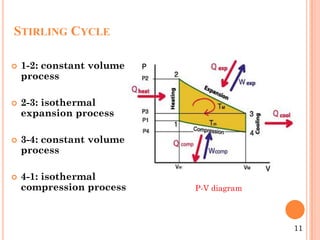
STIRLING CYCLE
 1-2: constant volume
process
 2-3: isothermal
expansion process
 3-4: constant volume
process
 4-1: isothermal
compression process P-V diagram
11
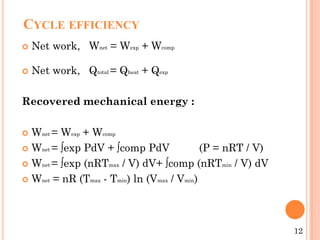
CYCLE EFFICIENCY
 Net work, Wnet = Wexp + Wcomp
 Net work, Qtotal = Qheat + Qexp
Recovered mechanical energy :
 Wnet = Wexp + Wcomp
 Wnet = ∫exp PdV + ∫comp PdV (P = nRT / V)
 Wnet = ∫exp (nRTmax / V) dV+ ∫comp (nRTmin / V) dV
 Wnet = nR (Tmax - Tmin) ln (Vmax / Vmin)
12
Provided heat :
Qexp = ∫exp PdV
Qexp = nR Tmax ln(Vmax / Vmin )
Qheat = nCv (Tmax - Tmin)
Qtotal = nCv (Tmax - Tmin) + nR Tmax ln (Vmax / Vmin)
Cycle efficiency :
η = [R (Tmax - Tmin) ln (Vmax / Vmin)] / [Cv (Tmax - Tmin) + R Tmax ln
(Vmax / Vmin)]
13
SETUP AND PREPARATION
14
ASSEMBLY DRAWING
15
: Assembly drawing
FABRICATION DRAWING
16Cylinder fabrication drawing
17
Clamp fabrication drawing
Crank wheel
FABRICATION AND ASSEMBLY
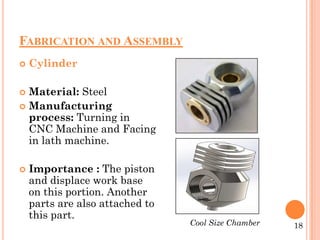
 Cylinder
 Material: Steel
 Manufacturing
process: Turning in
CNC Machine and Facing
in lath machine.
 Importance : The piston
and displace work base
on this portion. Another
parts are also attached to
this part.
18Cool Size Chamber
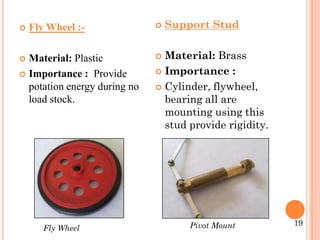
 Fly Wheel :-
 Material: Plastic
 Importance : Provide
potation energy during no
load stock.
 Support Stud
 Material: Brass
 Importance :
 Cylinder, flywheel,
bearing all are
mounting using this
stud provide rigidity.
19
Fly Wheel Pivot Mount
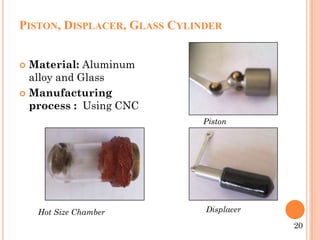
PISTON, DISPLACER, GLASS CYLINDER
 Material: Aluminum
alloy and Glass
 Manufacturing
process : Using CNC
20
Hot Size Chamber
Piston
Displacer
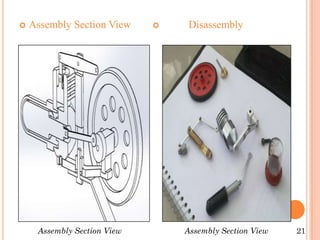
 Assembly Section View  Disassembly
21Assembly Section View Assembly Section View
3-D MODEL OF STIRLING ENGINE :
223D model of Actual machine
FABRICATION ASSEMBLY:
23
Stirling Engine
CONCLUSION
24
 The lack of pressurization may also be an opportunity
to improve the engine. Most successful Stirling
engines in our research were pressurized to some
extent. Currently there are leakage issues on the hot
side preventing pressurization, and more may become
apparent as pressure is increased
 Several problems remain to be addressed within the
engine. First among them is the overall lack of useful
work output by the engine. Most of the work is being
absorbed by the friction of the crankshaft and piston
linkages, and possibly by inferior bearings. Further
inspection of the compressor block is recommended to
isolate and rectify these problems.
25
REFERENCES
 [1] Institute of Engineering Thermo physics, Chinese
Academy of Sciences, No. 11, BeiSiHuanXi Road, Beijing
100190, China Beijing ShiYanTianQiang Technology ompany,
Beijing 100076, Chin Received 20 July 2011
 [2] Department of Mechanical Technology, Faculty of
Technical Education, Gazi University, 06500 Teknikokullar,
Ankara, Turkey,( Received 30 October 2007)
 [3] Department of Mechanical Technology, Faculty of
Technical Education, Gazi University, Besevler, 06500,
Ankara, Turkey Received 16 July 2007,
 [4]. Wikipedia free encyclopedia. Stirling engine,
www.wikipedia.org/wiki/stirlin-engine, (02/18/2009)
 [5] stirling cycle efficiency
http://www.robertstirlingengine.com/alpha_uk.php
26
THANK YOU
27

stirling engine ppt

  • 1.
    A PROJECT REPORTON “WORKING MODEL OF STIRLING ENGINE” SUBMITED BY : VISHAL V. PATEL (110750119018) HARSHAD B. PATEL (110750119001) RITESH V. PATEL (110750119024) PIYUSH J. PATEL (110750119026) GUIDED BY UMANG R. PATEL SHANKERSINH VAGHELA BAPU INSTITUTE OF TECHNOLOGY
  • 2.
    CONTENTS  ABSTRACT……………………………………..1  INTRODUCTION………………………………3 LITERATURE REVIEW………………………6  METHODOLOGY……………………………...10  SETUPAND PREPARATION………………....14  CONCLUSION………………………………….24
  • 3.
  • 4.
    ABSTRACT Worldwide attempts arebeing made to increase the use of our renewable energy sources as well as to use our current fossil fuel energy sources more efficiently. Waste heat recovery forms a substantial part of the latter and is the focus of this project. The aim of this project was to design, build, and review of Stirling engine capable of generating power. This project provided a great opportunity to gain experience with mechanical design, manufacturing, and the fundamentals of Stirling engines. We applied our knowledge of thermodynamics to the design of the engine, and developed formulas to predict its power output at different temperature differentials. 2
  • 5.
  • 6.
    HISTORY The Stirling Engineis one of the hot air engines. It was invented by Robert Stirling (1790-1878) and his brother James. His father was interesting in engine and he inherited it. He became a minister of the church at Scotland in 1816. At this period, he found the steam engines are dangerous for the workers. He decided to improve the design of an existing air engine. He hope it wound be safer alternative. Robert Stirling Earlier Stirling Engine 4
  • 7.
    DIFFERENT TYPES Alpha StirlingEngine Gamma Stirling Engine Beta Stirling Engine 5
  • 8.
  • 9.
     Author: DaWeiTanga, Zhigang Lia 20 July 2011  Title : Development and test of a Stirling engine driven by waste gases for the micro-CHP system.  Remark : The test results confirm the fact that Stirling engines driven by mid-high temperature waste gases are able to achieve a valuable output power for engineering application. 7
  • 10.
     Author: HalitKarabuluta, Hüseyin Serdar 30 October 2007  Title : An experimental study on the development of b-type Stirling engine for low and moderate temperature heat sources  Remark : Experimental results presented in this paper were obtained by testing the engine with air as working fluid. The hot end of the displacer cylinder was heated with a LPG flame and kept about 200 C constant temperature throughout the testing period. 8
  • 11.
     Author: Chin-HsiangCheng 6 April 2010  Title Dynamic simulation of a beta-type Stirling engine with cam-drive mechanism via the combination of the thermodynamic and dynamic models.  Remark . An extensive parametric study of the effects of different operating and geometrical parameters has been performed, and results regarding the effects of mass moment of inertia of the flywheel, initial rotational speed, initial charged pressure, phase angle, gap size, displacer length, and piston stroke are investigated. 9
  • 12.
  • 13.
    STIRLING CYCLE  1-2:constant volume process  2-3: isothermal expansion process  3-4: constant volume process  4-1: isothermal compression process P-V diagram 11
  • 14.
    CYCLE EFFICIENCY  Network, Wnet = Wexp + Wcomp  Net work, Qtotal = Qheat + Qexp Recovered mechanical energy :  Wnet = Wexp + Wcomp  Wnet = ∫exp PdV + ∫comp PdV (P = nRT / V)  Wnet = ∫exp (nRTmax / V) dV+ ∫comp (nRTmin / V) dV  Wnet = nR (Tmax - Tmin) ln (Vmax / Vmin) 12
  • 15.
    Provided heat : Qexp= ∫exp PdV Qexp = nR Tmax ln(Vmax / Vmin ) Qheat = nCv (Tmax - Tmin) Qtotal = nCv (Tmax - Tmin) + nR Tmax ln (Vmax / Vmin) Cycle efficiency : η = [R (Tmax - Tmin) ln (Vmax / Vmin)] / [Cv (Tmax - Tmin) + R Tmax ln (Vmax / Vmin)] 13
  • 16.
  • 17.
  • 18.
  • 19.
  • 20.
    FABRICATION AND ASSEMBLY Cylinder  Material: Steel  Manufacturing process: Turning in CNC Machine and Facing in lath machine.  Importance : The piston and displace work base on this portion. Another parts are also attached to this part. 18Cool Size Chamber
  • 21.
     Fly Wheel:-  Material: Plastic  Importance : Provide potation energy during no load stock.  Support Stud  Material: Brass  Importance :  Cylinder, flywheel, bearing all are mounting using this stud provide rigidity. 19 Fly Wheel Pivot Mount
  • 22.
    PISTON, DISPLACER, GLASSCYLINDER  Material: Aluminum alloy and Glass  Manufacturing process : Using CNC 20 Hot Size Chamber Piston Displacer
  • 23.
     Assembly SectionView  Disassembly 21Assembly Section View Assembly Section View
  • 24.
    3-D MODEL OFSTIRLING ENGINE : 223D model of Actual machine
  • 25.
  • 26.
  • 27.
     The lackof pressurization may also be an opportunity to improve the engine. Most successful Stirling engines in our research were pressurized to some extent. Currently there are leakage issues on the hot side preventing pressurization, and more may become apparent as pressure is increased  Several problems remain to be addressed within the engine. First among them is the overall lack of useful work output by the engine. Most of the work is being absorbed by the friction of the crankshaft and piston linkages, and possibly by inferior bearings. Further inspection of the compressor block is recommended to isolate and rectify these problems. 25
  • 28.
    REFERENCES  [1] Instituteof Engineering Thermo physics, Chinese Academy of Sciences, No. 11, BeiSiHuanXi Road, Beijing 100190, China Beijing ShiYanTianQiang Technology ompany, Beijing 100076, Chin Received 20 July 2011  [2] Department of Mechanical Technology, Faculty of Technical Education, Gazi University, 06500 Teknikokullar, Ankara, Turkey,( Received 30 October 2007)  [3] Department of Mechanical Technology, Faculty of Technical Education, Gazi University, Besevler, 06500, Ankara, Turkey Received 16 July 2007,  [4]. Wikipedia free encyclopedia. Stirling engine, www.wikipedia.org/wiki/stirlin-engine, (02/18/2009)  [5] stirling cycle efficiency http://www.robertstirlingengine.com/alpha_uk.php 26
  • 29.