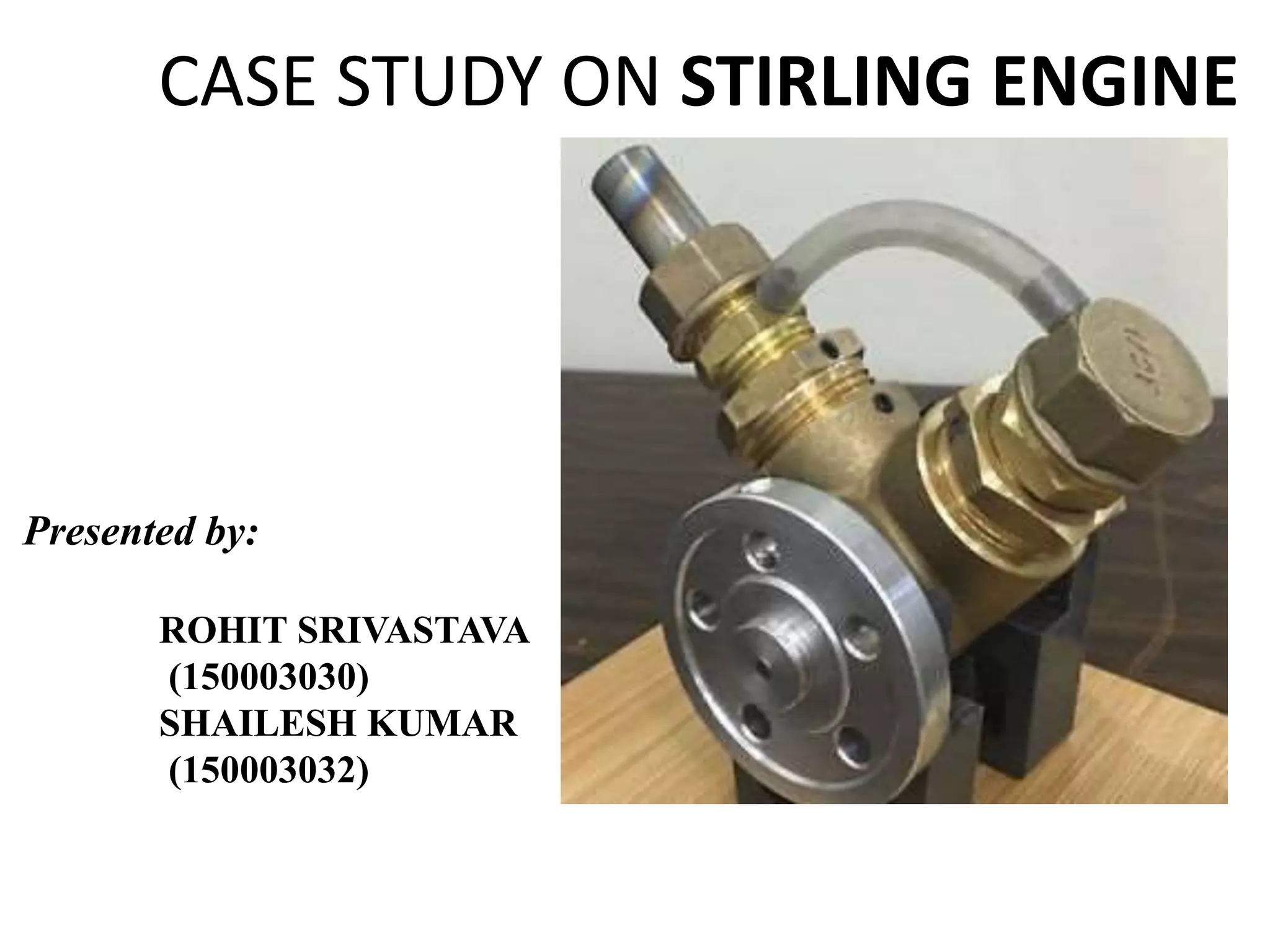
CASE STUDY ON STIRLING ENGINE
Presented by:
ROHIT SRIVASTAVA
(150003030)
SHAILESH KUMAR
(150003032)
CONTENT
•HISTORY
•STIRLING CYCLE & WORKING PRINCIPLE
•WHAT IS STIRLING ENGINE?
•KEY COMPONENTS
•CONFIGURATION & THEIR COMPARISON
•THERMODYNAMIC RELATIONS & EFFICIENCY
•COMPARISON WITH CARNOT ENGINE
•PRACTICAL ISSUES
•COMPARISON WITH IC ENGINE
•ADVANTAGES
•DISADVANTAGES
•APPLICATIONS
HISTORY
• Invented by Robert Stirling(1790-1878).
• He invented the first practical example of a closed
cycle air engine in 1816.
• He sought to replace the steam turbines of his days
due to frequent explosion caused by unsustainable
high pressure killing and injuring workers.
• The need for Stirling engines to run at very high
temperatures to maximize power and efficiency
exposed limitations in the materials of the day, and the
few engines that were built in those early years
suffered unacceptably frequent failures (albeit with far
less disastrous consequences than boiler explosions).
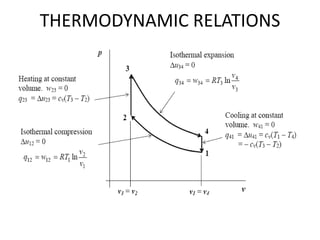
IDEAL STIRLING CYCLE
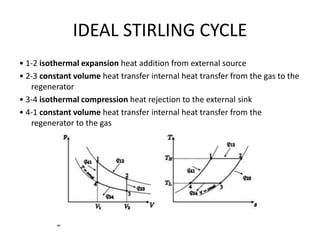
• 1-2 isothermal expansion heat addition from external source
• 2-3 constant volume heat transfer internal heat transfer from the gas to the
regenerator
• 3-4 isothermal compression heat rejection to the external sink
• 4-1 constant volume heat transfer internal heat transfer from the
regenerator to the gas
WORKING PRINCIPLE IDEAL STIRLING
CYCLE
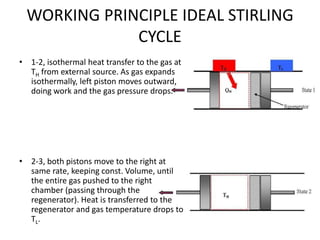
• 1-2, isothermal heat transfer to the gas at
TH from external source. As gas expands
isothermally, left piston moves outward,
doing work and the gas pressure drops.
• 2-3, both pistons move to the right at
same rate, keeping const. Volume, until
the entire gas pushed to the right
chamber (passing through the
regenerator). Heat is transferred to the
regenerator and gas temperature drops to
TL.
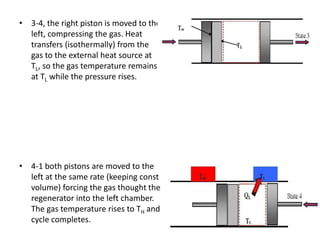
• 3-4, the right piston is moved to the
left, compressing the gas. Heat
transfers (isothermally) from the
gas to the external heat source at
TL, so the gas temperature remains
at TL while the pressure rises.
• 4-1 both pistons are moved to the
left at the same rate (keeping const
volume) forcing the gas thought the
regenerator into the left chamber.
The gas temperature rises to TH and
cycle completes.
WHAT IS STIRLING ENGINE
• A Stirling engine is a heat engine that operates by
cyclic compression and expansion of air or other gas
(the working fluid) at different temperatures, such that
there is a net conversion of heat energy to
mechanical work.
• It operates on a closed thermodynamic cyclic process
unlike the S.I./C.I., Jet engine.
• There is no inlet and outlet for working fluid, hence
does not need any valves.
• It utilizes, not necessarily, the regenerators which are
responsible for exchanging heat internally.
• It is the regenerator, that differentiates a Stirling
engine from other closed cycle hot air engines.
KEY COMPONENTS
• Heat Source: Since the heat source is external to the system, hence the
combustion of fuels, solar energy, geothermal energy, industrial waste
heat, nuclear energy and bio-energy can be used as source of heat to the
system. If solar power is used as a heat source, regular solar mirrors and
solar dishes may be utilised.
• Heat Exchanger(Hot side): In small, low power engines this may simply
consist of the walls of the hot space(s) but where larger powers are
required a greater surface area is needed to transfer sufficient heat.
Typical implementations are internal and external fins or multiple small
bore tubes. Engines that operate at high powers and pressures require
that heat exchangers on the hot side be made of alloys that retain
considerable strength at high temperatures and that don't corrode.
• Working fluid: The Stirling Cycle is a closed cycle and the various
thermodynamic processes are carried out on a working gas that is trapped
within the system. The working gas could be air, hydrogen, helium,
methane and ammonia.
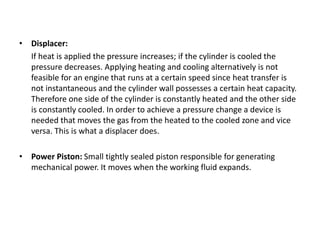
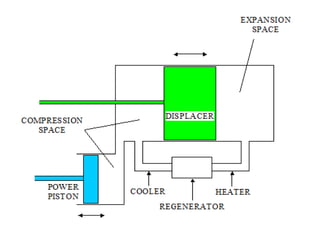
• Displacer:
If heat is applied the pressure increases; if the cylinder is cooled the
pressure decreases. Applying heating and cooling alternatively is not
feasible for an engine that runs at a certain speed since heat transfer is
not instantaneous and the cylinder wall possesses a certain heat capacity.
Therefore one side of the cylinder is constantly heated and the other side
is constantly cooled. In order to achieve a pressure change a device is
needed that moves the gas from the heated to the cooled zone and vice
versa. This is what a displacer does.
• Power Piston: Small tightly sealed piston responsible for generating
mechanical power. It moves when the working fluid expands.
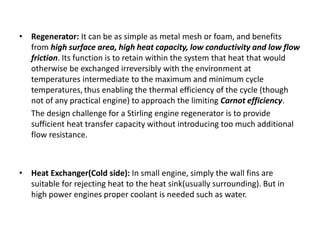
• Regenerator: It can be as simple as metal mesh or foam, and benefits
from high surface area, high heat capacity, low conductivity and low flow
friction. Its function is to retain within the system that heat that would
otherwise be exchanged irreversibly with the environment at
temperatures intermediate to the maximum and minimum cycle
temperatures, thus enabling the thermal efficiency of the cycle (though
not of any practical engine) to approach the limiting Carnot efficiency.
The design challenge for a Stirling engine regenerator is to provide
sufficient heat transfer capacity without introducing too much additional
flow resistance.
• Heat Exchanger(Cold side): In small engine, simply the wall fins are
suitable for rejecting heat to the heat sink(usually surrounding). But in
high power engines proper coolant is needed such as water.
CONFIGURATIONS
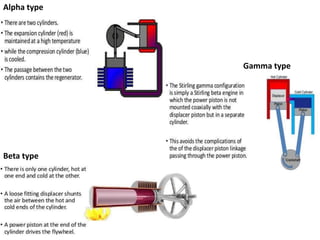
• There are 2 major types of stirling engine, that
are distinguish by the way they move the air
between hot and cold side of the cylinder.
• They are:
Alpha type- contains 2 power pistons in
separate cylinders, one hot and one cold.
Beta type- has a single power piston arranged
within the same cylinder on the same shaft as
a displacer piston.
• Gamma Stirling- is simply a beta Stirling with
the power piston mounted in a separate
cylinder alongside the displacer piston
cylinder, but still connected to the same
flywheel.
Alpha
Beta
Gamma
Alpha type
Gamma type
Beta type
THERMODYNAMIC RELATIONS
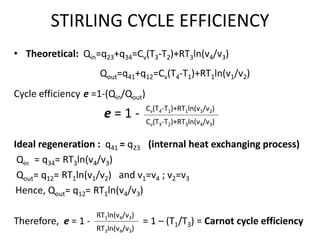
STIRLING CYCLE EFFICIENCY
• Theoretical: Qin=q23+q34=Cv(T3-T2)+RT3ln(v4/v3)
Qout=q41+q12=Cv(T4-T1)+RT1ln(v1/v2)
Cycle efficiency e =1-(Qin/Qout)
e = 1 -
Ideal regeneration : q41 = q23 (internal heat exchanging process)
Qin = q34= RT3ln(v4/v3)
Qout= q12= RT1ln(v1/v2) and v1=v4 ; v2=v3
Hence, Qout= q12= RT1ln(v4/v3)
Therefore, e = 1 - = 1 – (T1/T3) = Carnot cycle efficiency
Cv(T4-T1)+RT1ln(v1/v2)
Cv(T3-T2)+RT3ln(v4/v3)
RT1ln(v4/v3)
RT3ln(v4/v3)
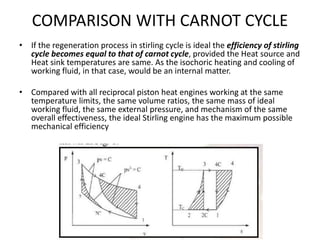
COMPARISON WITH CARNOT CYCLE
• If the regeneration process in stirling cycle is ideal the efficiency of stirling
cycle becomes equal to that of carnot cycle, provided the Heat source and
Heat sink temperatures are same. As the isochoric heating and cooling of
working fluid, in that case, would be an internal matter.
• Compared with all reciprocal piston heat engines working at the same
temperature limits, the same volume ratios, the same mass of ideal
working fluid, the same external pressure, and mechanism of the same
overall effectiveness, the ideal Stirling engine has the maximum possible
mechanical efficiency
PRACTICAL ISSUES
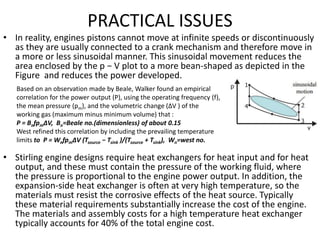
• In reality, engines pistons cannot move at infinite speeds or discontinuously
as they are usually connected to a crank mechanism and therefore move in
a more or less sinusoidal manner. This sinusoidal movement reduces the
area enclosed by the p − V plot to a more bean-shaped as depicted in the
Figure and reduces the power developed.
• Stirling engine designs require heat exchangers for heat input and for heat
output, and these must contain the pressure of the working fluid, where
the pressure is proportional to the engine power output. In addition, the
expansion-side heat exchanger is often at very high temperature, so the
materials must resist the corrosive effects of the heat source. Typically
these material requirements substantially increase the cost of the engine.
The materials and assembly costs for a high temperature heat exchanger
typically accounts for 40% of the total engine cost.
Based on an observation made by Beale, Walker found an empirical
correlation for the power output (P), using the operating frequency (f),
the mean pressure (pm), and the volumetric change (∆V ) of the
working gas (maximum minus minimum volume) that :
P = Bnfpm∆V, Bn=Beale no.(dimensionless) of about 0.15
West refined this correlation by including the prevailing temperature
limits to P = Wnfpm∆V (Tsource − Tsink )/(Tsource + Tsink), Wn=west no.
• At high temperatures and pressures, the oxygen in air-
pressurized crankcases, or in the working gas of hot air
engines, can combine with the engine's lubricating oil and
explode.
• Lubricants can also clog heat exchangers, especially the
regenerator. For these reasons, designers prefer non-
lubricated, low-coefficient of friction materials (such
as rulon or graphite), with low normal forces on the moving
parts, especially for sliding seals. Some designs avoid sliding
surfaces altogether by using diaphragms for sealed pistons.
These are some of the factors that allow Stirling engines to
have lower maintenance requirements and longer life than
internal-combustion engines.
COMPARISON WITH I.C. ENGINE
• In contrast to internal combustion engines, Stirling engines have the
potential to use renewable heat sources more easily, and to be quieter
and more reliable with lower maintenance.
• Being an external combustion engine (if combustion fuel is used as heat
source), the heater temperature always equals or exceeds the expansion
temperature. This means that the metallurgical requirements for the
heater material are very demanding. But is in contrast to an Otto
engine or Diesel engine, where the expansion temperature can far exceed
the metallurgical limit of the engine materials, because the input heat
source is not conducted through the engine, so engine materials operate
closer to the average temperature of the working gas.
• Compared to an internal combustion engine of the same power rating,
Stirling engines currently have a higher capital cost and are usually larger
and heavier. However, they are more efficient than most internal
combustion engines. Their lower maintenance requirements make the
overall energy cost comparable.
ADVANTAGES
• Stirling engines can run directly on any available heat source, not
just one produced by combustion, so they can run on heat from
solar, geothermal, biological, nuclear sources or waste heat from
industrial processes.
• The engine mechanisms are in some ways simpler than other
reciprocating engine types. No valves are needed, and the burner
system can be relatively simple.
• A Stirling engine uses a single-phase working fluid that maintains
an internal pressure close to the design pressure, and thus for a
properly designed system the risk of explosion is low. In
comparison, a steam engine uses a two-phase gas/liquid working
fluid, so a faulty overpressure relief valve can cause an explosion.
• They can be built to run quietly and without an air supply, for air-
independent propulsion use in submarines.
• Waste heat is easily harvested (compared to waste heat from an
internal combustion engine), making Stirling engines useful for
dual-output heat and power systems.
DISADVANTAGES
• The engine is complex due to use of heaters, regenerators, coolers
• The cost of the engine is high
• Heat transfers with a gas are delicate and often require bulky
apparatuses. Dissipation of waste heat is especially complicated
because the coolant temperature is kept as low as possible to
maximize thermal efficiency. This increases the size of the radiators.
• The lack of flexibility : the fast and effective variations of power are
difficult to obtain with a Stirling engine. This one is more qualified
to run with a constant nominal output. This point is a great
handicap for an utilisation in car industry
APPLICATIONS
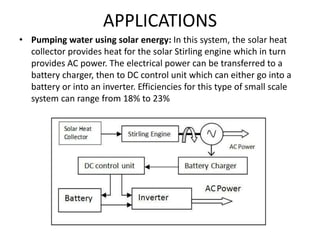
• Pumping water using solar energy: In this system, the solar heat
collector provides heat for the solar Stirling engine which in turn
provides AC power. The electrical power can be transferred to a
battery charger, then to DC control unit which can either go into a
battery or into an inverter. Efficiencies for this type of small scale
system can range from 18% to 23%
• Waste heat recovery system:
Different Energy Utilization Systems:-
a) Thermal Power Plant
b) Nuclear Power Plant
c) Gas Turbine Power Plant
d) Process Industries
e) Automotive Applications
Drawbacks of above Mentioned Energy Utilization Systems:- All the systems
use large amount of fossil fuels and reject large amount of energy to the
atmosphere thus causing global warming, causing environmental
degradation and wastage of fuel.
Waste heat recovery systems ,such as Recuperators & Regenerators,
utilises high and medium temperature waste heat only. They cannot recover
low temperature waste heat effectively. So if we want to recover low and
very low temperature waste heat we can go for Stirling Engine, which can
recover any kind of low grade waste heat because it is external combustion
engine and also its efficiency is very good
• Stirling Cryocooler:
Any Stirling engine will work in reverse as heat pump. When a
motion is applied to the shaft a temperature difference appears
between the reservoir.
Generating sufficient cold to liquefy gases can be done in various
ways. The choice is often determined by the temperature required
to liquefy the gas, and the degree of efficiency within a given
temperature range. Within the cryogenic range of 65 to 250 K, the
least efficient process is the Joule-Thomson method. This is based
on expansion of high-pressure gas by throttling. The compressor,
heat exchanger and expander technology used in the Claude
(turbine) process is only marginally more efficient.
The Stirling Cycle process is by far the most effective principle for
cryogenic operations. Consequently, all Stirling cryogenerator
feature this technique. It is a proven and tested concept that
assures the highest level as the blue line in the figure indic
CONCLUSION
• The stirling engine is noted for its high
efficiency compared to steam engines, quiet
operations, and the ease with it can use
almost any heat source.
• This engine is currently exciting interest as the
core component of micro combined heat and
power (CHP) units,in which it is more efficient
and safer than a comparable steam engine.
THANK YOU

Stirling engine case study

  • 1.
    CASE STUDY ONSTIRLING ENGINE Presented by: ROHIT SRIVASTAVA (150003030) SHAILESH KUMAR (150003032)
  • 2.
    CONTENT •HISTORY •STIRLING CYCLE &WORKING PRINCIPLE •WHAT IS STIRLING ENGINE? •KEY COMPONENTS •CONFIGURATION & THEIR COMPARISON •THERMODYNAMIC RELATIONS & EFFICIENCY •COMPARISON WITH CARNOT ENGINE •PRACTICAL ISSUES •COMPARISON WITH IC ENGINE •ADVANTAGES •DISADVANTAGES •APPLICATIONS
  • 3.
    HISTORY • Invented byRobert Stirling(1790-1878). • He invented the first practical example of a closed cycle air engine in 1816. • He sought to replace the steam turbines of his days due to frequent explosion caused by unsustainable high pressure killing and injuring workers. • The need for Stirling engines to run at very high temperatures to maximize power and efficiency exposed limitations in the materials of the day, and the few engines that were built in those early years suffered unacceptably frequent failures (albeit with far less disastrous consequences than boiler explosions).
  • 4.
    IDEAL STIRLING CYCLE •1-2 isothermal expansion heat addition from external source • 2-3 constant volume heat transfer internal heat transfer from the gas to the regenerator • 3-4 isothermal compression heat rejection to the external sink • 4-1 constant volume heat transfer internal heat transfer from the regenerator to the gas
  • 5.
    WORKING PRINCIPLE IDEALSTIRLING CYCLE • 1-2, isothermal heat transfer to the gas at TH from external source. As gas expands isothermally, left piston moves outward, doing work and the gas pressure drops. • 2-3, both pistons move to the right at same rate, keeping const. Volume, until the entire gas pushed to the right chamber (passing through the regenerator). Heat is transferred to the regenerator and gas temperature drops to TL.
  • 6.
    • 3-4, theright piston is moved to the left, compressing the gas. Heat transfers (isothermally) from the gas to the external heat source at TL, so the gas temperature remains at TL while the pressure rises. • 4-1 both pistons are moved to the left at the same rate (keeping const volume) forcing the gas thought the regenerator into the left chamber. The gas temperature rises to TH and cycle completes.
  • 7.
    WHAT IS STIRLINGENGINE • A Stirling engine is a heat engine that operates by cyclic compression and expansion of air or other gas (the working fluid) at different temperatures, such that there is a net conversion of heat energy to mechanical work. • It operates on a closed thermodynamic cyclic process unlike the S.I./C.I., Jet engine. • There is no inlet and outlet for working fluid, hence does not need any valves. • It utilizes, not necessarily, the regenerators which are responsible for exchanging heat internally. • It is the regenerator, that differentiates a Stirling engine from other closed cycle hot air engines.
  • 8.
    KEY COMPONENTS • HeatSource: Since the heat source is external to the system, hence the combustion of fuels, solar energy, geothermal energy, industrial waste heat, nuclear energy and bio-energy can be used as source of heat to the system. If solar power is used as a heat source, regular solar mirrors and solar dishes may be utilised. • Heat Exchanger(Hot side): In small, low power engines this may simply consist of the walls of the hot space(s) but where larger powers are required a greater surface area is needed to transfer sufficient heat. Typical implementations are internal and external fins or multiple small bore tubes. Engines that operate at high powers and pressures require that heat exchangers on the hot side be made of alloys that retain considerable strength at high temperatures and that don't corrode. • Working fluid: The Stirling Cycle is a closed cycle and the various thermodynamic processes are carried out on a working gas that is trapped within the system. The working gas could be air, hydrogen, helium, methane and ammonia.
  • 9.
    • Displacer: If heatis applied the pressure increases; if the cylinder is cooled the pressure decreases. Applying heating and cooling alternatively is not feasible for an engine that runs at a certain speed since heat transfer is not instantaneous and the cylinder wall possesses a certain heat capacity. Therefore one side of the cylinder is constantly heated and the other side is constantly cooled. In order to achieve a pressure change a device is needed that moves the gas from the heated to the cooled zone and vice versa. This is what a displacer does. • Power Piston: Small tightly sealed piston responsible for generating mechanical power. It moves when the working fluid expands.
  • 10.
    • Regenerator: Itcan be as simple as metal mesh or foam, and benefits from high surface area, high heat capacity, low conductivity and low flow friction. Its function is to retain within the system that heat that would otherwise be exchanged irreversibly with the environment at temperatures intermediate to the maximum and minimum cycle temperatures, thus enabling the thermal efficiency of the cycle (though not of any practical engine) to approach the limiting Carnot efficiency. The design challenge for a Stirling engine regenerator is to provide sufficient heat transfer capacity without introducing too much additional flow resistance. • Heat Exchanger(Cold side): In small engine, simply the wall fins are suitable for rejecting heat to the heat sink(usually surrounding). But in high power engines proper coolant is needed such as water.
  • 12.
    CONFIGURATIONS • There are2 major types of stirling engine, that are distinguish by the way they move the air between hot and cold side of the cylinder. • They are: Alpha type- contains 2 power pistons in separate cylinders, one hot and one cold. Beta type- has a single power piston arranged within the same cylinder on the same shaft as a displacer piston. • Gamma Stirling- is simply a beta Stirling with the power piston mounted in a separate cylinder alongside the displacer piston cylinder, but still connected to the same flywheel. Alpha Beta Gamma
  • 13.
  • 14.
  • 15.
    STIRLING CYCLE EFFICIENCY •Theoretical: Qin=q23+q34=Cv(T3-T2)+RT3ln(v4/v3) Qout=q41+q12=Cv(T4-T1)+RT1ln(v1/v2) Cycle efficiency e =1-(Qin/Qout) e = 1 - Ideal regeneration : q41 = q23 (internal heat exchanging process) Qin = q34= RT3ln(v4/v3) Qout= q12= RT1ln(v1/v2) and v1=v4 ; v2=v3 Hence, Qout= q12= RT1ln(v4/v3) Therefore, e = 1 - = 1 – (T1/T3) = Carnot cycle efficiency Cv(T4-T1)+RT1ln(v1/v2) Cv(T3-T2)+RT3ln(v4/v3) RT1ln(v4/v3) RT3ln(v4/v3)
  • 16.
    COMPARISON WITH CARNOTCYCLE • If the regeneration process in stirling cycle is ideal the efficiency of stirling cycle becomes equal to that of carnot cycle, provided the Heat source and Heat sink temperatures are same. As the isochoric heating and cooling of working fluid, in that case, would be an internal matter. • Compared with all reciprocal piston heat engines working at the same temperature limits, the same volume ratios, the same mass of ideal working fluid, the same external pressure, and mechanism of the same overall effectiveness, the ideal Stirling engine has the maximum possible mechanical efficiency
  • 17.
    PRACTICAL ISSUES • Inreality, engines pistons cannot move at infinite speeds or discontinuously as they are usually connected to a crank mechanism and therefore move in a more or less sinusoidal manner. This sinusoidal movement reduces the area enclosed by the p − V plot to a more bean-shaped as depicted in the Figure and reduces the power developed. • Stirling engine designs require heat exchangers for heat input and for heat output, and these must contain the pressure of the working fluid, where the pressure is proportional to the engine power output. In addition, the expansion-side heat exchanger is often at very high temperature, so the materials must resist the corrosive effects of the heat source. Typically these material requirements substantially increase the cost of the engine. The materials and assembly costs for a high temperature heat exchanger typically accounts for 40% of the total engine cost. Based on an observation made by Beale, Walker found an empirical correlation for the power output (P), using the operating frequency (f), the mean pressure (pm), and the volumetric change (∆V ) of the working gas (maximum minus minimum volume) that : P = Bnfpm∆V, Bn=Beale no.(dimensionless) of about 0.15 West refined this correlation by including the prevailing temperature limits to P = Wnfpm∆V (Tsource − Tsink )/(Tsource + Tsink), Wn=west no.
  • 18.
    • At hightemperatures and pressures, the oxygen in air- pressurized crankcases, or in the working gas of hot air engines, can combine with the engine's lubricating oil and explode. • Lubricants can also clog heat exchangers, especially the regenerator. For these reasons, designers prefer non- lubricated, low-coefficient of friction materials (such as rulon or graphite), with low normal forces on the moving parts, especially for sliding seals. Some designs avoid sliding surfaces altogether by using diaphragms for sealed pistons. These are some of the factors that allow Stirling engines to have lower maintenance requirements and longer life than internal-combustion engines.
  • 19.
    COMPARISON WITH I.C.ENGINE • In contrast to internal combustion engines, Stirling engines have the potential to use renewable heat sources more easily, and to be quieter and more reliable with lower maintenance. • Being an external combustion engine (if combustion fuel is used as heat source), the heater temperature always equals or exceeds the expansion temperature. This means that the metallurgical requirements for the heater material are very demanding. But is in contrast to an Otto engine or Diesel engine, where the expansion temperature can far exceed the metallurgical limit of the engine materials, because the input heat source is not conducted through the engine, so engine materials operate closer to the average temperature of the working gas. • Compared to an internal combustion engine of the same power rating, Stirling engines currently have a higher capital cost and are usually larger and heavier. However, they are more efficient than most internal combustion engines. Their lower maintenance requirements make the overall energy cost comparable.
  • 20.
    ADVANTAGES • Stirling enginescan run directly on any available heat source, not just one produced by combustion, so they can run on heat from solar, geothermal, biological, nuclear sources or waste heat from industrial processes. • The engine mechanisms are in some ways simpler than other reciprocating engine types. No valves are needed, and the burner system can be relatively simple. • A Stirling engine uses a single-phase working fluid that maintains an internal pressure close to the design pressure, and thus for a properly designed system the risk of explosion is low. In comparison, a steam engine uses a two-phase gas/liquid working fluid, so a faulty overpressure relief valve can cause an explosion. • They can be built to run quietly and without an air supply, for air- independent propulsion use in submarines. • Waste heat is easily harvested (compared to waste heat from an internal combustion engine), making Stirling engines useful for dual-output heat and power systems.
  • 21.
    DISADVANTAGES • The engineis complex due to use of heaters, regenerators, coolers • The cost of the engine is high • Heat transfers with a gas are delicate and often require bulky apparatuses. Dissipation of waste heat is especially complicated because the coolant temperature is kept as low as possible to maximize thermal efficiency. This increases the size of the radiators. • The lack of flexibility : the fast and effective variations of power are difficult to obtain with a Stirling engine. This one is more qualified to run with a constant nominal output. This point is a great handicap for an utilisation in car industry
  • 22.
    APPLICATIONS • Pumping waterusing solar energy: In this system, the solar heat collector provides heat for the solar Stirling engine which in turn provides AC power. The electrical power can be transferred to a battery charger, then to DC control unit which can either go into a battery or into an inverter. Efficiencies for this type of small scale system can range from 18% to 23%
  • 23.
    • Waste heatrecovery system: Different Energy Utilization Systems:- a) Thermal Power Plant b) Nuclear Power Plant c) Gas Turbine Power Plant d) Process Industries e) Automotive Applications Drawbacks of above Mentioned Energy Utilization Systems:- All the systems use large amount of fossil fuels and reject large amount of energy to the atmosphere thus causing global warming, causing environmental degradation and wastage of fuel. Waste heat recovery systems ,such as Recuperators & Regenerators, utilises high and medium temperature waste heat only. They cannot recover low temperature waste heat effectively. So if we want to recover low and very low temperature waste heat we can go for Stirling Engine, which can recover any kind of low grade waste heat because it is external combustion engine and also its efficiency is very good
  • 24.
    • Stirling Cryocooler: AnyStirling engine will work in reverse as heat pump. When a motion is applied to the shaft a temperature difference appears between the reservoir. Generating sufficient cold to liquefy gases can be done in various ways. The choice is often determined by the temperature required to liquefy the gas, and the degree of efficiency within a given temperature range. Within the cryogenic range of 65 to 250 K, the least efficient process is the Joule-Thomson method. This is based on expansion of high-pressure gas by throttling. The compressor, heat exchanger and expander technology used in the Claude (turbine) process is only marginally more efficient. The Stirling Cycle process is by far the most effective principle for cryogenic operations. Consequently, all Stirling cryogenerator feature this technique. It is a proven and tested concept that assures the highest level as the blue line in the figure indic
  • 25.
    CONCLUSION • The stirlingengine is noted for its high efficiency compared to steam engines, quiet operations, and the ease with it can use almost any heat source. • This engine is currently exciting interest as the core component of micro combined heat and power (CHP) units,in which it is more efficient and safer than a comparable steam engine.
  • 26.