Title of the Mini Project
Construction and Working of a Stirling
engine model
By
LAKSHI NANDAN BORAH(DC2013BTE0140)
GUIDE:- Asst. Prof. Pallav Gogoi
ENGINE
An engine is a machine designed to convert one form
of energy into mechanical energy.
12 February 2018 2
TYPES OF ENGINE
 INTERNAL COMBUSTION: An internal combustion
engine (ICE) is a heat engine where the combustion of
a fuel occurs with an oxidizer (usually air) in a
combustion chamber that is an integral part of the
working fluid flow circuit.
 EXTERNAL COMBUSTION: An external combustion
engine (EC engine) is a heat engine where a working
fluid, contained internally, is heated by combustion in
an external source, through the engine wall or a heat
exchanger.
12 February 2018 3
CLASSIFICATION OF IC ENGINE
 CYCLE OF OPERATION
 CYCLE OF COMBUSTION
 ARRANGEMENT OF CYLINDER
 USES
 FUEL USED
 SPEED OF ENGINE
 METHOD OF IGNITION
 COOLING OF CYLINDER
 NUMBER OF CYLINDER
 METHOD OF GOVERNING
 VALVE ARRANGEMENT
12 February 2018 4
CLASSIFICATION OF EXTERNAL
COMBUSTION ENGINE
 STEAM ENGINE
 STRILING ENGINE
12 February 2018 5
HISTORY OF STIRLING ENGINE
Inventor = Robert Stirling (1790 - 1878)
Sought to replace the steam turbines of his days due to
frequent explosion caused by unsustainable high
pressure, killing and injuring workers
Invented Stirling engine in 1816 which did not explode
and produced more power than the steam engines
used at that time.
12 February 2018 6
INTRODUCTION TO STIRLING
ENGINE
 It is an external heat combustion where heat is provided
outside the cylinder.
 It operates by continuous cyclic compression and
expansion of air.
 The working fluid is subjected to different temperature
levels so that there is a net conversion of heat energy to
mechanical work.
 In this engine the working fluid is constantly held inside
the cylinder so the system is in thermal equilibrium.
 It is different from other heat engines by means of
regenerator through which hot gases move from one
chamber to another chamber.
12 February 2018 7
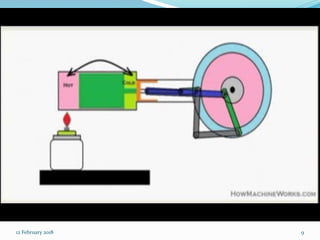
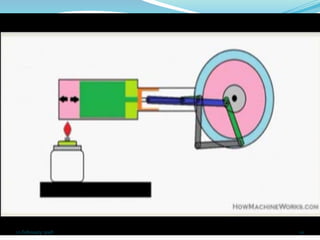
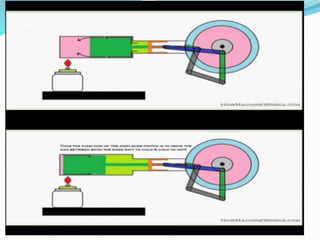
WORKING PRINCIPLE
It is an external combustion engine
The key principle of a Stirling engine is that a fixed
amount of a gas is sealed inside the engine.
The working of Stirling engine is similar to any other
engine:-
Alternate compression at low temperature and
expansion at high temperature.
12 February 2018 8
12 February 2018 9
12 February 2018 10
12 February 2018 11
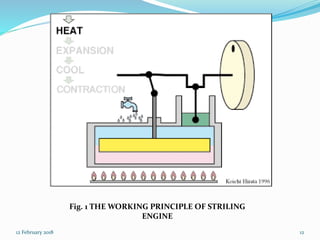
Fig. 1 THE WORKING PRINCIPLE OF STRILING
ENGINE
12 February 2018 12
TYPES OF STIRLING ENGINE
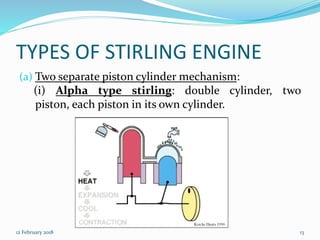
(a) Two separate piston cylinder mechanism:
(i) Alpha type stirling: double cylinder, two
piston, each piston in its own cylinder.
12 February 2018 13
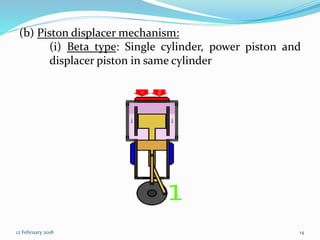
(b) Piston displacer mechanism:
(i) Beta type: Single cylinder, power piston and
displacer piston in same cylinder
12 February 2018 14
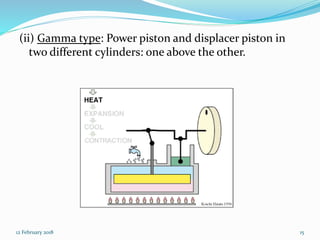
(ii) Gamma type: Power piston and displacer piston in
two different cylinders: one above the other.
12 February 2018 15
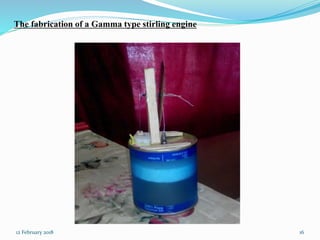
The fabrication of a Gamma type stirling engine
Fig.5 Constructed Gamma stirling engine
12 February 2018 16
PARTS OF THE STIRLING ENGINE
 Hot side heat exchanger
 Cold side heat exchanger
 Displacer piston
 Flywheel
 Power piston
12 February 2018 17
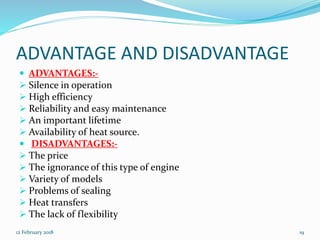
Working of the constructed
engine
1. The heat obtained from the source gives
heat energy to the working substance
(air).
2. The air expands and moves the displacer
piston towards the crank end side.
3. The hot air passes past the piston and
expands the air and also moves the power
piston (a flexible diaphragm is used here)
4. Due to expansion, the air cools down
5. Due to inertia of the flywheel, the pistons
continue to move and drives the air to the
heating zone
6. The cycle is continued
7. The output power is obtained from the
power piston.
12 February 2018 18
ADVANTAGE AND DISADVANTAGE
 ADVANTAGES:-
 Silence in operation
 High efficiency
 Reliability and easy maintenance
 An important lifetime
 Availability of heat source.
 DISADVANTAGES:-
 The price
 The ignorance of this type of engine
 Variety of models
 Problems of sealing
 Heat transfers
 The lack of flexibility
12 February 2018 19
APPLICATIONS
The stirling engine has many applications like
 Heating & Cooling in Underwater power systems
 Function in reverse as a heat pump for heating or
cooling
 Solar power generation
 Stirling cryocoolers
 Marine engines
 Low power aviation engines
 Low temperature difference engines
12 February 2018 20
IMPLEMENTATION IN INDUSTRIES
Stirling engines can run directly on any available
heat source, from solar, geothermal,etc.
 Electricity production
 Alternate for motors
 Dual power output to increase engine efficiency
 Fuel saver
 Alternate for air conditioner
12 February 2018 21
CONCLUSION
 Even though output of engine is not sufficient to run
an entire vehicle but it can be used a secondary engine
in automobiles, and for all industrial light duty
operations. Hence the objective of designing and
manufacturing of the engine was successful and can be
implemented as a replacement for low power motors.
It’s been proved that running costs of the engine is also
very less. This will help to minimize the use of fuel and
reduce air pollution
12 February 2018 22
References:-
1. Andy Ross, Making stirling engines, 3rd edition, 1997 at
http://StirlingBuilder.com
2. Caleb C., A low temperature differential stirling engine for power
generation, M. E. Thesis, Lloyd University of Canterbury, 2009
3. Yonus A. Cengel, Michael A. Boles , Thermodynamics An Engineering
Approach
4. http://www.stirlingbuilder.com/new-pop-can-engine
12 February 2018 23
THANK
YOU
12 February 2018 24

Construction and working of a Stirling engine model

  • 1.
    Title of theMini Project Construction and Working of a Stirling engine model By LAKSHI NANDAN BORAH(DC2013BTE0140) GUIDE:- Asst. Prof. Pallav Gogoi
  • 2.
    ENGINE An engine isa machine designed to convert one form of energy into mechanical energy. 12 February 2018 2
  • 3.
    TYPES OF ENGINE INTERNAL COMBUSTION: An internal combustion engine (ICE) is a heat engine where the combustion of a fuel occurs with an oxidizer (usually air) in a combustion chamber that is an integral part of the working fluid flow circuit.  EXTERNAL COMBUSTION: An external combustion engine (EC engine) is a heat engine where a working fluid, contained internally, is heated by combustion in an external source, through the engine wall or a heat exchanger. 12 February 2018 3
  • 4.
    CLASSIFICATION OF ICENGINE  CYCLE OF OPERATION  CYCLE OF COMBUSTION  ARRANGEMENT OF CYLINDER  USES  FUEL USED  SPEED OF ENGINE  METHOD OF IGNITION  COOLING OF CYLINDER  NUMBER OF CYLINDER  METHOD OF GOVERNING  VALVE ARRANGEMENT 12 February 2018 4
  • 5.
    CLASSIFICATION OF EXTERNAL COMBUSTIONENGINE  STEAM ENGINE  STRILING ENGINE 12 February 2018 5
  • 6.
    HISTORY OF STIRLINGENGINE Inventor = Robert Stirling (1790 - 1878) Sought to replace the steam turbines of his days due to frequent explosion caused by unsustainable high pressure, killing and injuring workers Invented Stirling engine in 1816 which did not explode and produced more power than the steam engines used at that time. 12 February 2018 6
  • 7.
    INTRODUCTION TO STIRLING ENGINE It is an external heat combustion where heat is provided outside the cylinder.  It operates by continuous cyclic compression and expansion of air.  The working fluid is subjected to different temperature levels so that there is a net conversion of heat energy to mechanical work.  In this engine the working fluid is constantly held inside the cylinder so the system is in thermal equilibrium.  It is different from other heat engines by means of regenerator through which hot gases move from one chamber to another chamber. 12 February 2018 7
  • 8.
    WORKING PRINCIPLE It isan external combustion engine The key principle of a Stirling engine is that a fixed amount of a gas is sealed inside the engine. The working of Stirling engine is similar to any other engine:- Alternate compression at low temperature and expansion at high temperature. 12 February 2018 8
  • 9.
  • 10.
  • 11.
  • 12.
    Fig. 1 THEWORKING PRINCIPLE OF STRILING ENGINE 12 February 2018 12
  • 13.
    TYPES OF STIRLINGENGINE (a) Two separate piston cylinder mechanism: (i) Alpha type stirling: double cylinder, two piston, each piston in its own cylinder. 12 February 2018 13
  • 14.
    (b) Piston displacermechanism: (i) Beta type: Single cylinder, power piston and displacer piston in same cylinder 12 February 2018 14
  • 15.
    (ii) Gamma type:Power piston and displacer piston in two different cylinders: one above the other. 12 February 2018 15
  • 16.
    The fabrication ofa Gamma type stirling engine Fig.5 Constructed Gamma stirling engine 12 February 2018 16
  • 17.
    PARTS OF THESTIRLING ENGINE  Hot side heat exchanger  Cold side heat exchanger  Displacer piston  Flywheel  Power piston 12 February 2018 17
  • 18.
    Working of theconstructed engine 1. The heat obtained from the source gives heat energy to the working substance (air). 2. The air expands and moves the displacer piston towards the crank end side. 3. The hot air passes past the piston and expands the air and also moves the power piston (a flexible diaphragm is used here) 4. Due to expansion, the air cools down 5. Due to inertia of the flywheel, the pistons continue to move and drives the air to the heating zone 6. The cycle is continued 7. The output power is obtained from the power piston. 12 February 2018 18
  • 19.
    ADVANTAGE AND DISADVANTAGE ADVANTAGES:-  Silence in operation  High efficiency  Reliability and easy maintenance  An important lifetime  Availability of heat source.  DISADVANTAGES:-  The price  The ignorance of this type of engine  Variety of models  Problems of sealing  Heat transfers  The lack of flexibility 12 February 2018 19
  • 20.
    APPLICATIONS The stirling enginehas many applications like  Heating & Cooling in Underwater power systems  Function in reverse as a heat pump for heating or cooling  Solar power generation  Stirling cryocoolers  Marine engines  Low power aviation engines  Low temperature difference engines 12 February 2018 20
  • 21.
    IMPLEMENTATION IN INDUSTRIES Stirlingengines can run directly on any available heat source, from solar, geothermal,etc.  Electricity production  Alternate for motors  Dual power output to increase engine efficiency  Fuel saver  Alternate for air conditioner 12 February 2018 21
  • 22.
    CONCLUSION  Even thoughoutput of engine is not sufficient to run an entire vehicle but it can be used a secondary engine in automobiles, and for all industrial light duty operations. Hence the objective of designing and manufacturing of the engine was successful and can be implemented as a replacement for low power motors. It’s been proved that running costs of the engine is also very less. This will help to minimize the use of fuel and reduce air pollution 12 February 2018 22
  • 23.
    References:- 1. Andy Ross,Making stirling engines, 3rd edition, 1997 at http://StirlingBuilder.com 2. Caleb C., A low temperature differential stirling engine for power generation, M. E. Thesis, Lloyd University of Canterbury, 2009 3. Yonus A. Cengel, Michael A. Boles , Thermodynamics An Engineering Approach 4. http://www.stirlingbuilder.com/new-pop-can-engine 12 February 2018 23
  • 24.