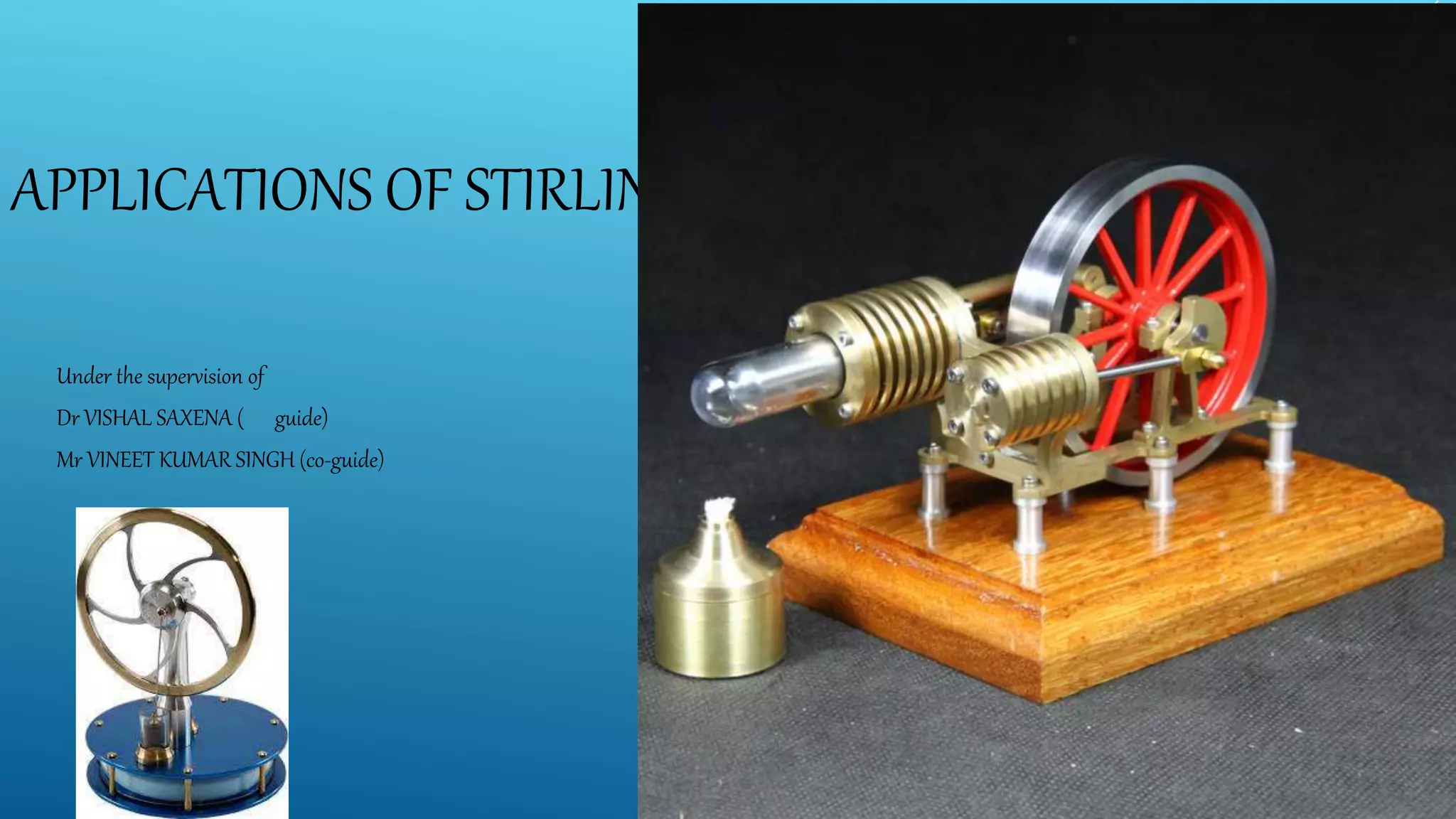
APPLICATIONS OF STIRLING ENGINE
Under the supervision of
Dr VISHAL SAXENA ( guide)
Mr VINEET KUMAR SINGH (co-guide)
 INTRODUCTION
 Application of Stirling engine range from mechanical propulsion to heating
and cooling to electrical generation systems.
 A Stirling engine is a heat engine operating by cyclic compression and expansion
of air or other gas, the "working fluid", at different temperature levels such that
there is a net conversion of heat to mechanical work.[1][2]
 The Stirling cycle heat engine can also be driven in reverse, using a mechanical
energy input to drive heat transfer in a reversed direction (i.e. a heat pump, or
refrigerator)
PROCESS IN STIRLING ENGINE
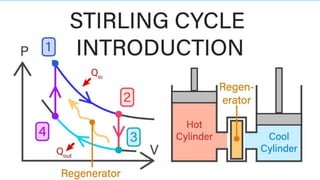
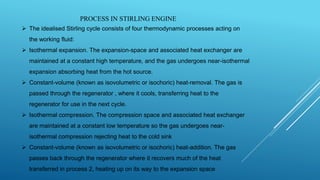
 The idealised Stirling cycle consists of four thermodynamic processes acting on
the working fluid:
 Isothermal expansion. The expansion-space and associated heat exchanger are
maintained at a constant high temperature, and the gas undergoes near-isothermal
expansion absorbing heat from the hot source.
 Constant-volume (known as isovolumetric or isochoric) heat-removal. The gas is
passed through the regenerator , where it cools, transferring heat to the
regenerator for use in the next cycle.
 Isothermal compression. The compression space and associated heat exchanger
are maintained at a constant low temperature so the gas undergoes near-
isothermal compression rejecting heat to the cold sink
 Constant-volume (known as isovolumetric or isochoric) heat-addition. The gas
passes back through the regenerator where it recovers much of the heat
transferred in process 2, heating up on its way to the expansion space
1.Automotive engines
 Automobiles exclusively powered by Stirling engines were developed in test
projects by NASA, as well as earlier projects by the Ford Motor Company using
engines provided by Philips,[6] and by American Motors Corporation (AMC) with
several cars equipped with units from Sweden's United Stirling built under a
license from Philips. The NASA vehicle test projects were designed by
contractors and designated MOD I and MOD II.
 The MOD II project in 1980 produced one of the most efficient automotive engines ever made.
 The engine reached a peak thermal efficiencyf 38.5%, compared to a modern
spark-ignition (gasoline) engine, which has a peak efficiency of 20-25%.
DRAWBACKOF STIRLING ENGINE IN AUTOMOTIVE ENGINE
1. IT IS OFTEN CLAIMED THAT THE STIRLING ENGINE HAS TOO LOW A POWER/WEIGHT
RATIO.
2. DUE TO HIGH A COST, AND TOO LONG A STARTING TIME FOR AUTOMOTIVE
APPLICATIONS
3. THEY ALSO HAVE COMPLEX AND EXPENSIVE HEAT EXCHANGERS.
4.THE MAIN DIFFICULTIES INVOLVED IN USING THE STIRLING ENGINE IN AN AUTOMOTIVE
APPLICATION ARE STARTUP TIME, ACCELERATION RESPONSE, SHUTDOWN TIME, AND
WEIGHT, NOT ALL OF WHICH HAVE READY-MADE SOLUTIONS.
1.2AIRCRAFT ENGINES
1.ROBERT MC CONAGHY CREATED THE FIRST FLYING STIRLING ENGINE-POWERED
AIRCRAFT IN AUGUST 1986.
2. THE BETA TYPE ENGINE WEIGHED 360 GRAMS, AND PRODUCED ONLY 20 WATTS OF
POWER IS USED.
1.3Marineengines
 The Stirling engine could be well suited for underwater power systems where
electrical work or mechanical power is required on an intermittent or continuous level.
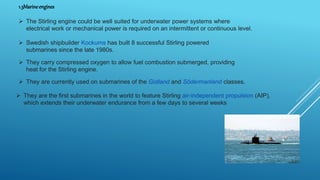
 Swedish shipbuilder Kockums has built 8 successful Stirling powered
submarines since the late 1980s.
 They carry compressed oxygen to allow fuel combustion submerged, providing
heat for the Stirling engine.
 They are currently used on submarines of the Gotland and Södermanland classes.
 They are the first submarines in the world to feature Stirling air-independent propulsion (AIP),
which extends their underwater endurance from a few days to several weeks
2.2Solar powergeneration
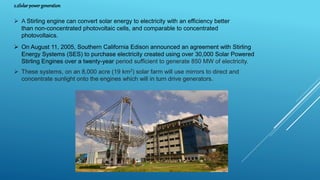
 A Stirling engine can convert solar energy to electricity with an efficiency better
than non-concentrated photovoltaic cells, and comparable to concentrated
photovoltaics.
 On August 11, 2005, Southern California Edison announced an agreement with Stirling
Energy Systems (SES) to purchase electricity created using over 30,000 Solar Powered
Stirling Engines over a twenty-year period sufficient to generate 850 MW of electricity.
 These systems, on an 8,000 acre (19 km2) solar farm will use mirrors to direct and
concentrate sunlight onto the engines which will in turn drive generators.
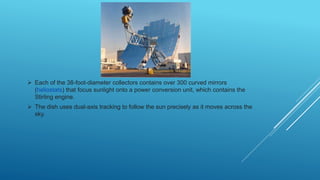
 Each of the 38-foot-diameter collectors contains over 300 curved mirrors
(heliostats) that focus sunlight onto a power conversion unit, which contains the
Stirling engine.
 The dish uses dual-axis tracking to follow the sun precisely as it moves across the
sky.
1.4Pumpengines
 Stirling engines can power pumps to move fluids like water, air and gasses. For
instance the ST-5 from Stirling Technology Inc. power output of 5 horsepower
(3.7 kW) that can run a 3 kW generator or a centrifugal water pump
2.0 Electrical power generation
2.1.Combined heat and power
 In a combined heat and power (CHP) system, mechanical or electrical power
is generated in the usual way, however, the waste heat given off by the
engine is used to supply a secondary heating application.
 According to the second law of thermodynamics, a heat engine can generate power from this
temperature difference. In a CHP system, the high-temperature primary heat enters the Stirling
engine heater, then some of the energy is converted to mechanical power in the engine, and the
rest passes through to the cooler, where it exits at a low temperature.
2.3Nuclear power
 Replacing the steam turbines of nuclear power plants with Stirling engines might
simplify the plant, yield greater efficiency.
 Also reduce the radioactive byproducts .
 A Stirling engine eliminates the need for water anywhere in the cycle.
 This would have advantages for nuclear installations in dry regions.
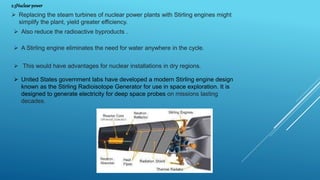
 United States government labs have developed a modern Stirling engine design
known as the Stirling Radioisotope Generator for use in space exploration. It is
designed to generate electricity for deep space probes on missions lasting
decades.
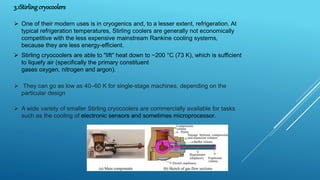
3.1Stirling cryocoolers
 One of their modern uses is in cryogenics and, to a lesser extent, refrigeration. At
typical refrigeration temperatures, Stirling coolers are generally not economically
competitive with the less expensive mainstream Rankine cooling systems,
because they are less energy-efficient.
 Stirling cryocoolers are able to "lift" heat down to −200 °C (73 K), which is sufficient
to liquefy air (specifically the primary constituent
gases oxygen, nitrogen and argon).
 They can go as low as 40–60 K for single-stage machines, depending on the
particular design
 A wide variety of smaller Stirling cryocoolers are commercially available for tasks
such as the cooling of electronic sensors and sometimes microprocessor.
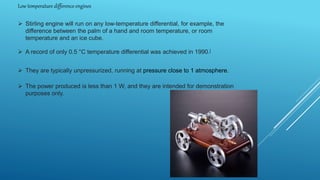
Low temperature difference engines
 Stirling engine will run on any low-temperature differential, for example, the
difference between the palm of a hand and room temperature, or room
temperature and an ice cube.
 A record of only 0.5 °C temperature differential was achieved in 1990.[
 They are typically unpressurized, running at pressure close to 1 atmosphere.
 The power produced is less than 1 W, and they are intended for demonstration
purposes only.
FUTURE SCOPE OF STIRLING ENGINE
 The future uses of this engine is SOLAR POWER GENERATION ,HEATING AND
COOLING .
 The best use of this is in DEFENCE SECTOR ,it is widely used in many
Submarines of SWEDEN .
 In future it’s demand increases due to CHP Combined Heat Power ,micro CHP.
 A wide variety of smaller Stirling cryocoolers are commercially available for
tasks such as the cooling of electronic sensors and sometimes microprocessors.

Application of Stirling engine

  • 1.
    APPLICATIONS OF STIRLINGENGINE Under the supervision of Dr VISHAL SAXENA ( guide) Mr VINEET KUMAR SINGH (co-guide)
  • 2.
     INTRODUCTION  Applicationof Stirling engine range from mechanical propulsion to heating and cooling to electrical generation systems.  A Stirling engine is a heat engine operating by cyclic compression and expansion of air or other gas, the "working fluid", at different temperature levels such that there is a net conversion of heat to mechanical work.[1][2]  The Stirling cycle heat engine can also be driven in reverse, using a mechanical energy input to drive heat transfer in a reversed direction (i.e. a heat pump, or refrigerator)
  • 4.
    PROCESS IN STIRLINGENGINE  The idealised Stirling cycle consists of four thermodynamic processes acting on the working fluid:  Isothermal expansion. The expansion-space and associated heat exchanger are maintained at a constant high temperature, and the gas undergoes near-isothermal expansion absorbing heat from the hot source.  Constant-volume (known as isovolumetric or isochoric) heat-removal. The gas is passed through the regenerator , where it cools, transferring heat to the regenerator for use in the next cycle.  Isothermal compression. The compression space and associated heat exchanger are maintained at a constant low temperature so the gas undergoes near- isothermal compression rejecting heat to the cold sink  Constant-volume (known as isovolumetric or isochoric) heat-addition. The gas passes back through the regenerator where it recovers much of the heat transferred in process 2, heating up on its way to the expansion space
  • 5.
    1.Automotive engines  Automobilesexclusively powered by Stirling engines were developed in test projects by NASA, as well as earlier projects by the Ford Motor Company using engines provided by Philips,[6] and by American Motors Corporation (AMC) with several cars equipped with units from Sweden's United Stirling built under a license from Philips. The NASA vehicle test projects were designed by contractors and designated MOD I and MOD II.  The MOD II project in 1980 produced one of the most efficient automotive engines ever made.  The engine reached a peak thermal efficiencyf 38.5%, compared to a modern spark-ignition (gasoline) engine, which has a peak efficiency of 20-25%.
  • 6.
    DRAWBACKOF STIRLING ENGINEIN AUTOMOTIVE ENGINE 1. IT IS OFTEN CLAIMED THAT THE STIRLING ENGINE HAS TOO LOW A POWER/WEIGHT RATIO. 2. DUE TO HIGH A COST, AND TOO LONG A STARTING TIME FOR AUTOMOTIVE APPLICATIONS 3. THEY ALSO HAVE COMPLEX AND EXPENSIVE HEAT EXCHANGERS. 4.THE MAIN DIFFICULTIES INVOLVED IN USING THE STIRLING ENGINE IN AN AUTOMOTIVE APPLICATION ARE STARTUP TIME, ACCELERATION RESPONSE, SHUTDOWN TIME, AND WEIGHT, NOT ALL OF WHICH HAVE READY-MADE SOLUTIONS. 1.2AIRCRAFT ENGINES 1.ROBERT MC CONAGHY CREATED THE FIRST FLYING STIRLING ENGINE-POWERED AIRCRAFT IN AUGUST 1986. 2. THE BETA TYPE ENGINE WEIGHED 360 GRAMS, AND PRODUCED ONLY 20 WATTS OF POWER IS USED.
  • 7.
    1.3Marineengines  The Stirlingengine could be well suited for underwater power systems where electrical work or mechanical power is required on an intermittent or continuous level.  Swedish shipbuilder Kockums has built 8 successful Stirling powered submarines since the late 1980s.  They carry compressed oxygen to allow fuel combustion submerged, providing heat for the Stirling engine.  They are currently used on submarines of the Gotland and Södermanland classes.  They are the first submarines in the world to feature Stirling air-independent propulsion (AIP), which extends their underwater endurance from a few days to several weeks
  • 8.
    2.2Solar powergeneration  AStirling engine can convert solar energy to electricity with an efficiency better than non-concentrated photovoltaic cells, and comparable to concentrated photovoltaics.  On August 11, 2005, Southern California Edison announced an agreement with Stirling Energy Systems (SES) to purchase electricity created using over 30,000 Solar Powered Stirling Engines over a twenty-year period sufficient to generate 850 MW of electricity.  These systems, on an 8,000 acre (19 km2) solar farm will use mirrors to direct and concentrate sunlight onto the engines which will in turn drive generators.
  • 9.
     Each ofthe 38-foot-diameter collectors contains over 300 curved mirrors (heliostats) that focus sunlight onto a power conversion unit, which contains the Stirling engine.  The dish uses dual-axis tracking to follow the sun precisely as it moves across the sky.
  • 10.
    1.4Pumpengines  Stirling enginescan power pumps to move fluids like water, air and gasses. For instance the ST-5 from Stirling Technology Inc. power output of 5 horsepower (3.7 kW) that can run a 3 kW generator or a centrifugal water pump 2.0 Electrical power generation 2.1.Combined heat and power  In a combined heat and power (CHP) system, mechanical or electrical power is generated in the usual way, however, the waste heat given off by the engine is used to supply a secondary heating application.  According to the second law of thermodynamics, a heat engine can generate power from this temperature difference. In a CHP system, the high-temperature primary heat enters the Stirling engine heater, then some of the energy is converted to mechanical power in the engine, and the rest passes through to the cooler, where it exits at a low temperature.
  • 11.
    2.3Nuclear power  Replacingthe steam turbines of nuclear power plants with Stirling engines might simplify the plant, yield greater efficiency.  Also reduce the radioactive byproducts .  A Stirling engine eliminates the need for water anywhere in the cycle.  This would have advantages for nuclear installations in dry regions.  United States government labs have developed a modern Stirling engine design known as the Stirling Radioisotope Generator for use in space exploration. It is designed to generate electricity for deep space probes on missions lasting decades.
  • 12.
    3.1Stirling cryocoolers  Oneof their modern uses is in cryogenics and, to a lesser extent, refrigeration. At typical refrigeration temperatures, Stirling coolers are generally not economically competitive with the less expensive mainstream Rankine cooling systems, because they are less energy-efficient.  Stirling cryocoolers are able to "lift" heat down to −200 °C (73 K), which is sufficient to liquefy air (specifically the primary constituent gases oxygen, nitrogen and argon).  They can go as low as 40–60 K for single-stage machines, depending on the particular design  A wide variety of smaller Stirling cryocoolers are commercially available for tasks such as the cooling of electronic sensors and sometimes microprocessor.
  • 13.
    Low temperature differenceengines  Stirling engine will run on any low-temperature differential, for example, the difference between the palm of a hand and room temperature, or room temperature and an ice cube.  A record of only 0.5 °C temperature differential was achieved in 1990.[  They are typically unpressurized, running at pressure close to 1 atmosphere.  The power produced is less than 1 W, and they are intended for demonstration purposes only.
  • 14.
    FUTURE SCOPE OFSTIRLING ENGINE  The future uses of this engine is SOLAR POWER GENERATION ,HEATING AND COOLING .  The best use of this is in DEFENCE SECTOR ,it is widely used in many Submarines of SWEDEN .  In future it’s demand increases due to CHP Combined Heat Power ,micro CHP.  A wide variety of smaller Stirling cryocoolers are commercially available for tasks such as the cooling of electronic sensors and sometimes microprocessors.