1
2
 Authors and funding source
 Background
 Objective
 Historical context
 Hypothesis
 Research questions
 Method
 Statistical analysis
 Result
 Discussion
 Conclusion
 Strength and weakness
 Recommendation
3
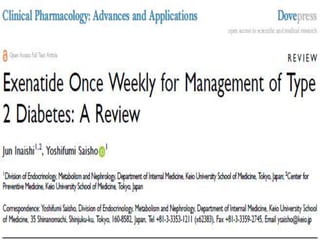
 Authors
› Jun Inaisho, Yoshifumi Saisho.
 Funding source
› Grants from the Ministry of Education, Culture,
Sports, Science and Technology (Grant Nos.
20K17542 and 21K08535).
4
 In the past two decades, new antidiabetic
medications for diabetes have been
developed and marketed, including incretin-
based therapy, which consists of two
different classes:
› Dipeptidyl peptidase-4 (DPP-4) inhibitors and
› Glucagon-like peptide-1 (GLP-1) receptor
agonists (GLP-1 RAs).
5
 DPP-4 inhibitors enhance the plasma levels
of native GLP-1 and glucose-dependent
insulinotropic polypeptide by preventing their
protolytic degradations, while GLP-1 RAs
display structural similarities to native GLP-1
and activate the GLP-1 receptor at a supra-
physiological level.
6
 Both agents can be used to manage the
blood glucose with low risk of hypoglycemia
by suppressing glucagon secretion and
enhancing insulin secretion in a glucose-
dependent manner.
 GLP-1 RAs also suppress gastric emptying
and sateity, resulting in the induction of
weight reduction.
7
 Furthermore, GLP-1 RAs were reported to
reduce cardiovascular disease (CVD)
events, ie, 3-point MACE (cardiovascular
death, non-fatal myocardial infarction, non-
fatal stroke), in several trials performed to
verify their cadiovascular safety, as well as in
a meta-analysis.
8
 In light of these evidences, the American
Diabetes Association recommends the patients
with type 2 diabetes (T2DM) and established
atherosclerotic cardiovascular disease
(ASCVD), indicators of high risk for ASCVD, or
chronic kidney disease are considered for
treatment with GLP-1 RAs.
 However, the heterogenicity of the efficacy or
safety for patients with T2DM among GLP-1
RAs remains unclear.
9
 Exenitide, one of the GLP-1 RAs, is a
synthetic GLP-1RA derived from exendin-4.
 Treatment with exenatide 2 mg once weely
(QW) as long-acting formulation was shown
to achieve a significant reduction in fasting
plasma glucose.
10
 Exendin-4 was discovered in a search for
biologically active peptides in the venom of
the Gila monster.
 This reptalian protein shares 50% amino
acid sequence identity with mammalian
GLP-1 and is resistant to DPP-4-mediated
degradation.
 Exenatide, lixisenatide and efpeglenatide
have all been developed based on exendin-
4.
11
 Although liraglutide, semaglutide,
dulaglutide, and albiglutide were based on
human GLP-1, it is unclear whether there is
any difference in the effects deriving from the
structural basis of the GLP-1RAs used for
management of T2DM.
12
 Exenatide QW was developed as long-acting
formulation with once-weekly administration and
consists of microspheres composed of a
biodegradable poly (lactide-co-glycolide) polymeric
matrix containing the peptide exenatide.
 Exenatide is slowly released from the
microspheres through diffusion and microsphere
breakdown breakdown following once-weekly
subcutaneous injection, and a steady-state plasma
concentration is reached after 6-8 weeks of
treatment.
13
 To study clinical efficacy and safety of
exenatide 2mg QW in patients with T2DM
14
 Exenatide QW failed to show a significant
cardiovascular risk reduction in a
cardiovascular outcome trial (CVOT), the
EXSCEL trail, while other GLP-1RAs have
shown positive outcomes.
15
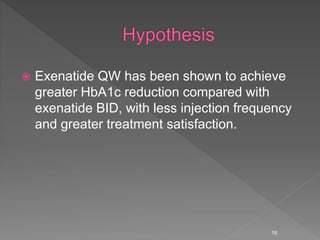
 Exenatide QW has been shown to achieve
greater HbA1c reduction compared with
exenatide BID, with less injection frequency
and greater treatment satisfaction.
16
 Why this study was conducted?
 For how long it was conducted?
 Where was it conducted?
 When it was conducted?
 What were the challenges encountered?
 Did the participants fill the eligible criteria?
 How would be applicable clinically?
 Did the authors qualified?
 How would be the expense covered?
17
 How many sample size?
 How was the method conducted?
 What type of research?
 What was the result?
18
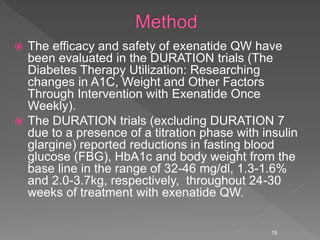
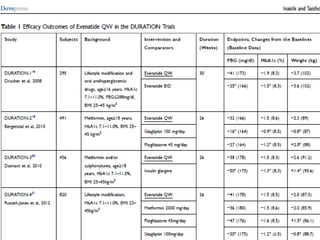
 The efficacy and safety of exenatide QW have
been evaluated in the DURATION trials (The
Diabetes Therapy Utilization: Researching
changes in A1C, Weight and Other Factors
Through Intervention with Exenatide Once
Weekly).
 The DURATION trials (excluding DURATION 7
due to a presence of a titration phase with insulin
glargine) reported reductions in fasting blood
glucose (FBG), HbA1c and body weight from the
base line in the range of 32-46 mg/dl, 1.3-1.6%
and 2.0-3.7kg, respectively, throughout 24-30
weeks of treatment with exenatide QW.
19
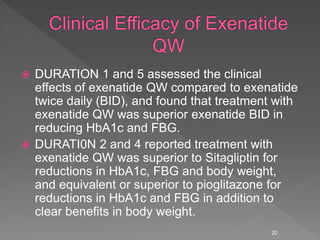
 DURATION 1 and 5 assessed the clinical
effects of exenatide QW compared to exenatide
twice daily (BID), and found that treatment with
exenatide QW was superior exenatide BID in
reducing HbA1c and FBG.
 DURATI0N 2 and 4 reported treatment with
exenatide QW was superior to Sitagliptin for
reductions in HbA1c, FBG and body weight,
and equivalent or superior to pioglitazone for
reductions in HbA1c and FBG in addition to
clear benefits in body weight.
20
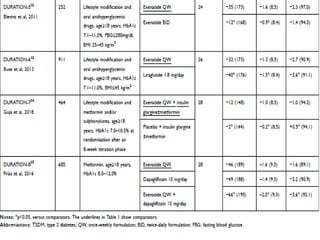
 DURATION 4 also reported treatment with
exenatide QW was equivallent to metformin for
reductions in HbA1c, FBG and body weight.
 DURATION 3 demonstrated the superiority of
treatment with exenatide QW for reductions in
HbA1c and body weight compared with insulin
glargine, inspite of the inferiority of FBG.
 DURATION 7 showed reductions in FBG, HbA1c,
and body weight of 12 mg/dl, 1.0% and 1.0 kg from
baseline respectively, in patients treated with
exenatide QW after an 8-week titration phase with
insulin glargine.
21
 DURATION 8 reported that treatment with
exenatide QW plus dapagliflozin was superior
to either drug alone for reductions in HbA1c,
FBG and body weight, demonstrating an
additive effect between these two agents.
 Both treatment with exenatide QW and
treatment with daily liraglutide 1.8 mg led to
reductions in FBG, HbA1c and body weight in
DURATION 6, and greater reductions were
noted with liraglutide.
22
 Thus, exenatide QW has been reported to body
weight, but it is not approved for treatment of
obesity, while liraglutide (3.0 mg once-daily) has
been approved for treatment of obesity by US Food
and Drug Adminstration (FDA).
 In the DURATION trials, treament for T2DM with
exenatide QW showed the clinical efficacy though
not as effective as liraglutide 1.8 mg, suggesting
that exenatide QW is an option for treament of
T2DM, but it might be used with lower priority
compared to liraglutide.
23
 The most common adverse events of GLP-
1RAs are nausea, vomiting and diarrhea,
and these adverse events associated with
exenatide QW were also most frequently
observed in the DURATION trials.
 Gastrointestinal adverse events caused by
GLP-1RAs often occur within the first month
of treatment and tend to diminish within a
couple of weeks.
24
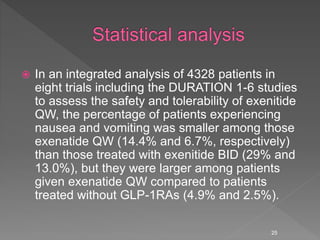
 In an integrated analysis of 4328 patients in
eight trials including the DURATION 1-6 studies
to assess the safety and tolerability of exenitide
QW, the percentage of patients experiencing
nausea and vomiting was smaller among those
exenatide QW (14.4% and 6.7%, respectively)
than those treated with exenitide BID (29% and
13.0%), but they were larger among patients
given exenatide QW compared to patients
treated without GLP-1RAs (4.9% and 2.5%).
25
26
27
 In this analysis, diarrhea was experienced by a
higher percentage of patients administered
exenatide QW (10.5%) than patients
administered exenatide BID (8.4%) or
comparators without GLP-1RAs (7.4%).
 DURATION 6 reported that nausea, vomiting
and diarrhea occurred in a smaller percentage
of patients treated with exenatide QW (9.3%,
3.7% and 6.1%, respectively) than patients with
liraglutide 1.8 mg/day (20.7%, 10.7% and
13.1%).
28
 On the other hand, adverse events related injection-site
reactions—which were mainly induration, nodule and
pruritus—were observed in greater percentage of patients
treated with exenatide QW (16-20%) compared to those
administered exenatide BID and liraglutide.
 However, cases of discontinuation due to adverse events
related to injection-site reactions seemed to be limited,
occuring in only 0.2-0.8% of patients treated with
exenatide QW.
 Thus, treatments with exenatide QW were shown to be
clinically safe, and gastrointestinal adverse events such as
nausea and vomiting were less frequent in the treatment
with exenatide QW compared to those with exenatide BID
or liraglutide.
29
 According to the
pharmacokinetic/pharmacodynamic profiles,
GLP-1RAs are categorized as either short-
acting compounds, which predominantly
suppress postprandial glucose levels by
delaying gastric emptying, or as long-acting
compounds, which predominantly reduce
fasting plasma glucose levels by stimulating
insulin secretion and suppressing glucagon
secretion.
30
 Exenatide has two formulations: a short-acting
BID formulation and a long-acting QW
formulation.
 The effects of switching from exenatide BID to
exenatide QW were elucidated by our group as
well as in studies by other authors, switching
from short- to long-acting formulations induces
reductions in FBG, and increases postprandial
hyperglycemia.
 Weights after switching were reported to be
unchanged in two of the studies.
31
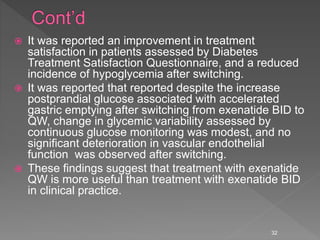
 It was reported an improvement in treatment
satisfaction in patients assessed by Diabetes
Treatment Satisfaction Questionnaire, and a reduced
incidence of hypoglycemia after switching.
 It was reported that reported despite the increase
postprandial glucose associated with accelerated
gastric emptying after switching from exenatide BID to
QW, change in glycemic variability assessed by
continuous glucose monitoring was modest, and no
significant deterioration in vascular endothelial
function was observed after switching.
 These findings suggest that treatment with exenatide
QW is more useful than treatment with exenatide BID
in clinical practice.
32
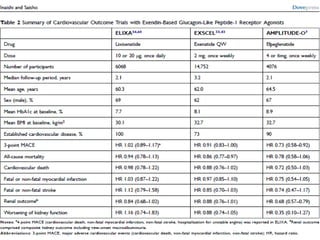
 The Exenatide Study of Cardiovascular Event
Lowering (EXSCEL) was a randomized, double-
blind and placebo-controlled trial to investigate
the cardiovascular effects of treatment with
exenatide QW in patients with T2DM.
 This trial enrolled 14,752 patients, 10,782 (73%)
of whom had CVD, and followed them for a
median 3.2 years.
 The primary outcome was evaluated a
composite endpoint of 3-point MACE, and
occurred in 839 patients (11.4%) with exenatide
QW compared 905 patients (12.2%) in the
placebo group.
33
 As a result, treatment with exenatide QW was
shown non-inferior to placebo (P<0.001), but
failed to reduce the 3-point MACE composite
compared with placebo (hazard ratio (HR) 0.91;
95% CI 0.83-1.00, P= 0.06 for superiority).
 While some GLP-1RAs such as lixisenide and
oral semaglutide also achieved no significant
reduction in CVD outcomes, other GLP-1RAs
such as liraglutide, semaglutide, albiglutide, and
dulaglutide achieved 13% (HR 0.87, 95% CI 0.78-
0.97), 26% (HR 0.74, 95% CI 0.58-0.95), 22%
(HR 0.78, 95% CI 0.68-0.90) and 12% (HR 0.88,
95% CI 0.79-0.99) reductions in the 3-point MACE
in their respective trials.
34
 Efpeglenatide, which consists of a modified
exendin-4 molecule conjugated to an IgG4 Fc
fragment, is one of the long acting GLP-1RAs.
 In the recent AMPLITUDE-O trial, treatment
with efpeglenatide 4 or 6mg QW was reported
to reduce the incidence of MACE (HR 0.73,
95% CI 0.58-0.92) and renal endpoint, as
assessed by the composite of
macroalbuminuria or a decrease in kidney
function (HR 0.68, 95% CI 0.57-0.79),
compared to placebo.
35
 Of note, the reduction in MACE in this trial was
observed regardless of using metformin or
SGLT2 inhibitor at baseline, while previous trials
included limited persons treated with an SGLT2
inhibitor.
 A recent meta-analysis of AMPLITUDE-O trial
and seven other trials, which was designed
which was designed to evaluate the
cardiovascular benefits and risks of GLP-1RAs,
reported that human and exendin-4 agents have
similar benefits for MACE regardless of the
structural basis of the GLP-1RAs.
36
 Treatment with efpeglenatide 4mg QW was
shown to reduce HbA1c and body weight
comparable to those by liraglutide 1.8mg/day.
 In the head-to-head trial of exenatide QW and
semaglutide 1.0mg QW (SUSTAIN 3), treatment
with semaglutide was superior to exenatide QW
in reducing HbA1c (-1.5% vs -0.9%), FBG (-
50mg/dl vs -36mg/dl) and body weight -56kg vs
-1.9kg) after 56 weeks of treatment.
37
 Moreover, a retrospective cohort study employing
an electronic medical record database reported
that treatment with exenatide QW achieved an
HbA1c reduction equivalent to that by dulaglutide
1.5mg, but a smaller reduction in body weight
compared to dulaglutide.
 Although, the reasons for hetrogenecity of effects
on CVD among GLP-1RAs remain unclear, the
greater efficacy for glycemic control or body eight
achieved by liraglutide (DURATION 6),
semaglutide (SUSTAIN 3) and dulaglutide
compared to exenatide QW might affect the
incidence of CVD.
38
 Indeed, a meta-analysis of 12 trials
evaluating the risk of MACE for treatment
with the newer glucose-lowering drugs,
including GLP-1RAs, suggested a relation
between the reduction of HbA1c and the
lower HR of MACE.
39
 GLP-1RAs reduced the incidence of composite renal
outcomes in several trials.
 However, this effect was driven mainly by the
reduction in albuminuria.
 It remains unclear whether GLP-1RAs are able to
improve renal outcomes such as worsening kidney
function.
 A significant reduction in renal outcomes, as
assessed by the composite of 40% estimated
glumerular filtration rate (eGFR) decline, renal death,
renal replacement and new macroalbuminuria, was
reported with exenatide QW in an adjusted analysis
(HR 0.85, 95% CI 0.73-0.98).
40
 Finally, in the post hoc EXSCEL analysis,
treatments with exenatide QW improved
both the urinary albumin excretion and eGFR
decline in subjects with elevated baseline
urinary albumin compared to placebo,
suggesting that exenatide QW reduces
urinary albumin and improves the eGFR
slope specifically in subjects with an
elevated baseline urinary albumin: creatinine
ratio.
41
 The separation of Kaplan-Meier curves for CVD
events among treatments in the trials of GLP-
1RAs appeared to occur gradually compared to
the trials of sodium-glucose cotransporter 2
(SGLT2) inhibitors such as EMPA-REG
OUTCOME trial.
 These results suggest that GLP-1RAs achieve
a reduction in CVD events through anti-
atherosclerotic effects, in contrast to
hemodynamic effects associated with SGLT2
inhibitors.
42
 A recent study demonstrated no significant
difference in carotid plaque progression for 18
months between treatment with exenatide QW
and placebo, suggesting that longer duration of
treatment with exenatide QW may be needed to
exert anti-atherosclerotic effects.
 Other possible mechanisms of cardiorenal
protection by GLP-1RAs, such as anti-
inflammatory, anti-fibrotic, anti-oxidative or
vasodilatory effects, have been noted in other
studies.
43
 GLP-1RAs are becoming the mainstay of
therapeutic strategies for T2DM based on
the positive evidence of CV benefits.
 However, within the class of GLP-1RAs,
exenatide may not be a first choice for adult
patients with T2DM, and especially for
patients at high CV risk: despite its long-term
efficacy and safety, exenatide QW has not
been clearly shown to have CV benefits.
44
 It showed Reduction in MACE regardless of
metformin or SGLT2 inhibitor at baseline
 It improved both the urinary albumin excretion
and eGFR decline in subjects with elevated
baseline urinary albumin compared to placebo
 It had treatment adherence
 It was approved for pediatric use in children
 It had neuroprotective effect
45
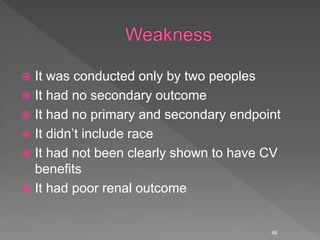
 It was conducted only by two peoples
 It had no secondary outcome
 It had no primary and secondary endpoint
 It didn’t include race
 It had not been clearly shown to have CV
benefits
 It had poor renal outcome
46
47
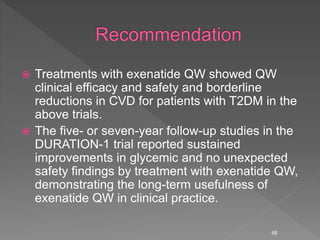
 Treatments with exenatide QW showed QW
clinical efficacy and safety and borderline
reductions in CVD for patients with T2DM in the
above trials.
 The five- or seven-year follow-up studies in the
DURATION-1 trial reported sustained
improvements in glycemic and no unexpected
safety findings by treatment with exenatide QW,
demonstrating the long-term usefulness of
exenatide QW in clinical practice.
48
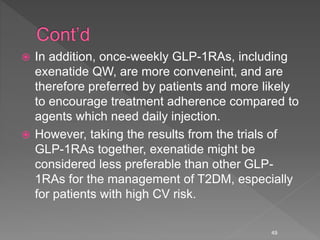
 In addition, once-weekly GLP-1RAs, including
exenatide QW, are more conveneint, and are
therefore preferred by patients and more likely
to encourage treatment adherence compared to
agents which need daily injection.
 However, taking the results from the trials of
GLP-1RAs together, exenatide might be
considered less preferable than other GLP-
1RAs for the management of T2DM, especially
for patients with high CV risk.
49
 Additionally, the FDA approved exenatide QW
for pediatric use in children aged 10 to 17 years
with T2DM based on positive phase 3 data.
 Exenatide QW was also reported to cause
weight loss in subjects aged 10 to 18 years with
obesity, and thus this agent is expected to be
effective for the management glycemia and
body weight, and to provide a new option as the
first once-weekly injectable GLP-1RA for
children and adolescents.
50
 Furthermore, exenatide QW as well as BID
was reported to exhibit positive effects on
motor scores in patients with Parkinson’s
disease, exenatide compared to the placebo.
 Although it is unclear how to improve motor
symptoms for patients with Parkinson’s
disease, exenatide is expected to have
neuroprotective effects in this disease and
other neurodegenerative disorders.
51
 Thus, further verification of the effects of
exenatide QW on children and adults with
T2DM or obesity, as well as patients with
neurodegenerative disorders, will be needed
in the future.
52
THANK YOU
53

LITERATURE EVALUATION.pptx

  • 1.
  • 2.
  • 3.
     Authors andfunding source  Background  Objective  Historical context  Hypothesis  Research questions  Method  Statistical analysis  Result  Discussion  Conclusion  Strength and weakness  Recommendation 3
  • 4.
     Authors › JunInaisho, Yoshifumi Saisho.  Funding source › Grants from the Ministry of Education, Culture, Sports, Science and Technology (Grant Nos. 20K17542 and 21K08535). 4
  • 5.
     In thepast two decades, new antidiabetic medications for diabetes have been developed and marketed, including incretin- based therapy, which consists of two different classes: › Dipeptidyl peptidase-4 (DPP-4) inhibitors and › Glucagon-like peptide-1 (GLP-1) receptor agonists (GLP-1 RAs). 5
  • 6.
     DPP-4 inhibitorsenhance the plasma levels of native GLP-1 and glucose-dependent insulinotropic polypeptide by preventing their protolytic degradations, while GLP-1 RAs display structural similarities to native GLP-1 and activate the GLP-1 receptor at a supra- physiological level. 6
  • 7.
     Both agentscan be used to manage the blood glucose with low risk of hypoglycemia by suppressing glucagon secretion and enhancing insulin secretion in a glucose- dependent manner.  GLP-1 RAs also suppress gastric emptying and sateity, resulting in the induction of weight reduction. 7
  • 8.
     Furthermore, GLP-1RAs were reported to reduce cardiovascular disease (CVD) events, ie, 3-point MACE (cardiovascular death, non-fatal myocardial infarction, non- fatal stroke), in several trials performed to verify their cadiovascular safety, as well as in a meta-analysis. 8
  • 9.
     In lightof these evidences, the American Diabetes Association recommends the patients with type 2 diabetes (T2DM) and established atherosclerotic cardiovascular disease (ASCVD), indicators of high risk for ASCVD, or chronic kidney disease are considered for treatment with GLP-1 RAs.  However, the heterogenicity of the efficacy or safety for patients with T2DM among GLP-1 RAs remains unclear. 9
  • 10.
     Exenitide, oneof the GLP-1 RAs, is a synthetic GLP-1RA derived from exendin-4.  Treatment with exenatide 2 mg once weely (QW) as long-acting formulation was shown to achieve a significant reduction in fasting plasma glucose. 10
  • 11.
     Exendin-4 wasdiscovered in a search for biologically active peptides in the venom of the Gila monster.  This reptalian protein shares 50% amino acid sequence identity with mammalian GLP-1 and is resistant to DPP-4-mediated degradation.  Exenatide, lixisenatide and efpeglenatide have all been developed based on exendin- 4. 11
  • 12.
     Although liraglutide,semaglutide, dulaglutide, and albiglutide were based on human GLP-1, it is unclear whether there is any difference in the effects deriving from the structural basis of the GLP-1RAs used for management of T2DM. 12
  • 13.
     Exenatide QWwas developed as long-acting formulation with once-weekly administration and consists of microspheres composed of a biodegradable poly (lactide-co-glycolide) polymeric matrix containing the peptide exenatide.  Exenatide is slowly released from the microspheres through diffusion and microsphere breakdown breakdown following once-weekly subcutaneous injection, and a steady-state plasma concentration is reached after 6-8 weeks of treatment. 13
  • 14.
     To studyclinical efficacy and safety of exenatide 2mg QW in patients with T2DM 14
  • 15.
     Exenatide QWfailed to show a significant cardiovascular risk reduction in a cardiovascular outcome trial (CVOT), the EXSCEL trail, while other GLP-1RAs have shown positive outcomes. 15
  • 16.
     Exenatide QWhas been shown to achieve greater HbA1c reduction compared with exenatide BID, with less injection frequency and greater treatment satisfaction. 16
  • 17.
     Why thisstudy was conducted?  For how long it was conducted?  Where was it conducted?  When it was conducted?  What were the challenges encountered?  Did the participants fill the eligible criteria?  How would be applicable clinically?  Did the authors qualified?  How would be the expense covered? 17
  • 18.
     How manysample size?  How was the method conducted?  What type of research?  What was the result? 18
  • 19.
     The efficacyand safety of exenatide QW have been evaluated in the DURATION trials (The Diabetes Therapy Utilization: Researching changes in A1C, Weight and Other Factors Through Intervention with Exenatide Once Weekly).  The DURATION trials (excluding DURATION 7 due to a presence of a titration phase with insulin glargine) reported reductions in fasting blood glucose (FBG), HbA1c and body weight from the base line in the range of 32-46 mg/dl, 1.3-1.6% and 2.0-3.7kg, respectively, throughout 24-30 weeks of treatment with exenatide QW. 19
  • 20.
     DURATION 1and 5 assessed the clinical effects of exenatide QW compared to exenatide twice daily (BID), and found that treatment with exenatide QW was superior exenatide BID in reducing HbA1c and FBG.  DURATI0N 2 and 4 reported treatment with exenatide QW was superior to Sitagliptin for reductions in HbA1c, FBG and body weight, and equivalent or superior to pioglitazone for reductions in HbA1c and FBG in addition to clear benefits in body weight. 20
  • 21.
     DURATION 4also reported treatment with exenatide QW was equivallent to metformin for reductions in HbA1c, FBG and body weight.  DURATION 3 demonstrated the superiority of treatment with exenatide QW for reductions in HbA1c and body weight compared with insulin glargine, inspite of the inferiority of FBG.  DURATION 7 showed reductions in FBG, HbA1c, and body weight of 12 mg/dl, 1.0% and 1.0 kg from baseline respectively, in patients treated with exenatide QW after an 8-week titration phase with insulin glargine. 21
  • 22.
     DURATION 8reported that treatment with exenatide QW plus dapagliflozin was superior to either drug alone for reductions in HbA1c, FBG and body weight, demonstrating an additive effect between these two agents.  Both treatment with exenatide QW and treatment with daily liraglutide 1.8 mg led to reductions in FBG, HbA1c and body weight in DURATION 6, and greater reductions were noted with liraglutide. 22
  • 23.
     Thus, exenatideQW has been reported to body weight, but it is not approved for treatment of obesity, while liraglutide (3.0 mg once-daily) has been approved for treatment of obesity by US Food and Drug Adminstration (FDA).  In the DURATION trials, treament for T2DM with exenatide QW showed the clinical efficacy though not as effective as liraglutide 1.8 mg, suggesting that exenatide QW is an option for treament of T2DM, but it might be used with lower priority compared to liraglutide. 23
  • 24.
     The mostcommon adverse events of GLP- 1RAs are nausea, vomiting and diarrhea, and these adverse events associated with exenatide QW were also most frequently observed in the DURATION trials.  Gastrointestinal adverse events caused by GLP-1RAs often occur within the first month of treatment and tend to diminish within a couple of weeks. 24
  • 25.
     In anintegrated analysis of 4328 patients in eight trials including the DURATION 1-6 studies to assess the safety and tolerability of exenitide QW, the percentage of patients experiencing nausea and vomiting was smaller among those exenatide QW (14.4% and 6.7%, respectively) than those treated with exenitide BID (29% and 13.0%), but they were larger among patients given exenatide QW compared to patients treated without GLP-1RAs (4.9% and 2.5%). 25
  • 26.
  • 27.
  • 28.
     In thisanalysis, diarrhea was experienced by a higher percentage of patients administered exenatide QW (10.5%) than patients administered exenatide BID (8.4%) or comparators without GLP-1RAs (7.4%).  DURATION 6 reported that nausea, vomiting and diarrhea occurred in a smaller percentage of patients treated with exenatide QW (9.3%, 3.7% and 6.1%, respectively) than patients with liraglutide 1.8 mg/day (20.7%, 10.7% and 13.1%). 28
  • 29.
     On theother hand, adverse events related injection-site reactions—which were mainly induration, nodule and pruritus—were observed in greater percentage of patients treated with exenatide QW (16-20%) compared to those administered exenatide BID and liraglutide.  However, cases of discontinuation due to adverse events related to injection-site reactions seemed to be limited, occuring in only 0.2-0.8% of patients treated with exenatide QW.  Thus, treatments with exenatide QW were shown to be clinically safe, and gastrointestinal adverse events such as nausea and vomiting were less frequent in the treatment with exenatide QW compared to those with exenatide BID or liraglutide. 29
  • 30.
     According tothe pharmacokinetic/pharmacodynamic profiles, GLP-1RAs are categorized as either short- acting compounds, which predominantly suppress postprandial glucose levels by delaying gastric emptying, or as long-acting compounds, which predominantly reduce fasting plasma glucose levels by stimulating insulin secretion and suppressing glucagon secretion. 30
  • 31.
     Exenatide hastwo formulations: a short-acting BID formulation and a long-acting QW formulation.  The effects of switching from exenatide BID to exenatide QW were elucidated by our group as well as in studies by other authors, switching from short- to long-acting formulations induces reductions in FBG, and increases postprandial hyperglycemia.  Weights after switching were reported to be unchanged in two of the studies. 31
  • 32.
     It wasreported an improvement in treatment satisfaction in patients assessed by Diabetes Treatment Satisfaction Questionnaire, and a reduced incidence of hypoglycemia after switching.  It was reported that reported despite the increase postprandial glucose associated with accelerated gastric emptying after switching from exenatide BID to QW, change in glycemic variability assessed by continuous glucose monitoring was modest, and no significant deterioration in vascular endothelial function was observed after switching.  These findings suggest that treatment with exenatide QW is more useful than treatment with exenatide BID in clinical practice. 32
  • 33.
     The ExenatideStudy of Cardiovascular Event Lowering (EXSCEL) was a randomized, double- blind and placebo-controlled trial to investigate the cardiovascular effects of treatment with exenatide QW in patients with T2DM.  This trial enrolled 14,752 patients, 10,782 (73%) of whom had CVD, and followed them for a median 3.2 years.  The primary outcome was evaluated a composite endpoint of 3-point MACE, and occurred in 839 patients (11.4%) with exenatide QW compared 905 patients (12.2%) in the placebo group. 33
  • 34.
     As aresult, treatment with exenatide QW was shown non-inferior to placebo (P<0.001), but failed to reduce the 3-point MACE composite compared with placebo (hazard ratio (HR) 0.91; 95% CI 0.83-1.00, P= 0.06 for superiority).  While some GLP-1RAs such as lixisenide and oral semaglutide also achieved no significant reduction in CVD outcomes, other GLP-1RAs such as liraglutide, semaglutide, albiglutide, and dulaglutide achieved 13% (HR 0.87, 95% CI 0.78- 0.97), 26% (HR 0.74, 95% CI 0.58-0.95), 22% (HR 0.78, 95% CI 0.68-0.90) and 12% (HR 0.88, 95% CI 0.79-0.99) reductions in the 3-point MACE in their respective trials. 34
  • 35.
     Efpeglenatide, whichconsists of a modified exendin-4 molecule conjugated to an IgG4 Fc fragment, is one of the long acting GLP-1RAs.  In the recent AMPLITUDE-O trial, treatment with efpeglenatide 4 or 6mg QW was reported to reduce the incidence of MACE (HR 0.73, 95% CI 0.58-0.92) and renal endpoint, as assessed by the composite of macroalbuminuria or a decrease in kidney function (HR 0.68, 95% CI 0.57-0.79), compared to placebo. 35
  • 36.
     Of note,the reduction in MACE in this trial was observed regardless of using metformin or SGLT2 inhibitor at baseline, while previous trials included limited persons treated with an SGLT2 inhibitor.  A recent meta-analysis of AMPLITUDE-O trial and seven other trials, which was designed which was designed to evaluate the cardiovascular benefits and risks of GLP-1RAs, reported that human and exendin-4 agents have similar benefits for MACE regardless of the structural basis of the GLP-1RAs. 36
  • 37.
     Treatment withefpeglenatide 4mg QW was shown to reduce HbA1c and body weight comparable to those by liraglutide 1.8mg/day.  In the head-to-head trial of exenatide QW and semaglutide 1.0mg QW (SUSTAIN 3), treatment with semaglutide was superior to exenatide QW in reducing HbA1c (-1.5% vs -0.9%), FBG (- 50mg/dl vs -36mg/dl) and body weight -56kg vs -1.9kg) after 56 weeks of treatment. 37
  • 38.
     Moreover, aretrospective cohort study employing an electronic medical record database reported that treatment with exenatide QW achieved an HbA1c reduction equivalent to that by dulaglutide 1.5mg, but a smaller reduction in body weight compared to dulaglutide.  Although, the reasons for hetrogenecity of effects on CVD among GLP-1RAs remain unclear, the greater efficacy for glycemic control or body eight achieved by liraglutide (DURATION 6), semaglutide (SUSTAIN 3) and dulaglutide compared to exenatide QW might affect the incidence of CVD. 38
  • 39.
     Indeed, ameta-analysis of 12 trials evaluating the risk of MACE for treatment with the newer glucose-lowering drugs, including GLP-1RAs, suggested a relation between the reduction of HbA1c and the lower HR of MACE. 39
  • 40.
     GLP-1RAs reducedthe incidence of composite renal outcomes in several trials.  However, this effect was driven mainly by the reduction in albuminuria.  It remains unclear whether GLP-1RAs are able to improve renal outcomes such as worsening kidney function.  A significant reduction in renal outcomes, as assessed by the composite of 40% estimated glumerular filtration rate (eGFR) decline, renal death, renal replacement and new macroalbuminuria, was reported with exenatide QW in an adjusted analysis (HR 0.85, 95% CI 0.73-0.98). 40
  • 41.
     Finally, inthe post hoc EXSCEL analysis, treatments with exenatide QW improved both the urinary albumin excretion and eGFR decline in subjects with elevated baseline urinary albumin compared to placebo, suggesting that exenatide QW reduces urinary albumin and improves the eGFR slope specifically in subjects with an elevated baseline urinary albumin: creatinine ratio. 41
  • 42.
     The separationof Kaplan-Meier curves for CVD events among treatments in the trials of GLP- 1RAs appeared to occur gradually compared to the trials of sodium-glucose cotransporter 2 (SGLT2) inhibitors such as EMPA-REG OUTCOME trial.  These results suggest that GLP-1RAs achieve a reduction in CVD events through anti- atherosclerotic effects, in contrast to hemodynamic effects associated with SGLT2 inhibitors. 42
  • 43.
     A recentstudy demonstrated no significant difference in carotid plaque progression for 18 months between treatment with exenatide QW and placebo, suggesting that longer duration of treatment with exenatide QW may be needed to exert anti-atherosclerotic effects.  Other possible mechanisms of cardiorenal protection by GLP-1RAs, such as anti- inflammatory, anti-fibrotic, anti-oxidative or vasodilatory effects, have been noted in other studies. 43
  • 44.
     GLP-1RAs arebecoming the mainstay of therapeutic strategies for T2DM based on the positive evidence of CV benefits.  However, within the class of GLP-1RAs, exenatide may not be a first choice for adult patients with T2DM, and especially for patients at high CV risk: despite its long-term efficacy and safety, exenatide QW has not been clearly shown to have CV benefits. 44
  • 45.
     It showedReduction in MACE regardless of metformin or SGLT2 inhibitor at baseline  It improved both the urinary albumin excretion and eGFR decline in subjects with elevated baseline urinary albumin compared to placebo  It had treatment adherence  It was approved for pediatric use in children  It had neuroprotective effect 45
  • 46.
     It wasconducted only by two peoples  It had no secondary outcome  It had no primary and secondary endpoint  It didn’t include race  It had not been clearly shown to have CV benefits  It had poor renal outcome 46
  • 47.
  • 48.
     Treatments withexenatide QW showed QW clinical efficacy and safety and borderline reductions in CVD for patients with T2DM in the above trials.  The five- or seven-year follow-up studies in the DURATION-1 trial reported sustained improvements in glycemic and no unexpected safety findings by treatment with exenatide QW, demonstrating the long-term usefulness of exenatide QW in clinical practice. 48
  • 49.
     In addition,once-weekly GLP-1RAs, including exenatide QW, are more conveneint, and are therefore preferred by patients and more likely to encourage treatment adherence compared to agents which need daily injection.  However, taking the results from the trials of GLP-1RAs together, exenatide might be considered less preferable than other GLP- 1RAs for the management of T2DM, especially for patients with high CV risk. 49
  • 50.
     Additionally, theFDA approved exenatide QW for pediatric use in children aged 10 to 17 years with T2DM based on positive phase 3 data.  Exenatide QW was also reported to cause weight loss in subjects aged 10 to 18 years with obesity, and thus this agent is expected to be effective for the management glycemia and body weight, and to provide a new option as the first once-weekly injectable GLP-1RA for children and adolescents. 50
  • 51.
     Furthermore, exenatideQW as well as BID was reported to exhibit positive effects on motor scores in patients with Parkinson’s disease, exenatide compared to the placebo.  Although it is unclear how to improve motor symptoms for patients with Parkinson’s disease, exenatide is expected to have neuroprotective effects in this disease and other neurodegenerative disorders. 51
  • 52.
     Thus, furtherverification of the effects of exenatide QW on children and adults with T2DM or obesity, as well as patients with neurodegenerative disorders, will be needed in the future. 52
  • 53.

Editor's Notes