Sexually Transmitted Infections
Kassahun B.
Learning Objectives
• Describe the association between STIs and HIV
• Identify the etiologies and mode of transmission of some
of the most common STIs
• Understand the major symptoms of commonly
encountered STIs
• Determine the most effective treatment approaches for
commonly encountered STIs
2
STI versus STD
• STI – Infections acquired through sexual
intercourse (may be symptomatic or
asymptomatic)
• STD – Symptomatic disease acquired through
sexual intercourse
• STI is most commonly used because it applies to
both symptomatic and asymptomatic infections
3
Introduction
 STIs are caused by more than 30 different pathogens
including bacteria, viruses, protozoa, fungus and ecto-
parasites.
 Most STIs are treatable
 However, resistance to many of the older antibiotics is a
challenge
 Other have no cure, such as herpes, genital warts, HIV
 Many STIs can lead to related conditions such as:
 Pelvic inflammatory disease
 Cervical cancer
 Complications in pregnancy
 STIs can have socio-economic consequences
 Education about these diseases and prevention are important
4
Commonly Encountered STIs
• Syphilis
• Gonorrhea
• Chlamydia
• Chancroid
• Genital Herpes
• Genital warts
• Trichomoniasis
• Lymphogranularoma Venerum
5
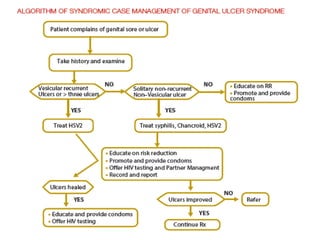
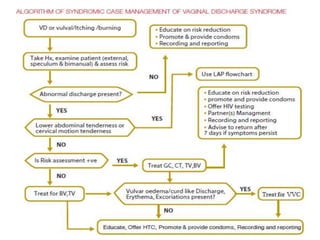
Management approach for STI
 There are three basic approaches in the management of STIs:
 Clinical Approach
 Etiologic Management: etiologic diagnosis using laboratory
tests to identify the causative agent
▪ Benefits: focused, specific therapy, avoiding the cost and
toxicity of unnecessary medications.
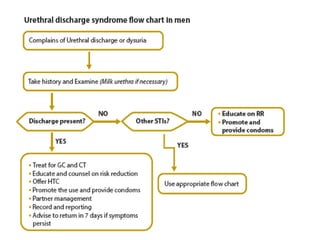
 Syndromic Management approach
▪ Considers the likely causative agent(s) for a given clinical
syndrome and treats accordingly, without regard for
identifying the specific infection.
▪ Management of STI in Ethiopia follows syndrome
approach
6
Components of syndromic management of STI
1. Drug treatment and follow-up
2. Partner notification and management
3. Health education and risk reduction
4. Condom provision and education
5. PITC
6. Abstinence from sex till all symptoms resolve
7. Recording and reporting
STI Syndromes
1. Urethral discharge or burning on urination in
men
2. Vaginal discharge
3. Genital ulcer
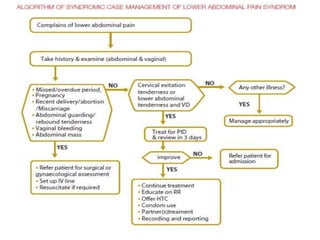
4. Lower abdominal pain in women
5. Scrotal swelling
6. Inguinal bubo
7. Neonatal Conjunctivitis
8
1. Urethral Discharge Syndrome
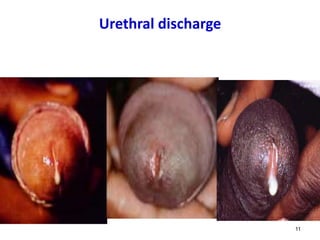
• Urethral discharge is the presence of abnormal
secretions from the distal part of the urethra and
it is the characteristic manifestation of urethritis
• The appearance of the discharge can be purulent
or mucoid, clear, white, or yellowish-green
• Accompanied by burning sensations (dysuria)
during micturition, increased frequency and
urgency of urination and itching sensation of
urethra.
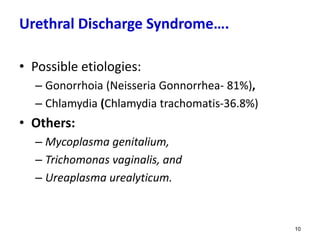
Urethral Discharge Syndrome….
• Possible etiologies:
– Gonorrhoia (Neisseria Gonnorrhea- 81%),
– Chlamydia (Chlamydia trachomatis-36.8%)
• Others:
– Mycoplasma genitalium,
– Trichomonas vaginalis, and
– Ureaplasma urealyticum.
10
Urethral discharge
11
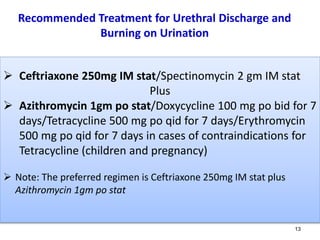
Recommended Treatment for Urethral Discharge and
Burning on Urination
13
 Ceftriaxone 250mg IM stat/Spectinomycin 2 gm IM stat
Plus
 Azithromycin 1gm po stat/Doxycycline 100 mg po bid for 7
days/Tetracycline 500 mg po qid for 7 days/Erythromycin
500 mg po qid for 7 days in cases of contraindications for
Tetracycline (children and pregnancy)
 Note: The preferred regimen is Ceftriaxone 250mg IM stat plus
Azithromycin 1gm po stat
Persistent/Recurrent Urethral Discharge
• Complain of persistent or recurrent burning sensation on
urination, with or without discharge, due to various
reasons:
– Inadequate treatment or poor compliance
– Re-infection (partner/s not managed)
– T. vaginals is also known to cause urethritis in men
– Infection by drug-resistant organisms ( N. gonorrhea)
14
Persistent/Recurrent Urethral
Discharge….
• If non-compliant or re-exposure occurs: Re-treat
with initial regimen
• If compliant with the initial regimen and re-
exposure can be excluded
– Metronidazole 2 gm po. stat/Tinidazole 1gm po once
for 3 days (Avoid Alcohol!) PLUS
– Azithromycin 1 g orally in a single dose (only if not
used during the initial episode to address doxycycline
resistant M.genitalium)
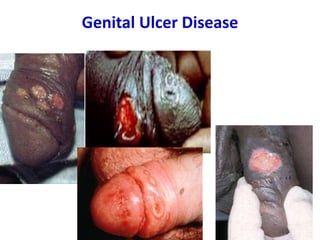
2. Genital Ulcer Diseases (GUD)
• Genital ulcer is an open sore or a break in the continuity of the skin
or mucous membrane of the genitalia
• Clinical manifestation and patterns of GUD may vary with presence
of HIV infection.
– The causes of genital ulcer are Treponema Pallidum (syphilis),
Herpes simplex virus (HSV-1 and HSV-2), Haemophilus ducreyi
(chancroid), C. trachomatis serovar L1, L2 & L3 (LGV), Chlamydia
and Klebsiella granulomatis (donovanosis)
– Most cases of genital herpes are caused by HSV-2.
– HSV2 alone was the leading cause of genital ulcer syndrome in
both males and females constituting 44% and 76% of the cases
respectively
16
Clinical manifestations
• Genital open sore or break,
• Constitutional symptoms (fever, headache,
malaise and muscular pain),
• Recurrent painful vesicles and irritations
Genital Ulcer Disease
18
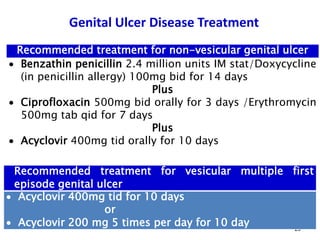
Genital Ulcer Disease Treatment
20
Recommended treatment for non-vesicular genital ulcer
 Benzathin penicillin 2.4 million units IM stat/Doxycycline
(in penicillin allergy) 100mg bid for 14 days
Plus
 Ciprofloxacin 500mg bid orally for 3 days /Erythromycin
500mg tab qid for 7 days
Plus
 Acyclovir 400mg tid orally for 10 days
Recommended treatment for vesicular multiple first
episode genital ulcer
 Acyclovir 400mg tid for 10 days
or
 Acyclovir 200 mg 5 times per day for 10 day
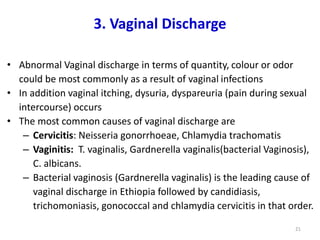
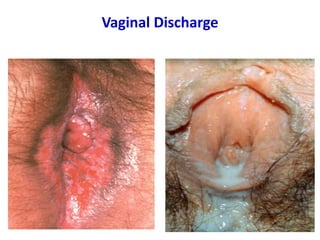
3. Vaginal Discharge
• Abnormal Vaginal discharge in terms of quantity, colour or odor
could be most commonly as a result of vaginal infections
• In addition vaginal itching, dysuria, dyspareuria (pain during sexual
intercourse) occurs
• The most common causes of vaginal discharge are
– Cervicitis: Neisseria gonorrhoeae, Chlamydia trachomatis
– Vaginitis: T. vaginalis, Gardnerella vaginalis(bacterial Vaginosis),
C. albicans.
– Bacterial vaginosis (Gardnerella vaginalis) is the leading cause of
vaginal discharge in Ethiopia followed by candidiasis,
trichomoniasis, gonococcal and chlamydia cervicitis in that order.
21
• One or more of the following are risk factors for STls related
cervicitis in Ethiopia:
 Multiple sexual partners in the last 3 months
 New sexual partner in the last 3 months
 Ever traded sex
 Age below 25 year
Vaginal Discharge
23
25
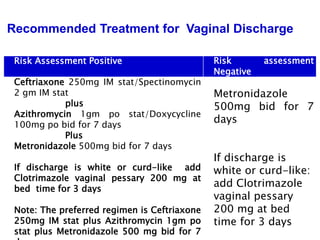
Risk Assessment Positive Risk assessment
Negative
Ceftriaxone 250mg IM stat/Spectinomycin
2 gm IM stat
plus
Azithromycin 1gm po stat/Doxycycline
100mg po bid for 7 days
Plus
Metronidazole 500mg bid for 7 days
If discharge is white or curd-like add
Clotrimazole vaginal pessary 200 mg at
bed time for 3 days
Note: The preferred regimen is Ceftriaxone
250mg IM stat plus Azithromycin 1gm po
stat plus Metronidazole 500 mg bid for 7
Metronidazole
500mg bid for 7
days
If discharge is
white or curd-like:
add Clotrimazole
vaginal pessary
200 mg at bed
time for 3 days
Recommended Treatment for Vaginal Discharge
4. Lower Abdominal Pain/Pelvic
Inflammatory Disease
• PID is ascending infection of the upper genital tract
(uterus, tubes, etc) from the cervix and/or vagina
• Common etiologies:
– Sexually transmitted:
• Neisseria gonorrhea,
• Chlamydia trachomatis,
– Others (non-STI): M. genitalium, Bacteroides species, E. coli, H.
influenza, Streptococcus
• Vaginal discharge is often present
26
28
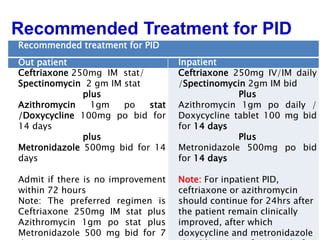
Recommended treatment for PID
Out patient Inpatient
Ceftriaxone 250mg IM stat/
Spectinomycin 2 gm IM stat
plus
Azithromycin 1gm po stat
/Doxycycline 100mg po bid for
14 days
plus
Metronidazole 500mg bid for 14
days
Admit if there is no improvement
within 72 hours
Note: The preferred regimen is
Ceftriaxone 250mg IM stat plus
Azithromycin 1gm po stat plus
Metronidazole 500 mg bid for 7
Ceftriaxone 250mg IV/IM daily
/Spectinomycin 2gm IM bid
Plus
Azithromycin 1gm po daily /
Doxycycline tablet 100 mg bid
for 14 days
Plus
Metronidazole 500mg po bid
for 14 days
Note: For inpatient PID,
ceftriaxone or azithromycin
should continue for 24hrs after
the patient remain clinically
improved, after which
doxycycline and metronidazole
Recommended Treatment for PID
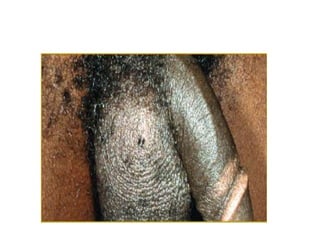
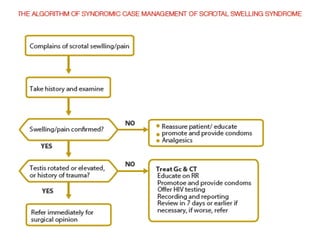
5. Scrotal Swelling
• Common STI causes of scrotal swelling are similar
to those of urethral discharge
– Neisseria gonorrhea
– Chlamydia trachomatis
• Exclude non-STI causes of scrotal swelling:
– TB
– Inguinal hernia
– Testicular torsion, etc
29
• Sign and Symptoms
Pain and swelling of the scrotum
Tender and hot scrotum on palpation
Edema and erythema of the scrotum
Dysuria
Sometimes frequency and urethral
discharge can be there
Scrotal Swelling: Recommended Therapy
• Non-Pharmacologic: scrotal support
• Pharmacologic
33
Recommend treatment for Scrotal Swelling
Ceftriaxone 250mg IM stat/ Spectinomycin 2gm IM stat
plus
Azithromycin 1gm po stat/Doxycycline 100mg bid PO
for 7 days
Note :The preferred regimen is Ceftriaxone 250mg IM
6. Inguinal Bubo
 This is a painful, fluctuant, swelling of the lymph
nodes in the inguinal region (groin)
 Swelling of inguinal lymph nodes as a result of
STIs (or other causes)
 Common causes:
 Chlamydia trachomatis (LGV)
 Hemophylus ducreyi (chancroid)
 Calymatobacterium granulomatis (granuloma inguinale)
 Treponema pallidum (syphilis)
34
Inguinal Bubo
35
Inguinal Bubo
36
Recommended treatment for Inguinal bubo
Ciprofloxacin 500mg bid for 3 days
plus
Doxycycline 100mg bid orally for 7 days/
Erythromycin 500mg qid orally for 14 days
7. Neonatal Conjunctivitis
• Infection of the eyes of the neonate as a result of
genital infection of the mother, transmitted during
birth
• Causes:
– Neisseria gonorrhea
– Chlamydia trachomatis
• Non-STIs:
– S. pneumonia,
– H. influenza,
– S. aureus.
37
Neonatal Conjunctivitis: Treatment
38
Ceftriaxone 50mg/kg or 125mg IM stat
maximum dose /
Spectinomycin 25 mg/kg IM stat maximum
dose 75mg
plus
Erythromycin 50mg/kg orally in four
divided doses for 14 days

10. STI.pptx

  • 1.
  • 2.
    Learning Objectives • Describethe association between STIs and HIV • Identify the etiologies and mode of transmission of some of the most common STIs • Understand the major symptoms of commonly encountered STIs • Determine the most effective treatment approaches for commonly encountered STIs 2
  • 3.
    STI versus STD •STI – Infections acquired through sexual intercourse (may be symptomatic or asymptomatic) • STD – Symptomatic disease acquired through sexual intercourse • STI is most commonly used because it applies to both symptomatic and asymptomatic infections 3
  • 4.
    Introduction  STIs arecaused by more than 30 different pathogens including bacteria, viruses, protozoa, fungus and ecto- parasites.  Most STIs are treatable  However, resistance to many of the older antibiotics is a challenge  Other have no cure, such as herpes, genital warts, HIV  Many STIs can lead to related conditions such as:  Pelvic inflammatory disease  Cervical cancer  Complications in pregnancy  STIs can have socio-economic consequences  Education about these diseases and prevention are important 4
  • 5.
    Commonly Encountered STIs •Syphilis • Gonorrhea • Chlamydia • Chancroid • Genital Herpes • Genital warts • Trichomoniasis • Lymphogranularoma Venerum 5
  • 6.
    Management approach forSTI  There are three basic approaches in the management of STIs:  Clinical Approach  Etiologic Management: etiologic diagnosis using laboratory tests to identify the causative agent ▪ Benefits: focused, specific therapy, avoiding the cost and toxicity of unnecessary medications.  Syndromic Management approach ▪ Considers the likely causative agent(s) for a given clinical syndrome and treats accordingly, without regard for identifying the specific infection. ▪ Management of STI in Ethiopia follows syndrome approach 6
  • 7.
    Components of syndromicmanagement of STI 1. Drug treatment and follow-up 2. Partner notification and management 3. Health education and risk reduction 4. Condom provision and education 5. PITC 6. Abstinence from sex till all symptoms resolve 7. Recording and reporting
  • 8.
    STI Syndromes 1. Urethraldischarge or burning on urination in men 2. Vaginal discharge 3. Genital ulcer 4. Lower abdominal pain in women 5. Scrotal swelling 6. Inguinal bubo 7. Neonatal Conjunctivitis 8
  • 9.
    1. Urethral DischargeSyndrome • Urethral discharge is the presence of abnormal secretions from the distal part of the urethra and it is the characteristic manifestation of urethritis • The appearance of the discharge can be purulent or mucoid, clear, white, or yellowish-green • Accompanied by burning sensations (dysuria) during micturition, increased frequency and urgency of urination and itching sensation of urethra.
  • 10.
    Urethral Discharge Syndrome…. •Possible etiologies: – Gonorrhoia (Neisseria Gonnorrhea- 81%), – Chlamydia (Chlamydia trachomatis-36.8%) • Others: – Mycoplasma genitalium, – Trichomonas vaginalis, and – Ureaplasma urealyticum. 10
  • 11.
  • 13.
    Recommended Treatment forUrethral Discharge and Burning on Urination 13  Ceftriaxone 250mg IM stat/Spectinomycin 2 gm IM stat Plus  Azithromycin 1gm po stat/Doxycycline 100 mg po bid for 7 days/Tetracycline 500 mg po qid for 7 days/Erythromycin 500 mg po qid for 7 days in cases of contraindications for Tetracycline (children and pregnancy)  Note: The preferred regimen is Ceftriaxone 250mg IM stat plus Azithromycin 1gm po stat
  • 14.
    Persistent/Recurrent Urethral Discharge •Complain of persistent or recurrent burning sensation on urination, with or without discharge, due to various reasons: – Inadequate treatment or poor compliance – Re-infection (partner/s not managed) – T. vaginals is also known to cause urethritis in men – Infection by drug-resistant organisms ( N. gonorrhea) 14
  • 15.
    Persistent/Recurrent Urethral Discharge…. • Ifnon-compliant or re-exposure occurs: Re-treat with initial regimen • If compliant with the initial regimen and re- exposure can be excluded – Metronidazole 2 gm po. stat/Tinidazole 1gm po once for 3 days (Avoid Alcohol!) PLUS – Azithromycin 1 g orally in a single dose (only if not used during the initial episode to address doxycycline resistant M.genitalium)
  • 16.
    2. Genital UlcerDiseases (GUD) • Genital ulcer is an open sore or a break in the continuity of the skin or mucous membrane of the genitalia • Clinical manifestation and patterns of GUD may vary with presence of HIV infection. – The causes of genital ulcer are Treponema Pallidum (syphilis), Herpes simplex virus (HSV-1 and HSV-2), Haemophilus ducreyi (chancroid), C. trachomatis serovar L1, L2 & L3 (LGV), Chlamydia and Klebsiella granulomatis (donovanosis) – Most cases of genital herpes are caused by HSV-2. – HSV2 alone was the leading cause of genital ulcer syndrome in both males and females constituting 44% and 76% of the cases respectively 16
  • 17.
    Clinical manifestations • Genitalopen sore or break, • Constitutional symptoms (fever, headache, malaise and muscular pain), • Recurrent painful vesicles and irritations
  • 18.
  • 20.
    Genital Ulcer DiseaseTreatment 20 Recommended treatment for non-vesicular genital ulcer  Benzathin penicillin 2.4 million units IM stat/Doxycycline (in penicillin allergy) 100mg bid for 14 days Plus  Ciprofloxacin 500mg bid orally for 3 days /Erythromycin 500mg tab qid for 7 days Plus  Acyclovir 400mg tid orally for 10 days Recommended treatment for vesicular multiple first episode genital ulcer  Acyclovir 400mg tid for 10 days or  Acyclovir 200 mg 5 times per day for 10 day
  • 21.
    3. Vaginal Discharge •Abnormal Vaginal discharge in terms of quantity, colour or odor could be most commonly as a result of vaginal infections • In addition vaginal itching, dysuria, dyspareuria (pain during sexual intercourse) occurs • The most common causes of vaginal discharge are – Cervicitis: Neisseria gonorrhoeae, Chlamydia trachomatis – Vaginitis: T. vaginalis, Gardnerella vaginalis(bacterial Vaginosis), C. albicans. – Bacterial vaginosis (Gardnerella vaginalis) is the leading cause of vaginal discharge in Ethiopia followed by candidiasis, trichomoniasis, gonococcal and chlamydia cervicitis in that order. 21
  • 22.
    • One ormore of the following are risk factors for STls related cervicitis in Ethiopia:  Multiple sexual partners in the last 3 months  New sexual partner in the last 3 months  Ever traded sex  Age below 25 year
  • 23.
  • 25.
    25 Risk Assessment PositiveRisk assessment Negative Ceftriaxone 250mg IM stat/Spectinomycin 2 gm IM stat plus Azithromycin 1gm po stat/Doxycycline 100mg po bid for 7 days Plus Metronidazole 500mg bid for 7 days If discharge is white or curd-like add Clotrimazole vaginal pessary 200 mg at bed time for 3 days Note: The preferred regimen is Ceftriaxone 250mg IM stat plus Azithromycin 1gm po stat plus Metronidazole 500 mg bid for 7 Metronidazole 500mg bid for 7 days If discharge is white or curd-like: add Clotrimazole vaginal pessary 200 mg at bed time for 3 days Recommended Treatment for Vaginal Discharge
  • 26.
    4. Lower AbdominalPain/Pelvic Inflammatory Disease • PID is ascending infection of the upper genital tract (uterus, tubes, etc) from the cervix and/or vagina • Common etiologies: – Sexually transmitted: • Neisseria gonorrhea, • Chlamydia trachomatis, – Others (non-STI): M. genitalium, Bacteroides species, E. coli, H. influenza, Streptococcus • Vaginal discharge is often present 26
  • 28.
    28 Recommended treatment forPID Out patient Inpatient Ceftriaxone 250mg IM stat/ Spectinomycin 2 gm IM stat plus Azithromycin 1gm po stat /Doxycycline 100mg po bid for 14 days plus Metronidazole 500mg bid for 14 days Admit if there is no improvement within 72 hours Note: The preferred regimen is Ceftriaxone 250mg IM stat plus Azithromycin 1gm po stat plus Metronidazole 500 mg bid for 7 Ceftriaxone 250mg IV/IM daily /Spectinomycin 2gm IM bid Plus Azithromycin 1gm po daily / Doxycycline tablet 100 mg bid for 14 days Plus Metronidazole 500mg po bid for 14 days Note: For inpatient PID, ceftriaxone or azithromycin should continue for 24hrs after the patient remain clinically improved, after which doxycycline and metronidazole Recommended Treatment for PID
  • 29.
    5. Scrotal Swelling •Common STI causes of scrotal swelling are similar to those of urethral discharge – Neisseria gonorrhea – Chlamydia trachomatis • Exclude non-STI causes of scrotal swelling: – TB – Inguinal hernia – Testicular torsion, etc 29
  • 31.
    • Sign andSymptoms Pain and swelling of the scrotum Tender and hot scrotum on palpation Edema and erythema of the scrotum Dysuria Sometimes frequency and urethral discharge can be there
  • 33.
    Scrotal Swelling: RecommendedTherapy • Non-Pharmacologic: scrotal support • Pharmacologic 33 Recommend treatment for Scrotal Swelling Ceftriaxone 250mg IM stat/ Spectinomycin 2gm IM stat plus Azithromycin 1gm po stat/Doxycycline 100mg bid PO for 7 days Note :The preferred regimen is Ceftriaxone 250mg IM
  • 34.
    6. Inguinal Bubo This is a painful, fluctuant, swelling of the lymph nodes in the inguinal region (groin)  Swelling of inguinal lymph nodes as a result of STIs (or other causes)  Common causes:  Chlamydia trachomatis (LGV)  Hemophylus ducreyi (chancroid)  Calymatobacterium granulomatis (granuloma inguinale)  Treponema pallidum (syphilis) 34
  • 35.
  • 36.
    Inguinal Bubo 36 Recommended treatmentfor Inguinal bubo Ciprofloxacin 500mg bid for 3 days plus Doxycycline 100mg bid orally for 7 days/ Erythromycin 500mg qid orally for 14 days
  • 37.
    7. Neonatal Conjunctivitis •Infection of the eyes of the neonate as a result of genital infection of the mother, transmitted during birth • Causes: – Neisseria gonorrhea – Chlamydia trachomatis • Non-STIs: – S. pneumonia, – H. influenza, – S. aureus. 37
  • 38.
    Neonatal Conjunctivitis: Treatment 38 Ceftriaxone50mg/kg or 125mg IM stat maximum dose / Spectinomycin 25 mg/kg IM stat maximum dose 75mg plus Erythromycin 50mg/kg orally in four divided doses for 14 days

Editor's Notes

  • #5 Notes: Social and economic consequences of STIs: Husband abandoning infertile wives Beatings and/or divorce Financial burden of treating STIs and their complications Antibiotic resistance making low cost regimens ineffective
  • #6 Note: Bacterial vaginosis and candidiasis are also common causes of reproductive tract infections (vaginal discharge), but are not sexually transmitted (currently debatable).
  • #14 Notes: (Source: National Guideline for the Management of STIs, March 2005) The gonococcal isolates in the validation study conducted by EHNRI/MOH in Ethiopia were uniformly sensitive to ciprofloxacin making it the drug of choice. However it can not be given for pregnant women and children, in which case Spectinomycin can be used.
  • #37 Notes: Some experts advise treating inguinal bubo for three weeks (Source national guideline for the management of STIs, March 2005)