Pharmacology of
Autonomous Nervous
System
By Salahadin A.
1
Chapter objectives
• Reviewing physiology of ANS
• Identify and distinguish different classes of autonomic drugs
• Understand PKs , PDs, clinical indications, adverse effects
and contraindications of common autonomic drugs
2
ANS
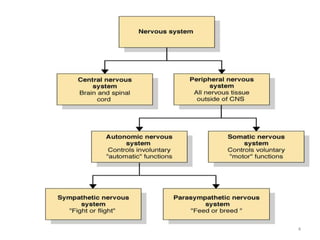
• The nervous system controls all the major functions of the
body. It is divided into central and peripheral nervous
systems. The peripheral nervous system includes the
somatic and autonomic nervous systems which control
voluntary and involuntary functions respectively.
3
4
ANS
 Autonomic nerves are composed of two neuron systems,
preganglionic and
postganglionic
A preganglionic neuron has its cell body in the
spinal cord or brain.
The postganglionic neurons send their axons directly
to the effector organs (peripheral involuntary
visceral organs).
5
ANS
The synapse is defined as a structure formed by the
close apposition of a neuron either with another
neuron or with effector cells.
6
ANS
• The ANS controls the vegetative functions of the body.
These include functions like circulation, respiration,
digestion and the maintenance of body temperature.
• The ANS is subdivided into two major sub-divisions; this
classification is based on both anatomic and physiologic
grounds; sympathetic (thoracolumbar) and
parasympathetic (craniosacral).
• The sympathetic nervous system arises from the thoracic
and lumbar areas of the spinal cord whereas
• The parasympathetic nervous system arise from the cranial
and sacral nerves
7
ANS
 In terms of function, the parasympathetic nervous system is
concerned primarily with conservation and restoration of
function.
 In contrast, the sympathetic nervous system is concerned
with the expenditure of energy, i.e., it has almost opposite
functions with parasympathetic nerve stimulation and it is
usually associated with arousal or in emergency situations,
i.e., prepares the body for fight-or-flight responses.
8
Differences b/n psNS and sNS
• Anatomical
– Origin
From brain stem and sacral segment of the spinal cord in
Parasympathetic
From thoracic and lumbar segments of the spinal cord in Sympathetic
– Ganglia
Close to effector cell in psNS
Generally close to vertebral column in sNS
– Pre and postganglionic neurons (length, ratio)
Almost one to one in parasympathetic
One to more than 20 in sympathetic
• Neurotransmitters
• Receptors
• Effects
9
10
Autonomic Neurotransmitters
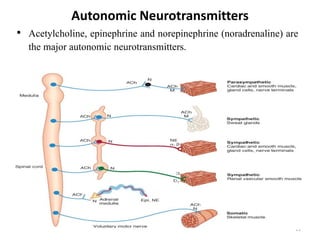
• Acetylcholine, epinephrine and norepinephrine (noradrenaline) are
the major autonomic neurotransmitters.
11
• Acetylcholine is a neurotransmitter which is
released after stimulation of the parasympathetic
nervous system to act on effector organs (cells)
to elicit their response.
• It also acts as a neurotransmitter:
 At the ganglia of both sympathetic and
parasympathetic nervous system,
 At postganlionic sympathetic nerve endings
to blood vessels of skeletal muscles and sweat
glands
 At the neuromuscular junction of skeletal
muscles (somatic motor fibers to skeletal
muscle), 12
Autonomic Neurotransmitters
• Acetylcholine is synthesized inside the cytoplasm of nerve
fibers from acetyl coenzyme A and choline through the
catalytic action of the enzyme choline acetyltransferase.
• Once synthesized, it is transported form the cytoplasm
into the vesicles to be stored; when action potential
reaches the terminal and the latter undergoes stimulation,
acetylcholine is released to the synaptic cleft.
• After release from the presynaptic terminal the molecule
binds to and activates an acetylcholine receptor
(cholinergic receptor) located on effector cell. Finally, it is
hydrolyzed into choline and acetate by acetyl
cholinesterase enzyme and thereby the action of the
13
• Cholinergic receptors are classified into
muscarinic and nicotinic receptors.
• The response of most autonomic effector cells in
peripheral visceral organs is typically muscarinic,
• whereas the responses in parasympathetic and
sympathetic ganglia, as well as responses of
skeletal muscle are nicotinic.
14
…NTs
• The effect of parasympathetic nervous
system activity in an organ may be
produced either
– By stimulation of a parasympathetic nerve
fibers supplying the organ or
– by the application of acetylcholine or
– By other parasympathomimetics to the
effector cells. This is known as cholinergic
15
…NTs
…ACh
 Cholinergic neurons:- Neurons that release
ACh
 Cholinoreceptors: are defined as those
receptors that mediate responses to
acetylcholine.
 Cholinomimetic drugs:- are those that mimic
ACh on interaction with cholinoreceptors
 Cholinoreceptor antagonists:- are drugs that
antagonize the effects of ACh
16
 Norepinephrine (NE) and epinephrine (Epi)
– NE is the neurotransmitter at sympathetic
postsynaptic neurons except those innervating
sweat glands.
– Adrenergic neurons:- that release NE and/or
Epi
– Adrenoceptors: are defined as those
receptors that mediate responses to
noradrenaline and adrenaline.
– Adrenomimetic (sympathomimetic):- drugs
that mimic NE/Epi on interaction with
adrenoceptors
– Adrenoceptor antagonists:- are drugs that
17
…NTs
• Noradrenaline is the neurotransmitter released by post
ganglionic sympathetic nerves to elicit its effect on
effectors cells.
• The post-ganglionic sympathetic fibers are called
noradrenergic or adrenergic.
• Sympathetic nerve activity may be demonstrated by
– sympathetic nerve stimulation or
– by application of noradrenaline or adrenaline or
– other sympathomimetics,
i.e. ‘adrenergic activity’, except in the case of sweat
glands and blood vessels to skeletal muscles where
acetylcholine is released as a neurotransmitter. 18
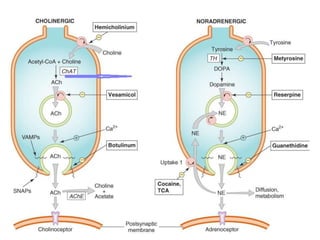
• Adrenergic neuron terminals synthesize noradrenaline,
store it in vesicles and release it to effector cells upon
stimulation of the nerve.
• The transmitter is synthesized from precursor tyrosine
(amino acid)
• Termination of noradrenergic transmission results from
several processes such as
– reuptake into the nerve terminal (reuptake1),
– diffusion away from the synaptic cleft and subsequent reuptake
into the perisynaptic glia or smooth muscle (reuptake2) or
– degradation by enzymes. 19
Steps in Neurohumoral transmission
 Synthesis of the transmitter
 Storage of the transmitter
 AP triggered release of the transmitter
 Interaction of the released transmitter with
receptors on the effector cell membrane and the
associated change in the effector cell
 Rapid removal of the transmitter from the
vicinity of the receptors
 Recovery of the effector cell to the state that
preceded transmitter action
20
Steps…cntd’
• Regardless of the type of neuron under
consideration, the fundamental steps in
chemical transmission are the same.
• Each of these steps is a potential site for
pharmacological intervention in the
normal transmission process
21
22
• There are five key features of neurotransmitter function
representing potential targets of pharmacologic therapy.
These are:
– synthesis
– storage
– release
– activation of receptors and
– termination of the action of the transmitter.
23
AUTONOMIC DRUGS
1. Drugs acting on the sympathetic nervous
system
a) Sympathomimetics or adrenergic drugs: are drugs
that mimic the effects of sympathetic nerve
stimulation.
b) Sympatholytics: are drugs that inhibit the activity
of sympathetic nerve or that of sympathomimetics.
2. Drugs acting on the parasympathetic nervous
system
a) Parasympathomimetics or cholinergic drugs: are
drugs which mimic acetylcholine or the effects of
24
Cholinergic Drugs
• Parasympathomimetics or cholinomimetics
 Stimulate parasympathetic nervous system in same
manner as does acetylcholine
 May stimulate cholinergic receptors directly or slow
acetylcholine metabolism at synapses (affect the
enzyme acetylcholinesterase)
 Useful in treating Alzheimer’s Disease, Myasthenia
gravis and to treatment of atony of the smooth
muscle of the GI system or urinary system 25
Cholinergic Drugs-Muscle
• Normal neuromuscular function, acetylcholine
binds to nicotinic receptors on cell membranes of
muscle cells to cause contraction
• Myasthenia gravis autoantibodies presumably
destroy nicotinic receptors; thus, acetylcholine
less able to stimulate muscle contraction.
• Results in severe muscle weakness.
26
Cholinergic Drugs-CNS
• Acetylcholine important neurotransmitter
affecting cognitive functioning, memory storage
and retrieval
• In Alzheimer’s disease (AD), abnormalities of the
cholinergic, serotonergic, noradrenergic, and
glutaminergic neurotransmission systems
• In cholinergic system, patient with AD found to
have loss of neurons that secrete acetylcholine
27
Cholinergic Drugs—GI effects
• Acetylcholine stimulates cholinergic receptors in
the gut to promote normal secretory and motor
activity
• Cholinergic activity in the gut will increase
peristalsis and facilitates movement of flatus and
feces
• The secretory functions of the salivary and
gastric glands also stimulated 28
Cholinergic Drugs—Renal effects
• Acetylcholine stimulates cholinergic
receptors in the urinary system to promote
urination
• Results in contraction of the detrusor
muscle and relaxation of the urinary
sphincter to facilitate emptying of the
urinary bladder
29
M1 Secretory glands salivation, stomach acid, sweating, lacrimation
M2 Heart Decreases heart rate  bradycardia
M3 Smooth muscle
(GI/Renal/Resp)
Contraction of smooth muscles (some)  diarrhea,
bronchospasm, urination
M3 Pupil and ciliary
muscle
Contracts  Miosis
Increased flow of aqueous humor
Nm Skeletal muscle
end plate
Contraction of skeletal muscle
Nn Autonomic
ganglia, Adrenal
Medulla
Secretion of Epinephrine
Controls ANS
30
Acetylcholine Receptor subtypes
Cholinergic agonists
• Parasympathomimetic drugs
• Cholinergic drugs or cholinomimetric
Cholinergic agonists are two types :
1.Direct acting
2.Indirect acting
31
Direct acting Cholinergic agonists
They act by binding directly to cholinoceptors
– Acetylcholine (Synthetic analogue of ACH)
– Carbachol
– methanchol
– Bethanechol
– Pilocarpine (naturally occurring alkaloid)
32
Mechanisms of Action—Direct Acting
Cholinergics
• Direct acting cholinergics are lipid
insoluble
• Do not readily enter the CNS so effects
are peripheral
• Resistant to metabolism by
acetylcholinesterase 33
Acetylcholine
 It is a quaternary ammonium compound so
Cannot penetrate the membrane
 Does not have any therapeutic importance,
because of multiplicity of actions & rapid
inactivation by acetylcholinesterases
 It has both Muscarinic & Nicotinic actions
 Neurotransmitter for pre-ganglionic neuron
34
Bethanechol
 Not hydrolyzed by acetylcholinesterases
 It has strong Muscarinic action & no Nicotinic
action
 Directly stimulates M receptors causing increased
intestinal motility & tone
 It stimulates detrusor muscle of the bladder while
trigone & sphincters are relaxed causing
expulsion of urine
35
» Methacoline is used to identify
bronchial hyperreactivity in patients
without clinically apparent asthma
36
Pilocarpine
An alkaloid, lipid soluble & is stable to hydrolysis
by cholinsterases
It has Muscarinic activity only.
When applied locally to cornea produces rapid
moisis & contraction of ciliary muscle produces
of spasm of accommodation & vision is fixed at
particular distance making it impossible to
focus for far situated objects
37
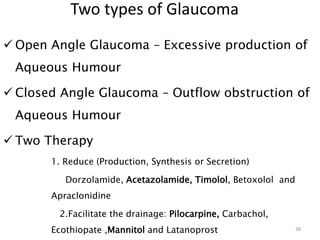
Two types of Glaucoma
 Open Angle Glaucoma – Excessive production of
Aqueous Humour
 Closed Angle Glaucoma – Outflow obstruction of
Aqueous Humour
 Two Therapy
1. Reduce (Production, Synthesis or Secretion)
Dorzolamide, Acetazolamide, Timolol, Betoxolol and
Apraclonidine
2.Facilitate the drainage: Pilocarpine, Carbachol,
Ecothiopate ,Mannitol and Latanoprost 38
Some adverse effects observed with cholinergic drugs
39
Indirect acting Cholinergic agonists
 They act through inhibition of Acetyl
cholinesterase enzyme….so increases
Acetylcholine level in the synapse
• Reversible:
– Neostigmine
– Physostigmine
– Pyridostigmine
– Edrophonium
– Tacrine
– Danopezil
40
•Irreversible :
Ecothiophate
Malathion
Parathion
Sarin
physostigmine
reversible inhibitor of cholinesterase
Stimulates muscarinic and nicotinic sites of
the autonomic nervous system and also
the nicotinic receptors of the
neuromuscular junction
intermediate-acting (2-4hr duration of
action)
is a tertiary amine
completely absorbed from the GIT
highly distributed throughout the body
it can pass the blood brain barrier 41
 Indications
Glaucoma
intestinal and bladder atony
treatment of overdoses of drugs with
anticholinergic actions
 Adverse effects:
 convulsions when high doses are used
 bradycardia and a fall in cardiac output
 accumulation of acetylcholine at NMJ
results in paralysis of skeletal muscle
 NB: However, the above adverse effects are
rarely seen with therapeutic doses 42
neostigmine
 like physostigmine, it reversibly inhibits cholinesterase
E
 but unlike physostigmine, it has additionally a direct
nicotinic action on skeletal muscle
 has a moderate duration of action, usually 30 min to 2
h
 poorly absorbed from the GIT
 poorly distributed throughout the body
 it cannot pass the blood brain barrier.
43
Indications
intestinal and bladder atony
reversal of effect of muscle
relaxants, e.g. tubocurarine
myasthenia gravis
 Adverse effects:
salivation, flushing, decreased
blood pressure, nausea,
abdominal pain, diarrhea, and
bronchospasm
44
pyridostigmine
used in the chronic management of
myasthenia gravis
durations of action are intermediate (3 to
6hrs)
adverse effect is similar to that of
neostigmine
edrophonium
Action similar to that of neostigmine
except that it is more rapidly absorbed
and has a short duration of action of 10
to 20 minutes
is a quaternary amine
used in the diagnosis of myasthenia
gravis and as antidote to tubocurarine 45
Myasthenia gravis
 An autoimmune process causes production of
antibodies that decrease the number of functional
nicotinic receptors on the post junctional end
plates.
 Common symptoms are:
– Double vision…. diplopia,
– Drooping of eyelids…. ptosis,
– Dysarthria ……Difficulty in speaking
– Dysphagia …..difficulty swallowing,
– Difficult in Daily routines
– Day passes, limb weakness increases.
– Difficulty in respiration. Severe disease may affect all
the muscles, including those necessary for respiration.
46
Cholinergic vs Myasthenic Crisis
 Extreme muscle weakness
Myasthenic crisis- requires more anticholinesterase drug
Cholinergic crisis:
• Is an overdose with a cholinesterase inhibitor
• The effects of cholinesterase inhibitors on skeletal muscle are dose
dependent
• At therapeutic doses, these drugs increase force of contraction. In
contrast, toxic doses reduce force of contraction
• requires discontinuation of the anticholinesterase drugs
• Differential Diagnosis can be made by evaluating patient
response to challenging dose of IV edrophonium, an ultrashort-
acting cholinesterase inhibitor.
– If alleviates symptoms, the crisis is Myasthenic
– If intensifies symptoms, the crisis is cholinergic
47
 Cholinesterase inhibitors in the CNS
 donepezil, tacrine,rivastigmine
–all are reversible inhibitors
–the drugs readily enter the CNS
–have been developed for use in treating
Alzheimer’s disease
• to delay the progression of the
disease, but none can stop its
progression
–gastrointestinal distress is their primary
adverse effect
48
echothiophate
is an organophosphate compound
covalently binds the active site of
acetylcholinesterase and inhibits it
irreversibly
generalized cholinergic stimulation
including paralysis of motor function
(causing breathing difficulties), and
convulsions.
intense miosis
49
• Indications
 ophthalmic solution is used in the eye for
the chronic treatment of open-angle
glaucoma. But not as a first line agent.
 Applied topically as a solution and is the
only irreversible AChEI for the treatment
of glaucoma
50
Irreversible cholinesterase inhibitors
• A number of phosphoester AChEIs have
been designed to be used as insecticides
and are beneficial in the agriculture sector
• Two important properties of these
compounds are extreme lipophilicity and
high vapor pressure
• Care must be taken to avoid skin exposure
and inhalation of these insecticides by
animals and humans
51
• Effects of poisoning by organophosphates
 the first signs are muscarinic stimulation,
followed by nicotinic receptor stimulation and
then desensitization of nicotinic receptors.
 Excessive enzyme inhibition can ultimately lead
to a cholinergic crisis that includes:
gastrointestinal distress (nausea, vomiting,
diarrhea, excessive salivation)
respiratory distress (bronchospasm and
increased bronchial secretions)
cardiovascular distress (bradycardia or
tachycardia, A-V block, hypotension)
52
visual disturbance (miosis, blurred vision)
 sweating
loss of skeletal motor function (progressing
through incoordination, muscle cramps,
weakness, fasciculation, and paralysis)
CNS symptoms include agitation, dizziness,
and mental confusion
• Death usually results from paralysis of skeletal
muscles required for respiration but may also
result from cardiac arrest
53
• Treatment of the Poisoning due to
cholinesterase inhibitors
 atropine
 injection of increasing doses of atropine
sulfate to block all adverse effects
resulting from stimulation of muscarinic
receptors.
 mechanical respiratory support
 This may be required since atropine will
not alleviate skeletal and respiratory
muscle paralysis
54
• when the poisoning is due to an
organophosphate
 Pralidoxime
 Weak AchEI
 displaces the phosphate group of the organophosphate
and
 reactivate cholinesterase in the periphery and a
decrease in the degree of the blockade at the
skeletal neuromuscular junction
» Pralidoxime has a greater effect at the
skeletal neuromuscular junction than at
autonomic effector sites.
– NB: after sometime, the enzyme-organophosphate
complex will undergo aging. After this time the
55
 Contra indications to the use of cholinomimetics
Bronchial asthma:- because they may induce
bronchial constriction and increase bronchial
secretions
Peptic ulcer disease:- b/c of the increase in
gastric acid secretion
Coronary insufficiency:- b/c the
hypotension produced will further
compromise coronary blood flow
Mechanical intestinal and urinary outlet
obstruction
56
Anticholinergics
 block the effects of Ach and other cholinergic
drugs at cholinergic receptors of effector cells.
1. Antimuscarinics: - antagonists of M receptors
– tertiary amines such as atropine,
scopolamine, tropicamide, etc.
– quaternary amines such as ipratropium,
propantheline, etc.
2. Antinicotinics:- antagonists of N receptors
 ganglion blockers such as
hexamethonium, trimethaphan, etc.
 neuromuscular blockers such as
gallamine, tubocurarine, pancuronium,
etc.
57
Indications for Use
• Helpful in treating irritable colon or colitis
• Useful in gastritis, pylorospasm and
ulcerative colitis as they slow motility
• Antispasmodic effects seen in overactive
bladder and in urinary incontinence
• In bronchospasm whether related to
asthma or COPD
58
• Those who cannot take Levodopa in PD
• Helpful in decreasing salivation, spasticity
and tremors
• Help prevent vagal stimulation and
potential bradycardia
• Reduce respiratory secretions as well
• Atropine is used to increase heart rate in
symptomatic bradycardias and higher
blocks
• Mydriatic and cycloplegia for examinations
59
Atropine
the prototype of muscarinic
antagonists
–antagonizes the effect of ACh by
competing for the muscarinic
receptors peripherally and in the
CNS
CNS:
lower doses produce sedation
higher doses produce excitation,
agitation and hallucination
Eyes:
relaxation of constrictor pupillae
(mydriasis)
relaxation or weakening of ciliary
muscle (cycloplegia-loss of ability to
accommodate) 60
 CVS:
bradycardia at low dose ??? Paradoxical
tachycardia at higher dose
 Respiratory:
bronchodilation and reduction of secretion
 GIT:
decreased motility and secretions
 GUS:
Relaxes smooth muscle of ureter and
bladder wall; voiding is slowed.
 Sweat Glands:
suppresses sweating
61
 Pharmacokinetics
is tertiary amine and well absorbed
from the GIT, conjunctiva and can
cross the BBB
 Clinical Indications
Pre anesthetic medication -to
reduce the amount of secretion and
to prevent excessive vagal tone due
to anesthesia.
As antispasmodic in cases of
intestinal, biliary, and renal colic
Heart block, Eye ,Hyperhidrosis
(too much sweating)
Antidote for cholinergic agonists
62
 Side effects
dryness of the mouth, tachycardia and
blurred vision, retention of urine
Photophobia
Hypothermia (Anhidrosis)
almost no detectable effect on the CNS in
doses that are used clinically
low doses of cholinesterase inhibitors
such as physostigmine may be used to
overcome atropine toxicity
 Contraindications
Glaucoma, Prostatic hyperplasia
Bladder outlet obstruction
63
hyoscine (scopolamine)
 is tertiary amine and has the same effect as atropine
except for some differences :-
 Unlike with atropine, CNS effects are observed at
therapeutic doses and has longer duration of CNS
action
 scopolamine has certain advantages over atropine.
These include:
 better for preanesthetic medication because of
strong antisecretory and antiemetic action and also
brings about amnesia
 can be used for short- travel motion sickness
– similar to atropine in pharmacokinetics and adverse
effects
64
ipratropium
– a quaternary amine derivative of atropine
– given via inhalation route
 Clinical indications
asthma
– in patients who are unable to take
adrenergic agonists
chronic obstructive pulmonary disease
tropicamide and cyclopentolate
like atropine to bring about mydriasis and
cycloplegia but preferred b/c of very short
duration of effect than atropine
65
• IPRATROPIUM AND TIOTROPIUM
pending approval for use in bronchial
asthma.
Ipratropium also has an FDA-approved
indication for perennial- and common
cold-associated rhinorrhea
• PIRENZEPINE, possessing partial
receptor selectivity and used in the
treatment of acid-peptic disease in
some countries
• Adverse effects commonly observed
with cholinergic antagonists 66
 Ganglionic Blockers
 act on the nicotinic receptors of both
sympathetic and parasympathetic autonomic
ganglia
 but show no selectivity
 the responses observed are complex and
unpredictable, making it impossible to
achieve selective actions. Therefore,
» ganglionic blockade is rarely used
therapeutically
»often serve as tools in experimental
pharmacology
67
nicotine
is effective in reducing the craving for
nicotine in people who wish to stop
smoking
–available as patches, lozenges, gums,
and other forms
mecamylamine
primarily used to lower blood
pressure in emergency situations
–can be absorbed when given orally
68
Neuromuscular blocking drugs
• Block synaptic transmission at the
neuromuscular junction
• Affect synaptic transmission only at
skeletal muscle
–Does not affect nerve transmission,
action potential generation
• Act at nicotinic acetylcholine receptor Nm
69
NMB are classified as:
I)Peripherally acting
• Depolarizing muscle relaxants.
• Non-depolarizing muscle relaxants
II)Centrally acting
o Diazepam, Baclofen
70
Depolarizing Muscle relaxants:
 Succinylcholine (short acting)
Non-depolarizing Muscle relaxants:
Short acting:
 Mivacurium
Intermediate –acting:
 Atracurium,
 Cisatracurium,
 Vecuronium,
 Rocuronium
Long acting :
 Doxacurium
 Pancuronium
 Pipecuronium
71
Clinical Use
• Anesthesia:
– facilitate tracheal intubation
– paralysis for surgery + mechanical
ventilation
• ICU:
– status epilepticus
–  ICP
–  shivering
72
 central muscle relaxants
– are another group of muscle relaxants
are used to control spastic muscle tone
due to different acute or chronic
conditions but not for muscle relaxation
in surgery
– These include:
diazepam- binds at -aminobutyric acid
(GABA) receptors of the CNS
baclofen- acts at GABA receptors in the
CNS
73
dantrolene sodium
– acts directly on muscle to prevent the
release of calcium from sarcoplasm stores
– is active orally, although its absorption is
slow
used in the treatment of spasticity due to
stroke, spinal injury, multiple sclerosis, or
cerebral palsy
It is also the drug of choice in prophylaxis
or treatment of malignant hyperthermia
»given IV when treating an attack of
malignant hyperthermia
– main side effect is dose-dependent muscle
weakness and hepatotoxicity
74
Drugs acting on the sympathetic nervous system
a. Sympathomimetics or adrenergic
drugs
b. Sympatholytics: -
75
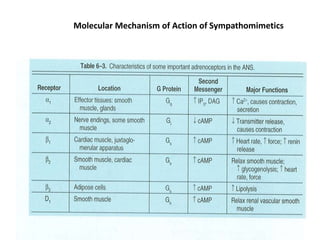
Molecular Mechanism of Action of Sympathomimetics
79
• In vascular smooth muscle.
– α1 stimulation cause VC :
–α1 – adrenoreceptor are the most
determine of arteriolar tone.
–When α1 stimulated no others receptors
have an effects on BP. So, hypertension
may be treated by blocking α1
–Vasoconstriction in the nasal blood
vessels cause relief congestion
• In the radial muscle of iris.
– α1 stimulation causes contraction of the radial
muscle causing mydriasis (dilation of the pupil)
80
β 2 – adrenoceptor
Site of β 2–adrenoceptor & the effects of their stimulation
• In the bronchial smooth muscle (very important
clinically).
– β2 stimulation causes relaxation of smooth
muscle (bronchodilatation)
• In the smooth muscle of blood vessels supplying
the skeletal muscle.
– β2 stimulation causes relaxation of smooth
muscle (Vasodilatation)
• This VD effects is usually masked by the
potent VC effect of α1 – receptors
85
Cont…
• In ciliary muscle.
– β2 stimulation causes relaxation of the ciliary muscle
leading to
• Accommodation for far vision
• Decrease outflow of aqueous humor via the canal of
Schlemm
• In the ciliary epithelium
–β2 stimulation causes increased production of
aqueous humor
Can we use β2 -adrenergic agonists for glaucoma?
88
Catecholamine
Non
catecholamines
Drug Receptor
stimulated
Drug Receptor
stimulated
Adrenaline α1, α2, β1, β2
Ephedrine α1, α2, β1, β2
Noradrenaline α1, α2, β1
Phenylephrine α1
Isoprenaline β1, β2
Terbutaline β2
Dopamine β1, DA
89
• can be grouped by mode of action
Direct acting: directly interact with and
activate adrenoreceptors, e.g., adrenaline
and noradrenaline
Indirect acting : their actions are dependent
on the release of endogenous
catecholamines.
i. Induction of release, e.g.,
amphetamine, tyramine
ii. inhibition of reuptake , e.g. cocaine,
tricyclic antidepressants
90
Epinephrine
• EP is released from adrenal medulla 80% and in
certain areas of the brain
• EP is a direct acting non-selective adrenergic
agonist in all receptors including β2 receptor.
• T1/2 = 2 – 5 min
• Like NE, It is given parenterally (SC, I.V and I.M) not
orally
• Does PK of Epinephrine different from NE?
92
Epinephrine
Therapeutic use
• Epinephrine is commonly used in practice as
compared to NE.
• In bronchial asthma
– Now it is not commonly used because of its
side effects (tachycardia and arrhythmia)
• In cardiogenic shock
– It is given I.V to increase SBP, BP, HR and
Cardiac Output
93
• In anaphylactic shock
– It is given SC to act on
• α1 cause VC, lead to increase BP & relief of
congestion
• β 1 cause increase HR leading to increase
CO, so, increase BP
• β 2 cause bronchodilation so, relieve
bronchospasm
94
Cont…
• In cardiac arrest (for Bradycardia)
• During surgery
– EP is added to the local anesthetic to cause VC
in the surgery area in order to
• Decrease bleeding
• Decrease the amount of local anesthetic
which will reach the systemic circulation.
Therefore, it will decrease the cardio
depressant effect of the local anesthetic
95
 Adverse effects
 hypertensive crisis
Arrhythmias, Angina
necrosis of the extremities
Hyperglycemia
anxiety, restlessness, headache ,
tremor
 Contra indications
– coronary diseases
– hyperthyroidism
– hypertension
– digitalis therapy
– injection around end arteries
96
Dopamine
– is immediate metabolic precursor of NE
and occurs naturally in the CNS as well as
in the adrenal medulla
– can activate  and ß adrenergic receptors
– Activate D1 and D2 dopaminergic
receptors found in peripheral mesenteric
and renal vascular beds and produce
vasodilation
– D2 receptors are also found on
presynaptic adrenergic neurons, where
their activation interferes with
norepinephrine release.
98
– effect on the ß1
• having both inotropic and chronotropic
effects
– 1 receptors
• at very high doses dopamine activates
receptors on the vasculature, resulting in
vasoconstriction
– dopaminergic receptors
• dilates renal and splanchnic arterioles by
activating dopaminergic receptors, thus
increasing blood flow to the kidneys and
other viscera
–Therefore, dopamine is clinically useful in
the treatment of shock, in which 99
Cont….
Dobutamine
• It is direct acting β 1 – selective agonist
(only)
• T1/2 = 10 – 15 min
• It is metabolized in the liver by oxidative
deamination
• There is tolerance to its action
• Given only parenterally (not orally)
• It causes increases in CO with minimal
effect on HR.
• It has less arrhythmogenic effects than
dopamine
• Uses: Inotropic agent for Heart Failure; in
septic and cardiogenic shock. 103
Salbutamol
• It is β2 – selective agonist
• Can be used orally, IV and by inhalation
• Clinical Uses
• Formulations: (Tablets; Syrup; Injection;
solution and Inhalation)
– bronchial asthma by β2 stimulation, which
leads to relaxation of bronchial smooth
muscle and bronchodilation.
– Treatment of refractory hyperkalemia (I.V)
104
Salmeterol and formeterol
– ß2-adrenergic selective, long-acting
bronchodilators
–the agents of choice for treating
nocturnal asthma in symptomatic
patients taking other asthma
medications
– Single inhalation dose has bronchodilation
over 12 hours, compared with less than 3
hours for albuterol
– salmeterol has a somewhat delayed onset of
action than formeterol
107
– Cause NE release from presynaptic
terminals or inhibit its uptake
– Potentiate the effects of norepinephrine
produced endogenously, but these
agents do not directly affect
postsynaptic receptors
 Amphetamine,
 tyramine
– enter the nerve terminal and displace
stored NE
– it is not a clinically useful drug but can
be found in foods
 cocaine- affects uptake of NE 111
Indirect-Acting Adrenergic Agonists
Amphetamine
• It is non-selective adrenergic agonist, non-
catecholamine
– Acts mainly, indirectly via enhancing NE
release
– Since it is non-catecholamine, it can be given
orally
– It is lipid–soluble enough to be absorbed from
intestines and goes to all parts including CNS
112
Clinical use of Amphetamine-like drugs
• To suppress appetite
– In very obese persons Amphetamine can act
centrally on the hunger center in the
hypothalamus to suppress appetite
• In narcolepsy
– Narcolepsy is irresistible attacks of sleep
during the day in spite of enough sleep at
night
– Amphetamine stimulates the CNS & make the
patient awake
• In ADHD “Attention Deficit Hyperactivity Disease”
113
Adrenergic Antagonists
• prevent stimulation of adrenergic receptors from
neurotransmitters or drugs
Alpha Adrenergic Blocker
  non selective- blocker: eg
phenoxybenzamine and phentolamine
  1 selective- bloker: eg Prazosin and
terazosin
Therapeutic applications of Alpha blockade
a) Treatment of hypertension
b) Reversal of toxicity caused by Alpha1
Agonists
c) Treatment of Pheochromocytoma 114
Adverse Effect of Alpha Blockade
1) Orthostatic (postural) hypotension
2) Nasal congestion
3) Inhibition of Ejaculation
4) Reflex tachycardia
115
Beta blockers
–β1-selective:
 metoprololol
 acebutolol
 atenolol
 betaxolol
 esmolol
–β-non selective blockers:
 propranolol
 Pindolol
 Timolol
 nadolol
117
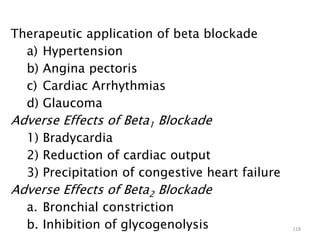
Therapeutic application of beta blockade
a) Hypertension
b) Angina pectoris
c) Cardiac Arrhythmias
d) Glaucoma
Adverse Effects of Beta1 Blockade
1) Bradycardia
2) Reduction of cardiac output
3) Precipitation of congestive heart failure
Adverse Effects of Beta2 Blockade
a. Bronchial constriction
b. Inhibition of glycogenolysis 118
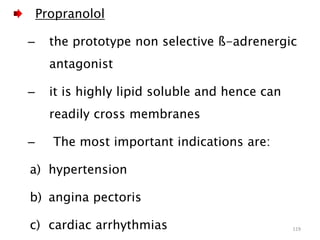
Propranolol
– the prototype non selective ß-adrenergic
antagonist
– it is highly lipid soluble and hence can
readily cross membranes
– The most important indications are:
a) hypertension
b) angina pectoris
c) cardiac arrhythmias 119
 Adverse Effects:
Bradycardia, bronchoconstriction, inhibit
glycogenolysis, HF,
 Central nervous system effects: nightmares,
hallucinations and depression
 Contra indication:
 HF
Diabetic Mellitus
 asthma 120
Atenolol
is selective to beta1
useful in hypertensive patients with
impaired pulmonary function
useful in diabetic hypertensive patients
who are receiving insulin or oral
hypoglycemic agents
121
Thank you
7/6/2022 124

PHARMACOLOGY I.pptx

  • 1.
  • 2.
    Chapter objectives • Reviewingphysiology of ANS • Identify and distinguish different classes of autonomic drugs • Understand PKs , PDs, clinical indications, adverse effects and contraindications of common autonomic drugs 2
  • 3.
    ANS • The nervoussystem controls all the major functions of the body. It is divided into central and peripheral nervous systems. The peripheral nervous system includes the somatic and autonomic nervous systems which control voluntary and involuntary functions respectively. 3
  • 4.
  • 5.
    ANS  Autonomic nervesare composed of two neuron systems, preganglionic and postganglionic A preganglionic neuron has its cell body in the spinal cord or brain. The postganglionic neurons send their axons directly to the effector organs (peripheral involuntary visceral organs). 5
  • 6.
    ANS The synapse isdefined as a structure formed by the close apposition of a neuron either with another neuron or with effector cells. 6
  • 7.
    ANS • The ANScontrols the vegetative functions of the body. These include functions like circulation, respiration, digestion and the maintenance of body temperature. • The ANS is subdivided into two major sub-divisions; this classification is based on both anatomic and physiologic grounds; sympathetic (thoracolumbar) and parasympathetic (craniosacral). • The sympathetic nervous system arises from the thoracic and lumbar areas of the spinal cord whereas • The parasympathetic nervous system arise from the cranial and sacral nerves 7
  • 8.
    ANS  In termsof function, the parasympathetic nervous system is concerned primarily with conservation and restoration of function.  In contrast, the sympathetic nervous system is concerned with the expenditure of energy, i.e., it has almost opposite functions with parasympathetic nerve stimulation and it is usually associated with arousal or in emergency situations, i.e., prepares the body for fight-or-flight responses. 8
  • 9.
    Differences b/n psNSand sNS • Anatomical – Origin From brain stem and sacral segment of the spinal cord in Parasympathetic From thoracic and lumbar segments of the spinal cord in Sympathetic – Ganglia Close to effector cell in psNS Generally close to vertebral column in sNS – Pre and postganglionic neurons (length, ratio) Almost one to one in parasympathetic One to more than 20 in sympathetic • Neurotransmitters • Receptors • Effects 9
  • 10.
  • 11.
    Autonomic Neurotransmitters • Acetylcholine,epinephrine and norepinephrine (noradrenaline) are the major autonomic neurotransmitters. 11
  • 12.
    • Acetylcholine isa neurotransmitter which is released after stimulation of the parasympathetic nervous system to act on effector organs (cells) to elicit their response. • It also acts as a neurotransmitter:  At the ganglia of both sympathetic and parasympathetic nervous system,  At postganlionic sympathetic nerve endings to blood vessels of skeletal muscles and sweat glands  At the neuromuscular junction of skeletal muscles (somatic motor fibers to skeletal muscle), 12 Autonomic Neurotransmitters
  • 13.
    • Acetylcholine issynthesized inside the cytoplasm of nerve fibers from acetyl coenzyme A and choline through the catalytic action of the enzyme choline acetyltransferase. • Once synthesized, it is transported form the cytoplasm into the vesicles to be stored; when action potential reaches the terminal and the latter undergoes stimulation, acetylcholine is released to the synaptic cleft. • After release from the presynaptic terminal the molecule binds to and activates an acetylcholine receptor (cholinergic receptor) located on effector cell. Finally, it is hydrolyzed into choline and acetate by acetyl cholinesterase enzyme and thereby the action of the 13
  • 14.
    • Cholinergic receptorsare classified into muscarinic and nicotinic receptors. • The response of most autonomic effector cells in peripheral visceral organs is typically muscarinic, • whereas the responses in parasympathetic and sympathetic ganglia, as well as responses of skeletal muscle are nicotinic. 14 …NTs
  • 15.
    • The effectof parasympathetic nervous system activity in an organ may be produced either – By stimulation of a parasympathetic nerve fibers supplying the organ or – by the application of acetylcholine or – By other parasympathomimetics to the effector cells. This is known as cholinergic 15 …NTs
  • 16.
    …ACh  Cholinergic neurons:-Neurons that release ACh  Cholinoreceptors: are defined as those receptors that mediate responses to acetylcholine.  Cholinomimetic drugs:- are those that mimic ACh on interaction with cholinoreceptors  Cholinoreceptor antagonists:- are drugs that antagonize the effects of ACh 16
  • 17.
     Norepinephrine (NE)and epinephrine (Epi) – NE is the neurotransmitter at sympathetic postsynaptic neurons except those innervating sweat glands. – Adrenergic neurons:- that release NE and/or Epi – Adrenoceptors: are defined as those receptors that mediate responses to noradrenaline and adrenaline. – Adrenomimetic (sympathomimetic):- drugs that mimic NE/Epi on interaction with adrenoceptors – Adrenoceptor antagonists:- are drugs that 17 …NTs
  • 18.
    • Noradrenaline isthe neurotransmitter released by post ganglionic sympathetic nerves to elicit its effect on effectors cells. • The post-ganglionic sympathetic fibers are called noradrenergic or adrenergic. • Sympathetic nerve activity may be demonstrated by – sympathetic nerve stimulation or – by application of noradrenaline or adrenaline or – other sympathomimetics, i.e. ‘adrenergic activity’, except in the case of sweat glands and blood vessels to skeletal muscles where acetylcholine is released as a neurotransmitter. 18
  • 19.
    • Adrenergic neuronterminals synthesize noradrenaline, store it in vesicles and release it to effector cells upon stimulation of the nerve. • The transmitter is synthesized from precursor tyrosine (amino acid) • Termination of noradrenergic transmission results from several processes such as – reuptake into the nerve terminal (reuptake1), – diffusion away from the synaptic cleft and subsequent reuptake into the perisynaptic glia or smooth muscle (reuptake2) or – degradation by enzymes. 19
  • 20.
    Steps in Neurohumoraltransmission  Synthesis of the transmitter  Storage of the transmitter  AP triggered release of the transmitter  Interaction of the released transmitter with receptors on the effector cell membrane and the associated change in the effector cell  Rapid removal of the transmitter from the vicinity of the receptors  Recovery of the effector cell to the state that preceded transmitter action 20
  • 21.
    Steps…cntd’ • Regardless ofthe type of neuron under consideration, the fundamental steps in chemical transmission are the same. • Each of these steps is a potential site for pharmacological intervention in the normal transmission process 21
  • 22.
  • 23.
    • There arefive key features of neurotransmitter function representing potential targets of pharmacologic therapy. These are: – synthesis – storage – release – activation of receptors and – termination of the action of the transmitter. 23
  • 24.
    AUTONOMIC DRUGS 1. Drugsacting on the sympathetic nervous system a) Sympathomimetics or adrenergic drugs: are drugs that mimic the effects of sympathetic nerve stimulation. b) Sympatholytics: are drugs that inhibit the activity of sympathetic nerve or that of sympathomimetics. 2. Drugs acting on the parasympathetic nervous system a) Parasympathomimetics or cholinergic drugs: are drugs which mimic acetylcholine or the effects of 24
  • 25.
    Cholinergic Drugs • Parasympathomimeticsor cholinomimetics  Stimulate parasympathetic nervous system in same manner as does acetylcholine  May stimulate cholinergic receptors directly or slow acetylcholine metabolism at synapses (affect the enzyme acetylcholinesterase)  Useful in treating Alzheimer’s Disease, Myasthenia gravis and to treatment of atony of the smooth muscle of the GI system or urinary system 25
  • 26.
    Cholinergic Drugs-Muscle • Normalneuromuscular function, acetylcholine binds to nicotinic receptors on cell membranes of muscle cells to cause contraction • Myasthenia gravis autoantibodies presumably destroy nicotinic receptors; thus, acetylcholine less able to stimulate muscle contraction. • Results in severe muscle weakness. 26
  • 27.
    Cholinergic Drugs-CNS • Acetylcholineimportant neurotransmitter affecting cognitive functioning, memory storage and retrieval • In Alzheimer’s disease (AD), abnormalities of the cholinergic, serotonergic, noradrenergic, and glutaminergic neurotransmission systems • In cholinergic system, patient with AD found to have loss of neurons that secrete acetylcholine 27
  • 28.
    Cholinergic Drugs—GI effects •Acetylcholine stimulates cholinergic receptors in the gut to promote normal secretory and motor activity • Cholinergic activity in the gut will increase peristalsis and facilitates movement of flatus and feces • The secretory functions of the salivary and gastric glands also stimulated 28
  • 29.
    Cholinergic Drugs—Renal effects •Acetylcholine stimulates cholinergic receptors in the urinary system to promote urination • Results in contraction of the detrusor muscle and relaxation of the urinary sphincter to facilitate emptying of the urinary bladder 29
  • 30.
    M1 Secretory glandssalivation, stomach acid, sweating, lacrimation M2 Heart Decreases heart rate  bradycardia M3 Smooth muscle (GI/Renal/Resp) Contraction of smooth muscles (some)  diarrhea, bronchospasm, urination M3 Pupil and ciliary muscle Contracts  Miosis Increased flow of aqueous humor Nm Skeletal muscle end plate Contraction of skeletal muscle Nn Autonomic ganglia, Adrenal Medulla Secretion of Epinephrine Controls ANS 30 Acetylcholine Receptor subtypes
  • 31.
    Cholinergic agonists • Parasympathomimeticdrugs • Cholinergic drugs or cholinomimetric Cholinergic agonists are two types : 1.Direct acting 2.Indirect acting 31
  • 32.
    Direct acting Cholinergicagonists They act by binding directly to cholinoceptors – Acetylcholine (Synthetic analogue of ACH) – Carbachol – methanchol – Bethanechol – Pilocarpine (naturally occurring alkaloid) 32
  • 33.
    Mechanisms of Action—DirectActing Cholinergics • Direct acting cholinergics are lipid insoluble • Do not readily enter the CNS so effects are peripheral • Resistant to metabolism by acetylcholinesterase 33
  • 34.
    Acetylcholine  It isa quaternary ammonium compound so Cannot penetrate the membrane  Does not have any therapeutic importance, because of multiplicity of actions & rapid inactivation by acetylcholinesterases  It has both Muscarinic & Nicotinic actions  Neurotransmitter for pre-ganglionic neuron 34
  • 35.
    Bethanechol  Not hydrolyzedby acetylcholinesterases  It has strong Muscarinic action & no Nicotinic action  Directly stimulates M receptors causing increased intestinal motility & tone  It stimulates detrusor muscle of the bladder while trigone & sphincters are relaxed causing expulsion of urine 35
  • 36.
    » Methacoline isused to identify bronchial hyperreactivity in patients without clinically apparent asthma 36
  • 37.
    Pilocarpine An alkaloid, lipidsoluble & is stable to hydrolysis by cholinsterases It has Muscarinic activity only. When applied locally to cornea produces rapid moisis & contraction of ciliary muscle produces of spasm of accommodation & vision is fixed at particular distance making it impossible to focus for far situated objects 37
  • 38.
    Two types ofGlaucoma  Open Angle Glaucoma – Excessive production of Aqueous Humour  Closed Angle Glaucoma – Outflow obstruction of Aqueous Humour  Two Therapy 1. Reduce (Production, Synthesis or Secretion) Dorzolamide, Acetazolamide, Timolol, Betoxolol and Apraclonidine 2.Facilitate the drainage: Pilocarpine, Carbachol, Ecothiopate ,Mannitol and Latanoprost 38
  • 39.
    Some adverse effectsobserved with cholinergic drugs 39
  • 40.
    Indirect acting Cholinergicagonists  They act through inhibition of Acetyl cholinesterase enzyme….so increases Acetylcholine level in the synapse • Reversible: – Neostigmine – Physostigmine – Pyridostigmine – Edrophonium – Tacrine – Danopezil 40 •Irreversible : Ecothiophate Malathion Parathion Sarin
  • 41.
    physostigmine reversible inhibitor ofcholinesterase Stimulates muscarinic and nicotinic sites of the autonomic nervous system and also the nicotinic receptors of the neuromuscular junction intermediate-acting (2-4hr duration of action) is a tertiary amine completely absorbed from the GIT highly distributed throughout the body it can pass the blood brain barrier 41
  • 42.
     Indications Glaucoma intestinal andbladder atony treatment of overdoses of drugs with anticholinergic actions  Adverse effects:  convulsions when high doses are used  bradycardia and a fall in cardiac output  accumulation of acetylcholine at NMJ results in paralysis of skeletal muscle  NB: However, the above adverse effects are rarely seen with therapeutic doses 42
  • 43.
    neostigmine  like physostigmine,it reversibly inhibits cholinesterase E  but unlike physostigmine, it has additionally a direct nicotinic action on skeletal muscle  has a moderate duration of action, usually 30 min to 2 h  poorly absorbed from the GIT  poorly distributed throughout the body  it cannot pass the blood brain barrier. 43
  • 44.
    Indications intestinal and bladderatony reversal of effect of muscle relaxants, e.g. tubocurarine myasthenia gravis  Adverse effects: salivation, flushing, decreased blood pressure, nausea, abdominal pain, diarrhea, and bronchospasm 44
  • 45.
    pyridostigmine used in thechronic management of myasthenia gravis durations of action are intermediate (3 to 6hrs) adverse effect is similar to that of neostigmine edrophonium Action similar to that of neostigmine except that it is more rapidly absorbed and has a short duration of action of 10 to 20 minutes is a quaternary amine used in the diagnosis of myasthenia gravis and as antidote to tubocurarine 45
  • 46.
    Myasthenia gravis  Anautoimmune process causes production of antibodies that decrease the number of functional nicotinic receptors on the post junctional end plates.  Common symptoms are: – Double vision…. diplopia, – Drooping of eyelids…. ptosis, – Dysarthria ……Difficulty in speaking – Dysphagia …..difficulty swallowing, – Difficult in Daily routines – Day passes, limb weakness increases. – Difficulty in respiration. Severe disease may affect all the muscles, including those necessary for respiration. 46
  • 47.
    Cholinergic vs MyasthenicCrisis  Extreme muscle weakness Myasthenic crisis- requires more anticholinesterase drug Cholinergic crisis: • Is an overdose with a cholinesterase inhibitor • The effects of cholinesterase inhibitors on skeletal muscle are dose dependent • At therapeutic doses, these drugs increase force of contraction. In contrast, toxic doses reduce force of contraction • requires discontinuation of the anticholinesterase drugs • Differential Diagnosis can be made by evaluating patient response to challenging dose of IV edrophonium, an ultrashort- acting cholinesterase inhibitor. – If alleviates symptoms, the crisis is Myasthenic – If intensifies symptoms, the crisis is cholinergic 47
  • 48.
     Cholinesterase inhibitorsin the CNS  donepezil, tacrine,rivastigmine –all are reversible inhibitors –the drugs readily enter the CNS –have been developed for use in treating Alzheimer’s disease • to delay the progression of the disease, but none can stop its progression –gastrointestinal distress is their primary adverse effect 48
  • 49.
    echothiophate is an organophosphatecompound covalently binds the active site of acetylcholinesterase and inhibits it irreversibly generalized cholinergic stimulation including paralysis of motor function (causing breathing difficulties), and convulsions. intense miosis 49
  • 50.
    • Indications  ophthalmicsolution is used in the eye for the chronic treatment of open-angle glaucoma. But not as a first line agent.  Applied topically as a solution and is the only irreversible AChEI for the treatment of glaucoma 50
  • 51.
    Irreversible cholinesterase inhibitors •A number of phosphoester AChEIs have been designed to be used as insecticides and are beneficial in the agriculture sector • Two important properties of these compounds are extreme lipophilicity and high vapor pressure • Care must be taken to avoid skin exposure and inhalation of these insecticides by animals and humans 51
  • 52.
    • Effects ofpoisoning by organophosphates  the first signs are muscarinic stimulation, followed by nicotinic receptor stimulation and then desensitization of nicotinic receptors.  Excessive enzyme inhibition can ultimately lead to a cholinergic crisis that includes: gastrointestinal distress (nausea, vomiting, diarrhea, excessive salivation) respiratory distress (bronchospasm and increased bronchial secretions) cardiovascular distress (bradycardia or tachycardia, A-V block, hypotension) 52
  • 53.
    visual disturbance (miosis,blurred vision)  sweating loss of skeletal motor function (progressing through incoordination, muscle cramps, weakness, fasciculation, and paralysis) CNS symptoms include agitation, dizziness, and mental confusion • Death usually results from paralysis of skeletal muscles required for respiration but may also result from cardiac arrest 53
  • 54.
    • Treatment ofthe Poisoning due to cholinesterase inhibitors  atropine  injection of increasing doses of atropine sulfate to block all adverse effects resulting from stimulation of muscarinic receptors.  mechanical respiratory support  This may be required since atropine will not alleviate skeletal and respiratory muscle paralysis 54
  • 55.
    • when thepoisoning is due to an organophosphate  Pralidoxime  Weak AchEI  displaces the phosphate group of the organophosphate and  reactivate cholinesterase in the periphery and a decrease in the degree of the blockade at the skeletal neuromuscular junction » Pralidoxime has a greater effect at the skeletal neuromuscular junction than at autonomic effector sites. – NB: after sometime, the enzyme-organophosphate complex will undergo aging. After this time the 55
  • 56.
     Contra indicationsto the use of cholinomimetics Bronchial asthma:- because they may induce bronchial constriction and increase bronchial secretions Peptic ulcer disease:- b/c of the increase in gastric acid secretion Coronary insufficiency:- b/c the hypotension produced will further compromise coronary blood flow Mechanical intestinal and urinary outlet obstruction 56
  • 57.
    Anticholinergics  block theeffects of Ach and other cholinergic drugs at cholinergic receptors of effector cells. 1. Antimuscarinics: - antagonists of M receptors – tertiary amines such as atropine, scopolamine, tropicamide, etc. – quaternary amines such as ipratropium, propantheline, etc. 2. Antinicotinics:- antagonists of N receptors  ganglion blockers such as hexamethonium, trimethaphan, etc.  neuromuscular blockers such as gallamine, tubocurarine, pancuronium, etc. 57
  • 58.
    Indications for Use •Helpful in treating irritable colon or colitis • Useful in gastritis, pylorospasm and ulcerative colitis as they slow motility • Antispasmodic effects seen in overactive bladder and in urinary incontinence • In bronchospasm whether related to asthma or COPD 58
  • 59.
    • Those whocannot take Levodopa in PD • Helpful in decreasing salivation, spasticity and tremors • Help prevent vagal stimulation and potential bradycardia • Reduce respiratory secretions as well • Atropine is used to increase heart rate in symptomatic bradycardias and higher blocks • Mydriatic and cycloplegia for examinations 59
  • 60.
    Atropine the prototype ofmuscarinic antagonists –antagonizes the effect of ACh by competing for the muscarinic receptors peripherally and in the CNS CNS: lower doses produce sedation higher doses produce excitation, agitation and hallucination Eyes: relaxation of constrictor pupillae (mydriasis) relaxation or weakening of ciliary muscle (cycloplegia-loss of ability to accommodate) 60
  • 61.
     CVS: bradycardia atlow dose ??? Paradoxical tachycardia at higher dose  Respiratory: bronchodilation and reduction of secretion  GIT: decreased motility and secretions  GUS: Relaxes smooth muscle of ureter and bladder wall; voiding is slowed.  Sweat Glands: suppresses sweating 61
  • 62.
     Pharmacokinetics is tertiaryamine and well absorbed from the GIT, conjunctiva and can cross the BBB  Clinical Indications Pre anesthetic medication -to reduce the amount of secretion and to prevent excessive vagal tone due to anesthesia. As antispasmodic in cases of intestinal, biliary, and renal colic Heart block, Eye ,Hyperhidrosis (too much sweating) Antidote for cholinergic agonists 62
  • 63.
     Side effects drynessof the mouth, tachycardia and blurred vision, retention of urine Photophobia Hypothermia (Anhidrosis) almost no detectable effect on the CNS in doses that are used clinically low doses of cholinesterase inhibitors such as physostigmine may be used to overcome atropine toxicity  Contraindications Glaucoma, Prostatic hyperplasia Bladder outlet obstruction 63
  • 64.
    hyoscine (scopolamine)  istertiary amine and has the same effect as atropine except for some differences :-  Unlike with atropine, CNS effects are observed at therapeutic doses and has longer duration of CNS action  scopolamine has certain advantages over atropine. These include:  better for preanesthetic medication because of strong antisecretory and antiemetic action and also brings about amnesia  can be used for short- travel motion sickness – similar to atropine in pharmacokinetics and adverse effects 64
  • 65.
    ipratropium – a quaternaryamine derivative of atropine – given via inhalation route  Clinical indications asthma – in patients who are unable to take adrenergic agonists chronic obstructive pulmonary disease tropicamide and cyclopentolate like atropine to bring about mydriasis and cycloplegia but preferred b/c of very short duration of effect than atropine 65
  • 66.
    • IPRATROPIUM ANDTIOTROPIUM pending approval for use in bronchial asthma. Ipratropium also has an FDA-approved indication for perennial- and common cold-associated rhinorrhea • PIRENZEPINE, possessing partial receptor selectivity and used in the treatment of acid-peptic disease in some countries • Adverse effects commonly observed with cholinergic antagonists 66
  • 67.
     Ganglionic Blockers act on the nicotinic receptors of both sympathetic and parasympathetic autonomic ganglia  but show no selectivity  the responses observed are complex and unpredictable, making it impossible to achieve selective actions. Therefore, » ganglionic blockade is rarely used therapeutically »often serve as tools in experimental pharmacology 67
  • 68.
    nicotine is effective inreducing the craving for nicotine in people who wish to stop smoking –available as patches, lozenges, gums, and other forms mecamylamine primarily used to lower blood pressure in emergency situations –can be absorbed when given orally 68
  • 69.
    Neuromuscular blocking drugs •Block synaptic transmission at the neuromuscular junction • Affect synaptic transmission only at skeletal muscle –Does not affect nerve transmission, action potential generation • Act at nicotinic acetylcholine receptor Nm 69
  • 70.
    NMB are classifiedas: I)Peripherally acting • Depolarizing muscle relaxants. • Non-depolarizing muscle relaxants II)Centrally acting o Diazepam, Baclofen 70
  • 71.
    Depolarizing Muscle relaxants: Succinylcholine (short acting) Non-depolarizing Muscle relaxants: Short acting:  Mivacurium Intermediate –acting:  Atracurium,  Cisatracurium,  Vecuronium,  Rocuronium Long acting :  Doxacurium  Pancuronium  Pipecuronium 71
  • 72.
    Clinical Use • Anesthesia: –facilitate tracheal intubation – paralysis for surgery + mechanical ventilation • ICU: – status epilepticus –  ICP –  shivering 72
  • 73.
     central musclerelaxants – are another group of muscle relaxants are used to control spastic muscle tone due to different acute or chronic conditions but not for muscle relaxation in surgery – These include: diazepam- binds at -aminobutyric acid (GABA) receptors of the CNS baclofen- acts at GABA receptors in the CNS 73
  • 74.
    dantrolene sodium – actsdirectly on muscle to prevent the release of calcium from sarcoplasm stores – is active orally, although its absorption is slow used in the treatment of spasticity due to stroke, spinal injury, multiple sclerosis, or cerebral palsy It is also the drug of choice in prophylaxis or treatment of malignant hyperthermia »given IV when treating an attack of malignant hyperthermia – main side effect is dose-dependent muscle weakness and hepatotoxicity 74
  • 75.
    Drugs acting onthe sympathetic nervous system a. Sympathomimetics or adrenergic drugs b. Sympatholytics: - 75
  • 76.
    Molecular Mechanism ofAction of Sympathomimetics 79
  • 77.
    • In vascularsmooth muscle. – α1 stimulation cause VC : –α1 – adrenoreceptor are the most determine of arteriolar tone. –When α1 stimulated no others receptors have an effects on BP. So, hypertension may be treated by blocking α1 –Vasoconstriction in the nasal blood vessels cause relief congestion • In the radial muscle of iris. – α1 stimulation causes contraction of the radial muscle causing mydriasis (dilation of the pupil) 80
  • 78.
    β 2 –adrenoceptor Site of β 2–adrenoceptor & the effects of their stimulation • In the bronchial smooth muscle (very important clinically). – β2 stimulation causes relaxation of smooth muscle (bronchodilatation) • In the smooth muscle of blood vessels supplying the skeletal muscle. – β2 stimulation causes relaxation of smooth muscle (Vasodilatation) • This VD effects is usually masked by the potent VC effect of α1 – receptors 85
  • 79.
    Cont… • In ciliarymuscle. – β2 stimulation causes relaxation of the ciliary muscle leading to • Accommodation for far vision • Decrease outflow of aqueous humor via the canal of Schlemm • In the ciliary epithelium –β2 stimulation causes increased production of aqueous humor Can we use β2 -adrenergic agonists for glaucoma? 88
  • 80.
    Catecholamine Non catecholamines Drug Receptor stimulated Drug Receptor stimulated Adrenalineα1, α2, β1, β2 Ephedrine α1, α2, β1, β2 Noradrenaline α1, α2, β1 Phenylephrine α1 Isoprenaline β1, β2 Terbutaline β2 Dopamine β1, DA 89
  • 81.
    • can begrouped by mode of action Direct acting: directly interact with and activate adrenoreceptors, e.g., adrenaline and noradrenaline Indirect acting : their actions are dependent on the release of endogenous catecholamines. i. Induction of release, e.g., amphetamine, tyramine ii. inhibition of reuptake , e.g. cocaine, tricyclic antidepressants 90
  • 82.
    Epinephrine • EP isreleased from adrenal medulla 80% and in certain areas of the brain • EP is a direct acting non-selective adrenergic agonist in all receptors including β2 receptor. • T1/2 = 2 – 5 min • Like NE, It is given parenterally (SC, I.V and I.M) not orally • Does PK of Epinephrine different from NE? 92
  • 83.
    Epinephrine Therapeutic use • Epinephrineis commonly used in practice as compared to NE. • In bronchial asthma – Now it is not commonly used because of its side effects (tachycardia and arrhythmia) • In cardiogenic shock – It is given I.V to increase SBP, BP, HR and Cardiac Output 93
  • 84.
    • In anaphylacticshock – It is given SC to act on • α1 cause VC, lead to increase BP & relief of congestion • β 1 cause increase HR leading to increase CO, so, increase BP • β 2 cause bronchodilation so, relieve bronchospasm 94
  • 85.
    Cont… • In cardiacarrest (for Bradycardia) • During surgery – EP is added to the local anesthetic to cause VC in the surgery area in order to • Decrease bleeding • Decrease the amount of local anesthetic which will reach the systemic circulation. Therefore, it will decrease the cardio depressant effect of the local anesthetic 95
  • 86.
     Adverse effects hypertensive crisis Arrhythmias, Angina necrosis of the extremities Hyperglycemia anxiety, restlessness, headache , tremor  Contra indications – coronary diseases – hyperthyroidism – hypertension – digitalis therapy – injection around end arteries 96
  • 87.
    Dopamine – is immediatemetabolic precursor of NE and occurs naturally in the CNS as well as in the adrenal medulla – can activate  and ß adrenergic receptors – Activate D1 and D2 dopaminergic receptors found in peripheral mesenteric and renal vascular beds and produce vasodilation – D2 receptors are also found on presynaptic adrenergic neurons, where their activation interferes with norepinephrine release. 98
  • 88.
    – effect onthe ß1 • having both inotropic and chronotropic effects – 1 receptors • at very high doses dopamine activates receptors on the vasculature, resulting in vasoconstriction – dopaminergic receptors • dilates renal and splanchnic arterioles by activating dopaminergic receptors, thus increasing blood flow to the kidneys and other viscera –Therefore, dopamine is clinically useful in the treatment of shock, in which 99 Cont….
  • 89.
    Dobutamine • It isdirect acting β 1 – selective agonist (only) • T1/2 = 10 – 15 min • It is metabolized in the liver by oxidative deamination • There is tolerance to its action • Given only parenterally (not orally) • It causes increases in CO with minimal effect on HR. • It has less arrhythmogenic effects than dopamine • Uses: Inotropic agent for Heart Failure; in septic and cardiogenic shock. 103
  • 90.
    Salbutamol • It isβ2 – selective agonist • Can be used orally, IV and by inhalation • Clinical Uses • Formulations: (Tablets; Syrup; Injection; solution and Inhalation) – bronchial asthma by β2 stimulation, which leads to relaxation of bronchial smooth muscle and bronchodilation. – Treatment of refractory hyperkalemia (I.V) 104
  • 91.
    Salmeterol and formeterol –ß2-adrenergic selective, long-acting bronchodilators –the agents of choice for treating nocturnal asthma in symptomatic patients taking other asthma medications – Single inhalation dose has bronchodilation over 12 hours, compared with less than 3 hours for albuterol – salmeterol has a somewhat delayed onset of action than formeterol 107
  • 92.
    – Cause NErelease from presynaptic terminals or inhibit its uptake – Potentiate the effects of norepinephrine produced endogenously, but these agents do not directly affect postsynaptic receptors  Amphetamine,  tyramine – enter the nerve terminal and displace stored NE – it is not a clinically useful drug but can be found in foods  cocaine- affects uptake of NE 111 Indirect-Acting Adrenergic Agonists
  • 93.
    Amphetamine • It isnon-selective adrenergic agonist, non- catecholamine – Acts mainly, indirectly via enhancing NE release – Since it is non-catecholamine, it can be given orally – It is lipid–soluble enough to be absorbed from intestines and goes to all parts including CNS 112
  • 94.
    Clinical use ofAmphetamine-like drugs • To suppress appetite – In very obese persons Amphetamine can act centrally on the hunger center in the hypothalamus to suppress appetite • In narcolepsy – Narcolepsy is irresistible attacks of sleep during the day in spite of enough sleep at night – Amphetamine stimulates the CNS & make the patient awake • In ADHD “Attention Deficit Hyperactivity Disease” 113
  • 95.
    Adrenergic Antagonists • preventstimulation of adrenergic receptors from neurotransmitters or drugs Alpha Adrenergic Blocker   non selective- blocker: eg phenoxybenzamine and phentolamine   1 selective- bloker: eg Prazosin and terazosin Therapeutic applications of Alpha blockade a) Treatment of hypertension b) Reversal of toxicity caused by Alpha1 Agonists c) Treatment of Pheochromocytoma 114
  • 96.
    Adverse Effect ofAlpha Blockade 1) Orthostatic (postural) hypotension 2) Nasal congestion 3) Inhibition of Ejaculation 4) Reflex tachycardia 115
  • 97.
    Beta blockers –β1-selective:  metoprololol acebutolol  atenolol  betaxolol  esmolol –β-non selective blockers:  propranolol  Pindolol  Timolol  nadolol 117
  • 98.
    Therapeutic application ofbeta blockade a) Hypertension b) Angina pectoris c) Cardiac Arrhythmias d) Glaucoma Adverse Effects of Beta1 Blockade 1) Bradycardia 2) Reduction of cardiac output 3) Precipitation of congestive heart failure Adverse Effects of Beta2 Blockade a. Bronchial constriction b. Inhibition of glycogenolysis 118
  • 99.
    Propranolol – the prototypenon selective ß-adrenergic antagonist – it is highly lipid soluble and hence can readily cross membranes – The most important indications are: a) hypertension b) angina pectoris c) cardiac arrhythmias 119
  • 100.
     Adverse Effects: Bradycardia,bronchoconstriction, inhibit glycogenolysis, HF,  Central nervous system effects: nightmares, hallucinations and depression  Contra indication:  HF Diabetic Mellitus  asthma 120
  • 101.
    Atenolol is selective tobeta1 useful in hypertensive patients with impaired pulmonary function useful in diabetic hypertensive patients who are receiving insulin or oral hypoglycemic agents 121
  • 102.