DEPARTMENT OF PHARMACEUTICAL SCIENCES
Dr. HARISINGH GOUR VISHWAVIDYALAYA, SAGAR (M. P.)
PARENTERAL CONTROLLED DRUG DELIVERY SYSTEM
PRESENTED BY :
AVIJIT KUMAR BAKSHI
SUPERVISED BY :
Mr. VIKAS PANDEY
INTRODUCTION
The parenteral administration route is the most effective and common form of delivery for active
drug substances with poor bioavailability and the drugs with a narrow therapeutic index.
But parenteral route offers rapid onset of action with rapid declines of systemic drug level.
It requires frequent injection, which ultimately leads to patient discomfort.
For this reason, drug delivery system which can reduce total number of injection throughout the
effective treatment, improve patient compliance as well as pharmacoeconomic was required.
A number of technological advances have been made in the area of parenteral drug delivery,
leading to the development of sophisticated systems that allow drug targeting and the sustained or
controlled release of parenteral medicines.
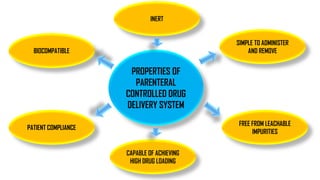
PROPERTIES OF
PARENTERAL
CONTROLLED DRUG
DELIVERY SYSTEM
SIMPLE TO ADMINISTER
AND REMOVEBIOCOMPATIBLE
PATIENT COMPLIANCE
FREE FROM LEACHABLE
IMPURITIES
CAPABLE OF ACHIEVING
HIGH DRUG LOADING
INERT
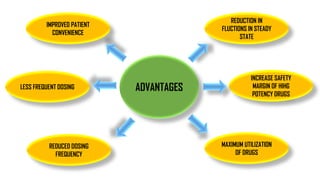
ADVANTAGES
IMPROVED PATIENT
CONVENIENCE
LESS FREQUENT DOSING
REDUCED DOSING
FREQUENCY
MAXIMUM UTILIZATION
OF DRUGS
INCREASE SAFETY
MARGIN OF HIHG
POTENCY DRUGS
REDUCTION IN
FLUCTIONS IN STEADY
STATE
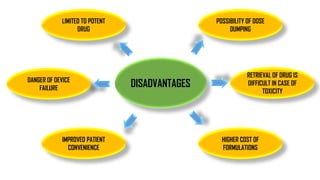
DISADVANTAGES
LIMITED TO POTENT
DRUG
POSSIBILITY OF DOSE
DUMPING
HIGHER COST OF
FORMULATIONS
RETRIEVAL OF DRUG IS
DIFFICULT IN CASE OF
TOXICITY
DANGER OF DEVICE
FAILURE
IMPROVED PATIENT
CONVENIENCE
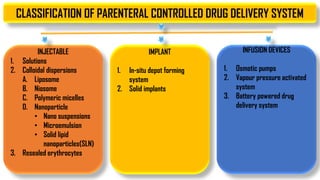
CLASSIFICATION OF PARENTERAL CONTROLLED DRUG DELIVERY SYSTEM
INJECTABLE
1. Solutions
2. Colloidal dispersions
A. Liposome
B. Niosome
C. Polymeric micelles
D. Nanoparticle
• Nano suspensions
• Microemulsion
• Solid lipid
nanoparticles(SLN)
3. Resealed erythrocytes
IMPLANT
1. In-situ depot forming
system
2. Solid implants
INFUSION DEVICES
1. Osmotic pumps
2. Vapour pressure activated
system
3. Battery powered drug
delivery system
INJECTABLES
SOLUTIONS
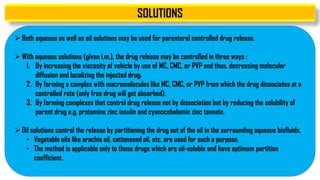
 Both aqueous as well as oil solutions may be used for parenteral controlled drug release.
 With aqueous solutions (given i.m.), the drug release may be controlled in three ways :
1. By increasing the viscosity of vehicle by use of MC, CMC, or PVP and thus, decreasing molecular
diffusion and localizing the injected drug.
2. By forming a complex with macromolecules like MC, CMC, or PVP from which the drug dissociates at a
controlled rate (only free drug will get absorbed).
3. By forming complexes that control drug release not by dissociation but by reducing the solubility of
parent drug e.g. protamine zinc insulin and cyanocobalamin zinc tannate.
 Oil solutions control the release by partitioning the drug out of the oil in the surrounding aqueous biofluids.
• Vegetable oils like arachis oil, cottonseed oil, etc. are used for such a purpose.
• The method is applicable only to those drugs which are oil-soluble and have optimum partition
coefficient.
LIPOSOMES
 Liposomes are formed by the self-assembly of phospholipid molecules in an aqueous environment. The
amphiphilic phospholipid molecules form a closed bilayer sphere in an attempt to shield their hydrophobic groups
from the aqueous environment while still maintaining contact with the aqueous phase via the hydrophilic head
group.
 Applications :
1. Liposomal Anti Cancer Agent :
• It was observed that doxorubicin-loaded stealth liposomes circulate for prolonged periods, accumulate,
and extravagate within tumors and also improve tumoricidal activity in mice.
• Liposomal doxorubicin is now licensed as Caelyx for the treatment of Kaposi's sarcoma.
2. Liposomes as Vaccine Adjuvants :
• Liposomal vaccines can be made by associating microbes, soluble antigens, cytokines, or DNA with
liposomes, the latter stimulating an immune response on expression of the antigenic protein.
3. Liposomal Anti-Infective Agents:
• Liposomal amphotericin B (Ambisome) is used for the treatment of systemic fungal infection.
NIOSOMES
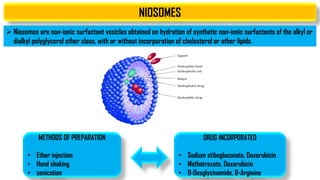
 Niosomes are non-ionic surfactant vesicles obtained on hydration of synthetic non-ionic surfactants of the alkyl or
dialkyl polyglycerol ether class, with or without incorporation of cholesterol or other lipids.
METHODS OF PREPARATION
• Ether injection
• Hand shaking
• sonication
DRUG INCORPORATED
• Sodium stibogluconate, Doxorubicin
• Methotrexate, Doxorubicin
• 9-Desglycinamide, 8-Arginine
APPLICATIONS OF NIOSOMES :
• Anticancer Niosomes: Anticancer niosomes, if suitably designed, will be expected to accumulate within
tumors.
• Niosomes at Targeted Site: Uptake by the liver and spleen make niosomes ideal for targeting diseases
manifestation in these organs, One such condition is leishmaniasis.
• Niosomes as Vaccine Adjuvants: It was studied that niosomal antigens are potent stimulators of the cellular
and humoral immune response.
ADVANTAGES OF NIOSOMES :
• They are osmotically active and stable.
• They possess an infrastructure consisting of hydrophobic and hydrophilic moieties together and as a result
can accommodate drug molecules with a wide range of solubilities.
• They improve the therapeutic performance of the drug molecules by delaying the clearance from the
circulation, protecting the drug from biological environment, and restricting effects to target cells.
POLYMERIC MICELLES
 Polymeric micelles are nanosized core assemblies of amphiphilic block copolymers that are suitable for the
delivery of hydrophobic and amphiphilic agents.
 Among different micelle-forming block copolymers, those with PEG as the shell forming block and Poly lactic
acid and poly(ester)s as the core forming block are most popular in drug development.
 Hydrophobic core of polymeric micelles provides an excellent host for the incorporation and stabilization of
anticancer agents that are mostly hydrophobic.
 Nano size of these micelles enables them to escape the phagocytic effects of RES, enhance their circulation
life and penetration in to tumour tissues.
NANO SUSPENSION
 A pharmaceutical nano suspension can be defined as the nano-sized drug particle which is finely dispersed in an
aqueous vehicle for either oral and topical use or parenteral and pulmonary administration.
 In general, the particle size in nano suspension is always less than 1μm (usually lies between 200nm to 600nm).
 Application of Nano suspension as Parenteral Administration:
• Nano suspension can be delivered either intra-articular or intravenous route. But in case of parenteral
administration, solute should remain in solubilized form or particle or globule size below 5 μm to avoid
capillary blockage.
• Current approaches have resolved the drawbacks of poorly soluble drugs for parenteral delivery, these are
salt formation, solubilization using co-solvent, miceller solution, complexation with cyclodextrin and vesicular
system (liposome and transferosome).
• However nanosuspension has still been considered as a useful dosage form which employs better efficacy for
parenterally administered drugs. for example, paclitaxel nano suspension has been found better responses in
treating tumour than taxol.
SOLID LIPID NANO PARTICLES
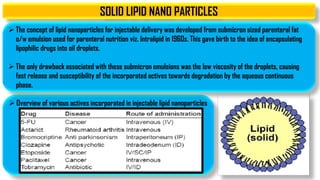
 Overview of various actives incorporated in injectable lipid nanoparticles
 The concept of lipid nanoparticles for injectable delivery was developed from submicron sized parenteral fat
o/w emulsion used for parenteral nutrition viz. Intralipid in 1960s. This gave birth to the idea of encapsulating
lipophilic drugs into oil droplets.
 The only drawback associated with these submicron emulsions was the low viscosity of the droplets, causing
fast release and susceptibility of the incorporated actives towards degradation by the aqueous continuous
phase.
 Application of Lipid Nanoparticles for Parenteral Drug Delivery:
• Treatment of Cancer: SLN have been shown to improve the efficacy and residence time of the cytotoxic
drugs, with concomitant reduction in the side-effects associated with them. The salient features of SLN
which make them a suitable carrier for antitumor drug delivery is their ability to encapsulate
antitumor agents of diverse physiochemical properties, improved stability of the drug, less in vitro
toxicity, enhanced drug efficacy, and improved pharmacokinetics.
• Liver Targeting: Particulate carriers (including SLN) usually accumulate in the liver by passive
targeting on parenteral administration. However, passive targeting leads to entrapment of the drug in
the Kupffer cells and not in the hepatocytes, which is the major target for the treatment of hepatic
diseases such as cancers. Hence, for liver targeting, SLN containing galactosylated or mannosylated
lipids are employed.
• Targeting the Central Nervous System: Various drugs ranging from antipsychotics, antiparkinson,
antieschemic to antibiotics have been encapsulated in lipid nanoparticles with the aim to either modify
the biodistribution or for brain targeting.
RESEALED ERYTHROCYTES
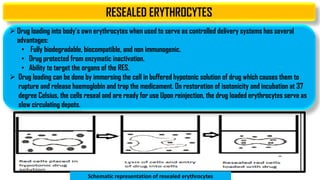
Schematic representation of resealed erythrocytes
 Drug loading into body’s own erythrocytes when used to serve as controlled delivery systems has several
advantages:
• Fully biodegradable, biocompatible, and non immunogenic.
• Drug protected from enzymatic inactivation.
• Ability to target the organs of the RES.
 Drug loading can be done by immersing the cell in buffered hypotonic solution of drug which causes them to
rupture and release haemoglobin and trap the medicament. On restoration of isotonicity and incubation at 37
degree Celsius, the cells reseal and are ready for use Upon reinjection, the drug loaded erythrocytes serve as
slow circulating depots.
IMPLANTS
 Implants are cylindrical, monolithic devices of mm or cm dimensions, implanted by a minor surgical incision or
injected through a large bore needle into the s.c or i.m tissue. Theycanbe definedassmallrodshapedor ovoid
shapedsteriletabletsconsistingof the highly purifieddrug, usually compressedwithoutexcipient.
 The drug in implant may be dissolved, dispersed or embedded in a matrix of polymer or waxes/lipids that
control release by dissolution and/or diffusion, bio erosion, biodegradation or an activation process such as
osmosis or hydrolysis.
 Nonbiodegradable polymers, such as polydimethylsiloxane, deliver drug by simple diffusion at a rate dependent
on drug solubility in the polymer and the surface area of the implant.
 Biodegradable polymers, such as poly(caprolactone), poly(lactic acid), poly(glycolic acid), deliver drug by
diffusion and/or polymer erosion. Provided the bioerosion rate is constant, drug release rate will be directly
proportional to it’s physical dimensions.
 The devices thus prepared had a high degree of hardness and virtually zero porosity. since water did not
penetrate the matrix, drug release occurred principally by surface dissolution.
ADVANTAGES OF IMPLANTS
 Potential for controlled release :
• Implants are available which deliver drugs by zero-order controlled release kinetics.
• Zero order controlled release offers the advantages of: Avoiding the peaks (risk of toxicity) and troughs (risk of
ineffectiveness) of conventional therapy which Reduces the dosing frequency Increases patient compliance.
 Potential for intermittent release :
Externally programmable pumps can facilitate intermittent release.
Intermittent release can facilitate drug release in response to such factors as : Circadian rhythms.
 Potential for bio-responsive release: Bio-responsive release from implants is an area of ongoing research
 Improved drug delivery: By avoiding first pass effect.
 Flexibility: Considerable flexibility is possible with these systems, in the choice of materials, methods of
manufacture, degree of drug loading, drug release rate etc.
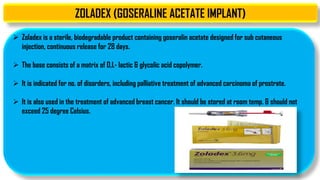
ZOLADEX (GOSERALINE ACETATE IMPLANT)
 Zoladex is a sterile, biodegradable product containing goseralin acetate designed for sub cutaneous
injection, continuous release for 28 days.
 The base consists of a matrix of D,L- lactic & glycolic acid copolymer.
 It is indicated for no. of disorders, including palliative treatment of advanced carcinoma of prostrate.
 It is also used in the treatment of advanced breast cancer. It should be stored at room temp. & should not
exceed 25 degree Celsius.
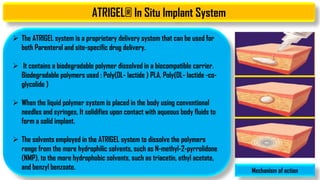
ATRIGEL® In Situ Implant System
 The ATRIGEL system is a proprietary delivery system that can be used for
both Parenteral and site-specific drug delivery.
 It contains a biodegradable polymer dissolved in a biocompatible carrier.
Biodegradable polymers used : Poly(DL- lactide ) PLA, Poly(DL- lactide -co-
glycolide )
 When the liquid polymer system is placed in the body using conventional
needles and syringes, It solidifies upon contact with aqueous body fluids to
form a solid implant.
 The solvents employed in the ATRIGEL system to dissolve the polymers
range from the more hydrophilic solvents, such as N-methyl-2-pyrrolidone
(NMP), to the more hydrophobic solvents, such as triacetin, ethyl acetate,
and benzyl benzoate. Mechanism of action
Advantages of ATRIGEL®
1. EASE OF INJECTION: The ATRIGEL ® liquid formulation uses standard needles for ease of administration.
2. SUSTAINED DRUG RELEASE: Released over a specified period of time, from a few days to several months,
thereby reducing the frequency of drug administration.
3. BIODEGRADABLE: The ATRIGEL ® implant is fully biodegradable and therefore does not require removal prior
to the next injection.
4. BIOCOMPATIBLE: All components of the ATRIGEL ® system are biocompatible and each has established safety
and toxicity profiles.
5. SITE-SPECIFIC DRUG DELIVERY: Drugs are administered directly to the target area, potentially achieving
higher drug conc. at the desired site of action and thereby minimizing systemic side effects.
INFUSION DEVICES
 These are also implantable devices but are versatile in the sense that they are intrinsically powered to
release the medicament at a zero -order rate and the drug reservoir can be replenished from time to
time.
 Depending upon the mechanism by which these implantable pumps are powered to release the contents,
they are classified into following types:
• I. Osmotic pressure activated drug delivery systems
• II. Vapour pressure activated drug delivery systems
• III. Battery powered drug delivery systems
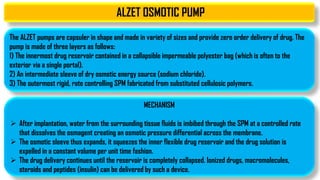
ALZET OSMOTIC PUMP
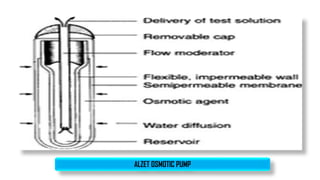
The ALZET pumps are capsuler in shape and made in variety of sizes and provide zero order delivery of drug. The
pump is made of three layers as follows:
1) The innermost drug reservoir contained in a collapsible impermeable polyester bag (which is often to the
exterior via a single portal).
2) An intermediate sleeve of dry osmotic energy source (sodium chloride).
3) The outermost rigid, rate controlling SPM fabricated from substituted cellulosic polymers.
MECHANISM
 After implantation, water from the surrounding tissue fluids is imbibed through the SPM at a controlled rate
that dissolves the osmagent creating an osmotic pressure differential across the membrane.
 The osmotic sleeve thus expands, it squeezes the inner flexible drug reservoir and the drug solution is
expelled in a constant volume per unit time fashion.
 The drug delivery continues until the reservoir is completely collapsed. Ionized drugs, macromolecules,
steroids and peptides (insulin) can be delivered by such a device.
ALZET OSMOTIC PUMP
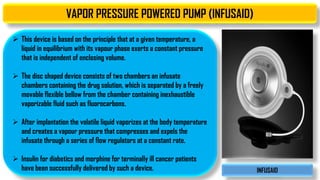
VAPOR PRESSURE POWERED PUMP (INFUSAID)
 This device is based on the principle that at a given temperature, a
liquid in equilibrium with its vapour phase exerts a constant pressure
that is independent of enclosing volume.
 The disc shaped device consists of two chambers an infusate
chambers containing the drug solution, which is separated by a freely
movable flexible bellow from the chamber containing inexhaustible
vaporizable fluid such as fluorocarbons.
 After implantation the volatile liquid vaporizes at the body temperature
and creates a vapour pressure that compresses and expels the
infusate through a series of flow regulators at a constant rate.
 Insulin for diabetics and morphine for terminally ill cancer patients
have been successfully delivered by such a device. INFUSAID
CONCLUSION
Drug delivery technologies (discussed above) are used to control the delivery of drug by parenteral
administration. Parenteral drug delivery systems have grown to become important technology platforms which are
used by pharmaceutical companies in the recent years. So, it is important to study parenteral drug delivery
system, as it provides rapid treatment objective to save valuable life of human being.
REFERENCE
1. Kapoor S: An overview on advanced parenteral drug delivery system in clinical disease management. Pharmainfo Net. 2007.
2. Panayiotis PC, Mahesh VC, Robert S: Advances in lipid nanodispersions for parenteral drug delivery and targetting. Science
2008;60:757-67.
3. Straubinger RM, Arnold RD, Zhou R: Antivascular and antitumor activities of liposome-associated drugs. Anticancer Res
2004;24:397-404.
THANK YOU

PARENTERAL CONTROLLED DRUG DELIVERY SYSTEMS,

  • 1.
    DEPARTMENT OF PHARMACEUTICALSCIENCES Dr. HARISINGH GOUR VISHWAVIDYALAYA, SAGAR (M. P.) PARENTERAL CONTROLLED DRUG DELIVERY SYSTEM PRESENTED BY : AVIJIT KUMAR BAKSHI SUPERVISED BY : Mr. VIKAS PANDEY
  • 2.
    INTRODUCTION The parenteral administrationroute is the most effective and common form of delivery for active drug substances with poor bioavailability and the drugs with a narrow therapeutic index. But parenteral route offers rapid onset of action with rapid declines of systemic drug level. It requires frequent injection, which ultimately leads to patient discomfort. For this reason, drug delivery system which can reduce total number of injection throughout the effective treatment, improve patient compliance as well as pharmacoeconomic was required. A number of technological advances have been made in the area of parenteral drug delivery, leading to the development of sophisticated systems that allow drug targeting and the sustained or controlled release of parenteral medicines.
  • 3.
    PROPERTIES OF PARENTERAL CONTROLLED DRUG DELIVERYSYSTEM SIMPLE TO ADMINISTER AND REMOVEBIOCOMPATIBLE PATIENT COMPLIANCE FREE FROM LEACHABLE IMPURITIES CAPABLE OF ACHIEVING HIGH DRUG LOADING INERT
  • 4.
    ADVANTAGES IMPROVED PATIENT CONVENIENCE LESS FREQUENTDOSING REDUCED DOSING FREQUENCY MAXIMUM UTILIZATION OF DRUGS INCREASE SAFETY MARGIN OF HIHG POTENCY DRUGS REDUCTION IN FLUCTIONS IN STEADY STATE
  • 5.
    DISADVANTAGES LIMITED TO POTENT DRUG POSSIBILITYOF DOSE DUMPING HIGHER COST OF FORMULATIONS RETRIEVAL OF DRUG IS DIFFICULT IN CASE OF TOXICITY DANGER OF DEVICE FAILURE IMPROVED PATIENT CONVENIENCE
  • 6.
    CLASSIFICATION OF PARENTERALCONTROLLED DRUG DELIVERY SYSTEM INJECTABLE 1. Solutions 2. Colloidal dispersions A. Liposome B. Niosome C. Polymeric micelles D. Nanoparticle • Nano suspensions • Microemulsion • Solid lipid nanoparticles(SLN) 3. Resealed erythrocytes IMPLANT 1. In-situ depot forming system 2. Solid implants INFUSION DEVICES 1. Osmotic pumps 2. Vapour pressure activated system 3. Battery powered drug delivery system
  • 7.
  • 8.
    SOLUTIONS  Both aqueousas well as oil solutions may be used for parenteral controlled drug release.  With aqueous solutions (given i.m.), the drug release may be controlled in three ways : 1. By increasing the viscosity of vehicle by use of MC, CMC, or PVP and thus, decreasing molecular diffusion and localizing the injected drug. 2. By forming a complex with macromolecules like MC, CMC, or PVP from which the drug dissociates at a controlled rate (only free drug will get absorbed). 3. By forming complexes that control drug release not by dissociation but by reducing the solubility of parent drug e.g. protamine zinc insulin and cyanocobalamin zinc tannate.  Oil solutions control the release by partitioning the drug out of the oil in the surrounding aqueous biofluids. • Vegetable oils like arachis oil, cottonseed oil, etc. are used for such a purpose. • The method is applicable only to those drugs which are oil-soluble and have optimum partition coefficient.
  • 9.
    LIPOSOMES  Liposomes areformed by the self-assembly of phospholipid molecules in an aqueous environment. The amphiphilic phospholipid molecules form a closed bilayer sphere in an attempt to shield their hydrophobic groups from the aqueous environment while still maintaining contact with the aqueous phase via the hydrophilic head group.  Applications : 1. Liposomal Anti Cancer Agent : • It was observed that doxorubicin-loaded stealth liposomes circulate for prolonged periods, accumulate, and extravagate within tumors and also improve tumoricidal activity in mice. • Liposomal doxorubicin is now licensed as Caelyx for the treatment of Kaposi's sarcoma. 2. Liposomes as Vaccine Adjuvants : • Liposomal vaccines can be made by associating microbes, soluble antigens, cytokines, or DNA with liposomes, the latter stimulating an immune response on expression of the antigenic protein. 3. Liposomal Anti-Infective Agents: • Liposomal amphotericin B (Ambisome) is used for the treatment of systemic fungal infection.
  • 10.
    NIOSOMES  Niosomes arenon-ionic surfactant vesicles obtained on hydration of synthetic non-ionic surfactants of the alkyl or dialkyl polyglycerol ether class, with or without incorporation of cholesterol or other lipids. METHODS OF PREPARATION • Ether injection • Hand shaking • sonication DRUG INCORPORATED • Sodium stibogluconate, Doxorubicin • Methotrexate, Doxorubicin • 9-Desglycinamide, 8-Arginine
  • 11.
    APPLICATIONS OF NIOSOMES: • Anticancer Niosomes: Anticancer niosomes, if suitably designed, will be expected to accumulate within tumors. • Niosomes at Targeted Site: Uptake by the liver and spleen make niosomes ideal for targeting diseases manifestation in these organs, One such condition is leishmaniasis. • Niosomes as Vaccine Adjuvants: It was studied that niosomal antigens are potent stimulators of the cellular and humoral immune response. ADVANTAGES OF NIOSOMES : • They are osmotically active and stable. • They possess an infrastructure consisting of hydrophobic and hydrophilic moieties together and as a result can accommodate drug molecules with a wide range of solubilities. • They improve the therapeutic performance of the drug molecules by delaying the clearance from the circulation, protecting the drug from biological environment, and restricting effects to target cells.
  • 12.
    POLYMERIC MICELLES  Polymericmicelles are nanosized core assemblies of amphiphilic block copolymers that are suitable for the delivery of hydrophobic and amphiphilic agents.  Among different micelle-forming block copolymers, those with PEG as the shell forming block and Poly lactic acid and poly(ester)s as the core forming block are most popular in drug development.  Hydrophobic core of polymeric micelles provides an excellent host for the incorporation and stabilization of anticancer agents that are mostly hydrophobic.  Nano size of these micelles enables them to escape the phagocytic effects of RES, enhance their circulation life and penetration in to tumour tissues.
  • 13.
    NANO SUSPENSION  Apharmaceutical nano suspension can be defined as the nano-sized drug particle which is finely dispersed in an aqueous vehicle for either oral and topical use or parenteral and pulmonary administration.  In general, the particle size in nano suspension is always less than 1μm (usually lies between 200nm to 600nm).  Application of Nano suspension as Parenteral Administration: • Nano suspension can be delivered either intra-articular or intravenous route. But in case of parenteral administration, solute should remain in solubilized form or particle or globule size below 5 μm to avoid capillary blockage. • Current approaches have resolved the drawbacks of poorly soluble drugs for parenteral delivery, these are salt formation, solubilization using co-solvent, miceller solution, complexation with cyclodextrin and vesicular system (liposome and transferosome). • However nanosuspension has still been considered as a useful dosage form which employs better efficacy for parenterally administered drugs. for example, paclitaxel nano suspension has been found better responses in treating tumour than taxol.
  • 14.
    SOLID LIPID NANOPARTICLES  Overview of various actives incorporated in injectable lipid nanoparticles  The concept of lipid nanoparticles for injectable delivery was developed from submicron sized parenteral fat o/w emulsion used for parenteral nutrition viz. Intralipid in 1960s. This gave birth to the idea of encapsulating lipophilic drugs into oil droplets.  The only drawback associated with these submicron emulsions was the low viscosity of the droplets, causing fast release and susceptibility of the incorporated actives towards degradation by the aqueous continuous phase.
  • 15.
     Application ofLipid Nanoparticles for Parenteral Drug Delivery: • Treatment of Cancer: SLN have been shown to improve the efficacy and residence time of the cytotoxic drugs, with concomitant reduction in the side-effects associated with them. The salient features of SLN which make them a suitable carrier for antitumor drug delivery is their ability to encapsulate antitumor agents of diverse physiochemical properties, improved stability of the drug, less in vitro toxicity, enhanced drug efficacy, and improved pharmacokinetics. • Liver Targeting: Particulate carriers (including SLN) usually accumulate in the liver by passive targeting on parenteral administration. However, passive targeting leads to entrapment of the drug in the Kupffer cells and not in the hepatocytes, which is the major target for the treatment of hepatic diseases such as cancers. Hence, for liver targeting, SLN containing galactosylated or mannosylated lipids are employed. • Targeting the Central Nervous System: Various drugs ranging from antipsychotics, antiparkinson, antieschemic to antibiotics have been encapsulated in lipid nanoparticles with the aim to either modify the biodistribution or for brain targeting.
  • 16.
    RESEALED ERYTHROCYTES Schematic representationof resealed erythrocytes  Drug loading into body’s own erythrocytes when used to serve as controlled delivery systems has several advantages: • Fully biodegradable, biocompatible, and non immunogenic. • Drug protected from enzymatic inactivation. • Ability to target the organs of the RES.  Drug loading can be done by immersing the cell in buffered hypotonic solution of drug which causes them to rupture and release haemoglobin and trap the medicament. On restoration of isotonicity and incubation at 37 degree Celsius, the cells reseal and are ready for use Upon reinjection, the drug loaded erythrocytes serve as slow circulating depots.
  • 17.
  • 18.
     Implants arecylindrical, monolithic devices of mm or cm dimensions, implanted by a minor surgical incision or injected through a large bore needle into the s.c or i.m tissue. Theycanbe definedassmallrodshapedor ovoid shapedsteriletabletsconsistingof the highly purifieddrug, usually compressedwithoutexcipient.  The drug in implant may be dissolved, dispersed or embedded in a matrix of polymer or waxes/lipids that control release by dissolution and/or diffusion, bio erosion, biodegradation or an activation process such as osmosis or hydrolysis.  Nonbiodegradable polymers, such as polydimethylsiloxane, deliver drug by simple diffusion at a rate dependent on drug solubility in the polymer and the surface area of the implant.  Biodegradable polymers, such as poly(caprolactone), poly(lactic acid), poly(glycolic acid), deliver drug by diffusion and/or polymer erosion. Provided the bioerosion rate is constant, drug release rate will be directly proportional to it’s physical dimensions.  The devices thus prepared had a high degree of hardness and virtually zero porosity. since water did not penetrate the matrix, drug release occurred principally by surface dissolution.
  • 19.
    ADVANTAGES OF IMPLANTS Potential for controlled release : • Implants are available which deliver drugs by zero-order controlled release kinetics. • Zero order controlled release offers the advantages of: Avoiding the peaks (risk of toxicity) and troughs (risk of ineffectiveness) of conventional therapy which Reduces the dosing frequency Increases patient compliance.  Potential for intermittent release : Externally programmable pumps can facilitate intermittent release. Intermittent release can facilitate drug release in response to such factors as : Circadian rhythms.  Potential for bio-responsive release: Bio-responsive release from implants is an area of ongoing research  Improved drug delivery: By avoiding first pass effect.  Flexibility: Considerable flexibility is possible with these systems, in the choice of materials, methods of manufacture, degree of drug loading, drug release rate etc.
  • 20.
    ZOLADEX (GOSERALINE ACETATEIMPLANT)  Zoladex is a sterile, biodegradable product containing goseralin acetate designed for sub cutaneous injection, continuous release for 28 days.  The base consists of a matrix of D,L- lactic & glycolic acid copolymer.  It is indicated for no. of disorders, including palliative treatment of advanced carcinoma of prostrate.  It is also used in the treatment of advanced breast cancer. It should be stored at room temp. & should not exceed 25 degree Celsius.
  • 21.
    ATRIGEL® In SituImplant System  The ATRIGEL system is a proprietary delivery system that can be used for both Parenteral and site-specific drug delivery.  It contains a biodegradable polymer dissolved in a biocompatible carrier. Biodegradable polymers used : Poly(DL- lactide ) PLA, Poly(DL- lactide -co- glycolide )  When the liquid polymer system is placed in the body using conventional needles and syringes, It solidifies upon contact with aqueous body fluids to form a solid implant.  The solvents employed in the ATRIGEL system to dissolve the polymers range from the more hydrophilic solvents, such as N-methyl-2-pyrrolidone (NMP), to the more hydrophobic solvents, such as triacetin, ethyl acetate, and benzyl benzoate. Mechanism of action
  • 22.
    Advantages of ATRIGEL® 1.EASE OF INJECTION: The ATRIGEL ® liquid formulation uses standard needles for ease of administration. 2. SUSTAINED DRUG RELEASE: Released over a specified period of time, from a few days to several months, thereby reducing the frequency of drug administration. 3. BIODEGRADABLE: The ATRIGEL ® implant is fully biodegradable and therefore does not require removal prior to the next injection. 4. BIOCOMPATIBLE: All components of the ATRIGEL ® system are biocompatible and each has established safety and toxicity profiles. 5. SITE-SPECIFIC DRUG DELIVERY: Drugs are administered directly to the target area, potentially achieving higher drug conc. at the desired site of action and thereby minimizing systemic side effects.
  • 23.
  • 24.
     These arealso implantable devices but are versatile in the sense that they are intrinsically powered to release the medicament at a zero -order rate and the drug reservoir can be replenished from time to time.  Depending upon the mechanism by which these implantable pumps are powered to release the contents, they are classified into following types: • I. Osmotic pressure activated drug delivery systems • II. Vapour pressure activated drug delivery systems • III. Battery powered drug delivery systems
  • 25.
    ALZET OSMOTIC PUMP TheALZET pumps are capsuler in shape and made in variety of sizes and provide zero order delivery of drug. The pump is made of three layers as follows: 1) The innermost drug reservoir contained in a collapsible impermeable polyester bag (which is often to the exterior via a single portal). 2) An intermediate sleeve of dry osmotic energy source (sodium chloride). 3) The outermost rigid, rate controlling SPM fabricated from substituted cellulosic polymers. MECHANISM  After implantation, water from the surrounding tissue fluids is imbibed through the SPM at a controlled rate that dissolves the osmagent creating an osmotic pressure differential across the membrane.  The osmotic sleeve thus expands, it squeezes the inner flexible drug reservoir and the drug solution is expelled in a constant volume per unit time fashion.  The drug delivery continues until the reservoir is completely collapsed. Ionized drugs, macromolecules, steroids and peptides (insulin) can be delivered by such a device.
  • 26.
  • 27.
    VAPOR PRESSURE POWEREDPUMP (INFUSAID)  This device is based on the principle that at a given temperature, a liquid in equilibrium with its vapour phase exerts a constant pressure that is independent of enclosing volume.  The disc shaped device consists of two chambers an infusate chambers containing the drug solution, which is separated by a freely movable flexible bellow from the chamber containing inexhaustible vaporizable fluid such as fluorocarbons.  After implantation the volatile liquid vaporizes at the body temperature and creates a vapour pressure that compresses and expels the infusate through a series of flow regulators at a constant rate.  Insulin for diabetics and morphine for terminally ill cancer patients have been successfully delivered by such a device. INFUSAID
  • 28.
    CONCLUSION Drug delivery technologies(discussed above) are used to control the delivery of drug by parenteral administration. Parenteral drug delivery systems have grown to become important technology platforms which are used by pharmaceutical companies in the recent years. So, it is important to study parenteral drug delivery system, as it provides rapid treatment objective to save valuable life of human being.
  • 29.
    REFERENCE 1. Kapoor S:An overview on advanced parenteral drug delivery system in clinical disease management. Pharmainfo Net. 2007. 2. Panayiotis PC, Mahesh VC, Robert S: Advances in lipid nanodispersions for parenteral drug delivery and targetting. Science 2008;60:757-67. 3. Straubinger RM, Arnold RD, Zhou R: Antivascular and antitumor activities of liposome-associated drugs. Anticancer Res 2004;24:397-404.
  • 30.