1/18/2023 1
Introduction
 PRINCE 2 is a set of project management standard.
 It is sponsored by Central Computing and
Telecommunications Agency(CCTA)
 Step Wise should be comfortable with PRINCE 2
 It covers planning stage of a project, not monitoring
and control the project
1/18/2023 2
 A Structured Project Management
Methodology. PRINCE2 (PRojects IN
Controlled Environments) is a process-based
method for effective project management.
PRINCE2 is a de facto standard used by the
UK Government, widely recognised and
practised in the private sector in the UK and
internationally.
1/18/2023 3
1/18/2023 4
Steps in Project Planning
Step 0 : Select project
Step 1 : Identify project scope and objectives
Step 2 : Identify project infrastructure
Step 3 : Analyze project characteristics
Step 4 : Identify project products and activities
Step 5: Estimate effort for each activity
Step 6 : Identify activity risks
Step 7 : Allocate resources
Step 8: Review / Publicize plan
Step 9 & 10 : Execute plan / lower level of planning
1/18/2023 5
1/18/2023 6
 It is outside the main project planning process
While a feasibility study might suggest the project is worthwhile
There are three types of feasible analysis
 Technical
It is based on resources
 Economical
It is based on cost
 Operational
Whether the employee able to work the project
1/18/2023 7
1/18/2023 8
Step 1.1 Identify objectives and measure of
effectiveness
 Get the objectives of a project
 Measuring effectiveness can be in terms of
software quality
 Performance measurement
 Mean time of failure
 Predictive measurement
 Error in code
1/18/2023 9
Step 1.2 Establish a project authority
 ‘Who is the boss?’
 Identify the authority of the project
Step 1.3 Stakeholders Analysis
Identify all stakeholders in the project
The stockholders who are all having interest in project
 With the team we want to check
 Not in project team but with in
organization
 External stakeholders
1/18/2023 10
Step 1.4 Change objectives based on stakeholder
analysis
The stakeholder suggestion is satisfied means change the
objective
 If it’s not satisfied means , don’t change the original objective
of the project
Step 1.5 Establish method of communication with all
parties
We should satisfy the customer requirements
How do we keep in contact with customer
1/18/2023 11
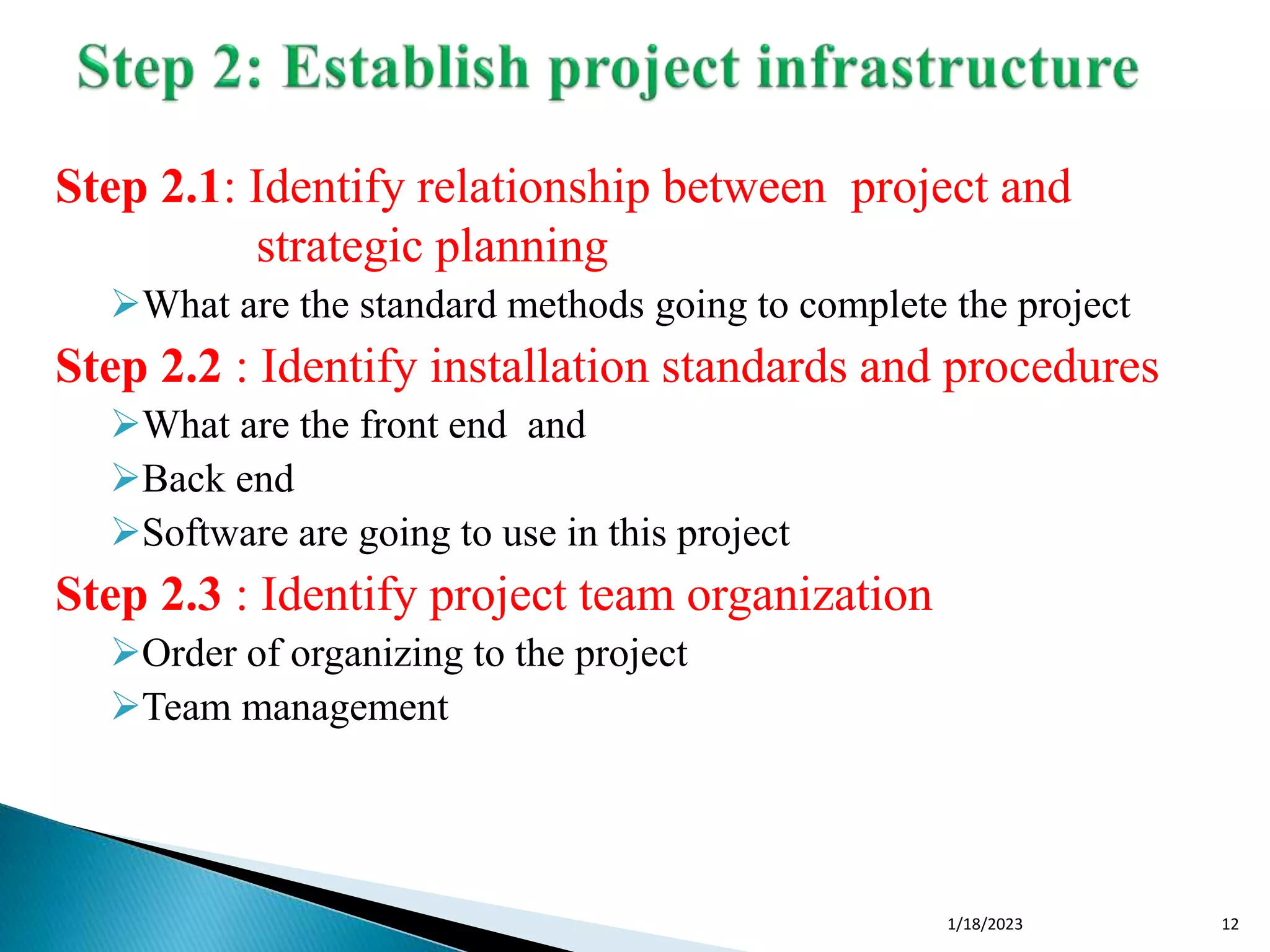
Step 2.1: Identify relationship between project and
strategic planning
What are the standard methods going to complete the project
Step 2.2 : Identify installation standards and procedures
What are the front end and
Back end
Software are going to use in this project
Step 2.3 : Identify project team organization
Order of organizing to the project
Team management
1/18/2023 12
Step 3.1 : Distinguish project as objective driven or
product driven
Product - It will be given by the user & design by external
person
Objective - Problem is given
We want to find the solution
Get recommendation
Step 3.2 : Analyze other project characteristics
 Including quality –based ones
What are the problems going to solve
1/18/2023 13
Step 3.3 : Identify high level of project risks
 Identify the level of risk
Step 3.4: Take user requirement concerning
implementation
Confirm with the user requirement
Step 3.5: Select development methodology and life
cycle approach
Step by step process ,what are the methods going to follow in
the project
Step 3.6: Review overall resource estimation
After risk identification, re-estimate effort & resources of
project
1/18/2023 14
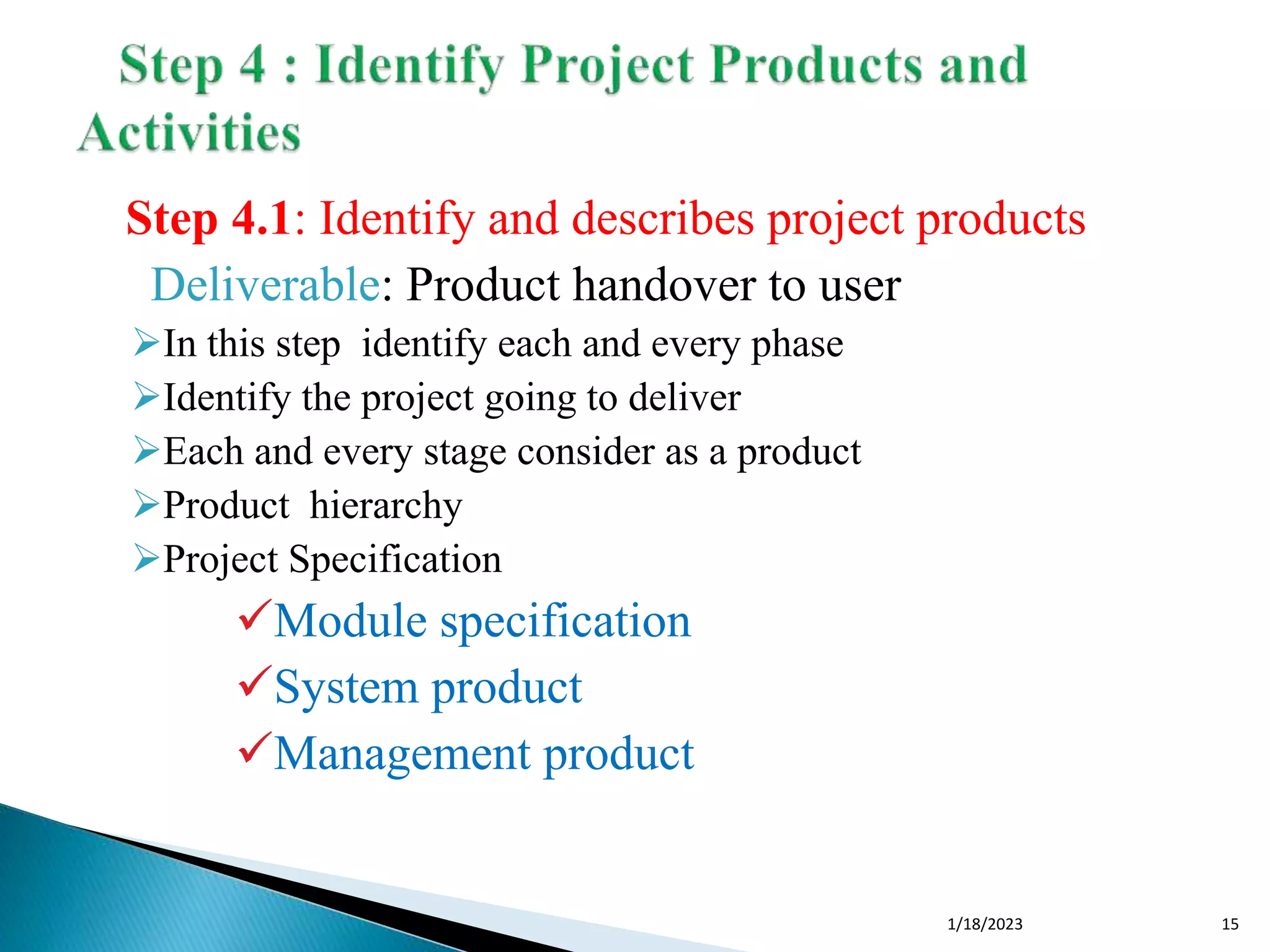
Step 4.1: Identify and describes project products
Deliverable: Product handover to user
In this step identify each and every phase
Identify the project going to deliver
Each and every stage consider as a product
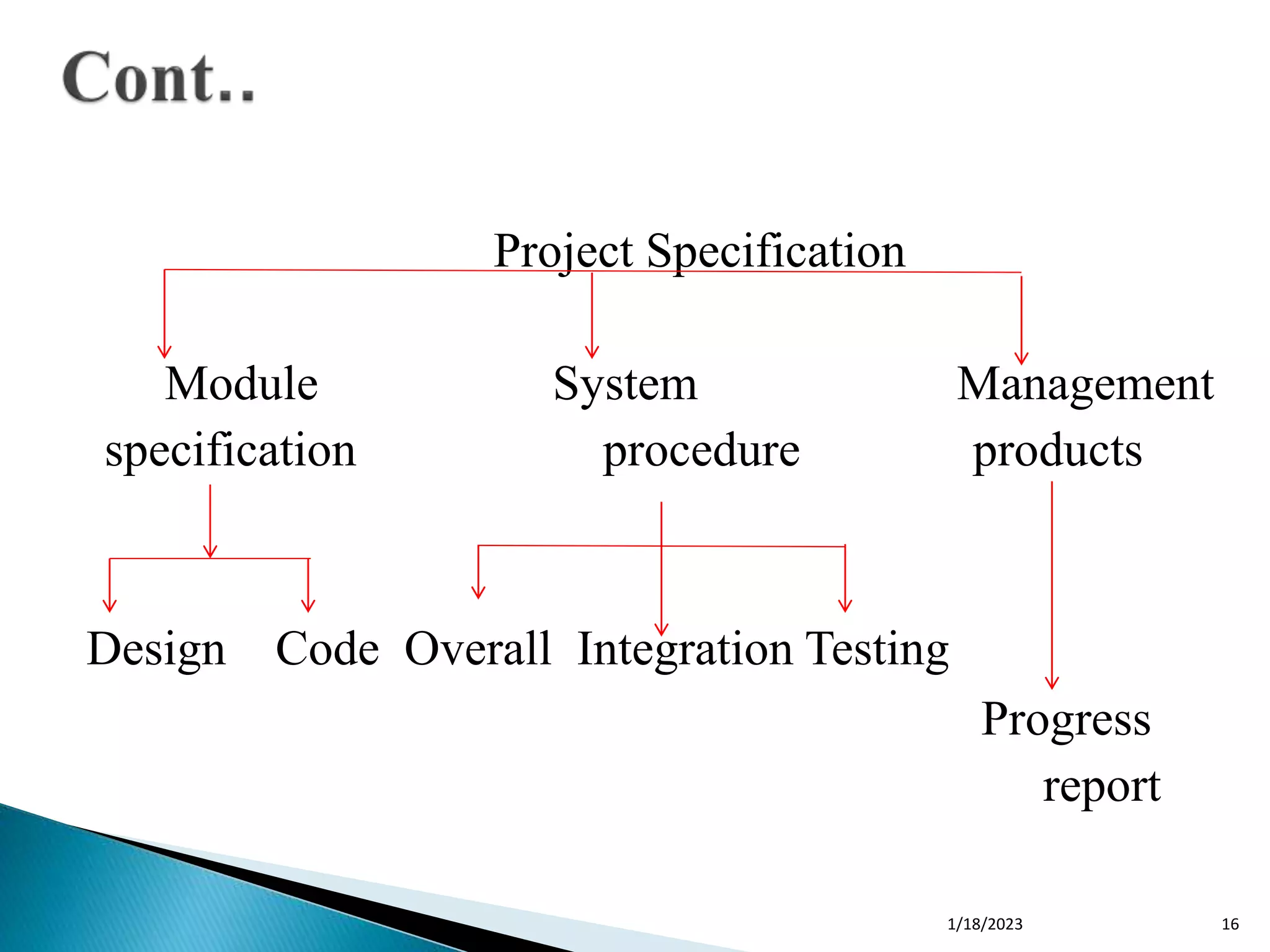
Product hierarchy
Project Specification
Module specification
System product
Management product
1/18/2023 15
Project Specification
Module System Management
specification procedure products
Design Code Overall Integration Testing
Progress
report
1/18/2023 16
Step 4.2 : Document generic product flows
 Product flow diagram
 One stage output is given to input of other stage
Eg: Requirements
Design
Coding
Testing
Step 4.3 : Record product instances
For each and every product what are the steps going to follow
Identifying product instance
1/18/2023 17
Step 4.4 : Produce ideal activity network
 Each and every module having several activity
 After complete individual module combine all the modules
Step 4.5 : Modify ideal to take stages and
checkpoints
 Project divided into number of product check each and every
stage we do correctly or not
 Check point to check the progress of the project
1/18/2023 18
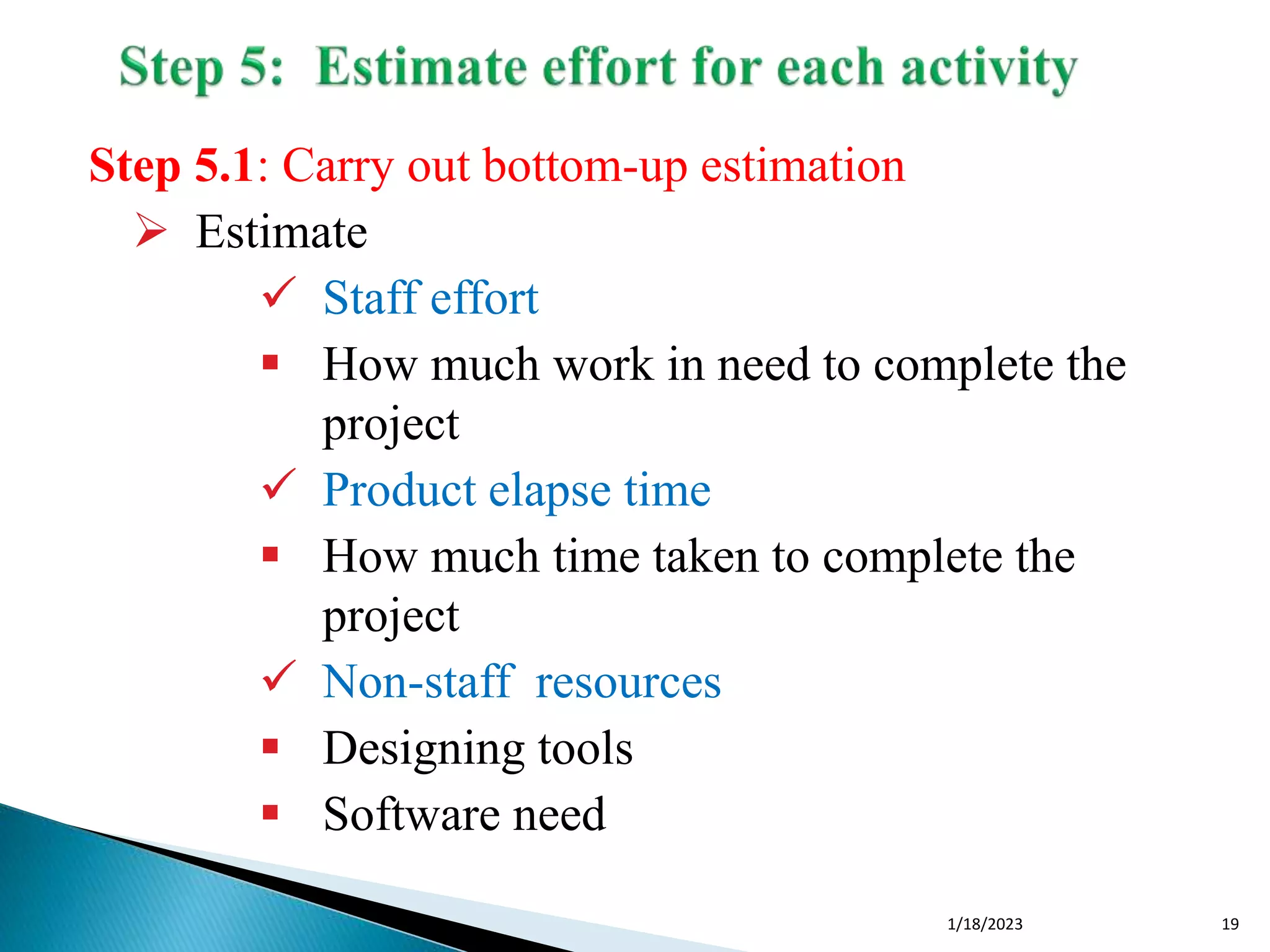
Step 5.1: Carry out bottom-up estimation
 Estimate
 Staff effort
 How much work in need to complete the
project
 Product elapse time
 How much time taken to complete the
project
 Non-staff resources
 Designing tools
 Software need
1/18/2023 19
Step 5.2: Revise plan to create controllable activities
 Every phase we need to control
 Need to break a task into a series of manageable
sub-tasks
 Break up very long activities into a series of
smaller ones as we can’t judge the status in long
activities
1/18/2023 20
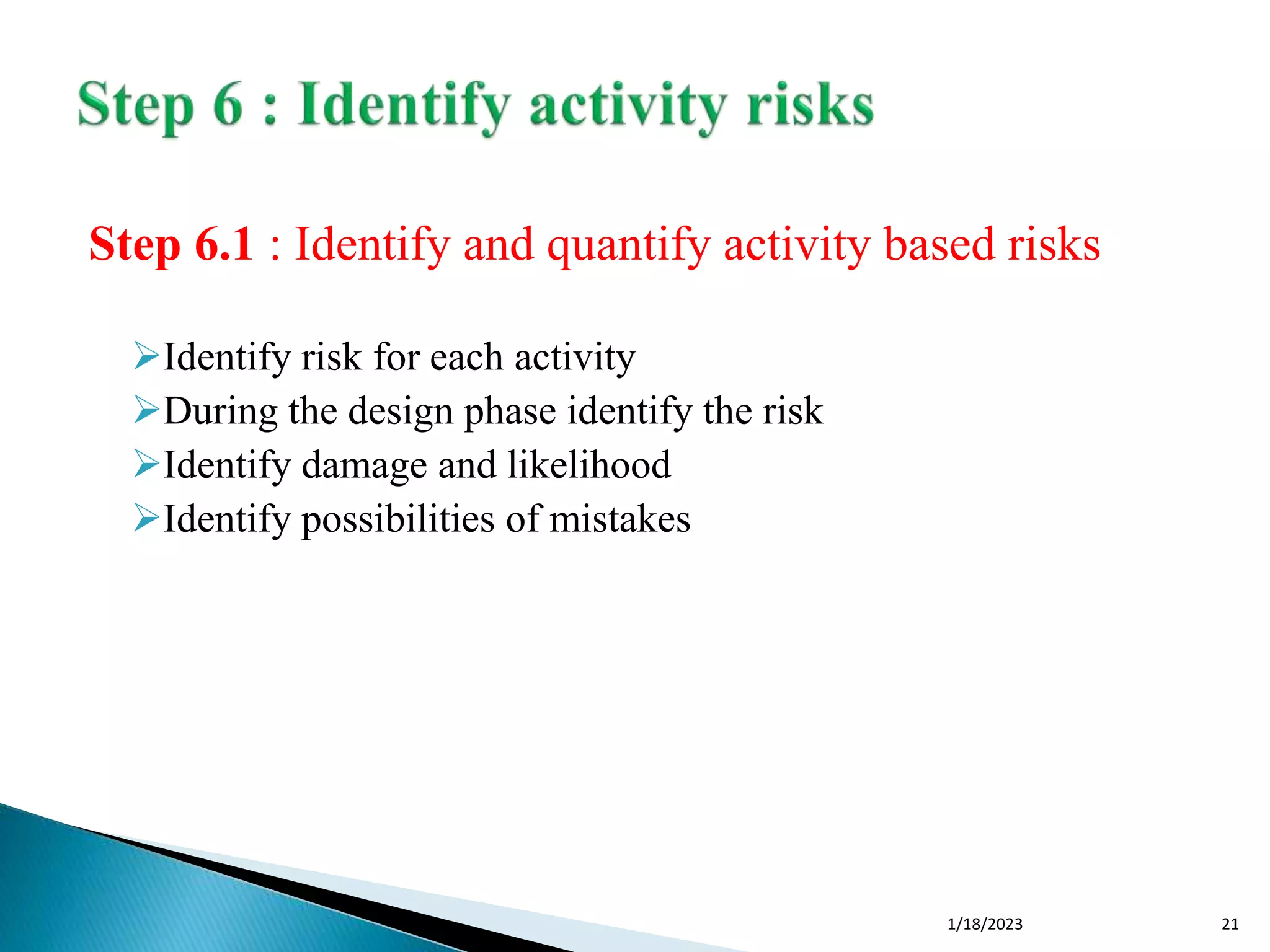
Step 6.1 : Identify and quantify activity based risks
Identify risk for each activity
During the design phase identify the risk
Identify damage and likelihood
Identify possibilities of mistakes
1/18/2023 21
Step 6.2 : Plan risk reduction and contingency
measures where appropriate
Review plan and do some steps for reduce risk
Have the alternative plan
Alternative measurement
Otherwise specify a contingency plan
For example:
Contract temporary developer if team member
becomes unavailable through illness
1/18/2023 22
Step 6.3 : Adjust overall plans and estimates to take
account of the risks
 Including add new activities - such as training and practice -
if needed
 Add new activities which reduce risk
 associated with other activities
E.g. Training
Pilot trials
Information gathering
1/18/2023 23
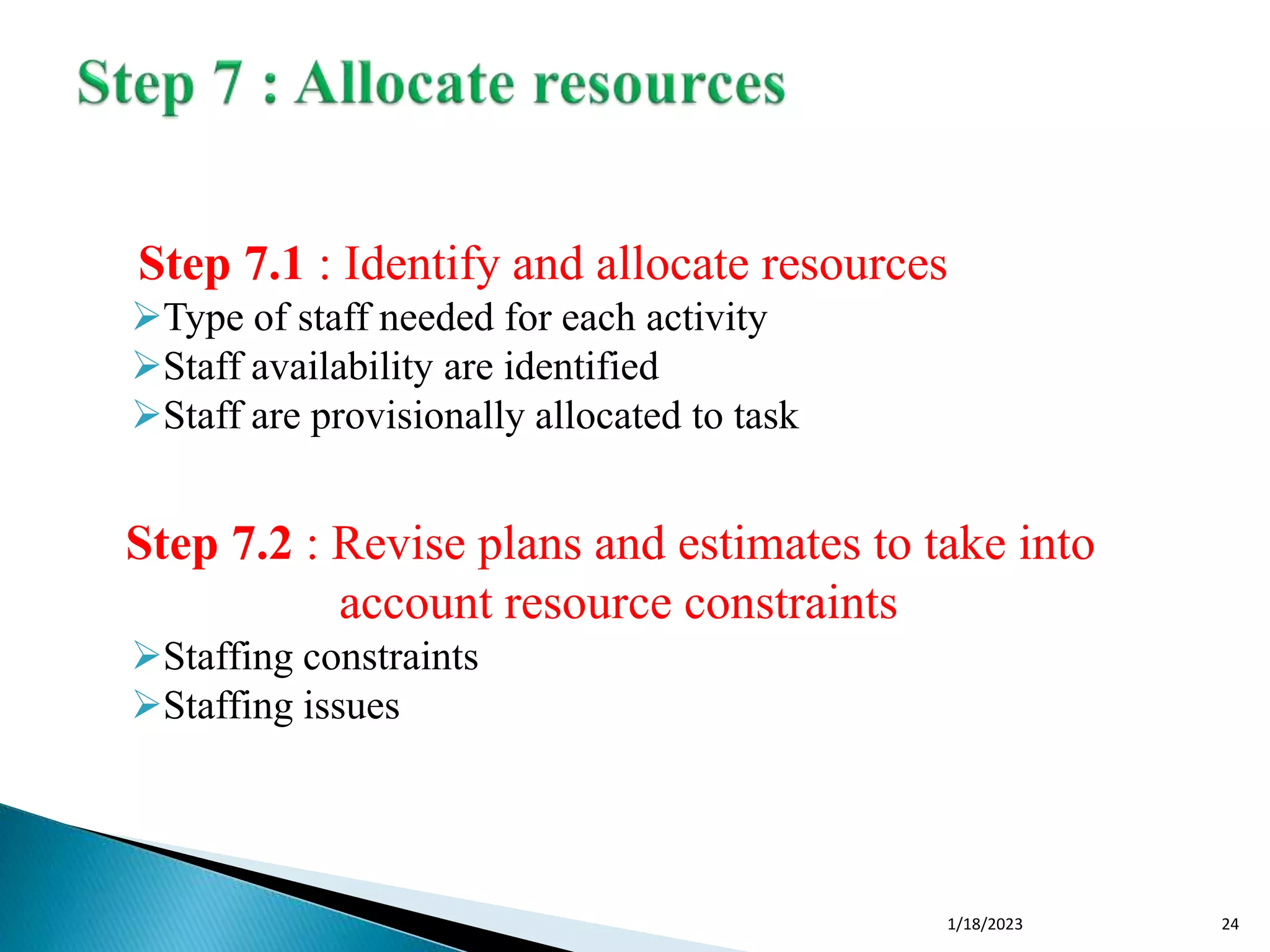
Step 7.1 : Identify and allocate resources
Type of staff needed for each activity
Staff availability are identified
Staff are provisionally allocated to task
Step 7.2 : Revise plans and estimates to take into
account resource constraints
Staffing constraints
Staffing issues
1/18/2023 24
Step 8.1 : Review quality aspects of the project plan
To ensure each activity is completed with a quality product
Each activity should have “exit requirements”
This ensures the quality of product on each activity
Check quality of phase before going to next stage
1/18/2023 25
Step 8.2 : Document plans and obtain agreements
 All parties understand and agree to the
commitments in the plan
 Make sure everyone understands and agree
 Specify this task in a communication plan if
needed
 Develop the documentation
1/18/2023 26
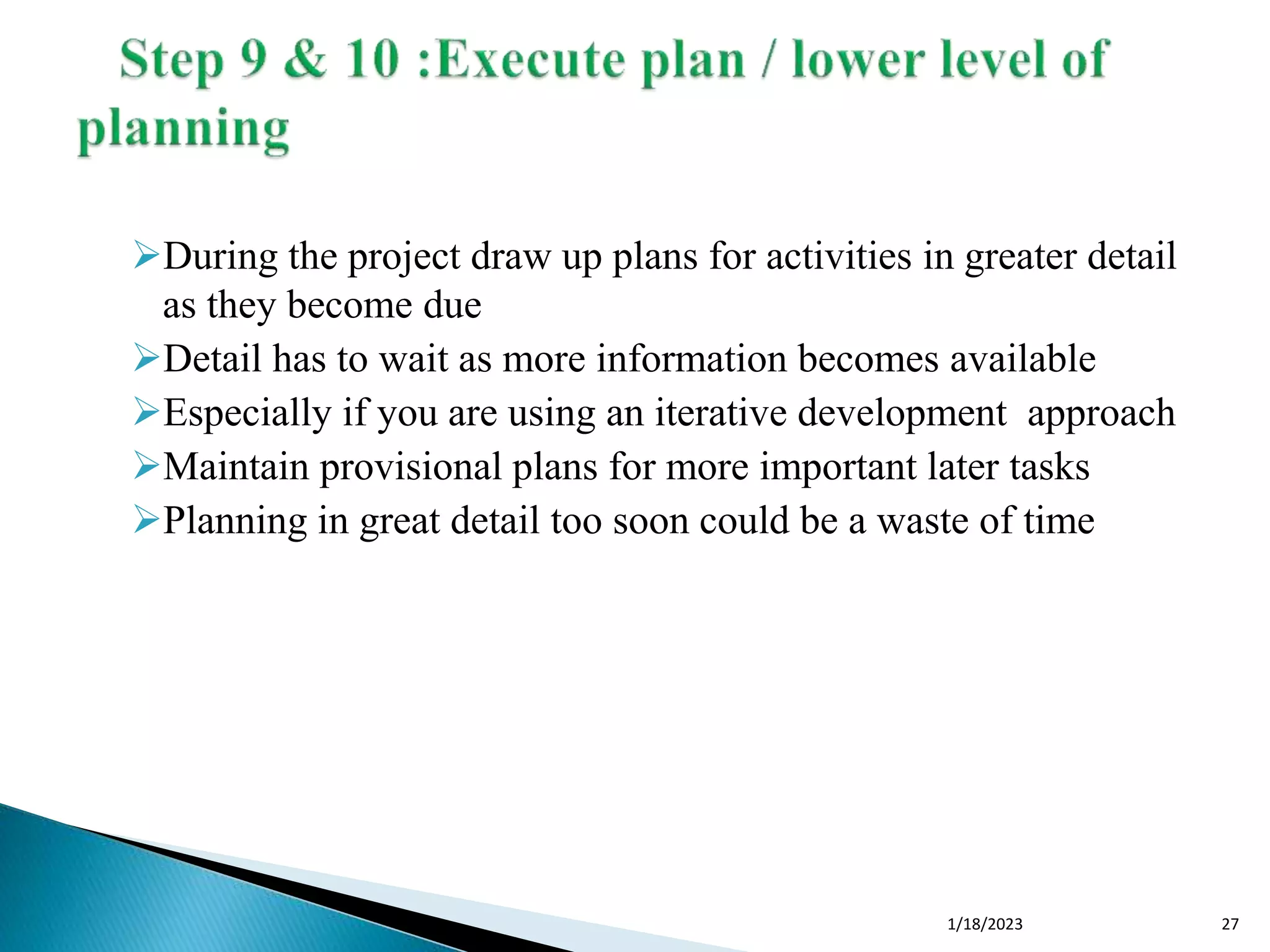
During the project draw up plans for activities in greater detail
as they become due
Detail has to wait as more information becomes available
Especially if you are using an iterative development approach
Maintain provisional plans for more important later tasks
Planning in great detail too soon could be a waste of time
1/18/2023 27
References:
Bob Hughes and Mike Cotterell (2004) “Software
Project Management”, McGraw-Hill.
P.Jalote(2000) “Software Project Management In
Practice”, Pearson Education..
https://learning.uonbi.ac.ke/courses/ICS616/docu
ment/Lecture_3_-Project_planning.pdf
http://www.itglitz.in/SPM/stepwise
1/18/2023 28
1/18/2023 29
1/18/2023 30

spm-01.ppt

  • 1.
  • 2.
    Introduction  PRINCE 2is a set of project management standard.  It is sponsored by Central Computing and Telecommunications Agency(CCTA)  Step Wise should be comfortable with PRINCE 2  It covers planning stage of a project, not monitoring and control the project 1/18/2023 2
  • 3.
     A StructuredProject Management Methodology. PRINCE2 (PRojects IN Controlled Environments) is a process-based method for effective project management. PRINCE2 is a de facto standard used by the UK Government, widely recognised and practised in the private sector in the UK and internationally. 1/18/2023 3
  • 4.
  • 5.
    Steps in ProjectPlanning Step 0 : Select project Step 1 : Identify project scope and objectives Step 2 : Identify project infrastructure Step 3 : Analyze project characteristics Step 4 : Identify project products and activities Step 5: Estimate effort for each activity Step 6 : Identify activity risks Step 7 : Allocate resources Step 8: Review / Publicize plan Step 9 & 10 : Execute plan / lower level of planning 1/18/2023 5
  • 6.
  • 7.
     It isoutside the main project planning process While a feasibility study might suggest the project is worthwhile There are three types of feasible analysis  Technical It is based on resources  Economical It is based on cost  Operational Whether the employee able to work the project 1/18/2023 7
  • 8.
  • 9.
    Step 1.1 Identifyobjectives and measure of effectiveness  Get the objectives of a project  Measuring effectiveness can be in terms of software quality  Performance measurement  Mean time of failure  Predictive measurement  Error in code 1/18/2023 9
  • 10.
    Step 1.2 Establisha project authority  ‘Who is the boss?’  Identify the authority of the project Step 1.3 Stakeholders Analysis Identify all stakeholders in the project The stockholders who are all having interest in project  With the team we want to check  Not in project team but with in organization  External stakeholders 1/18/2023 10
  • 11.
    Step 1.4 Changeobjectives based on stakeholder analysis The stakeholder suggestion is satisfied means change the objective  If it’s not satisfied means , don’t change the original objective of the project Step 1.5 Establish method of communication with all parties We should satisfy the customer requirements How do we keep in contact with customer 1/18/2023 11
  • 12.
    Step 2.1: Identifyrelationship between project and strategic planning What are the standard methods going to complete the project Step 2.2 : Identify installation standards and procedures What are the front end and Back end Software are going to use in this project Step 2.3 : Identify project team organization Order of organizing to the project Team management 1/18/2023 12
  • 13.
    Step 3.1 :Distinguish project as objective driven or product driven Product - It will be given by the user & design by external person Objective - Problem is given We want to find the solution Get recommendation Step 3.2 : Analyze other project characteristics  Including quality –based ones What are the problems going to solve 1/18/2023 13
  • 14.
    Step 3.3 :Identify high level of project risks  Identify the level of risk Step 3.4: Take user requirement concerning implementation Confirm with the user requirement Step 3.5: Select development methodology and life cycle approach Step by step process ,what are the methods going to follow in the project Step 3.6: Review overall resource estimation After risk identification, re-estimate effort & resources of project 1/18/2023 14
  • 15.
    Step 4.1: Identifyand describes project products Deliverable: Product handover to user In this step identify each and every phase Identify the project going to deliver Each and every stage consider as a product Product hierarchy Project Specification Module specification System product Management product 1/18/2023 15
  • 16.
    Project Specification Module SystemManagement specification procedure products Design Code Overall Integration Testing Progress report 1/18/2023 16
  • 17.
    Step 4.2 :Document generic product flows  Product flow diagram  One stage output is given to input of other stage Eg: Requirements Design Coding Testing Step 4.3 : Record product instances For each and every product what are the steps going to follow Identifying product instance 1/18/2023 17
  • 18.
    Step 4.4 :Produce ideal activity network  Each and every module having several activity  After complete individual module combine all the modules Step 4.5 : Modify ideal to take stages and checkpoints  Project divided into number of product check each and every stage we do correctly or not  Check point to check the progress of the project 1/18/2023 18
  • 19.
    Step 5.1: Carryout bottom-up estimation  Estimate  Staff effort  How much work in need to complete the project  Product elapse time  How much time taken to complete the project  Non-staff resources  Designing tools  Software need 1/18/2023 19
  • 20.
    Step 5.2: Reviseplan to create controllable activities  Every phase we need to control  Need to break a task into a series of manageable sub-tasks  Break up very long activities into a series of smaller ones as we can’t judge the status in long activities 1/18/2023 20
  • 21.
    Step 6.1 :Identify and quantify activity based risks Identify risk for each activity During the design phase identify the risk Identify damage and likelihood Identify possibilities of mistakes 1/18/2023 21
  • 22.
    Step 6.2 :Plan risk reduction and contingency measures where appropriate Review plan and do some steps for reduce risk Have the alternative plan Alternative measurement Otherwise specify a contingency plan For example: Contract temporary developer if team member becomes unavailable through illness 1/18/2023 22
  • 23.
    Step 6.3 :Adjust overall plans and estimates to take account of the risks  Including add new activities - such as training and practice - if needed  Add new activities which reduce risk  associated with other activities E.g. Training Pilot trials Information gathering 1/18/2023 23
  • 24.
    Step 7.1 :Identify and allocate resources Type of staff needed for each activity Staff availability are identified Staff are provisionally allocated to task Step 7.2 : Revise plans and estimates to take into account resource constraints Staffing constraints Staffing issues 1/18/2023 24
  • 25.
    Step 8.1 :Review quality aspects of the project plan To ensure each activity is completed with a quality product Each activity should have “exit requirements” This ensures the quality of product on each activity Check quality of phase before going to next stage 1/18/2023 25
  • 26.
    Step 8.2 :Document plans and obtain agreements  All parties understand and agree to the commitments in the plan  Make sure everyone understands and agree  Specify this task in a communication plan if needed  Develop the documentation 1/18/2023 26
  • 27.
    During the projectdraw up plans for activities in greater detail as they become due Detail has to wait as more information becomes available Especially if you are using an iterative development approach Maintain provisional plans for more important later tasks Planning in great detail too soon could be a waste of time 1/18/2023 27
  • 28.
    References: Bob Hughes andMike Cotterell (2004) “Software Project Management”, McGraw-Hill. P.Jalote(2000) “Software Project Management In Practice”, Pearson Education.. https://learning.uonbi.ac.ke/courses/ICS616/docu ment/Lecture_3_-Project_planning.pdf http://www.itglitz.in/SPM/stepwise 1/18/2023 28
  • 29.
  • 30.