1 ©The McGraw-Hill Companies,
Software Project
Management
4th Edition
Programme
management and
project evaluation
Chapter 3
2 ©The McGraw-Hill Companies,
Main topics to be covered
• Programme management
• Benefits management
• Project evaluation
– Cost benefit analysis
– Cash flow forecasting
• Project risk evaluation
3 ©The McGraw-Hill Companies,
Programme management
• One definition:
‘a group of projects that are managed in
a co-ordinated way to gain benefits that
would not be possible were the projects
to be managed independently’ Ferns
4 ©The McGraw-Hill Companies,
Programmes may be
• Strategic
• Business cycle programmes
• Infrastructure programmes
• Research and development
programmes
• Innovative partnerships
5 ©The McGraw-Hill Companies,
Programme managers
versus project managers
Programme manager
– Many simultaneous
projects
– Personal relationship
with skilled
resources
– Optimization of
resource use
– Projects tend to be
seen as similar
Project manager
– One project at a time
– Impersonal
relationship with
resources
– Minimization of
demand for
resources
– Projects tend to be
seen as unique
6 ©The McGraw-Hill Companies,
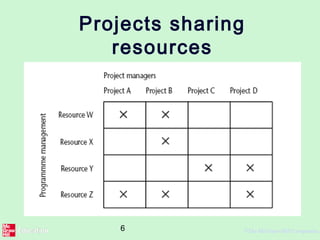
Projects sharing
resources
7 ©The McGraw-Hill Companies,
Strategic programmes
• Based on OGC approach
• Initial planning document is the
Programme Mandate describing
– The new services/capabilities that the
programme should deliver
– How an organization will be improved
– Fit with existing organizational goals
• A programme director appointed a
champion for the scheme
8 ©The McGraw-Hill Companies,
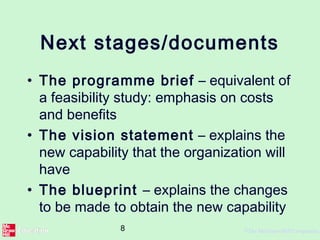
Next stages/documents
• The programme brief – equivalent of
a feasibility study: emphasis on costs
and benefits
• The vision statement – explains the
new capability that the organization will
have
• The blueprint – explains the changes
to be made to obtain the new capability
9 ©The McGraw-Hill Companies,
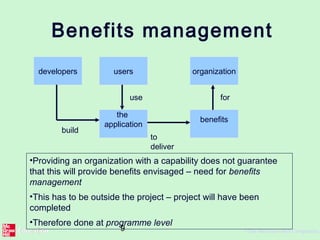
Benefits management
the
application
developers users
benefits
build
use
to
deliver
organization
for
•Providing an organization with a capability does not guarantee
that this will provide benefits envisaged – need for benefits
management
•This has to be outside the project – project will have been
completed
•Therefore done at programme level
10 ©The McGraw-Hill Companies,
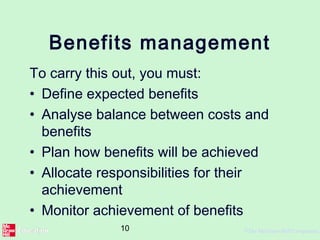
Benefits management
To carry this out, you must:
• Define expected benefits
• Analyse balance between costs and
benefits
• Plan how benefits will be achieved
• Allocate responsibilities for their
achievement
• Monitor achievement of benefits
11 ©The McGraw-Hill Companies,
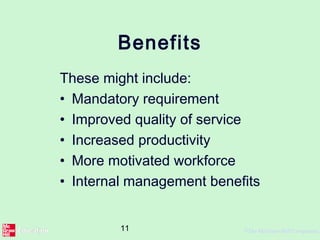
Benefits
These might include:
• Mandatory requirement
• Improved quality of service
• Increased productivity
• More motivated workforce
• Internal management benefits
12 ©The McGraw-Hill Companies,
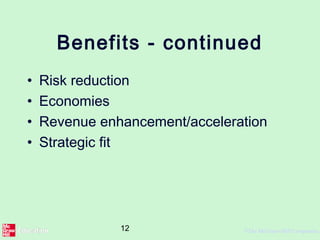
Benefits - continued
• Risk reduction
• Economies
• Revenue enhancement/acceleration
• Strategic fit
13 ©The McGraw-Hill Companies,
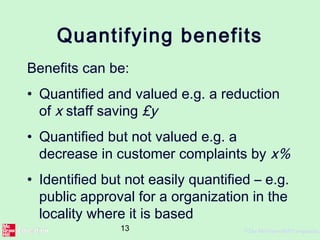
Quantifying benefits
Benefits can be:
• Quantified and valued e.g. a reduction
of x staff saving £y
• Quantified but not valued e.g. a
decrease in customer complaints by x%
• Identified but not easily quantified – e.g.
public approval for a organization in the
locality where it is based
14 ©The McGraw-Hill Companies,
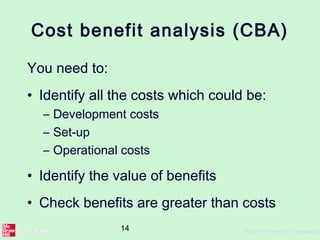
Cost benefit analysis (CBA)
You need to:
• Identify all the costs which could be:
– Development costs
– Set-up
– Operational costs
• Identify the value of benefits
• Check benefits are greater than costs
15 ©The McGraw-Hill Companies,
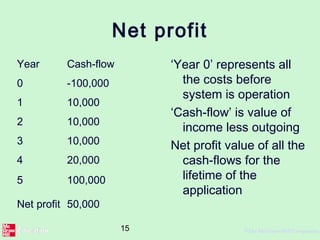
Net profit
‘Year 0’ represents all
the costs before
system is operation
‘Cash-flow’ is value of
income less outgoing
Net profit value of all the
cash-flows for the
lifetime of the
application
Year Cash-flow
0 -100,000
1 10,000
2 10,000
3 10,000
4 20,000
5 100,000
Net profit 50,000
16 ©The McGraw-Hill Companies,
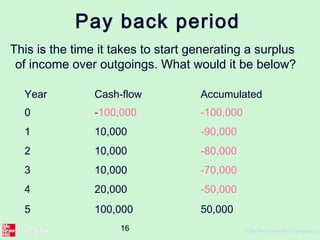
Pay back period
This is the time it takes to start generating a surplus
of income over outgoings. What would it be below?
Year Cash-flow Accumulated
0 -100,000 -100,000
1 10,000 -90,000
2 10,000 -80,000
3 10,000 -70,000
4 20,000 -50,000
5 100,000 50,000
17 ©The McGraw-Hill Companies,
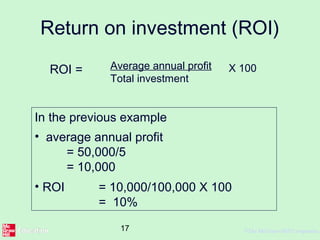
Return on investment (ROI)
ROI = Average annual profit
Total investment
X 100
In the previous example
• average annual profit
= 50,000/5
= 10,000
• ROI = 10,000/100,000 X 100
= 10%
18 ©The McGraw-Hill Companies,
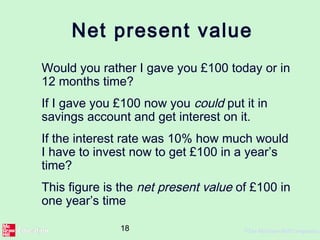
Net present value
Would you rather I gave you £100 today or in
12 months time?
If I gave you £100 now you could put it in
savings account and get interest on it.
If the interest rate was 10% how much would
I have to invest now to get £100 in a year’s
time?
This figure is the net present value of £100 in
one year’s time
19 ©The McGraw-Hill Companies,
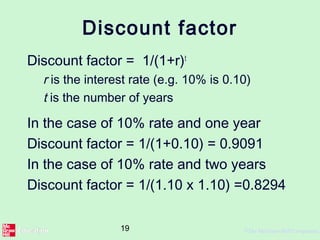
Discount factor
Discount factor = 1/(1+r)t
r is the interest rate (e.g. 10% is 0.10)
t is the number of years
In the case of 10% rate and one year
Discount factor = 1/(1+0.10) = 0.9091
In the case of 10% rate and two years
Discount factor = 1/(1.10 x 1.10) =0.8294
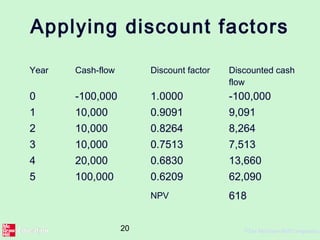
20 ©The McGraw-Hill Companies,
Applying discount factors
Year Cash-flow Discount factor Discounted cash
flow
0 -100,000 1.0000 -100,000
1 10,000 0.9091 9,091
2 10,000 0.8264 8,264
3 10,000 0.7513 7,513
4 20,000 0.6830 13,660
5 100,000 0.6209 62,090
NPV 618
21 ©The McGraw-Hill Companies,
Internal rate of return
• Internal rate of return (IRR) is the
discount rate that would produce an
NPV of 0 for the project
• Can be used to compare different
investment opportunities
• There is a Microsoft Excel function
which can be used to calculate
22 ©The McGraw-Hill Companies,
Dealing with uncertainty:
Risk evaluation
• project A might appear to give a better
return than B but could be riskier
• Could draw up draw a project risk
matrix for each project to assess risks –
see next overhead
• For riskier projects could use higher
discount rates
23 ©The McGraw-Hill Companies,
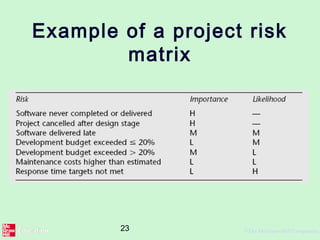
Example of a project risk
matrix
24 ©The McGraw-Hill Companies,
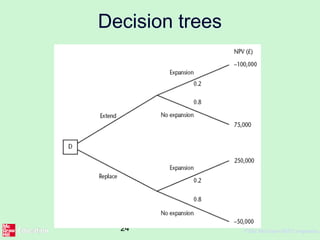
Decision trees
25 ©The McGraw-Hill Companies,
Remember!
• A project may fail not through poor
management but because it should never
have been started
• A project may make a profit, but it may be
possible to do something else that makes
even more profit
• A real problem is that it is often not possible
to express benefits in accurate financial terms
• Projects with the highest potential returns are
often the most risky

Programme management and project evaluation

  • 1.
    1 ©The McGraw-HillCompanies, Software Project Management 4th Edition Programme management and project evaluation Chapter 3
  • 2.
    2 ©The McGraw-HillCompanies, Main topics to be covered • Programme management • Benefits management • Project evaluation – Cost benefit analysis – Cash flow forecasting • Project risk evaluation
  • 3.
    3 ©The McGraw-HillCompanies, Programme management • One definition: ‘a group of projects that are managed in a co-ordinated way to gain benefits that would not be possible were the projects to be managed independently’ Ferns
  • 4.
    4 ©The McGraw-HillCompanies, Programmes may be • Strategic • Business cycle programmes • Infrastructure programmes • Research and development programmes • Innovative partnerships
  • 5.
    5 ©The McGraw-HillCompanies, Programme managers versus project managers Programme manager – Many simultaneous projects – Personal relationship with skilled resources – Optimization of resource use – Projects tend to be seen as similar Project manager – One project at a time – Impersonal relationship with resources – Minimization of demand for resources – Projects tend to be seen as unique
  • 6.
    6 ©The McGraw-HillCompanies, Projects sharing resources
  • 7.
    7 ©The McGraw-HillCompanies, Strategic programmes • Based on OGC approach • Initial planning document is the Programme Mandate describing – The new services/capabilities that the programme should deliver – How an organization will be improved – Fit with existing organizational goals • A programme director appointed a champion for the scheme
  • 8.
    8 ©The McGraw-HillCompanies, Next stages/documents • The programme brief – equivalent of a feasibility study: emphasis on costs and benefits • The vision statement – explains the new capability that the organization will have • The blueprint – explains the changes to be made to obtain the new capability
  • 9.
    9 ©The McGraw-HillCompanies, Benefits management the application developers users benefits build use to deliver organization for •Providing an organization with a capability does not guarantee that this will provide benefits envisaged – need for benefits management •This has to be outside the project – project will have been completed •Therefore done at programme level
  • 10.
    10 ©The McGraw-HillCompanies, Benefits management To carry this out, you must: • Define expected benefits • Analyse balance between costs and benefits • Plan how benefits will be achieved • Allocate responsibilities for their achievement • Monitor achievement of benefits
  • 11.
    11 ©The McGraw-HillCompanies, Benefits These might include: • Mandatory requirement • Improved quality of service • Increased productivity • More motivated workforce • Internal management benefits
  • 12.
    12 ©The McGraw-HillCompanies, Benefits - continued • Risk reduction • Economies • Revenue enhancement/acceleration • Strategic fit
  • 13.
    13 ©The McGraw-HillCompanies, Quantifying benefits Benefits can be: • Quantified and valued e.g. a reduction of x staff saving £y • Quantified but not valued e.g. a decrease in customer complaints by x% • Identified but not easily quantified – e.g. public approval for a organization in the locality where it is based
  • 14.
    14 ©The McGraw-HillCompanies, Cost benefit analysis (CBA) You need to: • Identify all the costs which could be: – Development costs – Set-up – Operational costs • Identify the value of benefits • Check benefits are greater than costs
  • 15.
    15 ©The McGraw-HillCompanies, Net profit ‘Year 0’ represents all the costs before system is operation ‘Cash-flow’ is value of income less outgoing Net profit value of all the cash-flows for the lifetime of the application Year Cash-flow 0 -100,000 1 10,000 2 10,000 3 10,000 4 20,000 5 100,000 Net profit 50,000
  • 16.
    16 ©The McGraw-HillCompanies, Pay back period This is the time it takes to start generating a surplus of income over outgoings. What would it be below? Year Cash-flow Accumulated 0 -100,000 -100,000 1 10,000 -90,000 2 10,000 -80,000 3 10,000 -70,000 4 20,000 -50,000 5 100,000 50,000
  • 17.
    17 ©The McGraw-HillCompanies, Return on investment (ROI) ROI = Average annual profit Total investment X 100 In the previous example • average annual profit = 50,000/5 = 10,000 • ROI = 10,000/100,000 X 100 = 10%
  • 18.
    18 ©The McGraw-HillCompanies, Net present value Would you rather I gave you £100 today or in 12 months time? If I gave you £100 now you could put it in savings account and get interest on it. If the interest rate was 10% how much would I have to invest now to get £100 in a year’s time? This figure is the net present value of £100 in one year’s time
  • 19.
    19 ©The McGraw-HillCompanies, Discount factor Discount factor = 1/(1+r)t r is the interest rate (e.g. 10% is 0.10) t is the number of years In the case of 10% rate and one year Discount factor = 1/(1+0.10) = 0.9091 In the case of 10% rate and two years Discount factor = 1/(1.10 x 1.10) =0.8294
  • 20.
    20 ©The McGraw-HillCompanies, Applying discount factors Year Cash-flow Discount factor Discounted cash flow 0 -100,000 1.0000 -100,000 1 10,000 0.9091 9,091 2 10,000 0.8264 8,264 3 10,000 0.7513 7,513 4 20,000 0.6830 13,660 5 100,000 0.6209 62,090 NPV 618
  • 21.
    21 ©The McGraw-HillCompanies, Internal rate of return • Internal rate of return (IRR) is the discount rate that would produce an NPV of 0 for the project • Can be used to compare different investment opportunities • There is a Microsoft Excel function which can be used to calculate
  • 22.
    22 ©The McGraw-HillCompanies, Dealing with uncertainty: Risk evaluation • project A might appear to give a better return than B but could be riskier • Could draw up draw a project risk matrix for each project to assess risks – see next overhead • For riskier projects could use higher discount rates
  • 23.
    23 ©The McGraw-HillCompanies, Example of a project risk matrix
  • 24.
    24 ©The McGraw-HillCompanies, Decision trees
  • 25.
    25 ©The McGraw-HillCompanies, Remember! • A project may fail not through poor management but because it should never have been started • A project may make a profit, but it may be possible to do something else that makes even more profit • A real problem is that it is often not possible to express benefits in accurate financial terms • Projects with the highest potential returns are often the most risky

Editor's Notes

  • #2 This talk provides an overview of the basic steps needed to produce a project plan. The framework provided should allow students to identify where some of the particular issues discussed in other chapters are applied to the planning process. As the focus is on project planning, techniques to do with project control are not explicitly described. However, in practice, one element of project planning will be to decide what project control procedures need to be in place.
  • #4 The quotation is from a paper that appeared in the International Journal of Project Management August 1991
  • #5 Strategic Several projects together implement a single strategy. For example, merging two organizations will involve many different activities e.g. physical re-organization of offices, redesigning the corporate image, merging ICT systems etc. Each of these activities could be project within an overarching programme. Business cycle programmes A portfolio of project that are to take place within a certain time frame e.g. the next financial year Infrastructure programmes In an organization there may be many different ICT-based applications which share the same hardware/software infrastructure Research and development programmes In a very innovative environment where new products are being developed, a range of products could be developed some of which are very speculative and high-risk but potentially very profitable and some will have a lower risk but will return a lower profit. Getting the right balance would be key to the organization’s long term success Innovative partnerships e.g. pre-competitive co-operation to develop new technologies that could be exploited by a whole range of companies
  • #6 The programme manager may well have a pool of staff upon which to call. He/she will be concerned with ensuring the best use of staff e.g ensuring that staff have regular work with no periods of enforced idleness between project tasks. The project leader would think in terms of ‘I need a Java programmer for four weeks’ without being concerned which specific person it is (beyond obvious concerns that they are fully capable).
  • #7 During the resource allocation phase of project planning – see chapter/lecture 8 on resource allocation – some project activities could be delayed while waiting for a resource to become available.
  • #8 The material here is based on the UK government’s Office of Government Commerce (OGC) approach which is described in detail in their publication Managing successful programmes. The programme director should be someone who is in a prominent position in the organization so that the seriousness and commitment of the organization to the programme are made clear. An example of what might be a programme is given in Section 3.4 in the text. It might be found at the IOE company that the customers’ experience of the organization can be very variable and inconsistent. The employee who records the customer’s requirements is different from the people who actually carry out the work and different again from the clerk who deals with accounts. Different maintenance engineers deal with different types of equipment. A business objective might be to present a consistent and uniform interface to the client. This objective might need changes to a number of different systems which until now have been largely self-contained. The work to reorganize each individual area might be treated as separate projects, co-ordinated at a higher level as a programme.
  • #9 The programme brief – is it worth it? The vision statement – the ‘what’ The blueprint – the ‘how’
  • #11 Benefit profiles can be produced that document when and how it is planned that the benefits will be experienced. As different components of the new capability are developed, a series of tranches of projects (projects grouped in different steps of the programme) may be completed, each with a set of associated benefits. The achievement of benefits might be made the responsibility of staff who are designated as business change managers.
  • #12 You could argue that as you have to comply with a mandatory requirement, the question of benefits is irrelevant in this case. However as failure to comply will a negative outcome (e.g. not being able to trade), avoiding that negative outcome is clearly a benefit which could be costed. ‘Internal management benefits’ includes things like better decision-making. In the case of an insurance company a deeper analysis of insurance claims might help identify types of business that are most risky and allow the company to adjust premiums to cover these.
  • #13 ‘Economies’ refers to cost-cutting e.g. using an automated telephone system to direct calls without human intervention could allow an organization to reduce staff. Revenue enhancement/acceleration e.g. the sooner that bills reach the customers, the sooner they can pay them. ‘Strategic fit’ A change might not benefit any single group within an organization but might have to be made to obtain a benefit for the organization as a whole.
  • #15 Section 3.10 of the text expands this material. Exercise 3.1 requires students to identify the potential costs and benefits of the Brightmouth College payroll application.
  • #16 See Section 3.12 for further details. Exercise 3.2 is applicable here
  • #17 The payback period would be about 4.5 years. Exercise 3.3. in the text is relevant hee.
  • #18 Exercise 3.4. gives further practice is calculating ROI.
  • #19 If you invested £91 now you would get £9.10 in interest which would give you £100.10 in 12 months
  • #21 NPV is the sum of the discounted cash flows for all the years of the ‘project’ (note that in NPV terms the lifetime of the completed application is included in the ‘project’) The figure of £618 means that £618 more would be made than if the money were simply invested at 10%. An NPV of £0 would be the same amount of profit would be generated as investing at 10%.
  • #22 A quite detailed discussion of IRR features in the text in Section 3.12
  • #24 In the table ‘Importance’ relates to the cost of the damage if the risk were to materialize and ‘likelihood’ to the probability that the risk will actual occur. ‘H’ indicates ‘High’, ‘M’ indicates ‘medium’ and ‘L’ indicates ‘low’. The issues of risk analysis are explored in much more depth in lecture/chapter 7.
  • #25 The diagram here is figure 3.8 in the text. This illustrates a scenario relating to the IOE case study. Amanda is responsible for extending the invoicing system. An alternative would be to replace the whole of the system. The decision is influenced by the likelihood of IOE expanding their market. There is a strong rumour that they could benefit from their main competitor going out of business: in this case they could pick up a huge amount of new business, but the invoicing system could not cope. However replacing the system immediately would mean other important projects would have to be delayed. The NPV of extending the invoicing system is assessed as £75,000 if there is no sudden expansion. If there were a sudden expansion then there would be a loss of £100,000. If the whole system were replaced and there was a large expansion there would be a NPV of £250,000 due to the benefits of being able to handle increased sales. If sales did not increase then the NPV would be -£50,000. The decision tree shows these possible outcomes and also shows the estimated probability of each outcome. The value of each outcome is the NPV multiplied by the probability of its occurring. The value of a path that springs from a particular decision is the sum of the values of the possible outcomes from that decision. If it is decided to extend the system the sum of the values of the outcomes is £40,000 (75,000 x 0.8 – 100,000 x 0.2) while for replacement it would be £10,000 (250,000 x 0.2 – 50,000 x 0.80). Extending the system therefore seems to be the best bet (but it is still a bet!).