Statistical Reports
STEPS TO TAKE WHEN WRITING A
STATISTICAL REPORT
WHAT IS A STATISTICAL REPORT?
● It summarises a statistical representations
● It shows trends (patterns) in the data.
● It shows any peculiarities in the data.
A piece of writing that informs about
numerical data.
STEP 1 -READ THE QUESTION AND
IDENTIFY YOUR PURPOSE
● When you identify your purpose, this guides your
● Examination of the graphic
● Writing style
Example:
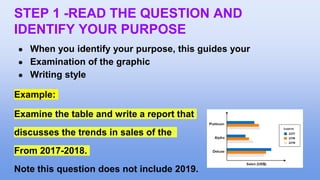
Examine the table and write a report that
discusses the trends in sales of the
From 2017-2018.
Note this question does not include 2019.
STEP 2 - EXAMINE THE STATISTICAL
REPRESENTATION
● Identify what the statistical representation is intended to
present (N.B. This will most likely form part of the title of your
report).
● Examine each category.
● Note any differences that occur among the categories.
● Note any patterns or fluctuations that occur among and
across the categories.
● Make an attempt to classify related information.
● Compare and contrast findings.
STEP 3 - PLAN THE REPORT
● Create a heading
● Review the notes you made when examining the
statistical representation.
● Decide on the most logical and efficient way to
present the information. You need to deliver the
information in a way that makes sense to the
reader and in a way that uses the least number of
words.
STEP 4 - DRAFT THE REPORT
Write the report keeping in mind:
● Use a neutral tone. Do not show any emotion or
opinion through the words that you use.
● Stick to the facts
● Use linkwords and transitional phrases
STEP 5 - CHECK OVER YOUR WORK
Read over your work and ask yourself:
1. Have I achieved the purpose of this report?
2. Is my language neutral?
3. Do I have all the necessary details?
4. Does it flow and make sense?
5. Did I spell everything correctly?
6. Is my work grammatically correct?
SUMMARY - STEPS IN WRITING A STATISTICAL
REPORT
1. Read the question and identify your purpose
2. Examine the statistical representation
3. Plan the report
4. Draft the report
5. Check over your work

Steps in writing a statistical reports

  • 1.
    Statistical Reports STEPS TOTAKE WHEN WRITING A STATISTICAL REPORT
  • 2.
    WHAT IS ASTATISTICAL REPORT? ● It summarises a statistical representations ● It shows trends (patterns) in the data. ● It shows any peculiarities in the data. A piece of writing that informs about numerical data.
  • 3.
    STEP 1 -READTHE QUESTION AND IDENTIFY YOUR PURPOSE ● When you identify your purpose, this guides your ● Examination of the graphic ● Writing style Example: Examine the table and write a report that discusses the trends in sales of the From 2017-2018. Note this question does not include 2019.
  • 4.
    STEP 2 -EXAMINE THE STATISTICAL REPRESENTATION ● Identify what the statistical representation is intended to present (N.B. This will most likely form part of the title of your report). ● Examine each category. ● Note any differences that occur among the categories. ● Note any patterns or fluctuations that occur among and across the categories. ● Make an attempt to classify related information. ● Compare and contrast findings.
  • 5.
    STEP 3 -PLAN THE REPORT ● Create a heading ● Review the notes you made when examining the statistical representation. ● Decide on the most logical and efficient way to present the information. You need to deliver the information in a way that makes sense to the reader and in a way that uses the least number of words.
  • 6.
    STEP 4 -DRAFT THE REPORT Write the report keeping in mind: ● Use a neutral tone. Do not show any emotion or opinion through the words that you use. ● Stick to the facts ● Use linkwords and transitional phrases
  • 7.
    STEP 5 -CHECK OVER YOUR WORK Read over your work and ask yourself: 1. Have I achieved the purpose of this report? 2. Is my language neutral? 3. Do I have all the necessary details? 4. Does it flow and make sense? 5. Did I spell everything correctly? 6. Is my work grammatically correct?
  • 8.
    SUMMARY - STEPSIN WRITING A STATISTICAL REPORT 1. Read the question and identify your purpose 2. Examine the statistical representation 3. Plan the report 4. Draft the report 5. Check over your work