ENGLISH PRESENTATION
TOPIC – REPORT WRITING SUBMITTED BY - ASFIYA
WHAT IS
REPORT
WRITING
Report writing is the process of presenting information
in a structured and organized format. It involves
collecting and analyzing data, identifying trends, and
making recommendations based on the findings.
Reports are used in a variety of settings, including
business, academia, and government, and can range
from short, informal documents to lengthy, technical
reports.
WHAT IS A REPORT?
A report is a formal document that presents information and findings
on a specific topic to a particular audience.
COMPONENTS OF A WELL-
STRUCTURED REPORT:
•Title Page
•Table of Contents
•Executive Summary
•Introduction
•Body
•Conclusion
•Recommendations
•References
•Appendices
TO CREATE EFFECTIVE
REPORTS, IT'S
IMPORTANT TO
FOLLOW A
STRUCTURED
APPROACH. HERE ARE
SOME KEY ELEMENTS
AND STEPS TO
CONSIDER IN THE
REPORT WRITING
PROCESS:
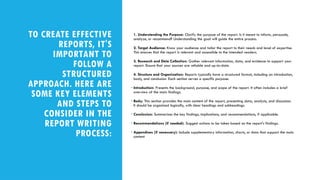
1. Understanding the Purpose: Clarify the purpose of the report. Is it meant to inform, persuade,
analyze, or recommend? Understanding the goal will guide the entire process.
2. Target Audience: Know your audience and tailor the report to their needs and level of expertise.
This ensures that the report is relevant and accessible to the intended readers.
3. Research and Data Collection: Gather relevant information, data, and evidence to support your
report. Ensure that your sources are reliable and up-to-date.
4. Structure and Organization: Reports typically have a structured format, including an introduction,
body, and conclusion. Each section serves a specific purpose:
• Introduction: Presents the background, purpose, and scope of the report. It often includes a brief
overview of the main findings.
• Body: This section provides the main content of the report, presenting data, analysis, and discussion.
It should be organized logically, with clear headings and subheadings.
• Conclusion: Summarizes the key findings, implications, and recommendations, if applicable.
• Recommendations (if needed): Suggest actions to be taken based on the report's findings.
• Appendices (if necessary): Include supplementary information, charts, or data that support the main
content
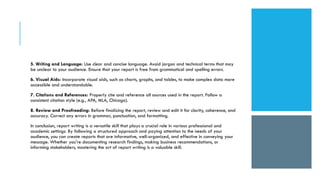
5. Writing and Language: Use clear and concise language. Avoid jargon and technical terms that may
be unclear to your audience. Ensure that your report is free from grammatical and spelling errors.
6. Visual Aids: Incorporate visual aids, such as charts, graphs, and tables, to make complex data more
accessible and understandable.
7. Citations and References: Properly cite and reference all sources used in the report. Follow a
consistent citation style (e.g., APA, MLA, Chicago).
8. Review and Proofreading: Before finalizing the report, review and edit it for clarity, coherence, and
accuracy. Correct any errors in grammar, punctuation, and formatting.
In conclusion, report writing is a versatile skill that plays a crucial role in various professional and
academic settings. By following a structured approach and paying attention to the needs of your
audience, you can create reports that are informative, well-organized, and effective in conveying your
message. Whether you're documenting research findings, making business recommendations, or
informing stakeholders, mastering the art of report writing is a valuable skill.
TYPES OF
REPORT :
Reports can be categorized into information only
reports, research reports, and case study analysis
reports.
INFORMATION ONLY REPORTS :
Information only reports are designed to present data, facts, and other information without
any analysis or recommendations. These reports are often used to provide background
information or to update stakeholders on the progress of a project or initiative.
Report Structure :
Information only reports typically follow a standard structure, including an introduction, a
body, and a conclusion. The introduction provides background information and context for
the report, while the body presents the data and information in a clear and organized
manner. The conclusion summarizes the main points of the report and may include
recommendations for future action.
Visualizing Data and Information :
To make information only reports more engaging and easier to understand, it's important
to use visual aids such as graphs, charts, and tables. These tools can help readers quickly
grasp complex data and information.
RESEARCH REPORTS
Research reports are detailed and in-depth documents that aim to
present the findings of a research project. They typically include an
introduction, literature review, methodology, results, discussion, and
conclusion sections. Research reports are often used to share the
results of academic research, scientific experiments, or market
research studies.
Features of a Well-Written Research Report
•Clear and concise language
•Logical and well-structured presentation of information
•Accurate and reliable data
•Appropriate use of visuals to support data and findings
CASE STUDY ANALYSIS REPORT
A case study analysis report is a detailed examination of a particular event,
situation, or individual. It requires the writer to conduct extensive research,
analyze data, and draw conclusions based on the findings. The report should
identify the key issues, provide a detailed analysis of the problem, and
recommend solutions.
Structure of a Case Study Analysis Report
•Introduction: Provide background information on the case study and its
relevance.
•Analysis: Describe the problem, identify key issues, and provide a detailed
analysis of the situation.
•Recommendations: Provide solutions and recommendations for the problem
identified in the analysis.
•Conclusion: Summarize the key findings and recommendations of the report.
PLANNING AND STRUCTURING YOUR
REPORT
Identify the Purpose and Scope of Your Report
Before starting your report, it is important to identify the purpose and scope of your report. This will
help you stay focused and ensure that you include all the necessary information. Ask yourself what you
want to achieve with your report and who your target audience is.
Outline Your Report Structure
Once you have identified the purpose and scope of your report, you can start outlining your report
structure. This will help you organize your thoughts and ensure that you cover all the necessary
information. Your report structure should include an introduction, main body, and conclusion. The main
body should be divided into sections and subsections, each covering a specific topic.
Consider Your Audience
When planning and structuring your report, it is important to consider your audience. Think about their
level of knowledge on the topic and what information they would find most useful. This will help you
tailor your report to your audience and ensure that it is effective.
RESEARCHING AND
GATHERING INFORMATION
Sources of Information
Primary sources such as interviews, surveys, and experiments.
Secondary sources such as books, articles, and online databases.
Evaluating Sources
Consider the credibility, objectivity, and relevance of each source.
Note Taking
Organize your notes by source and topic, and record all necessary
information for citations.
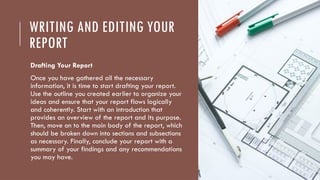
WRITING AND EDITING YOUR
REPORT
Drafting Your Report
Once you have gathered all the necessary
information, it is time to start drafting your report.
Use the outline you created earlier to organize your
ideas and ensure that your report flows logically
and coherently. Start with an introduction that
provides an overview of the report and its purpose.
Then, move on to the main body of the report, which
should be broken down into sections and subsections
as necessary. Finally, conclude your report with a
summary of your findings and any recommendations
you may have.
Editing Your Report
Once you have completed a draft of your report, it
is important to edit and revise it carefully. Start by
reviewing the overall structure and organization of
your report, making sure that it is easy to follow and
that the information is presented in a logical
manner. Then, focus on the content of each section,
ensuring that the information is accurate, relevant,
and well-supported. Finally, proofread your report
carefully to catch any spelling or grammatical
errors.
VISUALIZING DATA AND
INFORMATION
Visualizing data and information is an important aspect of report
writing. It helps in presenting complex data in a more
understandable and engaging way. Visuals like graphs, charts,
tables, and diagrams can help readers comprehend the information
better.
Tips for Effective Data Visualization
1. Choose the right type of visualization for your data.
2. Keep it simple and avoid clutter.
3. Use clear and concise labels.
4. Use colors effectively to highlight important information.
5. Make sure the visuals are easy to read and understand.
FEATURES OF A WELL WRITTEN REPORT
A well-written report should be clear, concise, and comprehensive. It should
present information in a logical and organized manner, making it easy for the
reader to understand and follow. Here are some key features of a well-written
report:
Accuracy and Objectivity: The report should be based on accurate and reliable
information, and should present that information in an objective manner.Clarity
and Conciseness: The report should be written in clear and concise language,
avoiding unnecessary jargon or technical terms.Organization and Structure: The
report should be well-organized and structured, with a clear introduction, main
body, and conclusion.Relevance and Significance: The report should focus on the
most relevant and significant information, and should avoid irrelevant or trivial
details.Visual Aids: The report should include appropriate visual aids such as
graphs, charts, and tables, to help illustrate key points and make the information
more accessible.
DELIVERING AND PRESENTING YOUR
REPORT
Once you have completed writing your report, it's time to deliver and present it. Here are some tips to make sure your report is
well-received:
Know Your Audience
Before presenting your report, consider who your audience is and what their expectations may be. Tailor your presentation to
their needs and interests.
Practice Your Delivery
Practice your presentation several times to ensure that you are comfortable with the material and can deliver it smoothly. Practice
in front of a mirror or with a colleague for feedback.
Use Visual Aids
Visual aids can help to reinforce your message and make your presentation more engaging. Consider using charts, graphs, and
images to illustrate key points.
Be Prepared for Questions
Be prepared to answer questions about your report and the research that went into it. Anticipate potential questions and
prepare thoughtful responses.
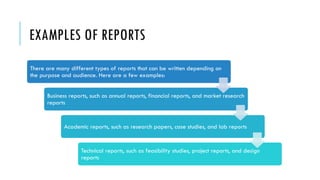
EXAMPLES OF REPORTS
There are many different types of reports that can be written depending on
the purpose and audience. Here are a few examples:
Business reports, such as annual reports, financial reports, and market research
reports
Academic reports, such as research papers, case studies, and lab reports
Technical reports, such as feasibility studies, project reports, and design
reports
THANK YOU FOR YOUR ATTENTION
I appreciate your time and hope this presentation on report writing has been
informative and helpful.

ENGLISH PRESENTATION for report writing in assignment

  • 1.
    ENGLISH PRESENTATION TOPIC –REPORT WRITING SUBMITTED BY - ASFIYA
  • 2.
    WHAT IS REPORT WRITING Report writingis the process of presenting information in a structured and organized format. It involves collecting and analyzing data, identifying trends, and making recommendations based on the findings. Reports are used in a variety of settings, including business, academia, and government, and can range from short, informal documents to lengthy, technical reports.
  • 3.
    WHAT IS AREPORT? A report is a formal document that presents information and findings on a specific topic to a particular audience.
  • 4.
    COMPONENTS OF AWELL- STRUCTURED REPORT: •Title Page •Table of Contents •Executive Summary •Introduction •Body •Conclusion •Recommendations •References •Appendices
  • 5.
    TO CREATE EFFECTIVE REPORTS,IT'S IMPORTANT TO FOLLOW A STRUCTURED APPROACH. HERE ARE SOME KEY ELEMENTS AND STEPS TO CONSIDER IN THE REPORT WRITING PROCESS: 1. Understanding the Purpose: Clarify the purpose of the report. Is it meant to inform, persuade, analyze, or recommend? Understanding the goal will guide the entire process. 2. Target Audience: Know your audience and tailor the report to their needs and level of expertise. This ensures that the report is relevant and accessible to the intended readers. 3. Research and Data Collection: Gather relevant information, data, and evidence to support your report. Ensure that your sources are reliable and up-to-date. 4. Structure and Organization: Reports typically have a structured format, including an introduction, body, and conclusion. Each section serves a specific purpose: • Introduction: Presents the background, purpose, and scope of the report. It often includes a brief overview of the main findings. • Body: This section provides the main content of the report, presenting data, analysis, and discussion. It should be organized logically, with clear headings and subheadings. • Conclusion: Summarizes the key findings, implications, and recommendations, if applicable. • Recommendations (if needed): Suggest actions to be taken based on the report's findings. • Appendices (if necessary): Include supplementary information, charts, or data that support the main content
  • 6.
    5. Writing andLanguage: Use clear and concise language. Avoid jargon and technical terms that may be unclear to your audience. Ensure that your report is free from grammatical and spelling errors. 6. Visual Aids: Incorporate visual aids, such as charts, graphs, and tables, to make complex data more accessible and understandable. 7. Citations and References: Properly cite and reference all sources used in the report. Follow a consistent citation style (e.g., APA, MLA, Chicago). 8. Review and Proofreading: Before finalizing the report, review and edit it for clarity, coherence, and accuracy. Correct any errors in grammar, punctuation, and formatting. In conclusion, report writing is a versatile skill that plays a crucial role in various professional and academic settings. By following a structured approach and paying attention to the needs of your audience, you can create reports that are informative, well-organized, and effective in conveying your message. Whether you're documenting research findings, making business recommendations, or informing stakeholders, mastering the art of report writing is a valuable skill.
  • 7.
    TYPES OF REPORT : Reportscan be categorized into information only reports, research reports, and case study analysis reports.
  • 8.
    INFORMATION ONLY REPORTS: Information only reports are designed to present data, facts, and other information without any analysis or recommendations. These reports are often used to provide background information or to update stakeholders on the progress of a project or initiative. Report Structure : Information only reports typically follow a standard structure, including an introduction, a body, and a conclusion. The introduction provides background information and context for the report, while the body presents the data and information in a clear and organized manner. The conclusion summarizes the main points of the report and may include recommendations for future action. Visualizing Data and Information : To make information only reports more engaging and easier to understand, it's important to use visual aids such as graphs, charts, and tables. These tools can help readers quickly grasp complex data and information.
  • 9.
    RESEARCH REPORTS Research reportsare detailed and in-depth documents that aim to present the findings of a research project. They typically include an introduction, literature review, methodology, results, discussion, and conclusion sections. Research reports are often used to share the results of academic research, scientific experiments, or market research studies. Features of a Well-Written Research Report •Clear and concise language •Logical and well-structured presentation of information •Accurate and reliable data •Appropriate use of visuals to support data and findings
  • 10.
    CASE STUDY ANALYSISREPORT A case study analysis report is a detailed examination of a particular event, situation, or individual. It requires the writer to conduct extensive research, analyze data, and draw conclusions based on the findings. The report should identify the key issues, provide a detailed analysis of the problem, and recommend solutions. Structure of a Case Study Analysis Report •Introduction: Provide background information on the case study and its relevance. •Analysis: Describe the problem, identify key issues, and provide a detailed analysis of the situation. •Recommendations: Provide solutions and recommendations for the problem identified in the analysis. •Conclusion: Summarize the key findings and recommendations of the report.
  • 11.
    PLANNING AND STRUCTURINGYOUR REPORT Identify the Purpose and Scope of Your Report Before starting your report, it is important to identify the purpose and scope of your report. This will help you stay focused and ensure that you include all the necessary information. Ask yourself what you want to achieve with your report and who your target audience is. Outline Your Report Structure Once you have identified the purpose and scope of your report, you can start outlining your report structure. This will help you organize your thoughts and ensure that you cover all the necessary information. Your report structure should include an introduction, main body, and conclusion. The main body should be divided into sections and subsections, each covering a specific topic. Consider Your Audience When planning and structuring your report, it is important to consider your audience. Think about their level of knowledge on the topic and what information they would find most useful. This will help you tailor your report to your audience and ensure that it is effective.
  • 12.
    RESEARCHING AND GATHERING INFORMATION Sourcesof Information Primary sources such as interviews, surveys, and experiments. Secondary sources such as books, articles, and online databases. Evaluating Sources Consider the credibility, objectivity, and relevance of each source. Note Taking Organize your notes by source and topic, and record all necessary information for citations.
  • 13.
    WRITING AND EDITINGYOUR REPORT Drafting Your Report Once you have gathered all the necessary information, it is time to start drafting your report. Use the outline you created earlier to organize your ideas and ensure that your report flows logically and coherently. Start with an introduction that provides an overview of the report and its purpose. Then, move on to the main body of the report, which should be broken down into sections and subsections as necessary. Finally, conclude your report with a summary of your findings and any recommendations you may have.
  • 14.
    Editing Your Report Onceyou have completed a draft of your report, it is important to edit and revise it carefully. Start by reviewing the overall structure and organization of your report, making sure that it is easy to follow and that the information is presented in a logical manner. Then, focus on the content of each section, ensuring that the information is accurate, relevant, and well-supported. Finally, proofread your report carefully to catch any spelling or grammatical errors.
  • 15.
    VISUALIZING DATA AND INFORMATION Visualizingdata and information is an important aspect of report writing. It helps in presenting complex data in a more understandable and engaging way. Visuals like graphs, charts, tables, and diagrams can help readers comprehend the information better. Tips for Effective Data Visualization 1. Choose the right type of visualization for your data. 2. Keep it simple and avoid clutter. 3. Use clear and concise labels. 4. Use colors effectively to highlight important information. 5. Make sure the visuals are easy to read and understand.
  • 16.
    FEATURES OF AWELL WRITTEN REPORT A well-written report should be clear, concise, and comprehensive. It should present information in a logical and organized manner, making it easy for the reader to understand and follow. Here are some key features of a well-written report: Accuracy and Objectivity: The report should be based on accurate and reliable information, and should present that information in an objective manner.Clarity and Conciseness: The report should be written in clear and concise language, avoiding unnecessary jargon or technical terms.Organization and Structure: The report should be well-organized and structured, with a clear introduction, main body, and conclusion.Relevance and Significance: The report should focus on the most relevant and significant information, and should avoid irrelevant or trivial details.Visual Aids: The report should include appropriate visual aids such as graphs, charts, and tables, to help illustrate key points and make the information more accessible.
  • 17.
    DELIVERING AND PRESENTINGYOUR REPORT Once you have completed writing your report, it's time to deliver and present it. Here are some tips to make sure your report is well-received: Know Your Audience Before presenting your report, consider who your audience is and what their expectations may be. Tailor your presentation to their needs and interests. Practice Your Delivery Practice your presentation several times to ensure that you are comfortable with the material and can deliver it smoothly. Practice in front of a mirror or with a colleague for feedback. Use Visual Aids Visual aids can help to reinforce your message and make your presentation more engaging. Consider using charts, graphs, and images to illustrate key points. Be Prepared for Questions Be prepared to answer questions about your report and the research that went into it. Anticipate potential questions and prepare thoughtful responses.
  • 18.
    EXAMPLES OF REPORTS Thereare many different types of reports that can be written depending on the purpose and audience. Here are a few examples: Business reports, such as annual reports, financial reports, and market research reports Academic reports, such as research papers, case studies, and lab reports Technical reports, such as feasibility studies, project reports, and design reports
  • 19.
    THANK YOU FORYOUR ATTENTION I appreciate your time and hope this presentation on report writing has been informative and helpful.