SEQUENCE
Strategies for Identifying Sequence in Informative Texts
What is Sequence?
Sequence is a form of text structure that organises pieces of
information one after the other in a logical manner.
This logical manner may be:
1. According to time
2. According to steps in a process
Why is it important to identify sequence in texts?
Recognising sequence can help you to understand the
chronological flow of a text. This can give you an accurate
account of how events have occurred such as with a report or
a historical account.
Also, it can help you to clearly identify steps in a process. If
you are reading to understand how to do something, you will
be able to learn the steps and the order in which they must
occur, such as with a recipe or directions to a location.
Explicit and Implied Sequence
Sequence may be obvious in a text because it is directly
stated.
Other times, the chain of events in a sequence may be more
indirectly communicated and so, forms part of the writer’s
implied meaning.
How can we identify sequence in informative texts?
There are different strategies that we can use when trying to
identify sequence:
• Pay attention to the building blocks of meaning of the text:
the actors, actions and circumstances.
• Look out for signal words for sequence
• Use a graphic organiser when reading
Use a graphic organiser when reading
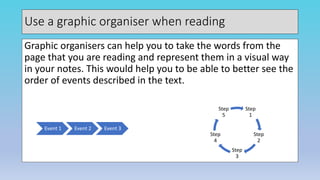
Graphic organisers can help you to take the words from the
page that you are reading and represent them in a visual way
in your notes. This would help you to be able to better see the
order of events described in the text.
Event 1 Event 2 Event 3
Step
1
Step
2
Step
3
Step
4
Step
5
Look out for signal words for sequence
Signal words for sequence include:
• Words that refer to time e.g. dates, time of day
• Adverbs of time e.g. now, soon, later, tomorrow
• Transitional words and phrases that describe time and order
e.g. firstly, secondly, next
Pay attention to the building blocks of meaning of the
text: the actors, actions and circumstances.
It is possible to break down sentences and even longer passages
into the following:
1. The action (The verb of the sentence)
2. The actor (The subject of the sentence)
3. The circumstances (The situation and/or details surrounding
the action and actor)
Practicing this can help to give you a clearer mental picture of
what is going on in the passage.
Pay attention to the building blocks of meaning of the
text: the actors, actions and circumstances.
After you have identified the subject and the actions in the
text, focus on the ‘when’ when identifying the circumstances.
Ask your self “Who or what did what when?”.
This will help you to identify the time and order of the events
in the text so that you can visualise the sequence.
Example – Explicit Sequence
There are four steps to completing a front snap kick. First,
stand in a front-facing stance with your legs wide apart and
slightly bent for good stability. Then, bring your back leg
forward, keeping it bent with your thigh parallel to the floor
and your toes pointing downward. Next, kick the lower leg to
the front in a snapping motion. Lastly, return the leg you just
kicked with to its original position.
Example – Explicit Sequence
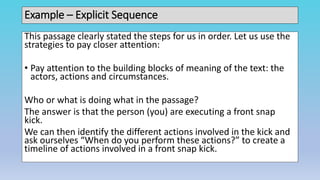
This passage clearly stated the steps for us in order. Let us use the
strategies to pay closer attention:
• Pay attention to the building blocks of meaning of the text: the
actors, actions and circumstances.
Who or what is doing what in the passage?
The answer is that the person (you) are executing a front snap
kick.
We can then identify the different actions involved in the kick and
ask ourselves “When do you perform these actions?” to create a
timeline of actions involved in a front snap kick.
Example – Explicit Sequence
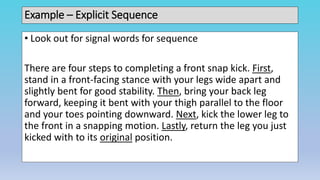
• Look out for signal words for sequence
There are four steps to completing a front snap kick. First,
stand in a front-facing stance with your legs wide apart and
slightly bent for good stability. Then, bring your back leg
forward, keeping it bent with your thigh parallel to the floor
and your toes pointing downward. Next, kick the lower leg to
the front in a snapping motion. Lastly, return the leg you just
kicked with to its original position.
Example – Explicit Sequence
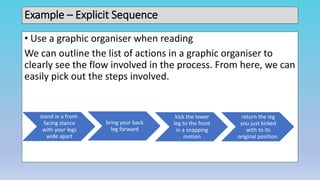
• Use a graphic organiser when reading
We can outline the list of actions in a graphic organiser to
clearly see the flow involved in the process. From here, we can
easily pick out the steps involved.
bring your back
leg forward
stand in a front-
facing stance
with your legs
wide apart
kick the lower
leg to the front
in a snapping
motion
return the leg
you just kicked
with to its
original position.
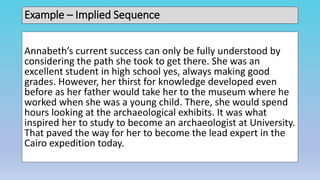
Example – Implied Sequence
Annabeth’s current success can only be fully understood by
considering the path she took to get there. She was an
excellent student in high school yes, always making good
grades. However, her thirst for knowledge developed even
before as her father would take her to the museum where he
worked when she was a young child. There, she would spend
hours looking at the archaeological exhibits. It was what
inspired her to study to become an archaeologist at University.
That paved the way for her to become the lead expert in the
Cairo expedition today.
Example – Implied Sequence
This passage is less straightforward than the previous one. It
does imply the sequence of events but the details are not
clearly laid out one after the other. However, we can use the
strategies to outline the events.
Example – Implied Sequence
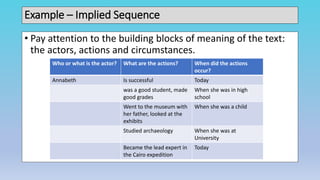
• Pay attention to the building blocks of meaning of the text:
the actors, actions and circumstances.
Who or what is the actor? What are the actions? When did the actions
occur?
Annabeth Is successful Today
was a good student, made
good grades
When she was in high
school
Went to the museum with
her father, looked at the
exhibits
When she was a child
Studied archaeology When she was at
University
Became the lead expert in
the Cairo expedition
Today
Example – Implied Sequence
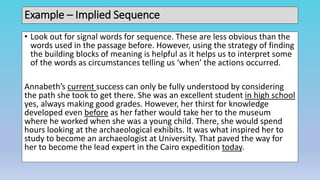
• Look out for signal words for sequence. These are less obvious than the
words used in the passage before. However, using the strategy of finding
the building blocks of meaning is helpful as it helps us to interpret some
of the words as circumstances telling us ‘when’ the actions occurred.
Annabeth’s current success can only be fully understood by considering
the path she took to get there. She was an excellent student in high school
yes, always making good grades. However, her thirst for knowledge
developed even before as her father would take her to the museum
where he worked when she was a young child. There, she would spend
hours looking at the archaeological exhibits. It was what inspired her to
study to become an archaeologist at University. That paved the way for
her to become the lead expert in the Cairo expedition today.
Example – Implied Sequence
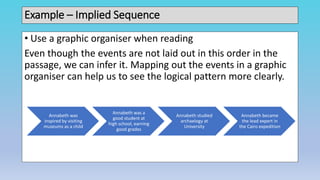
• Use a graphic organiser when reading
Even though the events are not laid out in this order in the
passage, we can infer it. Mapping out the events in a graphic
organiser can help us to see the logical pattern more clearly.
Annabeth was
inspired by visiting
museums as a child
Annabeth was a
good student at
high school, earning
good grades
Annabeth studied
archaelogy at
University
Annabeth became
the lead expert in
the Cairo expedition
Summary
Sequence is a means of organising pieces of information in a text
in a logical pattern based on time or steps in a process.
Sequence may be explicitly stated or implied.
We can use strategies to help us to identify sequence:
• Pay attention to the building blocks of meaning of the text: the
actors, actions and circumstances.
• Look out for signal words for sequence
• Use a graphic organiser when reading

Sequence

  • 1.
    SEQUENCE Strategies for IdentifyingSequence in Informative Texts
  • 2.
    What is Sequence? Sequenceis a form of text structure that organises pieces of information one after the other in a logical manner. This logical manner may be: 1. According to time 2. According to steps in a process
  • 3.
    Why is itimportant to identify sequence in texts? Recognising sequence can help you to understand the chronological flow of a text. This can give you an accurate account of how events have occurred such as with a report or a historical account. Also, it can help you to clearly identify steps in a process. If you are reading to understand how to do something, you will be able to learn the steps and the order in which they must occur, such as with a recipe or directions to a location.
  • 4.
    Explicit and ImpliedSequence Sequence may be obvious in a text because it is directly stated. Other times, the chain of events in a sequence may be more indirectly communicated and so, forms part of the writer’s implied meaning.
  • 5.
    How can weidentify sequence in informative texts? There are different strategies that we can use when trying to identify sequence: • Pay attention to the building blocks of meaning of the text: the actors, actions and circumstances. • Look out for signal words for sequence • Use a graphic organiser when reading
  • 6.
    Use a graphicorganiser when reading Graphic organisers can help you to take the words from the page that you are reading and represent them in a visual way in your notes. This would help you to be able to better see the order of events described in the text. Event 1 Event 2 Event 3 Step 1 Step 2 Step 3 Step 4 Step 5
  • 7.
    Look out forsignal words for sequence Signal words for sequence include: • Words that refer to time e.g. dates, time of day • Adverbs of time e.g. now, soon, later, tomorrow • Transitional words and phrases that describe time and order e.g. firstly, secondly, next
  • 8.
    Pay attention tothe building blocks of meaning of the text: the actors, actions and circumstances. It is possible to break down sentences and even longer passages into the following: 1. The action (The verb of the sentence) 2. The actor (The subject of the sentence) 3. The circumstances (The situation and/or details surrounding the action and actor) Practicing this can help to give you a clearer mental picture of what is going on in the passage.
  • 9.
    Pay attention tothe building blocks of meaning of the text: the actors, actions and circumstances. After you have identified the subject and the actions in the text, focus on the ‘when’ when identifying the circumstances. Ask your self “Who or what did what when?”. This will help you to identify the time and order of the events in the text so that you can visualise the sequence.
  • 10.
    Example – ExplicitSequence There are four steps to completing a front snap kick. First, stand in a front-facing stance with your legs wide apart and slightly bent for good stability. Then, bring your back leg forward, keeping it bent with your thigh parallel to the floor and your toes pointing downward. Next, kick the lower leg to the front in a snapping motion. Lastly, return the leg you just kicked with to its original position.
  • 11.
    Example – ExplicitSequence This passage clearly stated the steps for us in order. Let us use the strategies to pay closer attention: • Pay attention to the building blocks of meaning of the text: the actors, actions and circumstances. Who or what is doing what in the passage? The answer is that the person (you) are executing a front snap kick. We can then identify the different actions involved in the kick and ask ourselves “When do you perform these actions?” to create a timeline of actions involved in a front snap kick.
  • 12.
    Example – ExplicitSequence • Look out for signal words for sequence There are four steps to completing a front snap kick. First, stand in a front-facing stance with your legs wide apart and slightly bent for good stability. Then, bring your back leg forward, keeping it bent with your thigh parallel to the floor and your toes pointing downward. Next, kick the lower leg to the front in a snapping motion. Lastly, return the leg you just kicked with to its original position.
  • 13.
    Example – ExplicitSequence • Use a graphic organiser when reading We can outline the list of actions in a graphic organiser to clearly see the flow involved in the process. From here, we can easily pick out the steps involved. bring your back leg forward stand in a front- facing stance with your legs wide apart kick the lower leg to the front in a snapping motion return the leg you just kicked with to its original position.
  • 14.
    Example – ImpliedSequence Annabeth’s current success can only be fully understood by considering the path she took to get there. She was an excellent student in high school yes, always making good grades. However, her thirst for knowledge developed even before as her father would take her to the museum where he worked when she was a young child. There, she would spend hours looking at the archaeological exhibits. It was what inspired her to study to become an archaeologist at University. That paved the way for her to become the lead expert in the Cairo expedition today.
  • 15.
    Example – ImpliedSequence This passage is less straightforward than the previous one. It does imply the sequence of events but the details are not clearly laid out one after the other. However, we can use the strategies to outline the events.
  • 16.
    Example – ImpliedSequence • Pay attention to the building blocks of meaning of the text: the actors, actions and circumstances. Who or what is the actor? What are the actions? When did the actions occur? Annabeth Is successful Today was a good student, made good grades When she was in high school Went to the museum with her father, looked at the exhibits When she was a child Studied archaeology When she was at University Became the lead expert in the Cairo expedition Today
  • 17.
    Example – ImpliedSequence • Look out for signal words for sequence. These are less obvious than the words used in the passage before. However, using the strategy of finding the building blocks of meaning is helpful as it helps us to interpret some of the words as circumstances telling us ‘when’ the actions occurred. Annabeth’s current success can only be fully understood by considering the path she took to get there. She was an excellent student in high school yes, always making good grades. However, her thirst for knowledge developed even before as her father would take her to the museum where he worked when she was a young child. There, she would spend hours looking at the archaeological exhibits. It was what inspired her to study to become an archaeologist at University. That paved the way for her to become the lead expert in the Cairo expedition today.
  • 18.
    Example – ImpliedSequence • Use a graphic organiser when reading Even though the events are not laid out in this order in the passage, we can infer it. Mapping out the events in a graphic organiser can help us to see the logical pattern more clearly. Annabeth was inspired by visiting museums as a child Annabeth was a good student at high school, earning good grades Annabeth studied archaelogy at University Annabeth became the lead expert in the Cairo expedition
  • 19.
    Summary Sequence is ameans of organising pieces of information in a text in a logical pattern based on time or steps in a process. Sequence may be explicitly stated or implied. We can use strategies to help us to identify sequence: • Pay attention to the building blocks of meaning of the text: the actors, actions and circumstances. • Look out for signal words for sequence • Use a graphic organiser when reading