cure not just curiosity
By
Stem cells by Islam Osman Page 1
tem cell is the
mother of all cells ,
it’s a blank
unspecialized
immature cell that
has the capacity of
self-renewal and
differentiated cells regeneration .
Unique features:
stem cell has some properties that
make it different from other cells
Self-renewal : stem cells are
capable of dividing and renewing
themselves for long periods
Differentiation: stem cells are
blank cells that can be transformed
to other types of cells.
Plasticity: the ability of stem cells
from one tissue to generate
specialized cell type of another
tissue, for example hemopoietic
cells may give rise to skeletal,
myocardial and hepatic cells.
Potency: it’s the differentiation
potential of the stem cells and
according to potency stem cells can
be classified.
Classification of stem cells:
stem cells can be calssified
according to potency to
Totipotent: stem cells produced
from fusion of an egg and sperm.
Cells produced by the first few
divisions of the fertilized egg are
also totipotent. These cells can be
differentiated into embryonic and
extra embryonic cell types (e.g.
placenta)
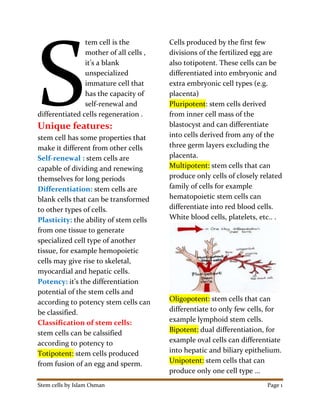
Pluripotent: stem cells derived
from inner cell mass of the
blastocyst and can differentiate
into cells derived from any of the
three germ layers excluding the
placenta.
Multipotent: stem cells that can
produce only cells of closely related
family of cells for example
hematopoietic stem cells can
differentiate into red blood cells.
White blood cells, platelets, etc.. .
Oligopotent: stem cells that can
differentiate to only few cells, for
example lymphoid stem cells.
Bipotent: dual differentiation, for
example oval cells can differentiate
into hepatic and biliary epithelium.
Unipotent: stem cells that can
produce only one cell type …
S
Stem cells by Islam Osman Page 2
for example muscle stem cells.
stem cells could be classified also
According to their origin into:
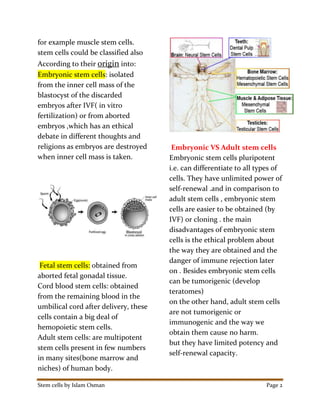
Embryonic stem cells: isolated
from the inner cell mass of the
blastocyst of the discarded
embryos after IVF( in vitro
fertilization) or from aborted
embryos ,which has an ethical
debate in different thoughts and
religions as embryos are destroyed
when inner cell mass is taken.
Fetal stem cells: obtained from
aborted fetal gonadal tissue.
Cord blood stem cells: obtained
from the remaining blood in the
umbilical cord after delivery, these
cells contain a big deal of
hemopoietic stem cells.
Adult stem cells: are multipotent
stem cells present in few numbers
in many sites(bone marrow and
niches) of human body.
Embryonic VS Adult stem cells
Embryonic stem cells pluripotent
i.e. can differentiate to all types of
cells. They have unlimited power of
self-renewal .and in comparison to
adult stem cells , embryonic stem
cells are easier to be obtained (by
IVF) or cloning . the main
disadvantages of embryonic stem
cells is the ethical problem about
the way they are obtained and the
danger of immune rejection later
on . Besides embryonic stem cells
can be tumorigenic (develop
teratomes)
on the other hand, adult stem cells
are not tumorigenic or
immunogenic and the way we
obtain them cause no harm.
but they have limited potency and
self-renewal capacity.
Stem cells by Islam Osman Page 3
Are there other sources of
stem cells ?
the answer was negative till the
emergence of the last few years ,
science have exceeded the classic
limit of stem cells knowledge by
the appearance of two miracles ,
induced pluripotent stem cells
(IPSc) and stimulus triggered
conversion of somatic cells into
pluripotency (STAP) .
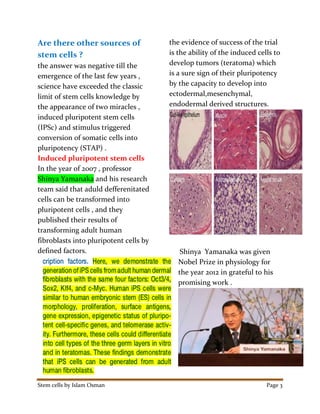
Induced pluripotent stem cells
In the year of 2007 , professor
Shinya Yamanaka and his research
team said that aduld defferenitated
cells can be transformed into
pluripotent cells , and they
published their results of
transforming adult human
fibroblasts into pluripotent cells by
defined factors.
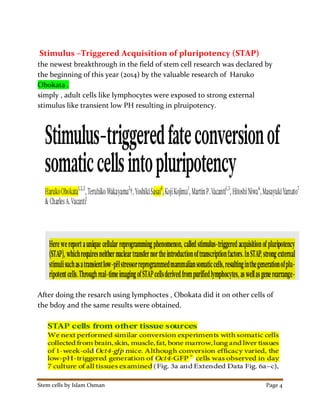
the evidence of success of the trial
is the ability of the induced cells to
develop tumors (teratoma) which
is a sure sign of their pluripotency
by the capacity to develop into
ectodermal,mesenchymal,
endodermal derived structures.
Shinya Yamanaka was given
Nobel Prize in physiology for
the year 2012 in grateful to his
promising work .
Stem cells by Islam Osman Page 4
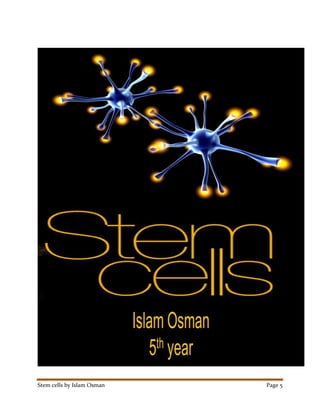
Stimulus –Triggered Acquisition of pluripotency (STAP)
the newest breakthrough in the field of stem cell research was declared by
the beginning of this year (2014) by the valuable research of Haruko
Obokata .
simply , adult cells like lymphocytes were exposed to strong external
stimulus like transient low PH resulting in plruipotency.
After doing the resarch using lymphoctes , Obokata did it on other cells of
the bdoy and the same results were obtained.
Stem cells by Islam Osman Page 5
Stem cells by Islam Osman Page 6
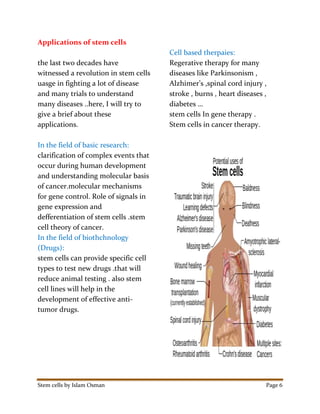
Applications of stem cells
the last two decades have
witnessed a revolution in stem cells
uasge in fighting a lot of disease
and many trials to understand
many diseases ..here, I will try to
give a brief about these
applications.
In the field of basic research:
clarification of complex events that
occur during human development
and understanding molecular basis
of cancer.molecular mechanisms
for gene control. Role of signals in
gene expression and
defferentiation of stem cells .stem
cell theory of cancer.
In the field of biothchnology
(Drugs):
stem cells can provide specific cell
types to test new drugs .that will
reduce animal testing . also stem
cell lines will help in the
development of effective anti-
tumor drugs.
Cell based therpaies:
Regerative therapy for many
diseases like Parkinsonism ,
Alzhimer’s ,spinal cord injury ,
stroke , burns , heart diseases ,
diabetes …
stem cells In gene therapy .
Stem cells in cancer therapy.
Stem cells by Islam Osman Page 7
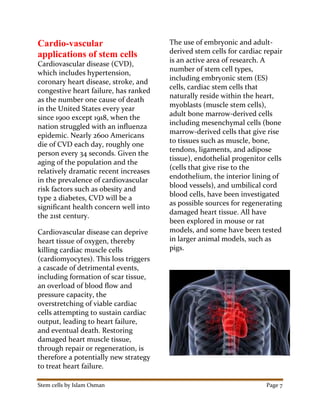
Cardio-vascular
applications of stem cells
Cardiovascular disease (CVD),
which includes hypertension,
coronary heart disease, stroke, and
congestive heart failure, has ranked
as the number one cause of death
in the United States every year
since 1900 except 1918, when the
nation struggled with an influenza
epidemic. Nearly 2600 Americans
die of CVD each day, roughly one
person every 34 seconds. Given the
aging of the population and the
relatively dramatic recent increases
in the prevalence of cardiovascular
risk factors such as obesity and
type 2 diabetes, CVD will be a
significant health concern well into
the 21st century.
Cardiovascular disease can deprive
heart tissue of oxygen, thereby
killing cardiac muscle cells
(cardiomyocytes). This loss triggers
a cascade of detrimental events,
including formation of scar tissue,
an overload of blood flow and
pressure capacity, the
overstretching of viable cardiac
cells attempting to sustain cardiac
output, leading to heart failure,
and eventual death. Restoring
damaged heart muscle tissue,
through repair or regeneration, is
therefore a potentially new strategy
to treat heart failure.
The use of embryonic and adult-
derived stem cells for cardiac repair
is an active area of research. A
number of stem cell types,
including embryonic stem (ES)
cells, cardiac stem cells that
naturally reside within the heart,
myoblasts (muscle stem cells),
adult bone marrow-derived cells
including mesenchymal cells (bone
marrow-derived cells that give rise
to tissues such as muscle, bone,
tendons, ligaments, and adipose
tissue), endothelial progenitor cells
(cells that give rise to the
endothelium, the interior lining of
blood vessels), and umbilical cord
blood cells, have been investigated
as possible sources for regenerating
damaged heart tissue. All have
been explored in mouse or rat
models, and some have been tested
in larger animal models, such as
pigs.
Stem cells by Islam Osman Page 8
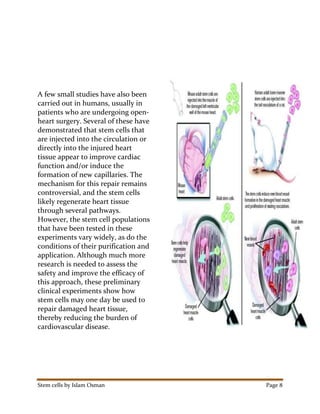
A few small studies have also been
carried out in humans, usually in
patients who are undergoing open-
heart surgery. Several of these have
demonstrated that stem cells that
are injected into the circulation or
directly into the injured heart
tissue appear to improve cardiac
function and/or induce the
formation of new capillaries. The
mechanism for this repair remains
controversial, and the stem cells
likely regenerate heart tissue
through several pathways.
However, the stem cell populations
that have been tested in these
experiments vary widely, as do the
conditions of their purification and
application. Although much more
research is needed to assess the
safety and improve the efficacy of
this approach, these preliminary
clinical experiments show how
stem cells may one day be used to
repair damaged heart tissue,
thereby reducing the burden of
cardiovascular disease.
Stem cells by Islam Osman Page 9
Stem cells in diabetes Milletus
Scientists believe they may have
moved a step closer to a cure for
the type of diabetes that develops
in childhood and usually leads to a
lifetime of insulin injections.
Researchers in California report
that they have reversed the
equivalent of type 1 diabetes in
mice through transplants of stem
cells. Their experiments have
replaced cells in the pancreas
damaged by the disease that are
unable to make insulin.
Without insulin, the body has
difficulty absorbing sugars such as
glucose from the blood. The
disease usually first shows in
childhood or early adulthood and
used to be a killer, but glucose
levels can now be monitored and
regulated with insulin injections.
Scientists have long wanted to try
to replace the damaged ß-cells that
normally produce insulin. This has
been one of the prime targets of
stem cell experiments. But until
now, it has proved difficult, partly
because mature ß-cells do not
readily regenerate.
Writing in the journal Cell Stem
Cell, scientists at the Gladstone
Institutes in San Francisco describe
how they took a step back and
collected skin cells, called
fibroblasts, from laboratory mice.
Then, by treating the fibroblasts
with a unique "cocktail" of
molecules and reprogramming
factors, they transformed the cells
into endoderm-like cells.
Endoderm cells are a type of cell
found in the early embryo, and
which eventually mature into the
body's major organs – including
the pancreas. "Using another
chemical cocktail, we then
transformed these endoderm-like
cells into cells that mimicked early
pancreas-like cells, which we called
PPLCs," said the Gladstone
postdoctoral scholar Ke Li, the
paper's lead author. "Our initial
goal was to see whether we could
coax these PPLCs to mature into
cells that, like ß-cells, respond to
Stem cells by Islam Osman Page 10
the correct chemical signals and –
most importantly – secrete insulin.
And our initial experiments,
performed in a petri dish, revealed
that they did."
The team then injected these cells
into mice that had been genetically
modified to have high glucose
levels, mimicking the type 1
diabetes condition in humans.
"Importantly, just one week post-
transplant, the animals' glucose
levels started to decrease, gradually
approaching normal levels," said Li.
"And when we removed the
transplanted cells, we saw an
immediate glucose spike, revealing
a direct link between the
transplantation of the PPLCs and
reduced hyperglycemia [high
glucose level]."
Eight weeks after the
transplantation, the scientists
found that the pancreas-like cells
had turned into the real thing –
fully functional insulin-secreting ß-
cells had developed in the mice.
The team says this is proof of
principle, which one day might be
used to cure type 1 diabetes in
humans. "I am particularly excited
about the prospect of translating
these findings to the human
system," said Matthias Hebrok, one
of the study's authors and director
of the UCSF Diabetes Center.
"Most immediately, this technology
in human cells could significantly
advance our understanding of how
inherent defects in ß-cells result in
diabetes, bringing us notably closer
to a much-needed cure.
Stem cells in skin burns
Stem cells may have a promising
role in the treatment of extenxive
burns and lrge ulcer through
providing suffiecent numbers of
epidermal and epithelial cell lines
that can be used in replacing
damged tissues.
Stem cells by Islam Osman Page 11
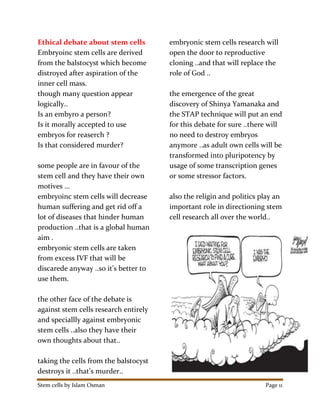
Ethical debate about stem cells
Embryoinc stem cells are derived
from the balstocyst which become
distroyed after aspiration of the
inner cell mass.
though many question appear
logically..
Is an embyro a person?
Is it morally accepted to use
embryos for reaserch ?
Is that considered murder?
some people are in favour of the
stem cell and they have their own
motives …
embryoinc stem cells will decrease
human suffering and get rid off a
lot of diseases that hinder human
production ..that is a global human
aim .
embryonic stem cells are taken
from excess IVF that will be
discarede anyway ..so it’s better to
use them.
the other face of the debate is
against stem cells research entirely
and speciallly against embryonic
stem cells ..also they have their
own thoughts about that..
taking the cells from the balstocyst
destroys it ..that’s murder..
embryonic stem cells research will
open the door to reproductive
cloning ..and that will replace the
role of God ..
the emergence of the great
discovery of Shinya Yamanaka and
the STAP technique will put an end
for this debate for sure ..there will
no need to destroy embryos
anymore ..as adult own cells will be
transformed into pluripotency by
usage of some transcription genes
or some stressor factors.
also the religin and politics play an
important role in directioning stem
cell research all over the world..
Stem cells by Islam Osman Page 12
References :
1-Robert Lanza , Essentials of stem cells , second edition.
2-Stewart Sell , Stem Cells Handbook .
3- Takahashi, Kazutoshi; Yamanaka, Shinya (2006). "Induction of Pluripotent
Stem Cells from Mouse Embryonic and Adult Fibroblast Cultures by Defined
Factors". Cell 126 (4): 663–676
4- Obokata, Haruko; et al. (2014-01-30). "Stimulus-triggered fate conversion
of somatic cells into pluripotency". Nature 505 (7485): 641–647.
5- Jain, KK (2002). "Ethical and regulatory aspects of embryonic stem cell
research". Expert opinion on biological therapy 2 (8): 819–26
6- Current Regulation of Human Embryonic Stem Cell Research (2005).
Guidelines for Human Embryonic Stem Cell Research. Washington D.C, The
National Academies Press: 63-80
7- http://en.wikipedia.org/wiki/Main_Page

Stem cells

  • 1.
    cure not justcuriosity By
  • 2.
    Stem cells byIslam Osman Page 1 tem cell is the mother of all cells , it’s a blank unspecialized immature cell that has the capacity of self-renewal and differentiated cells regeneration . Unique features: stem cell has some properties that make it different from other cells Self-renewal : stem cells are capable of dividing and renewing themselves for long periods Differentiation: stem cells are blank cells that can be transformed to other types of cells. Plasticity: the ability of stem cells from one tissue to generate specialized cell type of another tissue, for example hemopoietic cells may give rise to skeletal, myocardial and hepatic cells. Potency: it’s the differentiation potential of the stem cells and according to potency stem cells can be classified. Classification of stem cells: stem cells can be calssified according to potency to Totipotent: stem cells produced from fusion of an egg and sperm. Cells produced by the first few divisions of the fertilized egg are also totipotent. These cells can be differentiated into embryonic and extra embryonic cell types (e.g. placenta) Pluripotent: stem cells derived from inner cell mass of the blastocyst and can differentiate into cells derived from any of the three germ layers excluding the placenta. Multipotent: stem cells that can produce only cells of closely related family of cells for example hematopoietic stem cells can differentiate into red blood cells. White blood cells, platelets, etc.. . Oligopotent: stem cells that can differentiate to only few cells, for example lymphoid stem cells. Bipotent: dual differentiation, for example oval cells can differentiate into hepatic and biliary epithelium. Unipotent: stem cells that can produce only one cell type … S
  • 3.
    Stem cells byIslam Osman Page 2 for example muscle stem cells. stem cells could be classified also According to their origin into: Embryonic stem cells: isolated from the inner cell mass of the blastocyst of the discarded embryos after IVF( in vitro fertilization) or from aborted embryos ,which has an ethical debate in different thoughts and religions as embryos are destroyed when inner cell mass is taken. Fetal stem cells: obtained from aborted fetal gonadal tissue. Cord blood stem cells: obtained from the remaining blood in the umbilical cord after delivery, these cells contain a big deal of hemopoietic stem cells. Adult stem cells: are multipotent stem cells present in few numbers in many sites(bone marrow and niches) of human body. Embryonic VS Adult stem cells Embryonic stem cells pluripotent i.e. can differentiate to all types of cells. They have unlimited power of self-renewal .and in comparison to adult stem cells , embryonic stem cells are easier to be obtained (by IVF) or cloning . the main disadvantages of embryonic stem cells is the ethical problem about the way they are obtained and the danger of immune rejection later on . Besides embryonic stem cells can be tumorigenic (develop teratomes) on the other hand, adult stem cells are not tumorigenic or immunogenic and the way we obtain them cause no harm. but they have limited potency and self-renewal capacity.
  • 4.
    Stem cells byIslam Osman Page 3 Are there other sources of stem cells ? the answer was negative till the emergence of the last few years , science have exceeded the classic limit of stem cells knowledge by the appearance of two miracles , induced pluripotent stem cells (IPSc) and stimulus triggered conversion of somatic cells into pluripotency (STAP) . Induced pluripotent stem cells In the year of 2007 , professor Shinya Yamanaka and his research team said that aduld defferenitated cells can be transformed into pluripotent cells , and they published their results of transforming adult human fibroblasts into pluripotent cells by defined factors. the evidence of success of the trial is the ability of the induced cells to develop tumors (teratoma) which is a sure sign of their pluripotency by the capacity to develop into ectodermal,mesenchymal, endodermal derived structures. Shinya Yamanaka was given Nobel Prize in physiology for the year 2012 in grateful to his promising work .
  • 5.
    Stem cells byIslam Osman Page 4 Stimulus –Triggered Acquisition of pluripotency (STAP) the newest breakthrough in the field of stem cell research was declared by the beginning of this year (2014) by the valuable research of Haruko Obokata . simply , adult cells like lymphocytes were exposed to strong external stimulus like transient low PH resulting in plruipotency. After doing the resarch using lymphoctes , Obokata did it on other cells of the bdoy and the same results were obtained.
  • 6.
    Stem cells byIslam Osman Page 5
  • 7.
    Stem cells byIslam Osman Page 6 Applications of stem cells the last two decades have witnessed a revolution in stem cells uasge in fighting a lot of disease and many trials to understand many diseases ..here, I will try to give a brief about these applications. In the field of basic research: clarification of complex events that occur during human development and understanding molecular basis of cancer.molecular mechanisms for gene control. Role of signals in gene expression and defferentiation of stem cells .stem cell theory of cancer. In the field of biothchnology (Drugs): stem cells can provide specific cell types to test new drugs .that will reduce animal testing . also stem cell lines will help in the development of effective anti- tumor drugs. Cell based therpaies: Regerative therapy for many diseases like Parkinsonism , Alzhimer’s ,spinal cord injury , stroke , burns , heart diseases , diabetes … stem cells In gene therapy . Stem cells in cancer therapy.
  • 8.
    Stem cells byIslam Osman Page 7 Cardio-vascular applications of stem cells Cardiovascular disease (CVD), which includes hypertension, coronary heart disease, stroke, and congestive heart failure, has ranked as the number one cause of death in the United States every year since 1900 except 1918, when the nation struggled with an influenza epidemic. Nearly 2600 Americans die of CVD each day, roughly one person every 34 seconds. Given the aging of the population and the relatively dramatic recent increases in the prevalence of cardiovascular risk factors such as obesity and type 2 diabetes, CVD will be a significant health concern well into the 21st century. Cardiovascular disease can deprive heart tissue of oxygen, thereby killing cardiac muscle cells (cardiomyocytes). This loss triggers a cascade of detrimental events, including formation of scar tissue, an overload of blood flow and pressure capacity, the overstretching of viable cardiac cells attempting to sustain cardiac output, leading to heart failure, and eventual death. Restoring damaged heart muscle tissue, through repair or regeneration, is therefore a potentially new strategy to treat heart failure. The use of embryonic and adult- derived stem cells for cardiac repair is an active area of research. A number of stem cell types, including embryonic stem (ES) cells, cardiac stem cells that naturally reside within the heart, myoblasts (muscle stem cells), adult bone marrow-derived cells including mesenchymal cells (bone marrow-derived cells that give rise to tissues such as muscle, bone, tendons, ligaments, and adipose tissue), endothelial progenitor cells (cells that give rise to the endothelium, the interior lining of blood vessels), and umbilical cord blood cells, have been investigated as possible sources for regenerating damaged heart tissue. All have been explored in mouse or rat models, and some have been tested in larger animal models, such as pigs.
  • 9.
    Stem cells byIslam Osman Page 8 A few small studies have also been carried out in humans, usually in patients who are undergoing open- heart surgery. Several of these have demonstrated that stem cells that are injected into the circulation or directly into the injured heart tissue appear to improve cardiac function and/or induce the formation of new capillaries. The mechanism for this repair remains controversial, and the stem cells likely regenerate heart tissue through several pathways. However, the stem cell populations that have been tested in these experiments vary widely, as do the conditions of their purification and application. Although much more research is needed to assess the safety and improve the efficacy of this approach, these preliminary clinical experiments show how stem cells may one day be used to repair damaged heart tissue, thereby reducing the burden of cardiovascular disease.
  • 10.
    Stem cells byIslam Osman Page 9 Stem cells in diabetes Milletus Scientists believe they may have moved a step closer to a cure for the type of diabetes that develops in childhood and usually leads to a lifetime of insulin injections. Researchers in California report that they have reversed the equivalent of type 1 diabetes in mice through transplants of stem cells. Their experiments have replaced cells in the pancreas damaged by the disease that are unable to make insulin. Without insulin, the body has difficulty absorbing sugars such as glucose from the blood. The disease usually first shows in childhood or early adulthood and used to be a killer, but glucose levels can now be monitored and regulated with insulin injections. Scientists have long wanted to try to replace the damaged ß-cells that normally produce insulin. This has been one of the prime targets of stem cell experiments. But until now, it has proved difficult, partly because mature ß-cells do not readily regenerate. Writing in the journal Cell Stem Cell, scientists at the Gladstone Institutes in San Francisco describe how they took a step back and collected skin cells, called fibroblasts, from laboratory mice. Then, by treating the fibroblasts with a unique "cocktail" of molecules and reprogramming factors, they transformed the cells into endoderm-like cells. Endoderm cells are a type of cell found in the early embryo, and which eventually mature into the body's major organs – including the pancreas. "Using another chemical cocktail, we then transformed these endoderm-like cells into cells that mimicked early pancreas-like cells, which we called PPLCs," said the Gladstone postdoctoral scholar Ke Li, the paper's lead author. "Our initial goal was to see whether we could coax these PPLCs to mature into cells that, like ß-cells, respond to
  • 11.
    Stem cells byIslam Osman Page 10 the correct chemical signals and – most importantly – secrete insulin. And our initial experiments, performed in a petri dish, revealed that they did." The team then injected these cells into mice that had been genetically modified to have high glucose levels, mimicking the type 1 diabetes condition in humans. "Importantly, just one week post- transplant, the animals' glucose levels started to decrease, gradually approaching normal levels," said Li. "And when we removed the transplanted cells, we saw an immediate glucose spike, revealing a direct link between the transplantation of the PPLCs and reduced hyperglycemia [high glucose level]." Eight weeks after the transplantation, the scientists found that the pancreas-like cells had turned into the real thing – fully functional insulin-secreting ß- cells had developed in the mice. The team says this is proof of principle, which one day might be used to cure type 1 diabetes in humans. "I am particularly excited about the prospect of translating these findings to the human system," said Matthias Hebrok, one of the study's authors and director of the UCSF Diabetes Center. "Most immediately, this technology in human cells could significantly advance our understanding of how inherent defects in ß-cells result in diabetes, bringing us notably closer to a much-needed cure. Stem cells in skin burns Stem cells may have a promising role in the treatment of extenxive burns and lrge ulcer through providing suffiecent numbers of epidermal and epithelial cell lines that can be used in replacing damged tissues.
  • 12.
    Stem cells byIslam Osman Page 11 Ethical debate about stem cells Embryoinc stem cells are derived from the balstocyst which become distroyed after aspiration of the inner cell mass. though many question appear logically.. Is an embyro a person? Is it morally accepted to use embryos for reaserch ? Is that considered murder? some people are in favour of the stem cell and they have their own motives … embryoinc stem cells will decrease human suffering and get rid off a lot of diseases that hinder human production ..that is a global human aim . embryonic stem cells are taken from excess IVF that will be discarede anyway ..so it’s better to use them. the other face of the debate is against stem cells research entirely and speciallly against embryonic stem cells ..also they have their own thoughts about that.. taking the cells from the balstocyst destroys it ..that’s murder.. embryonic stem cells research will open the door to reproductive cloning ..and that will replace the role of God .. the emergence of the great discovery of Shinya Yamanaka and the STAP technique will put an end for this debate for sure ..there will no need to destroy embryos anymore ..as adult own cells will be transformed into pluripotency by usage of some transcription genes or some stressor factors. also the religin and politics play an important role in directioning stem cell research all over the world..
  • 13.
    Stem cells byIslam Osman Page 12 References : 1-Robert Lanza , Essentials of stem cells , second edition. 2-Stewart Sell , Stem Cells Handbook . 3- Takahashi, Kazutoshi; Yamanaka, Shinya (2006). "Induction of Pluripotent Stem Cells from Mouse Embryonic and Adult Fibroblast Cultures by Defined Factors". Cell 126 (4): 663–676 4- Obokata, Haruko; et al. (2014-01-30). "Stimulus-triggered fate conversion of somatic cells into pluripotency". Nature 505 (7485): 641–647. 5- Jain, KK (2002). "Ethical and regulatory aspects of embryonic stem cell research". Expert opinion on biological therapy 2 (8): 819–26 6- Current Regulation of Human Embryonic Stem Cell Research (2005). Guidelines for Human Embryonic Stem Cell Research. Washington D.C, The National Academies Press: 63-80 7- http://en.wikipedia.org/wiki/Main_Page