Course instructor :
Dr. Waseem Ahmad
Presentation on:
Stellar Fusion
Presented by:
Mehak Tariq
Stellar Fusion
A star is a hot ball of mostly hydrogen gas; the Sun is an example of a typical, ordinary
star.
In the core of the star, the temperature and densities are high enough to sustain
nuclear fusion reactions, and the energy produced by these reactions works its way to
the surface and radiates into space as heat and light.
The process of building up heavier elements from lighter ones by nuclear reactions, is
called stellar evolution.
The stars' fuel for energy generation is the stuff they are made
of -- hydrogen, helium, carbon, etc. -- which they burn by
converting these elements into heavier elements.
"Burning" in this context does not refer to the kind of burning
we are familiar with, such as the burning of wood or coal, which
is chemical burning.
It refers to nuclear burning, in which the nuclei of atoms fuse
into nuclei of heavier atoms.
When stars start their lives, they consist mostly of hydrogen,
some helium, and small amounts of heavier elements, such as
carbon, nitrogen, and oxygen.
In 1938, Hans Albrecht and Weizsacker analyzed two process in stars, p-p chain
and CNO cycle and believed to be the source of energy in Stars. They showed the
possibility to converting hydrogen into helium through nuclear reaction. These
reactions take place at high temperature and high densities.
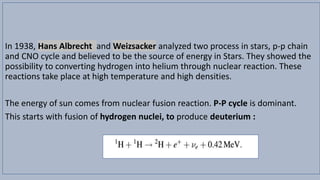
The energy of sun comes from nuclear fusion reaction. P-P cycle is dominant.
This starts with fusion of hydrogen nuclei, to produce deuterium :
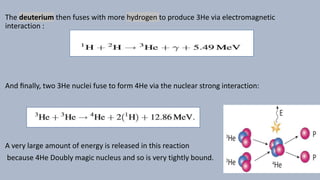
The deuterium then fuses with more hydrogen to produce 3He via electromagnetic
interaction :
And finally, two 3He nuclei fuse to form 4He via the nuclear strong interaction:
A very large amount of energy is released in this reaction
because 4He Doubly magic nucleus and so is very tightly bound.
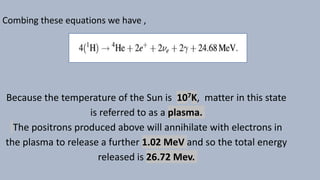
Combing these equations we have ,
Because the temperature of the Sun is 107K, matter in this state
is referred to as a plasma.
The positrons produced above will annihilate with electrons in
the plasma to release a further 1.02 MeV and so the total energy
released is 26.72 Mev.
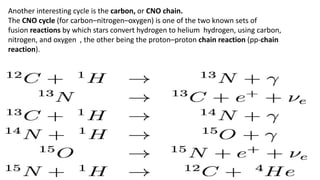
Another interesting cycle is the carbon, or CNO chain.
The CNO cycle (for carbon–nitrogen–oxygen) is one of the two known sets of
fusion reactions by which stars convert hydrogen to helium hydrogen, using carbon,
nitrogen, and oxygen , the other being the proton–proton chain reaction (pp-chain
reaction).
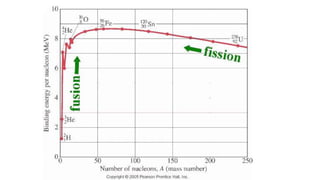
Fusion processes continue to produce heavier
elements until the core of the stellar object is
composed mainly of nuclei with A 56, i.e.( the
peak of the
binding energy per nucleon curve).
Heavier nuclei are produced in supernova
explosions, but this is properly the subject of
astrophysics and
we will not pursue it further.
Thanks for listening ..
Don’t forget to ask Questions
.. ?

Stellar fusion

  • 1.
    Course instructor : Dr.Waseem Ahmad Presentation on: Stellar Fusion Presented by: Mehak Tariq
  • 2.
    Stellar Fusion A staris a hot ball of mostly hydrogen gas; the Sun is an example of a typical, ordinary star. In the core of the star, the temperature and densities are high enough to sustain nuclear fusion reactions, and the energy produced by these reactions works its way to the surface and radiates into space as heat and light. The process of building up heavier elements from lighter ones by nuclear reactions, is called stellar evolution.
  • 3.
    The stars' fuelfor energy generation is the stuff they are made of -- hydrogen, helium, carbon, etc. -- which they burn by converting these elements into heavier elements. "Burning" in this context does not refer to the kind of burning we are familiar with, such as the burning of wood or coal, which is chemical burning. It refers to nuclear burning, in which the nuclei of atoms fuse into nuclei of heavier atoms. When stars start their lives, they consist mostly of hydrogen, some helium, and small amounts of heavier elements, such as carbon, nitrogen, and oxygen.
  • 4.
    In 1938, HansAlbrecht and Weizsacker analyzed two process in stars, p-p chain and CNO cycle and believed to be the source of energy in Stars. They showed the possibility to converting hydrogen into helium through nuclear reaction. These reactions take place at high temperature and high densities. The energy of sun comes from nuclear fusion reaction. P-P cycle is dominant. This starts with fusion of hydrogen nuclei, to produce deuterium :
  • 5.
    The deuterium thenfuses with more hydrogen to produce 3He via electromagnetic interaction : And finally, two 3He nuclei fuse to form 4He via the nuclear strong interaction: A very large amount of energy is released in this reaction because 4He Doubly magic nucleus and so is very tightly bound.
  • 6.
    Combing these equationswe have , Because the temperature of the Sun is 107K, matter in this state is referred to as a plasma. The positrons produced above will annihilate with electrons in the plasma to release a further 1.02 MeV and so the total energy released is 26.72 Mev.
  • 7.
    Another interesting cycleis the carbon, or CNO chain. The CNO cycle (for carbon–nitrogen–oxygen) is one of the two known sets of fusion reactions by which stars convert hydrogen to helium hydrogen, using carbon, nitrogen, and oxygen , the other being the proton–proton chain reaction (pp-chain reaction).
  • 8.
    Fusion processes continueto produce heavier elements until the core of the stellar object is composed mainly of nuclei with A 56, i.e.( the peak of the binding energy per nucleon curve). Heavier nuclei are produced in supernova explosions, but this is properly the subject of astrophysics and we will not pursue it further.
  • 10.
    Thanks for listening.. Don’t forget to ask Questions .. ?